Showing posts with label War. Show all posts

Mar 24, 2021

24FPS @ BFI Flare 2021: Firebird

Dir: Peeter Rebane
At the height of the cold war, Private Sergey (Tom Prior) and Lieutenant Roman (Oleg Zagorodnii) meet and fall in love on base. When they are suspected, Sergey leaves the army for his long held dream of going to drama school and Roman marries Luisa (Diana Pozharskaya), Sergey’s best friend. Still, Sergey and Roman continue to be drawn to each other.

Every film whether, like this one, it is based on a true story or it is the most fantastical and surreal tale ever told, sets out to create a world that is, in itself, credible. In some ways, Firebird does this: the historical detail—sets, props, hairstyles, costumes—appears to be on point, but right from the start, something is off. The film is spoken almost entirely in English (background dialogue that doesn’t need to be subtitled is in Russian, as is signage and other incidental writing). The commercial imperatives of this choice are clear and easy to understand, but the fact remains that Firebird is telling a fundamentally Russian story. The story takes place entirely within the USSR, the characters are all Russian, and two of the three lead actors are Ukrainian. From the first moment they start talking to each other in accented English (often dubiously so in Tom Prior’s case), a vital part of the world-building is broken however good the rest of the film may be.

Unfortunately, even apart from this glaring issue, Firebird isn’t a particularly good film. The performances are a mixed bag; the actors are clearly capable, with the films quieter moments coming off well. The longing looks between Sergei and Roman, the silent build of chemistry, and Sergei’s terror, which he has to hide from the other soldiers when Roman’s plane gets into trouble, are all effective. The best moment in the film comes from Tom Prior. When Sergei hears that Roman is marrying Luisa we can see the deep, under the surface, hurt coming to the fore for just a moment. However, probably thanks to the language issue, dialogue is often stiff and stilted, never more so than in a dinner table scene between Roman and Luisa. This means the film always feels uneven. While it looks handsome enough and Rebane puts some of his influences on display (a beach scene late on has a definite air of Francois Ozon), the direction isn’t especially inspired and, on a couple of occasions, notably clunky. This is never more true than when we find out that Luisa is pregnant with Roman’s child, there is a hard cut to Sergei standing in the pouring rain—a cheap, corny, and cliche emotional shortcut.

Taken purely at an emotional level as a story of forbidden love, Firebird has its affecting moments. We do believe in the relationship at its heart, and it’s hard not to feel for the characters, especially knowing that the story is at least broadly true. On the other hand, every detail is clunky. The language issue means everything feels artificial and Peeter Rebane doesn’t find much visual inventiveness with which to tell his story. There’s the kernel of a great movie here, but it’s not the one that ended up on the screen.
★★

Oct 16, 2017

24FPS @ LFF 2017: Family Films

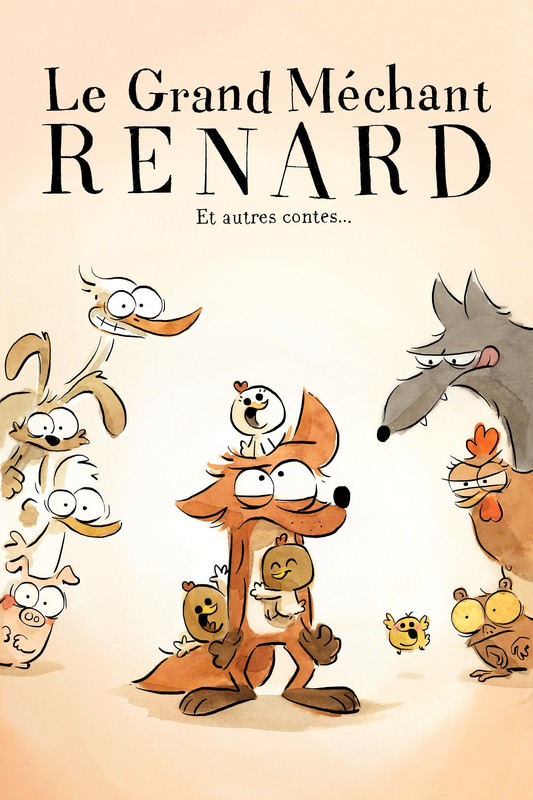
The Big Bad Fox and Other Tales
Dir: Patrick Imbert, Benjamin Renner
This delightful French animated film is set up as three short plays, put on by the animals in a farmyard. In Baby Delivery, Pig and his dimwitted friends, Rabbit and Duck, must fill in for an injured Stork. The Big Bad Fox sees Fox accidentally become mother to three chicks he steals for himself and Wolf to eat. In Saving Christmas, Duck believes he has killed Father Christmas and he, Rabbit and Pig must fill in for him, as they did for the Stork.

The Big Bad Fox and Other Tales is this year’s Family Gala screening at the London Film Festival, this is the strand that contains the films pitched at children, but this is a true family film. It will delight children (I’d suggest it for ages six and over) but, without aiming jokes over children’s heads, it should also work for adults. The animation style is very different; a little sketchy, but beautifully simple and full of character rather than crude, but the tone of the film has much in common with classic animated shorts. The slapstick gags come thick and fast, with the timing and execution of classic era Tom and Jerry, while the way these moments combine with the verbal humour recalls Looney Tunes strongly (especially in the relationship between Pig, Rabbit and Duck).

There are some wonderfully absurd touches and running gags to be enjoyed; the chickens forming a self-defence group because the guard dog is lazy, the calamities that happen to Pig’s house and Little Michel, who pops up in the last two stories to endearing and hilarious effect.

Any further review of this film would amount to my repeating my favourite jokes, which would rather spoil what is a wonderfully enjoyable film. I will say to stay in your seats during the credits as during them there are some lovely jokes, a recipe and a closing moment that seems to be a nod to Michigan J. Frog and sent me out of the cinema with a mile wide smile on my face. This may be pitched as a kids film, but it’s for anyone with a functional funnybone.
★★★★½

The Day My Father Became A Bush
Dir: Nicole Van Kilsdonk
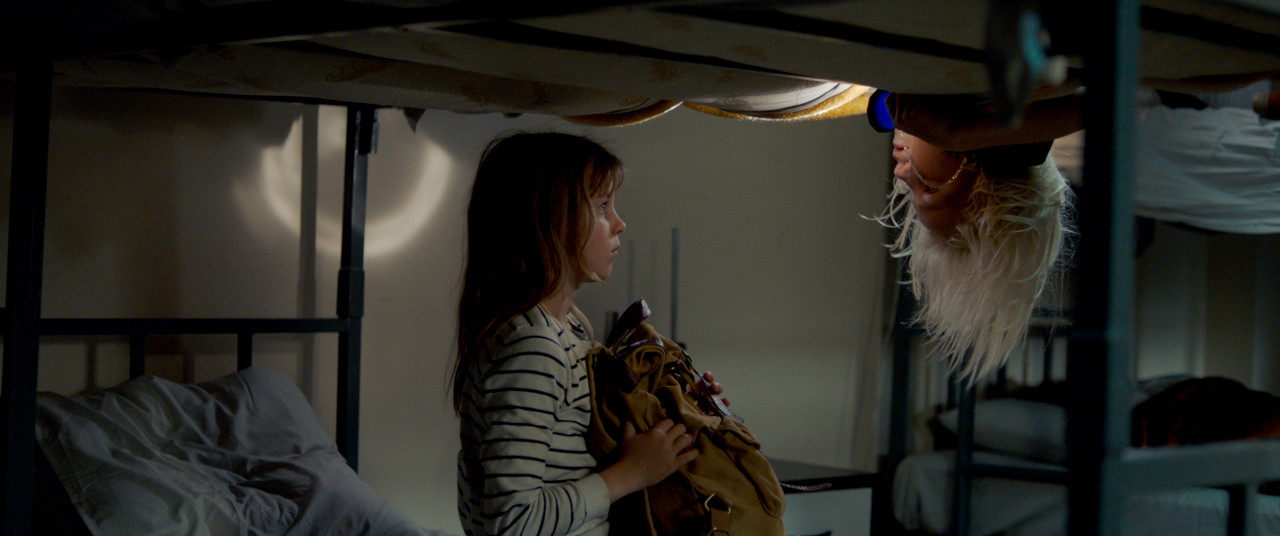
Toda (Celeste Holsheimer) is ten years old and lives with her pastry chef father (Teun Kuilboer) in an unnamed country. When war breaks out between ‘The Ones’ and ‘The Others’ Toda’s grandmother comes to stay, while her father is called to fight. Eventually it becomes too dangerous at home and Toda is sent abroad to join the mother (Noortje Herlaar) she doesn't know. Along the way she gets separated from the people taking her and must make her way on her own.

I am a great believer that children’s cinema can and should be much more than mindless entertainment. The Day My Father Became A Bush tackles some big issues: war and its futility, displacement and the dislocating reality of suddenly becoming a refugee, but does it from a child’s eye view, making those issues comprehensible for its target audience. A big part of this success is in the way it addresses war. Nicole Van Kilsdonk never explores what the fighting is about or whether we should see ‘The Ones’ or ‘The Others’ as the good guys in the conflict. This isn't what’s important to Toda, what matters to her is that her father is away and that his camouflage be good enough to make sure he comes home (in one of the film’s most quietly touching scenes she puts branches on his helmet so ‘even birds will think you’re a tree’). 

Ultimately, the film says, which side we’re on doesn't matter much. Her father wears a blue badge but at one point Toda finds herself sharing a shack with a man wearing a yellow badge, soon she’s sharing food with him and, sweetly, helping him learn to give orders (he has deserted because he found he wasn't assertive enough for his command role. This scene is a fine example of the way the film leavens its messages with humour and heart.

Toda is a great character for young girls to see and identify with. She’s inquisitive and intelligent, brave in the face of scary situations and compassionate with a slightly younger boy who attaches himself to her, whom she nicknames Stickie (Matsen Montsma). She’s also just a typical ten year old, who calls herself a daddy’s girl. As Toda, Celeste Holsheimer gives a performance free of anything actorly or precocious. She hits the funny moments nicely, but is particularly adept in the dramatic scenes, especially towards the end of the film when, having lost her mother’s address, Toda finds herself a refugee.

The Day My Father Became A Bush asks kids to engage with some big themes, but it takes them gently through those ideas, leavening them with humour and, even in the film’s toughest moments, the optimistic outlook that Toda radiates. It’s an entertaining and intelligent film and an ideal opportunity to discuss some challenging subjects with your kids. 
★★★

Oct 10, 2016

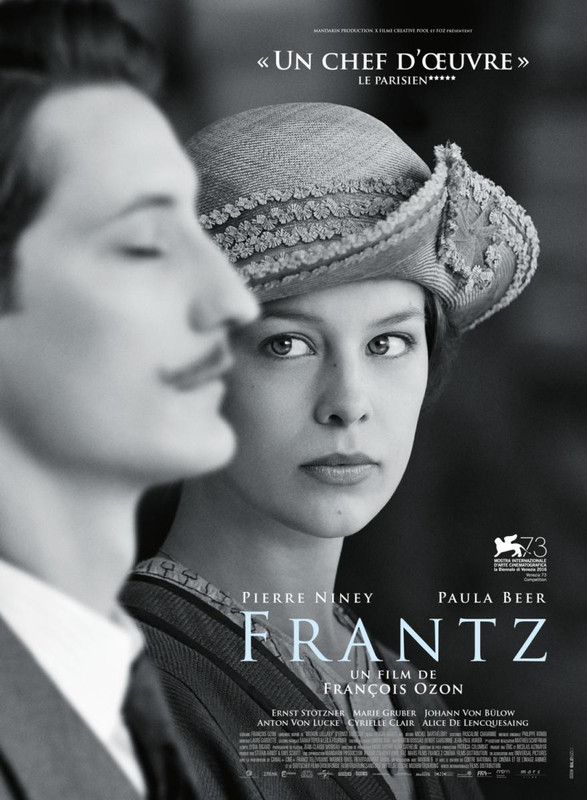
24FPS @ LFF 2016: Frantz

Dir: Francois Ozon
The new film by Francois Ozon is always an occasion I await with great anticipation, and it has become a tradition that he brings them to LFF each year. After a run of quality all but unprecedented among working directors (a parade of 4 and 5 star films broken only by his English language début, Angel) Ozon hit his first major stumble with Jeune et Jolie, but seemed to have regained momentum with his last film, The New Girlfriend. Frantz, disappointingly, represents another backward step.

The auteur theory can be overapplied, but if it were written to describe any modern director then it is Ozon. One of the most versatile directors of his generation, Ozon can change mood, subject and genre wildly between films, but his identity, his favoured images and ideas, recur like a fingerprint. An Ozon film is different from every other Ozon film, but you would never be in any doubt as to who directed it. Until now.  

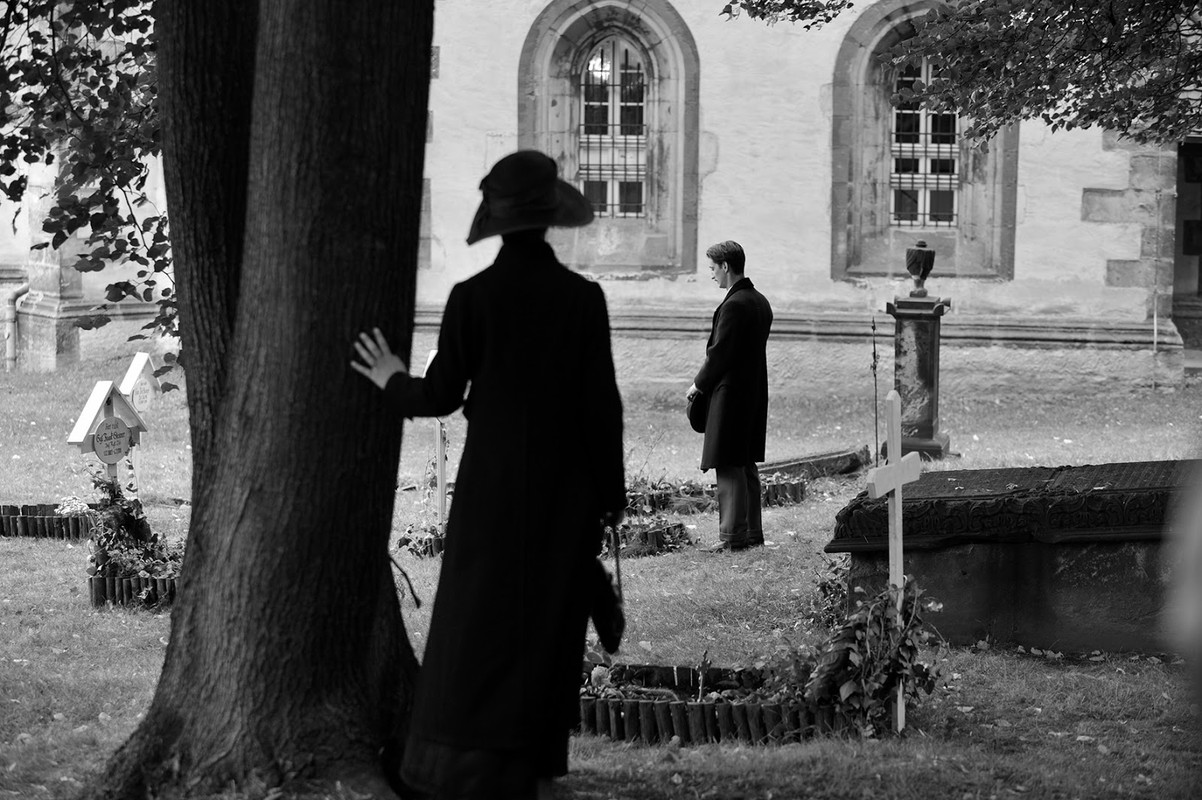
Frantz, as ever, finds its director in new territory. Set in the aftermath of World War One, it begins in a small German town. Visiting the grave of her fiancée Frantz, Anna (Paula Beer) finds flowers that were not left by her. The next day she discovers that they were placed by a French soldier, Adrien (Pierre Niney), who says that he was a friend of Frantz' before the war. Frantz' family begin to rely on Adrien, who reminds them of their son and Anna's feelings for the Frenchman begin to grow, but Adrien has a secret that changes those relationships again.

Perhaps the biggest change from his previous films is that here the colour obsessed Ozon shoots almost entirely in black and white. This is supposed to plug us into the period in which the film is set, but it looks too clean for that to come off. More disappointing still is the limited use of colour. The slightly faded colours are beautiful, but the moments that Ozon chooses to use them couldn't be more obvious or groan-inducingly literal. Yes, he uses colour to reflect the characters emotional states, but it's so basic an idea that the execution feels more like that of a clumsy film student than one of modern cinema's greats. This is only exacerbated by the awful final shot; a piece of sentimentality straight out of the ending of (500) Days of Summer, and maybe the single worst scene Ozon has put on screen.

The force of personality that Ozon usually brings to his films has gone missing here. The film's forward looking message, the German and Paris scenes both laced with warnings of the coming Second World War, feels less of this filmmaker than it does like Ozon trying to do The White Ribbon; Haneke on happy pills perhaps.  But Ozon can't pull off the doomy sense of the weight of destiny that Haneke delivered. The happy pills aren't working either, here Ozon has none of his usual playfulness and while he's also effective in severe, dramatic form, Frantz also misses this target. 

In just about every way, Frantz is a weightless film. The budding romance between Adrien – Niney looking unsure and out of place, like a kid playing dress up in a stick on moustache – and Anna is unconvincing, even before Adrien's entirely expected revelation comes out, after that point, with such a tenuous connection established between the characters, it becomes almost laughable, fatally undermining the film's Paris set third act. This might have worked in the 1930s, in the Lubitsch film in which Ozon based his screenplay, but the whether it's the non-existent chemistry between Beer and Niney or the fact that the screenplay gives them too little to hang the relationship story on, something about it just doesn't work here.

There are a couple of positives to take from Frantz. German actress Paula Beer is a find; Ozon gives her less to work with than his usual rich female roles, but she gives a strong performance, much of it in a second language (Niney struggles more with his German than Beer does with her French). The best performances in the film, however, come from  Ernst Stotzner and Marie Gruber as Frantz' parents, both broken by grief, but cheered by the little glimpses of their son that Adrien offers them. There are also a few standout scenes: Anna inventing a letter from Adrien, to avoid telling Frantz' parents the real truth; Anna sitting, deeply uncomfortable, as the Marseilles is sung in a Paris bar, but these are scattered moments in a near two hour film, and good as they are in isolation they can't make it knit together as an effective whole.

If Frantz isn't Ozon's worst film it's certainly his most anonymous. This doesn't feel like a filmmaker changing direction, it feels like he's dropped the map and got lost. Worse than all this is that, for the first time in an Ozon film I didn't like, I can't see what drew him to tell this story, what he was going for. For all its faults, Jeune et Jolie had something interesting at its core, it didn't work, but it still gave me something to think about and discuss. Frantz doesn't even have that, it's a pure misfire, not even very interesting in its failure.
★★

Dec 1, 2014

The Imitation Game [12A]

Dir: Morten Tyldum
The story of the breaking of the Enigma code, a breakthrough which, if it didn't actually win us the whole thing, shortened World War Two considerably, is one that should be full of drama and of rich and interesting characters.   This telling, while not especially bad in any way, never really has either of those things.

The film focuses on Alan Turing (Benedict Cumberbatch), his relationship with Joan Clarke (Keira Knightley), a brilliant young member of the team at Bletchley Park, his building of Christopher; the computer that would crack Enigma and the secret that would ultimately lead to a horrible injustice against him later in life.

If you think that suggests that the film's focus is scattered then, frustratingly, you'd be right.  While all of these elements were important in Turing's life, trying to tell them all (plus a flashback to his school days) in roughly 105 minutes discounting the credits means that The Imitation Game struggles either to find a central thread or to tell any of its smaller stories especially satisfyingly.

The fact that we all know how the story ends (both for good and for ill) shouldn't be a reason for a film to fail to engage as a thriller.  Director Morten Tyldum tries hard to bring that edge of tension to the development of Christopher, but it never comes off.  Zodiac, ultimately, is a film about men looking through information in boxes and slowly building it into a complete picture, but it's also an intensive character study of those men and what drives their obsession.  Both sides of this seem to go missing from The Imitation Game.  

Benedict Cumberbatch is perfectly fine as Turing, but the performance is never anything more than that; Benedict Cumberbatch putting on a convincing period accent and convincing period clothing to give a performance.  I got a sense that I was being told who Alan Turing was and watching re-enactments of moments from his life, rather than living inside those moments with him, which is the sense of immersion achieved by Zodiac.

We get a sense of the reason behind the building of Christopher and of Turing's drive to achieve it, but the process itself is left largely offscreen and little attempt is made to explain how the machine works.  We see the stages of its building, but not the nuts and bolts work, so the achievement doesn't seem quite as hard won as it clearly was.  Instead what we get are cliché movie moments; Turing standing in front of his machine shouting that his bosses will never understand the importance of it; papers being flung from desks in frustration.  These things may have happened but, in the context of a movie that doesn't entirely absorb you into its world, they ring false.

Cumberbatch is relatively typical of the performers here.  Like him, Keira Knightley and Matthew Goode are perfectly fine, they're not doing anything wrong, as such, but from both there is a sense that they are working very hard and that we're watching actors acting.  The only moments of naturalism come from an engagement party sequence where we get to see the staff at Bletchley interacting as people – or as close to being a person as Turing is able to get. 

There seems to be an indecision at the heart of the film about what it wants to be; a biopic of Turing or a film about the cracking of Enigma.  This leads to Tyldum and screenwriter Graham Moore trying to have it both ways.  The problem is that the film doesn't come close to splitting its focus equally, so the treatment of Turing's school days and of the framing device involving the hideous injustice of his arrest for indecency and chemical castration is almost insultingly prosaic.  There are the ingredients here for two interesting films; one about Enigma and another about Turing's arrest, trial and conviction, but both of those films would need to dig much deeper than The Imitation Game.

Decently executed though it is, The Imitation Game is remarkable only in how utterly unremarkable it is.  It's not bad, but it's also no more than a couple of notches above a Sunday night drama on ITV.

Feb 17, 2014

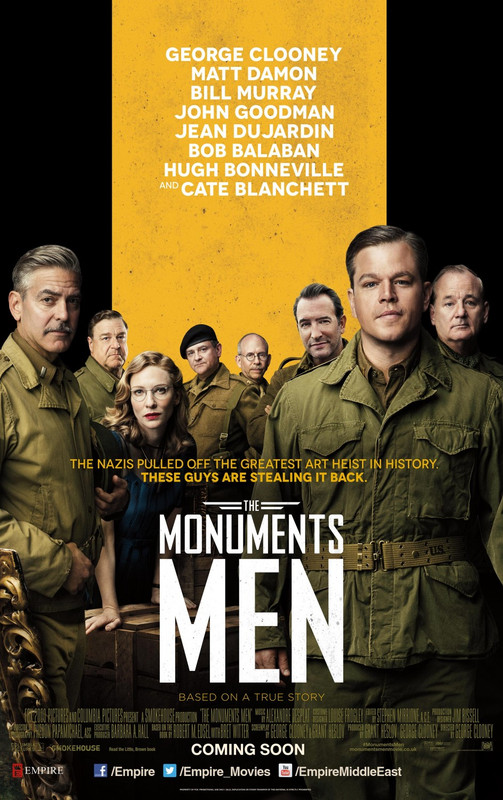
The Monuments Men [12A]

Dir: George Clooney
There is something peculiarly old-fashioned about George Clooney as both a movie star and a filmmaker.  On screen, he has a charisma that suggests a studio star like Cary Grant or Clark Gable.  Behind the camera, he shows an interest in classical storytelling and a type of filmmaking that looks back to the slower paced stories of 70's cinema and sometimes further (his screwball comedy Leatherheads).  You'd think he'd be well suited to making and starring in a World War 2 set men on a mission movie.  On this evidence, he's not.  At all.

Based, apparently rather loosely, on the true story of a unit of art experts dispatched in the dying days of World War 2 to recover and return to their rightful owners the privately owned works of art stolen and hoarded by the Nazis, the film attempts to combine an extremely earnestly meant question of whether art, even great art, is worth someone's life with a caper movie, tracing various stories as this mismatched group of unsuited soldiers attempts various parts of its mission.  

The chief problem of the film is easily diagnosed; Clooney, as writer, director and leading actor, completely fails to reconcile the dual tones that he's trying to strike here.  At one moment the film wants us to be emotional as Bill Murray's character listens to his daughter sing 'Have Yourself A Merry Little Christmas' on a record sent from home.  The next moment the film will reach for a jaunty tone, as in the scene where Murray has to have emergency dental treatment or Matt Damon hilariously treads on a mine.  Even when he's more set on the tone he's going for, Clooney botches it.  The central question and theme of the film is stated and restated over and over, but the film only ever engages with the question of whether art is worth a life (or lives) in a way that is at once incredibly perfunctory and so mawkish that it's like being drowned in treacle while someone screams 'IS ART WORTH THIS MAN'S LIFE?' at you over and over.  The other problem with this is that every time a speech is given on this subject (four times during the film) it is substantially the same.  There are no new ideas in the last speech in the film as compared to the first, two long hours earlier.

The tonal issues might be less of a burden if the film achieved the half-serious adventure movie tone (think Indiana Jones with historical accuracy) that it goes for outside of its mawkishness.  It doesn't.  Splitting the group into smaller groups and sending them all off on their own adventures (Bill Murray and Bob Balaban as a sarcastic odd couple; John Goodman's sad bulldog look paired with Jean Dujardin's benevolent version of The Joker's smile; Matt Damon trying to get intelligence material out of Cate Blanchett) means that the film suffers from a fatal lack of focus and that we hardly get to know the characters.  but worse, none of these little stories are very engaging in and of themselves.  Even when they do throw up the odd decent scene it's derivative of something better.  Murray and Balaban's interlude in a farmer's house plays like the opening of Inglourious Basterds, but without Christoph Waltz or any tension, yet still counts as one of the film's strongest moments.  You'd expect a smattering of action in these scenes as well.  We get two perfunctory and derivative scenes that could have been lifted from any number of films.

You have to give The Monuments Men this much: it has a great cast, but they're wasted.  Clooney is blandly heroic when not in lecture mode (and he's in lecture mode a lot).  Murray and Balaban try hard to be the comic relief, but their material isn't that funny and the rest of the film often has a jarringly comic tone that takes away from that function.  Most of the others are simply betrayed by bad writing, giving them dull and underdeveloped characters.  It is, however, worth singling out Cate Blanchett; a brilliant actress, she gives the single worst performance of her career here.  She has no character to play and her role is almost totally redundant in the story, so rather than a character she ends up playing an accent.  A terrible, terrible accent.  She's supposed to be French but there's German and comedy Russian in there too.  It's laughably bad.

Even when the film does, 90 minutes in, acquire a little momentum, Clooney simply can't sustain it.  He's wedded closely enough to history that the antagonists of the film are kept almost completely offscreen, but this means that there is no sense of peril in the journey to the goal, and thus little sense of achievement when it is reached.  I don't see the problem with taking inspiration from history and then making it more cinematic.  I wish Clooney had looked more to Indiana Jones; the history is largely window dressing, but the films are exciting, fun, funny and engaging.  The Monuments Men, on the other hand, feels stuffy; like a historical reenactment that only wants to show us the dullest bits. 

George Clooney can be an interesting filmmaker, and it's great to see someone showing such dedication in his career to trying to bring back a somewhat old-fashioned patience in storytelling, but he's come unstuck here because The Monuments Men mistakes sentimentality for moral questioning and weds it to a poorly told story.  These men deserved better, and so did the question of whether art was worth their lives.

Jan 26, 2013

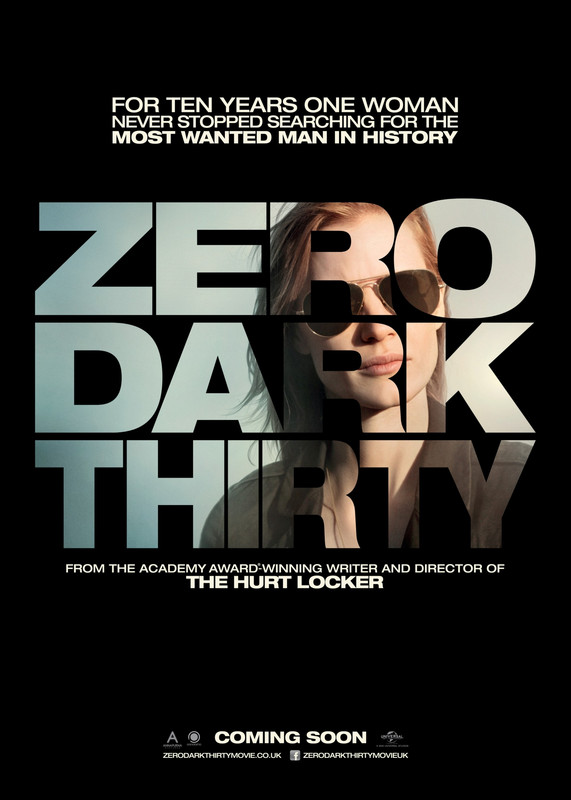
Zero Dark Thirty [15]

Dir: Kathryn Bigelow
When I look back at Kathryn Bigelow's last film, the Best Picture Oscar winner The Hurt Locker, all I can see now is its opening caption: War is a Drug, which increasingly strikes me as the only thing that overpraised film had to say. That being the case, and given the perhaps even more vociferous praise for this film, I walked into Zero Dark Thirty largely on the promise of two and a half hours of Jessica Chastain and needing to be convinced. I'm convinced.

The story, just in case you need reminding, is that of the hunt for and (spoilers) eventual killing of Osama Bin Laden. Apparently based on eyewitness testimony, there is sure to have been some dramatisation and combining of characters here, but it certainly feels like a film that sticks as closely to the facts as the demands of 150 minutes of cinema will allow.

Let's get the politics out of the way to begin with. I'm what most people would probably describe as pretty far to the left, and I find the use of torture despicable. That said, I really don't have a problem with the way Zero Dark Thirty depicts it and its use, beyond the fact that I wish it had found perhaps five minutes to give us a scene that would acknowledge the practical problems with torture; the false information it frequently produces. That aside, I think the film depicts 'enhanced interrogation' as a sordid business; it doesn't shy away from the brutality and, while it doesn't lean on the point to a preachy degree, it suggests the negative impact it has on the people meting it out. Ultimately, this isn't a morally simplistic film, and even in its greatest and most earned moment of triumph, it doesn't seem to me to go in for jingoism and flag waving.

For me, the film Zero Dark Thirty most closely recalls is David Fincher's masterpiece Zodiac. Like that film, ZDT is a thriller with a problem that seems insoluble; its ending is well known by most if not all of its potential audience, so how does one create suspense when the end result is a foregone conclusion? Kathryn Bigelow and screenwriter Mark Boal square this particular circle, as Fincher did, by focusing on detail, drawing out the process in almost unbearable fashion, and by focusing this detail around an outstanding central performance.

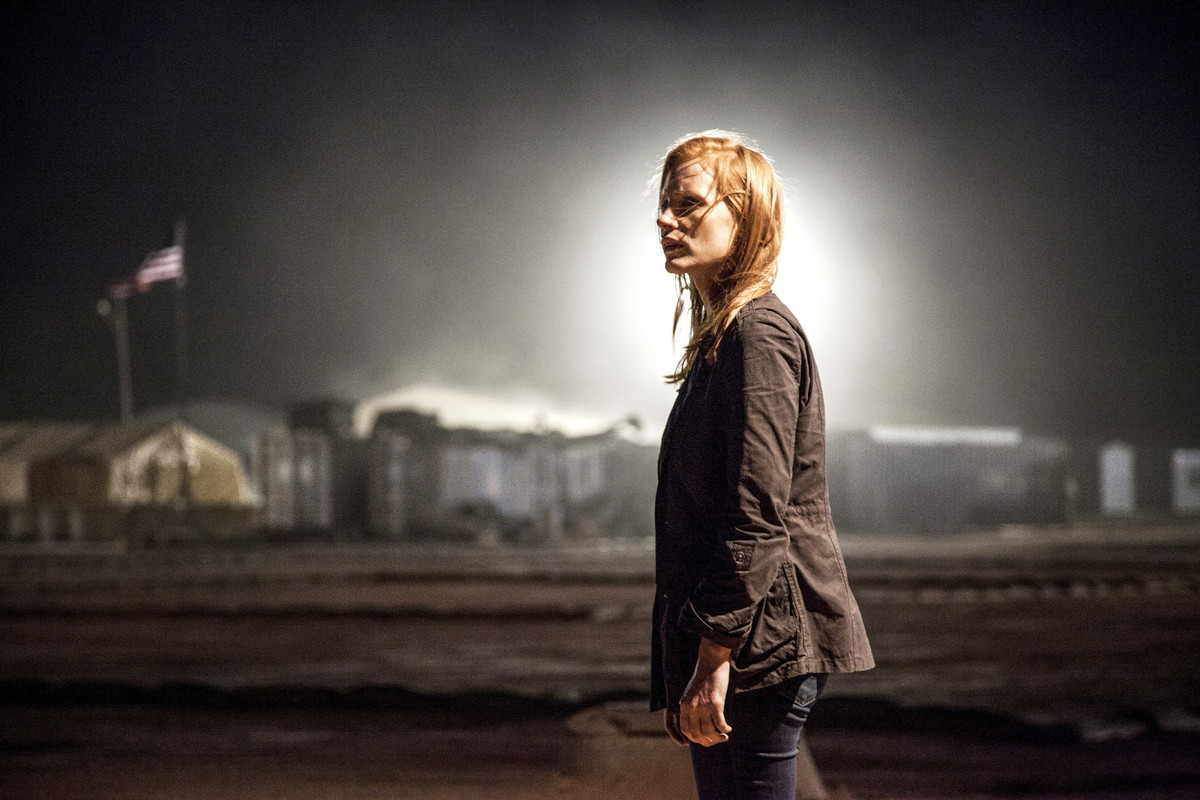
Jessica Chastain burst on to the film scene in 2011 with an incredible run of performances (landing an Oscar nomination for, of course, one of her less interesting performances that year). This is quite a change of pace for her; she's played tough before, but few saw her as a cop in Texas Killing Fields, and she's considerably more effective as CIA operative Maya. Chastain's arc is subtly drawn, but she plays it with great conviction, from the young woman whose stomach seems to turn at her first interrogation, we watch as she ages and demonstrably changes over eight years to become a much harder shell, and an immovable object. You have to believe that Maya's pure passion and belief in her lead on a man who may be Bin Laden's courier (a lead that goes cold for years at a time) can make her bosses put their trust in that lead, and Chastain makes you believe it, and believe the process by which Maya comes by that conviction.

Understated would be the wrong word for Kathryn Bigelow's direction, as she has a very identifiable and quite raw style, but as I watched Zero Dark Thirty I seldom found myself thinking about the direction, because for the most part Bigelow manages to put us compellingly in the midst of what's happening, without allowing her shooting (frequently handheld) to call attention to itself and pop us out of the events of the story. This is, of course, also down to her handling of the actors, and while it's sometimes jarring to see recognisable faces (oh, hi John Barrowman), everyone acquits themselves well and plays into the realistic and somewhat downbeat tone that the film pursues. The character actors filling out the supporting cast are a talented bunch, with Jason Clarke as the man who does the dirty work in Maya's early interrogations and Jennifer Ehle as a fellow CIA operative having perhaps the most impactful roles.

Jennifer Ehle's role, through no fault of the underrated actress herself, leads to the only scene in the film that I felt didn't work. The Camp Chapman attack – which was something that I, though I'm sure I'd heard it in the news at the time, had forgotten about and so should have been in the dark as to the outcome of – is the one thing that feels as though it's a scene from a movie. The whole setup, the details, whether they're accurate or not, just seem to scream out contrivance, and signpost what is going to happen. One particular detail, which I can't find any reference for, feels especially risible, and as though it has been inserted for purposes of dramatic irony.

I can forgive the film this minor stumble though, because the rest of it is so good. The procedural elements are all well addressed, and the plot's various connections are easy to follow without feeling dumbed down, or as if you're simply being given a point by point lecture so that you can keep up. More action driven scenes are few and quite far between, but Bigelow executes them with panache. The final incursion in which Bin Laden is killed is a brilliant set piece. Despite a handheld camera and having to follow multiple small teams as they break in at various points, Bigelow manages to keep the geography of the sequence very clear, while also putting us right in the midst of the attack. We know how it's going to end, we even know that no Americans died, and yet you're still on the edge of your seat, largely because the film and Chastain have done such a good job of putting you in Maya's shoes that you're largely seeing this as if from her chair.

There will be many conversations about the politics of Zero Dark Thirty, and people from all over the political spectrum will likely have interesting and relevant things to say about it, but for me it is, ultimately, a thriller set against the background of those political moments and issues that feature in it, and it's one that does its job almost flawlessly.
★★★★★

Oct 12, 2012

24FPS @ LFF 2012: 12/10

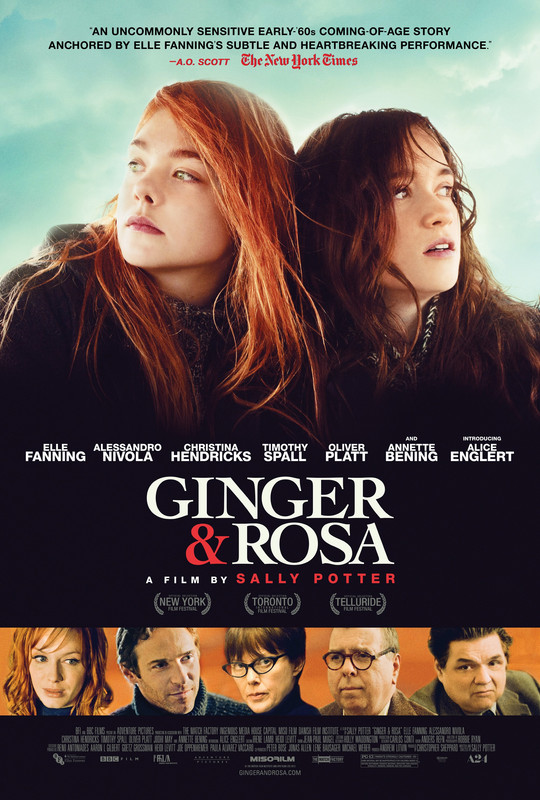
Ginger and Rosa
Dir: Sally Potter
Sally Potter's latest is the very definition of a mixed bag. There are some excellent things here, but unfortunately, they are wrapped in a film that is terribly inconsistent, full of baffling decisions and things that feel unfinished.

Ginger (Elle Fanning) and Rosa (Alice Englert) are two girls of sixteen, born on the same day in 1945 and best friends all their lives. In 1962, however, they begin to drift apart as Rosa becomes interested in boys, while Ginger's attentions are taken up by what, she's convinced, is our impending nuclear destruction.

This could easily be an effective coming of age story, and there are snatches of that movie in here, but Sally Potter muffles it, burying the essential story, and thus much of the connection we should have to the characters and the plot under a fog of stylistic choices that really didn't work for me. On the plus side the film often has a lovely, dreamlike, feel, which contrasts nicely with the grimier visual moments (this is the early 60's, and neither family seems well off), but while it often looks good, the style often gets in the way of the storytelling and the character study to which Potter seems to aspire here.

The film is cut almost as a series of ellipses, and this means that many scenes feel like incomplete thoughts. You get the idea of, say, the scene in which Rosa comes boating with Ginger and her Father (Alessandro Nivola), but though the series of images is pretty, and what Potter is doing with them obvious (largely because it's been obvious for some time, perhaps unintentionally) these 30 silent seconds feel like the start of a larger scene now residing on the cutting room floor, in which we could have added to the character aspect of the film. This is just one example of many, the film continually frustrates by cutting in and cutting away when a scene seems to be in the middle of a thought.

The limited dialogue serves Elle Fanning well.  A consummate young actress – at this point surely the best of her young generation – she's adept at conveying great emotion with just a tiny alteration in expression. She also seems to have a tremendously malleable face, in some scenes she seems incredibly childlike (at shooting she was three years younger than her character), and in one, after Ginger is arrested at a protest, she seems old beyond her years. Fanning's remarkable performance also extends to a fine English accent, and an ability to nail any tone, from the carefree scenes of the girls in the early part of the film, to a climactic meltdown.

Fanning and the rest of the actors are battling a mannered script, which gives them a lot of very scripted sounding dialogue to wrestle. Many of them lose, but none so totally as Christina Hendricks, who is hilariously miscast as Fanning's Mother, and concentrating so hard on her (shockingly awful) accent that she has completely forgotten to act. On the plus side, her lines when she serves Nivola a pie are perhaps the funniest of the festival so far, entirely by accident. Alice Englert makes a creditable debut, but in terms of screentime as well as impact she is overshadowed by Fanning. Alessandro Nivola does what he can with a completely unlikeable and often irritating character, but the supporting cast does offer some highlights in the form of Timothy Spall and Olvier Platt as Ginger's two godfathers – a film about their relationship during the war might be worth a watch.

Ultimately, Ginger and Rosa is a frustrating failure. You can see the seeds of a really fine film here; the images are often beautiful, there are some strong performances, including a great lead and the character arcs are inherently interesting, but it's so patchy, and when it falls flat it can test your patience with its desperate pretensions to art. In a more focused, less elliptical, version I can imagine liking this film very much, but as it stands I can recommend Elle Fanning's performance, but not the film.

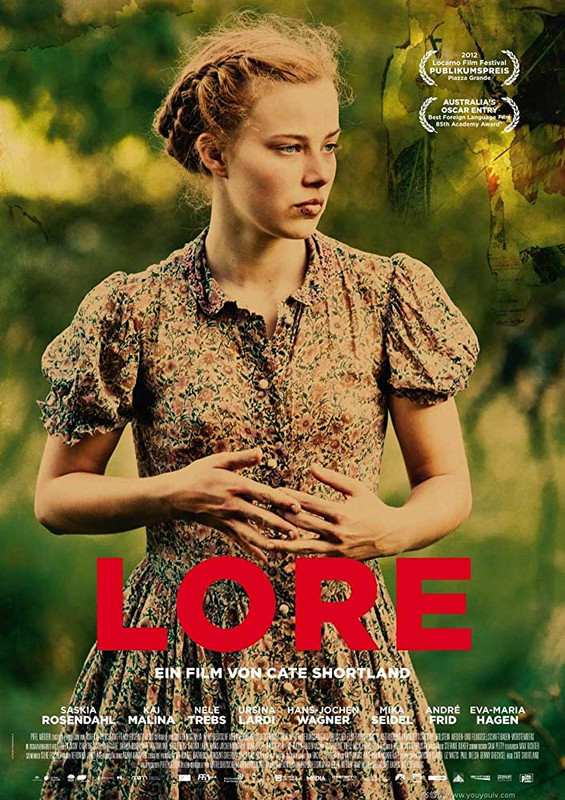
Lore
Dir: Cate Shortland 
It's been a long wait for fans of Cate Shortland's first film, Somersault (I was not among them) for her second feature.  Lore is certainly not what I expected Shortland to deliver next, at least in concept.  Acted entirely in German, it's a second world war story told from an angle we don't often see.  Just after Hitler's death, and the end of the war Lore's (Saskia Rosendahl) Father comes home and instructs Lore, her Mother (Ursina Lardi) and her siblings to pack essentials and things they can barter, because they are leaving the home, Lore's family are Nazis, and the allies are now rounding up war criminals.  Soon Lore's Father disappears, and her Mother opts to hand herself over to the allies rather than be arrested.  This leaves Lore to take her younger siblings - 11 year old sister Liesel (Nele Trebs), a brother of about ten, twins about seven and baby Peter - on a long and dangerous walk from the Black Forest to their Grandmother's house in Hamburg.  Along the way they are aided by a concentration camp survivor; Thomas (Kai Malina).

The difficulty with Lore - both character and film - is one of sympathy.  Can we have sympathy with these characters?  We obviously can't with the parents, and the younger children haven't been raised with anything but Nazism, and they at least develop some acceptance of their eventual Jewish travelling companion.  Lore herself, however, is more problematic.  We can see where her opinions come from, but given that she's about 18 is that enough to allow us to sympathise with her anyway, as she frequently abuses the person who is helping her family ("You're a liar, just like all filthy Jews").  I really struggled with this.  It would help if Lore had more of a character arc but, aside from a rather impressionistic rejection of her Grandmother and Mother, she seems essentially to be the same character as the closing credits go up as she was as the film began.  Ultimately, excellent though Saskia Rosendahl's performance (her film debut) is, and welcome as any degree of moral complexity is, I felt that I was left emotionally at arms length from the film, because I couldn't really engage with and root for the main character in the same way as in, say, The Way Back.

That difficulty aside though, Lore has much to recommend it.  Shortland and her young DP Adam Arkapaw (who also shot Snowtown) give the film a pastoral beauty which contrasts with the harsh realities of the story, though the amount of soft focus close ups on nature or on Lore does get a little tiresome and begin to make the film feel a touch padded at just under two hours, however beautiful the individual shots are.  The performances are excellent all round, and the tension between Lore and Thomas, sexual and racial, is especially well played by Rosendahl and Malina.  Of the other siblings only Nele Trebs and Andre Frid (as ten year old Gunther) have especially developed roles, but the family dynamic is convincingly played.  It's a bit of a shame that Ursina Lardi has only a small role as Lore's Mother, she's well cast (one shot seems to show Lore trying to dress and make up like her Mother, and the resemblance is pretty startling) and her hard edged and unapologetic character is interesting.

The journey is engaging throughout, and while the film does unfold, as these long walk movies tend to, largely as a series of encounters and individual scenes, it also manages to spring a couple of genuinely surprising twists.  Shortland's decision to shoot the film entirely in German is also especially welcome, as it surely makes for far better performances from her cast, and because this is a specifically German story, and would likely ring far less true if it had been played, whether by German or American or British actors, in accented English.

I have reservations about Lore, but the story grips, the performances are all strong, and it is lovely to look at.  It's well worth a watch, get back to me when you've seen it, and we can talk about the issue of emotional engagement.

Apr 9, 2011

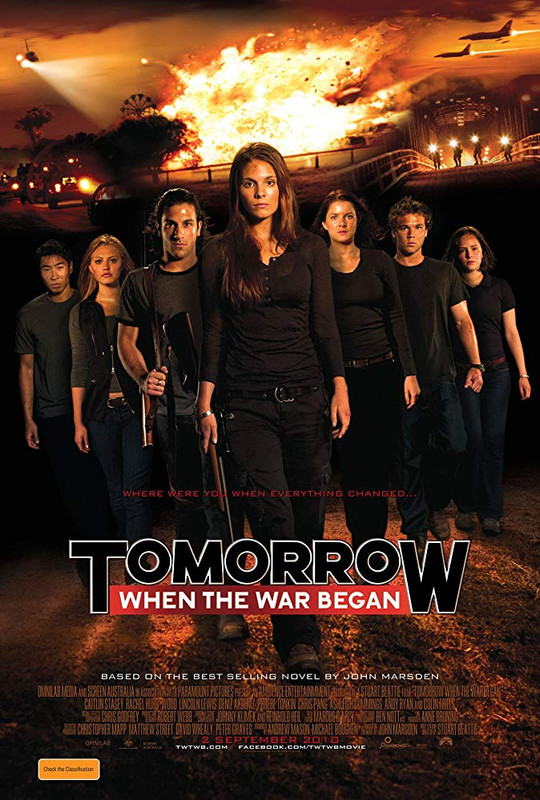
Tomorrow When the War Began [12A]

Dir: Stuart Beattie
Tomorrow When the War Began is based on the first in a series (oh God, no) of books by Australian author John Marsden. It has a compelling idea at its heart; seven teenagers go for a weekend of camping in a remote part of Australia, when they return to their small town they find it deserted, and soon discover that it, and the rest of Australia, has been captured by an invading army. The group soon determine that, rather than just hiding, they should become guerrilla fighters and join this war.

With that premise, this really should be an engaging movie, mixing slam bang action with a little political context and some well drawn relationships between the small cast. Oh, if only. The main problem with Tomorrow When the War Began is simple; it is excruciatingly dull, and there are no stakes whatsoever. There are two big reasons for this. First of all the threat, despite the fact that the invading army seem to have taken Australia within two days, feels weak. The villains are faceless, have no defined goal or personality, the most we ever learn is that they're Asian. The villains' pursuit of the group seems halfhearted; frequently the teens escape the invading army just by running away, and there seems to be no concerted move against them.

The other thing that undermines the film and lowers the stakes is the character writing; there isn't any. None of these people has a personality and several of them lack even the most basic of traits. We're told by her narration that main character Ellie (played by the unfeasibly pretty, but very flat, Caitlin Stasey) has been lifelong friends with both Corrie (Rachel Hurd Wood) and Homer (Deniz Akendiz), but that connection is never felt in the script or in the performances. Most of the characters can be described with one word: Asian (Chris Pang as Lee); Religious (Ashleigh Cummings as Robyn); Stoner (Andrew Ryan as Chris); Muscles (Akendiz as Homer); Dick (Lincoln Lewis as Kevin) Leader (Stasey as Ellie). The rest... I can't even give that little credit to, Phoebe Tonkin's character Fiona is such a complete void that I forgot she was in the film for about an hour (to be fair so did the film) and Rachel Hurd Wood's Corrie has the personality of driftwood. How can I possibly begin to care about such thin characters? I keep saying it, but since writers don't seem to listen I'll keep repeating myself: If your characters don't feel real to me, I am not going to give two shits what happens to them.

The script issues don't stop there, because these blank characters all speak clangingly awful dialogue. In every conversation, there is at least one horrible line, usually one that 'foreshadows' something that will soon develop in the action. For example, Robyn's repeated refusal to even attempt to harm the invaders because of her faith signposts her actions in the climactic action scene with the subtlety and grace of a tapdancing elephant. For the most part though the dialogue is just bland, with lines that feel completely interchangeable between the various mouthpieces.

There is no one performance here that is either especially good or especially bad as a whole, but everyone has at least one laugh out loud moment that could find itself used in one of the Nostalgia Critic's recurring 'I'm Acting' jokes. Again though, blandness tends to be the order of the day. Caitlin Stasey is memorable for two reasons; she's the lead and... well, just look at her, but otherwise the mass of adequacy makes everyone equally forgettable. It was never going to be on the cards, given the screenplay, for anyone to give a searingly honest and memorable performance here, but what's irritating is that it feels like the cast knew this, and largely decided not to try. Behind the camera, debuting director Stuart Beattie makes a predictably middling job of the lensing. The film does use the stunning locations well, and the lighting is frequently strong, but even at a visual level the action lacks a feeling of immediacy and danger, meaning that this apparently high stakes movie about guerrilla warfare, never raised my pulse.

Despite having a lot to work with, Tomorrow When the War Began manages to be the dullest and most non-descript movie I've seen in some time. It's not awful, it's not good, it's not really anything. There is literally nothing here; no characters, no enemy, no stakes, no tension, no excitement, no context, no metaphor, nothing to invest in, and, criminally, no ending. This is cinematic ephemera, it's so totally devoid of content that I'm not even sure I've seen it.
★★☆☆☆

Mar 13, 2011

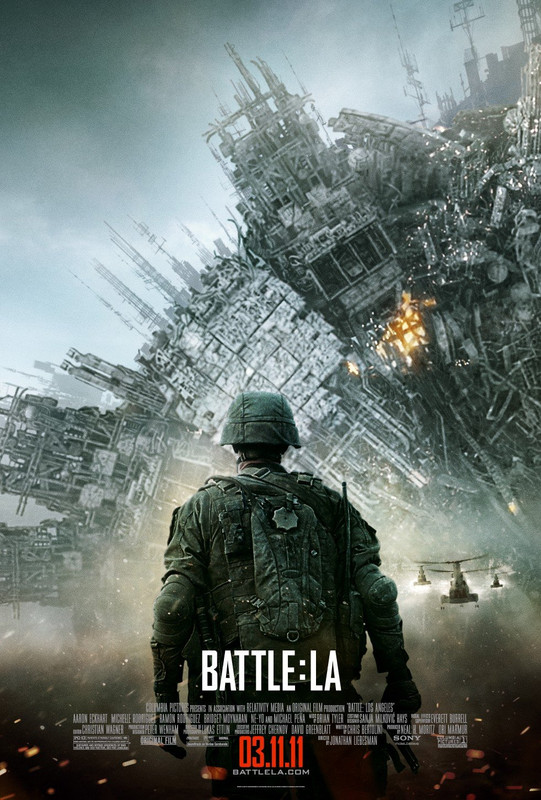
Battle: Los Angeles [12A]

Dir: Jonathan Liebesman
Boom! Bang! Ratatat! "WE'RE NOT DYING HERE!" Boom! Bang! Boom! "GET THIS TO MY WIFE!" Ratatat! Bang! Boom! "RANDOM MILITARY FILM CLICHE!" Dear God, Battle: LA is awful.

I can deal with movies not working, there's so much to get right that it's inevitable that most of the time some things will work better than others, that the odd bad line, or shoddy performance, will slip through. That's fine. What I object to is when I get the sense that nobody working on a film cares about even trying to make it good, and that's how I felt while watching this one.

Battle: LA isn't just bad, it's inept, at any level you care to name it's just about unwatchable, budget really is all that separates it from a DTV movie shot in someone's back yard. My problem in itemising its failings is in knowing where to begin. Well, let's begin where filmmakers should begin; the script. I understand that true originality is astonishingly rare, that finding a totally new story at this point in history is all but impossible, but that's no excuse for doing something like this. The script on show here (which, one suspects, ran to about 15 pages with blanks filled in by the phrase 'stuff go boom now') is an abysmal cut and paste job, apparently assembled by a computer programmed to put together all the most hackneyed clichés of both alien invasion and the military action genres.

The film opens with about 20 minutes of the most hackneyed and perfunctory excuses for character development you'll ever see. We meet Aaron Eckhart (playing a 20-year veteran of the marines, who is just about to retire) and then the soldiers he's going to end up leading, and I'm not going to pretend, I don't know who any of them are and couldn't tell you which of them died. One guy is black, wears glasses and is getting married, by this film's standards he's a rounded character. Another is young (ooh, deep), another apparently has some form of PTSD, well, for five minutes anyway. The rest don't even have traits, let alone personalities, they hold guns and bark largely unintelligible things at one another as stuff goes boom. A little later Michelle Rodriguez comes into the action, when she's asked if she can use her gun she says "I didn't get here on my good looks", probably because this film couldn't bear leaving a cliche unspoken.

Stupid dialogue abounds (few lines in cinema are dumber than Bridget Moynahan's offer to help dissect an alien because "I'm a veterinarian") and so it's hard to blame the actors for being terrible, but terrible they most certainly are. Thankfully most of them are so forgettable that it probably won't hurt their careers much, but while you're watching them these are MST3K worthy levels of actorly ineptitude. Only Aaron Eckhart, a great actor, even attempts to rise above, but he's crippled by a script so totally broken that God himself couldn't give a decent performance in it.

What makes Battle: LA such an incredible trial to sit through isn't, at the end of the day, the acting or the script, it's the direction; the hideous, hideous direction. I'm going to start a charity drive, I'm now accepting donations to buy EVERY film unit in Hollywood a tripod. PUT THE FUCKING CAMERA DOWN! I liked The Bourne Identity, and even The Bourne Supremacy well enough, but what has followed in their wake; the increasing dominance of this ugly, boring, nonsensical 'shakycam' style is threatening to destroy action cinema as I know and love it. Battle: LA's action scenes (and there are a lot of them) make absolutely no sense. The shakycam style is so bitty and indistinct that all sense of the geography of the scene is thrown out of the window. This also takes any tension (that hasn't already gone because you don't know who any of the characters are) out of the scene, because you don't know where the threat comes from, or the spatial relationships of one character to the next unless they are in the same frame. I'm all for equal working rights, but I'm really not sure that a constantly fitting epileptic is the best choice for the role of camera operator and focus puller.

This isn't to say that the rest of the film makes sense. Cuts between locations often threw me ('how'd they get there so fast?'), and in the final scenes there is an 'it's night... now it's day' moment that Ed Wood would have been proud of. Battle: LA is abysmal; ineptly written, acted and shot, boring, stupid, annoying and basically unwatchable. If you go and see it (don't, for the love of all that is holy, don't) please don't say I didn't warn you.
★☆☆☆☆

May 18, 2009

The Complete... Guillermo Del Toro - Part 3

Populist Auteur

First off, sorry it's taken me so long to get to this. I promise to get through future Complete... series faster. Anyway, we left off last time with Guillermo Del Toro freshly confirmed as a bankable Hollywood director who could make a little money look like a lot, and deliver mainstream films that pleased audiences and critics alike. The world was essentially his oyster. Rather than take on a big money job Del Toro finally took the oppurtunity to make a film he's since said would have been his first, had he been able to make it at the time. A sister film to The Devil's Backbone, again setting a fantastic story against the Spanish Civil War.


Pan's Labyrinth [2006]
Del Toro's most clearly personal work, Pan's Labyrinth concerns a young girl, Ofelia (Ivana Baquero), who moves with her pregnant, sickly, Mother (Adriana Gil) at the insistence of her Stepfather (Sergi Lopez), a Captain in Franco’s fascist army, currently concerned with trying to put down a rebllion. In the nearby woods Ofelia discovers a maze, and at its end a faun, who tells her she is a long missing Princess of a fairytale kingdom, and sets her three tasks to complete by the full moon. The synopsis seems fantasy led, but in fact about two thirds of the film takes place in the real world, and deals more with the harsh reality of Franco’s Spain, and the brutality of Captain Vidal. This is a smart choice, because it grounds the film in a grim reality that makes Ofelia’s wish to escape into a fantasy world, any fantasy world, even one so dark as this often appears, easily understandable and seductive for the audience. This also allows the fantasy to work, because by establishing one believable world, and grounding us in it for some time, Del Toro makes it easier for us to believe in the fantasy world.

The design is as stunning as we’ve been conditioned to expect of this filmmaker. Every single shot of this film is packed with detail, things that you hardly notice the first time you see them, but which enrich the experience at both visual and metaphorical levels. One of my favourites is that Captain Vidal’s private quarters are underneath the main building of the mill he and his soldiers have taken over, and his desk right in front the workings of the mill’s water wheel. This is a beautiful piece of composition, especially when Vidal is trying to fix a watch in the same shot, and also fulfils Del Toro’s obsession with villain’s fascination with clockwork, but it’s also a subtle and clever statement about what Vidal stands for – the imposition of regimentation, which Ofelia is trying to escape, both in the real world and by going into Pan’s world.

I was sure, even before I saw a single frame of it that Pan’s Labyrinth was going to be stunningly beautiful. The first teaser poster, showing a tiny young girl walking into a tree whose shape was unmistakably uterine, was so striking, and so unusual that even if the film ended up being bad I was sure from that image that it would never be dull or ugly. It isn’t. There are so many visuals here that will live in the memory that picking out highlights seems almost futile, as if you’re damning the rest of the film by faint praise. Still, things like the backwards opening, the mandrake root, Pan himself, whose appearance subtly changes each time we see him and Vidal sewing up his own cheek in front of the mirror are all indelible pieces of film.

Then, of course, there’s the Pale Man. Del Toro is a master at seducing an audience before scaring the wits out of them, and he’s never done it better than he does here. The Pale Man is the product of your most beautiful nightmares, and the mix of the amazing suit design, the sound effects that make it sound as if his leg bones are breaking with every step he takes, and Doug Jones’ supremely deft physical performance (which he also brings to Pan) makes this five minute sequence, one that isn’t actually particularly integral to the film, perhaps the finest moment of a great film.

Of course the visuals aren’t the only thing that Pan’s Labyrinth has going for it. If Del Toro had a real weakness in his previous films it was as a writer, but this script is clearly a labour of love and everything about it fits together beautifully. The characters are all extremely well rendered; even the supporting characters have dimensions, complex motivations, and purpose within the film. It’s a genuinely moving story, and one that, to Del Toro’s enormous credit, even knowing how it will end, never lacks for impact. This is especially true of the real world portion of the story, which is gritty and violent to a pretty shocking degree, particularly in a scene in which Vidal beats a young man to death with a bottle, this violence is so at odds with the strange beauty and lyricism of the fantasy world that it brings you back down to earth with an unpleasant thud.

Del Toro also draws strong performances from his entire cast. Sergi Lopez, as Vidal, is a true standout. He’s a true monster, scarier than even the Pale Man, because Vidal chooses his evil, but Lopez never makes an unrealistic choice. Everything is underplayed, he never rages, never explodes, his violence is utterly controlled and clinical. It’s this absolute coldness that makes the performance so blood-chillingly memorable. Again showing a facility for directing children Del Toro draws a warm and vital performance from 11-year-old Ivana Baquero as Ofelia, who brings real three-dimensionality to her performance, which is real, but without the distracting precociousness of a Dakota Fanning. There’s also a strong show from Maribel Verdu, whose quiet determination works well for the kitchen maid who becomes a surrogate parent to Ofelia.

I love the ending of Pan’s Labyrinth, because even though the film has a circular structure it still holds surprises, and is moving on a couple of separate levels, it takes a special filmmaker to have you end his movie smiling, and fighting away tears, and yet makes both of those conflicting emotions feel completely natural. This was Del Toro’s first truly great film, showing a total mastery of every aspect of the story he’s telling. It's unlikely to be be his last masterpiece, but it will always be his first.


Pan's Labyrinth was a critical smash, and instantly catapulted Del Toro to the first rank of working auteurs. It collected a mass of awards, including several BAFTA's and Oscars, but missed out, sadly, on the Best Foreign Language Film Oscar. It's box office take wasn't going to trouble the Top 10 of the year, but for a subtitled release it did spectacularly well, making almost £2 million in the UK and $37 million in the US, against a budget of roughly $18 million. This really left Del Toro free to pick and choose, and gave him the ability to demand creative control of his next film.


Hellboy II: The Golden Army
In Summer 2008 critics described one superhero film as deep, dark, morally complex and brilliant. Sadly that’s how they described The Dark Knight, the most overrated film of that year, when they should have been describing the most underrated mainstream film of 2008, Guillermo Del Toro’s sadly overlooked Hellboy II: The Golden Army, in those glowing terms.

It is said that in cinema the law of diminishing returns is all but incontrovertible. For every Godfather Part 2 or Empire Strikes Back there are hundreds of Robocop 2’s, hundreds of Speed 2’s. Given that Hellboy was a deeply flawed, if fitfully brilliant, film there was little hope of its sequel being a great movie, but great Hellboy II most certainly is, it is, at last, the perfect coming together of the artistic and the mainstream sides of Guillermo Del Toro’s cinema, as achingly beautiful to behold as anything he’s ever done, and as roaringly entertaining a blockbuster as had been released for years. Make no mistake, this is mainstream entertainment at its very finest.

Most mainstream cinema is stupid, simplistic, or both. Not so Helllboy II, unusually for a summer movie its themes are genuinely thought provoking, the moral dilemmas of its leading character truly thorny, and even as an audience you’re never sure that the ‘villain’ of this piece isn’t in the right, at least in some respects. The backstory, dealt with in a gorgeous opening sequence redolent of the underseen British film Strings, concerns The Golden Army, an indestructible force created for and Elf king’s war against mankind, after much bloodshed the king had a change of heart and called a truce, breaking up the crown that allowed him to control the army and giving one piece to men while keeping two. Thousands of years later, with Elves and their like endangered, the king’s son Nuada (Luke Goss) comes out of hiding to reunite the crown pieces and use the Golden Army to wage a new war.

The great thing about Hellboy II as a sequel is that it appears to have recognised the flaws of its predecessor and jettisoned them, as well as seeing the first film’s strengths, and building on each of those. This is particularly the case with the villain, who at one point tells Hellboy (Ron Perlman) that they should be on the same side, that humanity hates both of them and neither of them belongs to the human world. It’s a fantastic point, one that is undeniably true, and which throws up a whole new side to this film. Hellboy was used as an agent of the apocalypse in the first film, but never when he was in control of himself, here there’s always the possibility that he could come to see things Nuada’s way, because in a lot of ways Nuada isn’t wrong, which makes both the story and the villain much more interesting than in the previous film. Luke Goss is still no Shakespearean actor, but he’s perfectly fine as Nuada, and gives the character weight and pathos, as well as, once again, seriously impressing when it comes to the acrobatic and rather hard hitting fight sequences.

This is also a much more varied film than the first, thanks in large part to an increased budget (increased only modestly though, this film looks as good as any $200 million production, but cost just $73 million), which allowed Del Toro to let his imagination run riot when it comes to monsters, especially the many that populate the outstanding Troll Market sequence. Hellboy II is a constant visual feast, be it the astonishing shopkeeper whose face is a city in miniature, the giant one eyed troll Mr Wink, or the more subtle work on Nuada and his sister Nuala’s (Anna Walton) alabaster skin, there is something in just about every frame to take your breath away. Compared to the endless Sammaels of the first film this increased imagination allows Del Toro to craft a greater range of action scenes, from the Godzilla like sequence with the elemental, which has a genuinely moving and beautiful ending, to the sharp, punchy, fight between Hellboy and Wink, and the battle with the massed ranks of the golden army, to mention just a few.

The returning characters are as compelling as ever. Ron Perlman simply is Hellboy, he’s so good that you never question the logic of the character (which, since he’s an almost ageless demon, is a hell of a trick to pull off) the conceit of this monster as a simple blue collar guy is as funny as ever, and Perlman’s warm and funny performance makes him a truly engaging and entertaining hero. Doug Jones gets a great deal more to do as Abe Sapien this time out, getting to lend his voice as well as his ever impressive physicality to the character this time out. He matches David Hyde Pierce’s performance from the first film well, but it just feels more natural this time, more connected to Abe’s movements, it also allows Abe to develop more of a rapport with the other characters, key to the film’s funniest scene in which Hellboy and Abe, both down about their relationships (Hellboy with Liz and Abe with Princess Nuala) get drunk and sing along to Barry Manilow together. It’s a scene that absolutely shouldn’t work, but it’s extremely funny, and so well played that it becomes one of the film’s highlights. Selma Blair is still the weak link, she doesn’t really have much purpose here, other than as a plot device, but she outdoes herself in her one big moment in the movie, in the sequence featuring one of Del Toro’s most memorable creations – the Angel of Death.

That sequence, which opens the film’s fantastic third act, is one of the best of Del Toro’s career. It’s nightmarish, it’s so beautiful that and frame could hang on a gallery wall, but it is the drama of the scene that makes it so compelling, and the way that it promises so very much for the surely inevitable Hellboy III. The first time I saw this sequence and Liz said “Him” the hairs on the back of my neck stood up.

I can’t say enough good things about Hellboy II, it’s just about the perfect blockbuster. It runs at a terrific pace, but makes just enough room for character, so that it never threatens to become empty spectacle. It’s packed with memorable characters and brilliant design (check out the little clockwork mechanism used to give new character Johan Krauss (Seth MacFarlane) expression). It has depth, complex morality and darkness in spades, but it also manages to maintain a fun, light tone, and be on occasion uproariously funny. It’s the complete entertainment package, a film that improves on every viewing, and very possibly the best superhero film I’ve ever seen.


Next comes The Hobbit, a pair of films to be produced in association with Peter Jackson. This makes me nervous, because much of it will be dictated by what Jackson has done before, including some of the casting, and most importantly the look of the film. It’s already been stated that the films will be styled to link up with Jackson’s Lord of the Rings films. That being the case I can’t see why you’d have Del Toro direct them. You hire this great filmmaker for HIS vision, not to interpret and link up with someone else’s vision. That said, I’ll be seeing them, and anything else Del Toro makes, on opening night, if not before.

Feb 1, 2009

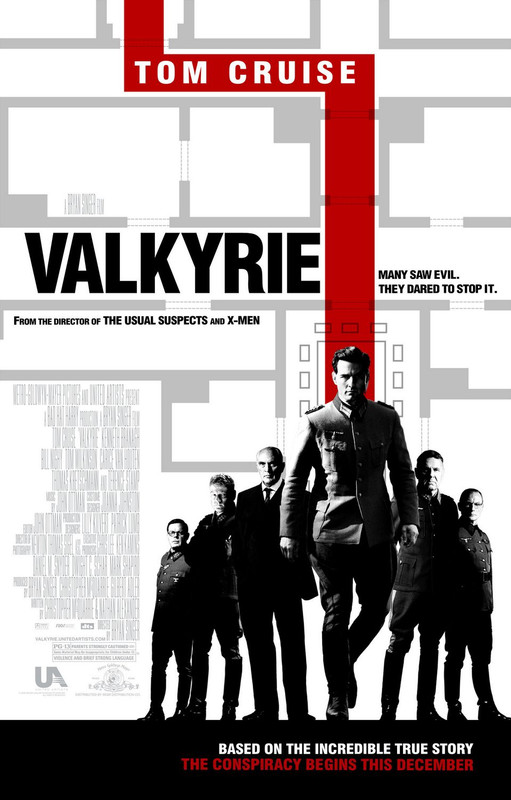
Valkyrie [12A]

Dir: Bryan Singer
You can’t say its not an exciting story, that of the last major attempt, by a German resistance, on the life of Adolf Hitler, one that very nearly succeeded, but as a film Valkyrie works only about half of the time.

For many years it was quite standard to see Nazis portrayed speaking English in British accents, but that feels more anachronistic now, in an age when foreign language films can make it into the multiplex (however seldom) especially when a new generation of German filmmakers are themselves re-examining the second world war in a wave of largely excellent films. The language issue doesn’t, however, dog Valkyrie in quite the way that it did The Reader, a fact that can be largely put down to two things; the decision to let the whole cast use their own accents, and the casting itself. Besides its impossibly famous American star Valkyrie is almost exclusively cast with Europeans, most of them Brits. Only two major speaking roles go to German actors, and both Christian Berkel and Thomas Kretschmann prove as adept as actors in English as in their native language.

It also helps that most of the performances are very good. Bill Nighy, recently seen turning the bad acting up to 11 in Underworld: Rise of the Lycans, gives a restrained, frightened performance as General Olbricht and Tom Wilkinson is as good as ever as General Fromm. There are also nicely underplayed turns from Kenneth Branagh and Terence Stamp, whose final line is one of the film’s best and beautifully delivered. Carice Van Houten, on the strength and length of her part as Nina Von Stauffenberg, should barely rate a mention here, but it’s a shame she’s not in the film more as she again suggests that she’s a very fine actress, and makes you long for the day someone will use her better in English. On the other side of the acting coin there’s Eddie Izzard, who is a terrific comedian, but seems lost in an entirely straight role, and undecided whether to do an accent.

The elephant in the room, of course, is Tom Cruise. He’s in an unusually vulnerable position, he’s had a couple of films that haven’t done very well, Valkyrie delayed, and his future as a studio owner at United Artists is to some degree riding on this film. About the behind the scenes stuff, who can say? As an actor, he is largely vindicated here. Cruise has always been a better actor than he is given credit for and he makes a strongly, but never blandly or solely, heroic Claus Von Stauffenberg. The fact that he sounds exactly as he always sounds, amid a sea of Englishmen, playing a German, takes a bit of getting used to, but he’s good enough that it only takes a few minutes.

Though it is always impressively mounted Valkyrie does take a little while to get going, with the usual hoops to be jumped through, the exposition in which Stauffenberg is brought into the plot. Thereafter the film ramps up, and becomes, for a story to which the ending is known, a surprisingly tense thriller. You wish that the film had had the courage to simply throw you into the plot itself, and skip the preamble. The sequences dealing with the attempt on Hitler’s life and the implementation of Operation Valkyrie (which was to allow the plotters to take control of Berlin after Hitler’s death) are genuinely thrilling, even though Cruise’s role is largely limited to making deals over the phone, which did, briefly, cause me a Jerry Maguire flashback. It is this part of the story, how far the plotters got, how close they came, that I knew little of.

There isn’t a great deal of complexity to Valkyrie; there are the plotters (yay) and the Nazis (boo), and while a little more grey area would go a long way to giving the film a little more depth it is, at heart, a mainstream thriller and in that respect the second half of the film does a sterling job. It’s not Bryan Singer’s best work, and in fact feels a bit directorially anonymous, perhaps Singer keeping his head down and turning ‘one for them’ out after his disappointing Superman Lives, but it’s also by no means a bad film.
★★★