Showing posts with label Adaptation. Show all posts

Sep 8, 2019

It: Chapter Two [15]

Dir: Andy Muschietti
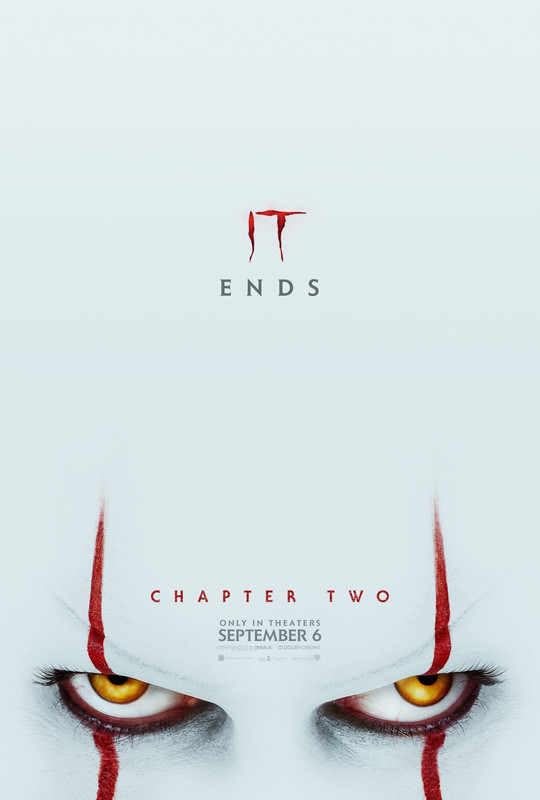
The first part of this adaptation of one of Stephen King’s best regarded novels became, on its 2017 release, the highest grossing horror film of all time (albeit unadjusted for inflation), so it makes sense that director Andy Muschietti has been afforded expanded freedoms for this second and final instalment. It’s probably not coincidental that the finished film is a good argument for reining a director in.

We pick up the action 27 years after the end of the last film, with the Losers Club now far-flung and having been out of contact and, with the exception of Mike Hanlon (Isaiah Mustafa), out of Derry since shortly after the summer they believed they defeated Pennywise (Bill Skarsgard). When a man is murdered, Mike discovers writing in blood that tells him Pennywise has returned, and he must reunite the Losers to finally destroy him once and for all. 

It’s tough to argue with the quality of many aspects of It: Chapter Two. Cinematographer Checco Varese, production designer Paul D. Austerberry and art director Nigel Churcher all help craft a striking look for the film. Scenes with Bill (James McAvoy) trapped in a funhouse and Richie (Bill Hader) seeing Pennywise floating above him, hanging from a pyramid of red balloons are particularly strong images in their own right. The good work in the behind camera departments continues with some effective transitions between past and present, some achieved via effects and others through Jason Ballantine’s editing, and there is excellent practical effects work from the make up department, notably the Pennywise unit and largely successful de-aging CGI on the kids, who have all grown since the first film. The join is only visible on Finn Wolfhard, who obviously needed more work to match his look from the first film and can occasionally appear a bit waxy in the flashback sequences. Unusually, the film’s MVP is arguably casting director Rich Delia who, having found a talented group of kids for the first film, matches them brilliantly both in look and personality with the adult cast here. 

With all this quality work in departments that don’t often get singled out for notice, it’s disappointing that where It: Chapter Two falls down is in the key aspects of its writing and direction. The film starts well enough, with a genuinely shocking and nasty scene of a gay bashing murder (with filmmaker Xavier Dolan playing the victim), but inconsistency soon rears its head. 

Gary Dauberman’s screenplay is bitty and episodic, often putting its emphasis on the wrong things. In the long search for ‘tokens’ the Losers have to sacrifice to help them defeat Pennywise, only a couple feel hugely significant to the characters, Bev’s (Jessica Chastain) postcard being the one we feel the owner has the deepest connection to. Criminally, Bill’s bike feels more like his token, given the emphasis put on it during the sequence, than what it turns out to be. Some of the problems with the writing, like the nuance free depiction of characters like Bev’s abusive husband, can be traced back to Stephen King, who never wrote a bully who wasn’t pure unvarnished evil, but Dauberman should have been able to use the film’s massive running time to draw the story together more effectively, and to find something for Mike Hanlon to do aside from spout exposition. A running gag about Bill (King’s self-insert author in this story) not being able to write satisfying endings is not only tiresome, making a joke about something doesn’t mean it’s not true.

Like Dauberman, Andy Muschietti seems to struggle with the unwieldy length of his film (169 minutes, longer than 2001, The Life and Death of Colonel Blimp and recent byword for self-indulgent overlength, Once Upon a Time… in Hollywood). The pacing is notably stop/start, with the film cramming in the exposition in the opening twenty minutes, with scenes so brief to establish where the Losers Club are now that they feel pat and tossed off. After the first act, every single scene is drawn out long beyond the time at which its point is made. This is especially true of the token seeking scenes and the funhouse sequence, all of which could easily lose a third of their running time. This is all without taking account of scenes that could be cut wholesale, such as every last frame involving Henry Bowers (Teach Grant), another of King’s one note bullies, and entirely superfluous here. 

Only in a couple of sequences does Muschietti show any knack for building atmosphere, and in both the funhouse and Beverly’s encounter with an old lady who lives in her former home, he manages to undermine what creeping fear he does engender, either with a laughable monster or poor pacing. Otherwise, the film’s scares are the typical ‘boo’ jumps. Some work, if only as a result of the law of averages, but they can almost all be counted in.
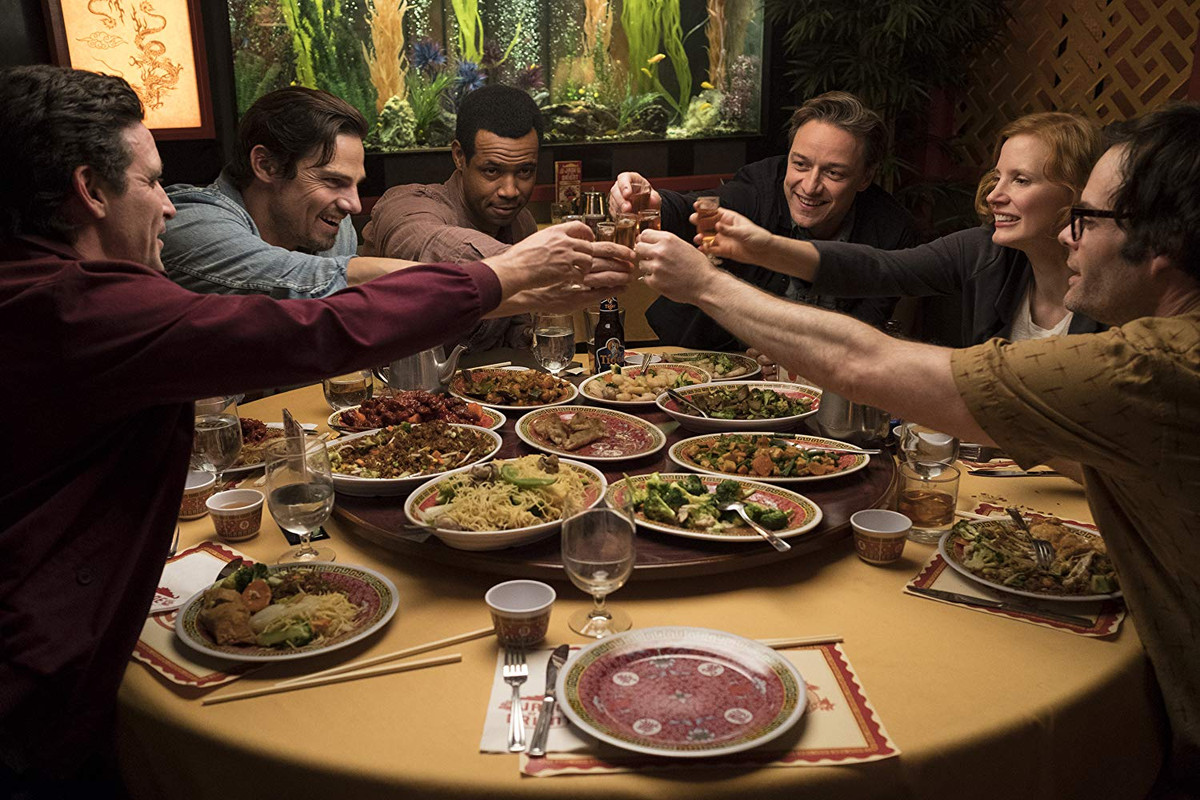
The acting is better than the screenplay and direction deserve. Chastain is the biggest name here but, while she’s typically good, she’s not a standout the way Sophia Lillis was, and remains among the teenage cast. McAvoy is also effective as the older Bill, convincing us of the long held guilt his character feels over ‘abandoning’ his little brother to Pennywise and the scene in which he works through that is one of the film’s best moments. The adult cast all channel their young counterparts, capturing the same essence and energy, suggesting both that our essential natures never really change and that, when drawn back together, they fall easily into old relationships. This is the film’s most affecting material, as it advances the coming of age stories that were the most compelling aspect of Chapter One

Among the adult Losers, the best performances come from Bill Hader as Richie and James Ransone as Eddie, the latter now somewhat meeker but still the risk averse person he was as a kid. Hader’s performance has both the emotional content of his work on The Skeleton Twins and the sharp comic timing he always shows, but he isn’t always well served by the script, which puts too much emphasis on his wisecracking, often puncturing potentially scary scenes with gags that, while well delivered, aren’t funny enough to justify undermining the horror element of what is supposed to be a horror film. Equally, the secret that Pennywise taunts Richie with, obvious as it is, appears to be set up to pay off in a bigger way, and while the way it’s depicted is heartfelt, it doesn’t land with the emotional punch the setup promises. Ransone, who made a strong impression in the Sinister films, might give the best performance of the whole Losers Club, struggling to overcome the hypochondria of his childhood which has led into work as a risk analyst, not a personality type best suited to fighting a demonic clown. As Ben Hanscom, Jay Ryan’s character is, for the first two acts, often little more than a soundalike of his surname. Ben’s story only comes into focus in the final act, but at least that’s more than Isaiah Mustafa gets as Mike, the film’s sole black character finding himself sidelined for large swathes of a second film in a row.

The other key cast member here is Bill Skarsgard as Pennywise. While the make up does a lot of work for him, the actor inhabits it brilliantly. Almost every element of the film’s pure horror scenes that works is thanks to his deeply weird and unnerving performance. This is particularly true when Pennywise attacks a little girl under the bleachers at a baseball game, Skarsgard’s childlike voice only adding to the skin-crawlingly horrible feel of the scene.

It would be unfair to say that It: Chapter Two is a bad film, there are too many well crafted elements for that to be true. The film comes into focus just often enough to make you think that buried somewhere in this morass of footage is a genuinely frightening film about the things that haunt us from our childhood. Unfortunately, to find that movie you have to pick through an overlong and digressive collection of scenes that often feel like they are stuck in the same inert state as the lady Bev has tea with. Muschietti is capable both of boring us with his longueurs and of making us groan with his painfully obvious allusions to films infinitely better than this one (from the King universe and outside). Next to these moments, the scenes that do manage to grip or to scare don’t add up to enough to allow the film to work as a whole. Taken together with the equally overlong and patchy Chapter One, there may be a way to carve out a great four hour film, but these two hours and forty nine minutes are only sporadically interesting.
★★½

Oct 27, 2014

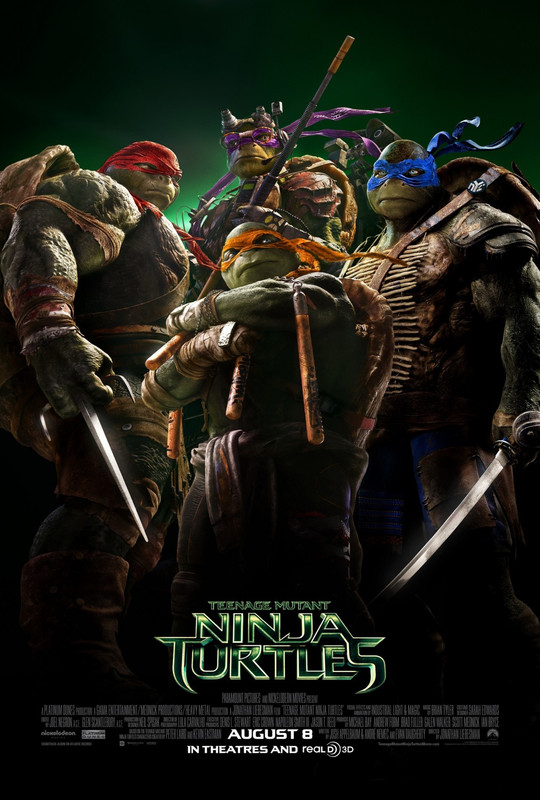
Teenage Mutant Ninja Turtles ['14] [12A]

Dir: Jonathan Liebesman
To my slight dismay I am now old enough for my childhood and teenage years to be mined for pop culture nostalgia.  I grew up on the Teenage Mutant Hero Turtles (thanks, BBC censorship, for making the word Ninja a surprise when I saw the first film).  Michaelangelo was always my favourite, he was closest to my own personality; the pizza obsessed joker, and he had the coolest weapons.  I hadn't thought about the turtles in a good couple of decades until this film was announced and I found myself revisiting the earlier movies, discovering that the first held up well; a surprisingly deft mix of humour, action and a little grit.  This did not make me optimistic for this reboot, and nor did the 'talent' behind it.

Jonathan Liebesman has previously brought us such contributions to the art of cinema as Battle: LA and such respectful, high quality, takes on franchises with a long legacy as Texas Chainsaw Massacre: The Beginning while producer Michael Bay has a long list on his crimes against geeks charge sheet, chiefly the unspeakably abysmal Transformers franchise.  The pairing doesn't inspire confidence.

In some respects, given the floor level expectations, Teenage Mutant Ninja Turtles qualifies as a reasonably pleasant surprise.  I never read the comics, I was too young for them when I was into the cartoon and perceived myself, perhaps wrongly, as too old for them after I grew out of the show and the previous films.  This being the case I always saw rather broad characterisations of each of the Turtles.  Leonardo was the stoical leader, Raphael the loose cannon, Donatello the nerd and Michaelangelo the joker.  The turtles don't need all that much more nuance, and to the film's credit it gets these personality traits right, though they come through more intermittently than you'd like and, sadly and in contrast to the 90's films, seldom figure in the action.  Mikey has some funny moments and his crush on April (played by Megan Fox) is intact, while Donatello is less anonymous here than he has been in some  iterations of the franchise.  The interplay between the brothers is good and faithful to the source, though Raph's separation from the group and rivalry with Leo could be a touch more developed.

The action takes longer to ramp up here than in the 90's films and between the fact that he has too much exposition up front and hides the Turtles for much too long it takes Liebesman more than half of the film's (wisely brief) running time to get to an action scene in which we can really see each of the Turtles fighting.  The choreography is solid enough, and while they can be ludicrous the large scale set pieces of the film's third act, especially one that takes the action down the side of a snowy mountain, are also a lot of fun if you can locate your inner nine year old and make him sit still to watch the film.  I was never caught up in the story, but I did find myself enjoying the action scenes purely as action scenes.

Unfortunately, while Teenage Mutant Ninja Turtles is better than you'd expect, it's not all that much better than you'd expect and for every thing it gets right it gets two wrong.  The casting is a mixed bag.  Johnny Knoxville does well as Leonardo, as does Alan Ritchson as Raph, but Mikey and Don both have pretty grating voices (Noel Fisher and Jeremy Howard respectively) and  Tony Shalhoub's Splinter simply doesn't carry the gravitas of previous takes on the character.  

Then there's Megan Fox.  Fox never seemed a likely April O'Neil to me, the character was always, while depicted as attractive, defined by her job rather than her looks.  That might have been true here but for the casting of Fox; a vacant actress who has long coasted on her perceived hotness.  She does nothing here to suggest she has any ambition to change that.  There is an attempt here to give April some depth that she never had in either the show or the other movies (despite Judith Hoag's perfectly solid performance), but the screenplay does this in only the most perfunctory way, giving her an off the peg dead father subplot that also ties into the origin of the Turtles, which is another of the film's big problems.

Tying April in to the origin story not only leads to her lame and predictable back story, but it means that the film has to give us several lengthy and boring infodumps that simply wouldn't be necessary if it weren't for that specific character being tied in to events.  It would be fine if it made a dramatic contribution to the film, but it doesn't, beyond Fox's late realisation about the film's villain, which prompts her to actually say, out loud, "You killed my father" (I confess to openly laughing at Megan Fox's blank delivery of that line).  

This storyline also gives us a terribly ineffectual villain.  The 90's films, while they had a menacing Shredder and a pretty cool second stringer in Tatsu, never quite captured the fun rogues gallery of the TV show, and this is a problem this new film echoes.  William Fichtner's villain is an empty suit with little menace, a silly, hackneyed, plan and a ridiculous motive: to become "stupid rich", despite the fact he already lives in a literal mansion.

The only familiar villain used is Shredder and he is the hub of the design problems that are the film's second major issue.  Shredder was never the most plausible looking villain, but the 1990 film made gave him a look that fitted into the reality of the New York it presented.  The bladed outfit looked threatening, but like something you could imagine someone would make in order to scare the gang he leads into submission.  This film's Shredder, by contrast, looks ridiculous.  He looks like a cross between one of Bay's Transformers and a sentient knife factory.  The first appearance of his costume was another moment at which I let out an inappropriate laugh.

The design issues don't stop there.  The Turtles themselves actually look better in motion than they did in publicity shots, but there are still a few moments when the attempts to humanise their faces become just a little eerie and their design is just a bit overly busy with straps, makeshift armour and other accessories.

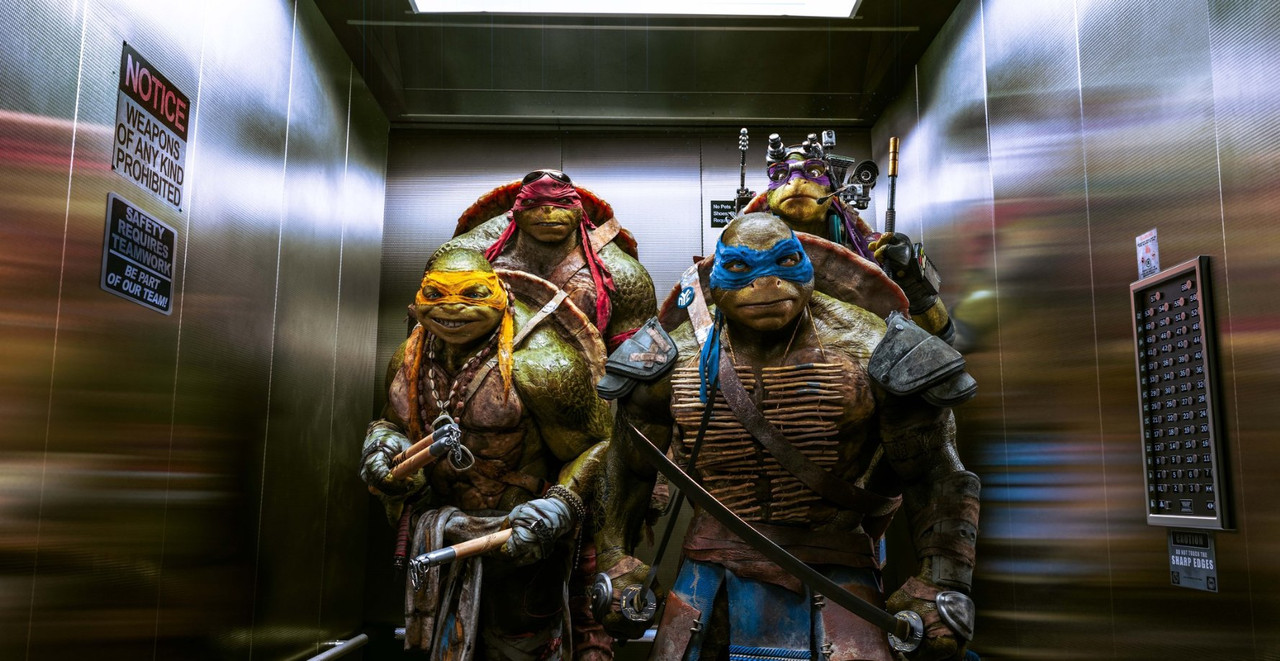
The film isn't badly shot, but it's anonymous looking.  Liebesman is, at best, a journeyman and not even one of Hollywood's more reliable directors in that category.  I'd love to have seen how Joe Johnston, a much more talented journeyman, would have tackled this assignment.  Still, Teenage Mutant Ninja Turtles does most of what it's supposed to do pretty well.  What's frustrating is that there are flashes of a better film - as in a funny little digression in the elevator on the way to the final fight with Shredder - and easy fixes that could have solved some of the film's problems.  

The kids in my audience lapped it up and, given that it's for them, perhaps that's all that matters.  Still, as someone who grew up a Turtles fan, I'd like to have got more from this film.  I think there's room to please old fans and new here, and I'm at least interested enough to see whether a sequel can marshal the elements a bit better, because when this film get things right it's a lot of fun, but it gets them wrong too often.
★★½

Oct 9, 2014

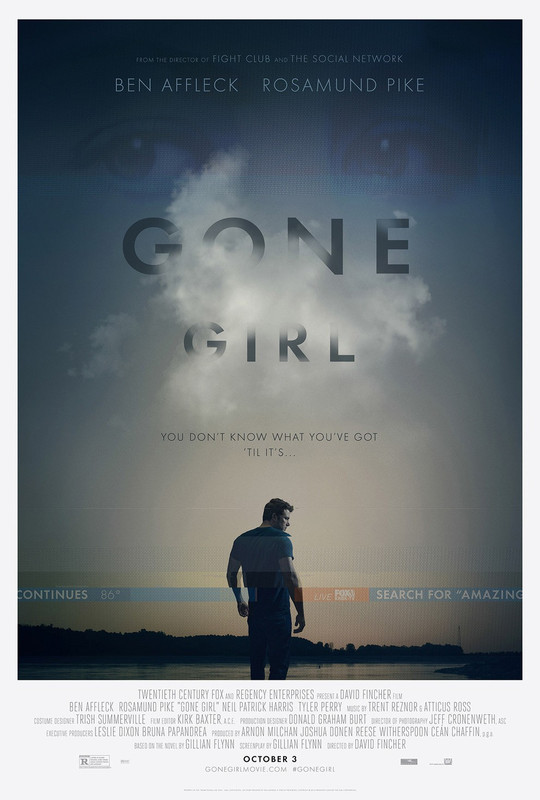
Gone Girl [18]

Dir: David Fincher
Gone Girl is a contradictory piece of work: it's trashy and tawdry, pure pulp, but it's also classy; precisely crafted and looking to award season with a degree of expectation.  These are things that David Fincher has previously combined to brilliant (Se7en) and numbingly pointless (The Girl With The Dragon Tattoo) effect. Sadly Gone Girl, while it has more reason to exist than Fincher's last, ends up leaning more towards the latter.

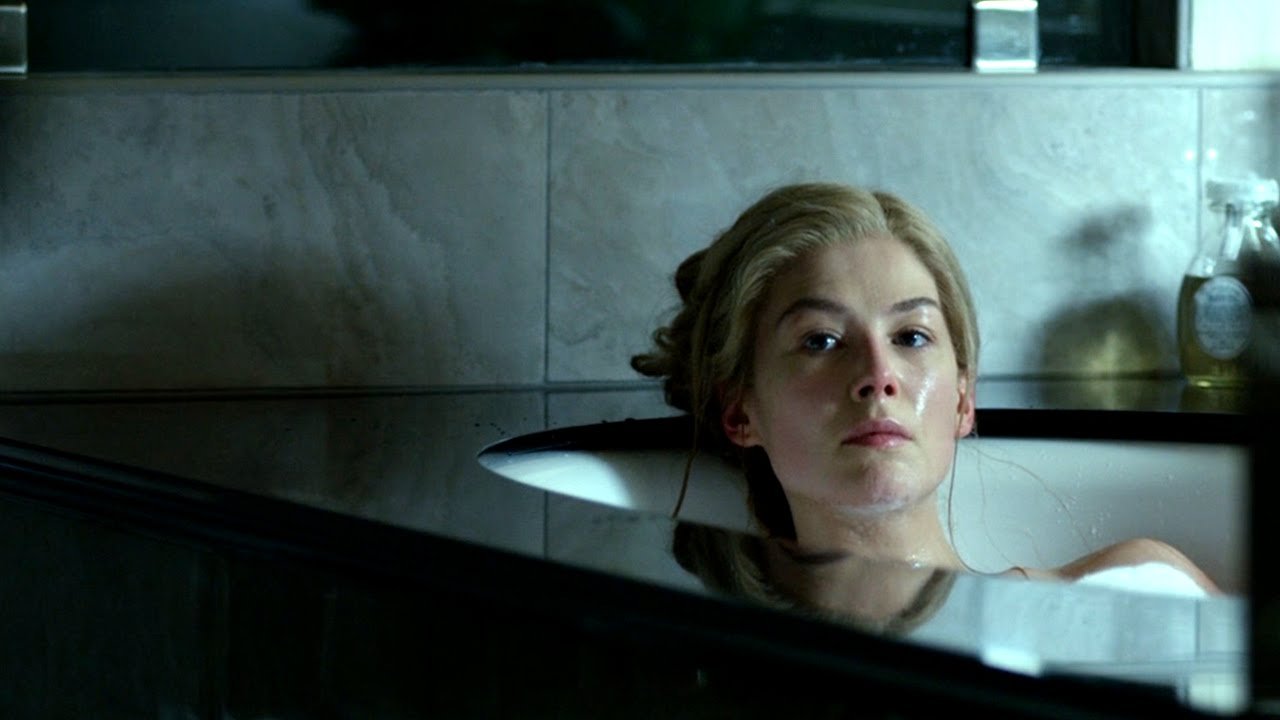
Based on Gillian Flynn's novel, and adapted by Flynn herself, the setup of Gone Girl sees Amy Dunne (Rosamund Pike) vanish on her fifth wedding anniversary from the home she shares with her husband Nick (Ben Affleck).  As the investigation continues details emerge about Nick and Amy's lives and their marriage which throw suspicion on Nick.  That, of course, is only the premise, but to say much more would be to spoil the film for those, like myself, who come to it without having read the novel and that would be a shame because one of its undoubted strengths is the fact that the plot twists genuinely throw you for a loop.

There is, on the surface, much to recommend here.  As you might expect of a craftsman as assured as Fincher, the film looks impeccable.  There is a coldness to his eye here that renders suburbia something foreboding, visually and geographically removed from the grimier part of town where The Bar, which Nick owns with his twin sister Margo (Carrie Coon), is found.  Every frame is perfectly composed, reeking of design, and the camera movement follows suit.

Similarly there is little outwardly wrong with the performances.  Affleck does some of if not the best work of his career.  A TV interview late in the film is full of meaningful touches that resonate with scenes from right back to the start of the film.  Rosamund Pike, given a standout role as Amy, grabs hold of the part with both hands and owns every scene she's in.  As far back as her debut as a bad Bond girl in Die Another Day filmmakers have recognised Pike's icy quality and it seems perfect that she was once the lead in a play titled Hitchcock Blonde.  Fincher uses and manipulates those attributes in Pike to  striking effect.

Many of the film's best roles are for women and perennial supporting player Kim Dickens, as a thoughtful, methodical detective and Carrie Coon, in her first, potentially star making, film role as Margo; dragged into events simply by being related to Nick both give strong performances and are allowed to be more than just props to move the action along.  Perhaps the biggest surprise is Tyler Perry, regarded by people who aren't fans of his Madea films as at best and irritant and at worst an embarrassment, he here turns in a credible and authoritative dramatic performance as Nick's lawyer, Tanner Bolt.

And yet, as there is a dark underbelly to Nick and Amy's marriage there is a flipside to many of the virtues of Gone Girl.  It IS perfect looking, designed to within an inch of its life, and perhaps the coldness that that design gives the film is exactly what Fincher and his brilliant DP Jeff Cronenweth intended.  Still, I can't deny that it meant I could see them behind every shot, that the film held me at a distance, almost as if I was watching it being directed rather than watching the story unfold.  Surprising as the events of the story are, I found myself so aware of their assembly that I was never fully engaged with them.

The performances ARE largely excellent (though Patrick Fugit gets lost in the shuffle and Missi Pyle is too hammy as TV news reporter) but they all feel like performances.  This, again, may be down to the fact that I could always feel Fincher's hand driving the film, which, controlled as they are, I never have in his other works.  It's particularly true of Rosamund Pike.  Again there is perhaps intent in this; a sense that we're supposed to feel that Amy is always playing a role, but this is something that I've felt has been done better in a lot of previous Neo-Noir.  Pike is an actress I've long been a fan of, and she's clearly been directed to this performance, which is technically difficult to fault, but it's that very technicality that was the problem; I could always see the cogs turning, in a way I can't usually when I see her on screen.  It would be easier to say that this was just a choice about Nick and Amy's characters if the same feeling weren't present in most of the other performances.  I found it particularly forced with Neil Patrick Harris' character.  Perhaps Fincher is trying to externalise the idea that everyone has a hidden agenda, but it's just one more thing that kept me very aware I was watching a construct that I felt more and more removed from even as I admired its craft.

For its first two hours Gone Girl strains credulity progressively more and more, with a plot that hinges so completely on everything going exactly to plan and everyone behaving just as expected that it is always on the knife edge of seeming ridiculous, but it's only in the last 30 minutes or so that the balance falters and my suspension of disbelief went from strained to snapped.  Up to that point I just about believed that the main characters would behave as the narrative needs them to, but that stopped being true after the big twist that heralds the film's long coda.  This might be less of an issue if Gone Girl had been more embracing of its pulpiness from the outset, but amping up those elements feels an odd fit with the prevailing tone of the film.

Watching Gone Girl I kept thinking of John Dahl's great film The Last Seduction, which is as pulpy as any 90's neo-noir and has many elements that echo here, including that cold tone.  For me Dahl marshals and combines those elements much better, into a film I am much more absorbed by.  David Fincher and his cast and crew are exceptional craftsmen, but the more I think about it the more my experience of Gone Girl is one of watching them build a beautiful empty vessel.

Oct 5, 2014

24FPS @ LFF 2014: 3/10

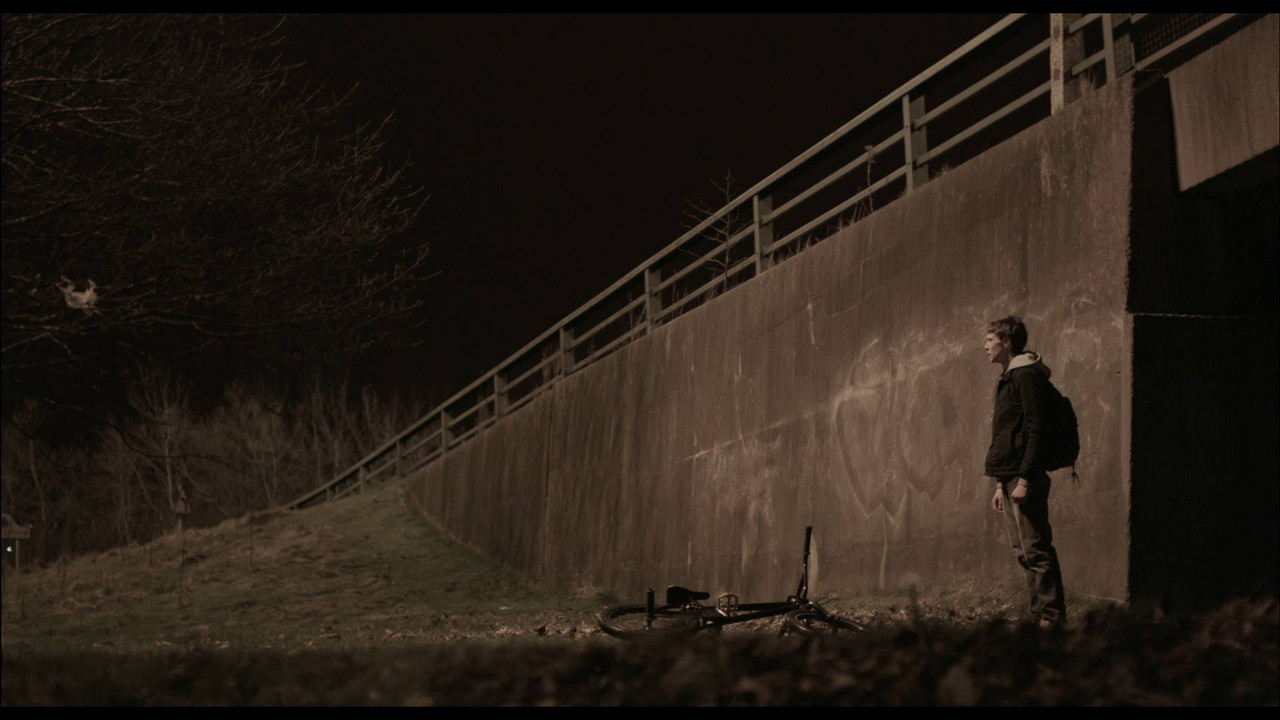
Bypass
Dir: Duane Hopkins
Better Things director Duane Hopkins has taken his time following up his debut, which I managed to miss when it came out five years ago.  I'm not exactly desperate to play catch up having seen Bypass.

Tim (George McKay) is in his early 20's.  His mother has died, his older brother has just been released from prison and he has turned to low level crime in an attempt to eke out a living for himself and his younger sister.  As the film proceeds, Tim finds himself falling deeper into the criminal world and struggling with an illness that is becoming serious.

As you might gather from that synopsis, Bypass is rather by the numbers stuff. Story wise, there's little here that hasn't been in another dozen British crime or council estate misery dramas in recent years.  Hopkins tries his level best to disguise this with his stylistic choices, but he fails miserably.  Bypass is perhaps the most self-consciously, self-regardingly, over-stylised film I've seen this year.  Almost every shot in Bypass is a soft focus, moving, close up on something.  Tim and the other characters are almost never seen in a full length shot and the camera is constantly searching, moving around to try and find every insignificant detail that it can (almost) focus on.  Hopkins doesn't stop at this.  His use of slow motion is also out of control (usually in combination with his 'meaningfully' shallow focus and off kilter framing) and the use of sound can also be grating, returning to the same trick of starting a scene's dialogue long before its visuals over and over ad nauseum. Without Hopkins' obnoxiously artsy approach, Bypass would just be banal, with it is is beyond grating.

More irritating than Hopkins' limited and repetitious artistic ideas is the fact the overuse of them means that they fall flat when Tim is at his most fraught.  In these moments the lack of focus and moving camera might reflect what's going on in Tim's mind, but because Hopkins uses these techniques as a crutch throughout the film they are robbed of that meaning.

The news is little better when it comes to the performances.  George McKay and Benjamin Dilloway are both hit and miss as Tim and his older brother Greg.  McKay has a few good moments, and his performance has a physicality that can be effective.  His best scene is perhaps an incredibly realistic and difficult to watch fit that Tim has, tellingly it's a silent scene.  When he has dialogue McKay turns in a flat performance, largely unencumbered by expression.  Still, he's light years better than either Chanel Cresswell as his younger sister or Charlotte Spencer, who is disastrously monotonous as his girlfriend.

To be fair, only some of this is the fault of the cast.  It's tough to make something out of nothing, and nothing is what Hopkins' screenplay gives them to work with.  The characters are all empty suits.  Tim is quiet and pliant, which makes his the most detailed characterisation in the film.  Of course Charlotte Spencer is dreadful, her character Lily barely has anything that counts as a trait, let alone a personality, so what chance does she have to do anything with her performance?  The limited dialogue is as poor as the character writing and the plot turns in ways that are ever more trite and loaded with implied but unfulfilled meaning, building to a staggeringly awful last ten minutes.  The ending is so wrapped up in the cleverness of its visual devices (the same visual devices we've seen for the past 90 minutes) that it completely fumbles its message.  Is it supposed to be redemptive or the restarting of the same cycle?  Who knows and, frankly, after this who cares?  

Bypass is directorial masturbation that fails to cover for the banality of the story and characters we're watching.

Tokyo Tribe
Dir: Sion Sono
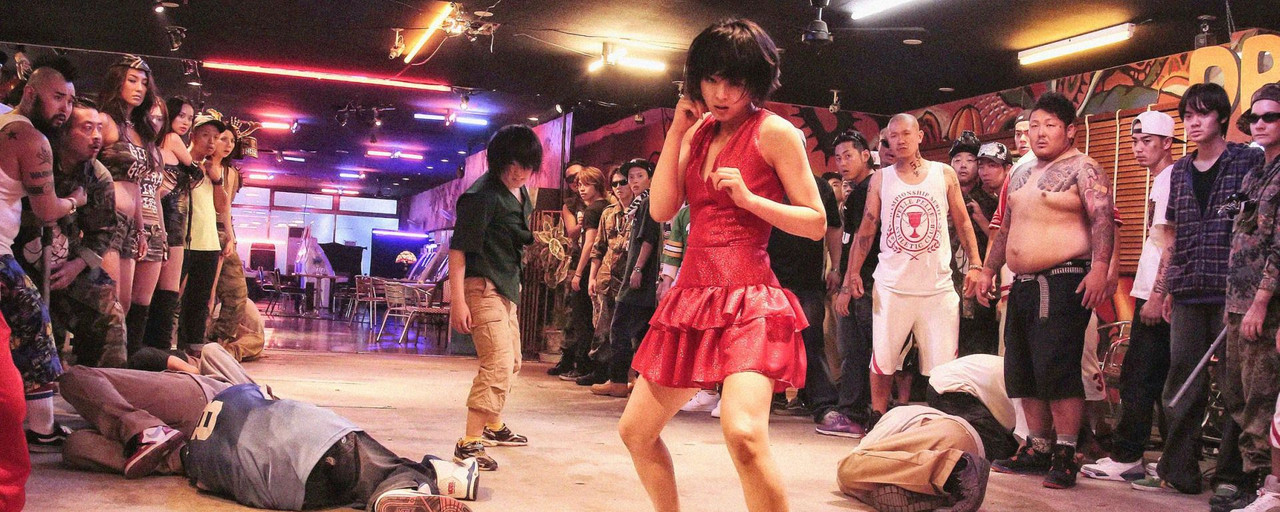
Sion Sono might be 21st century cinema's foremost absurdist.  That's not to say that there isn't more to his films than their craziness, but that is often their defining feature and seldom more so than with the blisteringly energetic and relentlessly bonkers Tokyo Tribe; a Manga- based post apocalyptic hip hop musical, jam packed with martial arts action. In other words it's pure, unrefined, Sono.  This is both great and a little problematic.

The story, such as it is, is introduced by an MC (played by Shota Somentani, the lead in Sono's Himizu and one of several cast members who recur from the director's earlier work).  He introduces the gangs who now rule Tokyo society and vie for dominance and also acts as a sort of greek chorus for the film.  The main thrust of the plot involves a gang headed by grotesque mob boss Buppa (Riki Takeuchi) and his enforcer Mera (Ryôhei Suzuki) trying to destroy all the other gangs one by one so that they can rule Tokyo but Kai (Young Dais), the peace and love promoting leader of a Musashino gang wants to fight back. To do so he teams up with Sunmi (Nana Seino), who has escaped being kidnapped for Buppa's brothel.

Sion Sono often makes long films, and while Tokyo Tribe has a relatively conservative running time of 116 minutes there is enough packed into it for it to be twice as long.  Earthquakes, gatling guns, bizarre side characters, penis envy, satanism, a Caligula inspired wall of death and pinku style sexploitation all raise their heads at some point and that doesn't come close to covering all of the oddness on display.  

As you would expect given that description and Sono's history, Tokyo Tribe is blazingly energetic and inventive.  The opening sequence introduces us to all of the gangs through the device of a gang member using a knife to demonstrate their relative positions to a female cop he's holding hostage.  Each gang also gets a showpiece rap at this point that cements a style for their contributions throughout the film.  This is a great choice by Sono because otherwise, with so many factions, the film could easily have become messy.

While there is an overarching story and a message (be nice to each other), Tokyo Tribe largely unfolds as a series of linked setpieces.  This being the case, the energy level seldom drops and the film can be exhausting, but every scene is packed with gleeful little details to keep you totally engaged.  Perhaps my favourite of these comes early in the film when Buppa is served his tea by a beatboxing girl.  It's so incongruous and comes so out of the blue that I can't imagine anyone not falling for the film, at least briefly, in that moment.  

This isn't to say that all the fun of the film is in its margins.  Takeuchi and Suzuki overplay everything, providing more ham between them than you'd find at the buffet table of a pork butcher's convention, but because evrything is so heightened here it works brilliantly.  Suzuki's unhinged Mera is especially great; a preening, perpetually half naked psychopath whose motivation, when it is revealed late in the day, is perhaps the film's best and its most juvenile joke.  There are also charismatic turns from Nana Seino, whose Sunmi goes convincingly from exploited innocent to badass fighter and from Kikoto Sakaguchi as her young sidekick whose martial arts moves use breakdance to bone breaking effect.  The only real issue with the performances is that, amongst this strong cast, Young Dais comes off a little bit dull as Kai.

The music is great, the insistent beats power the film along even when scenes lapse out of rap and into normal dialogue and there is a great variety in both the skills and the styles of rap on display.  Riki Takeuchi, for instance, is no MC, but he doesn't have to be because you get the sense that Buppa's rapping is only tolerated because if it's not he will literally kill someone.  Most of the main cast do a good job with what must have been a challenging task for those of them not from the music world.  Only Shota Somentani lets the side down a little, with a flat tone that never generates a great sense of flow.

There is so much to enjoy in Tokyo Tribe. The martial arts sequences, which are varied and brilliantly shot and choreographed, have an energetic brutality throughout , but there's also such fun in the details; the truck with chandeliers for headlights; the nod to Scarface with Buppa's 'Fuck Da World' globe sculpture and so many more.  The design is stunning and overblown throughout, never more so than in the room full of living furniture owned by Buppa's son Nkoi (an intensely creepy Yosuke Kubozuka).

The problem with this being, as I said, pure unrefined Sono is that there are a few troubling things here.  Tough as it is to take the film's sexual politics seriously, they can make you a little queasy.  With the exception of Sunmi (who has her own troubling scene early on), all of the women in the film are depicted purely as objects, most of them, at some point, stripped.  The most exploitative and uncomfortable moment comes early in the film when a female cop, who we never see again, is stripped.  This is perhaps the one moment where the exploitative tone eclipses the absurdity and becomes offensive.  This isn't new territory for Sono, but ultimately it's more muted and less troubling here than in, say, Himizu, because the film isn't asking us to take it seriously at that level.

Ultimately, you have to take Tokyo Tribe for what it is; a relentless and rather silly entertainment.  I can't imagine you failing to have at least some fun with it at that level.

Jun 30, 2014

The Fault In Our Stars [12A]

Dir: Josh Boone
I saw two films over the weekend that were, at least in parts, attempting to make me cry.  At the end of Jeux Interdits I was extremely emotional and wiping tears away, but by the time that mawkish YA adaptation The Fault In Our Stars had a measure of mercy and stopped I was simply relieved that it was over.

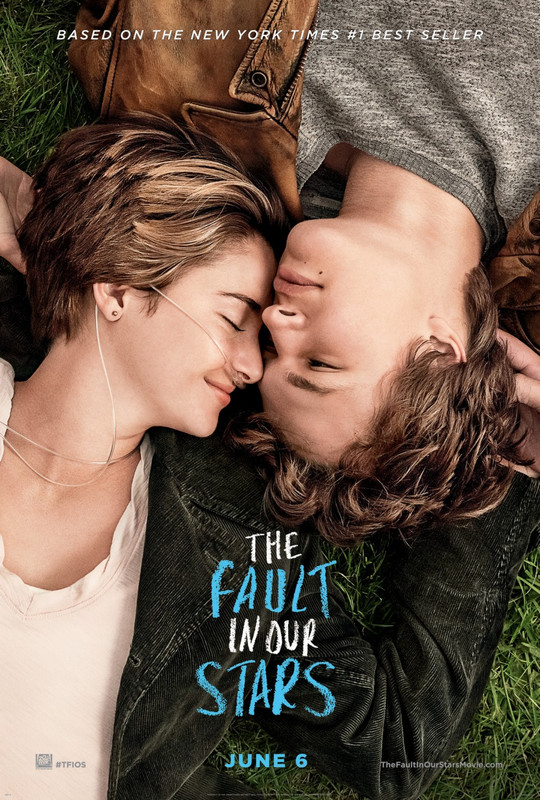
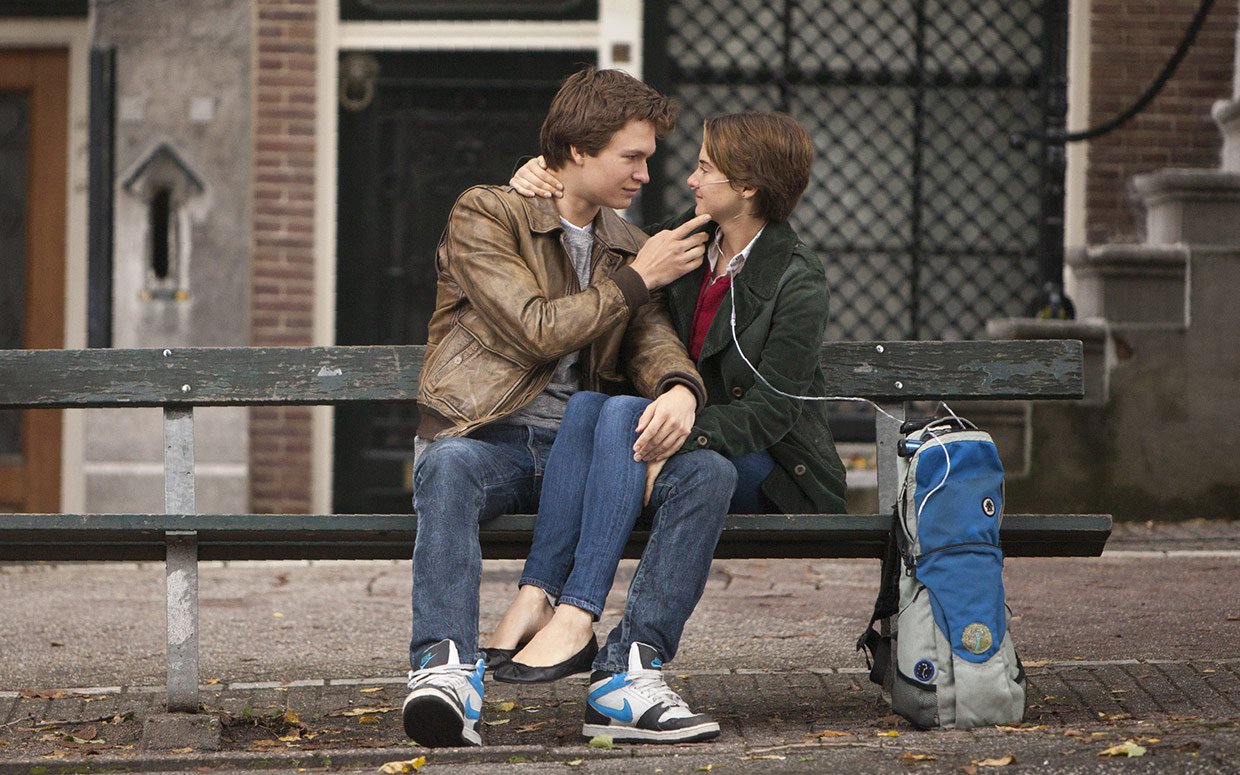
As the film opens our main character Hazel (Shailene Woodley) tells us, almost apologetically, that this is not one of those stories in which hardship results in "beautiful people learning beautiful lessons".  I wonder which story she's talking about, because that is exactly what this film is.  Hazel is 17 and she has terminal cancer, but thanks to an experimental treatment she's managing to stay at least a little way from death's door.  At a support group she meets cancer survivor Augustus (Ansel Elgort), who immediately begins to pursue her.  The two fall in love, bonding over the work of a reclusive author and facing up to an uncertain future.

We live in an age in which most mainstream, studio backed, cinema only seems interested in engaging our eyes and our ears, so on the one hand it's a relief to see a film like The Fault In Ours Stars, which is attempting to engage its audience on an emotional level, getting a major release.  On the other hand, it's much easier to engage an audience viscerally than speak to their emotions.  For instance, I love Jackie Chan movies, they're fun and exciting and it's amazing to watch his inventiveness with props, but do I worry about his character, do I find myself engaged in his relationships?  No.  The point is that, at least for me, an emotional charge in a film comes from the feeling that these are believable people that we're watching, if I don't feel that there is an honesty at the heart of the film and the characters then they just become props for the story to move about.  This is what happens here, for much of the running time Hazel and Augustus aren't so much characters as they are pointy sticks with which the film repeatedly prods you to see how long it will be before you start crying.

This is especially disappointing given the pedigree of The Fault In Our Stars.  Screenwriters Michael J Weber and Scott Neustadter's last film was The Spectacular Now, which I adored and called the best American teen movie of recent years.  This is quite the drop off.  The thing that made The Spectacular Now so special for me was that at the centre of it there were two characters that I recognised, they felt like real people. Real people with real and complex problems.  Real people who fuck up, and might not stop fucking up after the film ends.  This is where we come to what I hated most about The Fault In Our Stars (bar a few specific scenes that, trust me, we'll get to).  The only thing wrong with either Hazel or Augustus is their cancer.

Augustus in particular is, as written, almost obnoxiously perfect, he seems less a real person than the product of a focus group, custom designed to be the caring, clever, witty, boy who is interested in the girl who serves as the analogue for the teenage target audience.  He pursues Hazel doggedly, but completely unthreateningly and when the subject of sex comes up he's ever so charming about making it clear that he'd like to do it with Hazel, but not seeming to pressure her.  These are all perfectly admirable traits, wrapped in a package that, through happy genetic accident, is also classically handsome, but nothing about it rings true.  All of Augustus' dialogue is much too considered.  It plays as exactly what it is; three older men (the third being original novel writer John Green) painstakingly crafting the best, most articulate, version of their teenage self.  This falseness at the heart of Augustus' character is not helped by Ansel Elgort's performance.  His perma-smirking face gives off an air of eminently punchable smugness and because everything about him seems so calculated and so false he comes off as pretentious (an affectation of having an unlit cigarette as a metaphor) and sometimes a little creepy. 

The problem is the similar with Hazel though less acute, because Shailene Woodley is so clearly talented that she manages to make a few moments play, the bits of her performance that are truly unbearable (two separate eulogies, for instance) are down to the screenplay.  The biggest problem with Woodley's character here is that she's essentially The Spectacular Now's Aimee, but with stage 4 cancer.  This parallel is never clearer than when Hazel and Augustus first talk and there is a beat for beat repeat of a charming moment from The Spectacular Now when Woodley has to react disbelievingly to being called beautiful.  It's the same moment, down to Woodley's inflection on "oh my god, no" but Hazel is so much less human as a character that even at this early stage in the film it rings false.  In that moment it feels like Aimee cut her hair and lost her personality.

Woodley's efforts may be in vain, but at least she turns up.  The only other performance that isn't either lifeless (Sam Tramell) or just plain awful (a surprise guest star) is Laura Dern's.  She has only clichés to play as Hazel's mother, but between her and Woodley they do, towards the end, manage to pull out the film's sole half decent scene.  That's something, not much, but something.

The Fault In Our Stars is dull, deadeningly false and filled with vomit inducing dialogue (a conversation about champagne, for instance) throughout, but it becomes offensively bad in its second half.  Hazel and Augustus are invited to Amsterdam to meet the reclusive writer they are both fans of and ask him questions about what happens after the end of his book.  This leads to a scene in the Anne Frank house which is so completely outside the realm of plausibility that it may as well take place in space.  I'm sorry, but I have to spoil this bit.  After arriving, with much effort, at the top of the Anne Frank house, Hazel and Augustus begin making out in the middle of the room.  You might think this would draw some disapproving glances but no.  EVERYONE APPLAUDS.  Seriously, this is a thing that happens.  At this moment I was no longer watching a story.  All I could see was making of footage of two actors making out in what, surely, is one of the least appropriate places in the world.  All I could think was whether anyone had said, 'you know, this might be a little insensitive, given what this place means'.  If I had even the slightest engagement with this badly staged and written torrent of trite and treacly bullshit it was now over, irrevocably.

The last 40 minutes or so are not quite so ugly as that scene, but they try, dunking your head in treacle over and over, finding several endings but refusing to stop until the film is confident that it has manipulated that last tear out of you.  Two notably awful moments are so utterly implausible that they seem to have teleported in from an alternate dimension, especially the reaction of one character to an incident when Hazel, Augustus and a friend throw eggs at a car. 

I wish The Fault In Our Stars was the film it promised to be in its opening narration.  I wouldn't mind seeing a film that avoided the usual clichés of the cancer movie, that refused to sentimentalise its characters and their problems, that didn't end up being all about beautiful people learning beautiful lessons.  True, this film never offers much in the way of hope to its characters, but that's hardly radical and the presentation is as by the numbers as you could imagine.  The film it wants to be already exists, it's called 50/50.  It's not perfect, but it's a damn sight better, smarter and more authentically moving than this turgid piece of crap which is infinitely more impressed with itself than you should be with it.

Apr 25, 2014

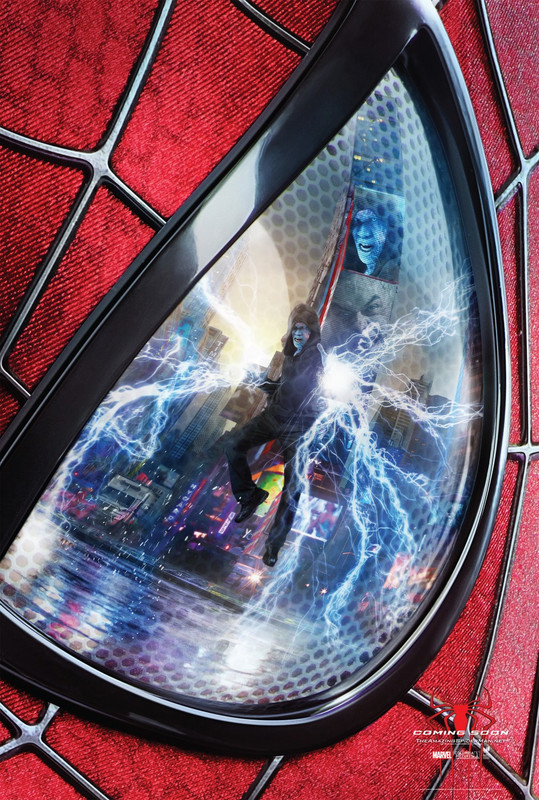
The Amazing Spider-Man 2 [2D] [12A]

Dir: Marc Webb
As a lifelong Spider-Man fan I was surprised that anyone even remotely liked Marc Webb's 2012 reboot of the franchise.  I hated it, finding it boring and, more importantly, a betrayal of almost everything that I've always loved about Spidey and his alter-ego Peter Parker.  The Amazing Spider-Man 2 is a better film than its predecessor, it almost had to be, but it's also a more frustrating film because for a few brief moments it gets Spidey as right as he's ever been on screen, but this only makes the many moments that don't work stand out even more.

The film picks up a few months after the first ends with Peter (Andrew Garfield) and his girlfriend Gwen Stacy (Emma Stone) graduating from high school (despite the fact that Garfield is quite obviously in his late twenties).  Peter seems comfortable with his dual identity as Spider-Man, but for the promise, he made to Gwen's father not to involve her and thus put her in danger.  Danger soon arrives in the forms of Max Dillon; an Oscorp worker transformed into Electro in an accident and Peter's old friend Harry Osborn (Dane DeHaan), desperate for a cure for the disease that killed his father.

Ghostly fathers hang heavy over this film.  Peter's parents were introduced in the previous film and there is more background on them here, Gwen's father died in the fight with the Lizard in the last film and now Peter is seeing him everywhere and an important shift in Harry Osborn's character is caused by his father's death.  This isn't a bad thematic idea; three central characters drawn together and set apart by the different ways in which they deal with the same trauma, but the film never really exploits the possibilities, instead using these ghosts merely as cheap dramatic motivators.  This is especially evident in the case of Gwen's father.  All that Denis Leary has to do in this film is stand around silently, basically expressionless.  This, however, may be preferable to what the film chooses to do with Peter's father (an admittedly well cast Campbell Scott).  One of the major problems with the first film was that it introduced Peter's father and suggested that he may have had a role in why Peter became Spider-Man, but never really did anything with it.  This time Webb goes in the opposite direction, slathering on exposition, along with an utterly pointless opening action scene, to make more use of Richard Parker.  The problem is that all it really adds is running time.  The film never finds the thematic weight it's clearly reaching for here, and instead this storyline only complicates the film's exposition.

Jamming in the storyline involving Peter's father means that other things go underexplored, and this is especially felt when it comes to the (too many) villains.  It's almost universally agreed that Sam Raimi's Spider-Man 3 suffered from an overabundance of villains, and so it is odd that this film should try so hard to replicate that problem.  True, Paul Giamatti's Rhino is much less of a presence than you might expect, but the uneven split of screentime between Electro and the Harry Osborn version of Green Goblin serves neither character very well and combining it with the relationship arc between Peter and Gwen and stories involving Richard Parker and an increasingly peripheral Aunt May (Sally Field) means that all the individual strands feel rushed.

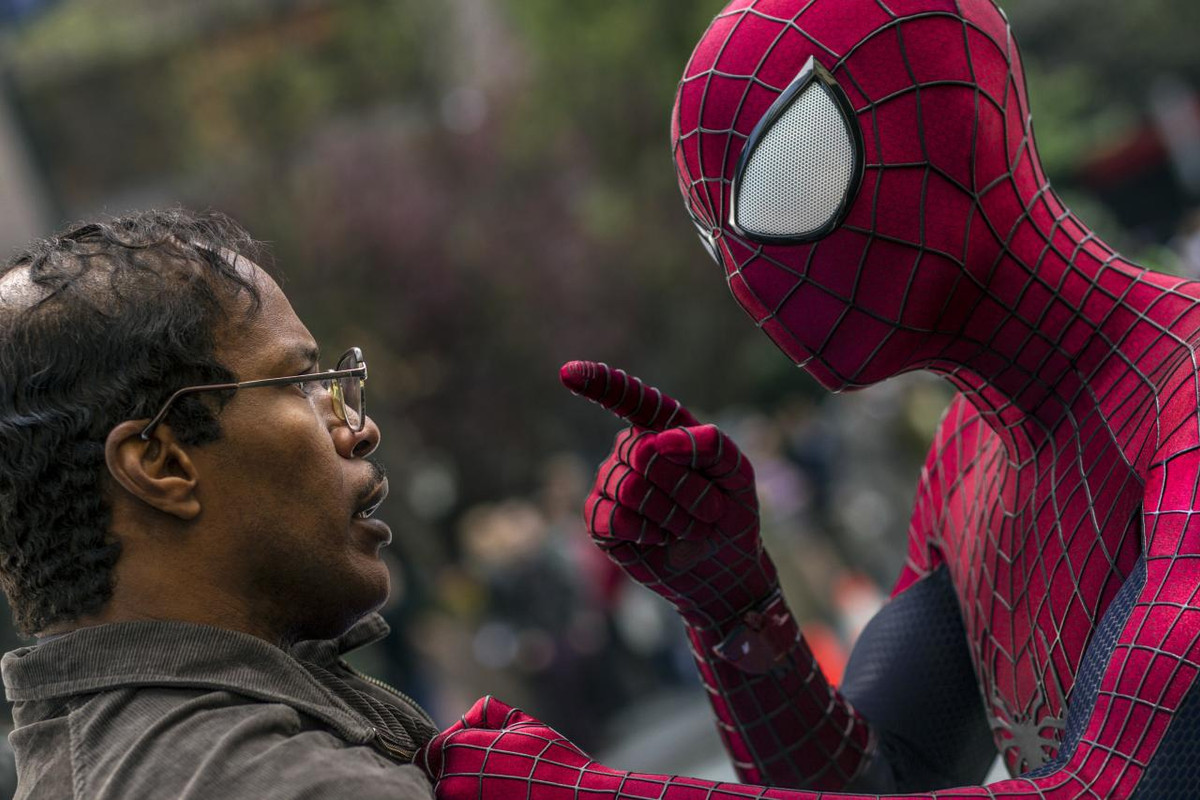
The jam packed story is one of many reasons Electro doesn't work.  Jamie Foxx always sounded like strange casting in the role and that's not something that dissipates as you watch his performance.  In the early going he seems to be channeling Jim Carrey's pre-transformation Riddler from Batman Forever as a brilliant but nerdy scientist with an obsessive love of the film's hero.  It's an odd fit for an actor who gives off as much of a cool vibe as Foxx does, and even tragically awful hair doesn't change that.  However, this is not the extent of the film's problems when it comes to Electro.  

Two issues raise their heads repeatedly.  The first is that the action scenes involving the character, for all their spectacular use of CGI, have some bizarrely awful filmmaking choices thrust upon them.  This is most notable when it comes to the sound design.  During Electro's first confrontation with Spidey, Hans Zimmer's score suddenly goes all faux dubstep, while a sample of Foxx's voice whispers away in the background.  This is clearly Dillon's broken psyche talking him up to his villainy as Electro, but combined with the score and the the flashy visuals, and especially because Foxx feels out of sorts in the role, it ends up more like the awful vocals to a dreadful music video that has somehow spliced itself into this superhero movie.  The other serious problem when it comes to Electro is this: he's a distraction.  There is a much more interesting villain developing in the form of Dane DeHaan's Harry Osborn, his motivations run deeper, his connection to Spidey is is personal and by the end of the film he's pretty formidable (even if he does look like Harry from Spider-Man 3 mated with Sloth from The Goonies), but it seems the film is unwilling to ask its audience's patience instead feeling it has to dish up action scenes at regular intervals to keep them engaged.  The Electro scenes feel as though they are simply marking time, doing little to advance the plot or the characters and this makes them boring even at their most spectacular.

One thing that has been mentioned as both a positive and a great step on from Raimi's films is the relationship between Peter and Gwen, and while I found there was more chemistry this time I still don't see the depth that people find in this relationship.  I found Gwen's character woefully underdeveloped in the previous film and little has changed here.  Her apparent scientific brilliance is a plot crutch at best and while she has a certain snarky charm there's not much personality there.  This, for me, is something I often find with Emma Stone, I suspect I'd like her if we met, she seems fun and she's certainly attractive, but all I see when I watch her on screen is Emma Stone.  Gwen Stacy was never the deepest of characters, but the actress never disappears for me and that undermines the whole relationship thread.

Much more impressive in the acting stakes is Dane DeHaan, bringing an indie cred to the role of Harry Osborn.  He's agreeably slimy from the start and while this does make you wonder why he and Peter were ever friends it largely works for the character's arc.  DeHaan is the only actor to really find and chart a great evolution in his character and he does it with such limited screentime that you can't help but wish some the side stories were shunted aside in his favour.  It will be interesting to see where he takes Harry in the future.

The worst aspect of the previous film was its depiction of Peter - to put it bluntly, he was an arsehole - but that has been fixed here.  Andrew Garfield seems more comfortable with the character this time around and the screenplay comes closer to finding the line between nerdy and charming that Peter has always walked.  While it doesn't always get him right, Amazing Spider-Man 2 does also have perhaps the two best Spider-Man scenes I've yet seen, it's unfortunate that they are at opposite ends of the film, but at least they exist.  Both times that we see Spidey squaring off against Rhino something seems to click.  The forced wisecracking of the last film (and moments of Raimi's trilogy) goes away and there he is; the sharp, sarcastic, funny, cool Spider-Man I've loved for nearly 30 years.  Unfortunately, during the long and tedious middle section of the film this Spidey only shows up intermittently; there will be a few cool lines here and there, but never a whole scene that nails it the way that these two do.  Another way in which the film comes much closer to getting Spider-Man right is with the costume.  The previous film's dark redesign always felt off for me and I was glad to see a return to a brighter and more classical look, reminiscent of John Romita Sr's art.

The other thing that works is the film's ending.  The big battle with Electro is something of an anti-climax, but one key decision that many Spidey fans were tipped off to by a certain costume choice has the potential to be a game-changer in terms of the dynamics and personal stakes of the series.  Even as it was happening I was silently saying 'don't take it back' and the moment certainly seems to have a real finality about it.  Hopefully, this will end up developing the series in interesting ways in both Sinister Six and Amazing Spider-Man 3.

Amazing Spider-Man 2 addresses some of the problems of its predecessor, but it shares many of them too.  The tone is sometimes uncertain (especially in the scenes between Peter and Aunt May), and there are, again, far too many storylines and characters, which contributes to another pressing issue: this doesn't feel like a film in its own right.  We're used to the first film in a superhero franchise being a glorified trailer to set the table for its own sequel, but that seems to be exactly what Amazing Spider-Man 2 is doing as well.  Thanks to the success of the last film and this film's presumed even bigger blockbuster status, Spider-Man is about to become a mega franchise along the lines of Marvel's Avengers films.  This isn't a terrible idea, but in practice it means that Amazing Spider-Man 2 ends up as a 140 minute trailer for its own sequels rather than a standalone film.  Everything that is interesting here (and much that isn't) is mere setup to be paid off down the line.  Only the dull Electro storyline comes to an end, and even that is questionable in its finality.  One of the most naked bits of setup is the appearance of Felicity Jones as Harry's secretary Felecia, thankless in this film but catnip for the fans for next time.  Setup is great when combined with a satisfyingly self-contained story (see Captain America: The Winter Soldier), but here the final scene only confirms the unsatisfying impression that this simply isn't a standalone film.

I wish I had liked The Amazing Spider-Man 2 more, because in it there are flashes of a movie that the 8 year old Spidey obsessive me would have loved, but ultimately too much of it is either marking time or setting up a franchise and too little of it is concerned with telling a focused and exciting story with these characters.

Sep 25, 2013

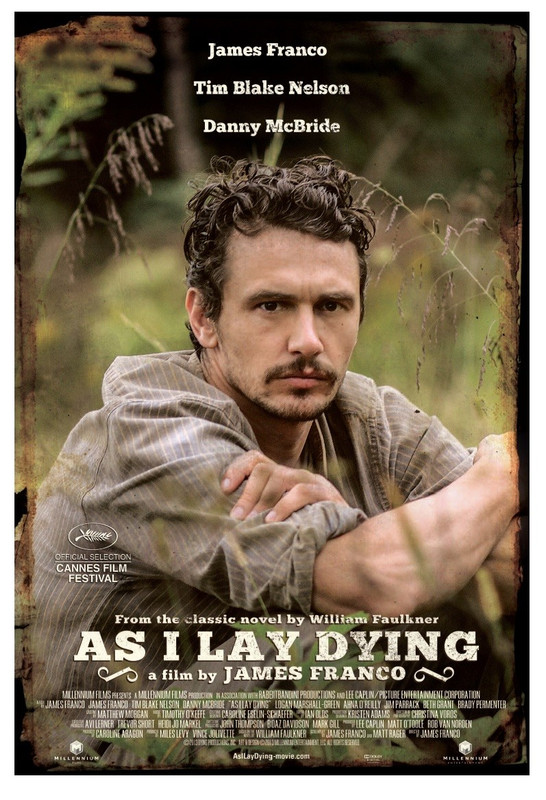
24FPS @ Lff 2013: As I Lay Dying

Dir: James Franco
Your response to As I Lay Dying will likely depend on your response to co-writer/director James Franco.  I'm mixed on him; there is clearly talent there, but he's also got a tendency to spread himself thin and allow his artsy pursuits to become very self-indulgent. For me, this tends to make his work harder to love than it is to respect.

Based on William Faulkner's novel (which, for the record, I've not read), As I Lay Dying tells a very simple story of an extremely poor family; father (an impenetrably accented Tim Blake Nelson), four sons (including Franco and Logan Marshall-Green) and sister (Ahna O’Reilly) and their journey to bury their recently deceased mother (Beth Grant).  Along the way family tensions and secrets emerge.

Perhaps because of the overwhelming simplicity of the story and the potential tendency toward melodrama, Franco opts to use a very consciously designed, elliptical, impressionistic style that constantly alerts you to the fact that you're watching a film.  Passages that apparently occur as internal monologue in the book are here rendered as fourth wall breaking pieces to camera, the one thing that could be fairly called an action sequence is drained of all sound and about half of the film is split screen.

For me, Franco's use of split screen is the perfect demonstration of the film's successes and its failures.  When the technique works – as when it juxtaposes Dewey going to procure an abortion as her brothers dig their mother's grave – it works beautifully, providing interesting ideas, and it frequently means we have two beautiful shots on screen rather than just one.  On the other hand, it can also feel like a crutch, as though Franco is using it to avoid choosing between two shots he likes, or as though we're watching two different films at once.  It's telling that as the film develops more of a plot as it goes on Franco relies on the split screen less and less, which also suggests that in the uneventful opening hour it is a bit of a crutch.

There are great things here; a beautiful, intricate and unusual score, breathtaking cinematography, a set of fine performances, especially from Marshall-Green, O'Reilly and Franco himself and a clear craftsman's hand at work.  I just wish that Franco could rein himself in a little, display his directorial sleight of hand when it will add the most to the film, rather than with the near indiscriminate frequency he does, it's this that marks the film out as a debut.

The problem with all this technique is that it is, for me, extremely distancing.  This may be by design, but I still found it extremely frustrating.  The film held me at arm's length for the first hour, but as the story and characters developed I found myself drawn into the story of this family until, every now and then, the movie would in essence shout 'you're watching a movie'.  

Some people will love As I Lay Dying and I can see why, but Franco consistently works against his own film, I wish he'd trusted it more.

Feb 21, 2013

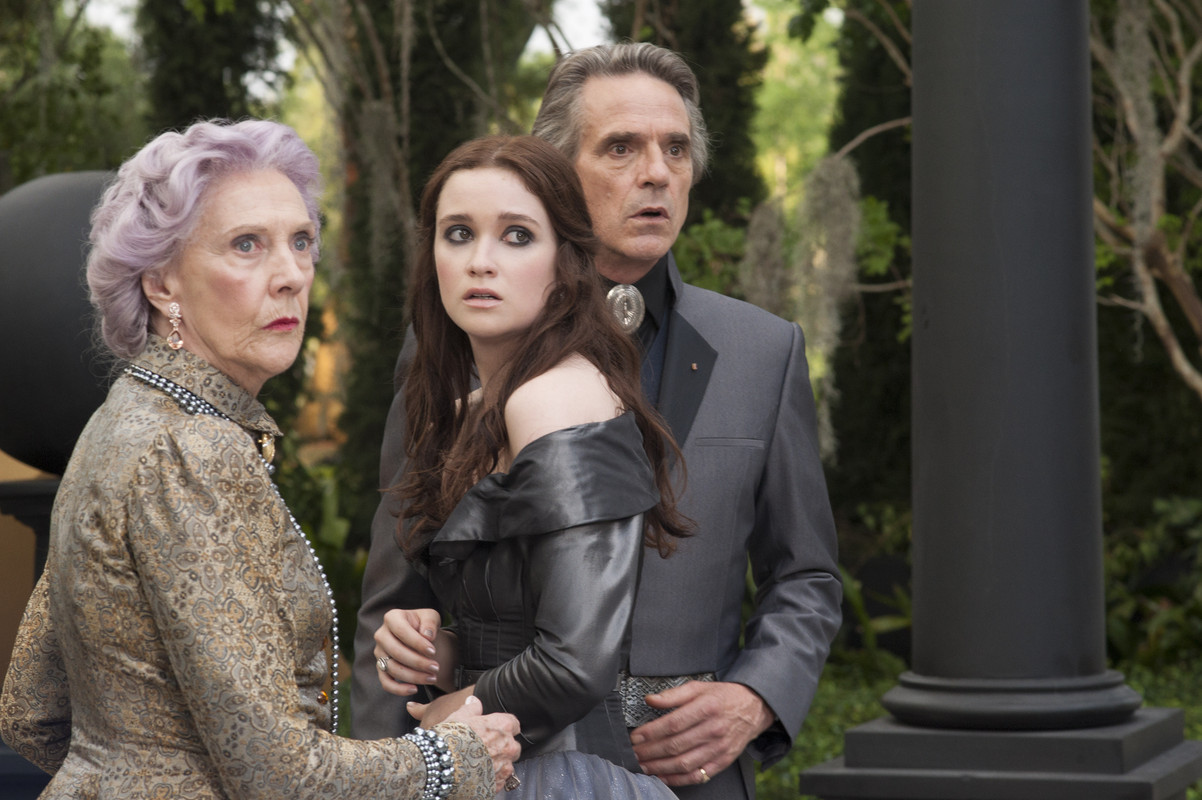
Beautiful Creatures [12A]

Dir: Richard LaGravenese
When I saw the trailer for Beautiful Creatures my heart, as it so often does during trailer reels, sank.  I thought I was done with this supernatural romance twaddle, but no sooner has Twilight finally gone away than this - which basically looked like a gender reversed version of that accursed series with a witch in place of a vampire - rears its head.  It looked like horribly acted, idiotic, cheese for fourteen year old girls.  Unfortunately, I'm a film critic and something of a cinemasochist, so off I went to check it out.

I don't often eat my words, and while I perhaps won't finish the plate in this case, there is definitely some humble pie to be consumed, because Beautiful Creatures is not Twilight, nor is it bad.

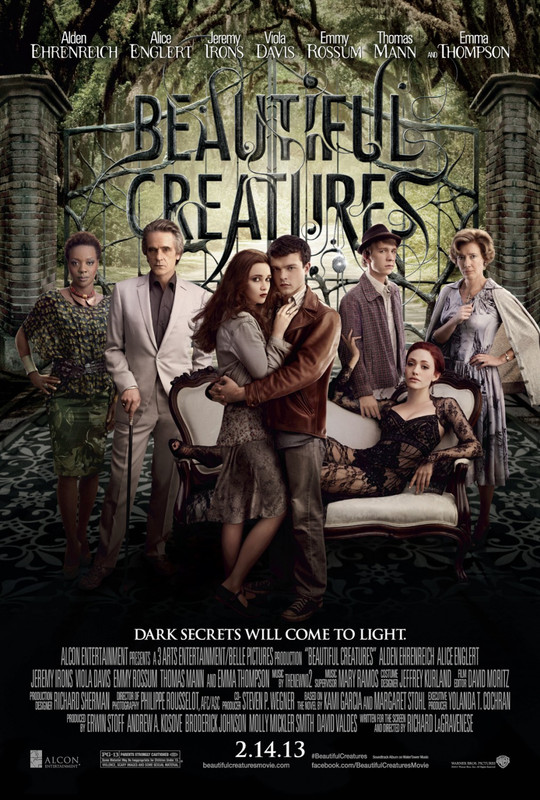
The story, from the first in a four book series by Kami Garcia and Margaret Stohl, is set in America's deep south in a conservative town that main character Ethan Wate (Alden Ehrenreich) can't wait to leave.  As Ethan starts his Junior year of high school there is a new arrival; Lena Duchannes (Alice Englert), whose extended family have owned most of the town for generations and are said to be devil worshippers.  Ethan is fascinated by Lena, largely because he thinks he's been dreaming about her, and after she initially rebuffs him the two become friends.  It soon becomes clear that while Lena's family aren't all the evildoers that people think they are, they are different; they're casters, and soon, when she turns 16, Lena will be chosen by either the light or the dark side of magic, and this makes her friendship and eventual love for Ethan dangerous for both of them.

From that summary you're probably thinking; so far, so Twilight, and you'd be right, but for me the problem with that series was not so much the tale as the telling. That's where Beautiful Creatures exceeds expectations.  There is an absurdity about the scale of some of the themes in this story; good vs evil, the possibility that love is pre-destined, the supernatural colliding with the real world, and the first smart thing that Richard LaGravenese does from both a screenwriting and a directorial point of view is to embrace that absurdity.  He never quite allows the film to slip into parody, at least when it comes to the main characters, but around the margins he plays up the camp value, avoiding the po-faced seriousness that, ironically, made the Twilight series so hard to take seriously.  

The other strength here is in the characterisation.  That's not to say that these are world's richest and most complex characters; they're drawn in pretty broad strokes and many fall into very black and white categories of good and evil, but the central pairing have a lot going for them.  First of all both Ethan and Lena are smart, they think about and talk about things beyond the depths of their feelings for each other, and that gives those feelings a little more weight.  They're also sympathetic and, while they are definitely designed for the target audience to either see themselves as or fall in love with, neither is the empty shell of a character that we've often seen in films like this.  

The solid writing is backed up with an interesting cast, all of whom do good work in hitting the tone that LaGravenese asks of them, which is a bit different for each actor.  For example Emma Thompson (as a judgmental local possessed by an evil caster) and Jeremy Irons (as Lena's uncle, who has forced himself on to the light side of magic) have a tremendous time competing to see who can slice the ham thickest.  Almost equally big, in a different way, is Emmy Rossum's vampy performance as Lena's cousin, you can almost see her smacking her lips at how deliciously evil she is.  It's not all great news; Viola Davis has a bit of a nothing role, and I suspect there's more of her on the cutting room floor.

The leads are also good.  Alden Ehrenreich manages to give us some depth to the way Ethan feels about Lena, without coming off overly earnest, so much so that a key plot point near the end, which could easily fall flat, actually hits you.  Alice Englert was somewhat overshadowed by Elle Fanning in Ginger and Rosa, but she comes into her own her with a strong performance that gives the film's theme of good and evil both trying to pull Lena in their direction some punch.  It's also nice to see, in a film primarily targeted at teenage girls, a young female lead who is intelligent and not only doesn't wait for a boy to save her, but sees it as her job to use her special abilities to save him.

All this praise isn't to say that Beautiful Creatures is perfect.  Visually it's a little by the numbers, and has more than a handful of ropey bits of CGI, and the third act does become a bit more of a by the numbers exercise, seemingly in a bit of a hurry to get to the end credits before the film breaks the two hour barrier, when it could use some more breathing space.

On the whole though, this is much better than expected, and, that being the case, it has underperformed at the box office.  That's a pity, because the point that this film ends at is one that sets up an interesting sequel, which I'd really quite like to see made.  If you are at all on the fence about this one, or want to take your kids out for a film, I'd say it's well worth a look, and that's advice I really didn't expect to be giving.

Sep 9, 2012

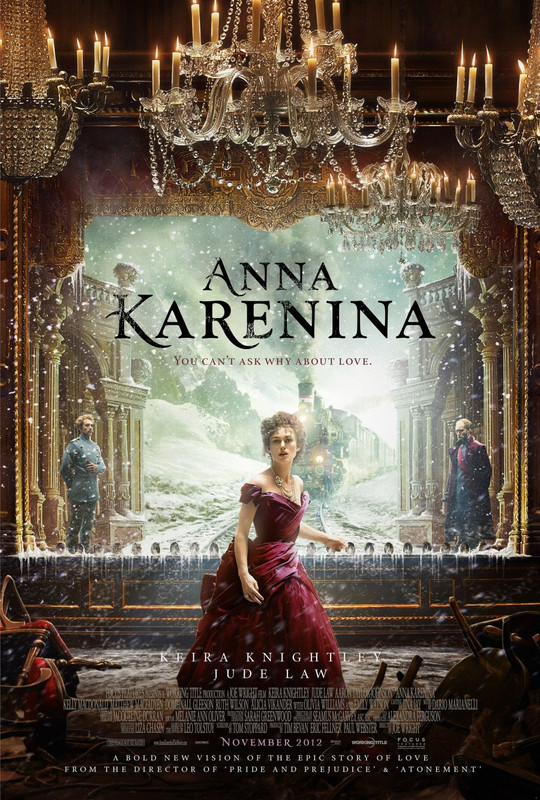
Anna Karenina [12A]

Dir: Joe Wright
Before I even begin I should admit upfront that I've not read Tolstoy's Anna Karenina, nor seen any of the other film and TV versions that have been made over the years, so I am coming to Joe Wright's telling of this story about as fresh as is possible. I'm not sure that's the ideal way to watch this radically stylised telling of what is, at its heart, a simple story, but I was surprised by how much I - for the most part - enjoyed it.

Director Joe Wright has a bit of a mixed record with me, I enjoyed his lightweight Pride and Prejudice, loved the first third of Atonement, but struggled with the rest, and found Hanna to be a very mixed bag, with some outstanding things in it.  Anna Karenina is his most ambitious work, and, despite the luminous beauty of Keira Knightley in the lead, it is Wright who is really the star of this film.

The technical quality of Wright's filmmaking has been undisputed since Atonement's ambitious D Day set piece shot, but he has truly excelled himself here.  For a while this was planned as a straightforward adaptation of the novel, with Wright scouting locations in Russia, but just a couple of months before cameras rolled the visual concept was completely changed, and it was decided that the whole film would be set inside a theatre - all the world's a stage indeed.  Obviously this has huge impact on the design and the choreography of the film.  Wright has always seemed a classical filmmaker to me, and his Karenina is right out of the 1940's.  The film I kept seeing the influence of was Powell and Pressburger's The Red Shoes, in terms of the design, the movement (characters frequently move in a way that could be called balletic, and do mid scene, on screen, costume changes) and in terms of the way Wright directs his actors.  This isn't to say that Anna Karenina isn't its own film, for all the influences it feels like Wright is doing something that is original, and frequently very impressive.

It's a dazzling looking film, and an intelligently and evocatively designed one, whether it's the moment that Levin (Domhnall Gleeson) leaves a stately home to find his brother in a slum; a journey that takes him up above the stage, among the ropes and cables, or the moment he decides to return to his farm, and a backdrop is removed from the stage to reveal a snowy meadow, I was often left amazed at how well the stylistic choices work.  It takes a while to adjust, but after twenty minutes I found myself simply accepting the setting; it seems perfectly natural that after hearing that his wife is pregnant with another man's child Alexei Karenin (Jude Law), goes and sits in a chair in a spotlight at the front of a stage, because Wright has fully established a world here; one that is heightened, of course, but still one that feels credible, if not 'real'.

That same period of adjustment is also needed for the performances, which, to varying degrees, tend towards the theatrical.  Matthew MacFadyen, for example, is an overblown riot as Anna's brother Oblonsky, and clearly the beneficiary of most of screenwriter Tom Stoppard's comic instincts, it's always great to see Oblonsky in the film, because MacFadyen's performance leavens the seriousness and potential po-faced nature of the rest of the film. 

On the other end of the scale is Jude Law, whose reserved performance as a seemingly closed off Karenin, keeping his emotional cards close to the chest and not confronting his wife even when her behaviour, frankly, would warrant it, is perhaps his best ever.  What's really great about Law's performance is that he lets us see everything that is going on beneath Karenin's controlled exterior; the anger, the hurt, all of it is written on his face, but it's never overplayed.  The supporting cast is excellent, the aforementioned Domhnall Gleeson must by now be counted among the best young actors around, and he and Alicia Vikander; the young Swedish actress recently seen in A Royal Affair, make the secondary love story between Levin and Anna's cousin Kitty rather affecting (there is a lovely scene in which they communicate with blocks with letters printed on them).  Also impressing in smaller parts are Kelly MacDonald, Olivia Williams, Holliday Grainger and Emily Watson, among many others.

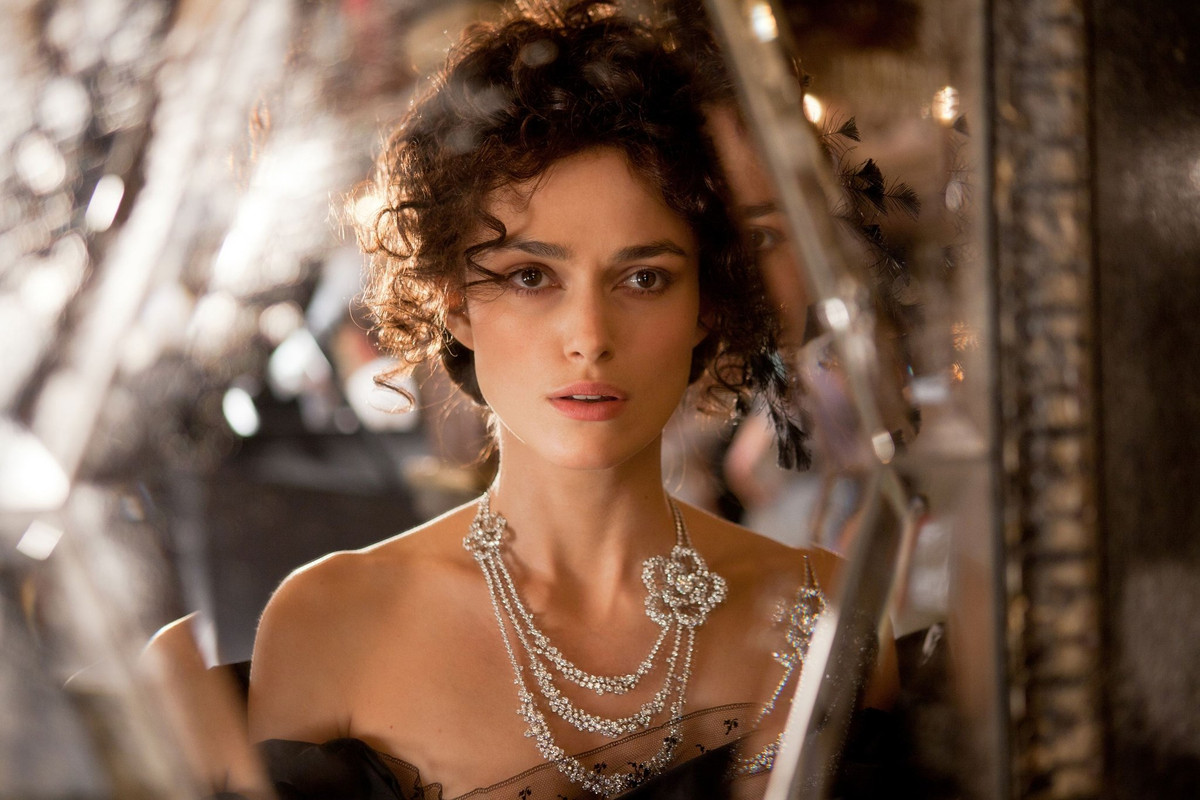
I always feel I have to make excuses for being a fan of Keira Knightley's.  Well, forget it, I'm done making excuses.  As I said, I've not read the book, but for the story being told here Knightley seems well cast.  Like Jude Law, she suggests a lot beneath the surface.  In early scenes, when she goes to a ball where Kitty is, essentially, being unveiled as a prospect for marriage proposals, we get a real sense of history; of how this was Anna ten years ago, and this plays into the relationship with Law and to her attraction to Aaron Taylor-Johnson's Vronsky.  Good as Knightley is, and she's great, emotionally matching her character's physical transformation from hemmed in society lady to wild haired romantic running off with her lover, her performance is somewhat undermined by Taylor-Johnson's.  The Kick Ass star makes for a rather pallid and charisma deficient Count, and seems to have missed the tone of the film, underplaying to the point that he doesn't allow us to believe in the operatic scale of Anna and Vronsky's need for each other, we buy it from Knightley's side, but there is a lack of that grand passion in Taylor-Johnson's performance which can't quite be repaired by either the sumptuous imagery or the good work going on around it.

That the film as a whole manages to overcome this flaw really does attest to its many other strengths.  Seamus McGarvey's cinematography is stunning, and is likely to be in contention for an Oscar (assuming the Academy has any taste), but the style is far from the only reason to get out and see this Anna Karenina.  It may not be perfect, but quality performances abound and, for the most part, it has the substance to match its style.  This is easily Joe Wright's most complete and best film to date, and I'm excited to see where he goes from here.
★★★☆☆