Showing posts with label Sequels. Show all posts

Apr 25, 2014

The Amazing Spider-Man 2 [2D] [12A]

Dir: Marc Webb
As a lifelong Spider-Man fan I was surprised that anyone even remotely liked Marc Webb's 2012 reboot of the franchise.  I hated it, finding it boring and, more importantly, a betrayal of almost everything that I've always loved about Spidey and his alter-ego Peter Parker.  The Amazing Spider-Man 2 is a better film than its predecessor, it almost had to be, but it's also a more frustrating film because for a few brief moments it gets Spidey as right as he's ever been on screen, but this only makes the many moments that don't work stand out even more.

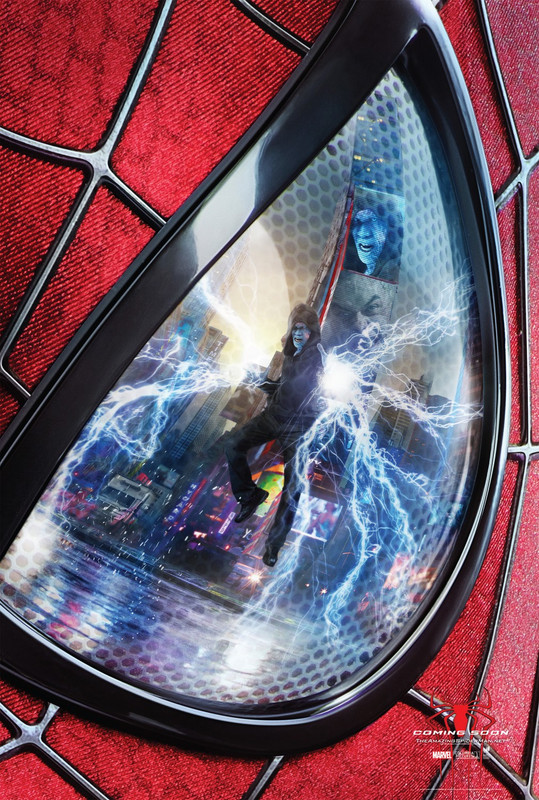
The film picks up a few months after the first ends with Peter (Andrew Garfield) and his girlfriend Gwen Stacy (Emma Stone) graduating from high school (despite the fact that Garfield is quite obviously in his late twenties).  Peter seems comfortable with his dual identity as Spider-Man, but for the promise, he made to Gwen's father not to involve her and thus put her in danger.  Danger soon arrives in the forms of Max Dillon; an Oscorp worker transformed into Electro in an accident and Peter's old friend Harry Osborn (Dane DeHaan), desperate for a cure for the disease that killed his father.

Ghostly fathers hang heavy over this film.  Peter's parents were introduced in the previous film and there is more background on them here, Gwen's father died in the fight with the Lizard in the last film and now Peter is seeing him everywhere and an important shift in Harry Osborn's character is caused by his father's death.  This isn't a bad thematic idea; three central characters drawn together and set apart by the different ways in which they deal with the same trauma, but the film never really exploits the possibilities, instead using these ghosts merely as cheap dramatic motivators.  This is especially evident in the case of Gwen's father.  All that Denis Leary has to do in this film is stand around silently, basically expressionless.  This, however, may be preferable to what the film chooses to do with Peter's father (an admittedly well cast Campbell Scott).  One of the major problems with the first film was that it introduced Peter's father and suggested that he may have had a role in why Peter became Spider-Man, but never really did anything with it.  This time Webb goes in the opposite direction, slathering on exposition, along with an utterly pointless opening action scene, to make more use of Richard Parker.  The problem is that all it really adds is running time.  The film never finds the thematic weight it's clearly reaching for here, and instead this storyline only complicates the film's exposition.

Jamming in the storyline involving Peter's father means that other things go underexplored, and this is especially felt when it comes to the (too many) villains.  It's almost universally agreed that Sam Raimi's Spider-Man 3 suffered from an overabundance of villains, and so it is odd that this film should try so hard to replicate that problem.  True, Paul Giamatti's Rhino is much less of a presence than you might expect, but the uneven split of screentime between Electro and the Harry Osborn version of Green Goblin serves neither character very well and combining it with the relationship arc between Peter and Gwen and stories involving Richard Parker and an increasingly peripheral Aunt May (Sally Field) means that all the individual strands feel rushed.

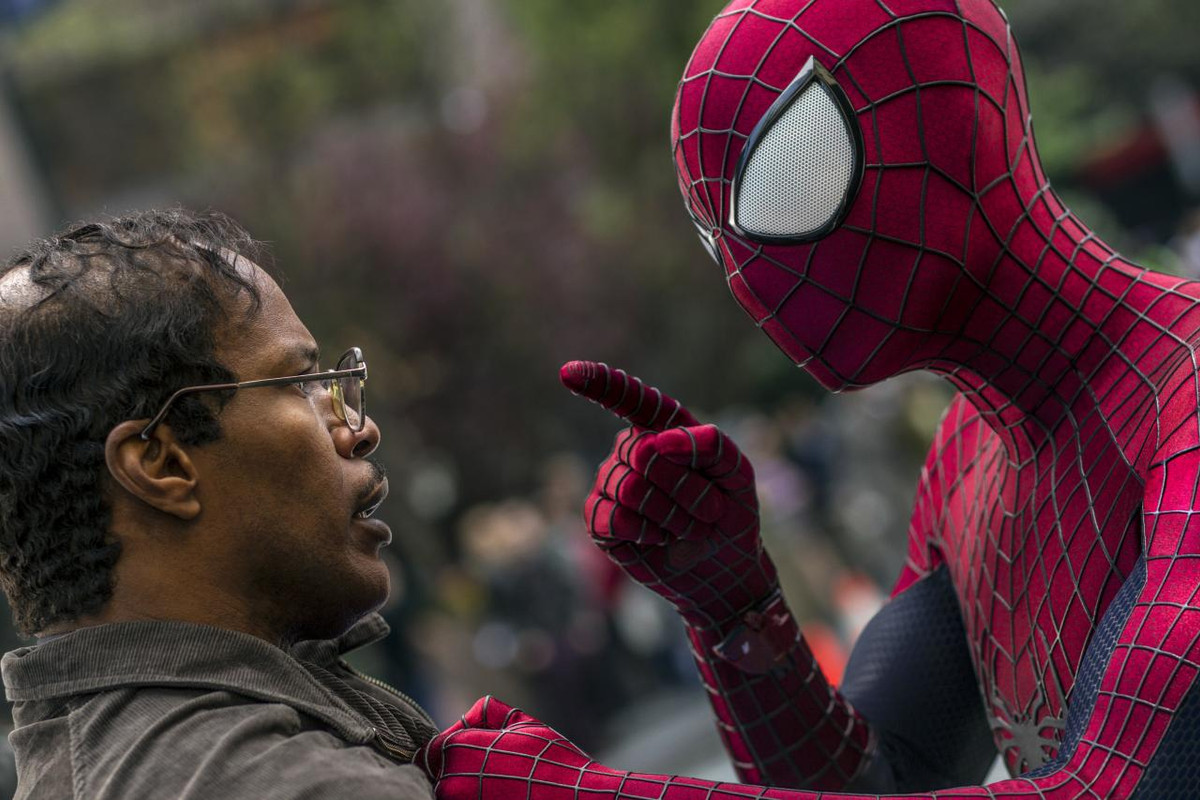
The jam packed story is one of many reasons Electro doesn't work.  Jamie Foxx always sounded like strange casting in the role and that's not something that dissipates as you watch his performance.  In the early going he seems to be channeling Jim Carrey's pre-transformation Riddler from Batman Forever as a brilliant but nerdy scientist with an obsessive love of the film's hero.  It's an odd fit for an actor who gives off as much of a cool vibe as Foxx does, and even tragically awful hair doesn't change that.  However, this is not the extent of the film's problems when it comes to Electro.  

Two issues raise their heads repeatedly.  The first is that the action scenes involving the character, for all their spectacular use of CGI, have some bizarrely awful filmmaking choices thrust upon them.  This is most notable when it comes to the sound design.  During Electro's first confrontation with Spidey, Hans Zimmer's score suddenly goes all faux dubstep, while a sample of Foxx's voice whispers away in the background.  This is clearly Dillon's broken psyche talking him up to his villainy as Electro, but combined with the score and the the flashy visuals, and especially because Foxx feels out of sorts in the role, it ends up more like the awful vocals to a dreadful music video that has somehow spliced itself into this superhero movie.  The other serious problem when it comes to Electro is this: he's a distraction.  There is a much more interesting villain developing in the form of Dane DeHaan's Harry Osborn, his motivations run deeper, his connection to Spidey is is personal and by the end of the film he's pretty formidable (even if he does look like Harry from Spider-Man 3 mated with Sloth from The Goonies), but it seems the film is unwilling to ask its audience's patience instead feeling it has to dish up action scenes at regular intervals to keep them engaged.  The Electro scenes feel as though they are simply marking time, doing little to advance the plot or the characters and this makes them boring even at their most spectacular.

One thing that has been mentioned as both a positive and a great step on from Raimi's films is the relationship between Peter and Gwen, and while I found there was more chemistry this time I still don't see the depth that people find in this relationship.  I found Gwen's character woefully underdeveloped in the previous film and little has changed here.  Her apparent scientific brilliance is a plot crutch at best and while she has a certain snarky charm there's not much personality there.  This, for me, is something I often find with Emma Stone, I suspect I'd like her if we met, she seems fun and she's certainly attractive, but all I see when I watch her on screen is Emma Stone.  Gwen Stacy was never the deepest of characters, but the actress never disappears for me and that undermines the whole relationship thread.
Much more impressive in the acting stakes is Dane DeHaan, bringing an indie cred to the role of Harry Osborn.  He's agreeably slimy from the start and while this does make you wonder why he and Peter were ever friends it largely works for the character's arc.  DeHaan is the only actor to really find and chart a great evolution in his character and he does it with such limited screentime that you can't help but wish some the side stories were shunted aside in his favour.  It will be interesting to see where he takes Harry in the future.

The worst aspect of the previous film was its depiction of Peter - to put it bluntly, he was an arsehole - but that has been fixed here.  Andrew Garfield seems more comfortable with the character this time around and the screenplay comes closer to finding the line between nerdy and charming that Peter has always walked.  While it doesn't always get him right, Amazing Spider-Man 2 does also have perhaps the two best Spider-Man scenes I've yet seen, it's unfortunate that they are at opposite ends of the film, but at least they exist.  Both times that we see Spidey squaring off against Rhino something seems to click.  The forced wisecracking of the last film (and moments of Raimi's trilogy) goes away and there he is; the sharp, sarcastic, funny, cool Spider-Man I've loved for nearly 30 years.  Unfortunately, during the long and tedious middle section of the film this Spidey only shows up intermittently; there will be a few cool lines here and there, but never a whole scene that nails it the way that these two do.  Another way in which the film comes much closer to getting Spider-Man right is with the costume.  The previous film's dark redesign always felt off for me and I was glad to see a return to a brighter and more classical look, reminiscent of John Romita Sr's art.

The other thing that works is the film's ending.  The big battle with Electro is something of an anti-climax, but one key decision that many Spidey fans were tipped off to by a certain costume choice has the potential to be a game-changer in terms of the dynamics and personal stakes of the series.  Even as it was happening I was silently saying 'don't take it back' and the moment certainly seems to have a real finality about it.  Hopefully, this will end up developing the series in interesting ways in both Sinister Six and Amazing Spider-Man 3.

Amazing Spider-Man 2 addresses some of the problems of its predecessor, but it shares many of them too.  The tone is sometimes uncertain (especially in the scenes between Peter and Aunt May), and there are, again, far too many storylines and characters, which contributes to another pressing issue: this doesn't feel like a film in its own right.  We're used to the first film in a superhero franchise being a glorified trailer to set the table for its own sequel, but that seems to be exactly what Amazing Spider-Man 2 is doing as well.  Thanks to the success of the last film and this film's presumed even bigger blockbuster status, Spider-Man is about to become a mega franchise along the lines of Marvel's Avengers films.  This isn't a terrible idea, but in practice it means that Amazing Spider-Man 2 ends up as a 140 minute trailer for its own sequels rather than a standalone film.  Everything that is interesting here (and much that isn't) is mere setup to be paid off down the line.  Only the dull Electro storyline comes to an end, and even that is questionable in its finality.  One of the most naked bits of setup is the appearance of Felicity Jones as Harry's secretary Felecia, thankless in this film but catnip for the fans for next time.  Setup is great when combined with a satisfyingly self-contained story (see Captain America: The Winter Soldier), but here the final scene only confirms the unsatisfying impression that this simply isn't a standalone film.

I wish I had liked The Amazing Spider-Man 2 more, because in it there are flashes of a movie that the 8 year old Spidey obsessive me would have loved, but ultimately too much of it is either marking time or setting up a franchise and too little of it is concerned with telling a focused and exciting story with these characters.
★★

Mar 15, 2014

300: Rise Of An Empire [15]

Dir: Noam Murro
I had no intention of seeing 300: Rise of an Empire.  I saw Zack Snyder's film at the cinema and found it rather dull and over-stylised, with little to recommend it unless you thought the visuals were cool (which I didn't, at least not notably).  The thing is, Eva Green is in it, and Eva Green has a history of making rubbish things tolerable (Dark Shadows, anyone?).  So, persuaded by promises that she was very cool in her part here, I found myself sitting down.

300: Rise Of An Empire isn't a typical sequel, it takes place before, around, on top of and after the events of the previous film (though original star Gerard Butler appears only briefly, in footage culled from Snyder's film).  This time the focus is on Themistocles (Sullivan Stapleton); an Athenian general who wants to unite the city states of Greece as a single free nation, but first must repel a Persian attack, led by ferocious naval commander Artemesia (Green).  Story wise, it's extremely basic, with the key difference from 300 being that the bulk of the fighting takes place on the water rather than hand to hand.  Otherwise, it's largely the familiar formula; men in their pants and (sometimes) capes chopping each other into pieces with swords, only this time in commercially mandated 3D.

Though it also has issues when it comes to storytelling and acting, 300: ROAE is, for me, nearly crippled by its visuals.  I was expecting the look to be very similar to that of Zack Snyder's film (and almost the antithesis of the look of director Noam Murro's last film; middling dramedy Smart People) and it is, or would be, but for the 3D.  We've long known that 3D means that there is a considerable loss of brightness in the projected image, but I haven't seen the darkening effect of the process pose such problems as it does here in a long time.  While the 3D is rather better utilised, the level of darkening reminded me of 2010's abysmal Clash of the Titans, famously hurriedly and poorly converted.  This comes as less of a surprise when you know that this film is also a conversion job, but in this day and age, it should not look this bad.  For the few scenes in which it is reasonably bright when seen without glasses, the 3D renders 300: ROAE washed out.  Every scene that is intended to have some brightness seems overcast and grey.  This is a particular problem for a film that is set predominantly outside because I was never able to tell what time of day it was supposed to be.

As bad as the 'brighter' scenes look, most of the film is clearly designed to be dark, and this is especially true of the many battle scenes.  The sea battles look absolutely appalling, drained of all light it's sometimes like trying to watch shadow puppetry against a black background.  It's even more annoying because, peering through the murk, there does seem to be some pretty cool fighting to watch here and the action sequences here do seem more varied than those I recall from the first film.  At its most basic the aspiration of 3D cinema is surely to allow you to see and experience more in a film.  In this and many other cases, the process accomplishes the exact opposite.

Noam Murro's direction is otherwise only really notable by how anonymous it seems.  The film is totally in thrall to the visual template set down by Frank Miller and Zack Snyder.  Murro seems about as much a director here as I am a carpenter when I build an Ikea shelving unit.  But, like an Ikea shelving unit when the instructions have been followed, the end product stands up and does its job. The cast aren't too bad for the most part, given how basic the material is.  Sullivan Stapleton yells his stirring pre and post battle speeches with some degree of force, and Hans Matheson is okay as his second in command.  The rest of the characters are largely identikit half dressed men, essentially there to be inventively sliced to bits.  Reprising his role as Xerxes from the original, Rodrigo Santoro is physically imposing, but sadly has little to do.  

300: Rise Of An Empire is a film largely about and apparently largely for men.  It's surprising then that its two female characters completely steal the show.  First, there is Lena Heady, reprising her role as Queen Gorgo and narrating the film.  Heady has a great voice and makes the exposition more engaging than it deserves to be, but more than that I've always liked her as a screen presence.  Even when she's standing still, Heady has force about her, and that pays dividends here; Gorgo is believably tough, very much the female equivalent of Gerard Butler's character and when, at the very end of the film, she gets into the action I found myself ready to watch another half hour of her slicing and dicing Persians, for I am a man of simple pleasures.

Good as Heady is, her role is limited and she and the rest of the cast are simply blown off the screen by the sheer force of charisma that is Eva Green.  Green is arrestingly beautiful but more than that she just has something that draws you to her; she's a proper movie star.  She also, as she did with Dark Shadows, completely gets the tone of what she's doing here.  'I'm in a 300 movie', she seems to calculate, 'there's no such thing as too much'.  In Green's hands, Artemisia becomes the most gleefully nasty villain I've seen for some time.  In a film full of men she's the one with the biggest balls, and it's fun to watch her malevolently calculate her every move, scything her way through men as she does so.  The film improves immensely whenever she is on screen and when she departs it seems to tread water until her next appearance.  Green also provides the film with a scene and a few images that belong in the pantheon of cool exploitation cinema moments.  None more so than when, topless and immediately post-sex, she threatens Themistocles with her sword.  300: Rise Of An Empire is, at the most fundamental level, risible nonsense, but all by herself Eva Green makes it worth watching and, for much of the running time, immense fun.  Someone has to give her her own action franchise.  Now.

I didn't expect to enjoy 300: Rise Of An Empire at all, but I surprised myself.  It's no masterpiece, even on its own terms, and the fact I enjoyed it at all is largely down to Eva Green and Lena Heady.  I suspect it will improve on Blu Ray, when the fog of 3D will lift and more of the action will be visible and, to my surprise, I'll likely pick up the disc to find out if that's the case.
★★★

Mar 12, 2014

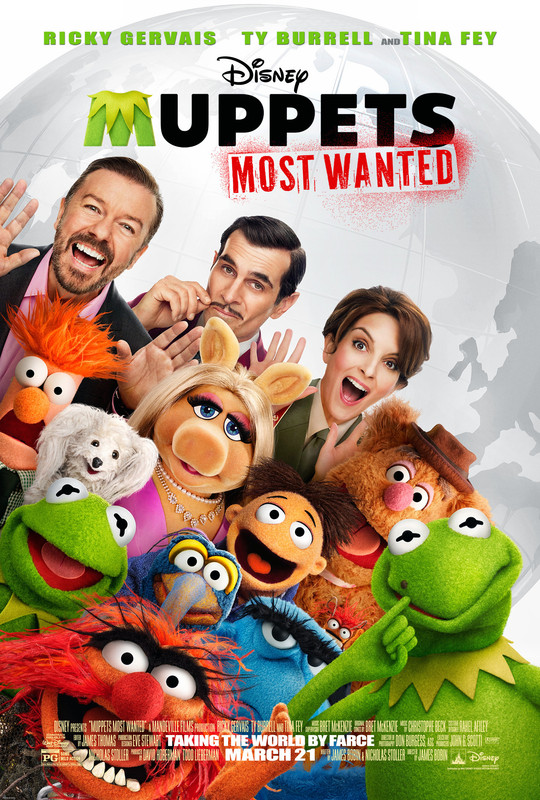
Muppets Most Wanted [U]

Dir: James Bobin
Sequels are a strange sort of contract between a filmmaker and an audience.  One party promises to deliver something like what the other party previously enjoyed, but without making it so similar that the audience feels that they have been short changed.  On the face of it, Muppets Most Wanted delivers to the letter on this contract, but the ways in which it departs from 2012's wonderful The Muppets are likely to be disappointing, especially for an adult audience.

The Muppets often take on familiar film structures and give them their own distinctive spin, last time it was the old canard of getting the band back together/putting on a show, this time it's the caper movie. The film revolves around a case of mistaken identity; when 'the world's most dangerous frog', Constantine, escapes from a Siberian gulag his uncanny resemblance to Kermit allows him to take Kermit's place at the head of The Muppet Show, using it as a front for a series of heists, while Kermit is recaptured by Nadia (Tina Fey) and thrown into the gulag.

The film resumes directly after the final shot of The Muppets (complete with obvious body doubles for Jason Segel and Amy Adams), segueing into a song about the idea of doing a sequel.  This is one of the film's best numbers, suggesting some amusing ideas including one priceless spoof that is the best gag in the whole film.  Soon after, the gang are won over by Dominic Badguy (groan), played by Ricky Gervais (GROAN), who offers to promote their tour and we're off on the caper.

The great thing about The Muppets was that it set the emotional stakes high.  Remember that scene where we find Fozzie in his Las Vegas 'dressing room', or Pictures In My Head?  Those moments, along with many others, were funny, but they combined the laughs with a deep emotional resonance that connected with the audience's relationship to these characters, who many of them have been watching all their lives.  This depth is absent from Muppets Most Wanted.  A few scenes about Miss Piggy's desire to marry Kermit attempt to find something like this level of connection, but with Kermit off in his own story it just doesn't stick.

Alongside its pathos and emotion, The Muppets was bust a gut funny, and that's another area in which Muppets Most Wanted simply doesn't bear up to its predecessor.  There are some funny moments, but the film leans too heavily on cameos, many of which clunk, and for the most part is only mildly funny.  Ricky Gervais is more tolerable than usual as Dominic, but there's still a sense of smugness about him, and I simply don't find him amusing (though the fact that his funniest line comes when he's introduced is unhelpful).  Tina Fey works hard and has a solid enough comedy Russian accent.  She seems to be dubbed for her big song, which is fine, but seems a missed opportunity for some good jokes.  Fey gets much of the funniest stuff in the film as an outwardly cruel gulag boss, mining laughs from the affection she sometimes has for the prisoners (all played by cameoing stars, including one who gets a very funny namecheck).

The gulag scenes are easily the film's best, not least because they reunite us with Kermit, whose almost total absence from the main storyline just feels strange and makes this feel much less of a Muppet movie.  This side of the film also provides it with a little of the 'let's put on a show' stuff that the Muppets do best.  The caper movie falls down for the simple reason that it just isn't that much fun.  Ty Burrell does his best Jean Dujardin as an Interpol cop paired with Sam Eagle's CIA agent (their joke about badges goes on far too long), but Gervais and Constantine make for anemic villains and the jokes just aren't that inventive.  At two hours or so the movie drags, with the so-so songs (I couldn't hum you any of them bar 'We're Doing A Sequel') and  sometimes flat gags making it wheeze its way to the finish line.  It's perhaps more kid oriented than the previous film, but it's not as if the adult skew of some of the jokes and the emotion of The Muppets (or Frozen, for that matter) left the kids in the audiences I saw it with behind.  By contrast, Muppets Most Wanted often felt like it was leaving the adult audience behind, whether on purpose or by accident.

Ultimately the biggest issue with Muppets Most Wanted is that as I sit here and write this I find myself thinking back on gags and songs and moments not from it but from The Muppets.  That film has lasted in my memory, this one vanished within moments of the credits rolling.
★★

Jan 9, 2014

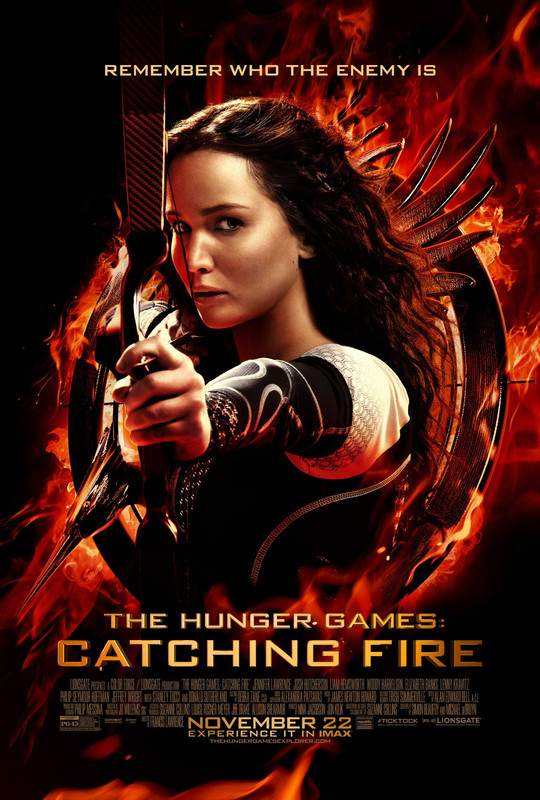
The Hunger Games: Catching Fire [12A]

Dir: Francis Lawrence
When I walked in to see the first Hunger Games film in 2012 I had little idea what to expect.  What I found was a tonally unbalanced mess; Battle Royale via Twilight with a side order of dictatorial dystopia, styled by Monty Python on acid.  In short, I didn't like it.  I wasn't planning to see this second installment in the series (which, no doubt inspired by Harry Potter and Twilight, is splitting the adaptation of its third and final source novel into two films), but I was at a loose end, it was still showing, and every review I'd seen of the film had deemed it better than the original.

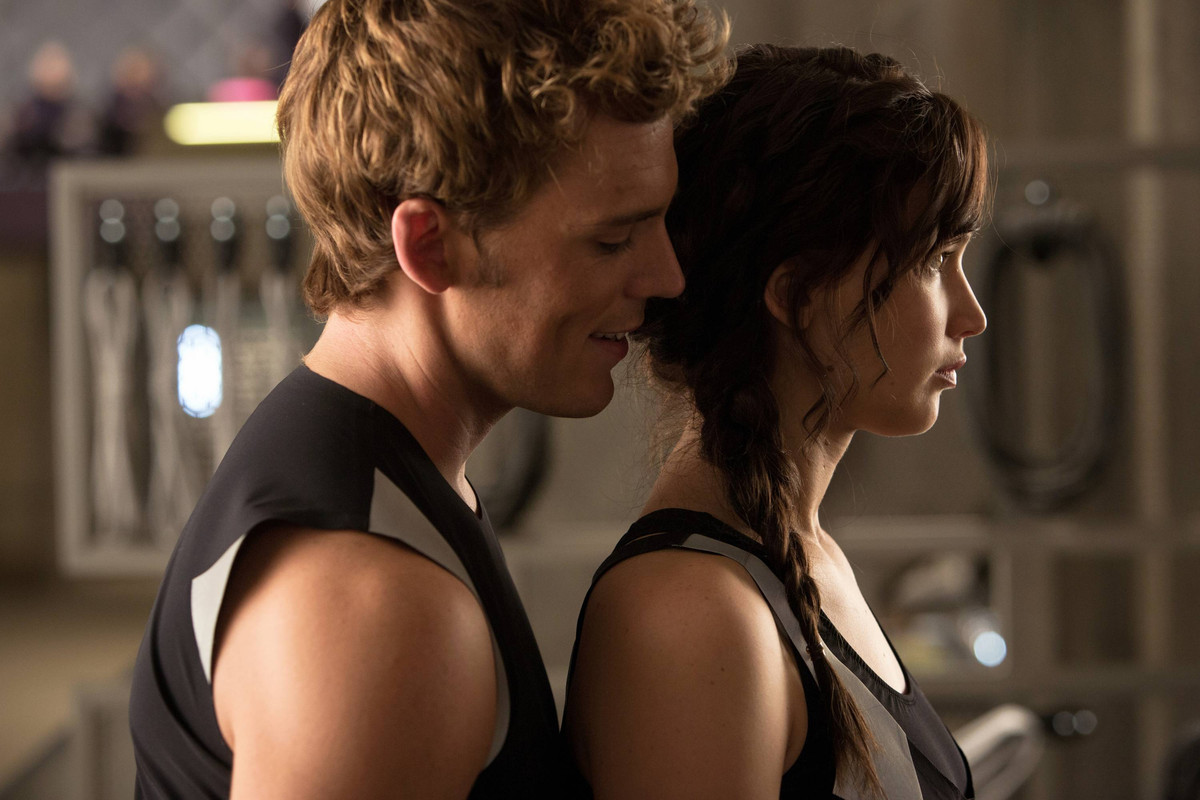
Catching Fire picks up the story of Katniss (Jennifer Lawrence) and Peeta (Josh Hutcherson) a few weeks after their victory in the 74th Hunger Games.  As is traditional they are being sent on a winner's tour of the 12 districts of Pan-Em as a propaganda tool for the Capitol and President Snow (Donald Sutherland).  The way that Katniss and Peeta subverted the intention of the games has led to incipient rebellion in some districts and to quell this rebellion new gamemaker Plutarch Heavensbee (Philip Seymour Hoffman) suggests that the 75th Hunger Games set former winners against each other, leading to Katniss and Peeta being back in the fray.  Alongside this, Katniss and Peeta must pretend to be in a relationship, while she is still in love with Gale (Liam Hemsworth).

As you can probably tell from the above paragraph, there is a lot to get through in Catching Fire, unfortunately the film (and I should stress at this point that I've not read the book) shunts many of its most interesting ideas off to the side and ends up dwelling, for much of its running time, on the preparation for and events of the games themselves.  The stakes have risen, but much of the film feels like a rerun of what was already overlong and reasonably dull in the first film.  It also, joy of joys, gives us ample opportunity to revisit Stanley Tucci's supremely annoying performance and catastrophic hairstyle.  

The disappointment is that, to my surprise, the film is pretty effective in its first 40 minutes or so, before we get back to the drudgery of the games.  The dystopia in which the series is set was presented largely through the games in the first film, but here we see a little more of the districts and peek further behind the machinations of the Capitol.  The way that Katniss and Peeta are being used, the implied threats to them and their families and the glimpses of the crackdown the Capitol is enforcing on even the smallest acts of rebellion manage to give this film a much more serious and darker tone, at least until Elizabeth Banks waltzes on as Effie to remind us how ludicrous the rest of the film looks and undermine the seriousness that is otherwise being established.

Assisting the film in grounding its first act are solid performances from Jennifer Lawrence and Josh Hutcherson.  Both are especially good in the scenes in which they have to pretend to be in love, playing the different ways their characters are hurt by this.  Sadly this is another area in which the film manages to undermine itself, robbing Katniss' side of the love triangle of much of its power by still neglecting to develop its third point, Liam Hemsworth's Gale, as a character.  However, Lawrence and Hutcherson play well off each other and their relationship gives the film much of its drive.

Also contributing solid work are some of the other 'tributes' that Katniss and Peeta must face during the games.  Most memorable are Jeffery Wright, as a tribute who uses his scientific knowledge to survive and Jena Malone, who steals several scenes, notably her first, as the ballsy, bitchy Johanna Mason.  Of course, there are bum notes hit in the performances; Sam Claflin remains as bland a presence as ever, Woody Harrelson sticks to drunk performance 101 and the less said about Stanley Tucci and Elizabeth Banks' irritating camp the better.

Once the film segues into the games and what surrounds them it largely loses its way.  It's tough to talk about why this is, because where I would like the focus to be is on the build up to the film's big twist, to see how that is being worked behind the scenes, given the Police state it's happening in, with the games in the background as motivating, rather than driving, force.  This might also, to some degree, get around the problem with the twist, which is that when you sit back and consider all the variables that have to work at the exact right moments for it to be viable you realise how absurd it is, and the story collapses like a house of cards.

Stepping away from the games might also have allowed more time to give Gale some weight as a character and make the love triangle more engaging, it might have allowed us to get further into what's happening in the districts and how President Snow's plan to change the perception of Katniss is working.  In short, it would allow some real world building, which the first act begins to do, but never gets far enough with, rather than a rehash of something we've already seen.

Francis Lawrence (who made the reasonable Constantine and the rubbish I Am Legend) is better suited to this material than the first film's director Gary Ross.  The best instinct Lawrence has is immediately evident, while the first film was a shakycammed mess this one has a much steadier visual style, which leads me to suspect that the moments the action degenerates into nonsense are a result of rating concerns rather than poor filmmaking per-se.  Unfortunately for the film Lawrence does engage in one of the most irritating traits of big budget filmmaking right now; the teal and orange (in this case mostly teal) look.  Barring some of the scenes in the Capitol and the greens that the jungle setting for the games introduces, almost every frame of this film is dominated by a steel blue tint and highlighted with bright yellow or orange.  In some scenes characters are watching footage from elsewhere in Pan-Em, so you'll have teal and orange within teal and orange.  It is incredibly boring to look at.

The Hunger Games left me with little hope for its sequel and while this is a better film, and promises better things for the next two installments, it is a film beset with problems that have easy remedies.  It's a frustrating watch because somewhere here there's an interesting, thrilling, intelligent film, but only hints of it have made it to the screen.
★★

Nov 3, 2013

Cloudy With a Chance of Meatballs 2 [3D] [U]

Dir: Cody Cameron, Chris Pearn
I enjoy titles.  I enjoy coming up with them and I love to see a well crafted title, indeed that alone can be enough to get me into a cinema or interested in hearing an album.  Cloudy With A Chance Of Meatballs is not a title that I was immediately sold on; it's unwieldy and unappetising in several ways, but I ended up seeing it when I heard it described by Mark Kermode as 'David Lynch for kids'.  I found it not quite what I expected - more Lynch crossbred with Looney Tunes - but still an hilariously funny and highly inventive movie.  I didn't, however, leave thinking 'that needs a sequel', but it made lots of money and so here we are.

Cloudy 2 opens moments after the first film ends, with Flint (Bill Hader) and his friends planning to start a lab together.  However, Flint's childhood hero, Chester V (Will Forte) shows up and offers him a job working at his suspiciously Apple-like company LiveCorp, who are taking care of the cleanup of Swallow Falls.  Flint takes the job, but is soon manipulated by Chester into going back to Swallow Falls - now overrun by living, sentient, foodimals - to find the FLSMDFR.

Cloudy With A Chance of Meatballs 2 never really stood a chance.  The first film was incredibly refreshing; an anarchic, witty, surreal thing of the kind we don't often see, it's the kind of thing that, one suspects, can't be repeated.  This proves to be the case right from the off.  The first film established its anarchic tone with a banana falling from the sky and knocking the Columbia lady from her pedestal and with the title card 'A Film By A Lot Of People'.  Cloudy 2 replicates these moments, this time with a banana foodimal and 'Another Film By A Lot Of People', but they feel like empty echoes, desperate attempts to recapture what was fresh in the first film.  And so the tone is set.

There are only two new elements to the film: Flint's hero worship of Chester V (who, oddly, was never mentioned in the first film, it's almost as if he's an afterthought) and the Foodimals.  Neither really works.  Chester V's ultimate role in proceedings is obvious from the off, and the weird motion of the character (an odd fluid movement through his spindly limbs) is as offputting as the voice Will Forte gives him.  He's neither funny nor threatening and the broadsided satire of Apple feels pretty empty.  The foodimals fare even worse, because ultimately all they are - and all a great deal of the film is - are a collection of food puns.  Some are mildly amusing, but even these become wearing because there are just so very many of them.

The existing characters fail to develop beyond where they were at the end of the first film.  A forced conflict puts a wedge between Flint and his friends, but the dynamic between the characters falls flat throughout.  This is, sadly, especially true of Flint and his weather forecaster girlfriend Sam Sparks (Anna Faris).  There was a nice progression of their relationship in the first film, and a connection that made the characters a great fit together.  All of that spark has gone this time, even before that issue becomes a plot point.

The animation is solid enough and there are some scattered laughs (thanks largely to Steve the Monkey), but overall Cloudy 2 is a listless and uninspired sequel to one of the most entertaining kids movies of the last few years.
★★

Nov 2, 2013

Thor: The Dark World [12A]

Dir: Alan Taylor
Generally speaking, I've enjoyed the films based on Marvel comics much more than those based on DC properties.  They've had their misses (notably the awful Fantastic Four films and the horrendous recent Spider-Man reboot), but generally they've managed to be well cast, exciting and plenty of fun, especially those films that built up to Avengers Assemble last year.  Of the Marvel's Phase 1 films, Thor wasn't the worst, but it was for me the one that felt most perfunctory and where the tone and characters felt most awkward, though it did give us a fine villain in Tom Hiddleston's Loki.  

Taking place a few months after Avengers Assemble, The Dark World sees Asgard and the rest of the nine realms threatened by a dark elf named Malekith (Christopher Eccleston) who is after an ultimate power, long thought lost, known as the aether.  Of course Thor's (Chris Hemsworth) physicist girlfriend Jane Foster (Natalie Portman) gets wrapped up in events and to save both her and the nine realms Thor must choose to trust his brother Loki.

For me the biggest problem with Kenneth Branagh's franchise opener was the fact that it felt like two different films jostling for position.  There was a reasonably dark drama, with unmistakable Shakespearean overtones; two superpowered brothers vying for a throne and their Father's approval.  Then there was a goofy fish out of water romantic comedy.  Everyone worked hard, but for me the film never squared the circle and in this respect The Dark World represents a step backwards.  In the first film the main villain did at least feel like a threat, a personal one at that, and the motives behind his plans had weight.  Here the villain of the piece is an underdeveloped bore, a clearly slumming Eccleston evincing all the enthusiasm of a man making a mortgage payment, and even when his plans involve Jane there is no real sense of weight or threat about them.

If the threat falls flat this time then so, as it did before, does much of the fish out of water stuff.  I'm not the greatest fan of Natalie Portman, but she's completely wasted on the pathetically thin role of Jane Foster.  I know Portman is, in real life, extremely intelligent and accomplished, but whether it's the writing or the performance the idea that Jane is a brilliant physicist is only slightly more credible than Denise Richards being a nuclear physicist in The World Is Not Enough.  For the most part Jane seems to exist to provide exposition and be in a laughably underdeveloped romance with Thor.  The problem is that she hardly has a personality.  Outside of these two things - is a scientist, fancies Thor - I would struggle to tell you one thing about the character even after two movies.

The earthbound part of the film falls completely flat, not just because Jane is so monumentally dull, but because her friends are back.  Kat Dennings' Darcey may be the most annoying and most pointless character in the Marvel cinematic universe.  She does not one useful thing and exists solely to crack jokes, every one of them bad.  This is probably not Dennings' fault, but still, every line she has is like fingernails down a blackboard.  If Dennings and Portman are both wasted something sadder happens with Stellan Skarsgaard, who is utterly humiliated as Eric Selvig.  It's sad to see the film stooping for laughs, reducing itself and Skarsgaard to a scene in which the principal gag is that he's not wearing trousers.  The only honest laugh the film achieves in its earthbound scenes is unintentional, prompted when Thor asks for directions on the tube and is given woefully incorrect advice.

So that's the Earth half of the film, what of Asgard?  This time out the film spends more time in Asgard, but it doesn't really develop either the place or the story very much and ends up hitting many of the same beats as the original.  That said, Chris Hemsworth remains perfectly cast as Thor.  He's got the physical presence but also has the charm and charisma to carry the film on his absurdly large shoulders, as well as a solid way with a one liner.  Hemsworth, like everything else in the film, comes off best when he's alongside Tom Hiddleston's Loki.  It's annoying that Loki is sidelined for so much of the film - and in such a similar way to what happened to him in Avengers Assemble, indeed one line is almost a direct quote - but even hemmed in Hiddleston is brilliant.  There is such palpable glee to his performance that whenever he was on screen having fun, I was too.  The film's best sequence involves the planning of Thor, Jane and Loki's escape from Asgard, you can feel just how much the writers enjoyed this sequence and especially how much fun one cameo player was having channeling Loki while in character.  The only problem is that because Loki is only in the film for about half an hour the rest just feels like it's marking time between his scenes.

Director Alan Taylor brings a slightly darker visual sense to this film, perhaps inevitable with an overcast London replacing the sun baked New Mexico desert, but otherwise he fails to stamp any real directorial authority on the Marvel universe.  This is one of the biggest disappointments of the film.  For better or worse Marvel does seem to allow their directors quite a free hand, their last two films, Avengers Assemble and Iron Man 3, were unmistakably the work of Joss Whedon and Shane Black respectively, in these terms Taylor simply comes up empty.  For the record, I saw the film in 2D, but I can't imagine the 3D adding anything and I'm glad I didn't have to see the Dark World scenes with a 30% loss of brightness, because they're already pretty dark, as you might expect.

Ultimately Thor: The Dark World suffers from the exact same issues as its predecessor: the tone is mismatched, the comic relief often unfunny, key characters underdeveloped and on the whole it seems to be less a standalone film than a facilitator; the phase 2 Thor movie that has to happen before Avengers: Age of Ultron.  Hemsworth and Hiddleston just about save it from total redundancy, but it's little fun and seeing it felt more like an obligation than a pleasure.
★★

Aug 21, 2013

Kick Ass 2 [15]

Dir: Jeff Wadlow
I've struggled with the opening paragraph of this review.  You see, an opening paragraph is about setting a tone, and tone is vital.  Finding the right tone can be the difference between saying what you have set out to say articulately and completely botching your argument.  On that note: Kick Ass 2.

Three years ago, Kick Ass came out of nowhere, certainly if you weren't a big comic book reader.  It offended many with its brutal violence, glib comedy and dirty mouth and by attaching all of those things to, among others, Hit Girl, played by a then 11 year old Chloe Grace Moretz.  For me though, Kick Ass struck exactly the right tone.  Its violence, for instance, was just brutal enough to feel painful and make you feel that consequence was, in this film's world, much more acute than in the Spider-Man films.  On the other hand it was just heightened enough, and leavened with just enough humour that I wasn't offended by the violence and felt free to enjoy the film as a series of visceral set pieces.  This is exactly where Kick Ass 2 begins to go wrong.

The biggest problem that Kick Ass 2 has is that it is very little and very seldom fun to watch.  There are quite a few reasons for this, but the major one is the prevailing tone of the film.  It's not that this is a darker film - let's face it, the first featured a Father who had taught his daughter to kill since she was six years old - butthat it feels more out and out mean, and lacks the lightness of touch that I felt in the first film.  This is especially reflected in the film's violence, which this time round, for the most part, lacks the slight fantastical edge of the original.  This in turn means that the film, rather than feeling like it is continuing the first movie's parody of the 'with great power comes great responsibility' line of many superhero films, ping pongs between preaching that line and depictions of violence that make that preaching feel disingenuous.  Ultimately the whole 'this is real' emphasis of this film works against it in a lot of ways.

The tonal issues are not the only balance problem that Kick Ass 2 has.  The original film was certainly stolen by Hit Girl and Big Daddy, but it was definitely a Kick Ass movie.  The thrust of the story came from geeky Dave Lizewski (played here, again, by Aaron Taylor-Johnson) wondering why nobody had ever decided to become a superhero, putting on a suit and - at least somewhat - coming of age in his new guise as Kick Ass.  Kick Ass 2, by contrast, barely feels like a Kick Ass movie, seeming to go out of its way to downplay the character's importance, from placing him in a superhero team (not even as the leader) to giving him a perfunctory storyline which merely repeats, almost beat for beat, Hit Girl's storyline from the first film.  In terms of character development it seems that Kick Ass, if he had moved to roughly square 5 of his superhero journey by the end of the previous film, starts this one back at square one.  It's not very satisfying, and Taylor-Johnson's muted and dull performance really doesn't help matters.

There is a void left in this film by Nicolas Cage, whose eccentric turn as Big Daddy - his best work for many years - was a real highlight of the previous film.  Wadlow attempts to fill this void by casting Jim Carrey as born again Christian and Justice Forever leader Colonel Stars and Stripes.  Like Cage, Carrey is a fine and versatile actor who is frequently prone to laziness.  Unlike Cage, this franchise doesn't find him in especially high gear.  The character is (part of) a transparent attempt to give Kick Ass the same emotional journey that Hit Girl had in the first film, but it doesn't work because there's no depth to any connection between him and Colonel Stars, and nor is the character that memorable in his own right, perhaps because he's one of approximately 700 new characters that aren't all that well developed.

As I said though, this film barely counts as Kick Ass movie, it's much more interested in supervillain The Motherfucker (Christopher Mintz-Plasse, reprising his role as Chris D'Amico, formerly Red Mist) and in Hit Girl.  The Motherfucker is, from his frequently-repeated-to-ever-diminishing-comic-returns name on down, a perfect distillation of the overarching tonal issues.  He is at once too evil to be especially funny and too jokey in his rendering to feel like a serious threat, it's perhaps the most notable way in which the film tries to have its cake and eat it, but instead ends up dropping the cake entirely.

Focusing much of the film around Chloe Grace Moretz as Mindy/Hit Girl isn't a bad idea, she's easily the most charismatic performer here, and even when Wadlow's screenplay puts try too hard faux badass lines like "I'm gonna go Saudi Arabia on your ass and cut your hands off" in her mouth she makes the best of them.  This line, and many others, feel like they are aiming to replicate the tone of Jane Goldman and Matthew Vaughn's writing from the first film, but to be fair Moretz also gets most of the film's (limited) good lines.  Moretz has great instincts as an actor, and the way she tosses away lines like "Robin wishes he was me" works really well for Hit Girl's no bullshit persona.

For much of the film, however, Mindy is trying not to be Hit Girl, and instead we get a truncated remake of Mean Girls featuring Mindy.  Mean Girls was a film I never imagined I'd like, but ended up loving, and however good Moretz is this part of Kick Ass 2 comes off as a pale imitation that substitutes the wit of that film for swearing and, eventually, a stupid gross out gag.  As with so much else in this film it's not that the idea is bad, and in this case Moretz makes a few individual scenes play, so much as it is badly executed.

The one thing that unambiguously works is the relationship between Dave and Mindy.  Their training sequences early in the film recapture some of the snap of the dialogue between them in the first film and the added element of Mindy's sudden awareness of her hormones, beautifully played by Moretz, who also visibly lifts Taylor-Johnson's performance, does add a new and different element to that relationship.

For everything that does work - for instance the exhilarating and fun action sequence with Mother Russia (Olga Kurlinka) destroying about five Police cars - three things don't work.  This is as true of the action as anything else.  As much as anything the first Kick Ass excels as an action film, with a wide variety of styles and situations, all shot and cut in a way that - in a rare touch for recent mainstream action cinema - actually makes spatial sense.  The variety is much more limited here, particularly when it comes to the stylistic choices in the action scenes, there is nothing remotely as inventive as the warehouse scene from the original nor as intense as either the corridor or the lumber plant scenes.  Another issue that seems to dog the film is that of stunt doubling.  It's hard to define exactly what it is about Jeff Wadlow's shooting and cutting style (maybe the timing of his cutaways) but it seemed to me much more obvious this time out when Moretz in particular was being doubled.

For the most part I found Kick Ass 2 unengaging.  I'm tempted to say that this is because you can only give the superhero movie this sort of kick up the arse once, but that ignores the fact that Kick Ass is a very rewatchable film.  Jeff Wadlow is on record as being a big fan of the first film, and that, ultimately, is what Kick Ass 2 feels like to me; a big budget fan film by someone who doesn't quite understand how and why the first film worked.
★★

Aug 12, 2013

A Good Day to Die Hard: Uncut [15]

Dir: John Moore
I refused to see A Good Day to Die Hard at the cinema because 20th Century Fox decided to baby British viewers, cutting the film for a 12A rating at the cinema for purely commercial reasons, while releasing the full R Rated cut (though NOT this cut, which is exclusive to Blu Ray) in the US.

The fifth in the series, A Good Day to Die Hard follows John McClane (Bruce Willis, visibly totting up what he's going to do with the paycheque) to Russia, where his son Jack (Jai Courtney) is on trial for murder.  Of course that's not the whole story, Jack is CIA agent charged with protecting a man (Sebastian Koch) who may have information on a nuclear plot against the US and John gets caught up in his mission.

It's difficult to enumerate the ways in which A Good Day to Die Hard is a terrible movie, but I'll try to give you a partial list.

1: It is all - ALL - teal and orange.
This is one of my least favourite current trends, one that is making movies all but indistinguishable from one another and almost every single shot in AGDTDH is filtered with either a steely teal blue or an amber shade (mostly the former).  It looks atrocious, and is just one more thing that undermines the verisimilitude that made the first Die Hard so great.

2: It's weak sauce.
15 it may be, but even in this version AGDTDH is anaemic when it comes to any really adult content.  At least when Die Hard 4.0 was beefed up for  its uncut version there was something of the sweary snap that McClane had in the first three films.  Here the language remains very muted (about six F Bombs), and feels very perfunctory and tacked on.  The difference, it seems to me, is that for 4.0 restoring McClane's cursing may have BEEN fan service, but here it FEELS like fan service.  The weak sauce feel also extends to the action.  You never get the sense that the violence hurts McClane (or Jack for that matter) and there's a tremendous lack of invention at work.  The first action scene is a tedious near 15 minute car chase, and towards the end the same action beat is essentially repeated twice.  However, the problems run deeper even than this.

3: It doesn't understand the franchise it's a part of.
This is the key failing of the film.  The great strength of Die Hard (and one that has been less the case with every subsequent film, to the detriment of the series) was that John McClane was not some heroic figure; he was a guy hanging on by his fingernails - in all aspects of his life.  Here, McClane is more of a superhero than ever, okay, he's got a few scratches by the end, but he's nothing like the limping bloodied shell we see at the end of the first (and even the two subsequent) films.  If anything shouldn't he be more vulnerable at 57 than he was at 32?

McClane was also always a reluctant hero, but there is little reason for him to get drawn into this.  Yes, his son is in danger, but his son, it turns out, is a highly trained CIA operative who tells his Dad, multiple times, that he's really not helping.  McClane should be a spanner in the bad guy's works, not making the bad guy's day easier by fucking up his son's plan.  This also comes through in the script's apparent lack of knowledge about why McClane is in Russia in the first place.  He goes there, it's clear, because Jack has been arrested and is going on trial for murder, and yet he INCESSANTLY says that being caught up in the plot here is ruining his vacation.  This is how lazy the screenplay is; the screenwriters didn't even remember, or think to check, the reason McClane is in this situation in the first place.

Another thing the film fails to understand about this franchise is that McClane doesn't like violence.  McClane has tended to go out of his way to avoid collateral damage (remember how devastated he is in Die Hard 2 when he can't save a plane, and the effort he goes to in the attempt), this sits rather at odds with the big car chase here, which sees him nonchalantly driving over the roofs of occupied cars, presumably killing many people in the process.

All of this, along with Bruce Willis' disconnected performance, a terrible villain and a charisma vacuum in Jai Courtney, conspire to make this film feel very unlike a Die Hard movie.  The 'uncut' version is no help.  According to an online comparison the major change, aside from a few more F words, is the removal of Mary Elizabeth Winstead's cameo as Lucy McClane.  This is irritating.  Winstead was one of the brightest parts of Die Hard 4.0, and there's an inherent charm to her that could only have helped this film, not, I suspect, that it would have led me to alter the grade.

Ultimately, A Good Day to Die Hard is a lazy, stupid, boring badly written and shot movie that seems to have been produced by people who not only don't like Die Hard, not only don't understand it, but may simply never have seen it.  Of the three action comebacks from the stars of the 80's and 90's, this is by far the worst, largely because it feels like an insult to a genuinely great film.
★

Dec 18, 2010

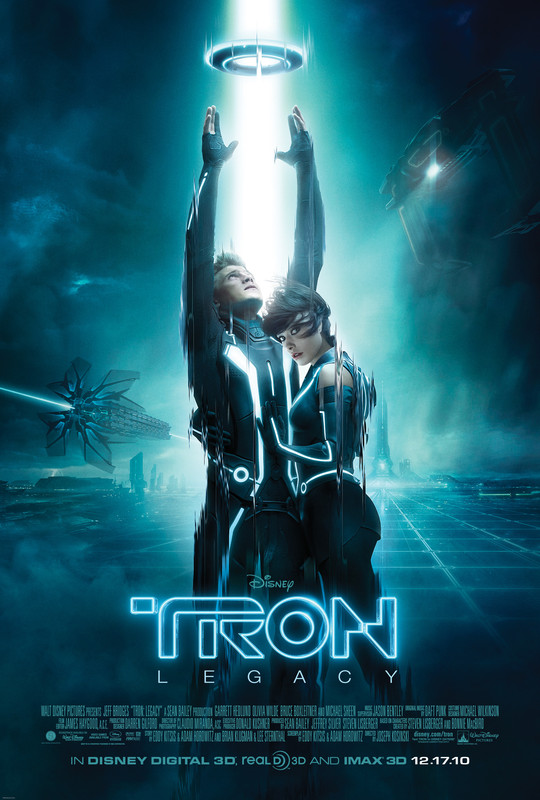
Tron: Legacy [PG]

Dir: Joseph Kosinski
I’m not the biggest Tron fan, but in watching this movie I felt bad for them. I can’t imagine the level of disappointment I’d feel if I really had been waiting with anticipation for 28 years for Tron to have a sequel, and then this was what was delivered. I don’t say that because Tron: Legacy is awful, but because it is mediocre, and because you can see how it might have been far better.

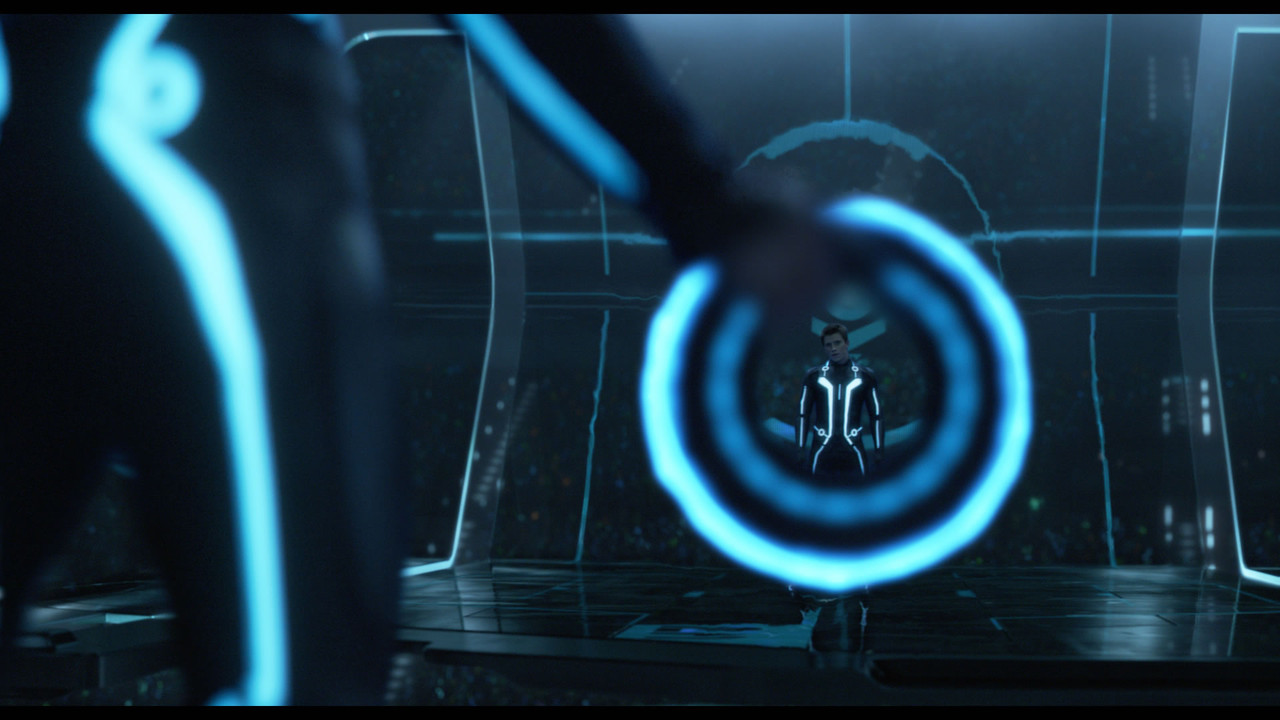
The original Tron was the first film to use computer-generated imagery, and it did so brilliantly. As basic as the CGI was (a few very simple polygon forms) it was used to enhance live action footage, and to give a genuinely new and otherworldly look to the film. Legacy picks up the story 28 years later, and focuses on Sam Flynn (Garrett Hedlund), son of the original’s main character Kevin Flynn (Jeff Bridges) who has grown up without the father who disappeared 20 years ago (as is explained, along with the events of the first movie, in a graceless ten minute infodump at the beginning of the film). When Flynn’s old partner Alan Bradley (played again by Bruce Boxleitner; a good actor who really should get more work) receives a page from Flynn’s office he tells Sam, who goes to investigate, discovers his Dad’s secret office and soon finds himself on ‘The Grid’, a digital world ruled over by Clu (Bridges, with the assistance of the next generation of the technology used to make Brad Pitt appear young in The Curious Case of Benjamin Button).

That’s just the setup, but lets be entirely honest, the story isn’t what’s really important about Tron: Legacy, what people are coming for, what they’re hoping to be sucked in by, is the design. It’s not quite the triumph it should be. The 2D trailers blew me away with their visual beauty, but for me, as with so many other films, the 3D process not only fails to add to the visual splendor, it detracts from it. Joseph Kosinski has deliberately made The Grid a dark world; dark blues and blacks dominate, highlighted with glowing lines of sky blue or white (for goodies) or orange (for baddies). This is pretty poorly served by the 3D process, which casts a murky grey sheen over everything and desaturates all colour. Add to that the fact that the depth is no more impressive (except for the title card, which does look amazing) in the 3D segment of the film than it is in the 2D real world scenes and I’m hankering to see this again in 2D.

Another problem with the 3D is that fast motion still doesn’t quite work; it retains a blurry and indistinct quality, which made the otherwise excellent lightcycle scenes difficult to understand, for the most part I couldn’t tell who was driving which lightcycle, and the geography of each of those scenes (thanks largely to the many transparent layers of the grid) is incredibly hard to follow. This said, the design is astounding, the grid is beautiful and the effects work is, for the most part, very strong. Kosinski has, at least, succeeded in credibly updating the look of the grid we saw in the first Tron and showing us an evolution and expansion of that world.

Quite apart from being something that people had never seen before, Tron had ideas that were incredibly ahead of their time. The idea of people having a digital presence that is as much themselves as their real life presence is a reality now (though not in the same way as Tron depicts it) and the concept of digitizing objects (again, not quite so literally) is also a huge part of how we live. What Legacy fails to do is have similarly ambitious ideas and subtext, at one point Bridges’ Kevin Flynn observes of wireless communication between digital devices “I thought of that in 1985”, and that’s really the problem, it doesn’t feel like Legacy brings anything new to the table, not in terms of ideas and certainly not in terms of story, which is the same old orphaned kid searching for his dad tale that we’ve seen in roughly EVERY DISNEY MOVIE EVER. It’s not even very well told. The only time the script really comes to life is when Bridges - clearly having fun - gets to inject some of himself into Flynn (To Sam: Quit messing with my zen thing, man). Otherwise it’s all exposition and colourless character interaction, focused, sadly, on a somnambulant Hedlund. However, Hedlund’s not the worst thing here, no, the performers' wooden spoon goes to Michael Sheen, whose outrageously camp performance as club owner Castor (who he plays as a gayer Aladdin Sane era Bowie) is completely insufferable.

The only good news on the new casting front comes in the shape of Olivia Wilde, who is appealing as Quorra, a program whose true nature will prove interesting in the surely inevitable sequel. She makes the most of the few lines she’s got to help give her character depth, and she really does look like she’s been custom designed in a computer to make every geek on Earth go weak at the knees. And then there’s Jeff Bridges. This film essentially casts him (at least as Kevin Flynn) as God, and why not? Who doesn’t want that to be true? As poor as Hedlund is, Bridges does manage to make his side of the father/son story play, and is the only character you have any real emotional investment in, and there are also a handful of moments when he’s just being his own unassailably cool self, which is never a bad thing. Of course Bridges also plays Clu. Digitally de-aged (with Against All Odds used for reference), the Clu avatar seldom entirely works, plunging us frequently into uncanny valley by being, all too obviously, a head digitally attached to a double’s body, but the work done on Bridges’ voice is remarkable, he sounds exactly like he did in his thirties and that and his performance sell the character, if not always the effect.

The one thing that is truly outstanding about Tron: Legacy is its score. Written and performed by the French electronic musicians Daft Punk (who appear in the End of Line Club as MP3s) it is this pulse pounding mix of strings and electronics that really powers the film, more than the script, more at times than the visuals. Ultimately its so good that it reduces the film, making it at times feel less like a movie than the best Daft Punk video ever made, even during a spectacular fight scene in the End of Line club I was considerably more interested in the fact that the brilliant Derezzed was pounding out of the cinema sound system than I was in anything happening on screen. In this way the film's score is both its strongest element and its biggest liability.

If you like 3D more than I do then I’d recommend Tron: Legacy, if only because it does show some intent to use 3D to tell a story, by using it only on The Grid (and despite what the opening caption says DO NOT leave your 3D glasses on during the 2D scenes), if you’re not fussed by 3D then I’d say buy the Daft Punk album and wait for the DVD.
★★☆☆☆

Jun 5, 2009

The Complete... Terminator

The Terminator  [15]
Dir: James Cameron
2029.  Mankind has finally won its war against the machines, but as a last ditch attempt to take back the victory the machines have sent a Terminator (Arnold Schwarzenegger) back through time to 1984, a cyborg killing machine with a mission to find and kill Sarah Connor (Linda Hamilton), who will become the Mother of the leader of the human resistance. To try and save the future humans are able to send a protector for Sarah back in time, its just a matter of whether Kyle Reese (Michael Biehn) or the Terminator will reach Sarah first.

The chase movie has a long history, and The Terminator, despite its futuristic trappings and sometimes confusing time traveling story, is basically a very simple and often brutally effective example of the genre. There are really only three major characters, and a very simple conflict – two men, one must kill a woman, the other must save her.  This means that James Cameron and his co-writer Gale Anne Hurd don’t need to spend a great deal of time on exposition and instead use that screentime to give their characters a level of depth that was and remains uncommon in the genre.

It’s often forgotten, given the megabudget follow ups, that The Terminator began life as a down and dirty film costing just $4million.  It had no major stars, and its commercial prospects didn’t look especially blockbusting. This actually ends up benefiting the film, giving it the feeling of something where anything goes, where because you don’t know any of these characters, or the actors playing them, and because the villain of the piece is both so remorseless and so deadly, all bets are off as to who lives and dies. This gives the film a drive that makes it incredibly compelling, even in the quiet scenes between set pieces.

However you feel about James Cameron as a filmmaker you have to admit, the man knows how to stage an action sequence, and there are plenty of stunning examples in The Terminator. Arnold Schwarzenegger’s deadly march through the Police station is a notably strong and scary sequence, showing just how utterly deadly the Terminator is.  The Tech-Noir sequence is another masterfully constructed suspense set piece, which turns into a terrific action sequence. Cameron also has an eye for a great image. The Terminator was born of a dream that Cameron had, in which he saw a robot rising out of fire. That image is in the film, and it is one of most memorable frames of 80’s cinema. It’s far from the sole iconic image in the film though – Schwarzenegger cutting his human eye out, a Terminator’s foot crushing a human skull and the images of the Terminator making his way through the Police station all stick in the mind long after they have gone by.

The film takes itself very seriously, and largely earns the right to do so. The script may be simple, but it’s never stupid, the dialogue is functional rather than truly characterful, but its given life by a largely solid cast. Schwarzenegger has just 16 lines, but he makes an impact with every one of them, more than that though his performance as the T800 is one that, 25 years later, still resonates. Nobody is ever going to accuse Schwarzenegger of being a great or indeed a versatile actor, but he’s perfect here. There’s the vacancy of his performance, the utter lack of emotion felt by the machine, but there’s also, even in this first entry in the franchise, a little humour behind the performance that makes the Terminator more than a blank space. Michael Biehn is the real standout of the film, his worn out but determined Reese is the film’s beating heart, he’s given little help by the dialogue in one key scene, in which Reese tells Sarah that he’s come through the time machine because he’s in love with her, based on a picture her son gave him, but Biehn’s sensitive performance wins out over the hackneyed scene (the same can’t be said for the silent, and laughable, sex scene).

The only downside as far as the cast is concerned is Linda Hamilton’s rather poor performance as Sarah Connor, some of her line readings – notably the final pay off of the movie, which she garbles – are weak and the growth of her character from the victim of the beginning to the warrior of the end is not terribly convincing. Though the action scenes are strong Cameron does sometimes let the pace lag, particularly in the middle part of the film, and the future war sequences add little to the movie aside from screentime. These rather minor gripes aside The Terminator is an extraordinarily enjoyable thriller, and one that holds up brilliantly after a quarter of a century.


Terminator 2: Judgment Day  [15]
Dir: James Cameron

10 years after skynet failed to kill John Connor (Edward Furlong), before he was even born, the machines are trying again, sending back a more advanced Terminator (Robert Patrick) to erase Connor as a child. Once again the resistance is able to send a protector back in time – the T-800 model (Arnold Schwarzenegger) that previously hunted Sarah Connor (Linda Hamilton) in 1984.

James Cameron’s long gestating follow up to his 1984 hit wasn’t, in the manner of most sequels, a simple reheating of the first film with improved special effects.  Instead Terminator 2 is smarter, deeper, more involving, more spectacular, in short bigger and better than its predecessor in all departments. Part of the reason that this sequel took such a long time to reach the screen was that its budgetary demands were so high - it was the first film to cost over $100 million - but more importantly Cameron had to wait until filmmaking technology was ready to realise his vision (a problem that still dogs him, his forthcoming Avatar has been 20 years in the planning). T2 was largely worth both the money and the wait.

In the time since The Terminator, and largely on the back of that role, Arnold Schwarzenegger had become perhaps the world’s biggest movie star (and one of the most expensive, his salary was $15 million), and that changed his role. However it came about, service to Schwarzenegger’s star image or just through Cameron and William Wisher’s writing, the decision to have Arnie’s Terminator go from antagonist to protector was an inspired one.  That simple choice allows the movie to tell a significantly different story to that of the first film, to throw all its relationships into disarray, and Schwarzenegger to play a very different character. Perhaps surprisingly Arnie is more than up to the challenge, in fact he’s never been more effective in a film. He retains the established nature of the Terminator - the emotionless killing machine - but through the simple device of establishing that the machine can learn behaviour Cameron and Schwarzenegger introduce a new layer to the character, allowing Schwarzenegger to have some fun. This is never more true than in the scene where John attempts to teach the machine to smile, a perfectly judged moment which may be the funniest thing Arnie has ever done on screen.

Another much improved performance comes from Linda Hamilton as Sarah Connor. This is no longer the big haired damsel in distress that proved so frequently irritating in The Terminator; rather she’s the film’s third killing machine. Hamilton trained for a long time to acquire the physique for this movie, and it pays off, her sinewy body making her a convincing threat. She’s also a good deal more credible in the role this time out, spitting her lines and executing her action scenes with a fire missing from the original film. She’s especially good in the early scenes when Sarah is confined to a mental hospital; credibly insane but never overplaying. Cameron campaigned for her to get an Oscar nomination for her role, and it wouldn’t have been undeserved.  At just 11 Edward Furlong has a tough task with the role of John Connor and sometimes, to be fair to him, he handles it with aplomb, at other times though Furlong is shrill and unbelieveable. His best moment comes in a powerful scene that wasn’t included in the theatrical cut of the film, in which the Terminator’s CPU has been extracted, so the it can be switched to allow the machine to learn, Sarah wants to destroy the chip and John must show the first signs of his leadership to come. It’s a great scene, with fine performances from both Furlong and Hamilton, but you do long for some consistency in the young actor’s performance.

Among the rest of the cast Robert Patrick stands out in a near mute role as the sleek T-1000 (a Porsche next to Schwarzenegger’s tank, was how Cameron described the new cyborg). There’s a sly wit to his performance that makes it very distinct from either of Schwarzenegger’s takes on a Terminator. Patrick is especially effective in the action scenes, he gives this Terminator a smooth, flowing, purposeful movement that distinguishes him still further from Arnie’s slow, heavy, relentlessness.

Of course the major story behind T2 at the time was its major advancements in computer generated special effects, and not only does the technology used to realize the liquid metal form of the T-1000 still hold up, it’s used extremely well. The CG is actually surprisingly sparingly used, even some shots that you’d think were CG (and now would be), like the moment when she pieces of the shattered T-1000 begin to melt and flow back together, are realised practically, helping the rest of the effects to feel more real and have more weight. Some of the pure CG moments remain breathtaking though, particularly one of the T-1000 rising from a floor, with the tile pattern all over its body. Cameron’s strong use of effects is also felt in another truly iconic moment, one of the film’s finest, in which Schwarzenegger peels the skin off his forearm to show the metal endoskeleton beneath, another practical effect that works much better than the CGI that would be used today.

This time out Cameron manages to pace the film rather more evenly, once the T-800, Sarah and John are on the run the pace seldom lets up, and when it does it’s a welcome breathing space from the relentless action and excitement that Cameron throws at us. The set pieces are breathtaking; the Pescadero escape stands out, as do the invasion of Cyberdyne and the incredible highway chase that leads to the final showdown. Where Cameron really scores over the first film though is in making this one affecting. There’s an emotional content that was missing from The Terminator and the ending here, though you know it has to come, and that the character you are getting emotional about is a fictional robot, is still moving.

Terminator 2 is a richer and better film than its predecessor, the high point of the series and, ultimately, one of the great blockbusters.


Terminator 3: Rise Of The Machines  [12A]
Dir: Jonathan Mostow
2004. Judgment Day hasn’t come, but John Connor (Nick Stahl), now 22, still lives ‘off the grid’, fearing that the machines may one day find him. Undeterred, Skynet sends back their latest model; the T-X (Kristanna Loken) to hunt down Connor’s lieutenants, all teenagers in 2004. However the T-X soon locates Connor. Once again the resistance have sent a protector for John and for Kate Brewster (Claire Danes), a young vet destined to become Connor’s wife, in the familiar form of the T-800 (Arnold Schwarzenegger), who informs them that Judgment Day was not stopped, only delayed.

When considering Terminator 3 it is perhaps best to begin at the end. Okay, getting there takes some major work, and bends the time travel aspects of the franchise almost to breaking point, but the ending of this film is a hugely ballsy choice. A lot of summer blockbusters begin with the end of the world, but few have ever ended that way; with the destruction of everything the characters have been fighting for for three movies. To his credit, director Jonathan Mostow doesn’t overplay his hand in the moment, the shots of missiles shooting out of the ground, and of mushroom clouds exploding all over the earth are not sensational but lyrical and rather moving. There are several things wrong with T3, but that one choice; so unexpected, but so fitting for the franchise, a moment that still makes the hairs on the back of my neck stand up, makes up for many of the film’s smaller sins.

One of the bigger of those sins is the choice by screenwriters John Brancato and Michael Ferris to try and inject a little parody into the film, referencing the earlier movies with a sly wink. It falls flat almost every time they do it, from the awful moment which has Schwarzenegger, suited up as the Terminator after taking a male stripper’s clothes (itself a joke that outstays its very brief welcome), putting on a pair of shades that – ‘hilariously’ – are pink and star shaped to the Terminator’s mimicking of human speech patterns which has gone from classics like “Fuck you, asshole” and “Hasta la vista, baby” to “Talk to the hand”.

The only other disappointment is Kristanna Loken’s blank performance as the T-X, of course she’s playing a robot, but there was always, in both Schwarzenegger’s and Robert Patrick’s Terminators, some measure of personality, even if it had been programmed in to allow them to fit in, even if it was never really natural, it was there. Loken is a blank slate, she’s expressionless and emotionless, there’s a total vacancy to her performance, but it doesn’t feel robotic as much as it simply feels like a bad actress giving a bad performance.

These gripes aside though, Terminator 3 is an extremely successful blockbuster; smarter than the average film of its type, but also better acted and extremely exciting. The action scenes are always the big story of a Terminator film, and Mostow here creates a selection of action beats that can easily stand with the best that James Cameron crafted in the first two films. There’s a brutal hand to hand fight between Schwarzenegger and Loken and a graveyard based shootout that leads into an excellent car chase.  The real standout moment is an insane chase through a city centre, with Loken driving a huge crane, Schwarzenegger hanging on to the crane’s hook and Stahl and Danes attempting to escape in a van. The destruction in this scene is incredible to watch, it was threatened with being cut, but Schwarzenegger put up his own money to finish the scene and it’s a good thing he did, not only because it’s a great scene but because the film needs the action beat at that point. The real highpoint comes in amazing moment in which the T-800, hanging from the crane, is dragged through a building, crashing through pillar after pillar, the building collapsing behind him.

The action is strong, but that’s not the only thing to recommend the film. Schwarzenegger is, again, pretty good, and again brings a different tone to the Terminator, who is considerably harder as a character this time round, dismissive to and violent with Connor.  The scenes that don’t work aren’t his fault, they are that of the script – no actor could make the scene which ends with the T-800 beating up a car play. Stahl makes a good Connor, nailing both the character’s vulnerability and his determination, but for me the real standout is Claire Danes. Danes was cast late, replacing Sophia Bush, who was felt to be too young for the part, and though she’s a variable actress when she gets it right Danes can be very good indeed, and here she gets it right. She has a similar journey to that of Linda Hamilton’s character in The Terminator, in that she has to go from damsel in distress to warrior in just 90 minutes.  Danes pulls that journey off with greater aplomb than Hamilton ever did, but also finds time to inject a little emotion into Kate. To ask us to accept an entirely new main character in a franchise on its third installment is a hard sell, but Kate is someone you’ll be interested in seeing more of, because of the growing strength Danes gives her.

The film is also quite visually inventive, especially in the way that, towards the end of the film, it begins showing us early Terminator designs (a room full of T-1’s) and early iterations of hunter killers. It’s this sort of intelligent retrofitting of what we know from the other movies about the future, rather than the parodic homages, that really play for franchise fans. It’s also nice to see, still, quite heavy use of practical machines, which continue to demonstrate just how much this franchise owes the work of the late Stan Winston, both in the design and the implementation of its effects.

What really makes Rise Of The Machines work for me though is that you always feel how high the stakes are for the characters, what they are trying to prevent is the literal, and imminent, end of civilization – it really doesn’t get more serious, and that gives what is, again, basically a long chase movie, that extra charge, ensuring that you’re always perched on the edge of your seat. Terminator 3 certainly has weak points, but so do its predecessors, and this is a truly unfairly maligned entry in an unusually consistent franchise.


Terminator: Salvation  [12A]
Dir: McG
2018. Judgment day has been and gone.  The war against Skynet and the Terminators is in full swing. The human resistance sees an opportunity to win the war in a signal that appears to shut down Skynet controlled machines. John Connor (Bale) is the leader of group of soldiers, but not among the high command of the resistance. Connor discovers that Skynet is taking human prisoners, among them the teenage Kyle Reese (Yelchin), who will become Connor’s father when, in 2029, Connor sends him back in time to 1984. With the help of the mysterious Marcus Wright Connor must save the prisoners, to protect his future and, hopefully, destroy Skynet.

When is a Terminator movie not a Terminator movie? There are certain things, even leaving aside MIA star Arnold Schwarzenegger, that you expect from a Terminator movie. It’s going to involve time travel, it’s going to be a chase, and it’s going to involve two Terminators; one hunting John Connor, the other his protector. None of these things is really true of Terminator: Salvation. It feels less like a genuine Terminator movie than it does an expensively mounted knock off that has simply elected to use the title.

Perhaps the strangest thing about this film is the fact that John Connor, around whom the franchise has always revolved, even when the character was not yet born, has become a supporting character, and not even a very important one at that, in what is supposed to be his own story. Christian Bale was apparently reluctant to take part in this film, not wanting to sign up to what would be the fourth best Terminator film, and going on record saying that nobody thinks Terminator 3 was the best of those films, so why make another?  Fair point Christian. There’s certainly no answer to that self-imposed question in Bale’s performance, in his perhaps 40 minutes of screen time (in a 115 minute film) Bale has exactly two styles of speaking; growly and shouty and exactly one expression; a mildly pained grimace. Bale has often been acclaimed as the most gifted actor of his generation, and at his best I can buy that.  Recently though there’s been something of an emperors new clothes syndrome at work and this performance marks a miserable, lazy, new low for Bale.

The actual main character is Sam Worthington’s Marcus Wright, whose true nature the film wants to spring on us as a big mid-film twist. There are two problems with that. First the dreadful opening sequence heavily signposts the revelation.  Second, even if you’re dumb enough not to be able to guess it from that opening, Marcus’ role in proceedings has been thoroughly spoiled in both full length trailers and TV spots, so all the intrigue is sucked out of the character. Australian actor Sam Worthington works hard, but his accent is inconsistent (and, really, why can’t he have an Aussie accent?) and the character is so ill defined that despite his hard work Worthington struggles to make a real impression.

The best performance in the film is from Anton Yelchin, excellent as the younger version of Michael Biehn’s character from the first film. As with his version of Chekov in the recent Star Trek he doesn’t impersonate the previous actor, but simply captures a flavour of them, especially here with Reese’s famous line “Come with me if you want to live”. The problem, as with many of the characters, is the fact that he’s afforded so little screen time (little more than half an hour) that he doesn’t really get to do much of great import - his role in the ending set piece of the film being largely sitting in a cell and yelling.

The film is massively overstuffed with pointless characters, and serves none of them well. There’s Resse’s mute, cute, 9 year old black sidekick named Star (Jadagrace). There’s Moon Bloodgood (great name, terrible actress) as resistance pilot Blair Williams, who shows up just long enough to perform her plot function before being promptly forgotten about. There’s Common, who stands around holding a gun while modeling an admittedly cool, but frankly rather too tidy for someone living in a post apocalyptic world, beard and says about two lines as Connor’s ‘right hand man’ Barnes. There’s Bryce Dallas Howard (who is in no way convincing as a 14 years older version of Claire Danes, largely because she’s two years younger), whose role is to simper and be pregnant in the background. Jane Alexander and a hilariously miscast Helena Bonham-Carter each get a couple of minutes of nothing to do, as does the always excellent Michael Ironside (who would have been a great old John Connor). It’s depressing to watch the way this movie wastes talent.

The major annoyance of all this is that it’s easy to see how the character count could be reduced, and the film better in consequence. It seems pretty obvious that Blair is a character spun off from Kate Connor (whose ability to fly a plane was established at the end of T3). Having Kate in that role would not only make her closer to the tough girl she was at the end of T3, it would also raise the stakes of a pivotal moment in the film by making a key betrayal infinitely worse.  Salvation doesn’t have that kind of bravery, instead it contents itself being perfunctory and loud.

Rather than handing the reins of the franchise back to Jonathan Mostow, who did such a fine job on T3, or to any of the innumerable action auteurs out there to choose from, the producers have plumped for one Joseph McGinty Nichol, or McG. Now I’m not going to mock McG for his name, because that’s rather like using a flamethrower to toast a marshmallow, and besides, he made Charlie’s Angels and that’s far more shameful than having a stupid name. To be entirely fair to McG Terminator: Salvation is nothing like as terrible as the apocalyptically awful Charlie’s Angels, but it doesn’t demonstrate much of an advance as a filmmaker either. He clearly has no idea of story as an overarching thing, not only does Salvation fit only very awkwardly into the franchise as whole, but it fits together only very loosely as a film. It’s less a coherent story than a series of bits (many overly reminiscent of other films), each floating almost independent of the other. There’s enough material here for an entire trilogy, given that overabundance of characters, but none of those movies would feel like a Terminator movie.

The action scenes and special effects are executed with a degree of unfussy competence, but what’s missing isn’t spectacle, it’s a reason to care. Even though John Connor’s very existence is nominally at stake, and with it humanity’s future, there’s never any sense of high stakes. There’s no urgency to this film, particularly when you compare it with the loudly ticking clock that is the last hour of T3. At the end of the day this means that, rather than being sucked irresistibly in to the experience of the action scenes as you were in the first three films, you simply watch them. It’s as impersonal and uninvolving as seeing a rolling demo of a computer game. There’s also an inconsistency in the threat level of the enemy. Sometimes the Terminators seem extremely easy to fight, at others (nearer the end of the film) they are all but unstoppable. The only things McG manages to show any mastery of here are shooting and things going boom, and that can be fun, but with nothing behind it it just becomes a collection of loud noises.

The nods to the fans are as hit and miss as they were in T3 (which was penned by the same duo of Brancato and Ferris, though here they have an uncredited assist from Jonathan Nolan, whose appointment was apparently a condition of Bale’s participation). Come with me if you want to live works, as does Linda Hamilton’s vocal cameo, in which she gives the most genuinely emotional performance in the film, and shows just how missed she was in T3.  However, Bale's “I’ll be back” feels perfunctory and drew a groan. Arnold Schwarzenegger’s cameo works well technically, the de-aging applied to his face making him look exactly, eerily, like he did in the first film.  Unfortunately McG muffs the execution with a very silly reveal where the T-800 is shown stepping, naked, from behind a door, modesty covered by a very convenient bit of mist. Well executed though it is it feels token, especially given that it’s a mute role (really, would it have killed them to take a line from the soundtrack of The Terminator?)

It’s a real shame that Terminator: Salvation is as bad as it is, because it wouldn’t be tough to fix, but make no mistake this is an almost complete failure, with only strong effects and Shane Hurlburt’s excellent photography to really recommend it.