Showing posts with label Superheroes. Show all posts

Apr 5, 2022

Spider-Man: No Way Home [12]

Dir: Jon Watts 
There have been many tries at adapting Spider-Man to the screen. Most have strengths, but all have their weaknesses. Sam Raimi’s films got Peter entirely right, with Tobey Maguire perfectly cast, but Spider-Man’s wisecracking wit got left behind somewhat. While Kirsten Dunst was good, the screenplays sanded off Mary Jane’s edges, and often leaned into cheese. The second of Raimi’s trilogy remains a hugely entertaining blockbuster, but even that one suffers from the wider problems of its franchise. I hate the Amazing Spider-Man films. Andrew Garfield clearly earnestly wanted to do the character justice, but only a couple of scenes throughout his tenure capture the character properly, and the problems are legion (reviews here and here). 

The Marvel Cinematic Universe initially couldn’t use Spider-Man but, with rights issues negotiated, he finally showed up, in the form of Tom Holland, for Captain America: Civil War, before the MCU embarked on what has become the Home trilogy of films. Like the other franchises centering on the character, it’s had its ups and downs. The first film, Homecoming, confirms what Civil War suggested: Tom Holland is a great choice, and this time not just as Peter Parker. For the first time, that film consistently nails down the persona of Peter’s Spider-Man; a witty kid who has a quip ready for every occasion. We get the sense here that the Spider-Man costume empowers him to that end, drawing a better-defined distinction between Peter in and out of costume than ever before. However, it’s not entirely a Spider-Man film. Far too much time is spent in service of the larger MCU, especially of featuring Iron Man. The film is at its best when Peter is doing his ‘friendly neighbourhood Spider-Man’ thing, and particularly when he’s in his own costume. The suit that Tony Stark made for him undermines Peter’s trademark intellect and ingenuity by, first of all, having to be something he got from another brilliant scientist, and secondly by doing too much for him. The sequel, Far From Home, doubles down on these problems while also stripping out much of Spidey’s wit. The use of Mysterio’s illusions is fantastic in a couple of late action scenes, but otherwise, it’s a weak film. 

That brings us to No Way Home. The marketing had me worried, the reliance on Dr Strange, the use of the Multiverse, which suggested nothing so much as a desperate attempt to make a live action version of Into The Spiderverse (still, hands down, the greatest Spider-Man film). Happily, this is easily the best of the MCU’s Spider-Man series, and probably one of the best films to feature the character. 

No Way Home picks up directly after the ending of Far From Home. Peter’s secret identity has been revealed to the world by J. Jonah Jameson (JK Simmons, reprising the role from the Raimi series, only this time as an Alex Jones style ranting commentator). This has major repercussions, as Spider-Man is thought by many to have murdered Mysterio, and the effects reverberate onto Peter’s friend Ned (Jacob Batalon), his girlfriend MJ (Zendaya), and his aunt May (Marisa Tomei). Most consequentially, the controversy means that Peter, Ned and MJ are all rejected from what should have been almost sure thing places at MIT. Wanting to set things right, Peter goes to Dr Strange (Benedict Cumberbatch) to ask him to cast a spell that will make people forget that he is Spider-Man. In his haste, he makes Strange change the spell so many times as it is in progress that it goes wrong, creating a crack in the multiverse that lets in anyone who knows, in any universe, that Peter is Spider-Man. 

I’m sorry for that long introduction, but it was important to set the pieces here, because that crack in the Multiverse pulls in many of the villains from the earlier Spider-Man franchises. No Way Home is soaked in Spider-Man lore, both from the earlier films and from the comics (often drawing the earlier versions of the characters much closer to their source material). There is no way to cover this without spoilers, so if you’ve not seen the film yet, beware. 

The first 40 minutes of No Way Home are MCU Spider-Man as we’ve come to expect, in both good and bad ways. I struggled with the point of Ned in the first film in the trilogy. The writers struggled with the point of him in the second, saddling him with a romance so prosaic they wrote it out at the end of the film. Here though, the dynamic between Peter, Ned and MJ feels much more balanced. They’re not well established as a trio in the first two films, but this film depicts them as much closer. It’s a little clumsy, but well played. There’s a sense that an offscreen friendship is bleeding into the film, and we do get a little invested in them all going to college together. The consequences of Peter’s identity being discovered could have been heavier (perhaps an alternate version would have leaned into a certain cameo and given us a trial of Spider-Man narrative), but what does weigh on Peter feels authentically life-altering for a teenager. I buy into the idea of Peter, used to fixing things with superpowers, looking first for that kind of solution. As ever, the points at which the film has to service the expansion of the MCU are its weakest. Worse, you can barely tell a difference in tone between the writing of Dr Strange (or many other characters) and Peter, when it comes to wisecracking, which is a perennial problem for the series. Overall, the first act is fine, but nothing new. 

The bridge scene is when things kick into gear, with the appearance of Alfred Molina’s Dr. Octopus. Molina positively relishes the part, and Jon Watts stages an imaginative action scene, with the fact that Doc Ock’s tentacles are now fully CG giving them somewhat greater freedom. It’s also a well-written scene when it comes to Peter’s character; he’s curious about why this man has suddenly appeared and attacked him, but it also incorporates some of Spidey’s humour, especially in his delight when he discovers how the nanotech of the Iron Spider suit interacts with the tentacles. It’s a tremendously entertaining sequence that combines all the best qualities of Spider-Man. 

Bringing the old villains in one by one allows Watts and writers Chris McKenna and Erik Sommers the chance to do a soft reboot on them, fixing some issues that fans had with the original cinematic incarnations. Jamie Foxx still plays Electro, but he’s no longer the Edward Nygma knockoff of Amazing Spider-Man 2; his powers have given him a swagger that Foxx is much more comfortable with, while a late change in look gives hints of the original comic character’s lightning bolt mask, without going for the full silliness of that look. Similarly, the Green Goblin of the Raimi films is retconned a little. Willem Dafoe continues to play him with the same glee he had in 2002, but the Power Ranger mask is smashed early on, and Norman takes on a look much closer to the classic John Romita design, purple cowl intact. For someone who has always loved the character, it’s a near perfect mix of something credible within its world and preserving the comic book look. 

What works best about the film though is that while the fanservice is present and correct, it’s not what the film is about. With great power, every Spidey series tells us, comes great responsibility, and even before that phrase has been uttered in this continuity, that’s what this film has Peter embracing. It’s also worth noting that the twist on how that maxim is delivered here works well. It hit me emotionally, both because of an affection for the characters its between and how it pays indirect tribute to the way it’s usually shown. The villains Peter encounters may have been teleported in from other dimensions, but he feels a responsibility to them and to the other people in those dimensions not to simply kill these people, but to cure them: to send them back as the decent people they once were. It’s a great encapsulation of the main lesson of Spider-Man and just one of the ways that this—finally—is an MCU movie about Spidey himself. Dr Strange may facilitate the mechanics of the plot here, but this isn’t about Peter’s relationship to him, or his place in The Avengers the way the other films in this series are. This is a film about finally becoming the hero that his powers make it possible to be, whatever the consequences. It’s also a film about connection: to friends who are essentially family, to a parent like May and, of course, to the only people Peter knows who share his experience. 

Even though Andrew Garfield denied it repeatedly, it was always clear that he and Tobey Maguire would be reprising their roles, playing alternate Peter Parkers (Peters Parker?) What was a pleasing surprise to me was how substantial their roles are in terms of screentime and what they contribute. If the reclaiming of the old characters and the moving of them closer to the established lore is largely subtext, one scene with Garfield makes it supertext. In a pep talk the others comfort Garfield’s Parker as he does himself down—clearly a reference to the Amazing series' critical and fan reception. Garfield is great here, it seems that this is everything he ever wanted his Peter to be, and there are some lovely moments as he relates to older and younger versions of ‘himself’. His excitement at being along for this ride is both palpable and contagious. No, it doesn’t mean the  Amazing series is suddenly good. Maguire seems a little less sure about being back, but that works for his older and more reflective Peter. It makes me wonder if he’s still doing the superhero thing in his part of the multiverse. The reference to his MJ is sweet, but I do wish we’d seen Kirsten Dunst reprise her role. 

Pulling three Spideys and something close to a full Sinister Six together for the final action sequence does mean the film’s ending is busy, but it’s also pretty exciting and surprisingly easy to follow. Watts and team break the sequence into a series of mini setpieces, and the costumes and styles are distinctive enough that it doesn’t get lost which Spider-Man we’re following at any given time. The theme of responsibility, and of the cost Peter was trying to avoid, comes full circle with the ending (which also has one image that nods poignantly to the ending of Raimi’s first film). It’s here that I really felt the point of spending so much time with Ned in the two previous films. While Homecoming was a teen movie, the ending makes this one feel like a true coming of age story for Holland’s Peter. There’s an innocence the character used to have that we’ll likely never see again. 

No Way Home has many of the flaws familiar in MCU films. Ultimately it’s just as anonymous looking as any of them, and I don’t doubt that any of the Marvel directors could have delivered much the same movie, given the same second units. That said, this was never intended to be auteur cinema. If the MCU delivers films almost as a mechanical process, this one feels like it’s been delivered by a machine that has been tinkered with, retooled to work at its highest potential. It’s the MCU Spider-Man film I’d been hoping for, and while it’s not perfect (and hasn’t a single image as indelible as Spiderverse’s ‘falling upwards’ shot), that feels like as much as I could have asked of it. 
★★★★

Apr 1, 2020

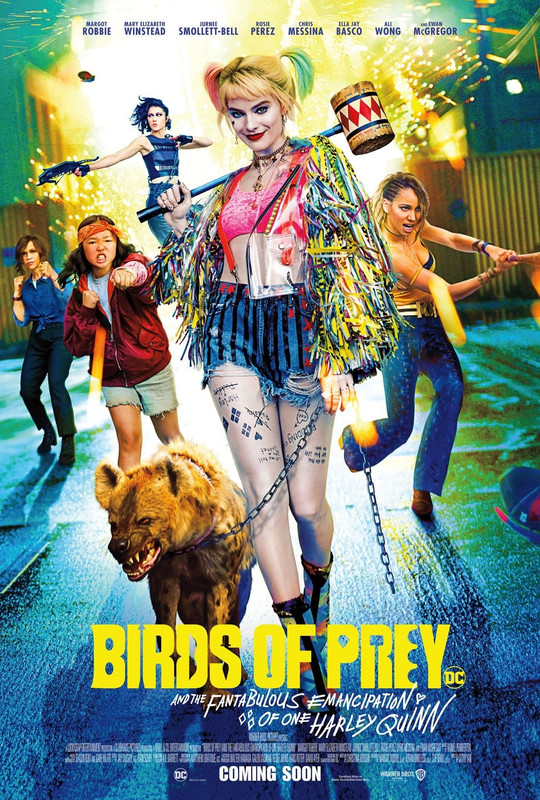
Birds of Prey and the Fantabulous Emancipation of One Harley Quinn [15]

Dir: Cathy Yan
The Marvel Cinematic Universe has changed cinema. I’d argue that one of the main reasons it managed to do so - even with its early stumbles and subsequent formulaic nature - is that it has been meticulously planned. From right at the beginning, it was clear there were two things at the heart of the MCU: vision and patience. By contrast, DC’s cinematic universe has always felt chaotic. The DCEU, whatever its merits, has never found the clear overarching identity the MCU has. It has taken a scattergun approach to universe building, and still doesn’t seem to have got its feet under it.

Suicide Squad was a mess. It promised something relatively novel: a team of villains becoming reluctant and sardonic heroes. It had a good trailer, but it was undone by a screenplay that made little sense and an obnoxious montage structure that meant the film spent what felt like half of its running time just introducing the characters. The one thing that did work, and the breakout success of the film, was Margot Robbie’s funny and mischievous performance as Harley Quinn, who she made both dangerous and entertaining. It’s no surprise that the first thing to come out of Suicide Squad was - almost - a solo film for her.

Christina Hodson’s screenplay picks up with Harley very much a solo act, her break up with the Joker has made her a target for the whole Gotham underworld and particularly for Black Mask (an over the top Ewan McGregor with a shaky accent). Given a day to recover a diamond taken by a young pickpocket (Ella Jay Basco), Harley ends up teaming with Black Canary (Jurnee Smollet-Bell), Huntress (Mary Elizabeth Winstead) and an ex-cop (Rosie Perez) to take down Black Mask.

Much like its title, this is a film of two halves. It begins with the Fantabulous Emancipation of One Harley Quinn. She is cut loose not only by the split with Joker enabling her to become more than a muse and homicidally crazy sidekick, but by the film itself. The rating is bumped up to an R. This allows for more graphic violence (Harley jumping on a man’s outstretched legs, breaking them) and for her to finally be “Harley fuckin’ Quinn”. This section of the film is fitfully funny, but there are a lot of scenes that play variations on a theme. It’s fairly slow going, but invigorated by Margot Robbie’s boundless energy and her sheer commitment to the bit. Things pick up in the second half, as the Birds of Prey form. Harley is an entertaining character, but she’s a little tiring on her own, giving her a gang adds some variety and the all female ensemble steps up with a combination of toughness and wit. None are better than Mary Elizabeth Winstead, whose two action roles of the past six months (this and Gemini Man) have finally delivered on the promise of the Die Hard sequels that underused her. She’s great here, whether stabbing a henchman as they ride down a funhouse slide or repeatedly getting cut off as she tries to dramatically announce her supervillain name.

It’s notable that much of the creative team here is female. Birds of Prey is hardly a political statement, but the difference is easily seen, with Robbie far less objectified here than she was in Suicide Squad. That said, it’s fair to say buns are still fetishised, only this time—in one of the film’s funniest moments—it’s a bun holding Harley’s ideal breakfast sandwich. In only her second feature, Cathy Yan makes an effortless transition to big scale filmmaking, marshaling better action scenes than most of her male competitors in recent superhero movies and Christina Hodson delivers another quality blockbuster script, following her work on the underseen Bumblebee.

One of the major problems of superhero films is that so many end the same way: a skybeam and a few blobs of CGI fighting. Yan and the action team do a fine job evading that cliché. Throughout, the fights are impressive and manage to throw some laugh out loud moments in with the violence. The combination never works better than in the third act funhouse fight, which plays as an excuse for all the departments: set design, props, stunts to throw everything at the wall and, as long as it can be done practically, see what sticks. It’s shot and edited with a sense of flow, shows clearly that the cast are doing as much stunt work as possible, and jammed full of great gags.

Birds of Prey has its issues (a weak villain and a relatively slow first act), but the pared down  (yet more impressive) action, Robbie’s performance and chemistry with her cast mates, and the sheer sense of fun make them feel pretty inconsequential as you’re watching it.
★★★½

Jul 3, 2019

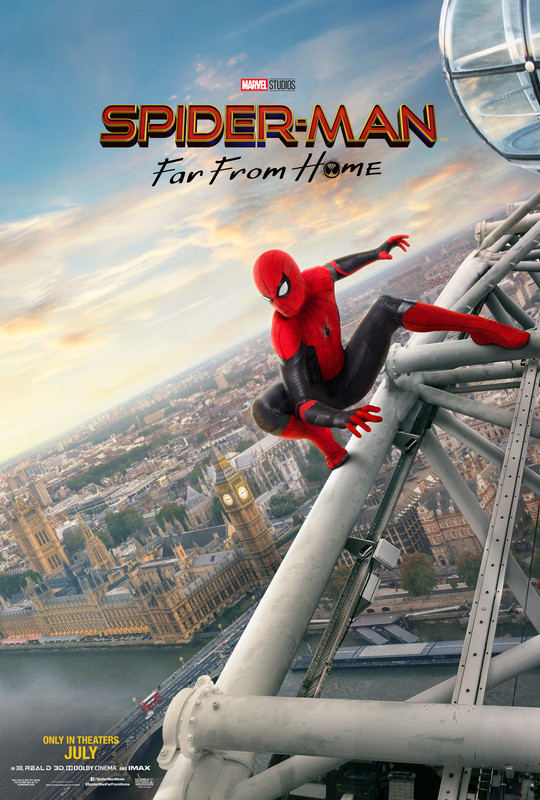
Spider-Man: Far From Home [12A]

Dir: Jon Watts
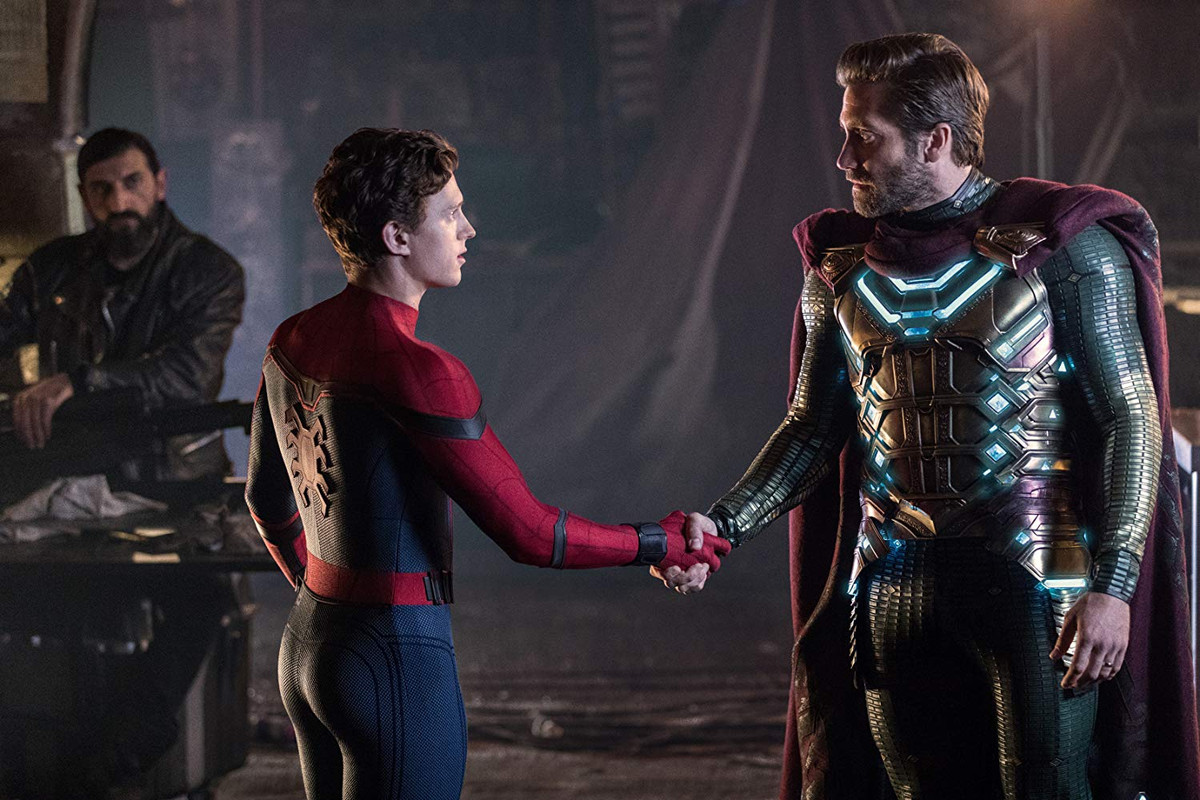
The second of the MCU’s Spider-Man films, and the closing film of Marvel’s Phase 3, Spider-Man: Far From Home picks up after the events of Avengers: Endgame. With Tony Stark gone, the world is looking to other heroes, as is Nick Fury (Samuel L Jackson). When reports begin of massive beings called elementals and of Quentin Beck (Jake Gyllenhaal), a soldier from another dimension trying to fight them, Fury calls in Spider-Man to assist. At least, he tries to. Peter Parker (Tom Holland) has a lot on his plate, juggling being a superhero with his life after the blip; most pressingly a school trip to Europe and a plan to tell MJ (Zendaya) how he feels about her. He doesn’t have time for Nick Fury, especially with this new hero, quickly nicknamed Mysterio, on the scene.

I’d call myself a casual observer of the Marvel Cinematic Universe. With a little distance from them, it’s probably only the first two Captain America films and Spider-Man: Homecoming that I’d say are, qualitatively, anything more than solid pieces of blockbuster filmmaking. On the other hand, I love Spider-Man. I always have. I love the 70s series with Nicholas Hammond in all its cheesy crappiness. I love the 90s cartoon. I love a lot about Sam Raimi’s trilogy of films, and... almost nothing about The Amazing Spider-Man reboots (reviews here and here). Homecoming was pretty much everything I ever wanted from a Peter Parker Spider-Man film, and the first film to manage to square the circle of the character and get both Peter and Spider-Man right, at least for me. Then Into the Spiderverse raised the bar. I didn’t have much investment in Miles Morales going in, having stopped reading Spider-Man books a few years before he came along, but I certainly had that investment on the way out (as well as an appreciation for the film’s dazzling art style). That film and Avengers: Endgame present challenges for this film, challenges it never manages to overcome.

Homecoming had a studiedly low key feel to it. As we first met Holland’s Spidey in the midst of a big action sequence in Captain America: Civil War, his own film deliberately foregrounded the idea of Peter as a relatively nomal teenager and of Spidey as ‘Your Friendly Neighbourhood Spider-Man’. It did the big action well too, and had a menacing villain in the shape of Michael Keaton’s Vulture, but the largely ground level feel of it (depsite the web slinging) was a great plus. With that groundwork laid, the mix doesn’t work the same way this time out. We don’t feel the effects of ‘the blip’ (the five year gap between the people who survived Thanos’ snap and those who didn’t) enough. Rather than just have one third string character be that much older, would it not have been interesting for  the dynamics of their relationship if Ned had survived the snap and was now several years further on than his friend Peter? Certainly it would be more interesting than Ned’s storyline, which screams that screenwriters Chris McKenna and Erik Sommers couldn’t think of anything to do with him. 

Homecoming, not having to do an origin story, got its feet under it immediately, but the emphasis on the teen comedy aspect and the high school trip to Europe (which is so nakedly a plot facilitator that at a certain point the film doesn’t even bother pretending about it) means that as a Spider-Man film Far From Home is a slow starter. Even when there are action scenes, for much of the first half of the film, Mysterio is the driving force. Jake Gyllenhaal is a bit of a casting coup for this film, and he brings his customary dedication to the role, dealing well with the several gigantic exposition drops he has to do, while also managing to create an interestingly nuanced character and draw a relationship with Holland which, though close to what Sam Raimi did with Dr Octopus in Spider-Man 2, carries weight for Peter as he looks for a new mentor in the wake of the loss of Stark. Of course there is another mentor figure available in Nick Fury (both Jackson and Cobie Smulders as Maria Hill have an increased presence here), but without Peter ever saying it, I think it’s that Beck shows himself as a scientist as well as a warrior that means Peter is drawn to him. He sees an older version of himself there - or at least a version to aspire to - in a way that he doesn’t in a top spy like Fury.

Jake Gyllenhaal also helps bring out the best in Holland's performance, we can feel his pride when Beck tells him never to be ashamed of being the smartest person in the room, how it fuels that desire to see Beck as a mentor, and how this desire might not make for the best judgement. That said, it’s only in the second half of the film that we see Mysterio used to his full potential. The first action scene that deploys his illusions in their full force is absolutely fantastic. Jon Watts and the crew find some wonderful and very comic book inflected images and have great fun pulling surprises on the characters and on us. This and other sequences in the second half also use the connection we’ve seen built between Peter and Mysterio effectively, giving some emotional power to underlie the action.

In its first half, the film does mark time. Ned’s story with Betty Brant (Angourie Rice) is notable here. Rice is well cast, and fun in the newscast that opens the film, but both she and Jacob Batalon (who still has nice comic timing, especially opposite Holland) are underserved by a story so prosaic that the film explicitly declares that it’s abandoning it before the end credits. This is also true of a lot of the class trip stuff, like the fairly unfunny dynamic between Martin Starr and JB Smoove as the teachers and Tony Revolori’s one joke version of Flash Thompson. It’s also the case with a weirdly misplaced action sequence. Yes, Peter’s carelessness is a theme here, but it’s a bit overegged at one particular moment, especially given that the film has other instances that trade on the same idea, but feel much more in character for Peter. The only part of the class trip narrative that really engages is the dynamic between Peter and MJ. Zendaya is definitely a departure from the traditional MJ, in both look and attitude, but it completely works for me; she gets bigger laughs with a withering look than almost any of the film’s one-liners, and her ability to throw Peter off balance is always funny (the exchange at the opera, when Peter tells MJ she looks beautiful, is perfectly timed and played). For all the sarcasm she throws his way though, there’s a genuine sweetness about Peter and MJ too, it’s a different take, but a smart and well-executed one.

The best things in the film come in the third act, which ups the action to an epic scale, but it’s a challenge to discuss any of it because every part of it is predicated on massive spoilers. Suffice to say that the idea that has defined every version of Spider-Man is that ‘with great power comes great responsibility’ and that in these sequences Spidey is feeling that at a very personal level. It’s a classic hero's journey all about the choice this young kid has to make in embracing his role, his responsibility. It’s not something we haven’t seen in cinematic Spider-Man stories, but it’s still effective thanks to Holland’s performance and in no small part thanks to the stunt teams and digital artists who help create Spidey, whose movements have never felt more fluid.

It’s worth briefly addressing the first of the two post-credits scenes (stay for both, by the way). As a fan, I was at once elated at a certain piece of casting and somewhat thrown off by the depiction, which feels like a departure from the principals of the character, if only because of what the iconography suggests it’s referencing. I’m not sure how I feel about it, but along with the other things this sequence throws up, we’ll surely be dealing with it in the next film.

Then there are, of course, those twin problems of Into the Spiderverse and Endgame. As a Spider-Man film, Far From Home simply can’t help but feel like a damp squib after the blisteringly inventive Spiderverse (especially as it seeds a similar idea early on), it’s got fun action and is incredibly well executed, but the sheer visual verve of that film is nowhere to be found, nor is there a single image with a tenth of the power of the shot of Miles falling upwards through the frame. Equally, as a closer for Marvel’s third phase, it can’t help but feel like an anti-climax next to the monumental (though flawed) Endgame. All that said, though it does take a while to plod its way there and too many characters seem stuffed in just because they were there in the last film, rather than because there’s a great need for them here, once it kicks into gear, Far From Home is a highly entertaining, very well acted and sometimes thoughtful Spider-Man film. I had a great time with it in its second hour and again loved the depiction of both Peter and Spidey throughout, but I can’t deny it failed to give me the charge of excitement I had after Homecoming.
★★★

Jun 22, 2019

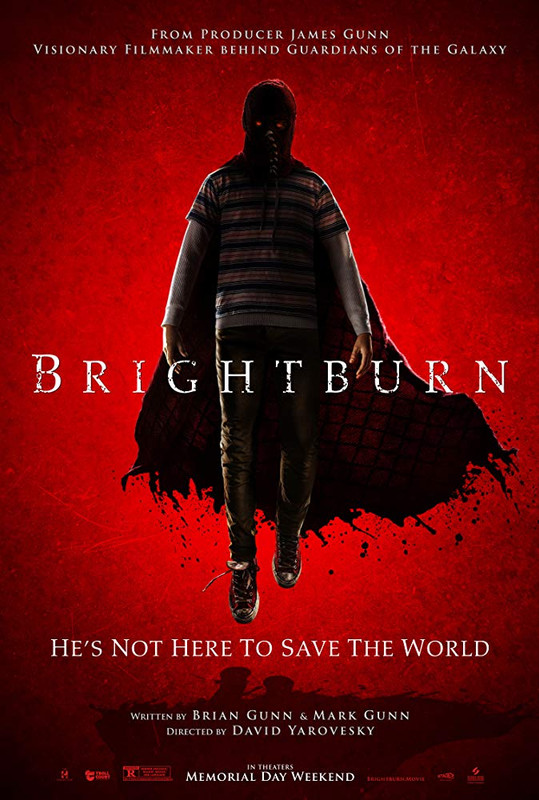
Brightburn [15]

Dir: David Yarovesky
‘What if Superman was evil?’ That’s the central question at the heart of Brightburn. 12-year-old Brandon Breyer (Jackson A. Dunn) knows he’s adopted, what his parents (Elizabeth Banks and David Denman) haven’t told him is that they didn’t go through an agency, but that they found him in the woods in a crashed spacecraft. As he hits his 12th birthday, Brandon realises he has superpowers. He is drawn to the ship and begins to exhibit violent and otherwise disturbing behaviour.

Brightburn has an interesting idea at its heart, the implications of an entity as powerful as Brandon using their powers for vengeance or in maliciously violent ways are terrifying. Buried somewhere in the film are ideas of interrogating nature vs nurture and psychopathy in children, unfortunately, screenwriters Brian and Mark  Gunn and director David Yarovesky seem content to take a very route one approach to the material and opt instead for a broad 90 minutes that simply depict Brandon’s turn towards evil in the bloodiest ways possible (cuts were needed for the 15 certificate). The only time it seems likely to explore what is driving this child’s sudden and extreme violence is minutes before the end, and ends up being a throwaway line when it could have given the whole film a disturbing sense of push and pull.

For that depth to be injected, the film needs more space to develop its ideas and its characters. The performances are solid enough all round, with Elizabeth Banks as the mother in denial and David Denman as the father who can see the danger earlier on but they and, after the first act,  Jackson A Dunn are stuck with fairly one-note figures to play. Had the film taken the time to slow down, to develop the turn in Bradon more patiently and with a greater degree of creeping menace, it might have greater impact.

Superman has never been an especially interesting character to me, his near invulnerability lessening the stakes of almost any fight he has. What he does have is a moral dimension. That’s another thing missing in Brightburn. As Brandon is drawn to his ship it seem that it, or some force emanating from it, is altering his behaviour. Clark Kent is raised well, by loving parents, and we see his choice to be moral and do good with his gifts. Brandon has similar guidance, but it would be much more interesting to get the sense of him making an affirmative choice in his actions. The script fudges and fumbles this question, never making it entirely clear to what degree Brandon chooses the direction he takes.

Brightburn isn’t a total loss. It fashions some memorable imagery; the way Bradon hangs in the air, often mere inches above the ground, has an inherent creepiness to it and his mask (by costume designer Autumn Steed, who appears to be drawing on Batman villain Scarecrow) looks authentically homemade and horrifying. The violence is brutal. Cuts are visible in one scene of eye trauma, which remains skin-crawlingly nasty but the practical effects deliver the red meat for gore fans. Overall though, the idea here is better than the execution. I get the sense there is a better film somewhere in Brightburn, perhaps an extended cut could find it by digging further into the moral questions and motivations at its heart. It may not work, but I’ll take this; an interesting failure, over another cookie cutter franchise entry. 
★★

Jun 6, 2019

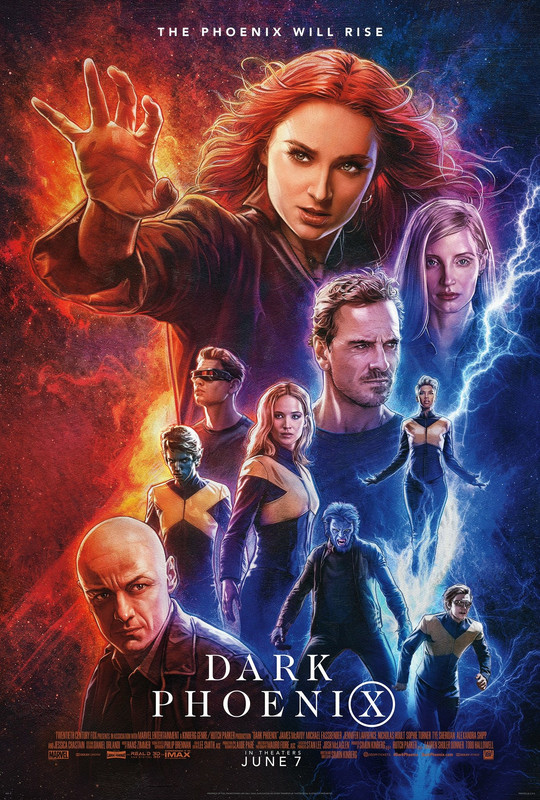
X-Men: Dark Phoenix [12A] [2D]

Dir: Simon Kinberg
There is no denying that the original X-Men film helped kickstart a revolution in mainstream cinema. Yes, Blade had helped rehabilitate the superhero movie somewhat, but for the mass audience it was the success of X-Men that repopularised the genre and its sequels and spin offs that acted as some level of proof of concept for the Marvel Cinematic Universe. It is rather ironic that a series about mutants - frequently spoken of as the next stage in human evolution - has, in the space of 19 years, gone from looking groundbreaking to being desperately outpaced by the things that evolved from it.

I’ve always felt that the third of the initial trilogy, The Last Stand, got something of a raw deal from critics and audiences. It’s not so much a truly bad film as it is one that ended up chaotic. It has too many ideas - many of them good - and is unable to pay most of them off in a satisfactory way, and the behind the scenes ructions (including a late director change) can’t have helped. For many of the fans of the comics though, the film’s greatest sin was squandering the legendary Dark Phoenix storyline, which stretched through multiple years in the comics. It’s no surprise that with the timeline reboot provided by Days of Future Past, there would be another attempt to adapt this storyline. What is perhaps surprising is just how much worse than the last attempt Dark Phoenix turns out to be.

This continuity of X-Men films, begun with 2010’s First Class,  is now four films old and fatigue had seemed to set in with the last entry, 2016’s Apocalypse. In that film Jennifer Lawrence, as Mystique, seemed particularly checked out, almost certainly aware that her career had long since passed the point at which she needed these films. For Dark Phoenix, the virus has spread, infecting not just the veteran cast but most of the new faces added for Apocalypse. This isn’t the worst film you’ll see this year (it’s not the worst film you can see this weekend), but it is the one with the strongest and most pervasive whiff of contractual obligation. None of the main cast seems invested in the story they are telling here, which leads to the whole thing feeling dry and bloodless, like watching the actors walk through blocking, speaking their lines out loud but seldom putting emotion or intention behind them.

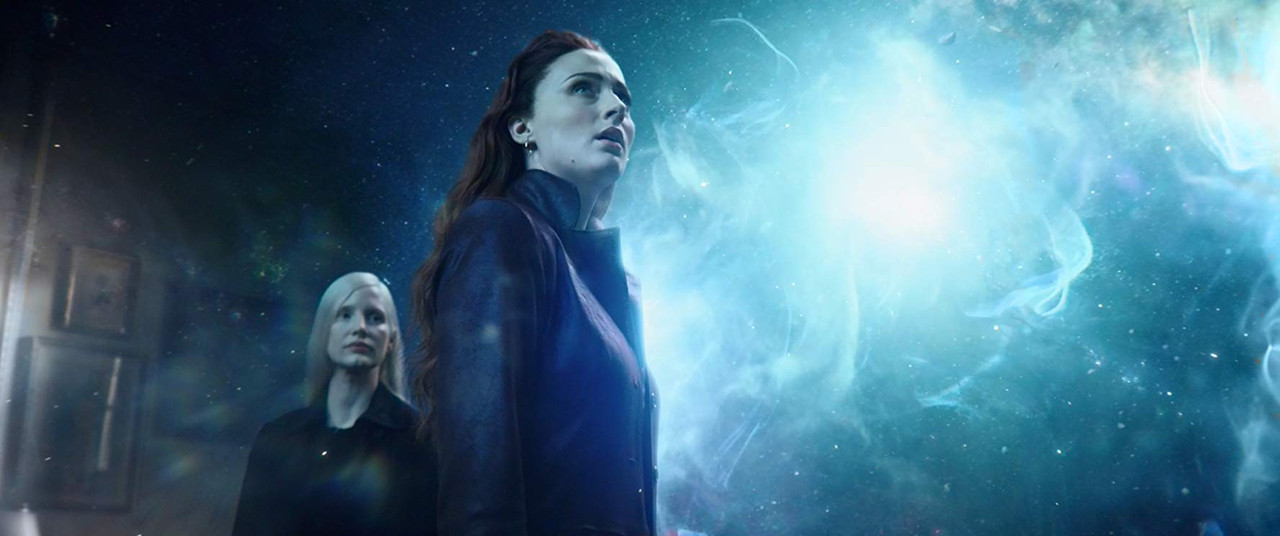
This is, unfortunately, notably true of Sophie Turner as Jean Grey, on whom the entire plot turns. Let’s forget that we clearly saw her Phoenix persona manifest at the end of Apocalypse (Simon Kinberg, who wrote both films and makes his directorial debut with this one, certainly has), here the power that she incubates after it crashes through her during a space rescue mission appears to be something that feeds on her pain. This is something we can infer from the story, but less often from Turner’s frequently blank-faced work. The relationship between her and Cyclops (Tye Sheridan), barely developed in the previous film, isn’t remotely convincing, and that too should be an emotional fulcrum for the film, especially in its third act. Scenes between Turner and Jessica Chastain should be compelling, with Chastain at first seeming to be a mentor figure but lusting after the power that Jean contains, unfortunately these moments too are painfully dull. There is likely a lot of material with Chastain on the cutting room floor, all that remains is the barest hint of a motive and an origin for her character, but she is hopelessly under served by what remains of her story arc, and looks like she’s well aware of the fact.

Aside from the cast appearing bored and the obvious swathes of cuts to get this down to 114 minutes (Apocalypse and Days of Future Past both came in around 140), there are sticking point in the form of the chasmic logic gaps in the timeline of these films. First Class was set in 1962 and with each film set roughly a decade later we have now ended up in 1992. Obviously some mutants age more slowly thanks to their powers (this was something specified about Mystique), but most don’t and we’ve previously seen that Professor X and Magneto (again played by James McAvoy and Michael Fassbender) clearly don’t. They should both be around 60 at the time of this film and there is no effort made to give them or any of the other characters any sort of ageing make up. Obviously heavy prosthetics aren’t much fun to wear and impact on your shooting schedule, but a little nod in the direction of making them look, at the very least, older than they did thirty years ago in movie time, would be both welcome and much less distracting.


Kinberg’s work feels as nonchalant as that of most of his cast. The writing is functional at best. He struggles to combine the various storylines interestingly and hardly manages to find any personality in the characters, especially the newer ones. As a director, he makes a resolutely middle of the road debut. This is too expensive a film with too big and professional a crew to look anything other than proficient, but Kinberg stamps no directorial authority on it, finds no interesting or provocative images, there’s nothing individual in his approach to either character or action. 

There are a few minor plus sides here. Michael Fassbender, even when disinterested, is too good an actor not to have a few compelling moments. Any emotional weight in the film comes from him in relation to the fate of a another character and the lengths it drives him to. The only person who seems to actually be enjoying himself is Kodi Smit-McPhee, whose performance as Nightcrawler is a much needed bright spot and whose powers, while not used as well as in X2’s opening sequence, lead to easily the film’s best action. While it’s neutered by the utter lack of stakes, there is at least some visceral enjoyment to be had from the climactic action set piece on a train, finally unleashing all the characters’ powers in an extended action sequence. 

That, sadly, is about all the good news. It’s not just that X-Men: Dark Phoenix is bad - though it is. The real disappointment is that after such a promising start for this cast and this section of the X-Men movie universe, this is the end. 19 years, a dozen films, and rather than the truly earned climax that the MCU’s first decade went out on, this series ends with a pitiful whimper.

May 9, 2016

Captain America: Civil War [12A] [2D]

Dir: Joe and Anthony Russo
Marvel's cinematic universe has, over the past eight years, reshaped the landscape of American cinema. Forget the long endangered idea of the standalone film, the standalone franchise is now a species on the watchlist. That's all down to the success of Marvel's interlocking superhero megafranchise, but what started out as a groundbreaking idea has now begun, for me at least, to devolve into predictable formula. That said, the third in the Captain America series always had my interest piqued, because the two previous films focused on Steve Rogers are easily the best the MCU has had to offer so far, and I only became more intrigued when my favourite superhero of all, Spider-Man, was added to the roster, thanks to a deal with Sony.

The film adapts the comic miniseries of the same title, keeping the same central idea, but changing the specifics of the central conflict, from a fight over superhero registration and the preservation of secret identities to a disagreement over a UN resolution to control Avengers interventions. Captain America (Chris Evans) and Iron Man (Robert Downey Jr) find themselves leading teams on opposite sides of this issue and fighting over that and over Steve's friend Bucky (Sebastian Stan), whose Winter Soldier persona may have been awakened again.

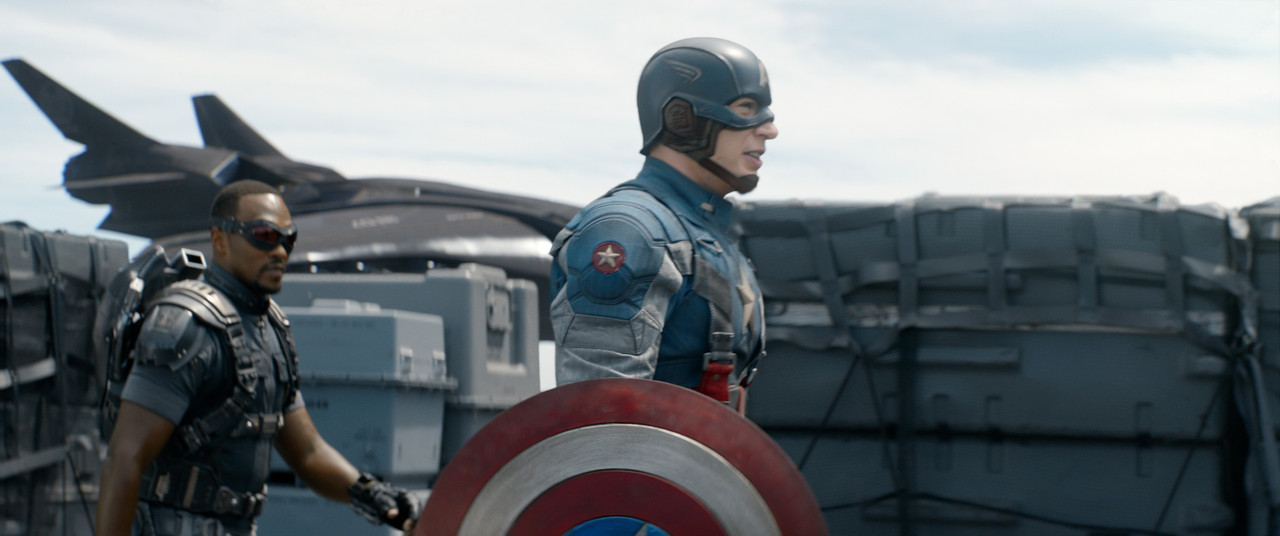
The strengths of the Captain America series so far largely continue with this installment. Chief among them is Chris Evans, who continues to lend solid presence and bring a measure of inner life to a character who could be played as little more than a square jaw and a circular shield. This film sees Steve much more adjusted to the 21st century, but the script ties back his motivations to a moral code that comes from when the character grew up. The connection of this to a funeral, early in the film, is a little on the nose, but Evans makes it work. Evans also continues to have chemistry with his co-stars, bouncing off Anthony Mackie's Falcon, Scarlett Johansson's Black Widow and Emily VanCamp's Sharon Carter especially well.

The series also continues to deal in a more complex set of morals than many superhero films, tying the legislation that sets the Avengers against each other to the unanticipated results of their actions grounds what is an outlandish set of characters and events in some sort of recognisable world - the debate being framed here being one that, in other forms, is very live on the world stage. However, while these issues are serious, the script and the actors manage to find a tone that allows the film to acknowledge them while still remaining fun, a circle that, by all accounts, DC has yet to square.

A blockbuster shouldn't live or die on its set pieces, but it certainly helps if they're strong, and Civil War has a couple of standouts. The opening action scene, which feels, in Indiana Jones tradition, like the ending of a movie you missed, gets things off to en exciting start. Frank Grillo is great value as Crossbones and while the action is over cut at times Joe and Anthony Russo do manage to keep a degree of sense in the geography of a scene involving a lot of characters and some scattered pockets of action. It's also a good showcase for the action style, which again hits a sweet spot between comic book physics and something that looks genuine enough to not feel like you're watching a computer game.


The film truly hits high gear with its central set piece, which delivers on the hype of two groups of heroes facing off against each other. It's extremely well shot and edited, with the cutting rhythm slowing down for these twenty minutes, allowing us to get more caught up in the conflict. Best of all, this doesn't feel like the film breaking for a fight, the Russos and writers Christopher Markus and Stephen McFeely never lose sight of the conflict between and personalities of their characters. The stakes feel high because they feel personal, but that also informs the way the fight is staged, with characters often clearly holding back. It's another way that Civil War acknowledges its themes.

With such a large cast of characters, it's fortunate that most of the ensemble is on form. There are still some characterisation issues; Hawkeye, in particular, still lacks definition and the quippy dialogue could perhaps be restricted, as when most of the characters hit that register it sounds less like a character beat and more like Marvel's house style asserting itself. That said, there is much more good work here than bad. Elizabeth Olsen and Paul Bettany, as Scarlet Witch and The Vision, have some strong scenes together and an interesting relationship. 

Of the new characters, Chadwick Boseman makes a strong impression as Black Panther, there's a rage simmering in the character that could make his solo film interesting. Daniel Bruhl is a fine actor, but until the closing scenes he's not given much to work with as Zemo, but those closing scenes do present an interesting take on villainy and are overall more interesting than another city destroying smackdown. The standout, however, is Tom Holland's take on Spider-Man. After the calamitously awful Amazing Spider-Man franchise, Marvel's most famous character was in desperate need of a(nother) reboot and, in the roughly ten minutes of screentime he has here, he's not only got that but what is potentially the defining cinematic take on the character. Tobey Maguire and Andrew Garfield occasionally got the wit of Spidey down, occasionally captured his intellect, occasionally gave us his nerdy personality. Holland and the Russos nail all this, and more besides, from the first instant we see Peter. As a lifelong Spidey fan, every second he's on screen here is a joy. I can't wait for Spider-Man: Homecoming next year.

All this said, Civil War is not entirely, perhaps not even mostly, a triumph. In some ways it's not the fault of this film, but of the series it is a part of. This doesn't feel like a standalone Captain America film. One of the great strengths of the first two films in this franchise within a franchise was that you could watch them independently of the rest of the MCU. More than that, each of them plugged the character into a genre that felt like something other than a standard superhero film; first a second world war men on a mission movie, then a 70's paranoid spy thriller. This is the first time in the series that Captain America has felt like just another superhero film. A fun one, one with a few ideas, sure, but it has much more of an assembly line feel. This feeling is only added to by the overwhelming sense that, rather than Captain America 3, this is Avengers 2.5, Black Panther 0 and Spider-Man 0, all rolled into one. This episodic structure and the constant trailering of things yet to come is making the MCU, for me, feel extremely televisual, despite its scale.


Civil War is also a long film, at 144 minutes it's only 8 minutes longer than The Winter Soldier, but it feels like more than that. After the opening action scene in Nigeria there is a lot of exposition to get through and it can be slow going. To my surprise, I found this particularly true thanks to the large role that Robert Downey Jr plays here. Downey has now been playing Tony Stark for the best part of a decade, and there are more than a handful of moments here where I felt like I could tell, like he seemed less engaged than usual. He's still not bad, and when he's playing off Tom Holland's Peter Parker and in the film's very personal final fight he's great, but for the first hour I thought he, like me, was finding the process of setting the pieces a bit drawn out.

While the bigger set pieces are great, some of the other action is less engaging. Smaller action beats seem to work on a much faster cutting pattern and sometimes I found myself disengaged, wanting a better and longer view of the film's many punch ups. It's not as if the Russos have suddenly turned into Paul Greengrass, but just a little pulling back on the pace of some of the action would have made a world of difference for me.

Ultimately, fun as it often is and much as there is, at times, to recommend here, Civil War is the weakest of the Captain America series. For me that's mainly because it exists more in service of the MCU than of the Captain America films within it. I kept feeling I was missing things here, having not seen Avengers: Age of Ultron and I suspect that, while bits of the MCU continue to interest me, that's something that will only become more acute and more to the series' detriment, as Phases 3 and 4 run on.
★★

Jan 18, 2016

A Week in Movies: January 11th -17th 2016

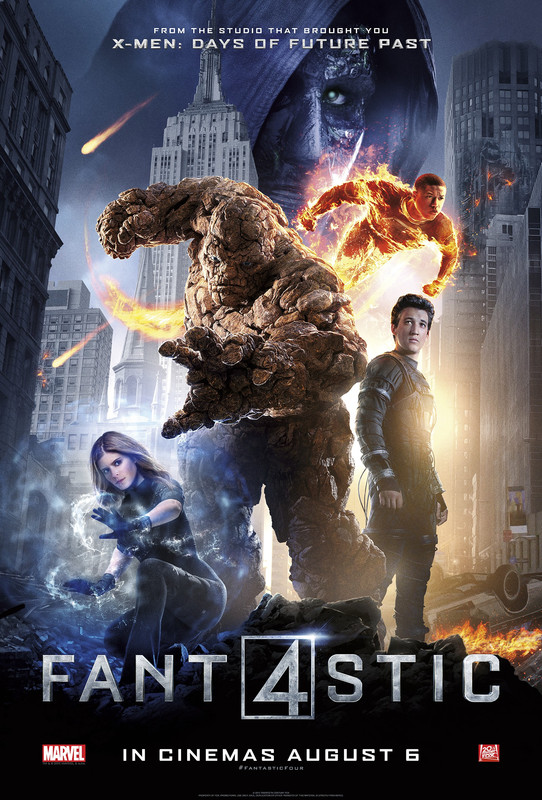
Fantastic Four [2015] [12]
Dir: Josh Trank
The Fantastic Four comic series has a fascinating big screen history, if only because, of four attempts to put the characters on screen, not a single one has managed to capture anything that seemed to explain why it was worth trying in the first place. The first version, never officially released, was a cynical rights holding move by Roger Corman. It was made for $7 and hot meals for the cast (citation needed) and is about as awful as you'd imagine. It's also by far the best version. This was followed by 20th Century Fox's first attempt at starting a franchise, with director Tim Story helming both Fantastic Four and its sequel Rise of the Silver Surfer. They were successful to a point, but horrendously miscast and entirely forgettable.

That brings us to this film... a cynical rights holding move by 20th Century Fox, who engaged Josh Trank, director of cult found footage superhero movie Chronicle, to make his big budget début. To say that the result, from production to final product, was and is a total clusterfuck is perhaps to be too kind. However, that doesn't mean that Fantastic Four 2015 - as a thing if not as a piece of drama - isn't interesting.

Fantastic Four fails at just about every level possible, and while it is easy to see that (and indeed when) the film was largely wrested from Trank's control, there is still plenty of blame to go around. It is not hard to see why executives would have thought that this film needed to be taken away from its director and his creative team. Throughout it seems imbued with a catastrophic lack of energy. The screenplay gorges itself on setup. To begin with, that doesn't work, partly because it suggests that 2014 Miles Teller (26) and Jamie Bell (28) are 17 or 18, which is laughable, but also because the backstory establishes very little about the characters. 

A screenwriter generally has to start with a blank page, that's not the case here, Trank and his co-writers have 50 years of comics to draw on, but what they come up with largely remains a blank page. Reed Richards (Teller) and Ben Grimm (Bell) are bland presences. Reed's one trait is that he's nerdy, which certainly marks him out among scientists working on inter-dimensional travel and Ben seems stripped even of his comic book toughness. Michael B. Jordan does what he can with the one note irresponsible daredevil he has to play as Johnny Storm, and contributes the film's best performance by coasting on his innate charisma. Kate Mara draws the short straw. Her Sue is consistently relegated to the back seat, she's pitched as a brilliant scientist but her biggest contribution to the mission that sends the team to another dimension seems to be in making their suits. Yes, it's more complicated than just having her do the sewing, but the symbolism is as loud as it is unintentional.

The first 40 minutes, before the characters travel to the other dimension (which is where, in this telling, they get their powers) should be setting up the four as individuals and as a team but - aside from a few unconvincing glimpses of Reed and Sue being attracted to each other so Toby Kebbel's Victor Von Doom can add jealously to ambition and generally being an asshole on the list of reasons he's the villain - it does no such thing. If Trank and the screenwriters had attempted to colour these characters in then the attempt at a down to earth, credible, take on this superhero origin story might have worked, but because they are so loosely sketched it is like watching them move cardboard cutouts around while explaining what's happening.

The tedious screenplay leads to another hobbling problem: the cast seem bored. Jordan at least tries to inject some exuberance into proceedings, but the downbeat tone, weak dialogue and characters, and by the numbers progression seems to sap the life from Miles Teller and Kate Mara in particular. Reed Richards and Sue Storm are one of the most famous couples in the Marvel Universe. It's important that, even if we don't see them as a potential couple, we understand why Doom does. Nothing about their interactions - more redolent of two people who have just met and are trying to pass time in after school detention than a potential couple - makes this remotely credible.

This is also reflected in the film's visuals, which are the typical teal and orange tediousness that so many would be blockbusters seem to be required to use. Trank injects no personality into the visuals, nor into the film as a whole, the corporate mandate drips from every frame even before the abrupt shift that seems to signal the moment that Fox put their director on a leash. The effects are at least competent, with The Thing looking the best he has ever looked on screen (though Jamie Bell's voice is hilariously mismatched with the post-transformation Ben) and The Human Torch looks good thanks to some surprisingly decent CGI fire (still something many films can't do well). These things and other solid effects suggest the film's sky high budget and solid tech team, so it's odd to see a simple, glaring, error in the visuals. Kate Mara's wig is awful, absolutely awful. How does something that basic slip past in a film of this scale? 

Ultimately I think it's - alongside the script and performances - an indication of a lack of passion that seems to pervade the film. The overwhelming impression is that of a company and a group of filmmakers working on a placeholder; something that will let them have a crack at doing this right in a couple of years time.

The film hits a lot of the expected beats: background, characters get powers, characters explore/moan about powers (in a sequence that could have been expanded upon quite interestingly, both in terms of its body horror and if it had engaged with politics that lay behind it, but which is dropped like a hot stone), but it does this without building up a villain. This is when the change in the film comes; as the third act opens a 'one year later' caption seems to end the film we've been watching (fine, I was bored) and start a new one, which is even more by the numbers and reintroduces Kebbell's Dr Doom. It's as if someone put a post it note in the screenplay that said 'insert generic end battle'.

The third act is an absolute mess. Doom's powers and motivation are ill defined, as is the way that the four, who he initially bats away with no seeming problem, should be able to defeat him (spoiler, it involves precisely no use of their apparently massive intellects). The plan that Doom uses to threaten the world is nonsense that feels like back of a napkin screenwriting, and the fact that the film to this point has barely engaged with the real world means that it has absolutely no weight or connection to anything of greater scale. I can see why execs wanted to take this boring and underpowered film away from Josh Trank, but you'd like to have imagined that if they were going to bother, they'd have ideas that would improve the thing.

Fantastic Four is a dull and derivative superhero film, made with absolutely no passion, but as a demonstration of how the modern Hollywood system works (or doesn't work) it is fascinating. Still, I'd rather see an honest documentary about it than this film itself.

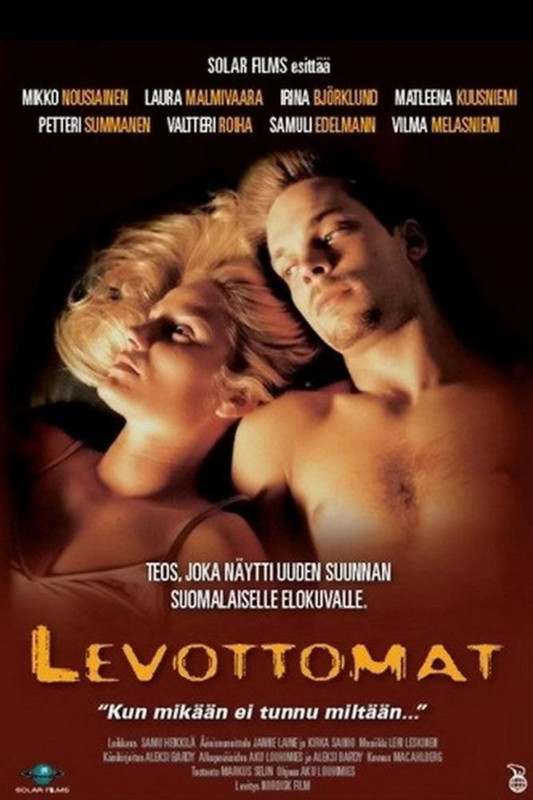
Levottomat
Dir: Aku Louhimies
The first of a loose trilogy, linked thematically rather than by characters, filmmakers or story, Levottomat was the college project of Aku Louhimies, writer Aleksi Bardy and editor Samu Heikkilä. For a group of young filmmakers, as a graduation piece, this is accomplished and confident stuff, but it does also betray its origins at times. 

The film centres on Ari (Mikko Nousiainen), a paramedic in his mid-twenties working in Turku, Finland. Ari remains largely emotionally disconnected from the world, especially when it comes to relationships, in which he has a policy of never sleeping with the same woman twice. That begins to change when he meets Tiina (Laura Malmivaara). Ari tells her what he's like, but Tiina wants to try to make it work and eventually introduces Ari to her friends, including free-spirited Ilona (Matleena Kuusniemi) and theology student and trainee priest Hanna-Rikka (Irina Björklund), both of whom Ari has affairs with.

The title Levottomat is translated literally in the credits as 'Restless', that's certainly a neat encapsulation of the state many of the characters are in, either as the film starts or as the events of the plot unfold. Ari's restlessness comes in his inability to commit or even to truly feel any emotion. Tiina's restlessness comes from Ari's and the fact that he doesn't seem to have the emotional capacity to be in the relationship she wants. Hanna-Rikka's restlessness comes from reconciling her belief with much of what she sees around her and with her own feelings for Ari. The theme echoes in all of the other characters as well, perhaps to too great a degree.

When it works, Levottomat is extremely engaging. The dynamic between Tiina and her friends (a group also including Ilona and Hanna-Rikka's boyfriends, played by Petteri Summanen and Valtteri Roiha) is convincing, as is the way that they are initially a little suspicious of Ari, but slowly allow him into the group (though this does begin to strain credulity in the third act). Having six main characters does mean that some go underdeveloped, with less time given to the boyfriends and to Hanna-Rikka's religion. I think the implication is that as Hanna-Rikka struggles more to contain her emotions she turns more towards her religion, but early on this isn't given the import that would allow it to develop more as a theme in her scenes. There is an interesting bit of background here, perhaps coincidental, perhaps not, in that Laura Malmivaara, who married Louhimies in 2003, studied theology for a time before becoming an actress.

Whatever the strengths and weaknesses of the writing, the acting is largely excellent. It would be easy to play Ari's detachment as robotic, emotionless, but Mikko Nousiainen brings rather more to it than that. There is a sense of emptiness at the heart of his performance, but it's something in the character rather than in his acting. Aside from Nousiainen it is largely the film's women who have the most developed roles, and they all acquit themselves well. Laura Malmivaara is affecting as Tiina, making us feel for her even as we know that the emotional cost of her decision to pursue Ari is inevitable. As the flightier Ilona, Matleena Kuusniemi is sexy and seductive, but never overblown. It would be easy to play Ilona as a one note seductress out to score with Ari, but the script and performance are somewhat smarter than that. While, as I mentioned above, Hanna-Rikka isn't quite so well developed as some of the other characters, Irina Bjorklund still makes her an interesting presence from scene to scene. If her performance comes off weaker it's because her characterisation, as written, is sometimes slapdash and developed in fits and starts. That said, she's the most interesting character by the third act of the film and probably the one I'd most like an update on, 16 years later.

At times Louhimies' film is overstuffed. For instance, the scene in which, having been thrown out by Tiina, Ari goes to stay with his paramedic friend, only to find him drunk and with a gun in his mouth. This scene serves only one plot purpose (which itself could easily be lost) and frankly, it seems a bit much. Levottomat is not a terribly happy film, but there seems little purpose to piling these 10 minutes of misery on, particularly as they never rate a subsequent mention.

As much as it's about the complexities of the relationships and the emotions of this group of characters, Levottomat is about sex, and it approaches this theme with what is a typical Scandinavian frankness, at times bordering on hardcore. There are nude scenes that tend toward titillation, but for the most part these are character scenes, often about the emptiness for Ari of what ought to be a moment of connection. The best of these scenes may be the one between Ari and Hanna-Rikka. I got the sense that Hanna-Rikka is trying to adopt some of Ari's detachment, but finds that she can't (something that comes through strongly in the next scene).

For the first 80 minutes or so, Louhimies keeps everything grounded. His technique isn't sophisticated, but it's unobtrusive enough to serve the story. In the third act, however, as the characters convene for Ilona's wedding, things take a turn for the melodramatic and a few cringeworthy scenes ensue. This is the only time the actors seem out of sorts (Malmivaara in particular overacts a few late moments), but even here there are strong moments, such as a quiet scene between Nousiainen and Bjorklund.

On the whole, Levottomat is flawed, it feels like a debut, but there's also a degree to which it's okay for the film to be messy, because it's about people whose lives are messy. I'd like to see what Louhimies went on to from here, because for all the bits that clunk there is a lot of promise, especially in his work with actors. If you can, this is worth tracking down.

Apr 25, 2014

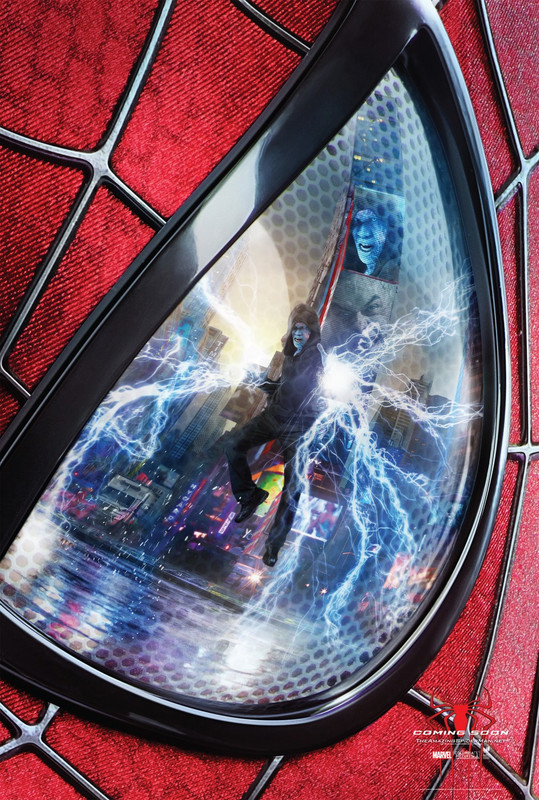
The Amazing Spider-Man 2 [2D] [12A]

Dir: Marc Webb
As a lifelong Spider-Man fan I was surprised that anyone even remotely liked Marc Webb's 2012 reboot of the franchise.  I hated it, finding it boring and, more importantly, a betrayal of almost everything that I've always loved about Spidey and his alter-ego Peter Parker.  The Amazing Spider-Man 2 is a better film than its predecessor, it almost had to be, but it's also a more frustrating film because for a few brief moments it gets Spidey as right as he's ever been on screen, but this only makes the many moments that don't work stand out even more.

The film picks up a few months after the first ends with Peter (Andrew Garfield) and his girlfriend Gwen Stacy (Emma Stone) graduating from high school (despite the fact that Garfield is quite obviously in his late twenties).  Peter seems comfortable with his dual identity as Spider-Man, but for the promise, he made to Gwen's father not to involve her and thus put her in danger.  Danger soon arrives in the forms of Max Dillon; an Oscorp worker transformed into Electro in an accident and Peter's old friend Harry Osborn (Dane DeHaan), desperate for a cure for the disease that killed his father.

Ghostly fathers hang heavy over this film.  Peter's parents were introduced in the previous film and there is more background on them here, Gwen's father died in the fight with the Lizard in the last film and now Peter is seeing him everywhere and an important shift in Harry Osborn's character is caused by his father's death.  This isn't a bad thematic idea; three central characters drawn together and set apart by the different ways in which they deal with the same trauma, but the film never really exploits the possibilities, instead using these ghosts merely as cheap dramatic motivators.  This is especially evident in the case of Gwen's father.  All that Denis Leary has to do in this film is stand around silently, basically expressionless.  This, however, may be preferable to what the film chooses to do with Peter's father (an admittedly well cast Campbell Scott).  One of the major problems with the first film was that it introduced Peter's father and suggested that he may have had a role in why Peter became Spider-Man, but never really did anything with it.  This time Webb goes in the opposite direction, slathering on exposition, along with an utterly pointless opening action scene, to make more use of Richard Parker.  The problem is that all it really adds is running time.  The film never finds the thematic weight it's clearly reaching for here, and instead this storyline only complicates the film's exposition.

Jamming in the storyline involving Peter's father means that other things go underexplored, and this is especially felt when it comes to the (too many) villains.  It's almost universally agreed that Sam Raimi's Spider-Man 3 suffered from an overabundance of villains, and so it is odd that this film should try so hard to replicate that problem.  True, Paul Giamatti's Rhino is much less of a presence than you might expect, but the uneven split of screentime between Electro and the Harry Osborn version of Green Goblin serves neither character very well and combining it with the relationship arc between Peter and Gwen and stories involving Richard Parker and an increasingly peripheral Aunt May (Sally Field) means that all the individual strands feel rushed.

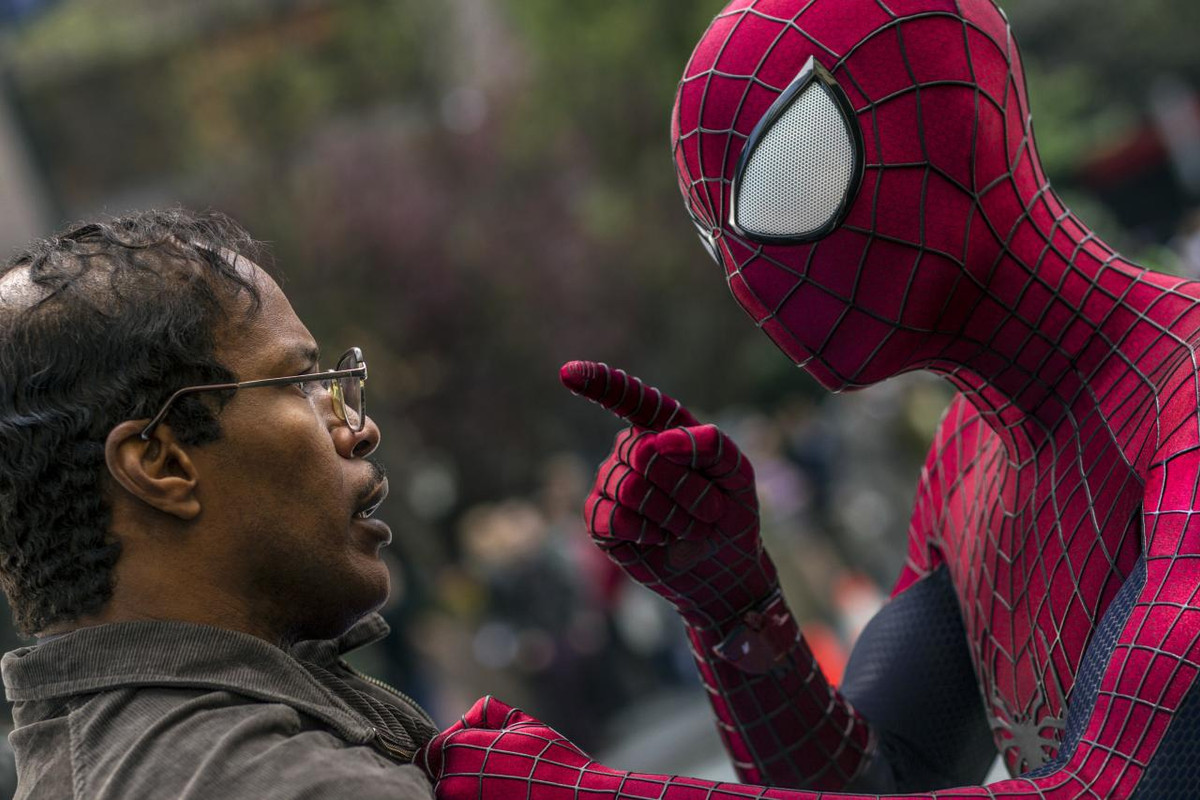
The jam packed story is one of many reasons Electro doesn't work.  Jamie Foxx always sounded like strange casting in the role and that's not something that dissipates as you watch his performance.  In the early going he seems to be channeling Jim Carrey's pre-transformation Riddler from Batman Forever as a brilliant but nerdy scientist with an obsessive love of the film's hero.  It's an odd fit for an actor who gives off as much of a cool vibe as Foxx does, and even tragically awful hair doesn't change that.  However, this is not the extent of the film's problems when it comes to Electro.  

Two issues raise their heads repeatedly.  The first is that the action scenes involving the character, for all their spectacular use of CGI, have some bizarrely awful filmmaking choices thrust upon them.  This is most notable when it comes to the sound design.  During Electro's first confrontation with Spidey, Hans Zimmer's score suddenly goes all faux dubstep, while a sample of Foxx's voice whispers away in the background.  This is clearly Dillon's broken psyche talking him up to his villainy as Electro, but combined with the score and the the flashy visuals, and especially because Foxx feels out of sorts in the role, it ends up more like the awful vocals to a dreadful music video that has somehow spliced itself into this superhero movie.  The other serious problem when it comes to Electro is this: he's a distraction.  There is a much more interesting villain developing in the form of Dane DeHaan's Harry Osborn, his motivations run deeper, his connection to Spidey is is personal and by the end of the film he's pretty formidable (even if he does look like Harry from Spider-Man 3 mated with Sloth from The Goonies), but it seems the film is unwilling to ask its audience's patience instead feeling it has to dish up action scenes at regular intervals to keep them engaged.  The Electro scenes feel as though they are simply marking time, doing little to advance the plot or the characters and this makes them boring even at their most spectacular.

One thing that has been mentioned as both a positive and a great step on from Raimi's films is the relationship between Peter and Gwen, and while I found there was more chemistry this time I still don't see the depth that people find in this relationship.  I found Gwen's character woefully underdeveloped in the previous film and little has changed here.  Her apparent scientific brilliance is a plot crutch at best and while she has a certain snarky charm there's not much personality there.  This, for me, is something I often find with Emma Stone, I suspect I'd like her if we met, she seems fun and she's certainly attractive, but all I see when I watch her on screen is Emma Stone.  Gwen Stacy was never the deepest of characters, but the actress never disappears for me and that undermines the whole relationship thread.

Much more impressive in the acting stakes is Dane DeHaan, bringing an indie cred to the role of Harry Osborn.  He's agreeably slimy from the start and while this does make you wonder why he and Peter were ever friends it largely works for the character's arc.  DeHaan is the only actor to really find and chart a great evolution in his character and he does it with such limited screentime that you can't help but wish some the side stories were shunted aside in his favour.  It will be interesting to see where he takes Harry in the future.

The worst aspect of the previous film was its depiction of Peter - to put it bluntly, he was an arsehole - but that has been fixed here.  Andrew Garfield seems more comfortable with the character this time around and the screenplay comes closer to finding the line between nerdy and charming that Peter has always walked.  While it doesn't always get him right, Amazing Spider-Man 2 does also have perhaps the two best Spider-Man scenes I've yet seen, it's unfortunate that they are at opposite ends of the film, but at least they exist.  Both times that we see Spidey squaring off against Rhino something seems to click.  The forced wisecracking of the last film (and moments of Raimi's trilogy) goes away and there he is; the sharp, sarcastic, funny, cool Spider-Man I've loved for nearly 30 years.  Unfortunately, during the long and tedious middle section of the film this Spidey only shows up intermittently; there will be a few cool lines here and there, but never a whole scene that nails it the way that these two do.  Another way in which the film comes much closer to getting Spider-Man right is with the costume.  The previous film's dark redesign always felt off for me and I was glad to see a return to a brighter and more classical look, reminiscent of John Romita Sr's art.

The other thing that works is the film's ending.  The big battle with Electro is something of an anti-climax, but one key decision that many Spidey fans were tipped off to by a certain costume choice has the potential to be a game-changer in terms of the dynamics and personal stakes of the series.  Even as it was happening I was silently saying 'don't take it back' and the moment certainly seems to have a real finality about it.  Hopefully, this will end up developing the series in interesting ways in both Sinister Six and Amazing Spider-Man 3.

Amazing Spider-Man 2 addresses some of the problems of its predecessor, but it shares many of them too.  The tone is sometimes uncertain (especially in the scenes between Peter and Aunt May), and there are, again, far too many storylines and characters, which contributes to another pressing issue: this doesn't feel like a film in its own right.  We're used to the first film in a superhero franchise being a glorified trailer to set the table for its own sequel, but that seems to be exactly what Amazing Spider-Man 2 is doing as well.  Thanks to the success of the last film and this film's presumed even bigger blockbuster status, Spider-Man is about to become a mega franchise along the lines of Marvel's Avengers films.  This isn't a terrible idea, but in practice it means that Amazing Spider-Man 2 ends up as a 140 minute trailer for its own sequels rather than a standalone film.  Everything that is interesting here (and much that isn't) is mere setup to be paid off down the line.  Only the dull Electro storyline comes to an end, and even that is questionable in its finality.  One of the most naked bits of setup is the appearance of Felicity Jones as Harry's secretary Felecia, thankless in this film but catnip for the fans for next time.  Setup is great when combined with a satisfyingly self-contained story (see Captain America: The Winter Soldier), but here the final scene only confirms the unsatisfying impression that this simply isn't a standalone film.

I wish I had liked The Amazing Spider-Man 2 more, because in it there are flashes of a movie that the 8 year old Spidey obsessive me would have loved, but ultimately too much of it is either marking time or setting up a franchise and too little of it is concerned with telling a focused and exciting story with these characters.

Mar 30, 2014

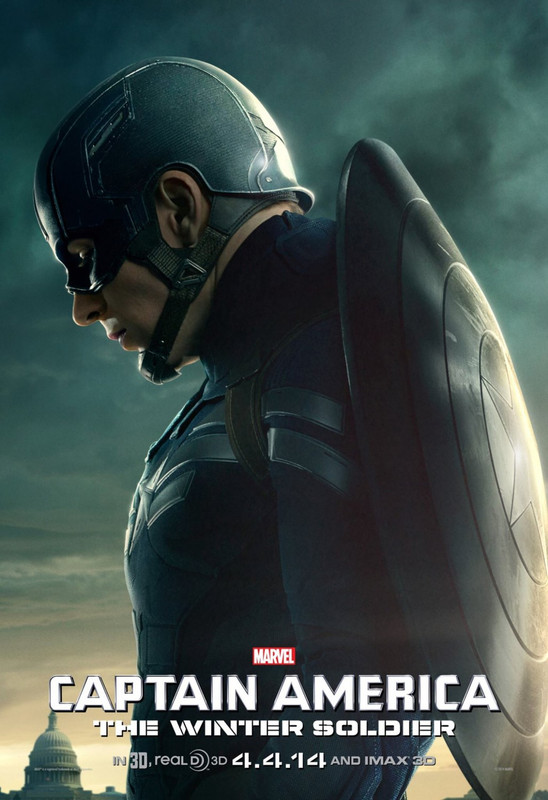
Captain America: The Winter Soldier [12A] [2D]

Dir: Anthony Russo / Joe Russo
For a series with such a united vision and tone, the Marvel Studios films, each phase of which builds to an Avengers film, are incredibly variable in quality.  Coming off the back of Thor: The Dark World, which vacillated between boring and screamingly stupid, only coming to life when Loki was on screen, Captain America: The Winter Soldier certainly has an easy job in following the last Marvel film, but following Captain America: The First Avenger is a different matter.  In amongst the mixed bag of Phase One, Joe Johnston's World War 2 set origin story for Steve Rogers [Captain America] was easily the best, boasting great action, strong dialogue and an ending that didn't embarrass itself when echoing A Matter of Life and Death.  

Only addressing the events of Avengers Assemble briefly and ignoring Iron Man 3 and Thor: The Dark World, The Winter Soldier picks up with Captain America (Chris Evans) still adjusting to his role at SHIELD, which seems to be that of an operative; a super-powered one, but essentially a grunt.  After his latest mission, Rogers is shown what Nick Fury (Samuel L. Jackson) and SHIELD have been working on; super-intelligent drones that can find and prioritise targets for themselves, apparently supposed to take human error out of the equation.  However, when Fury is targeted by an assassin named The Winter Soldier and SHIELD turns on Captain America, Rogers is forced on the run with Black Widow (Scarlett Johansson) and new ally Falcon (Anthony Mackie).

Captain America: The Winter Soldier is a curious hybrid.  It bows frequently to the requirements of being what it is; a $150 million plus blockbuster and an integral part of a 21st century action franchise, but in between those moments, while it is set in the contemporary world, it often has the feel of something more classical.  Where The First Avenger was essentially a superhero film crossed with a World War 2 men on a mission movie, The Winter Soldier has an air of 70's conspiracy thriller to it, not least in the casting of Robert Redford as a senator.  In between all of these considerations, there isn't a huge amount of room for character development, but there are some sharp lines and a few well-observed moments about Rogers' continued struggle to fit into the 21st century. 

Happily, the two most significant new characters; Redford's Alexander Pierce and Anthony Mackie's Falcon, do make an impression, though in both cases this is perhaps more down to the actors, who, different as they are, do share that indefinable quality of onscreen charisma that just makes them people that you want to watch.  Redford's role in proceedings is obvious a bit too early on, but it's nice to see the veteran star keep things grounded.  In a lot of ways, the central conflict in The Winter Soldier is one of political philosophy and Redford articulates it convincingly.  Mackie's character and the founding of his friendship with Rogers are established well in the film's opening scene.  The film forgets about him for much of the first and second acts, but the easy camaraderie of that scene feeds in when he reappears, and come the last hour (the film is 136 minutes) he is a key figure,  with some strong action scenes and bags of promise for the next film.

The returning cast pick up where they left off, comfortably falling into their roles once more.  Chris Evans is probably not the most gifted or versatile of actors, but he's well cast here; he has the good looks, the all-American charm and the air of straightforward decency to convince as Captain America, but here that straightforward moral compass comes into play in a more interesting way, because it is called into question whether it can fit into or address threats in the 21st century.  It's not a theme that either the script or the performance play up hugely, but it's there and welcome in both.

In an expanded role, Samuel L. Jackson continues to essentially play Samuel L. Jackson (with an eyepatch) as Nick Fury, but it works well for the character.  The disappointment continues to be Scarlett Johansson.  I don't know what it is about Johansson, but I just don't find her very interesting either as an actress or as the still woefully underdeveloped Black Widow, who adds up, still, to little more than a leather catsuit and kicking skills.  There are attempts at developing her relationship with Rogers here, but those are the scenes that fall flat for me and she, of all the characters in the Avengers group of franchises, is the least engaging and least individual.  For all her lack of screentime, I continue to find Cobie Smulders' Maria Hill (who has a bit more to do here) a much more interesting presence than Black Widow.

Of course The Winter Soldier is an action film and in that respect, it certainly doesn't disappoint.  I wouldn't have expected it from the guys behind You, Me and Dupree, but here the Russos have delivered one of the best executed mainstream action films in a long time.  Yes the camera moves quite a bit and the cutting tends to be fast, but there is a logical flow to the action, a sense of space that grounds even some of the more outrageously physics defying moments in the setpieces.  What is most pleasing about the action scenes is the directors' willingness to sit back and take a wider view of the fighting.  This is especially effective during the opening scene, when Cap has to face off against a henchman with some nifty martial arts skills and during the several throwdowns with the Winter Soldier (whose identity I will not be spoiling here).  There seems to be an understanding that close up action has impact, and has its place, but that without stepping back the scenes will be nonsensical.  With this understanding and the lack of the barrier of 3D glasses I found myself entirely wrapped up in the varied and exciting action scenes.

Once again, Captain America has thrown down a gauntlet to the rest of the Marvel franchises, it's exciting and involving, has a decent amount of wit and some intelligent things to say about the modern world, but never lets the commentary overwhelm the sense of fun.  It even manages to seed a few things for the upcoming films (Dr. Strange, for instance) without clunking.  Black Widow is a sticking point for me, but even with that said this is probably the best Marvel Studios film to date and will be a tough benchmark for the upcoming films to match.