Showing posts with label Marvel. Show all posts

Apr 5, 2022

Spider-Man: No Way Home [12]

Dir: Jon Watts 
There have been many tries at adapting Spider-Man to the screen. Most have strengths, but all have their weaknesses. Sam Raimi’s films got Peter entirely right, with Tobey Maguire perfectly cast, but Spider-Man’s wisecracking wit got left behind somewhat. While Kirsten Dunst was good, the screenplays sanded off Mary Jane’s edges, and often leaned into cheese. The second of Raimi’s trilogy remains a hugely entertaining blockbuster, but even that one suffers from the wider problems of its franchise. I hate the Amazing Spider-Man films. Andrew Garfield clearly earnestly wanted to do the character justice, but only a couple of scenes throughout his tenure capture the character properly, and the problems are legion (reviews here and here). 

The Marvel Cinematic Universe initially couldn’t use Spider-Man but, with rights issues negotiated, he finally showed up, in the form of Tom Holland, for Captain America: Civil War, before the MCU embarked on what has become the Home trilogy of films. Like the other franchises centering on the character, it’s had its ups and downs. The first film, Homecoming, confirms what Civil War suggested: Tom Holland is a great choice, and this time not just as Peter Parker. For the first time, that film consistently nails down the persona of Peter’s Spider-Man; a witty kid who has a quip ready for every occasion. We get the sense here that the Spider-Man costume empowers him to that end, drawing a better-defined distinction between Peter in and out of costume than ever before. However, it’s not entirely a Spider-Man film. Far too much time is spent in service of the larger MCU, especially of featuring Iron Man. The film is at its best when Peter is doing his ‘friendly neighbourhood Spider-Man’ thing, and particularly when he’s in his own costume. The suit that Tony Stark made for him undermines Peter’s trademark intellect and ingenuity by, first of all, having to be something he got from another brilliant scientist, and secondly by doing too much for him. The sequel, Far From Home, doubles down on these problems while also stripping out much of Spidey’s wit. The use of Mysterio’s illusions is fantastic in a couple of late action scenes, but otherwise, it’s a weak film. 

That brings us to No Way Home. The marketing had me worried, the reliance on Dr Strange, the use of the Multiverse, which suggested nothing so much as a desperate attempt to make a live action version of Into The Spiderverse (still, hands down, the greatest Spider-Man film). Happily, this is easily the best of the MCU’s Spider-Man series, and probably one of the best films to feature the character. 

No Way Home picks up directly after the ending of Far From Home. Peter’s secret identity has been revealed to the world by J. Jonah Jameson (JK Simmons, reprising the role from the Raimi series, only this time as an Alex Jones style ranting commentator). This has major repercussions, as Spider-Man is thought by many to have murdered Mysterio, and the effects reverberate onto Peter’s friend Ned (Jacob Batalon), his girlfriend MJ (Zendaya), and his aunt May (Marisa Tomei). Most consequentially, the controversy means that Peter, Ned and MJ are all rejected from what should have been almost sure thing places at MIT. Wanting to set things right, Peter goes to Dr Strange (Benedict Cumberbatch) to ask him to cast a spell that will make people forget that he is Spider-Man. In his haste, he makes Strange change the spell so many times as it is in progress that it goes wrong, creating a crack in the multiverse that lets in anyone who knows, in any universe, that Peter is Spider-Man. 

I’m sorry for that long introduction, but it was important to set the pieces here, because that crack in the Multiverse pulls in many of the villains from the earlier Spider-Man franchises. No Way Home is soaked in Spider-Man lore, both from the earlier films and from the comics (often drawing the earlier versions of the characters much closer to their source material). There is no way to cover this without spoilers, so if you’ve not seen the film yet, beware. 

The first 40 minutes of No Way Home are MCU Spider-Man as we’ve come to expect, in both good and bad ways. I struggled with the point of Ned in the first film in the trilogy. The writers struggled with the point of him in the second, saddling him with a romance so prosaic they wrote it out at the end of the film. Here though, the dynamic between Peter, Ned and MJ feels much more balanced. They’re not well established as a trio in the first two films, but this film depicts them as much closer. It’s a little clumsy, but well played. There’s a sense that an offscreen friendship is bleeding into the film, and we do get a little invested in them all going to college together. The consequences of Peter’s identity being discovered could have been heavier (perhaps an alternate version would have leaned into a certain cameo and given us a trial of Spider-Man narrative), but what does weigh on Peter feels authentically life-altering for a teenager. I buy into the idea of Peter, used to fixing things with superpowers, looking first for that kind of solution. As ever, the points at which the film has to service the expansion of the MCU are its weakest. Worse, you can barely tell a difference in tone between the writing of Dr Strange (or many other characters) and Peter, when it comes to wisecracking, which is a perennial problem for the series. Overall, the first act is fine, but nothing new. 

The bridge scene is when things kick into gear, with the appearance of Alfred Molina’s Dr. Octopus. Molina positively relishes the part, and Jon Watts stages an imaginative action scene, with the fact that Doc Ock’s tentacles are now fully CG giving them somewhat greater freedom. It’s also a well-written scene when it comes to Peter’s character; he’s curious about why this man has suddenly appeared and attacked him, but it also incorporates some of Spidey’s humour, especially in his delight when he discovers how the nanotech of the Iron Spider suit interacts with the tentacles. It’s a tremendously entertaining sequence that combines all the best qualities of Spider-Man. 

Bringing the old villains in one by one allows Watts and writers Chris McKenna and Erik Sommers the chance to do a soft reboot on them, fixing some issues that fans had with the original cinematic incarnations. Jamie Foxx still plays Electro, but he’s no longer the Edward Nygma knockoff of Amazing Spider-Man 2; his powers have given him a swagger that Foxx is much more comfortable with, while a late change in look gives hints of the original comic character’s lightning bolt mask, without going for the full silliness of that look. Similarly, the Green Goblin of the Raimi films is retconned a little. Willem Dafoe continues to play him with the same glee he had in 2002, but the Power Ranger mask is smashed early on, and Norman takes on a look much closer to the classic John Romita design, purple cowl intact. For someone who has always loved the character, it’s a near perfect mix of something credible within its world and preserving the comic book look. 

What works best about the film though is that while the fanservice is present and correct, it’s not what the film is about. With great power, every Spidey series tells us, comes great responsibility, and even before that phrase has been uttered in this continuity, that’s what this film has Peter embracing. It’s also worth noting that the twist on how that maxim is delivered here works well. It hit me emotionally, both because of an affection for the characters its between and how it pays indirect tribute to the way it’s usually shown. The villains Peter encounters may have been teleported in from other dimensions, but he feels a responsibility to them and to the other people in those dimensions not to simply kill these people, but to cure them: to send them back as the decent people they once were. It’s a great encapsulation of the main lesson of Spider-Man and just one of the ways that this—finally—is an MCU movie about Spidey himself. Dr Strange may facilitate the mechanics of the plot here, but this isn’t about Peter’s relationship to him, or his place in The Avengers the way the other films in this series are. This is a film about finally becoming the hero that his powers make it possible to be, whatever the consequences. It’s also a film about connection: to friends who are essentially family, to a parent like May and, of course, to the only people Peter knows who share his experience. 

Even though Andrew Garfield denied it repeatedly, it was always clear that he and Tobey Maguire would be reprising their roles, playing alternate Peter Parkers (Peters Parker?) What was a pleasing surprise to me was how substantial their roles are in terms of screentime and what they contribute. If the reclaiming of the old characters and the moving of them closer to the established lore is largely subtext, one scene with Garfield makes it supertext. In a pep talk the others comfort Garfield’s Parker as he does himself down—clearly a reference to the Amazing series' critical and fan reception. Garfield is great here, it seems that this is everything he ever wanted his Peter to be, and there are some lovely moments as he relates to older and younger versions of ‘himself’. His excitement at being along for this ride is both palpable and contagious. No, it doesn’t mean the  Amazing series is suddenly good. Maguire seems a little less sure about being back, but that works for his older and more reflective Peter. It makes me wonder if he’s still doing the superhero thing in his part of the multiverse. The reference to his MJ is sweet, but I do wish we’d seen Kirsten Dunst reprise her role. 

Pulling three Spideys and something close to a full Sinister Six together for the final action sequence does mean the film’s ending is busy, but it’s also pretty exciting and surprisingly easy to follow. Watts and team break the sequence into a series of mini setpieces, and the costumes and styles are distinctive enough that it doesn’t get lost which Spider-Man we’re following at any given time. The theme of responsibility, and of the cost Peter was trying to avoid, comes full circle with the ending (which also has one image that nods poignantly to the ending of Raimi’s first film). It’s here that I really felt the point of spending so much time with Ned in the two previous films. While Homecoming was a teen movie, the ending makes this one feel like a true coming of age story for Holland’s Peter. There’s an innocence the character used to have that we’ll likely never see again. 

No Way Home has many of the flaws familiar in MCU films. Ultimately it’s just as anonymous looking as any of them, and I don’t doubt that any of the Marvel directors could have delivered much the same movie, given the same second units. That said, this was never intended to be auteur cinema. If the MCU delivers films almost as a mechanical process, this one feels like it’s been delivered by a machine that has been tinkered with, retooled to work at its highest potential. It’s the MCU Spider-Man film I’d been hoping for, and while it’s not perfect (and hasn’t a single image as indelible as Spiderverse’s ‘falling upwards’ shot), that feels like as much as I could have asked of it. 
★★★★

Jul 3, 2019

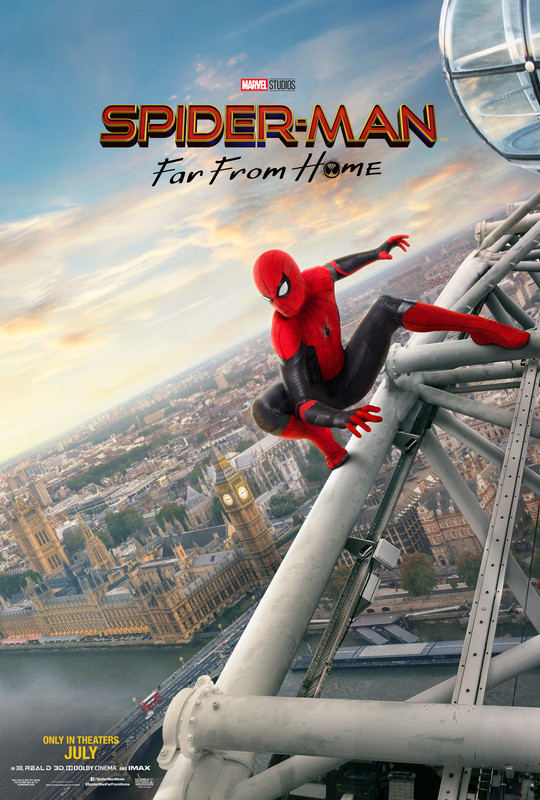
Spider-Man: Far From Home [12A]

Dir: Jon Watts
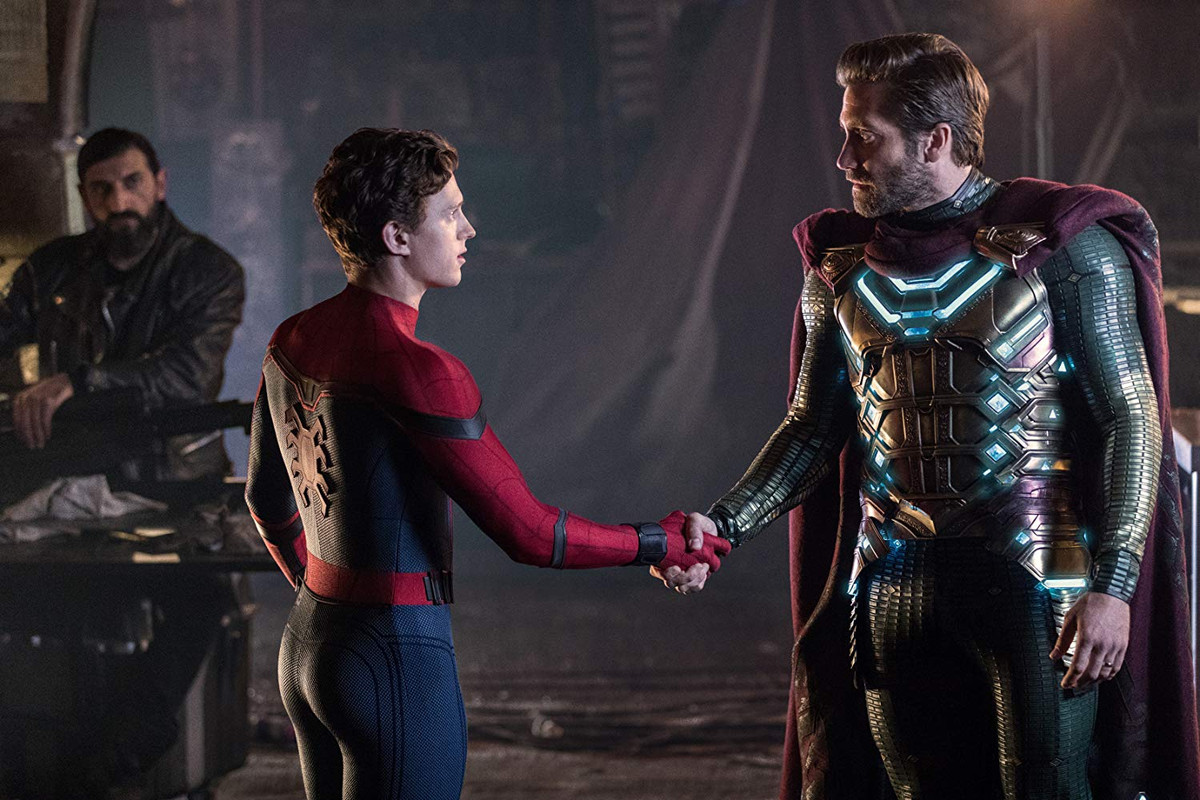
The second of the MCU’s Spider-Man films, and the closing film of Marvel’s Phase 3, Spider-Man: Far From Home picks up after the events of Avengers: Endgame. With Tony Stark gone, the world is looking to other heroes, as is Nick Fury (Samuel L Jackson). When reports begin of massive beings called elementals and of Quentin Beck (Jake Gyllenhaal), a soldier from another dimension trying to fight them, Fury calls in Spider-Man to assist. At least, he tries to. Peter Parker (Tom Holland) has a lot on his plate, juggling being a superhero with his life after the blip; most pressingly a school trip to Europe and a plan to tell MJ (Zendaya) how he feels about her. He doesn’t have time for Nick Fury, especially with this new hero, quickly nicknamed Mysterio, on the scene.

I’d call myself a casual observer of the Marvel Cinematic Universe. With a little distance from them, it’s probably only the first two Captain America films and Spider-Man: Homecoming that I’d say are, qualitatively, anything more than solid pieces of blockbuster filmmaking. On the other hand, I love Spider-Man. I always have. I love the 70s series with Nicholas Hammond in all its cheesy crappiness. I love the 90s cartoon. I love a lot about Sam Raimi’s trilogy of films, and... almost nothing about The Amazing Spider-Man reboots (reviews here and here). Homecoming was pretty much everything I ever wanted from a Peter Parker Spider-Man film, and the first film to manage to square the circle of the character and get both Peter and Spider-Man right, at least for me. Then Into the Spiderverse raised the bar. I didn’t have much investment in Miles Morales going in, having stopped reading Spider-Man books a few years before he came along, but I certainly had that investment on the way out (as well as an appreciation for the film’s dazzling art style). That film and Avengers: Endgame present challenges for this film, challenges it never manages to overcome.

Homecoming had a studiedly low key feel to it. As we first met Holland’s Spidey in the midst of a big action sequence in Captain America: Civil War, his own film deliberately foregrounded the idea of Peter as a relatively nomal teenager and of Spidey as ‘Your Friendly Neighbourhood Spider-Man’. It did the big action well too, and had a menacing villain in the shape of Michael Keaton’s Vulture, but the largely ground level feel of it (depsite the web slinging) was a great plus. With that groundwork laid, the mix doesn’t work the same way this time out. We don’t feel the effects of ‘the blip’ (the five year gap between the people who survived Thanos’ snap and those who didn’t) enough. Rather than just have one third string character be that much older, would it not have been interesting for  the dynamics of their relationship if Ned had survived the snap and was now several years further on than his friend Peter? Certainly it would be more interesting than Ned’s storyline, which screams that screenwriters Chris McKenna and Erik Sommers couldn’t think of anything to do with him. 

Homecoming, not having to do an origin story, got its feet under it immediately, but the emphasis on the teen comedy aspect and the high school trip to Europe (which is so nakedly a plot facilitator that at a certain point the film doesn’t even bother pretending about it) means that as a Spider-Man film Far From Home is a slow starter. Even when there are action scenes, for much of the first half of the film, Mysterio is the driving force. Jake Gyllenhaal is a bit of a casting coup for this film, and he brings his customary dedication to the role, dealing well with the several gigantic exposition drops he has to do, while also managing to create an interestingly nuanced character and draw a relationship with Holland which, though close to what Sam Raimi did with Dr Octopus in Spider-Man 2, carries weight for Peter as he looks for a new mentor in the wake of the loss of Stark. Of course there is another mentor figure available in Nick Fury (both Jackson and Cobie Smulders as Maria Hill have an increased presence here), but without Peter ever saying it, I think it’s that Beck shows himself as a scientist as well as a warrior that means Peter is drawn to him. He sees an older version of himself there - or at least a version to aspire to - in a way that he doesn’t in a top spy like Fury.

Jake Gyllenhaal also helps bring out the best in Holland's performance, we can feel his pride when Beck tells him never to be ashamed of being the smartest person in the room, how it fuels that desire to see Beck as a mentor, and how this desire might not make for the best judgement. That said, it’s only in the second half of the film that we see Mysterio used to his full potential. The first action scene that deploys his illusions in their full force is absolutely fantastic. Jon Watts and the crew find some wonderful and very comic book inflected images and have great fun pulling surprises on the characters and on us. This and other sequences in the second half also use the connection we’ve seen built between Peter and Mysterio effectively, giving some emotional power to underlie the action.

In its first half, the film does mark time. Ned’s story with Betty Brant (Angourie Rice) is notable here. Rice is well cast, and fun in the newscast that opens the film, but both she and Jacob Batalon (who still has nice comic timing, especially opposite Holland) are underserved by a story so prosaic that the film explicitly declares that it’s abandoning it before the end credits. This is also true of a lot of the class trip stuff, like the fairly unfunny dynamic between Martin Starr and JB Smoove as the teachers and Tony Revolori’s one joke version of Flash Thompson. It’s also the case with a weirdly misplaced action sequence. Yes, Peter’s carelessness is a theme here, but it’s a bit overegged at one particular moment, especially given that the film has other instances that trade on the same idea, but feel much more in character for Peter. The only part of the class trip narrative that really engages is the dynamic between Peter and MJ. Zendaya is definitely a departure from the traditional MJ, in both look and attitude, but it completely works for me; she gets bigger laughs with a withering look than almost any of the film’s one-liners, and her ability to throw Peter off balance is always funny (the exchange at the opera, when Peter tells MJ she looks beautiful, is perfectly timed and played). For all the sarcasm she throws his way though, there’s a genuine sweetness about Peter and MJ too, it’s a different take, but a smart and well-executed one.

The best things in the film come in the third act, which ups the action to an epic scale, but it’s a challenge to discuss any of it because every part of it is predicated on massive spoilers. Suffice to say that the idea that has defined every version of Spider-Man is that ‘with great power comes great responsibility’ and that in these sequences Spidey is feeling that at a very personal level. It’s a classic hero's journey all about the choice this young kid has to make in embracing his role, his responsibility. It’s not something we haven’t seen in cinematic Spider-Man stories, but it’s still effective thanks to Holland’s performance and in no small part thanks to the stunt teams and digital artists who help create Spidey, whose movements have never felt more fluid.

It’s worth briefly addressing the first of the two post-credits scenes (stay for both, by the way). As a fan, I was at once elated at a certain piece of casting and somewhat thrown off by the depiction, which feels like a departure from the principals of the character, if only because of what the iconography suggests it’s referencing. I’m not sure how I feel about it, but along with the other things this sequence throws up, we’ll surely be dealing with it in the next film.

Then there are, of course, those twin problems of Into the Spiderverse and Endgame. As a Spider-Man film, Far From Home simply can’t help but feel like a damp squib after the blisteringly inventive Spiderverse (especially as it seeds a similar idea early on), it’s got fun action and is incredibly well executed, but the sheer visual verve of that film is nowhere to be found, nor is there a single image with a tenth of the power of the shot of Miles falling upwards through the frame. Equally, as a closer for Marvel’s third phase, it can’t help but feel like an anti-climax next to the monumental (though flawed) Endgame. All that said, though it does take a while to plod its way there and too many characters seem stuffed in just because they were there in the last film, rather than because there’s a great need for them here, once it kicks into gear, Far From Home is a highly entertaining, very well acted and sometimes thoughtful Spider-Man film. I had a great time with it in its second hour and again loved the depiction of both Peter and Spidey throughout, but I can’t deny it failed to give me the charge of excitement I had after Homecoming.
★★★

May 9, 2016

Captain America: Civil War [12A] [2D]

Dir: Joe and Anthony Russo
Marvel's cinematic universe has, over the past eight years, reshaped the landscape of American cinema. Forget the long endangered idea of the standalone film, the standalone franchise is now a species on the watchlist. That's all down to the success of Marvel's interlocking superhero megafranchise, but what started out as a groundbreaking idea has now begun, for me at least, to devolve into predictable formula. That said, the third in the Captain America series always had my interest piqued, because the two previous films focused on Steve Rogers are easily the best the MCU has had to offer so far, and I only became more intrigued when my favourite superhero of all, Spider-Man, was added to the roster, thanks to a deal with Sony.

The film adapts the comic miniseries of the same title, keeping the same central idea, but changing the specifics of the central conflict, from a fight over superhero registration and the preservation of secret identities to a disagreement over a UN resolution to control Avengers interventions. Captain America (Chris Evans) and Iron Man (Robert Downey Jr) find themselves leading teams on opposite sides of this issue and fighting over that and over Steve's friend Bucky (Sebastian Stan), whose Winter Soldier persona may have been awakened again.

The strengths of the Captain America series so far largely continue with this installment. Chief among them is Chris Evans, who continues to lend solid presence and bring a measure of inner life to a character who could be played as little more than a square jaw and a circular shield. This film sees Steve much more adjusted to the 21st century, but the script ties back his motivations to a moral code that comes from when the character grew up. The connection of this to a funeral, early in the film, is a little on the nose, but Evans makes it work. Evans also continues to have chemistry with his co-stars, bouncing off Anthony Mackie's Falcon, Scarlett Johansson's Black Widow and Emily VanCamp's Sharon Carter especially well.

The series also continues to deal in a more complex set of morals than many superhero films, tying the legislation that sets the Avengers against each other to the unanticipated results of their actions grounds what is an outlandish set of characters and events in some sort of recognisable world - the debate being framed here being one that, in other forms, is very live on the world stage. However, while these issues are serious, the script and the actors manage to find a tone that allows the film to acknowledge them while still remaining fun, a circle that, by all accounts, DC has yet to square.

A blockbuster shouldn't live or die on its set pieces, but it certainly helps if they're strong, and Civil War has a couple of standouts. The opening action scene, which feels, in Indiana Jones tradition, like the ending of a movie you missed, gets things off to en exciting start. Frank Grillo is great value as Crossbones and while the action is over cut at times Joe and Anthony Russo do manage to keep a degree of sense in the geography of a scene involving a lot of characters and some scattered pockets of action. It's also a good showcase for the action style, which again hits a sweet spot between comic book physics and something that looks genuine enough to not feel like you're watching a computer game.


The film truly hits high gear with its central set piece, which delivers on the hype of two groups of heroes facing off against each other. It's extremely well shot and edited, with the cutting rhythm slowing down for these twenty minutes, allowing us to get more caught up in the conflict. Best of all, this doesn't feel like the film breaking for a fight, the Russos and writers Christopher Markus and Stephen McFeely never lose sight of the conflict between and personalities of their characters. The stakes feel high because they feel personal, but that also informs the way the fight is staged, with characters often clearly holding back. It's another way that Civil War acknowledges its themes.

With such a large cast of characters, it's fortunate that most of the ensemble is on form. There are still some characterisation issues; Hawkeye, in particular, still lacks definition and the quippy dialogue could perhaps be restricted, as when most of the characters hit that register it sounds less like a character beat and more like Marvel's house style asserting itself. That said, there is much more good work here than bad. Elizabeth Olsen and Paul Bettany, as Scarlet Witch and The Vision, have some strong scenes together and an interesting relationship. 

Of the new characters, Chadwick Boseman makes a strong impression as Black Panther, there's a rage simmering in the character that could make his solo film interesting. Daniel Bruhl is a fine actor, but until the closing scenes he's not given much to work with as Zemo, but those closing scenes do present an interesting take on villainy and are overall more interesting than another city destroying smackdown. The standout, however, is Tom Holland's take on Spider-Man. After the calamitously awful Amazing Spider-Man franchise, Marvel's most famous character was in desperate need of a(nother) reboot and, in the roughly ten minutes of screentime he has here, he's not only got that but what is potentially the defining cinematic take on the character. Tobey Maguire and Andrew Garfield occasionally got the wit of Spidey down, occasionally captured his intellect, occasionally gave us his nerdy personality. Holland and the Russos nail all this, and more besides, from the first instant we see Peter. As a lifelong Spidey fan, every second he's on screen here is a joy. I can't wait for Spider-Man: Homecoming next year.

All this said, Civil War is not entirely, perhaps not even mostly, a triumph. In some ways it's not the fault of this film, but of the series it is a part of. This doesn't feel like a standalone Captain America film. One of the great strengths of the first two films in this franchise within a franchise was that you could watch them independently of the rest of the MCU. More than that, each of them plugged the character into a genre that felt like something other than a standard superhero film; first a second world war men on a mission movie, then a 70's paranoid spy thriller. This is the first time in the series that Captain America has felt like just another superhero film. A fun one, one with a few ideas, sure, but it has much more of an assembly line feel. This feeling is only added to by the overwhelming sense that, rather than Captain America 3, this is Avengers 2.5, Black Panther 0 and Spider-Man 0, all rolled into one. This episodic structure and the constant trailering of things yet to come is making the MCU, for me, feel extremely televisual, despite its scale.


Civil War is also a long film, at 144 minutes it's only 8 minutes longer than The Winter Soldier, but it feels like more than that. After the opening action scene in Nigeria there is a lot of exposition to get through and it can be slow going. To my surprise, I found this particularly true thanks to the large role that Robert Downey Jr plays here. Downey has now been playing Tony Stark for the best part of a decade, and there are more than a handful of moments here where I felt like I could tell, like he seemed less engaged than usual. He's still not bad, and when he's playing off Tom Holland's Peter Parker and in the film's very personal final fight he's great, but for the first hour I thought he, like me, was finding the process of setting the pieces a bit drawn out.

While the bigger set pieces are great, some of the other action is less engaging. Smaller action beats seem to work on a much faster cutting pattern and sometimes I found myself disengaged, wanting a better and longer view of the film's many punch ups. It's not as if the Russos have suddenly turned into Paul Greengrass, but just a little pulling back on the pace of some of the action would have made a world of difference for me.

Ultimately, fun as it often is and much as there is, at times, to recommend here, Civil War is the weakest of the Captain America series. For me that's mainly because it exists more in service of the MCU than of the Captain America films within it. I kept feeling I was missing things here, having not seen Avengers: Age of Ultron and I suspect that, while bits of the MCU continue to interest me, that's something that will only become more acute and more to the series' detriment, as Phases 3 and 4 run on.
★★