Showing posts with label The Complete.... Show all posts

Oct 21, 2009

The Long Halloween: The Complete NOES Part 2

A Nightmare on Elm Street: The Dream Child (1989)
Dir: Stephen Hopkins

Like The Dream Master before it, this fifth Nightmare has a decent central idea. This time Alice (a returning Lisa Wilcox) is pregnant, and Freddy is able to use the dreams of her unborn child - somehow - to infiltrate into the world when she and her friends are awake. You could almost call this inspired: the enemy quite literally within, and Freddy making the ultimate invasion into the body and consciousness of his nemesis. Unfortunately this fine idea is wrapped up in a near totally incoherent movie, which lurches from set piece to poorly executed set piece with all the grace of a 20 stone man attempting to do ballet.

The problem is that, again, it’s all too clear that the storyline is an afterthought, the least important aspect of a script whose real purpose is to provide Freddy with more opportunities to make winking wisecracks as he kills. Most of these sequences are as bereft of scares and inspiration as they are laughs, but one manages to be surprisingly effective. One character is, for no reason really, a comic book fan and so he’s sucked into a comic for his dream sequence and in a very cool touch he becomes a drawing and when Freddy kills him all the colour drains out, of course even this is undermined by a terrible one liner (Freddy: Told you comic books was bad for ya!)

As with The Dream Master, Freddy is the biggest problem with this film. Drop the ‘comedy’ and you might have something here, but with it the tone of the film is massively confused and Freddy lacks any value as either villain or bogeyman. It is easy to tell that the film was shot and edited in just 8 weeks. The performances are awful all round (Robert Englund looks like he wishes he were dead) and some of the cutting is really dreadful. Most of all though the trouble is that the film makes absolutely no sense, it’s just a bunch of scenes, there’s no sense of a progressing story and even if there were, the characters are all so bland that it wouldn’t matter, because why would you care?

The Dream Child should be a better film than it is, and the fact that it is so bad is purely a matter of greed. If someone had taken some time with this film, with this idea, it could have been one of the best of the series. Oh well, next time, right?


Freddy’s Dead: The Final Nightmare (1991)
Dir: Rachel Talalay

You thought The Dream Child was bad? You thought it couldn’t get worse then Freddy’s Revenge? You were wrong, bitch. Once again a Nightmare film begins promisingly, this time with a caption: "Do you know the terror of he who falls asleep? To the very toes he is terrified, because the ground gives way under him, And the dream begins... ” - Friedrich Nietzsche. Amazingly, just 10 seconds later, all hope of a good film is pretty much lost, when that card is followed by this one: “Welcome to prime time, bitch” - Freddy Krueger. Kill me.

Even at their very worst, the previous Nightmares all had something interesting about them - a cool death scene here, an inexplicable homoerotic subtext there - Freddy’s Dead doesn’t. This abominably terrible film plays like somebody saw the worst stand up routine in history and decided to chop it up and insert it, line by line, into one of the worst horror films ever made. How bad is this film? Well, Pirates of the Carribean: At World’s End isn’t the worst film Johnny Depp has been in, or the least coherent.

Where to begin? How about with Freddy? His first appearance in this film has him dressed as witch, riding a broomstick and saying: I'll get you, my pretty! And your little soul, too! That, sadly, may be one of his best one liners in this film. The other really sad thing about Freddy here is how awful he looks. David Miller returned to do Freddy’s make up, but was constrained to sticking with the commercial look established in Nightmares 4 and 5. The results are shocking. Freddy looks like he’s got egg on his face literally as well as figuratively. The effect is comical rather than horrific; indeed it’s the only funny thing in the film.

The acting is spectacularly terrible. Englund appears tired and bored; if he’s not actually reading his lines from cue cards then he’s doing a very good impression of someone who is. It sometimes seems as if the film has been written to give Englund lots of screentime, but as little as possible to do. One endless sequence sees him attempting to kill a victim through a video game, which allows Englund to spend about ten minutes just sitting in a chair cracking abysmal jokes. At times the film resembles a cartoon, especially when Freddy pops up on TV and hits Johnny Depp in the face with a frying pan. So, it’s like a bad stand up set, like the worst Looney Tunes ever made, what it is never like is a horror film. The other performers are barely worth discussing, except to note that I think Lisa Zane spent the entire production of this movie in a coma, and that Breckin Meyer was indeed always that irritating.

Director Rachel Talalay had worked in some capacity on all the previous films, so it made sense that she be given her shot at directing. The results are just embarrassing. Her best shots are solidly uninspired, but her worst are absolute abominations - check out the stunningly awful shot that rotates around Freddy and Lisa Zane endlessly, first in one direction, then another - it’s a shot that says ‘I’ve seen the prom scene in Carrie, look, I can copy it’. I’ve never seen the 15-minute last reel in 3D, but it’s all stuff pointing awkwardly at the screen. Freddy’s Dead is a hideous film to watch, because it is poorly shot, and because the editing is like a 90-minute car crash.

This really is one of the worst horror films I’ve ever seen.


Wes Craven’s New Nightmare (1994)
Dir: Wes Craven

After six films in seven years, Freddy Krueger was pretty worn out. He’d gone from being a hideously burned ultimate bogeyman to a slightly melty-faced ‘comedian’ who killed. His creator, Wes Craven, had deserted him after being re-written on the third instalment, and, he felt, cheated out of a piece of the huge financial reward that New Line Cinema had reaped on the back of his work. New Nightmare came out of a discussion with New Line boss Bob Shaye, in which those money issues were addressed and Shaye asked Craven if he’d like to write one more Nightmare, saying that New Line ‘feared they had killed Freddy off too soon’.

The result is one that rewrites the rules of franchises. Artistically speaking returns are supposed to diminish as a series goes on, the seventh film in a franchise is not supposed to be the best. It just doesn’t happen. Except in this case. Craven ignores all the previous sequels, and instead reduces them to fodder for a film that is all too seldom given the credit it deserves as a truly groundbreaking piece of horror cinema.

New Nightmare takes place in the real world, and stars many of the key talents behind the series as themselves. Craven’s clever script posits the idea that Freddy was, in fact, an ancient evil, and that in creating Freddy he had trapped that evil inside the story of the Nightmare films, but now that the films are over that evil is attempting to escape, in the form of Freddy, into the real world. The one barrier? Heather Langenkamp; to escape, Freddy must defeat the actress who played the character who twice defeated him - the first to do so. Craven melds fact and fiction to brilliant effect. Langenkamp, John Saxon, Robert Englund and Craven all play themselves, and Langenkamp’s storyline is, to a degree and with her permission, drawn from her real life, in which she was stalked and telephoned by an obsessed fan, and is married to a special effects artist. This is very evident in Langenkamp’s performance, which is brilliant, especially as she becomes more and more unhinged as the film goes on.

Craven also resurrects the true Freddy Krueger. Here he’s genuinely frightening for the first time since the third film, and his make up is completely re-designed, again by David Miller, and the splitting skin look that he’s been given is really creepy, Miller regarded it as the definitive version, and up to this point I’d be inclined to agree with him. What really makes Freddy scary again though is Robert Englund’s performance; the actor really recaptures the utter evil of the character, and there are several genuinely scary sequences here, not least a brilliant reprisal of Tina’s death from the original film, only this time with Freddy visible as he kills Heather’s son’s babysitter (Tracy Middendorf). The whole film looks great, with the huge set for ‘Freddy Hell’ being especially impressive, along with some extremely memorable sequences with Freddy, not least when he appears in the sky, picking up Dylan (Miko Hughes) on one of his claws.

Craven really cuts loose with this film; it’s a confident, intelligent piece of work that he hasn’t come close to matching since. Scream got a lot of credit for introducing postmodern horror, but Craven did it first and best with New Nightmare which, as well as being gripping and scary, deconstructs both the horror genre and, through a doctor character, the rush to censorship. I wish Craven would get back to doing something this interesting with the genre.


Freddy Vs Jason (2003)
Dir: Ronny Yu

Freddy Vs Jason exists in a strange limbo. It doesn’t really belong to either the Nightmare franchise or the Friday the 13th franchise, and yet it is completely bound up with them. I wasn’t going to include it in this round up of the franchise, but on re-watching it I found it such an enormously fun guilty pleasure that I felt I had to cover it briefly.

I couldn’t claim that Freddy Vs Jason is a good film. The script is ropey, the characters are cardboard cutouts, the plot is beyond silly, and the acting is shockingly poor, all I know is that I enjoy the hell out of it anyway.

I think the key, at least looking at it as a Nightmare film, is that it has a respect for the history of the franchise (see the references to Hypnocil, established in Dream Warriors) and that, at last, it manages to square the circle of making Freddy both evil and funny. This is what Nightmares 4, 5 and 6 would have been like if they had worked. Freddy still has a cruel streak mile wide, but that is complemented, rather than leavened, by his jokes. It also helps that the make up has again been refined, and I think this is the best Freddy has ever looked.

Ronny Yu’s visuals are stylish and imaginative, making the violence as beautiful as it is brutal (witness Jason, on fire, stalking kids through a cornfield). There’s such viciousness to this film, and unlike most of the Elm Street sequels, it doesn’t shy from the bloodier images. Freddy and Jason tear literal chunks out of one another in a series of really painful looking fights. This may be a dimwitted film, but I challenge any fan of either franchise to fail to enjoy it.

Oct 19, 2009

The Long Halloween: The Complete NOES Part 1

I was going to write 8 full length reviews for this post, but as I watched the films it occurred to me that most of them simply didn’t warrant 1000 words or more consideration, that, and when the remake opens next year I’ll want to do a Versions post comparing Wes Craven’s film to Samuel Bayer’s. So here are some thoughts, in mini-review form, on this venerable series. However, I'm still going to post this in two parts, because apparently I think 500 words constitutes a mini-review.

I’m assuming that most people have seen these movies, and so there may be mild spoilers.

A Nightmare on Elm Street (1984)
Dir: Wes Craven

The early 80’s was boom time for slasher films. People were hungry for horror and it was being delivered both at the cinema and on a new fangled technology called video. Hundreds of slashers were made, most now justly forgotten. There were a few gems though, and A Nightmare on Elm Street still stands out as one of the very best slasher films ever made. Wes Craven is a master of the genre, and in Freddy - or, as he’s known here, Fred - Krueger (played in all eight films reviewed here by Robert Englund) Craven created one of the screen’s great original monsters. Krueger is a child murderer, himself burnt to death by the parents of the children he murdered on Elm Street, and now stalking the remaining Elm Street children in their dreams, wielding a razor fingered glove as weapon.

Craven said that his intent with Krueger’s backstory was to create the most corrupt monster he could imagine, and with Englund’s help he succeeds. In this first outing Freddy is a true monster; there’s no sympathy, little humour, and absolutely no pity in the way he acts. Put together with the character’s look - a fantastic, horrific, burn make up by David Miller - Englund’s performance creates a genuinely unnerving villain. Craven and DP Jacques Haitkin use a very small budget ($1.8 million) to create some truly memorable and haunting, if low tech, visuals. Some of the simplest effects in the film would now be realised with CGI, but Freddy’s extending arms (which were on fishing poles) and his face coming through the wall (which was made of spandex) still impress because they are obviously real.

In addition to Englund the cast, composed mainly of young newcomers, generally does well. Heather Langenkamp has worked mainly in TV since Nightmare, but she’s a strong lead, and gives Nancy resourcefulness and toughness of a kind rare in ‘final girls’ of the 80’s. She also has to carry some of the weightier dramatic scenes in the film, and does so with aplomb. Amanda Wyss is engaging as Tina, and that makes the reversal that Craven pulls on you when he kills her off early (in perhaps the film’s most startlingly visceral and truly nightmarish scene) genuinely shocking. Johnny Depp, who makes his debut as Nancy’s boyfriend, seems ill at ease, and overacts at times, certainly there’s nothing here to suggest the sort of masterful subtlety we’d see in Edward Scissorhands just six years later. The adults are a bit of a mixed bunch, John Saxon is good as Nancy’s cop father, while as her mother Ronee Blakley fumbles her big dramatic scene, when she has to tell Nancy about what the parents did to Krueger.

The rough edges are certainly there, but they don’t really matter, because Craven’s concept is so strong, and the film gains such momentum, that it is carried over the rough patches. The only real problem is the ending, which is extremely anticlimactic after such a strong build up. Still, A Nightmare on Elm Street entirely deserves a place in the pantheon of horror classics.


A Nightmare on Elm Street 2: Freddy’s Revenge (1985)
Dir: Jack Sholder

The Nightmare franchise opened with a massive mis-step in the shape of this very strange sequel. It’s set five years after the original, but takes place in an extremely obvious 1985 - witness the costumes, the music and the Kate Bush poster in the main character’s room. It completely changes the main idea behind Freddy Krueger who, instead of attacking kids in their dreams possesses Jesse (Mark Patton) so that he can attempt to cross over into the real world. This isn’t a bad idea in and of itself, but the execution is incredibly sloppy.

First off the script, assuming such a document existed, is flat out terrible. Wes Craven had a cast of well-rounded characters to kill off; these kids (most of whom look about 30) couldn’t muster a rounded personality between them. Most of them may as well not have names as you learn so little and care so little about them that they could just be grouped together in the credits as ‘corpses in waiting’. Sholder’s shooting is unhelpful; he shrouds the film in darkness, but lends it little atmosphere. This means that we never get to admire Kevin Yagher’s first go at the Freddy make up, and also that when the viscera should begin to fly we can’t really see it, it’s the worst of all worlds really.

These problems, however, are small beer compared to that of the casting. I’m willing to accept that Kim Myers - a cute Meryl Streep lookalike who plays Lisa, Jesse’s would be girlfriend - may be able to act and is defeated by the screenplay. Mark Patton is another thing entirely. First he doesn’t have the look of a horror lead; he’s too soft, girlish almost. This is borne out in his voice, or more specifically in his scream, which we hear a great deal of and which never ceases to be funny. Patton gives an outrageously camp performance, but also manages to set his face in a single expression, which is something akin to ‘huh?’ and never alter it for the film’s entire running time.

There is one thing about Nightmare 2 that is interesting - utterly misplaced, but interesting - and that’s the homoerotic undertone that runs through the film. One dream sequence begins in a leather bar, and ends with Jesse’s coach tied up, naked, in the school showers being whipped to death by a towel wielding ‘Freddy’. Then of course there’s the whole issue of Freddy trying to possess Jesse’s body “Fred Krueger!... He's inside me... and he wants to take me again!” You could even read the film as a fight between good (straight, personified by Lisa) and evil (gay, personified by Krueger and the Gym teacher) lifestyles, and Lisa’s final battle with Freddy as her attempt to rescue Jesse from homosexuality. I’ve spent too much time in film studies classes, clearly, but seeing Freddy's Revenge in this way does at least distract from how dreadful a film it is at every possible level.


A Nightmare on Elm Street 3: Dream Warriors (1987)
Dir: Chuck Russell

It is to New Line Cinema’s credit that, even though Freddy’s Revenge made more at the box office than the original Nightmare on Elm Street, they realised that the abrupt change of direction that made that film the strange beast it is was a misstep. To put the franchise back on track they turned to its creator. They asked Wes Craven to write and direct Nightmare 3, but he was already contracted for another film. He did write a script though, and gets a co-writing credit here. His big contribution was twofold. First, his screenplay brought back original heroine Nancy Thompson (again played by Heather Langenkamp), now a grad student training as a therapist and specialising in sleep disorders. Second, the central concept of the Dream Warriors - kids in a sleep clinic who find that in their dreams they have powers that can be used to fight Freddy - was Craven’s, and would power the franchise for a loose trilogy of sequels beginning here.

Craven’s screenplay was heavily re-written, and it is pretty easy to see the joins. In Freddy’s Revenge the process of leavening Freddy’s initial menace with some humour had begun, but it is in Dream Warriors that we first begin to see the seeds of what Freddy was ultimately to become; a shitty stand up comic with knives. The one-liners are perhaps less forced and painful here than they would become, but they still sound odd, and negate the essential menace of the character. Between these and other moments of silliness (the kids powers really can be painful, especially when one character declares himself the wizard master) there are some fantastic shock scenes.

After some seriously uninspired death scenes in Nightmare 2 this film really ups the ante when it comes to invention. Dream Warriors contains some of the series’ strongest nightmare sequences, with standouts including Kristen’s (Patricia Arquette) dream involving a huge Freddy snake and perhaps the series single coolest and most painful looking death in which Freddy rips a characters arteries out of his arms and legs and uses him as a puppet. Here, and in several more sequences, director Chuck Russell really outdoes himself, showing a talent for both visceral moments and tension. Russell also manages to draw good performances from his cast. Arquette and Langenkamp make for good feisty heroines, while John Saxon also reprises his role to good effect. As Freddy Robert Englund is as good here as he ever was. He seems to have more pure fun with the part in this instalment than any other, but he’s also still scary and evil.

Dream Warriors isn’t a great film by any means, and there are a lot of moments that clunk horribly, but when it comes together this is fun and engaging horror cinema and easily the best of the true Nightmare films not directed by Wes Craven.


A Nightmare on Elm Street 4: The Dream Master (1988)
Dir: Renny Harlin

I find The Dream Master a disappointing sequel to Dream Warriors. Nightmare 3 was hit and miss, but it hit a good portion of the time, had some fine acting and several startling nightmare sequences, all wrapped in a story that, while not exactly great literature, held together. The Dream Master really marks the beginning of a precipitous fall in the quality of the Nightmare films. That’s especially disappointing because the idea behind The Dream Master, which runs with the themes of Dream Warriors, is a pretty good one.

The film introduces a new nemesis for Freddy. Alice (Lisa Wilcox) is a friend of dream warrior Kirsten (now played by the rather unfortunately named Tuesday Knight) who finds that she can acquire all her friends dream powers, and use them to become the dream master, making her a match for Freddy. Incidentally, one thing the Nightmare series has always done right is present a strong, smart and self reliant heroine who is match for a monster, and Alice certainly belongs to that tradition. The problem is less with the story than it is with the script, which lacks colour, character and coherence. More than ever there is a feeling that the script was built around ideas for Freddy gags. ‘Gags’ is a metaphorical term; what effects artists call their work, but here, sadly, it’s also a literal term. The Freddy sequences have now become little more than a setup for the character’s dreadful one-liners. He began as the most evil thing Wes Craven can think of, but just four years later Freddy has become a vaudeville act with fake blood. Take this for example: Dan: Krueger! Freddy: Well, it ain't Dr. Seuss. They’re all that bad.

Antoher problem with film is the acting. Robert Englund does still seem engaged, but the feel of Freddy has changed so much that Englund can’t make him threatening any more. Tuesday Knight is a decent facsimile of Patricia Arquette, but a poor substitute. She’s got the look but lacks the talent, and Kristen, too, feels like a different character. The rest of the kids have pretty minor roles, and are all pretty wooden while waiting to be killed off. Lisa Wilcox does have a big role though, and Alice is probably the best-written and most rounded character in the film, but Wilcox can’t quite pull it off. She’s fine in the earlier part of the film, but when she has to go and fight Freddy she lacks the necessary steel, and that means that despite fine effects work from Kevin Yagher and Screaming Mad George - which results in some of the series’ most striking make up designs - the finale doesn’t really come off.

Renny Harlin does what he can, but he's pretty much hobbled by his material. Visually Nightmare 4 doesn't lack for style, but narratively it is broken. On the whole, if the original Nightmare on Elm Street was a scary night of theatre, The Dream Master strays dangerously close to pantomime.

Jun 5, 2009

The Complete... Terminator

The Terminator  [15]
Dir: James Cameron
2029.  Mankind has finally won its war against the machines, but as a last ditch attempt to take back the victory the machines have sent a Terminator (Arnold Schwarzenegger) back through time to 1984, a cyborg killing machine with a mission to find and kill Sarah Connor (Linda Hamilton), who will become the Mother of the leader of the human resistance. To try and save the future humans are able to send a protector for Sarah back in time, its just a matter of whether Kyle Reese (Michael Biehn) or the Terminator will reach Sarah first.

The chase movie has a long history, and The Terminator, despite its futuristic trappings and sometimes confusing time traveling story, is basically a very simple and often brutally effective example of the genre. There are really only three major characters, and a very simple conflict – two men, one must kill a woman, the other must save her.  This means that James Cameron and his co-writer Gale Anne Hurd don’t need to spend a great deal of time on exposition and instead use that screentime to give their characters a level of depth that was and remains uncommon in the genre.

It’s often forgotten, given the megabudget follow ups, that The Terminator began life as a down and dirty film costing just $4million.  It had no major stars, and its commercial prospects didn’t look especially blockbusting. This actually ends up benefiting the film, giving it the feeling of something where anything goes, where because you don’t know any of these characters, or the actors playing them, and because the villain of the piece is both so remorseless and so deadly, all bets are off as to who lives and dies. This gives the film a drive that makes it incredibly compelling, even in the quiet scenes between set pieces.

However you feel about James Cameron as a filmmaker you have to admit, the man knows how to stage an action sequence, and there are plenty of stunning examples in The Terminator. Arnold Schwarzenegger’s deadly march through the Police station is a notably strong and scary sequence, showing just how utterly deadly the Terminator is.  The Tech-Noir sequence is another masterfully constructed suspense set piece, which turns into a terrific action sequence. Cameron also has an eye for a great image. The Terminator was born of a dream that Cameron had, in which he saw a robot rising out of fire. That image is in the film, and it is one of most memorable frames of 80’s cinema. It’s far from the sole iconic image in the film though – Schwarzenegger cutting his human eye out, a Terminator’s foot crushing a human skull and the images of the Terminator making his way through the Police station all stick in the mind long after they have gone by.

The film takes itself very seriously, and largely earns the right to do so. The script may be simple, but it’s never stupid, the dialogue is functional rather than truly characterful, but its given life by a largely solid cast. Schwarzenegger has just 16 lines, but he makes an impact with every one of them, more than that though his performance as the T800 is one that, 25 years later, still resonates. Nobody is ever going to accuse Schwarzenegger of being a great or indeed a versatile actor, but he’s perfect here. There’s the vacancy of his performance, the utter lack of emotion felt by the machine, but there’s also, even in this first entry in the franchise, a little humour behind the performance that makes the Terminator more than a blank space. Michael Biehn is the real standout of the film, his worn out but determined Reese is the film’s beating heart, he’s given little help by the dialogue in one key scene, in which Reese tells Sarah that he’s come through the time machine because he’s in love with her, based on a picture her son gave him, but Biehn’s sensitive performance wins out over the hackneyed scene (the same can’t be said for the silent, and laughable, sex scene).

The only downside as far as the cast is concerned is Linda Hamilton’s rather poor performance as Sarah Connor, some of her line readings – notably the final pay off of the movie, which she garbles – are weak and the growth of her character from the victim of the beginning to the warrior of the end is not terribly convincing. Though the action scenes are strong Cameron does sometimes let the pace lag, particularly in the middle part of the film, and the future war sequences add little to the movie aside from screentime. These rather minor gripes aside The Terminator is an extraordinarily enjoyable thriller, and one that holds up brilliantly after a quarter of a century.


Terminator 2: Judgment Day  [15]
Dir: James Cameron

10 years after skynet failed to kill John Connor (Edward Furlong), before he was even born, the machines are trying again, sending back a more advanced Terminator (Robert Patrick) to erase Connor as a child. Once again the resistance is able to send a protector back in time – the T-800 model (Arnold Schwarzenegger) that previously hunted Sarah Connor (Linda Hamilton) in 1984.

James Cameron’s long gestating follow up to his 1984 hit wasn’t, in the manner of most sequels, a simple reheating of the first film with improved special effects.  Instead Terminator 2 is smarter, deeper, more involving, more spectacular, in short bigger and better than its predecessor in all departments. Part of the reason that this sequel took such a long time to reach the screen was that its budgetary demands were so high - it was the first film to cost over $100 million - but more importantly Cameron had to wait until filmmaking technology was ready to realise his vision (a problem that still dogs him, his forthcoming Avatar has been 20 years in the planning). T2 was largely worth both the money and the wait.

In the time since The Terminator, and largely on the back of that role, Arnold Schwarzenegger had become perhaps the world’s biggest movie star (and one of the most expensive, his salary was $15 million), and that changed his role. However it came about, service to Schwarzenegger’s star image or just through Cameron and William Wisher’s writing, the decision to have Arnie’s Terminator go from antagonist to protector was an inspired one.  That simple choice allows the movie to tell a significantly different story to that of the first film, to throw all its relationships into disarray, and Schwarzenegger to play a very different character. Perhaps surprisingly Arnie is more than up to the challenge, in fact he’s never been more effective in a film. He retains the established nature of the Terminator - the emotionless killing machine - but through the simple device of establishing that the machine can learn behaviour Cameron and Schwarzenegger introduce a new layer to the character, allowing Schwarzenegger to have some fun. This is never more true than in the scene where John attempts to teach the machine to smile, a perfectly judged moment which may be the funniest thing Arnie has ever done on screen.

Another much improved performance comes from Linda Hamilton as Sarah Connor. This is no longer the big haired damsel in distress that proved so frequently irritating in The Terminator; rather she’s the film’s third killing machine. Hamilton trained for a long time to acquire the physique for this movie, and it pays off, her sinewy body making her a convincing threat. She’s also a good deal more credible in the role this time out, spitting her lines and executing her action scenes with a fire missing from the original film. She’s especially good in the early scenes when Sarah is confined to a mental hospital; credibly insane but never overplaying. Cameron campaigned for her to get an Oscar nomination for her role, and it wouldn’t have been undeserved.  At just 11 Edward Furlong has a tough task with the role of John Connor and sometimes, to be fair to him, he handles it with aplomb, at other times though Furlong is shrill and unbelieveable. His best moment comes in a powerful scene that wasn’t included in the theatrical cut of the film, in which the Terminator’s CPU has been extracted, so the it can be switched to allow the machine to learn, Sarah wants to destroy the chip and John must show the first signs of his leadership to come. It’s a great scene, with fine performances from both Furlong and Hamilton, but you do long for some consistency in the young actor’s performance.

Among the rest of the cast Robert Patrick stands out in a near mute role as the sleek T-1000 (a Porsche next to Schwarzenegger’s tank, was how Cameron described the new cyborg). There’s a sly wit to his performance that makes it very distinct from either of Schwarzenegger’s takes on a Terminator. Patrick is especially effective in the action scenes, he gives this Terminator a smooth, flowing, purposeful movement that distinguishes him still further from Arnie’s slow, heavy, relentlessness.

Of course the major story behind T2 at the time was its major advancements in computer generated special effects, and not only does the technology used to realize the liquid metal form of the T-1000 still hold up, it’s used extremely well. The CG is actually surprisingly sparingly used, even some shots that you’d think were CG (and now would be), like the moment when she pieces of the shattered T-1000 begin to melt and flow back together, are realised practically, helping the rest of the effects to feel more real and have more weight. Some of the pure CG moments remain breathtaking though, particularly one of the T-1000 rising from a floor, with the tile pattern all over its body. Cameron’s strong use of effects is also felt in another truly iconic moment, one of the film’s finest, in which Schwarzenegger peels the skin off his forearm to show the metal endoskeleton beneath, another practical effect that works much better than the CGI that would be used today.

This time out Cameron manages to pace the film rather more evenly, once the T-800, Sarah and John are on the run the pace seldom lets up, and when it does it’s a welcome breathing space from the relentless action and excitement that Cameron throws at us. The set pieces are breathtaking; the Pescadero escape stands out, as do the invasion of Cyberdyne and the incredible highway chase that leads to the final showdown. Where Cameron really scores over the first film though is in making this one affecting. There’s an emotional content that was missing from The Terminator and the ending here, though you know it has to come, and that the character you are getting emotional about is a fictional robot, is still moving.

Terminator 2 is a richer and better film than its predecessor, the high point of the series and, ultimately, one of the great blockbusters.


Terminator 3: Rise Of The Machines  [12A]
Dir: Jonathan Mostow
2004. Judgment Day hasn’t come, but John Connor (Nick Stahl), now 22, still lives ‘off the grid’, fearing that the machines may one day find him. Undeterred, Skynet sends back their latest model; the T-X (Kristanna Loken) to hunt down Connor’s lieutenants, all teenagers in 2004. However the T-X soon locates Connor. Once again the resistance have sent a protector for John and for Kate Brewster (Claire Danes), a young vet destined to become Connor’s wife, in the familiar form of the T-800 (Arnold Schwarzenegger), who informs them that Judgment Day was not stopped, only delayed.

When considering Terminator 3 it is perhaps best to begin at the end. Okay, getting there takes some major work, and bends the time travel aspects of the franchise almost to breaking point, but the ending of this film is a hugely ballsy choice. A lot of summer blockbusters begin with the end of the world, but few have ever ended that way; with the destruction of everything the characters have been fighting for for three movies. To his credit, director Jonathan Mostow doesn’t overplay his hand in the moment, the shots of missiles shooting out of the ground, and of mushroom clouds exploding all over the earth are not sensational but lyrical and rather moving. There are several things wrong with T3, but that one choice; so unexpected, but so fitting for the franchise, a moment that still makes the hairs on the back of my neck stand up, makes up for many of the film’s smaller sins.

One of the bigger of those sins is the choice by screenwriters John Brancato and Michael Ferris to try and inject a little parody into the film, referencing the earlier movies with a sly wink. It falls flat almost every time they do it, from the awful moment which has Schwarzenegger, suited up as the Terminator after taking a male stripper’s clothes (itself a joke that outstays its very brief welcome), putting on a pair of shades that – ‘hilariously’ – are pink and star shaped to the Terminator’s mimicking of human speech patterns which has gone from classics like “Fuck you, asshole” and “Hasta la vista, baby” to “Talk to the hand”.

The only other disappointment is Kristanna Loken’s blank performance as the T-X, of course she’s playing a robot, but there was always, in both Schwarzenegger’s and Robert Patrick’s Terminators, some measure of personality, even if it had been programmed in to allow them to fit in, even if it was never really natural, it was there. Loken is a blank slate, she’s expressionless and emotionless, there’s a total vacancy to her performance, but it doesn’t feel robotic as much as it simply feels like a bad actress giving a bad performance.

These gripes aside though, Terminator 3 is an extremely successful blockbuster; smarter than the average film of its type, but also better acted and extremely exciting. The action scenes are always the big story of a Terminator film, and Mostow here creates a selection of action beats that can easily stand with the best that James Cameron crafted in the first two films. There’s a brutal hand to hand fight between Schwarzenegger and Loken and a graveyard based shootout that leads into an excellent car chase.  The real standout moment is an insane chase through a city centre, with Loken driving a huge crane, Schwarzenegger hanging on to the crane’s hook and Stahl and Danes attempting to escape in a van. The destruction in this scene is incredible to watch, it was threatened with being cut, but Schwarzenegger put up his own money to finish the scene and it’s a good thing he did, not only because it’s a great scene but because the film needs the action beat at that point. The real highpoint comes in amazing moment in which the T-800, hanging from the crane, is dragged through a building, crashing through pillar after pillar, the building collapsing behind him.

The action is strong, but that’s not the only thing to recommend the film. Schwarzenegger is, again, pretty good, and again brings a different tone to the Terminator, who is considerably harder as a character this time round, dismissive to and violent with Connor.  The scenes that don’t work aren’t his fault, they are that of the script – no actor could make the scene which ends with the T-800 beating up a car play. Stahl makes a good Connor, nailing both the character’s vulnerability and his determination, but for me the real standout is Claire Danes. Danes was cast late, replacing Sophia Bush, who was felt to be too young for the part, and though she’s a variable actress when she gets it right Danes can be very good indeed, and here she gets it right. She has a similar journey to that of Linda Hamilton’s character in The Terminator, in that she has to go from damsel in distress to warrior in just 90 minutes.  Danes pulls that journey off with greater aplomb than Hamilton ever did, but also finds time to inject a little emotion into Kate. To ask us to accept an entirely new main character in a franchise on its third installment is a hard sell, but Kate is someone you’ll be interested in seeing more of, because of the growing strength Danes gives her.

The film is also quite visually inventive, especially in the way that, towards the end of the film, it begins showing us early Terminator designs (a room full of T-1’s) and early iterations of hunter killers. It’s this sort of intelligent retrofitting of what we know from the other movies about the future, rather than the parodic homages, that really play for franchise fans. It’s also nice to see, still, quite heavy use of practical machines, which continue to demonstrate just how much this franchise owes the work of the late Stan Winston, both in the design and the implementation of its effects.

What really makes Rise Of The Machines work for me though is that you always feel how high the stakes are for the characters, what they are trying to prevent is the literal, and imminent, end of civilization – it really doesn’t get more serious, and that gives what is, again, basically a long chase movie, that extra charge, ensuring that you’re always perched on the edge of your seat. Terminator 3 certainly has weak points, but so do its predecessors, and this is a truly unfairly maligned entry in an unusually consistent franchise.


Terminator: Salvation  [12A]
Dir: McG
2018. Judgment day has been and gone.  The war against Skynet and the Terminators is in full swing. The human resistance sees an opportunity to win the war in a signal that appears to shut down Skynet controlled machines. John Connor (Bale) is the leader of group of soldiers, but not among the high command of the resistance. Connor discovers that Skynet is taking human prisoners, among them the teenage Kyle Reese (Yelchin), who will become Connor’s father when, in 2029, Connor sends him back in time to 1984. With the help of the mysterious Marcus Wright Connor must save the prisoners, to protect his future and, hopefully, destroy Skynet.

When is a Terminator movie not a Terminator movie? There are certain things, even leaving aside MIA star Arnold Schwarzenegger, that you expect from a Terminator movie. It’s going to involve time travel, it’s going to be a chase, and it’s going to involve two Terminators; one hunting John Connor, the other his protector. None of these things is really true of Terminator: Salvation. It feels less like a genuine Terminator movie than it does an expensively mounted knock off that has simply elected to use the title.

Perhaps the strangest thing about this film is the fact that John Connor, around whom the franchise has always revolved, even when the character was not yet born, has become a supporting character, and not even a very important one at that, in what is supposed to be his own story. Christian Bale was apparently reluctant to take part in this film, not wanting to sign up to what would be the fourth best Terminator film, and going on record saying that nobody thinks Terminator 3 was the best of those films, so why make another?  Fair point Christian. There’s certainly no answer to that self-imposed question in Bale’s performance, in his perhaps 40 minutes of screen time (in a 115 minute film) Bale has exactly two styles of speaking; growly and shouty and exactly one expression; a mildly pained grimace. Bale has often been acclaimed as the most gifted actor of his generation, and at his best I can buy that.  Recently though there’s been something of an emperors new clothes syndrome at work and this performance marks a miserable, lazy, new low for Bale.

The actual main character is Sam Worthington’s Marcus Wright, whose true nature the film wants to spring on us as a big mid-film twist. There are two problems with that. First the dreadful opening sequence heavily signposts the revelation.  Second, even if you’re dumb enough not to be able to guess it from that opening, Marcus’ role in proceedings has been thoroughly spoiled in both full length trailers and TV spots, so all the intrigue is sucked out of the character. Australian actor Sam Worthington works hard, but his accent is inconsistent (and, really, why can’t he have an Aussie accent?) and the character is so ill defined that despite his hard work Worthington struggles to make a real impression.

The best performance in the film is from Anton Yelchin, excellent as the younger version of Michael Biehn’s character from the first film. As with his version of Chekov in the recent Star Trek he doesn’t impersonate the previous actor, but simply captures a flavour of them, especially here with Reese’s famous line “Come with me if you want to live”. The problem, as with many of the characters, is the fact that he’s afforded so little screen time (little more than half an hour) that he doesn’t really get to do much of great import - his role in the ending set piece of the film being largely sitting in a cell and yelling.

The film is massively overstuffed with pointless characters, and serves none of them well. There’s Resse’s mute, cute, 9 year old black sidekick named Star (Jadagrace). There’s Moon Bloodgood (great name, terrible actress) as resistance pilot Blair Williams, who shows up just long enough to perform her plot function before being promptly forgotten about. There’s Common, who stands around holding a gun while modeling an admittedly cool, but frankly rather too tidy for someone living in a post apocalyptic world, beard and says about two lines as Connor’s ‘right hand man’ Barnes. There’s Bryce Dallas Howard (who is in no way convincing as a 14 years older version of Claire Danes, largely because she’s two years younger), whose role is to simper and be pregnant in the background. Jane Alexander and a hilariously miscast Helena Bonham-Carter each get a couple of minutes of nothing to do, as does the always excellent Michael Ironside (who would have been a great old John Connor). It’s depressing to watch the way this movie wastes talent.

The major annoyance of all this is that it’s easy to see how the character count could be reduced, and the film better in consequence. It seems pretty obvious that Blair is a character spun off from Kate Connor (whose ability to fly a plane was established at the end of T3). Having Kate in that role would not only make her closer to the tough girl she was at the end of T3, it would also raise the stakes of a pivotal moment in the film by making a key betrayal infinitely worse.  Salvation doesn’t have that kind of bravery, instead it contents itself being perfunctory and loud.

Rather than handing the reins of the franchise back to Jonathan Mostow, who did such a fine job on T3, or to any of the innumerable action auteurs out there to choose from, the producers have plumped for one Joseph McGinty Nichol, or McG. Now I’m not going to mock McG for his name, because that’s rather like using a flamethrower to toast a marshmallow, and besides, he made Charlie’s Angels and that’s far more shameful than having a stupid name. To be entirely fair to McG Terminator: Salvation is nothing like as terrible as the apocalyptically awful Charlie’s Angels, but it doesn’t demonstrate much of an advance as a filmmaker either. He clearly has no idea of story as an overarching thing, not only does Salvation fit only very awkwardly into the franchise as whole, but it fits together only very loosely as a film. It’s less a coherent story than a series of bits (many overly reminiscent of other films), each floating almost independent of the other. There’s enough material here for an entire trilogy, given that overabundance of characters, but none of those movies would feel like a Terminator movie.

The action scenes and special effects are executed with a degree of unfussy competence, but what’s missing isn’t spectacle, it’s a reason to care. Even though John Connor’s very existence is nominally at stake, and with it humanity’s future, there’s never any sense of high stakes. There’s no urgency to this film, particularly when you compare it with the loudly ticking clock that is the last hour of T3. At the end of the day this means that, rather than being sucked irresistibly in to the experience of the action scenes as you were in the first three films, you simply watch them. It’s as impersonal and uninvolving as seeing a rolling demo of a computer game. There’s also an inconsistency in the threat level of the enemy. Sometimes the Terminators seem extremely easy to fight, at others (nearer the end of the film) they are all but unstoppable. The only things McG manages to show any mastery of here are shooting and things going boom, and that can be fun, but with nothing behind it it just becomes a collection of loud noises.

The nods to the fans are as hit and miss as they were in T3 (which was penned by the same duo of Brancato and Ferris, though here they have an uncredited assist from Jonathan Nolan, whose appointment was apparently a condition of Bale’s participation). Come with me if you want to live works, as does Linda Hamilton’s vocal cameo, in which she gives the most genuinely emotional performance in the film, and shows just how missed she was in T3.  However, Bale's “I’ll be back” feels perfunctory and drew a groan. Arnold Schwarzenegger’s cameo works well technically, the de-aging applied to his face making him look exactly, eerily, like he did in the first film.  Unfortunately McG muffs the execution with a very silly reveal where the T-800 is shown stepping, naked, from behind a door, modesty covered by a very convenient bit of mist. Well executed though it is it feels token, especially given that it’s a mute role (really, would it have killed them to take a line from the soundtrack of The Terminator?)

It’s a real shame that Terminator: Salvation is as bad as it is, because it wouldn’t be tough to fix, but make no mistake this is an almost complete failure, with only strong effects and Shane Hurlburt’s excellent photography to really recommend it.

May 18, 2009

The Complete... Guillermo Del Toro - Part 3

Populist Auteur

First off, sorry it's taken me so long to get to this. I promise to get through future Complete... series faster. Anyway, we left off last time with Guillermo Del Toro freshly confirmed as a bankable Hollywood director who could make a little money look like a lot, and deliver mainstream films that pleased audiences and critics alike. The world was essentially his oyster. Rather than take on a big money job Del Toro finally took the oppurtunity to make a film he's since said would have been his first, had he been able to make it at the time. A sister film to The Devil's Backbone, again setting a fantastic story against the Spanish Civil War.


Pan's Labyrinth [2006]
Del Toro's most clearly personal work, Pan's Labyrinth concerns a young girl, Ofelia (Ivana Baquero), who moves with her pregnant, sickly, Mother (Adriana Gil) at the insistence of her Stepfather (Sergi Lopez), a Captain in Franco’s fascist army, currently concerned with trying to put down a rebllion. In the nearby woods Ofelia discovers a maze, and at its end a faun, who tells her she is a long missing Princess of a fairytale kingdom, and sets her three tasks to complete by the full moon. The synopsis seems fantasy led, but in fact about two thirds of the film takes place in the real world, and deals more with the harsh reality of Franco’s Spain, and the brutality of Captain Vidal. This is a smart choice, because it grounds the film in a grim reality that makes Ofelia’s wish to escape into a fantasy world, any fantasy world, even one so dark as this often appears, easily understandable and seductive for the audience. This also allows the fantasy to work, because by establishing one believable world, and grounding us in it for some time, Del Toro makes it easier for us to believe in the fantasy world.

The design is as stunning as we’ve been conditioned to expect of this filmmaker. Every single shot of this film is packed with detail, things that you hardly notice the first time you see them, but which enrich the experience at both visual and metaphorical levels. One of my favourites is that Captain Vidal’s private quarters are underneath the main building of the mill he and his soldiers have taken over, and his desk right in front the workings of the mill’s water wheel. This is a beautiful piece of composition, especially when Vidal is trying to fix a watch in the same shot, and also fulfils Del Toro’s obsession with villain’s fascination with clockwork, but it’s also a subtle and clever statement about what Vidal stands for – the imposition of regimentation, which Ofelia is trying to escape, both in the real world and by going into Pan’s world.

I was sure, even before I saw a single frame of it that Pan’s Labyrinth was going to be stunningly beautiful. The first teaser poster, showing a tiny young girl walking into a tree whose shape was unmistakably uterine, was so striking, and so unusual that even if the film ended up being bad I was sure from that image that it would never be dull or ugly. It isn’t. There are so many visuals here that will live in the memory that picking out highlights seems almost futile, as if you’re damning the rest of the film by faint praise. Still, things like the backwards opening, the mandrake root, Pan himself, whose appearance subtly changes each time we see him and Vidal sewing up his own cheek in front of the mirror are all indelible pieces of film.

Then, of course, there’s the Pale Man. Del Toro is a master at seducing an audience before scaring the wits out of them, and he’s never done it better than he does here. The Pale Man is the product of your most beautiful nightmares, and the mix of the amazing suit design, the sound effects that make it sound as if his leg bones are breaking with every step he takes, and Doug Jones’ supremely deft physical performance (which he also brings to Pan) makes this five minute sequence, one that isn’t actually particularly integral to the film, perhaps the finest moment of a great film.

Of course the visuals aren’t the only thing that Pan’s Labyrinth has going for it. If Del Toro had a real weakness in his previous films it was as a writer, but this script is clearly a labour of love and everything about it fits together beautifully. The characters are all extremely well rendered; even the supporting characters have dimensions, complex motivations, and purpose within the film. It’s a genuinely moving story, and one that, to Del Toro’s enormous credit, even knowing how it will end, never lacks for impact. This is especially true of the real world portion of the story, which is gritty and violent to a pretty shocking degree, particularly in a scene in which Vidal beats a young man to death with a bottle, this violence is so at odds with the strange beauty and lyricism of the fantasy world that it brings you back down to earth with an unpleasant thud.

Del Toro also draws strong performances from his entire cast. Sergi Lopez, as Vidal, is a true standout. He’s a true monster, scarier than even the Pale Man, because Vidal chooses his evil, but Lopez never makes an unrealistic choice. Everything is underplayed, he never rages, never explodes, his violence is utterly controlled and clinical. It’s this absolute coldness that makes the performance so blood-chillingly memorable. Again showing a facility for directing children Del Toro draws a warm and vital performance from 11-year-old Ivana Baquero as Ofelia, who brings real three-dimensionality to her performance, which is real, but without the distracting precociousness of a Dakota Fanning. There’s also a strong show from Maribel Verdu, whose quiet determination works well for the kitchen maid who becomes a surrogate parent to Ofelia.

I love the ending of Pan’s Labyrinth, because even though the film has a circular structure it still holds surprises, and is moving on a couple of separate levels, it takes a special filmmaker to have you end his movie smiling, and fighting away tears, and yet makes both of those conflicting emotions feel completely natural. This was Del Toro’s first truly great film, showing a total mastery of every aspect of the story he’s telling. It's unlikely to be be his last masterpiece, but it will always be his first.


Pan's Labyrinth was a critical smash, and instantly catapulted Del Toro to the first rank of working auteurs. It collected a mass of awards, including several BAFTA's and Oscars, but missed out, sadly, on the Best Foreign Language Film Oscar. It's box office take wasn't going to trouble the Top 10 of the year, but for a subtitled release it did spectacularly well, making almost £2 million in the UK and $37 million in the US, against a budget of roughly $18 million. This really left Del Toro free to pick and choose, and gave him the ability to demand creative control of his next film.


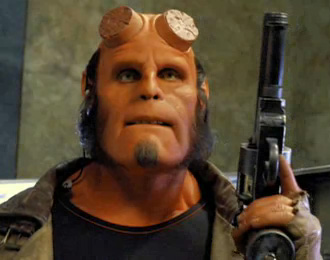
Hellboy II: The Golden Army
In Summer 2008 critics described one superhero film as deep, dark, morally complex and brilliant. Sadly that’s how they described The Dark Knight, the most overrated film of that year, when they should have been describing the most underrated mainstream film of 2008, Guillermo Del Toro’s sadly overlooked Hellboy II: The Golden Army, in those glowing terms.

It is said that in cinema the law of diminishing returns is all but incontrovertible. For every Godfather Part 2 or Empire Strikes Back there are hundreds of Robocop 2’s, hundreds of Speed 2’s. Given that Hellboy was a deeply flawed, if fitfully brilliant, film there was little hope of its sequel being a great movie, but great Hellboy II most certainly is, it is, at last, the perfect coming together of the artistic and the mainstream sides of Guillermo Del Toro’s cinema, as achingly beautiful to behold as anything he’s ever done, and as roaringly entertaining a blockbuster as had been released for years. Make no mistake, this is mainstream entertainment at its very finest.

Most mainstream cinema is stupid, simplistic, or both. Not so Helllboy II, unusually for a summer movie its themes are genuinely thought provoking, the moral dilemmas of its leading character truly thorny, and even as an audience you’re never sure that the ‘villain’ of this piece isn’t in the right, at least in some respects. The backstory, dealt with in a gorgeous opening sequence redolent of the underseen British film Strings, concerns The Golden Army, an indestructible force created for and Elf king’s war against mankind, after much bloodshed the king had a change of heart and called a truce, breaking up the crown that allowed him to control the army and giving one piece to men while keeping two. Thousands of years later, with Elves and their like endangered, the king’s son Nuada (Luke Goss) comes out of hiding to reunite the crown pieces and use the Golden Army to wage a new war.

The great thing about Hellboy II as a sequel is that it appears to have recognised the flaws of its predecessor and jettisoned them, as well as seeing the first film’s strengths, and building on each of those. This is particularly the case with the villain, who at one point tells Hellboy (Ron Perlman) that they should be on the same side, that humanity hates both of them and neither of them belongs to the human world. It’s a fantastic point, one that is undeniably true, and which throws up a whole new side to this film. Hellboy was used as an agent of the apocalypse in the first film, but never when he was in control of himself, here there’s always the possibility that he could come to see things Nuada’s way, because in a lot of ways Nuada isn’t wrong, which makes both the story and the villain much more interesting than in the previous film. Luke Goss is still no Shakespearean actor, but he’s perfectly fine as Nuada, and gives the character weight and pathos, as well as, once again, seriously impressing when it comes to the acrobatic and rather hard hitting fight sequences.

This is also a much more varied film than the first, thanks in large part to an increased budget (increased only modestly though, this film looks as good as any $200 million production, but cost just $73 million), which allowed Del Toro to let his imagination run riot when it comes to monsters, especially the many that populate the outstanding Troll Market sequence. Hellboy II is a constant visual feast, be it the astonishing shopkeeper whose face is a city in miniature, the giant one eyed troll Mr Wink, or the more subtle work on Nuada and his sister Nuala’s (Anna Walton) alabaster skin, there is something in just about every frame to take your breath away. Compared to the endless Sammaels of the first film this increased imagination allows Del Toro to craft a greater range of action scenes, from the Godzilla like sequence with the elemental, which has a genuinely moving and beautiful ending, to the sharp, punchy, fight between Hellboy and Wink, and the battle with the massed ranks of the golden army, to mention just a few.

The returning characters are as compelling as ever. Ron Perlman simply is Hellboy, he’s so good that you never question the logic of the character (which, since he’s an almost ageless demon, is a hell of a trick to pull off) the conceit of this monster as a simple blue collar guy is as funny as ever, and Perlman’s warm and funny performance makes him a truly engaging and entertaining hero. Doug Jones gets a great deal more to do as Abe Sapien this time out, getting to lend his voice as well as his ever impressive physicality to the character this time out. He matches David Hyde Pierce’s performance from the first film well, but it just feels more natural this time, more connected to Abe’s movements, it also allows Abe to develop more of a rapport with the other characters, key to the film’s funniest scene in which Hellboy and Abe, both down about their relationships (Hellboy with Liz and Abe with Princess Nuala) get drunk and sing along to Barry Manilow together. It’s a scene that absolutely shouldn’t work, but it’s extremely funny, and so well played that it becomes one of the film’s highlights. Selma Blair is still the weak link, she doesn’t really have much purpose here, other than as a plot device, but she outdoes herself in her one big moment in the movie, in the sequence featuring one of Del Toro’s most memorable creations – the Angel of Death.

That sequence, which opens the film’s fantastic third act, is one of the best of Del Toro’s career. It’s nightmarish, it’s so beautiful that and frame could hang on a gallery wall, but it is the drama of the scene that makes it so compelling, and the way that it promises so very much for the surely inevitable Hellboy III. The first time I saw this sequence and Liz said “Him” the hairs on the back of my neck stood up.

I can’t say enough good things about Hellboy II, it’s just about the perfect blockbuster. It runs at a terrific pace, but makes just enough room for character, so that it never threatens to become empty spectacle. It’s packed with memorable characters and brilliant design (check out the little clockwork mechanism used to give new character Johan Krauss (Seth MacFarlane) expression). It has depth, complex morality and darkness in spades, but it also manages to maintain a fun, light tone, and be on occasion uproariously funny. It’s the complete entertainment package, a film that improves on every viewing, and very possibly the best superhero film I’ve ever seen.


Next comes The Hobbit, a pair of films to be produced in association with Peter Jackson. This makes me nervous, because much of it will be dictated by what Jackson has done before, including some of the casting, and most importantly the look of the film. It’s already been stated that the films will be styled to link up with Jackson’s Lord of the Rings films. That being the case I can’t see why you’d have Del Toro direct them. You hire this great filmmaker for HIS vision, not to interpret and link up with someone else’s vision. That said, I’ll be seeing them, and anything else Del Toro makes, on opening night, if not before.

Apr 11, 2009

The Complete... Guillermo Del Toro - Part 2

Part 2: One for me, two for them.
We left part 1 of this retrospective with the poor critical and commercial reception of Del Toro’s American debut, the much interfered with Mimic. We pick up with the portly auteur returning to his native language to make a passion project…

El Espinazo del Diablo [The Devil’s Backbone] (2001)
Cast: Eduardo Noriega, Marisa Paredes, Federico Luppi,
Fernando Tielve, Íñigo Garcés

During the Spanish civil war Carlos (Tielve) arrives at an orphanage for boys whose parents have been killed or are fighting in the conflict. He soon discovers that the other children believe the orphanage is haunted, and that they may be right.


As the elder sibling to Pan’s Labyrinth it’s hard to assess The Devil’s Backbone on its own terms. Taken on its own terms there is a great deal to admire in Guillermo Del Toro’s third film, but looking at it now, through the prism of his similarly themed later masterpiece, much also clunks. It’s also unhelpful to The Devil’s Backbone’s cause that since it was released several other films have drawn inspiration from both its look and its story (most notably Juan Antonio Bayona’s overlauded, Del Toro produced, The Orphanage), making it seem less individual than it in fact is.
The main problem is with the pacing. Del Toro is telling two stories here; that of how the war outside the orphanage affects the people in it - teachers Luppi and Paredes and caretaker Noriega, as well as the kids - as much as it does the world outside and a ghost story about a child who officially went missing from the orphanage the same night a bomb fell in the grounds, but failed to explode. The problem is that they don’t balance brilliantly, and for the fifty minutes or so the war story is treading water while the ghost story never really becomes all that interesting, each of its beats staying firmly in the realm of cliché.

The movie does come to life in its second half, hints about one key character start to pay off and the film becomes a real pressure cooker, but one that manages to combine its chills with plenty of emotion, courtesy mainly of Federico Luppi’s beautifully layered turn as Dr Casares. While the ghost story never really shocks the civil war motivated second half certainly does, putting your heart in your mouth several times.

The performances are largely excellent, with the children something of a mixed bag, but the adults acquitting themselves extremely well. Luppi stands out, the sadness behind his eyes deeply moving, but he’s well matched by Paredes and by Eduardo Noriega’s progressively more loathsome and corrupt caretaker.

The one thing you absolutely can’t fault The Devil’s Backbone on is its look. This isn’t an expensive film, but Del Toro gets massive value for money from his budget, with brilliant (if sparing) CGI and awesome sets and props. The gothic look of the orphanage, particularly the cellar which is the setting for much of the second half, is both handsome and creepy; its cathedral like columns and arches lending a haunting air. This is carried through to the dormitories and to the exteriors, giving the film a real graphic identity. Many of Del Toro’s interest also crop up, there may be no clockwork, but Paredes character’s false leg receives much screentime and several loving close ups, while a sequence featuring foetuses in jars showcases imagery that recurs time and again in Del Toro’s films. His use of the ghost character, while seldom unexpected, is beautiful to behold, particularly in the way that CGI is used to make it always appear as if he’s underwater (the floating blood is a lovely touch).

The Devil’s Backbone is brilliant art 24 times per second. It’s not always quite so brilliant as entertainment, but its haunting ending will stick in the mind, and that’s something that you can’t say as often as you ought to be able to.
3/5


The Devil’s Backbone was a critical hit, and re-established Del Toro’s reputation after the poor reception of Mimic. An inexpensive film, it also made enough money that it could be considered a resounding commercial success. Then Hollywood again came calling. Del Toro’s next project wouldn’t be one that, like Devil’s Backbone, he had carefully nursed for 16 years, but it would give him his largest budget yet (a still rather modest $54 million) and let him work in a different style, and on a larger scale.


Blade II (2002)
Cast: Wesley Snipes, Luke Goss, Kriss Kristofferson,
Leonor Varela, Norman Reedus, Ron Perlman

The Blade franchise is a perfect encapsulation of what a Director brings to a studio film. The first film, directed by Stephen Norrington, is largely anonymous hackwork, enlivened by one stunningly executed set piece. The third, directed by franchise screenwriter David S Goyer, is an utter mess, directed by someone with no visual sense and a concept of editing that extends no further than throwing the rushes in a blender. Then there’s Blade II.

Under the steady hand of Guillermo Del Toro Blade II never forgets what it is; an essentially rather silly sequel to a not terribly good comic book movie, Del Toro sets his ambitions rather lower than he had for Cronos and The Devil’s Backbone, understanding that here he’s not trying to make art, but to craft a rollercoaster ride, and that simple aim he achieves with great aplomb and seeming ease. That he’s not trying to make art doesn’t mean that Del Toro doesn’t, almost inadvertently, end up injecting some of his artistry into Blade II, but the balance is very much tipped in favour of sensation.

The problem with the original Blade movie was that it never came close to topping its amazing opening sequence set in a club with vampires dancing under showers of blood. Blade II starts out in similarly energetic fashion, with an action sequence just four minutes in, but crucially Del Toro manages not to upstage himself early, delivering a series of strong and varied action sequences, courtesy of co-ordinators Donnie Yen and Jeff Ward, at regular and well paced intervals, while never losing sight of the (admittedly slightly anorexic) story. That story involves Blade (Snipes) teaming up with a pack of vampires trained to hunt him in order to go after a new kind of super vampire led by Luke Goss, formerly of Bros, as Jared Nomack.

The Reapers are one of the great triumphs of Blade II. Del Toro excels at monsters, always managing to inject personality, and in this case no small measure of pathos, into his bad guys, making the antagonists in his films at least as interesting as the protagonists (in this case, thanks to Snipes’ rather uncharismatic performance, more so) Goss is clearly no DeNiro, but he makes for a serviceable villain, mastering the martial arts and giving both sides of Nomack’s character – the animalistic killer and the abandoned outsider – believability and weight.

What doesn’t always work quite so well is the CGI. A bullet time style effect, deployed several times in the film, works only about fifty percent of the time, and the computer modelled characters that perform some of the impossible stunts are too putty like (Del Toro knows this only too well, ranting “I fucking hate this shot” on his commentary). Outside of a few CGI issues though the film’s design is awesome. The Reapers are nightmarish creatures that represent an entirely logical next evolutionary step along from vampires (their gaping maws were memorably and graphically compared to a vagina by Harry Knowles, in one of his very worst pieces of writing). Del Toro’s obsessions pop up again, with personal touches in every piece of set and prop design. Most notable is a huge array of foetuses seen in jars at the end of the film, explicitly recalling The Devil’s Backbone.


Blade II isn’t a profound film, and it’s probably not, at most levels, even an especially good one. David S Goyer’s screenplay, for example, is largely as schematic and bland as ever, it overflows with idiotic lines and most of the relationships are very poorly drawn. The acting isn’t great, whether you’re talking about Snipes and Kristofferson’s apparent growling competition, Leonor Varela’s bland love interest, or Thomas Kretchmann’s hammery. What Blade II is, though, is ridiculous amounts of fun. It’s a gorgeous rollercoaster ride that you can’t help but get caught up in, despite yourself. You end up forgiving all of its shortcomings because, from its first chilling moments to its overblown last scene it’s a tremendous entertainment.

Blade II may not be Guillermo Del Toro’s proudest or most personal moment as a filmmaker, but it’s where he honed his craft as a mainstream director, while also learning how to inject at least a bit of his own twisted vision into any movie.
3/5


Blade II was a hit, and it made Del Toro a commercially viable filmmaker as well as a renowned one. Studios responded by again bombarding him with offers. Blade: Trinity was waved in front of him, as were Harry Potter and the Prisoner of Azkhaban and Alien Vs Predator, but again Del Toro opted for a project he’d wanted to make, and been pushing to make without success, his new commercial clout finally allowing him to adapt one of his favourite comic books, and cast one of his favourite actors in the leading role.


Hellboy (2004)
Cast: Ron Perlman, Selma Blair, John Hurt,
Rupert Evans, Karel Roden, David Hyde Pierce

Up until Hellboy Guillermo Del Toro’s career had, intentionally or otherwise, been operating on a ‘one for me, one for them’ basis; alternating between his artier Spanish language films and crowdpleasing, broader, American financed and made would be blockbusters. Hellboy was Del Toro’s first real attempt to unite these two sides of his filmmaking personality, and like most beginnings it’s a little bit messy.

Hellboy is a film that I’ve found myself having quite different reactions to each time I watch it, and I think that’s because its quality is liable to vary so much, often from scene to scene. When it works Hellboy combines all the great things about Guillermo Del Toro’s cinema with an involving superhero story with a different and charming hero. On the other hand, when it doesn’t work, it can feel like wading through treacle, trudging through exposition and repetitive scenes mandated by the studio or the relatively small ($66 million) budget.

When they first met to discuss casting Del Toro and Hellboy creator Mike Mignola apparently revealed their choice for Hellboy in unison – both said “Ron Perlman”. The studio, perhaps understandably, wanted a star, and suggested Vin Diesel, but Del Toro stood his ground, and it was a fight well worth having because Perlman so completely inhabits Hellboy that you can’t imagine any other actor wielding the right hand of doom. Perlman has an easy charm that allows you quickly and easily to get to like and identify with Hellboy, despite the fact that he’s a rather odd hero, but he doesn’t allow the funny and charming side to take the edge off the character, making the moral dilemmas of the film’s ending more believable than they might otherwise be.


Perlman also has strong chemistry with Selma Blair, playing pyrokinetic Liz Sherman, who acts as love interest for both Hellboy and the main ‘normal’ character, a young FBI agent named Myers (Evans). This love triangle works well. First of all it creates many opportunities for the stars to play a little comedy, but it also helps make the fantastical things going on more relatable, because at the end of the day these characters worries are the same as anybody else’s. Blair takes some warming up to in the role, which is a little underwritten, but she plays it nicely and never lets Liz blend into the background.

The villains, unusually for Del Toro, aren’t particularly compelling. Del Toro is a filmmaker who has always engaged with his monsters, perhaps the problem here is that almost everyone, good or bad, in this move is a monster to some degree and in spending so much time making sure that we go along with Hellboy and the rest of the BPRD Del Toro has slightly lost his villains. This means that the main antagonist – Karel Roden’s Rasputin – is left with a rather poorly defined plot, and there is little urgency to stopping him because he never feels like a major threat. Another of the issues with the villains comes not from any writing problem, but budgetary considerations. Del Toro’s original script called for several different kinds of monster for Hellboy to fight, but when the budget proved inadequate to make that happen he came up with the solution of using the sammael monster over and over, justifying it by saying that whenever one dies, two are created. It’s a decent monster, but after Hellboy kills one of them it renders the rest rather less threatening, and sucks a little tension out of the ending.


However one villain works brilliantly. Kronen; an armoured Nazi whose undead body is kept alive (not coincidentally) by clockwork, and whose martial arts and knife skills provide the film some of its strongest action scenes, is a brilliant character. Del Toro knows it too, every time Kronen appears he’s introduced with a proper hero shot, his choreography is fluid and punchy, beautiful and very, very cool. Del Toro has said that the way he used Kronen is one of the things he regrets about Hellboy, that he should have made Kronen the main villain, and had the final fight be between him and Hellboy. He’s right. The fight between Kronen and Hellboy is excellent, but it’s over too fast and too easily, and neither Rasputin nor the giant pile of pixels that turns up at the very end (one climax too many) is a match for Kronen.

There’s a bigger misjudgement in the character of Myers. His purpose is to be the audience, to bring us in to the BPRD and make it easier to relate to Hellboy, Liz and Abe Sapien (an underused Doug Jones, with the voice of David Hyde Pierce). The thing is that he’s just not needed. Del Toro’s script and Perlman and Blair’s performances do that job and they leave Myers, his place in the love triangle notwithstanding, seeming rather redundant. It doesn’t help that he’s blandly played by Rupert Evans, but it’s hard to see what he could have done with the role to make it more compelling.


The action scenes are often excellent, with far better CGI than in Mimic or Blade II. A particularly strong set piece has Hellboy fighting a sammael in a subway station. Here Del Toro uses the whole of the set inventively to create an action sequence that delivers on the visceral level, advances Hellboy’s character and is very funny.

While it is a patchy film, with as many parts that clunk as it has moments that work perfectly, Hellboy has moments, both visual and character based, of real beauty and lyricism. The graveyard sequence is a visual masterpiece, with the snow that pops against Hellboy’s red skin helping to create several genuinely lovely images. It’s the film’s ending, though, that really hits the emotional buttons hardest. It’s rare that you really get to connect with and root for a relationship on screen, but the final moments of Hellboy, and Red’s word’s to Liz after she seems to return to life, are truly touching. I wish that the whole of Hellboy were as good as its finest moments, but its shortcomings end up feeling small because when the movie does get it right (which is most of the time) it is a brilliant and different superhero film.
4/5


Coming soon... Part 3: Populist Auteur