Showing posts with label 2012 Releases. Show all posts
Jan 9, 2013
The Picture Show: Jack Reacher / The Impossible
This week, for the first Picture Show of 2013, I'm joined by first time guest, film critic and TV and radio presenter Rebecca Perfect. For the first time on the show we cover movie news, discussing the BAFTA Rising Star nominees, then we review Tom Cruise in Jack Reacher and discuss tsunami drama The Impossible. The list this week covers our favourite DVD and BR releases of 2012.
If you'd like to see and hear more from my lovely guest (why wouldn't you?) you can find her on Twitter or at her own website.
As ever, you can listen to the show below or download it HERE
Labels:
2012 Releases,
2013 Releases,
Podcast,
The Picture Show
Dec 30, 2012
The Picture Show: The Best of 2012
In the second part of our review of 2012, we take a look at the very best films the past 12 months have offered up, running down and debating each of our Top 10 lists. Harmony breaks out with some titles, while others provoke much argument. You can listen to the show in the player below, or download it HERE.
Labels:
2012 in Review,
2012 Releases,
Podcast,
The Picture Show
Dec 13, 2012
Lovely Molly [18]
Dir: Eduardo Sanchez
It's safe to say that, despite a memorable screening in which a drunk man threw himself out of his seat and crawled up the aisle bellowing "It's fucking with my head", I've not exactly been eagerly anticipating the return of either of the directors of the much overrated Blair Witch Project. That being the case, it's a real and pleasing surprise to find that co-director Eduardo Sanchez has made one of the most interesting horror films of 2012.
The setup of Lovely Molly isn't terribly new; a young couple, Molly (Gretchen Lodge) and Tim (Johnny Lewis) move back into the house where she grew up. Soon after, following what may have been a break in, Molly begins to hear things and behave strangely. Questions linger over whether she is turning back to drugs, whether this is a symptom of a deeper illness, or whether there really is something in the house.
So far, so by the numbers noises off scarer then, but Lovely Molly benefits hugely from a screenplay and central performance that keep the ambiguity of the film alive right up to the end, and that makes the film much more involving than most of the similar fare I've seen lately. As Molly, Gretchen Lodge is in all but two scenes, and she gives a brilliant, layered performance, that never quite allows you to be sure whether Molly is being possessed, haunted, or simply losing her mind. Lodge has to shift her performance dramatically from scene to scene, and run the gamut from terrified, to crazed, seductive, to being on the verge of a breakdown, that she manages all this, and to give the character a throughline, is the really remarkable aspect of the film.
The fact that the whole film is filtered through Molly and her experiences makes it more than just another horror film where unseen things go bump in the night. It also helps that when things do go bump the sound is loud, jarring, and all around. Sanchez builds your paranoia alongside Molly's to fine effect. It's easy to be invested in Tim and Molly; they come across initially as a nice, normal, loving couple, thanks to an easy seeming chemistry between Lodge and Lewis (who is also excellent as the husband who loves her, but is pushed to breaking point), and this allows the drama of the possibility that Molly is going mad to play just as effectively as the horror that she might not be.
Sanchez mixes media and viewpoints. Some of the film is shot on a digital camcorder with Molly talking directly to camera. This isn't new territory for the director, and it's especially reminiscent of Blair Witch in the opening scene (which ends on an image that haunts the film). I think it works better here, and not just because Lodge is a better actor than any of the Blair Witch cast, but because, although most of the film takes a third person view of the action, it seems to always reflect Molly's experience of events.
I don't want to go into much detail, but the set pieces are extremely well staged and sustained, and the several scenes where we find Molly terrified in her bedroom while something incredibly menacing seems to be just the other side of the door are both scary and haunting. Even in the third act, when it becomes more visceral, the film doesn't lose its grip on its quite particular tone. Sanchez also executes both the suspense and the more visceral moments equally well, with the first bloody moment coming almost out of nowhere to hit you hard and painfully, both because it's so unexpected, and because it's so personal.
For me though, Lovely Molly is set apart not by its scares, but by the sadness that pervades it (which is why I have a few problems with the last two scenes, which, great images though they are, lean a bit too much on the horror). It's a high quality psychological horror film, and it promises good things for the future from Eduardo Sanchez and Gretchen Lodge.
★★★★
Dec 4, 2012
End of Watch [15]
Dir: David Ayer
Like Harsh Times and Training Day (which he wrote) before it, David Ayer's latest is a film that I can't help feeling that I should like more than I do. There are good things here, great things even, but - just as I've felt he has in the past - Ayer seems to actively work against me enjoying his film as a whole.
End of Watch has very little in terms of an overarching story, rather its throughline comes from its two lead characters; LA street cops Brian Taylor (Jake Gyllenhaal) and Mike Zavala (Michael Pena). The film is largely made up of Taylor's own footage (which apparently he's shooting for a pre-law college course, mentioned in the film's first scene and then never referred to again), and we stay with Taylor and Zavala in almost every scene, often riding along with them through cameras on the car dashboard or mini cameras pinned to their uniforms. The film unfolds essentially as a series of loosely linked vignettes as the two go about their work.
There is one thing in End of Watch that you just can't argue with; the quality and chemistry in the leading performances. Gyllenhaal and Pena are both great here, and it's especially gratifying to see Pena - a talented actor who has never quite got the notice he deserves - grab this part with both hands. The contrasts between the the two are nicely drawn both by Ayer's screenplay and by the actors, who have a real sense of being old and trusted friends. Gyllenhaal's may be the better role, as it's Brian who changes more during the film. Early on we hear him lay out his dating timetable, but when he gets together with Janet (Anna Kendrick), we can see him grow up. These performances make the many scenes in which we see Brian and Mike just bullshitting with each other as they drive between calls the heart of and by far the best thing in the film, and that just makes the problems with the rest of it more frustrating and disappointing.
David Ayer is 44, not that I'd believe it from his writing. Ayer has some strengths as a writer; the two main characters are well developed here, and he's got some colourful supporting characters too, but his dialogue lets him down. Ayer writes dialogue like a 13 year old who has just seen his first Tarantino film, and thus discovered the F word. Anyone who read this site, listens to my podcast or reads my Twitter feed will know I'm hardly shy of deploying profanity myself, so this isn't about being prudish, it's about two more fundamental things.
First of all, when all your characters talk in the same way it becomes hard to distinguish between them, and thus difficult to relate to them. Luckily we spend a lot of time with Brian and Mike, and Pena and Gyllehaal are good enough overcome this to a large degree, but the other characters all blend into an F bomb laden mass. The other problem is that it's just boring to listen to. David Mamet, for instance, uses swearing, and particularly the F word, creatively and even if he uses it a lot, every one is well placed. Ayer's characters don't use it like this. At certain points literally every other word in the scene is Fuck, and for me it popped me right out of the scene, because I'm no longer thinking about the characters, instead I'm thinking I should buy David Ayer a thesaurus for Christmas.
It might be easier to look past these issues with the dialogue if End of Watch were easier to look at. Ayer uses some tropes of the 'found footage' technique here and also some more straightforward 'shakycam' techniques, which take a third person view of the film. There are problems with both techniques. For me, when you're using a found footage technique in your film, it is important to contextualise it; to give the audience an idea of what, exactly, they are watching.
Ayer tries to do this with that throwaway comment in the opening scene, but he uses footage from so many other sources; dashboard cameras, cameras being used by gang members and an outside perspective - the filmmaker's, never given context - that the found footage conceit goes out the window for me, particularly because with all these sources colliding in an edited form there is no sense of what we're actually supposed to be watching, or where the footage that isn't from Brian has been obtained. Is it a TV show about Brian and Mike? Is it something put together by the Department? We never know, and again, that just forced my attention away from the story and on to the technique.
However, the 'shakycam' is the big problem. For me, it renders the film almost unwatchable, because however good the story is, however engaging the drama is, however intense the action is at any given moment, it means that I can barely see it. Every single frame outside the front seat of Brian and Mike's car (so about 85% of the film) is shot with a camera that barely comes to rest for more than a second. I get why this technique is employed. The argument is always that it puts you in the thick of the action with the characters, but I've only ever found that to be the case in isolated scenes (the opening scene of Joe Canahan's Narc, for instance). In every key scene of the film I felt this technique took away from the drama, and particularly in key setpieces in the film's second half, one involving a fire, the other a gunfight. I get that Ayer wants to plunge you into the characters confusion in the situation, but it's possible to do that without shaking the camera like an epileptic on cocaine and making sure we can only tell what's happening in a tiny handful of the shots. If you find this engaging, fine, to me it feels like an excuse, like a director saying 'I don't know how to shoot this, so just shake the camera a lot and maybe nobody will notice'.
With a dialogue focused rewrite - to make it less the profane drone it often feels like - and a more sedate camera technique I think I might have liked End of Watch a lot. Okay, it still wouldn't have been very original, but it certainly might have engaged as a cop movie just as it sometimes does as a film about male friendship. Ultimately though a screenplay that is thumpingly tedious whenever it cuts away from Brian and Mike as private people (whether together on the job or with their wives) and an actively irritating shooting style conspire to mean that I can't quite recommend it, despite two of the better leading actor performances of the year.
★★
Labels:
2 stars,
2012 Releases,
Crime,
Drama,
Film reviews
Nov 17, 2012
The Picture Show: Alps / Rust and Bone
This week Sam and Mike review two recent arthouse releases which - SPOILERS - also happen to be two of the best films of 2012. They also discuss some of their favourite uses of music in non-musical films and recommend recent DVD and Blu Ray releases. You can listen to the show in the player below or download it HERE
Labels:
2012 Releases,
Drama,
Film reviews,
France,
Greece,
Podcast,
The Picture Show
Nov 7, 2012
The Picture Show: Skyfall
Sam and Mike are back with a special Picture Show. In this episode they focus on a single film, reviewing the 50th anniversary Bond film, Skyfall, with a brief discussion of the franchise and their relationship to it.
You can listen to the show in the player below, or download it HERE
Labels:
2012 Releases,
Action,
Bond,
Film reviews,
Podcast,
The Picture Show
Nov 5, 2012
Skyfall [12A]
Dir: Sam Mendes
Skyfall is a film with an identity crisis. It can't decide if it wants to be a solemn study of a pretty much burnt out spy, a slam bang actioner, or a traditional James Bond film. The upshot is that it fails at all three.
The 23rd Bond film, also the franchise's 50th anniversary entry, opens with the theft of a hard drive containing the real identities of all the MI6 agents currently undercover in the world's terrorist organisations. James Bond (Daniel Craig) fails to retrieve it, and is presumed killed by a wayward shot from junior agent Eve (Naomie Harris) during the mission. Some time later an explosion at MI6 alerts British intelligence to the fact that someone is planning to use the data for nefarious purposes. Bond returns, in bad physical shape, but M (Judi Dench) reassigns him to find the person who has stolen the hard drive. This turns out to be Silva (Javier Bardem); a ruthless and tech savvy terrorist with a grudge.
Since relaunching, after disastrous 40th anniversary film Die Another Day, with Casino Royale, the Bond series has visibly strained to find a place in the 21st century. Casino Royale itself did well; the action was too indebted to the Bourne series for my liking, but it managed to strip away many of the series' sillier trademarks, while retaining much of the Bond feel, and, with Eva Green's Vesper Lynd, redefining the Bond girl in a way the series had been trying to do since Timothy Dalton's stint. However, Quantum of Solace pushed too far in one direction; becoming a barely comprehensibly directed and not terribly Bond like action film, and in trying to address that imbalance, Skyfall has emerged confused.
Skyfall has a lot going for it in the technical departments, with Sam Mendes providing a safe (read not particularly individual) pair of hands behind the camera, Roger Deakins as DP and Gary Powell returning from the previous two films as stunt coordinator, so it's no surprise that the opening pre-credits action sequence is pretty good; it's nicely cut by Stuart Baird and moves at a good clip, but even here there are things that bugged me. First off, and this is something that recurs throughout the film, for an experienced and well regarded secret agent, Bond is a terrible shot, but more importantly, for as fast as it moves and as much as it's never dull, this opening action beat never has a moment that feels new, and never takes the breath away. This is also far and away the best action scene in the film, as others suffer from some dreadful CGI (why are there no people on that [very fake looking] Underground train?) or simply lack impact (a punch up with a henchman in the film's climactic moments, which really ought to be against Silva), and for a 144 minute Bond movie the action beats are few, and far between.
Another key element of the Bond series Skyfall botches is the Bond girl. There really isn't a Bond girl in this film, and that is one of the key contributors to the constant nagging sensation that this doesn't really feel like a Bond film. Berenice Marlhoe, as Severine, is the closest thing the film has to a Bond girl, but after a very promising opening scene she becomes little more than a prop; facilitating a key meeting and simply fucked and forgotten, she has no real impact on the film, and is in it so briefly that by the end you'll likely have forgotten she existed. While there is another woman for Bond to invest in, in the form of M, the lack of a real Bond girl robs the film of a key, and fun, dynamic which has always been a part of the series in some fashion. It's also disappointing the route the film takes with Harris' character, who seems to decrease in importance and competence with each passing scene. If in this fashion the film misses the classic feel of a Bond film, when it does try to invoke franchise history it often falls on its face. The few wisecracking one liners in the film feel awkward set against the dour tone, and Craig can't deliver a joke to save his life. Worst, however, is the reintroduction of a classic prop, in a silly scene that seems as nakedly designed to play to the Bond fan gallery as any of the tribute moments in Die Another Day.
None of these issues, pressing as they are, is the biggest problem with the film. That is simply that there never seems to be any great urgency in the plot that it should be James Bond, rather than any more competent and better preserved MI6 agent, who takes this mission. The film has to work very hard to get Bond into position as M's protector, having her make some reckless decisions to facilitate that (these aren't the only decisions that suggest M is incompetent, seriously, what intelligence head wouldn't pull all her compromised operatives as soon as their identities were leaked, rather than wait what seems to be several months to see what happens?) The problem is that Bond is unimpressive; a terrible shot; a half broken shell who seems to suffer chronic pain in several areas and (though this may just be how Daniel Craig acts every role) seems disengaged. This didn't, for me, give the film the emotional depth that others seem to have seen in it, instead it just took me out of the film.
Unfortunately this doesn't translate to tension, because Javier Bardem's Silva is another of the ways the film seems confused. Writers Neal Purvis, Robert Wade and John Logan seem undecided on whether to make Silva a campy bad guy in the classic Bond mould or a more contemporary threat; a more physically imposing version of Tomorrow Never Dies' Elliot Carver. Javier Bardem almost manages to square this circle with his memorable performance, and he's especially good confronting Bond and M in a mid movie scene, but he does sometimes push the boat too far out into camp. When villains are as overblown as Bond's villains have traditionally been, you don't really question the logistics of their evil deeds, but the problem with attempting to bring the franchise down to Earth is that those questions start to niggle at you. Where does Silva suddenly get a helicopter and a small army of henchmen, what's in it for those henchmen? Certainly Silva's plan doesn't involve a ransom, so how are they waged? Without getting too deeply into it, there are a few echoes of The Rock in Silva's motives, and so it shouldn't have been difficult to establish motives for his henchmen (indeed giving them a background in this respect might have made the climatic scenes feel higher stakes, as they wouldn't just be moving targets for Bond). Even despite his various terrorist acts, Silva never feels much of a threat, there's little in the way of obvious cost in what he does (a few people die offscreen, one onscreen), and despite his background suggesting that he should be able to hold his own, Silva and Bond never have a proper fight, which is inexusable in an action film.
Skyfall has fine technical credentials, but they don't pay off to the degree that they should. Happily Stuart Baird's editing is comprehensible, meaning that while the action seldom gets the blood pumping it does manage not to give you a headache, and largely retain some sense in terms of spatial relationships. Sam Mendes brings professionalism to the table rather than personality, and that doesn't seem to me to be the way to really reinvigorate this franchise in its 50th year, but he captures everything competently, and guides his cast (the ever dull Craig aside) to solid if generally not spectacular performances. Most praised in the technical credits has been Roger Deakins, and to some degree I agree; his lighting is technically stunning, but I did grow tired of the very limited colour scheme, which consists largely of steel blues and golden yellows, in a way that isn't too far off the teal and orange colour schemes that have dominated action cinema of late. More problematic technically is the CGI, which is more obvious than it has any right to be in a film that cost something north of $150million, and makes a few key scenes look like they belong in something much lower rent.
All this said, Skyfall isn't entirely awful, one of the rare nods to the history of the franchise that actually works is provided by Ben Wishaw's Q, his dismissal of the exploding pens of the past strikes the right balance between gag and tribute, and he really comes into his own in a key end of second act set piece, the problem is that I think he's more fun (and perhaps more use) than Bond. There is also one extended part where the film works quite well, when Bond travels to Shanghai. This segment boasts the best shot action scene (a silhouetted fight with Ola Rapace) and the film's best scene, which introduces Severine. Most of all though it works because these ten or fifteen minutes are when this feels a bit like a Bond film.
The Bond series has always been hit and miss, and for me this will go down as a miss. It's ultimately no worse than Quantum of Solace, but sadly I don't think it's any better, though for very different reasons. I continue to hope that the Craig era of Bond can find a consistent tone, and recapture some of what made Casino Royale so refreshing, but the ending of this film has me in doubt.
★★
★★
Labels:
2 stars,
2012 Releases,
Action,
Bond,
Film reviews
Nov 4, 2012
The Picture Show: Holy Motors / Excision
After a long layoff, Sam and Mike are back with The Picture Show. This week they discuss (read argue about) Leos Carax' brilliant/irritating Holy Motors, Richard Bates Jr's disturbingly funny Excision and some of their favourite minor characters in movies.
You can listen to the show through the player below, or download it HERE.
We'll be back soon with a special show on the new James Bond film Skyfall.
You can listen to the show through the player below, or download it HERE.
We'll be back soon with a special show on the new James Bond film Skyfall.
Labels:
2012 Releases,
Film reviews,
France,
Horror,
Podcast,
Surreal,
The Picture Show
Oct 19, 2012
24FPS @ LFF 2012: Diary 18/10
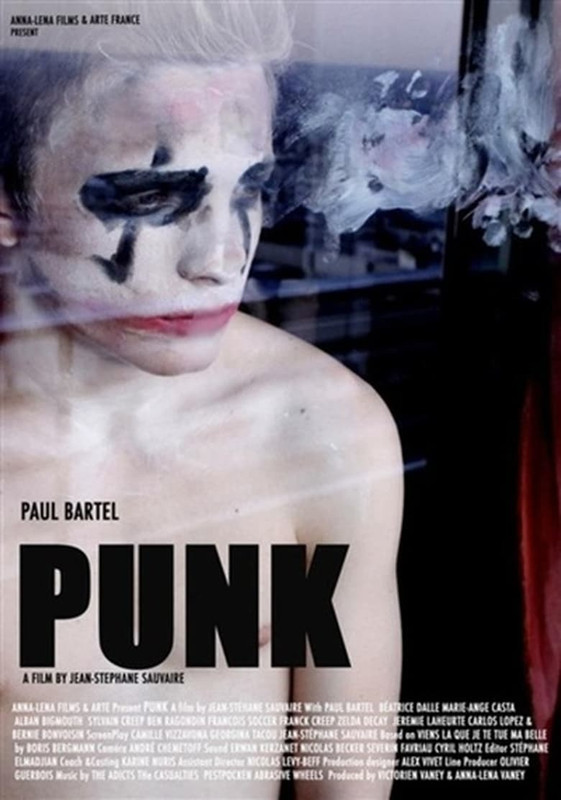
Punk
Dir: Jean-Stephane Sauvaire
Punk, in all honesty, isn't a terrible film, it's just one I feel like I've seen several hundred times before; one more in a long line of “I'm sixteen and angry at my Dad” movies. Looking as though it is set in the late 1970's among the French punk scene, and involving a couple of clashes between skinhead and anti fascist punks, the film it is most obviously comparable to is Shane Meadows' This is England, and that does Punk no favours at all.
Paul (Paul Bartel) is about sixteen, and lives with his Mother (Beatrice Dalle). He resents his absent Father, but has a few friends in the hardcore punk scenes and a Father figure at the gym he trains at. There's little in the way of story, and many trite scenes that we've seen in all of these films; the same fights with Mum, long anticipated confrontation with Dad, gang fights, fights with a girlfriend (Marie-Ange Casta, who shows up for about ten minutes total and contributes little of note aside from her fantastic breasts). None of it is notably terrible, but everything feels so rote, so seen it all before and so aimless.
Bartel and the rest of the non-professional cast do well enough, and Dalle remains a peculiarly fascinating presence, even in a role as thin as this, but I was never invested in Paul or his relationships.
Jean-Stephane Sauvaire is, apparently, yet another victim of the disease that makes its sufferers abandon technique in favour of 'realism'. In this case the most irksome feature is the fact that the film frequently looks like the focus puller fell asleep at his station. According to the LFF brochure the film is not set in the late 1970's as I thought. So when is it set? Sauvaire's design offers no clues, and if it is supposed to be contemporary why does nobody own a mobile phone? These are small details, but they all add up to create a satisfying picture of a world, and when they are missing that process is undermined.
I found Punk a wearing experience. I tired of its feedback loop of scenes of people shouting at each other between taking drugs, I found myself distinctly underwhelmed too by its desire to shock (a completely random scene featuring two transsexual hookers buying drugs) and annoyed by the level of cliché (yes, the obligatory traumatic haircut scene is here). However, the worst scene comes near the end, when Paul goes backstage at punk gig and get some spectacularly trite psych 101 advice from a singer, at which juncture Sauvaire may just as well put a flashing caption “THE POINT” on screen. It's a predictable and rather empty point, and getting there is a long and tedious process.
★★
★★
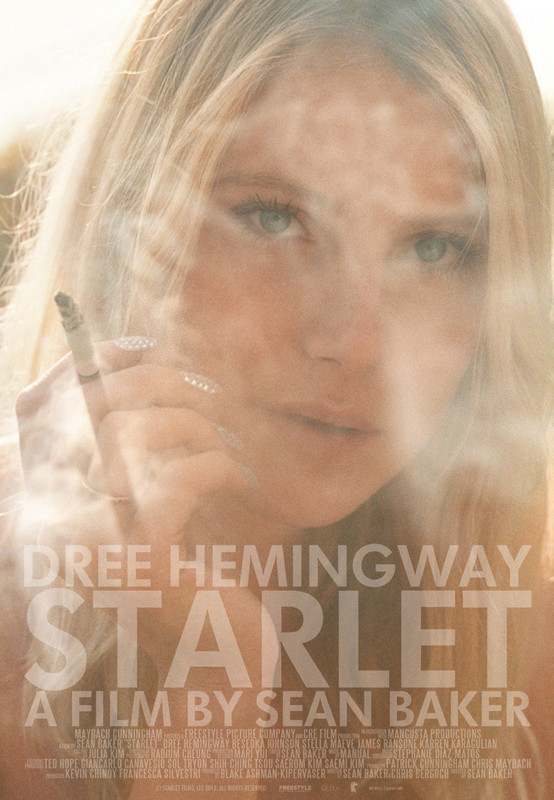
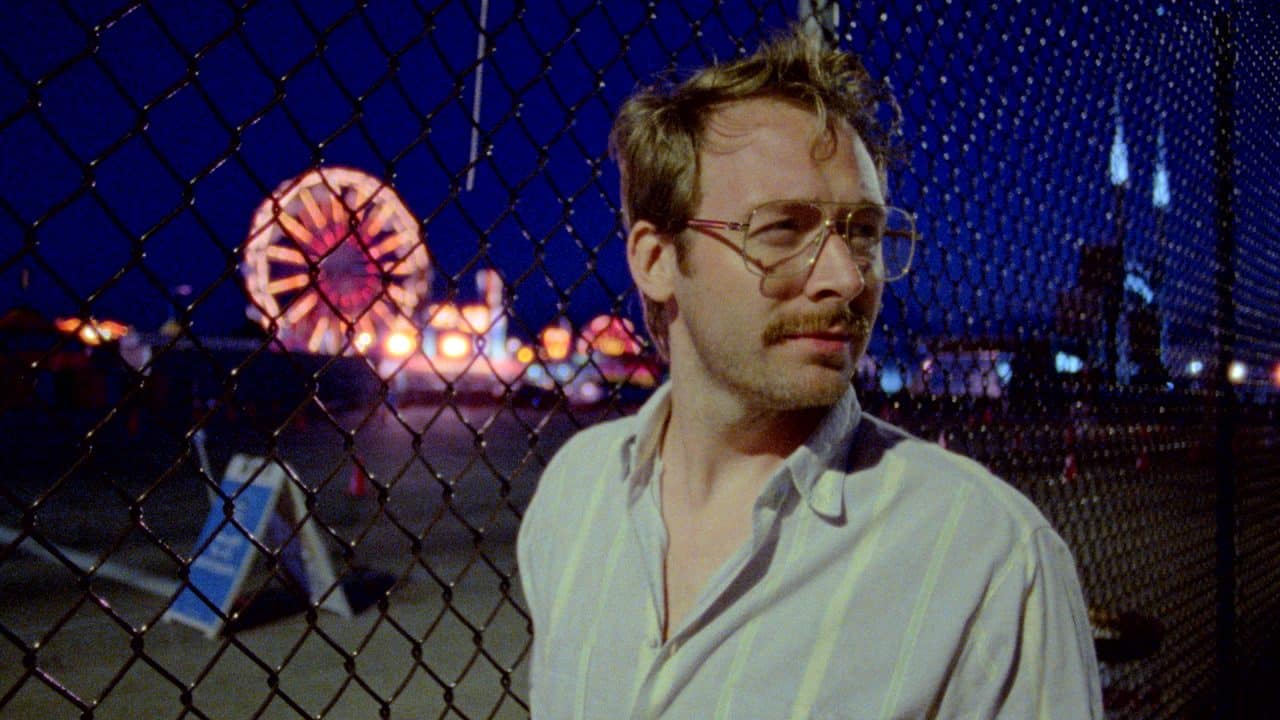
Dir: Sean Baker
The most frustrating experience as a critic is seeing a film you want to like, that you like parts of, but which doesn't manage to live up to its potential. On that note: Starlet.
Jane (Dree Hemingway) is a relatively new pornstar working in the San Fernando Valley. Furnishing her new rented room she picks up a large thermos at a yard sale, intending to use it as a vase. When she's first using the thermos, Jane discovers thousands of dollars in it. She spends some of the money and, feeling guilty about both that and the fact that Sadie (Besedka Johnson), the woman she bought the thermos from, clearly has no idea that there was money in it and won't take it back, Jane decides to befriend this irascible old woman.
In story terms, half of Starlet is excellent. The relationship between Sadie and Jane is original and well drawn by Baker's screenplay. It does go through all the familiar beats, as the suspicious Sadie slowly accepts Jane into her life and the sunny Jane works on brightening Sadie's life a little. Their interactions are funny, and the growing warmth that slowly seeps into Hemingway and Johnson's interactions with each other feels genuine.
For all that he does hit some familiar beats with his screenplay, Baker does have some more original touches, largely in what he doesn't include. Another film might have a forced heart to heart between Sadie and Jane about Jane's job, but it's never addressed (or judged), and the discussion about the money, which could hang over the film, never arises between them. This might feel like an oversight, but that scene could only really be a cliché, and I'm glad it's not there.
The two central performances are really the key. Johnson is prickly, irascible and often very funny while Hemingway is all sunshine and good intentions (so much so that after a while I forgot that she'd begun the film by, essentially, stealing from a woman in her eighties). Between them they make the half of the film that concentrates on this relationship both compelling and endearing.
The other side of the film, dealing with Jane's work and her friends in the porn industry (including her housemates Stella Maeve and James Ransone) is problematic in that it lacks that same appeal, has some serious issues with some of the performances, and suffers from a real tonal mismatch with the Jane/Sadie story. Worse is the decision to use hardcore insert shots during the scene that shows Jane going about her day job. I get that the film is going for gritty and realistic here, but it's undermined by the fact that it couldn't be more obvious that Dree Hemingway isn't the one performing these shots, and also by the fact that the scene feels completely gratuitous and out of place. It exists so that something can go wrong while Sadie is dogsitting for Jane, but there's no reason we need to see Jane at work, and certainly no reason for those hardcore shots, which will only limit the audience for a film that could otherwise have wider appeal. The tonal mismatch is stunning. The Jane/Sadie story is a film I would happily take my Mum to see, but the rest of the film totally and needlessly precludes that, and that's a real pity.
Starlet is Sean Baker's first feature, and you can tell. Visually the film is hamstrung by what is either technical incompetence or one of the worst artistic choices of the festival. Almost every other shot in the film, including every shot that takes place outside, is ridiculously overexposed, the light blown out to a distracting degree. Assuming the film was being correctly projected and that Baker and DP Radium Cheung aren't totally incompetent when it comes to lighting (and I suspect it was, and they're not, because the shots that aren't blown out are reasonably well composed) this is an inexplicable choice, and it nearly cripples the film.
I want to recommend Starlet, there are such good things in it, and Dree Hemingway makes a great impression and, I suspect, has as bright a future as her Mother, Mariel, but ultimately the film is so uneven. The good parts are well worth seeing, but really not enough reason to rush out and pay festival or cinema prices.
★★★
★★★
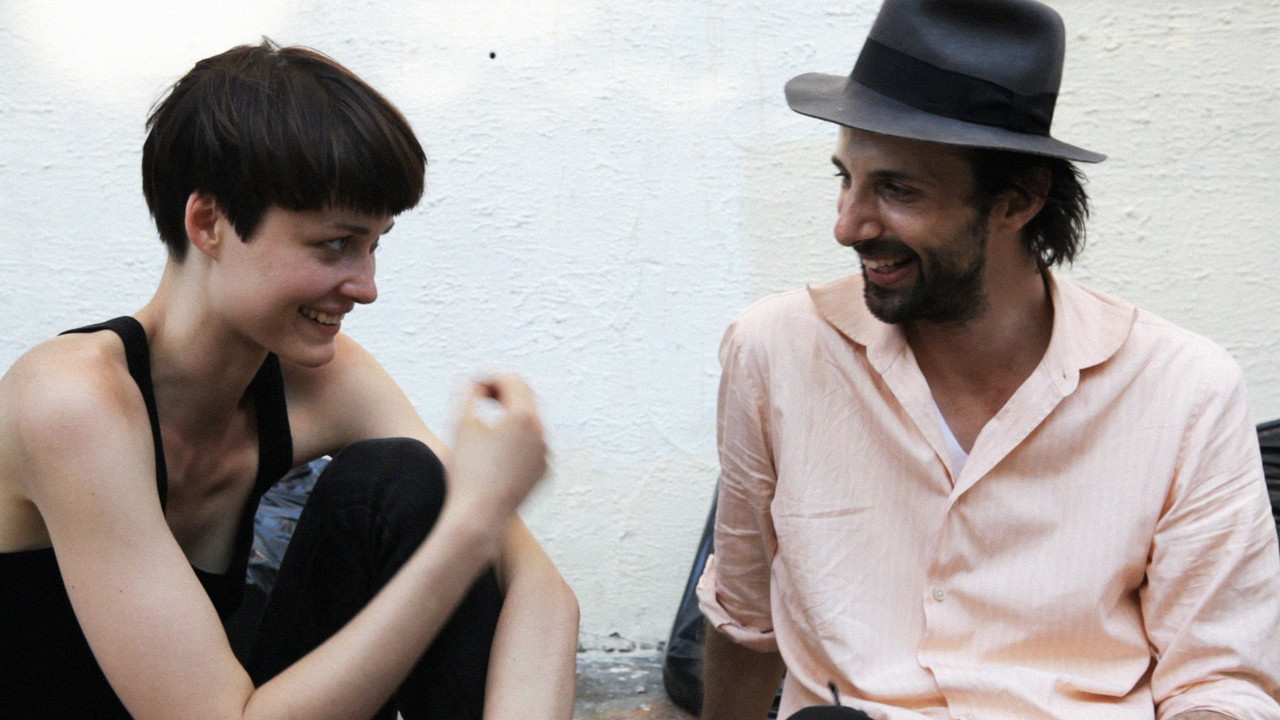
Love Story
Dir: Florian Habicht
Before our screening of Love Story began, co-writer/director/star Florian Habicht came in and told us about the genesis of the film, he'd seen a woman on the subway in New York and he had given her his email address so they could meet up again, but after waiting to hear from her, he realised he had given her an old address. He then spent several days walking around the place where he'd seen her, asking people if they'd seen a woman of her description, before giving up because in a city the size of New York it was ridiculous. He has, however, got a movie out of it. A movie this woman was watching with us yesterday.
Love Story is about the most generic title you could imagine, but Habicht's film is anything but generic. Boy (Habicht) meets girl holding a slice of cake (Masha Yakovenko). Boy misses his chance to see girl holding a slice of cake again. Boy finds girl (no longer holding a slice of cake) and from there, things get strange. Rather than just make a love story, Habicht appears to have his film largely written by vox pop. In what seem to be genuine interviews with real New Yorkers on the street (including one whose cab he abruptly jumps in) he elicits the twists and turns of his film. Some ideas are generic (looking for something to go wrong during his sex scene the first usable suggestion is that he loses his erection), others are unexpectedly original (interviewing a man who would likely place in New York's top 10 nerdiest he asks what kind of romantic gesture he should use to bring himself and the girl, Marsha, back together and gets a genuinely different and rather beautiful suggestion).
The blending and blurring of fact and fiction is cleverly done, and even when something is quite clearly staged (when it's clear that there are several angles he can choose from, for instance) it's incredibly easy to invest in because Habicht is such an endearing presence, and because he's established a (peculiar) sort of reality.
Love Story is extremely original, often funny and sometimes unexpectedly moving (a question about first love elicits an incredible story from a homeless man). I can see that some people will find the structure and the occasional preciousness annoying, but I found myself totally wrapped up, charmed by the story and impressed by the originality of the telling.
★★★★
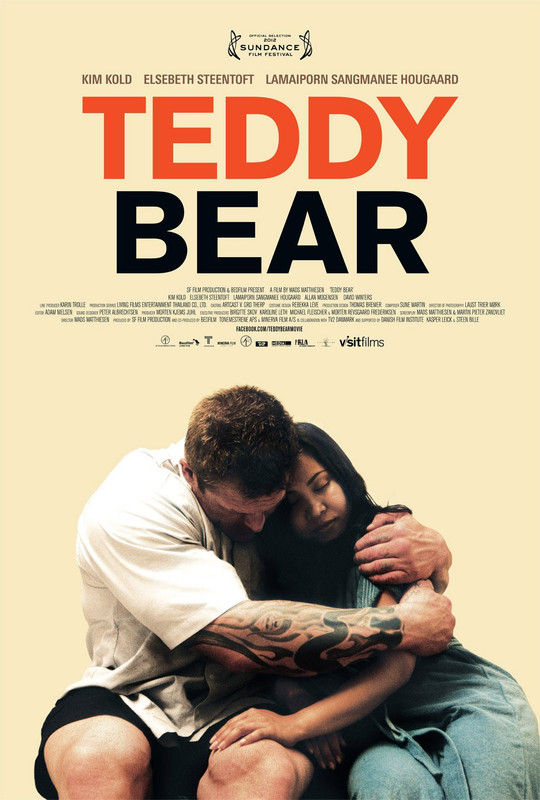
Teddy Bear
Dir: Mads Matthiesen
The Teddy Bear of this film's title is a man, Dennis (Kim Kold); a gentle giant of a professional bodybuilder, living in Denmark with his elderly mother (Elsebeth Steentoft). Dennis' uncle has just come back from Thailand with a pretty young wife, and he suggests that his nephew make the same trip. Dennis takes the trip, but lies to his controlling mother about where he is going.
Teddy Bear is a wonderfully warm film, and that's largely down to the character of Dennis, and to Kim Kold's excellent performance. Kold is huge; clearly a real bodybuilder, and you can imagine him to be a scary guy to run into, but he makes Dennis totally disarming with a performance full of crippling shyness outside of the stage, and a simple, sweet, endearing nature. This doesn't mean that Dennis isn't complex. The relationship with his Mother is well drawn, and we get hints that while he's grown up as a man who is polite almost to a fault this relationship has also, whether passively or actively, prevented him from forming other relationships.
The film isn't exactly jam packed with surprises. The Thailand section of the film has some nice comic moments as Dennis tries to deal with aggressive advances of the prospective matches, but that part of the film really takes off when he goes to a gym and meets the widowed owner (Lamaiporn Sangmanee Hougaard). The relationship between her and Dennis is sweet and Kold and Hougaard, while a decidedly odd couple, do have an awkward kind of chemistry between them which makes for some laughs and some very touching moments (a shot of the two in bed together, fully clothed, combines the two to fine effect).
Both an unconventional romance and a coming of (middle) age story, Teddy Bear does both well. It's a real shame that Kim Kold's very specific look may restrict the roles he's offered in future, because his small but hugely expressive performance is the engine of this charming little film.
★★★
Jeff
Dir: Chris James Thompson
Titled The Jeffrey Dahmer Files in the LFF brochure, but going by Jeff on its title card, this documentary is a strange one by any title.
Director Thompson combines interviews with three key witnesses to the investigation of Dahmer; Detective Pat Kennedy, who took his confession; medical examiner Jeffrey Jentzen and Dahmer's neighbour Pamela Bass with archive TV footage and some oddly chosen reconstructions in which Dahmer (Andrew Swant) goes about first day to day activities then things related to the murders (which are never themselves depicted).
The construction is simply bizarre, and while the interviews – the one with extravagantly moustachioed Kennedy in particular – are riveting in what they reveal both about Dahmer and about the interviewees, you can't help but feel that only having three people talking, and having them constantly interrupted by the reconstructions is somewhat like looking through a keyhole at Mount Everest. The reconstructions just don't work, they tell us nothing that couldn't be better related by the interviews, and while they are well shot (on what looks like 16mm) they don't bolster our understanding of Dahmer at all, and feel rather aimless. I, and I suspect many other audience members, soon began greeting them with a sigh.
The parts of the story the film addresses are well told, and Chris James Thompson clearly knows the questions to ask. He's also made a stylish film, it looks striking in the reconstruction scenes, and the repeated use of Swedish electro band The Knife on the soundtrack is perfect, given their chilling, doomy music. It's just a shame that the film's brief seems so restricted, and thus it feels incomplete.
★★★
★★★
Labels:
2 stars,
2012 Releases,
3 Stars,
4 stars,
Crime,
Denmark,
Documentary,
Drama,
Festivals,
Film reviews,
France,
LFF2012,
Mini-Reviews
Oct 15, 2012
24FPS @ LFF 2012: Rust and Bone
Dir: Jacques Audiard
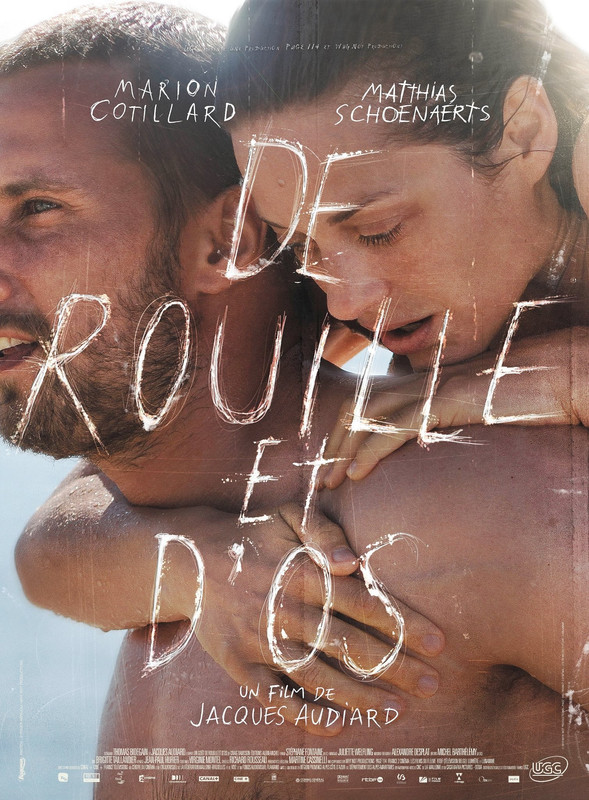
I walked into Rust and Bone sceptical. I'd heard great things, but then I also heard great things about Jacques Audiard's last film, A Prophet, which, after months of 'it's the best film of the year' style build up, I finally saw and thought was... fine. Having heard the regard Audiard is held in, and not yet having got around to any of his other films, I decided to give him another shot with the almost equally rapturously received Rust and Bone, I probably still won't get what the fuss is about A Prophet, but I do finally get what the fuss is about Audiard, because Rust and Bone is a beautiful, bruising, beast of a film.
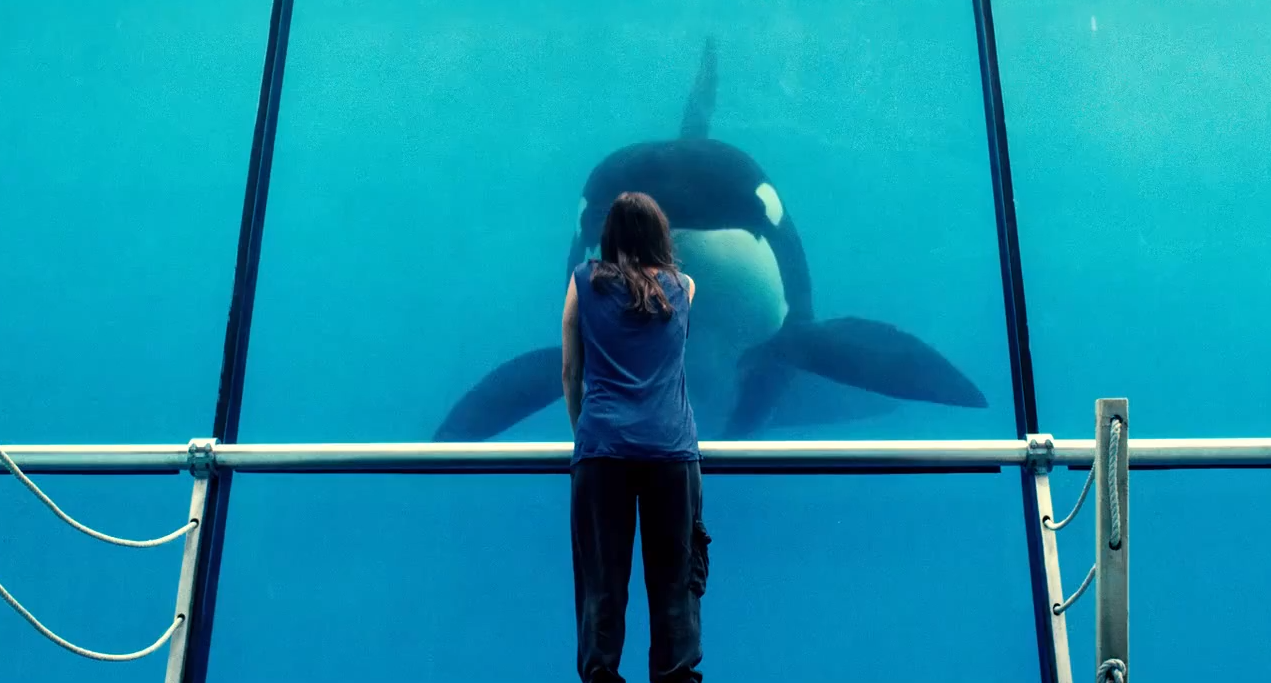
The film introduces us to two people. Ali (Matthias Schoenaerts) is an itinerant fighter, recently arrived in France with his five year old son Sam in tow to stay with his Sister. Stephanie (Marion Cotillard) is more settled; she trains and performs with Orcas. The two meet after Ali takes Stephanie back to her home from the club he's working at as a bouncer when she's caught in a fight, but they are drawn together only after Stephanie has a terrible accident in which she loses both of her legs.
At its heart, Rust and Bone is about someone who breaks people; physically and sometimes emotionally, and someone who is broken in both senses. This isn't a Hollywood film, people aren't always likeable, and the process of being fixed is long and at best uncertain, and what Ali offers to Stephanie in terms of care comes in a way that is, in its own fashion, pretty brutal. What makes the characters – Ali in particular – palatable is that neither Audiard nor his actors ask for your sympathy for them (empathy, yes, sympathy, no). Moments like Ali losing his temper and throwing his son down, hurting him, aren't dismissed, they just don't define him. Ali, like most people, isn't one thing. He's not merely a vicious fighter or an inattentive Father, he clearly cares about people – indeed when he first begins spending time with Stephanie after her accident there's nothing in it for him in terms of money or in terms of sex, no ulterior motive.
Stephanie is a more settled and perhaps more 'normal' person when we first meet her, but her sense of self is obviously profoundly changed by her accident. There's anger and grief at what she's lost, but also a sense of something new and different in her relationship with Ali. In a more conventional (read Hollywood) film the whole film would likely be about how Ali immediately changes, and helps Stephanie on her road to recovery, with her symbolically rediscovering herself in a big climactic set piece. Audiard's film is more real than that. Stephanie does have that moment of reconnecting with the person she used to be, but it's a low key thing, with only her in the scene, and it's all the more moving for that. Ali does take care of Stephanie, in his way, but that doesn't magically make him a great person (his response when Stephanie talks about her sexual frustration is caring in its way, but also blunt almost to the point of offensiveness).
To go along with the complexity of the characters, Rust and Bone boasts two rich and impressive leading performances. Schoenaerts bristles with coiled energy, which is what makes Ali both so interesting to Stephanie and so dangerous both as a fighter and as a guy in his life outside whatever ring or strip of dirt he's fighting on that day. We see that energy unleashed for good and for bad, and sometimes how hard it is distinguishing between the two. Schoenaerts is also good at suggesting much of what Ali is feeling beneath the hardened surface, only letting it spill over in one of the film's most visceral and desperate scenes. Marion Cotillard has top billing here, but also much the smaller part, we see Stephanie largely as Ali drifts in and out of her life, whether by his volition or hers. It would be easy for Cotillard to have overplayed this character, but her distress is raw and heartbreaking, and neither she nor Audiard let Stephanie's story stray into melodrama.
The writing, acting and Audiard's artistic but never obscure direction all combine to make Rust and Bone a truly affecting experience. Audiard's most impressive quality here is the ability to smoothly shift gears from raw and visceral moments like Ali's fights to a more impressionistic tone when Stephanie is hurt, and in parts of her recovery, particularly a scene that will ensure you will never, ever, hear Katy Perry's Firework the same way again (it does for this song what Take This Waltz recently did for Video Killed the Radio Star). The music selection in general is brilliant. A personal favourite, both as a scene and a music choice, was a remix of Lykke Li's I Follow Rivers during a key club scene, as Stephanie ventures on a night out for the first time since the accident.
The only part of the film where I felt it might have taken a mis-step is in the closing ten minutes. They felt perhaps a little sentimental and a little neat as I watched them, but reflecting on it later I think that last passage of the film fits perfectly, and brings it full circle. Without giving anything away, Stephanie is immeasurably changed early in the film by a huge event, and by the end it is Ali's turn. It feels like it comes quickly, and one or two longer scenes might have helped (I'd have happily watched more of this film), but it works with the tone and the story of the two preceding hours.
This is a film I feel sure will repay repeat viewings, there is so much in the performances, so many beautiful little layers to this unconventional is it or isn't it a love story. But it's the mix of bruising realism - physical and emotional - with moments of pure cinema which make it clearly the film of the festival and the film of the year so far.
★★★★★
★★★★★
Labels:
2012 Releases,
5 Stars,
Drama,
Festivals,
Film reviews,
France,
LFF2012
Oct 12, 2012
24FPS @ LFF 2012: 12/10
Ginger
and Rosa
Dir: Sally Potter
Lore
Dir: Cate Shortland
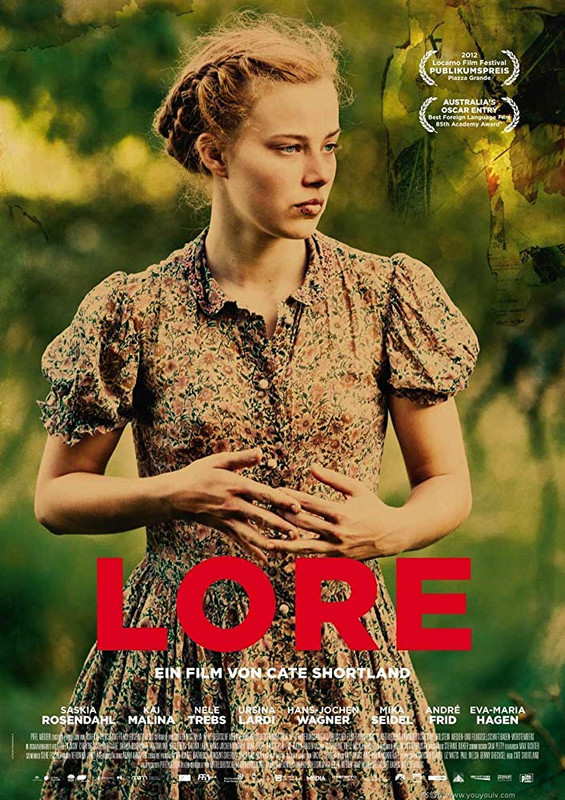
It's been a long wait for fans of Cate Shortland's first film, Somersault (I was not among them) for her second feature. Lore is certainly not what I expected Shortland to deliver next, at least in concept. Acted entirely in German, it's a second world war story told from an angle we don't often see. Just after Hitler's death, and the end of the war Lore's (Saskia Rosendahl) Father comes home and instructs Lore, her Mother (Ursina Lardi) and her siblings to pack essentials and things they can barter, because they are leaving the home, Lore's family are Nazis, and the allies are now rounding up war criminals. Soon Lore's Father disappears, and her Mother opts to hand herself over to the allies rather than be arrested. This leaves Lore to take her younger siblings - 11 year old sister Liesel (Nele Trebs), a brother of about ten, twins about seven and baby Peter - on a long and dangerous walk from the Black Forest to their Grandmother's house in Hamburg. Along the way they are aided by a concentration camp survivor; Thomas (Kai Malina).
The difficulty with Lore - both character and film - is one of sympathy. Can we have sympathy with these characters? We obviously can't with the parents, and the younger children haven't been raised with anything but Nazism, and they at least develop some acceptance of their eventual Jewish travelling companion. Lore herself, however, is more problematic. We can see where her opinions come from, but given that she's about 18 is that enough to allow us to sympathise with her anyway, as she frequently abuses the person who is helping her family ("You're a liar, just like all filthy Jews"). I really struggled with this. It would help if Lore had more of a character arc but, aside from a rather impressionistic rejection of her Grandmother and Mother, she seems essentially to be the same character as the closing credits go up as she was as the film began. Ultimately, excellent though Saskia Rosendahl's performance (her film debut) is, and welcome as any degree of moral complexity is, I felt that I was left emotionally at arms length from the film, because I couldn't really engage with and root for the main character in the same way as in, say, The Way Back.
That difficulty aside though, Lore has much to recommend it. Shortland and her young DP Adam Arkapaw (who also shot Snowtown) give the film a pastoral beauty which contrasts with the harsh realities of the story, though the amount of soft focus close ups on nature or on Lore does get a little tiresome and begin to make the film feel a touch padded at just under two hours, however beautiful the individual shots are. The performances are excellent all round, and the tension between Lore and Thomas, sexual and racial, is especially well played by Rosendahl and Malina. Of the other siblings only Nele Trebs and Andre Frid (as ten year old Gunther) have especially developed roles, but the family dynamic is convincingly played. It's a bit of a shame that Ursina Lardi has only a small role as Lore's Mother, she's well cast (one shot seems to show Lore trying to dress and make up like her Mother, and the resemblance is pretty startling) and her hard edged and unapologetic character is interesting.
The journey is engaging throughout, and while the film does unfold, as these long walk movies tend to, largely as a series of encounters and individual scenes, it also manages to spring a couple of genuinely surprising twists. Shortland's decision to shoot the film entirely in German is also especially welcome, as it surely makes for far better performances from her cast, and because this is a specifically German story, and would likely ring far less true if it had been played, whether by German or American or British actors, in accented English.
I have reservations about Lore, but the story grips, the performances are all strong, and it is lovely to look at. It's well worth a watch, get back to me when you've seen it, and we can talk about the issue of emotional engagement.
★★★
Dir: Sally Potter
Sally
Potter's latest is the very definition of a mixed bag. There are
some excellent things here, but unfortunately, they are wrapped in a
film that is terribly inconsistent, full of baffling decisions and
things that feel unfinished.
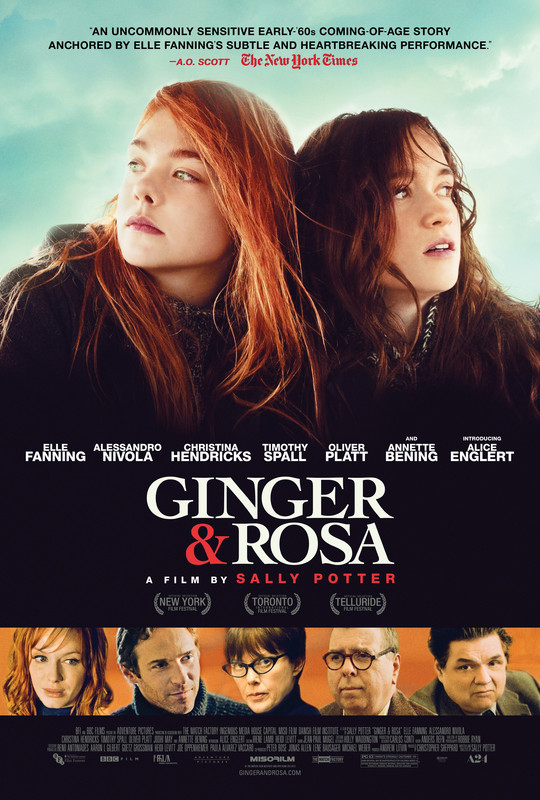
Ginger
(Elle Fanning) and Rosa (Alice Englert) are two girls of sixteen,
born on the same day in 1945 and best friends all their lives. In
1962, however, they begin to drift apart as Rosa becomes interested
in boys, while Ginger's attentions are taken up by what, she's
convinced, is our impending nuclear destruction.
This
could easily be an effective coming of age story, and there are
snatches of that movie in here, but Sally Potter muffles it, burying
the essential story, and thus much of the connection we should have
to the characters and the plot under a fog of stylistic choices that
really didn't work for me. On the plus side the film often has a
lovely, dreamlike, feel, which contrasts nicely with the grimier
visual moments (this is the early 60's, and neither family seems well off), but while it often looks good, the style often gets
in the way of the storytelling and the character study to which Potter
seems to aspire here.
The
film is cut almost as a series of ellipses, and this means that many
scenes feel like incomplete thoughts. You get the idea of, say, the
scene in which Rosa comes boating with Ginger and her Father
(Alessandro Nivola), but though the series of images is pretty, and
what Potter is doing with them obvious (largely because it's been
obvious for some time, perhaps unintentionally) these 30 silent
seconds feel like the start of a larger scene now residing on the
cutting room floor, in which we could have added to the character
aspect of the film. This is just one example of many, the film
continually frustrates by cutting in and cutting away when a scene
seems to be in the middle of a thought.
The
limited dialogue serves Elle Fanning well. A consummate young actress – at this point surely
the best of her young generation – she's adept at conveying great
emotion with just a tiny alteration in expression. She also seems to
have a tremendously malleable face, in some scenes she seems
incredibly childlike (at shooting she was three years younger than
her character), and in one, after Ginger is arrested at a protest,
she seems old beyond her years. Fanning's remarkable performance
also extends to a fine English accent, and an ability to nail any
tone, from the carefree scenes of the girls in the early part
of the film, to a climactic meltdown.
Fanning
and the rest of the actors are battling a mannered script, which
gives them a lot of very scripted sounding dialogue to wrestle. Many
of them lose, but none so totally as Christina Hendricks, who is
hilariously miscast as Fanning's Mother, and concentrating so hard on
her (shockingly awful) accent that she has completely forgotten to
act. On the plus side, her lines when she serves Nivola a pie are
perhaps the funniest of the festival so far, entirely by accident.
Alice Englert makes a creditable debut, but in terms of screentime as
well as impact she is overshadowed by Fanning. Alessandro Nivola
does what he can with a completely unlikeable and often irritating
character, but the supporting cast does offer some highlights in the
form of Timothy Spall and Olvier Platt as Ginger's two godfathers –
a film about their relationship during the war might be worth a
watch.
Ultimately,
Ginger and Rosa is a frustrating failure. You can see the seeds of a
really fine film here; the images are often beautiful, there are some
strong performances, including a great lead and the character arcs
are inherently interesting, but it's so patchy, and when it falls
flat it can test your patience with its desperate pretensions
to art. In a more focused, less elliptical, version I can imagine
liking this film very much, but as it stands I can recommend Elle
Fanning's performance, but not the film.
★★
★★
Lore
Dir: Cate Shortland
It's been a long wait for fans of Cate Shortland's first film, Somersault (I was not among them) for her second feature. Lore is certainly not what I expected Shortland to deliver next, at least in concept. Acted entirely in German, it's a second world war story told from an angle we don't often see. Just after Hitler's death, and the end of the war Lore's (Saskia Rosendahl) Father comes home and instructs Lore, her Mother (Ursina Lardi) and her siblings to pack essentials and things they can barter, because they are leaving the home, Lore's family are Nazis, and the allies are now rounding up war criminals. Soon Lore's Father disappears, and her Mother opts to hand herself over to the allies rather than be arrested. This leaves Lore to take her younger siblings - 11 year old sister Liesel (Nele Trebs), a brother of about ten, twins about seven and baby Peter - on a long and dangerous walk from the Black Forest to their Grandmother's house in Hamburg. Along the way they are aided by a concentration camp survivor; Thomas (Kai Malina).
The difficulty with Lore - both character and film - is one of sympathy. Can we have sympathy with these characters? We obviously can't with the parents, and the younger children haven't been raised with anything but Nazism, and they at least develop some acceptance of their eventual Jewish travelling companion. Lore herself, however, is more problematic. We can see where her opinions come from, but given that she's about 18 is that enough to allow us to sympathise with her anyway, as she frequently abuses the person who is helping her family ("You're a liar, just like all filthy Jews"). I really struggled with this. It would help if Lore had more of a character arc but, aside from a rather impressionistic rejection of her Grandmother and Mother, she seems essentially to be the same character as the closing credits go up as she was as the film began. Ultimately, excellent though Saskia Rosendahl's performance (her film debut) is, and welcome as any degree of moral complexity is, I felt that I was left emotionally at arms length from the film, because I couldn't really engage with and root for the main character in the same way as in, say, The Way Back.
That difficulty aside though, Lore has much to recommend it. Shortland and her young DP Adam Arkapaw (who also shot Snowtown) give the film a pastoral beauty which contrasts with the harsh realities of the story, though the amount of soft focus close ups on nature or on Lore does get a little tiresome and begin to make the film feel a touch padded at just under two hours, however beautiful the individual shots are. The performances are excellent all round, and the tension between Lore and Thomas, sexual and racial, is especially well played by Rosendahl and Malina. Of the other siblings only Nele Trebs and Andre Frid (as ten year old Gunther) have especially developed roles, but the family dynamic is convincingly played. It's a bit of a shame that Ursina Lardi has only a small role as Lore's Mother, she's well cast (one shot seems to show Lore trying to dress and make up like her Mother, and the resemblance is pretty startling) and her hard edged and unapologetic character is interesting.
The journey is engaging throughout, and while the film does unfold, as these long walk movies tend to, largely as a series of encounters and individual scenes, it also manages to spring a couple of genuinely surprising twists. Shortland's decision to shoot the film entirely in German is also especially welcome, as it surely makes for far better performances from her cast, and because this is a specifically German story, and would likely ring far less true if it had been played, whether by German or American or British actors, in accented English.
I have reservations about Lore, but the story grips, the performances are all strong, and it is lovely to look at. It's well worth a watch, get back to me when you've seen it, and we can talk about the issue of emotional engagement.
★★★
Labels:
2 stars,
2012 Releases,
3 Stars,
British,
Drama,
Film reviews,
LFF2012,
Mini-Reviews,
War
Oct 10, 2012
24FPS @ LFF 2012: Diary 10/10
The
Sessions
Dir: Ben Lewin
Wadjda
Dir: Ben Lewin
Mark
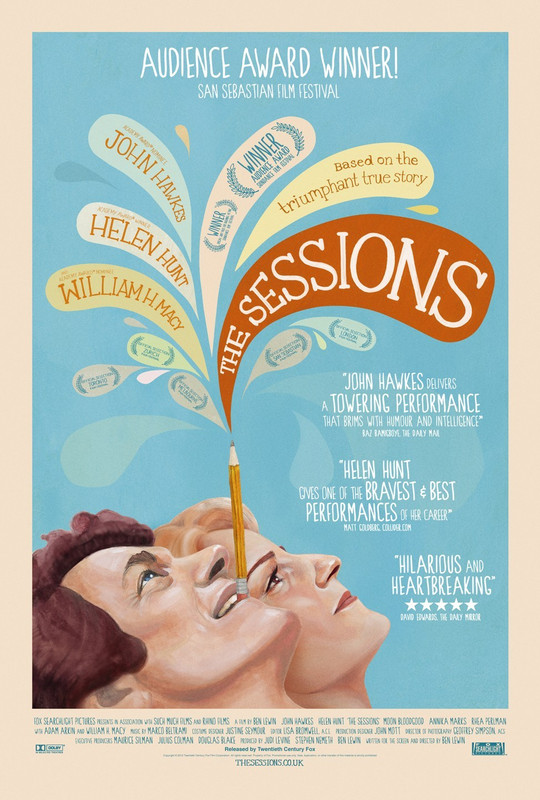
O'Brien (played here by John Hawkes) was a pretty remarkable man,
confined to an iron lung after a bout of polio when he was young, his
mind was still completely active. He went to university and
maintained a career as a poet and a journalist. This film, based on
one of O'Brien's articles, is about his experiences with a sex
surrogate (Helen Hunt's Cheryl); a type of therapist who introduces
severely disabled people who haven't been able to have any to sexual
experiences, up to and including having sex with the clients.
From
the subject matter it sounds as though The Sessions could be quite
sordid, or quite depressing, but while it's sexually frank and
unafraid of (female) nudity, and doesn't shy away from the
difficulties of Mark's disabilities it's an overwhelmingly warm and
very endearing film. This is largely down to the central
performances from Hawkes and Hunt.
Hawkes
is, for my money, one of the best character actors around, and his
performance as Mark is one of his best yet. It's one thing to turn
in an emotionally affecting and subtle performance when you can move
your whole body, but here everything but facial movement is
unavailable to Hawkes, and he's still brilliant. Mark is a complex
person, and Hawkes puts across his nervousness and his occasional
bitterness just as effectively as he does his charm and his
intellect. The scenes between Hawkes and Helen Hunt are perhaps the
film's best, and while it's probably an extremely idealised version
(not least in Hunt's casting), it's intriguing to see into this world
that most of us will be happy to never have to experience.
Helen
Hunt is not usually an actress I'm a fan of, but this is perhaps the
best I've seen her be. She gives a totally uninhibited performance.
We see how good Cheryl is at her job, and the fact that it is about
much more than sex. One criticism would be that it would be good to
see a bit more of her home life and how she manages the balance of
this work and her happy family life, but what there is of that works
well enough. Hunt exudes warmth as Cheryl, and even when the film
turns toward the cliché she and Hawkes keep it engaging. There are
several nice supporting performances too, from Moon Bloodgood and W.
Earl Brown as Mark's aides and particularly from William H Macy, who
has a very funny role as Mark's priest, who takes Mark's actions much
more liberally than you'd expect of a Catholic priest.
While
the performances are excellent and the screenplay is both moving and
amusing, The Sessions does suffer from slightly anonymous direction
from Ben Lewin. It's all very evenly lit and but for the extensive
nudity from Hunt could quite easily pass for television in terms of
its look. It's not a huge problem, and doesn't keep the film from
being highly engaging (nor will it stop Hawkes and Hunt getting Oscar
nods), but it does mean it doesn't feel hugely cinematic. Still,
it's well worth seeing for the acting alone.
★★★
★★★
Frankenweenie
3D
Dir:
Tim Burton
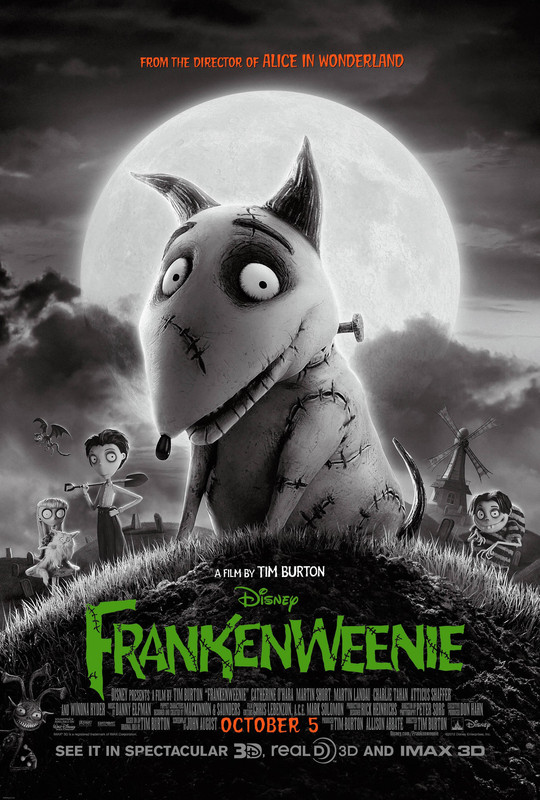
I can't help rooting for Tim Burton, even if it has been almost two decades since his last fully satisfying film, and he's seemed lately to slip into self parody more often than not. I like his early work (Beetlejuice, his two Batman films, Edward Scissorhands, Ed Wood) so much that I can't help feeling that he will at some point return to form. Frankenweenie isn't vintage Burton (except in concept, it's based on his 1984 short), but while not a full return to form it's definitely a step along that road, and the best thing he's made for ages.
The
story sees young Victor Frankenstein, the science whiz of New Holland
elementary school, lose his beloved dog Sparky when he is hit by a
car, after a demonstration in science class of how electricity can
animate a body, Victor decides to apply this to Sparky, and raises
his dog from the dead, but when some other kids from school find out and harness Victor's technology for themselves, things get out of
hand.
Like
most of Burton's films, Frankenweenie looks both beautiful, and like
it could only have come from Burton (though, as you'd expect, the 3D
adds nothing but a couple of shots where things pop out of the screen
because, again, that's what's been missing from cinema, it needed the
ability to point at us). The animation is excellent, the black and
white crisp – though more so without the 3D glasses, which I found
added a bit of a greenish cast – but the design is the real
star. The characters are all pretty memorable looking, and Sparky,
in re-animated form, is a great blend of disgusting and cute. Other
lovely bits of design include the monsters, which have a great Toho
feel to them, Winona Ryder's character Elsa, who looks like a 10 year
old version of Lydia from Beetlejuice and 'Weird Girl' and her cat
Mr. Whiskers, who are both so odd that every time Burton cuts to them
he scores a laugh. One of the most pressing problems here is really
that, from both a design and a character point of view, Victor may
be the least interesting thing in the film.
There
are a lot of nice set pieces here, many of which pay affectionate and
amusing homage to classic horror and monster films (most notably the
Universal films of the 30's). In other areas the homage becomes a
little wearing, the climax of the film has been in at least one other
Tim Burton movie, and close equivalents in several more, and Danny
Elfman's score is gratuitous self-plagarism, taking what sounds like
offcuts from his Batman and Edward Scissorhands scores and attempting
to pass them off as new themes.
The
problem with the structure, and this may come from the film being
birthed from a short, is that as entertaining as most of them are in
isolation, the set pieces feel like set pieces, not part of a larger
whole. Frankenweenie comes off worse because it follows the recent
Paranorman, which joined up its parts more organically, and had a
genuinely emotional finale. Though I saw at least one critic crying,
this film never really moved me.
Ultimately,
Frankenweenie is great looking and lots of fun, but ultimately, while
it's Burton's best for a while, it still feels lightweight and
inessential. Fun while it lasts, but little more.
★★★
★★★
Wadjda
Dir: Haifaa Al Mansour
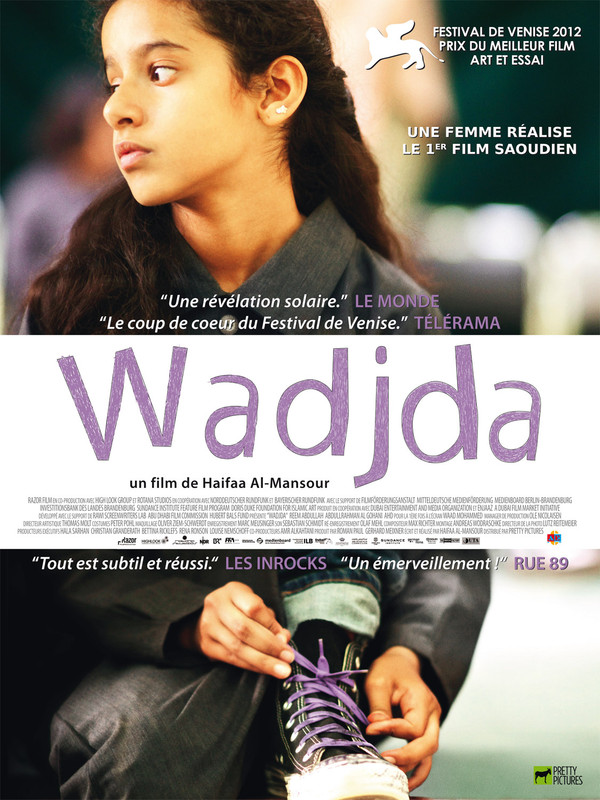
The fact Wadjda exists at all is pretty remarkable. In the country it and its (female) director come from cinemas have been banned for more than thirty years and women aren't even allowed to drive. The making of this film is a laudable achievement in and of itself, you could almost consider it simply a bonus that it is one of the very best films of the LFF so far, but to do so would be unfair.
Wadjda (Waad Mohammed) is a young Saudi girl - probably ten or eleven, though the film doesn't specify - she lives with her Mother in a middle class home and she's a little rebellious she doesn't like wearing her headscarf, listens to pop music and wears boots instead of simple black shoes. The thing she most wants is a bike, so she can race her friend Abdullah (Abdullah Al Gohani) and prove she's faster than him. Aside from not having the 800 Riyal it will cost, Wadjda is told that girls aren't supposed to ride bikes by many of the people around her.
A lot of political films can feel as though they are essays, bludgeoning you with their message while the filmmaker yells, asking if you get it yet, and this has certainly been true of many films about the political realities of the Arab world (the heavy handed Circumstance, for example). The real masterstroke of Haifaa Al Mansour's screenplay and direction is the way she makes the political - the film seems to me a full-throated indictment of the political situation, and especially the treatment of girls and women, in Saudi Arabia - and makes it completely personal by filtering the whole thing through a story about a girl who wants to buy a bike.
The camera essentially takes Wadjda's point of view, immersing you in her world from her angle. It's a pretty unfriendly place to be, with a teacher (Ahd) who stamps on every expression of individuality, a Father (Sultan Al Assaf) who comes and goes at irregular intervals and a world with an incredibly and increasingly restrictive set of rules, which we also see through Wadjda's Mother (Reem Abdullah), who has to have a driver to take her and the other women who live nearby to work.
Set against all this though, Wadjda is a pretty happy film about a pretty happy character, and one who is easy to engage with. Waad Mohammed's acting debut is one of the most naturally engaging I've seen for a long time; she gives Wadjda a good deal of spunk, as well as an open and optimistic character that allows you to believe she can knock down what are very stupid, very petty, but also very real boundaries. Her cheeky resourcefulness is charming (as when she gets four times the money originally offered for a simple errand) and while the narrative is short on large scale drama Mohammed's performance kept me in rapt attention the whole time. This isn't to say that the other performances aren't great too. Without doing anything overblown, Ahd exudes subtle menace as Wadjda's teacher, while Reem Abdullah is effective as a parent who has her own frustrations, and sometimes ends up taking them out on her daughter.
Haifaa Al Mansour's direction points to a strong naturalist talent to watch. Her shots, all the exteriors taken on location without permission, never sacrifice composition for immediacy, but achieve both effectively, and her handling of the actors is equally strong, resulting in a film full of strong performances, and two particularly good performances from her two youngest actors. Wadjda is a hugely effective and affecting film, and it's highly recommended.
★★★★★
★★★★★
Labels:
2012 Releases,
3D,
4 stars,
5 Stars,
Animation,
Coming of Age,
Drama,
Festivals,
Film reviews,
Horror,
LFF2012,
Mini-Reviews,
Syria
Subscribe to:
Posts (Atom)