Showing posts with label Period. Show all posts

Oct 9, 2017

24FPS @ LFF 2017: Short(ish) reviews.

Little Crusader
Dir: Václav Kadrnka

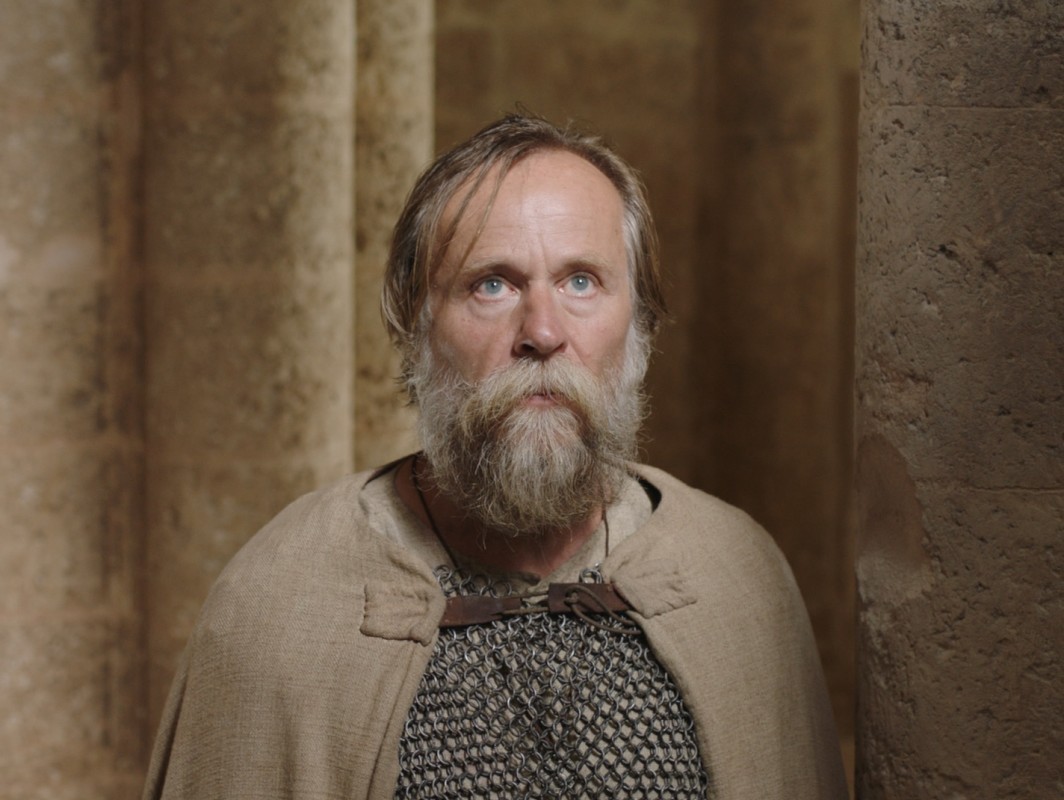
Set during the crusades, Little Crusader follows Borek (Karel Roden) on a near silent quest to find his young son (Matous John), who has run away and apparently vanished into the war.

The film opens with a silent ten minute sequence following the young boy. He puts on his tiny armoured breastplate, hangs his sword on his belt and moves around the castle where he lives and the surrounding area, before lowering the drawbridge to let two men in and walking off on his own. This sequence has some of the film’s most arresting images, not least the first, as an expanse of white gives way to show a Knight walking towards the camera. At first I thought this white was snow, but it turns out to be a pair of curtains, the crack between them flapping in the light breeze.

The film is stunningly composed throughout, with Vaclav Kadrnka making striking use of the 4:3 frame, particularly in long held shots. In one of these we see Borek finally arrive in the thick of the Crusades. In one unbroken shot he marches across the desert, cutting down one enemy after another. Another especially memorable long take has the medallion belonging to Borek’s son passed through what seems like an unending parade of children’s hands, searching for its owner. These and other shots do a hugely effective job of communicating the film’s story through pure imagery. The other notable thing about the imagery here is how incredibly textured it is. Every detail - hair, tree bark, the blades of swords, the fabric of a boat’s sail, feels like you could reach out and touch it. I don’t know how the film was shot, but if it’s digital then it’s some of the most detail rich digital I’ve seen.

The problem is, simple as the film is and short as its running time may be, I’m not sure it’s much other than stunning looking. In the first ten minutes we develop an attachment to Borek’s son and not seeing his side of this story seems a shame. The film is gorgeous, but emotionally it kept me a little distant. Still, if you’re fond of slow cinema, of following a character on a very literal journey, Little Crusader has some great rewards in store.
★★★½

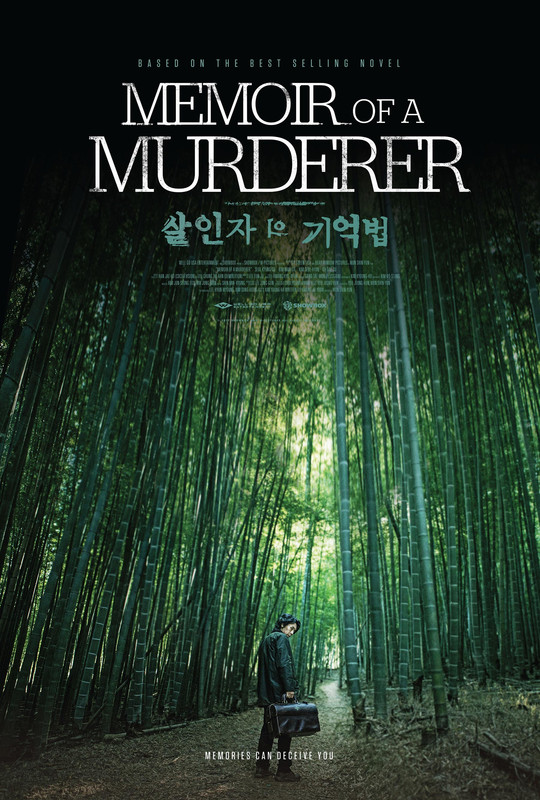
Memoir Of A Murderer
Dir: Won Shin-yun
It’s always useful to have a high concept, a brief logline that can tell a film’s potential audience what they’re in for. Whatever else you think of Memoir of a Murderer, you have to admit that ‘Memento, but with two serial killers, one of whom has dementia’ is a hell of a high concept.

Buyng-su (Kyung-gu Sol) has recently been diagnosed with alzheimer's, possibly as part of the after effects of a car accident 17 years ago. As his memory begins to go, two things remain: his love for his daughter Eun-hee (Seol-Hyun Kim) and his sense memory, the reflexes honed in a career as a serial killer, which ended the day of the accident. When he’s involved in another accident Byung-su comes to believe that the other driver, Tae-ju (Nam-gil Kim) is an active serial killer of young girls. Unfortunately Tae-ju is a cop, and Eun-hee’s boyfriend.

Memoir of a Murderer uses its killer hook to fine effect for most of the running time. Kyung-gu Sol pitches his performance as Byung-su expertly, vacillating between making the character a somewhat pitiable old man struggling with a disease and allowing us glimpses of the organised serial killer who says he only killed ‘bad’ people but, one suspects, is simply self-justifying. The film unpacks the facts about Byung-su, who is by his nature as both a serial murderer and a dementia sufferer a deeply unreliable narrator with patience, managing to land most of its twists as true surprises. Equally good is Nam-gil Kim, whose performance becomes ever more gleeful as he realises that he can let his true nature slip in front of Byung-su, because he’ll soon forget anyway.

Won Shin-yun balances tone well, undercutting the horror with some very black humour. As the film ramps up to its most operatic moments towards the end, it also hits on the best comedic use of Byung-su’s memory problems coming suddenly into play, combining a laugh and a scare in one moment. Won, however, isn’t a stylist on the level of a Park Chan-wook or a Kim Jee-woon and though the film has an effectively cold style and is well shot throughout, it’s not exactly shot through with personality. At just a shade under two hours, the pace flags a few times and the ending, in particular, could probably be tightened, which would also mean the film could pull back on some overblown moments that, for me, slightly sour the effective chill of the rest of the film.

Memoir of a Murderer is an entertaining ride, a little bumpy at times, but it’s got some thrills, some chills and more than a few guilty laughs. It’s worth a look.
★★★

Dec 1, 2014

The Imitation Game [12A]

Dir: Morten Tyldum
The story of the breaking of the Enigma code, a breakthrough which, if it didn't actually win us the whole thing, shortened World War Two considerably, is one that should be full of drama and of rich and interesting characters.   This telling, while not especially bad in any way, never really has either of those things.

The film focuses on Alan Turing (Benedict Cumberbatch), his relationship with Joan Clarke (Keira Knightley), a brilliant young member of the team at Bletchley Park, his building of Christopher; the computer that would crack Enigma and the secret that would ultimately lead to a horrible injustice against him later in life.

If you think that suggests that the film's focus is scattered then, frustratingly, you'd be right.  While all of these elements were important in Turing's life, trying to tell them all (plus a flashback to his school days) in roughly 105 minutes discounting the credits means that The Imitation Game struggles either to find a central thread or to tell any of its smaller stories especially satisfyingly.

The fact that we all know how the story ends (both for good and for ill) shouldn't be a reason for a film to fail to engage as a thriller.  Director Morten Tyldum tries hard to bring that edge of tension to the development of Christopher, but it never comes off.  Zodiac, ultimately, is a film about men looking through information in boxes and slowly building it into a complete picture, but it's also an intensive character study of those men and what drives their obsession.  Both sides of this seem to go missing from The Imitation Game.  

Benedict Cumberbatch is perfectly fine as Turing, but the performance is never anything more than that; Benedict Cumberbatch putting on a convincing period accent and convincing period clothing to give a performance.  I got a sense that I was being told who Alan Turing was and watching re-enactments of moments from his life, rather than living inside those moments with him, which is the sense of immersion achieved by Zodiac.

We get a sense of the reason behind the building of Christopher and of Turing's drive to achieve it, but the process itself is left largely offscreen and little attempt is made to explain how the machine works.  We see the stages of its building, but not the nuts and bolts work, so the achievement doesn't seem quite as hard won as it clearly was.  Instead what we get are cliché movie moments; Turing standing in front of his machine shouting that his bosses will never understand the importance of it; papers being flung from desks in frustration.  These things may have happened but, in the context of a movie that doesn't entirely absorb you into its world, they ring false.

Cumberbatch is relatively typical of the performers here.  Like him, Keira Knightley and Matthew Goode are perfectly fine, they're not doing anything wrong, as such, but from both there is a sense that they are working very hard and that we're watching actors acting.  The only moments of naturalism come from an engagement party sequence where we get to see the staff at Bletchley interacting as people – or as close to being a person as Turing is able to get. 

There seems to be an indecision at the heart of the film about what it wants to be; a biopic of Turing or a film about the cracking of Enigma.  This leads to Tyldum and screenwriter Graham Moore trying to have it both ways.  The problem is that the film doesn't come close to splitting its focus equally, so the treatment of Turing's school days and of the framing device involving the hideous injustice of his arrest for indecency and chemical castration is almost insultingly prosaic.  There are the ingredients here for two interesting films; one about Enigma and another about Turing's arrest, trial and conviction, but both of those films would need to dig much deeper than The Imitation Game.

Decently executed though it is, The Imitation Game is remarkable only in how utterly unremarkable it is.  It's not bad, but it's also no more than a couple of notches above a Sunday night drama on ITV.

May 9, 2009

Cheri [15]

Dir: Stephen Frears
Chéri has a fantastic pedigree.  It reunites the core creative team behind the excellent Dangerous Liaisons; Director Stephen Frears, screenwriter Christopher Hampton and actress Michelle Pfeiffer. Sadly the film is decidedly less than the sum of these fine parts.

Based on a pair of novels by Colette the film tells the story of a relationship between Lea (Michelle Pfeiffer), an aging courtesan and Chéri (Rupert Friend) the young son of a fellow courtesan which, after six years, is interrupted by the fact that Chéri’s mother (Kathy Bates) has arranged for him to be married. It’s a simple enough tale but the film never comes together, because neither Christopher Hampton’s screenplay nor the performances of Michelle Pfeiffer and Rupert Friend give us anything to care about. The film seems so concerned with surfaces (all the people and settings are stunningly beautiful) that it never gets under the skins of its characters.  This is a real problem, because we never feel the longing that Lea and Chéri supposedly have for one another. In order to work, a love story has to be emotionally engaging, and this one simply isn’t.

Stunning as the film looks that too is merely skin deep, because a lot of Frears’ staging is rather dull. It’s a very static film, with endless scenes of two people exchanging badly written banalities while sitting in rooms that are more diverting than the story, or lying in bed amid artfully messed up sheets. It’s all so completely fake that it actively discourages you from engaging with the film.

Though the cast, given Hampton’s stiff dialogue, have little to work with Frears has a pretty distinguished cast at his disposal, and he really should have been able to draw something of worth from them. Rupert Friend is an extremely handsome man; he looks as if he was carved, designed as a matinee idol. Sadly he also acts this way - he’s so wooden you could turn him into a chair.  Watching him attempt to emote is like watching a robot discover a hitherto unknown thing called happiness, or anger. He’s one of the blankest leads I’ve seen in a movie for some time, and listening to his clipped monotone drove me up the wall. If Friend is doing too little he’s certainly the only cast member guilty of that offence. Everyone else plays up to the films tone of outrageous camp. Kathy Bates is especially dreadful, mowing down all scenery in her path, making every single line a ridiculous production number, while Felicity Jones, pretty as a picture though she is, is so bad in her one big emotional scene that I had to stifle my laughter.

This is all disappointing, but not half so disappointing as Michelle Pfeiffer’s performance. I love Pfeiffer, I’ve always thought her a fine actress, and an underrated one, and I missed her during her five years away from the screen. This is her big comeback though; her first lead in a long while, and it saddens me to say that I've never seen her - Grease 2 apart - be worse. It’s not entirely her fault; she’s terribly miscast because she’s still so youthful and so beautiful that, despite Frears often shooting her to look older than she usually does, it’s completely unconvincing when she describes herself as aging, or losing her looks. Still, the performance is poor, her American accent an odd fit when everyone else (though the film is set in France) is doing a clipped British, and her acting being by turns so distant as to be completely free of emotion and so overblown as to be irritating.

Chéri is a picture postcard. It’s very beautiful, but completely devoid of substance. It’s uninvolving, unfunny and unemotional, skip it, and instead rent Francois Ozon’s Angel.