Showing posts with label LFF2016. Show all posts

Oct 24, 2016

The Picture Show: LFF 2016 Wrap Up

Toni Erdmann
Here is the last of the Picture Show's special episodes from this year's London Film Festival.  Once again, I'm joined by Mike to discuss the best (and a little of the worst) of this year's LFF, as we hand out our personal festival awards and run down our Top 5 lists from this year's early, extended, Christmas for movie nerds. 

Oct 16, 2016

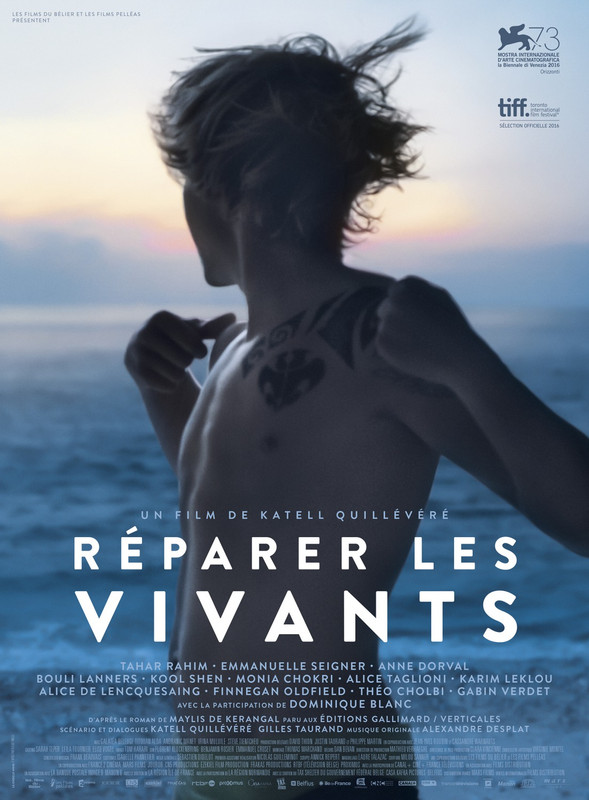
24FPS @ LFF 2016: Heal the Living

Dir: Katell Quillevere
As a film viewer, and especially as a critic, I am aware that when I approach a film I take things from it, but I also bring things to it. In the case of Heal the Living this was especially acute, because as I sat down to watch it I carried with me (as I do all the time) the weight of my medical history. Obviously this is hugely important in my life, but generally speaking it's not something that comes into play when I watch films. I have to be clear that Heal the Living was an exception, and that the impact it had on me has to be seen through the lens of that medical history.

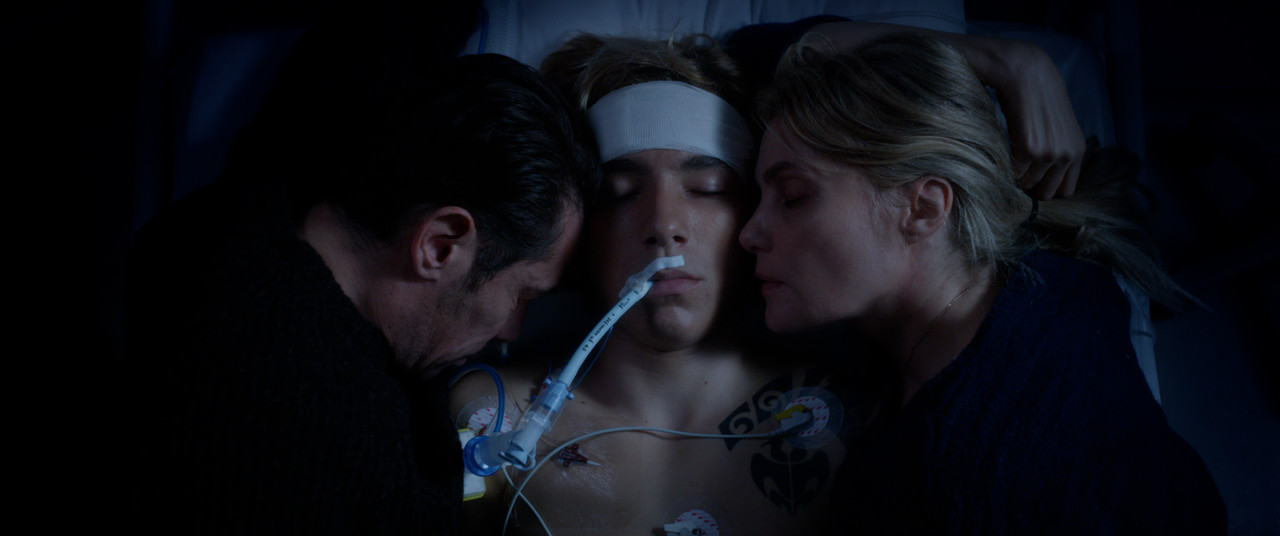
Katell Quillevere's third feature, adapted from a novel by Maylis de Kerangal, takes organ transplants as its subject, following a single procedure (a heart transplant) from both sides; that of the family of the donor and of the the recipient and her family. This is where my history comes into play: I have received two liver transplants (25 years ago, within 10 days of each other), so I have experienced this journey from one side and have often imagined what it must have been like from the other. For other viewers these events may be more abstract, but for me Heal the Living was deeply and devastatingly personal.

The donor is Simon (Gabin Verdet), brain dead after a car accident, and we are privy to the whole process as a young doctor (Tahar Rahim) sensitively introduces the prospect of donation to the devastated parents (Emmanuelle Seigner and Kool Shen). From the other side we see Claire (Anne Dorval) slowing down her life as she is placed on the transplant list and also trying to moderate the impact on her late teenage children (Finnegan Oldfield, Theo Cholbi). Quillevere divides the two parts quite decisively, only introducing Claire after about an hour, but also allowing time for each side of the story to develop independently before drawing them together.

The two parts of the film have similar form, but slightly different styles. In each section Quillevere allows for a few digressions, for instance following Monia Chokri's nurse for a little while and showing Claire reconnecting with a former lover (Alice Tagliolini), but the first hour has a more dreamlike feel, while the second half largely abandons those touches for something much closer to documentary style. For me, this seems to suggest the sense of dislocation that the extreme grief of Simon's parents must be causing for them spilling over into the film. This is acutely felt in a brief flashback to the first time Simon and his girlfriend kiss, a sweet scene which trades on Quillevere's mastery of coming of age cinema (her first film, Love Like Poison, is one of the 21st century's great entries in that genre). After sweeping you up briefly in this romantic moment, Quillevere immediately cuts to an ashen Seigner and Kool Shen, driving back from the hospital. The flashback is not a memory but either a parent's imagining of a moment in their son's life, now brutally cut short, or a memory of how he told that story. We never know which, but the question alone is affecting.

There are more beautiful directorial flourishes in the film's first part; the road becoming the sea as Simon's friend falls asleep at the wheel, causing the crash; images of Simon surfing, as if being sucked under into another world. These are not only striking in themselves, but in the contrast with the second half. Once Claire is introduced everything is matter of fact. Quillevere becomes more an observer, first of the relationship between Claire and her sons, then of the transplant procedure itself. Both operations, the harvesting and the transplant, are handled sensitively and with a matter of fact eye for procedure, but with enough restraint that the film always feels honestly sad, rather than sentimental.

This is delicate material, but Quillevere and her outstanding cast handle it beautifully. Tahar Rahim strikes a perfect balance between playing his character's desire to get consent for Simon's organs to be used and his determination to handle it with maximum sensitivity, while Seigner and Kool Shen, with relatively limited screentime, sketch believable studies of grief. In the second half, Anne Dorval finds a lot of moments that struck home for me, especially in the sequences after she gets the call to hospital; the nerves, the preparation, the goodbyes, all these things ring true and brought back raw images from 25 years ago. Even the small parts are expertly cast and played, with especially fine work from Bouli Lanners and Dominique Blanc.


Quillevere's balance between realism and poetic touches is exceptional throughout, but the moment that Rahim pauses the harvesting operation to say a few last words to Simon from his family is where it hits hardest. Devastatingly touching without ever feeling sugary or false, it's a moment that shows the film in miniature. 

After the blip I felt Suzanne represented after Love Like Poison, this is a dazzling piece of work from Quillevere. Heal the Living is beautifully cast and acted, expertly directed and well made in every technical respect, but for me it was so much more than that. Transplant isn't a subject often addressed in cinema, the last time I remember seeing it covered was in a very different context in Never Let Me Go, but Heal the Living has none of the abstraction and distance that Mark Romanek's film did. Instead this film lives in some of the most emotionally fraught moments of people's lives and rings true at every turn. I can't say whether other audiences will feel this film as viscerally as I did, but even if they don't, it remains essential viewing.

Oct 15, 2016

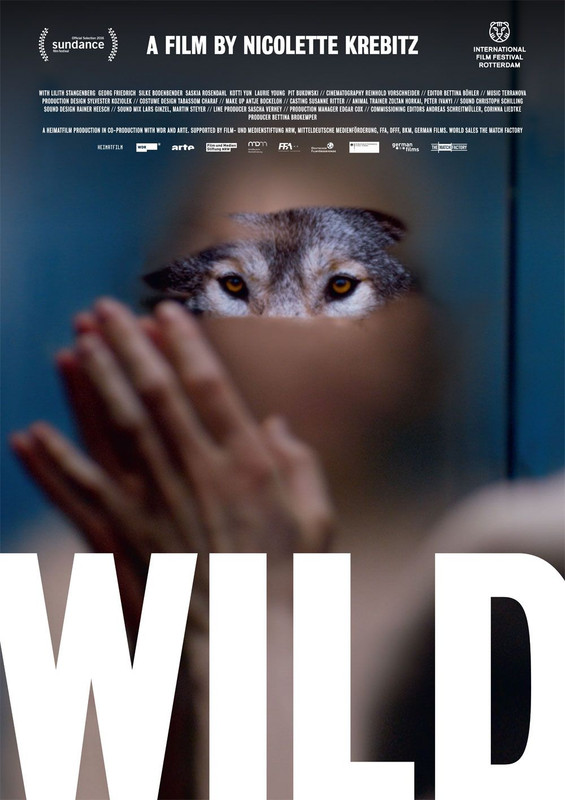
24FPS@ LFF 2016: Wild

Dir: Nicolette Krebitz
Over the eight years since her last film, The Heart is a Dark Forest, I have wondered why it has taken such a long time for writer/director Nicolette Krebitz to follow it up. I believe I now have my answer. Wild can not have been an easy film to set up; a challenging, provocative film that seems destined to upset quite a lot of people, it's both a fitting follow up to The Heart is a Dark Forest and one that confirms that film's promise.

Ania (Lilith Stangenburg) is in her early 20's and living something of a lonely life, stuck in an anonymous high rise, working a decent but soul sucking office job and watching her Grandfather slowly waste away in hospital. One day, as she walks to the bus for work, she sees a wolf emerge from the woods near her home and immediately becomes obsessed. Ania begins desperately looking for the wolf, eventually managing to capture the animal, taking it into her home and beginning a relationship of sorts with it.

Krebitz clearly realises her story may strain credulity, she plays with this idea in two distinct but equally effective ways. Firstly, she builds a credible environment for Ania. Her town, her flat, her job, the hospital, the annoying boss who may have a crush on her, all of these things have a drab, grey reality about them. This credibility grounds the story, but it also provides something that we buy in to Ania being desperate to leave behind; a reason why her encounter with the wolf excites her. 

At the same time, Krebitz implies for a while that this encounter with the wolf may be Ania's break with reality in another way. As she embarks on an initially fruitless quest to see the animal again, it's a distinct possibility that Ania has imagined or dreamed the initial encounter. This would be an interesting alternative route for the film to take, but it's all the more shocking when it becomes clear that this is not what's happening, that both Ania's obsession and the object of it are totally real.

The film's grounding is also aided by an exceptional performance from Lilith Stangenburg. Stangenburg carries the film, with it falling ever more on her shoulders as time runs on and she is more frequently the only person on screen. This would have been an easy role to play badly; just pushing the boat out a bit too far could make the scenes between Ania and the wolf risible. Instead, the inheld but detail rich performance Stangenburg gives makes Ania's loneliness and her pain feel raw and visceral and her gradual withdrawal into this clearly dysfunctional way of coping something we can feel for. Beyond the quality of her work, Stangenburg also gives one of the most daring performances I've seen in a long time, often as physically naked as she seems emotionally and frequently interacting uncomfortably closely with what always appears to be a real wolf. This is one of those performances that makes you sit up and take notice of an actor.

Krebitz gives the film's visuals a washed out colour scheme for the most part, but pulls out some truly striking imagery. A funny shot of Ania, dressed in a homemade protective suit, going in to feed the wolf for the first time since bringing it home sticks in the mind, as does a beautiful and meaningful moment at the film's end when Ania and the wolf take different routes down a hill, their separation speaking volumes. There are plenty more images that I'll struggle to shake, but to talk about them would be to spoil some of the film's most divisive content.

Wild is a bold film and Krebitz clearly as bold a filmmaker, but for all the discussion there will be about the film's content in its more troubling moments, this is ultimately a character study. In this respect Wild is a great film, it does it with an unusual character and through an unusual prism, to say the least, but the feelings it explores - grief, loneliness, a desire to escape - are all but universal. I hope it won't take Nicolette Krebitz another nine years to make her next film, she's too interesting for us to have to wait that long.
★★★★

24FPS @ LFF 2016: Animation Roundup

Apologies for not posting more written reviews while I was at LFF this year, I was having serious computer troubles.  Here, by way of apology, are short(er) reviews of three animated films I saw.


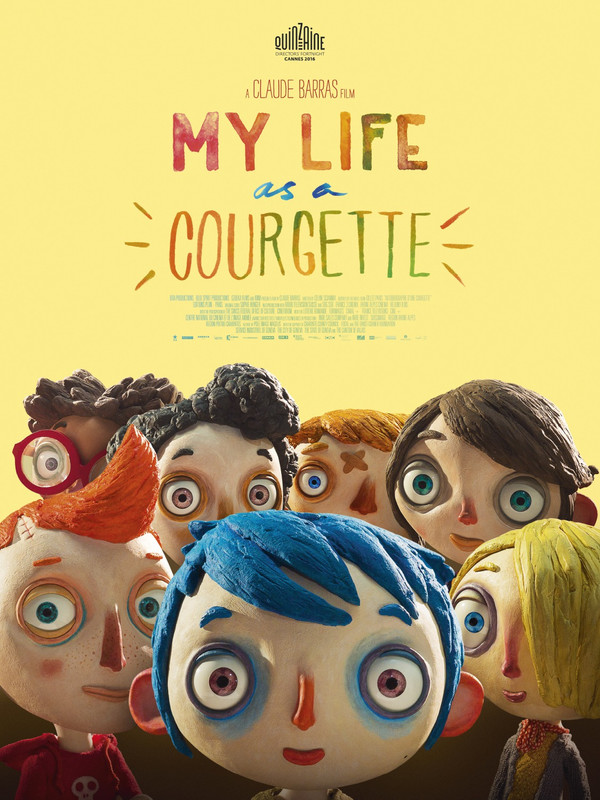
My Life as a Courgette
Dir: Claude Barras
For my money, the French writer/director Celine Sciamma is one of the most interesting talents to emerge in cinema in recent years. Her three directorial films: Water Lilies, Tomboy and Girlhood all number among the best of their respective years and I await her projects with great anticipation. While Sciamma didn't have any directorial work in the LFF this year, she wrote the screenplays for both the new Andre Techine film, Being 17 and for this, a delicate, nuanced, but optimistic children's film about a boy named Courgette who falls for the new girl at the orphanage he's sent to after his mother dies in an accident at home.

Director Claude Barras and his animators craft an interesting look for the film. The characters all have a certain look, but the designs are striking and individual, giving even the characters with the least screen time a distinctive look. They are set against backgrounds that are often a bit drab and have a homemade feel, like something out of a Michel Gondry animation. This is effective in making the characters stand out from their environment.

For a little while it seems that My Life as a Courgette might be a pretty miserable film. We get the expected beats when Courgette first arrives at the orphanage and is bullied by a bigger kid, but this dynamic soon shifts and a much brighter film emerges. This home is depicted as one where there is a genuine sense of community, and the film has a real warmth thanks to that. Little recurring jokes, like one child running to the door every time it opens, expecting her mother, amuse while also giving the film surprising emotional weight, but it's the way that Barras' images and Sciamma's screenplay combine to capture the little moments that define growing up that have stuck with me about this film. Courgette and Camille's relationship is touchingly well-observed, as are the growing bond between Courgette and the cop who initially takes him to the orphanage and the shifting dynamics of the group of kids. These things may be played out by plasticine models and in front of cardboard backdrops, but they ring true.

My Life As a Courgette should be suitable for kids from about 10 or 11, but I'd imagine that their parents will enjoy it just as much, it's sweet without being sickly, funny without compromising on some the darkness at the heart of the story, and eventually extremely touching.
★★★★★


Psychonauts, The Forgotten Children
Dir: Pedro Rivero / Alberto Vazquez
In a post-apocalyptic world, humans appear to have died out and animals are all that remains. Dinky longs to escape the island she lives on and her religious parents. For help she turns to her friends and to Birdboy, whose soul has been overtaken by a demon. To escape, they must make dangerous trek through the rubbish dumps where roving gangs of rats and mice live beyond the law.

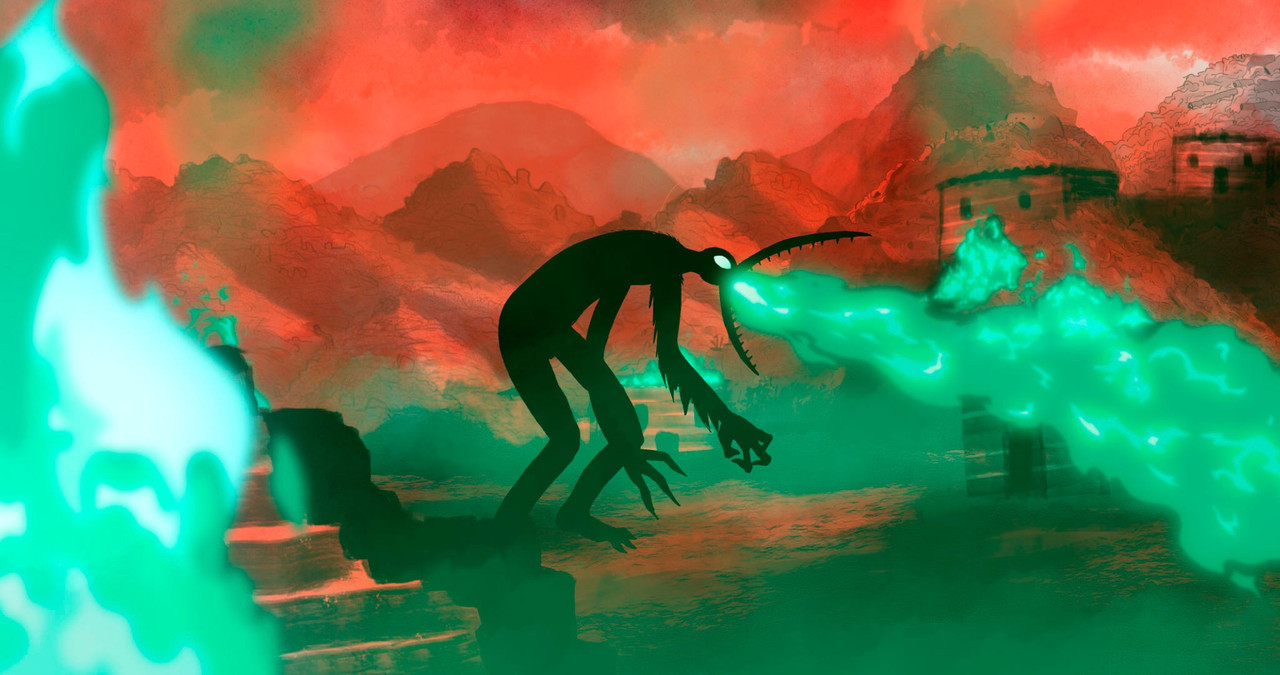
Psychonauts is a determinedly offbeat film. From its visual style on down, it mixes tones, combining dark subject matter and imagery (sometimes sketchy, sometimes in bold red and black silhouettes) with offbeat humour and cute design on Dinky and her friends. The jokes leaven the darkness of the film just enough that Psychonauts, while properly scary at times, is probably suitable for older kids as well as for adults.

The film's biggest laughs often come in the margins, the little moments, such as when Dinky's brother tells his parents what he wants to be when he grows up, or when the inflatable duck Dinky and her friends get to try to escape the island on tells his backstory. As much fun as these moments are though, there is something chilling at the core of Psychonauts; a scorched earth world that feels complete in its design. The opening moments, with a mouse and his son scavenging for rubbish and invoking the rules of their community, set this up brilliantly, as well as setting up a surprisingly human and moving relationship between the characters. This approach will carry through the film effectively, especially in Dinky's love for Birdboy.

The animation is brilliant, the mix of styles well executed and fitting for the film's mix of tones, and it's often surprising what level of character Rivero and Vazquez manage to get of their designs. This too is especially evident with Birdboy, who is essentially just a few shapes in black and white, but is rich in character despite being mute. Birdboy's eyes; huge empty black holes signifying the loss of his soul, are particularly haunting, and end up communicating a lot.  The film is at its best when Birdboy, fully possessed by a demon, attacks the Psychonauts village. This is a sequence straight out of a monster movie, and a brutal one at that, with images of burning characters that call to mind the atomic bomb sequence in Terminator 2.

Overall, Psychonauts, the Forgotten Children is a great surprise; a well balanced tonal juggling act that will horrify and amuse in almost equal measure. I hope it finds a UK release.
★★★★


Your Name
Dir: Makoto Shinkai
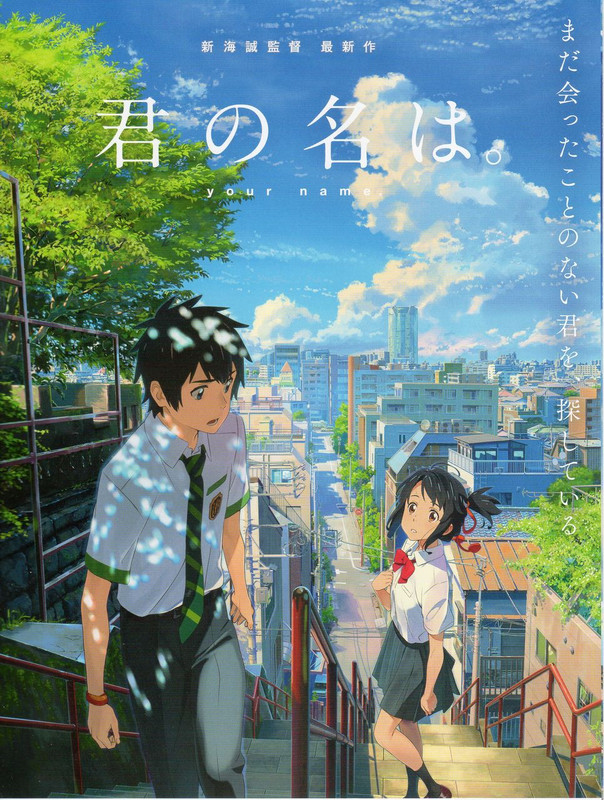
I've said it before, but it bears repeating, when we're talking about the most visually stunning films being made today, Makoto Shinkai needs to be in the conversation. His latest, Your Name, is the first anime to play in the (relatively new) London Film Festival competition section, and it is just as lush and gorgeous as we have come to expect.

Your Name will also feel somewhat familiar to Shinkai fans in its story (a tale of two young people falling for each other, though separated, then trying to find, and in this case remember, each other). While he is a visual master, Shinkai's flaws often come from his writing and Your Name doesn't have his strongest screenplay. Even for him, the boy sort of meets girl story that develops as Taki and Mitsuha begin to wake in each other's bodies is a rather sentimental and sometimes cloying one. That said, Shinkai does have a knack for this material, and while he sometimes overeggs the pudding, Your Name is also full of emotional moments that hit me just as deeply as the visuals did.

Visually, this is a film of dazzling beauty. The character designs are expressive, but as ever it's the world Shinkai grounds them in which is so stunning. From the most mundane things like images of trains passing, to the grandest in scale, such as the images of the comet that figures centrally in the film's story, everything is rendered with the same loving detail, everything seems lit from within. It's also important that the environments feel credible. There's a great sense of place and of the contrast between Taki's home in the fast-paced modernity of Tokyo and Mitsuha's life in a little village where tradition persists. If the film weren't grounded like this, then its flights of sci-fi fancy would strain credulity even more than they do. 

The character work here is strong. As the voices of Taki and Mitsuha, Ryûnosuke Kamiki and Mone Kamishiraishi shift their performances as the characters become more used to 'being' each other several times a week. There are overblown moments in each of their performances, but they are allowed to be smaller and more subtle as the film goes on and become more affecting as this happens. The scenes as the comet finally comes into play, particularly one set at twilight, are delicately played, beautifully animated and ultimately very moving.

Like much anime, I found Your Name to be at its weakest when it is at its broadest. While there are some fun running jokes, the early body swapping sequences can be loud, lacking nuance and sometimes a little wearing, but even in those scenes, the beauty of the film and the fluency of its animation are engaging all by themselves. 

This is a hit and miss film, it can even be a little grating at times. When it works though, when Shinkai pulls images, character and story together in a moment as simple and moving as a shot late in the film of Mitsuha opening her hand and seeing writing on it, it's as magical as the director's best work.
★★★

Oct 10, 2016

24FPS @ LFF 2016: Frantz

Dir: Francois Ozon
The new film by Francois Ozon is always an occasion I await with great anticipation, and it has become a tradition that he brings them to LFF each year. After a run of quality all but unprecedented among working directors (a parade of 4 and 5 star films broken only by his English language début, Angel) Ozon hit his first major stumble with Jeune et Jolie, but seemed to have regained momentum with his last film, The New Girlfriend. Frantz, disappointingly, represents another backward step.

The auteur theory can be overapplied, but if it were written to describe any modern director then it is Ozon. One of the most versatile directors of his generation, Ozon can change mood, subject and genre wildly between films, but his identity, his favoured images and ideas, recur like a fingerprint. An Ozon film is different from every other Ozon film, but you would never be in any doubt as to who directed it. Until now.  

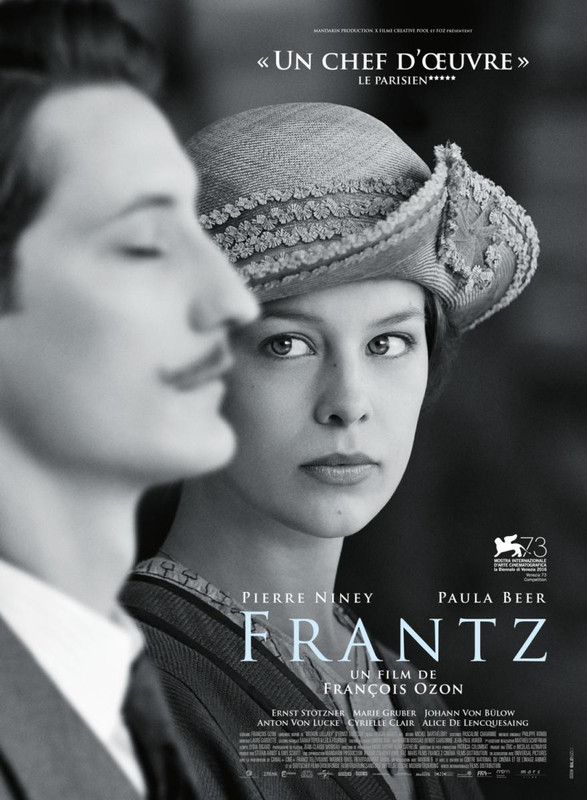
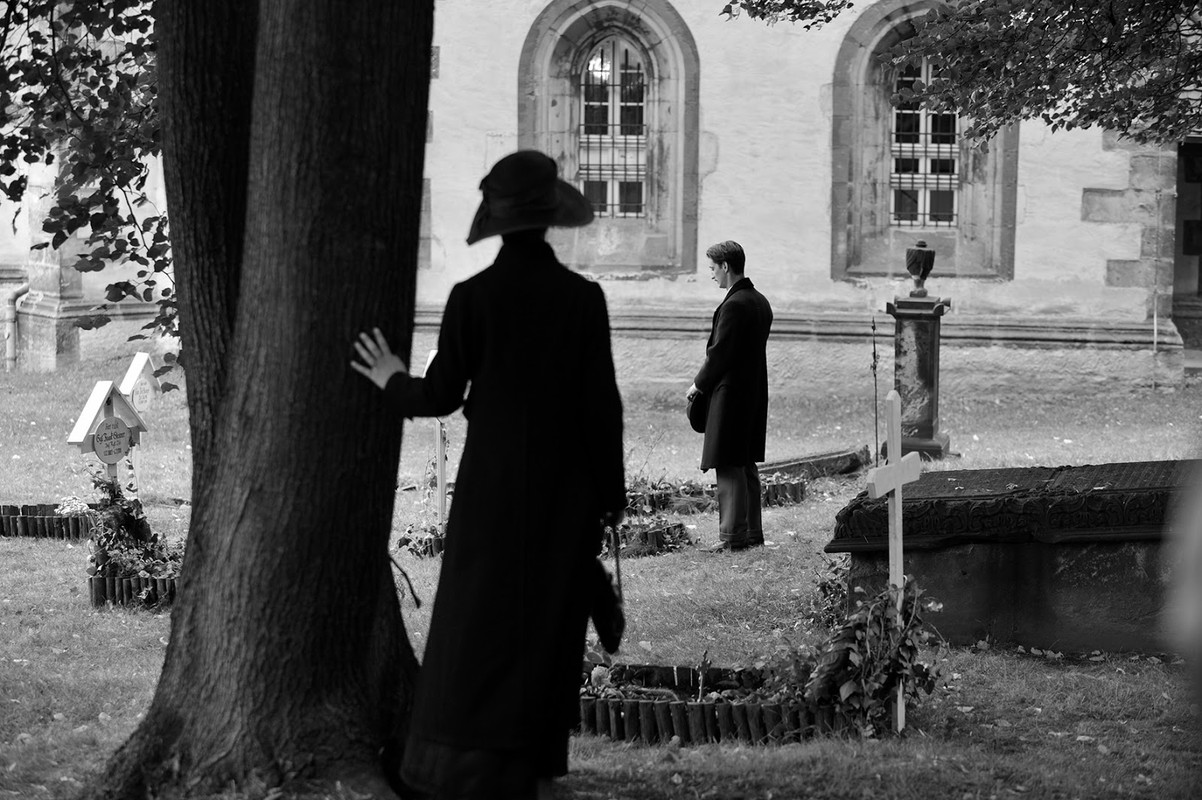
Frantz, as ever, finds its director in new territory. Set in the aftermath of World War One, it begins in a small German town. Visiting the grave of her fiancée Frantz, Anna (Paula Beer) finds flowers that were not left by her. The next day she discovers that they were placed by a French soldier, Adrien (Pierre Niney), who says that he was a friend of Frantz' before the war. Frantz' family begin to rely on Adrien, who reminds them of their son and Anna's feelings for the Frenchman begin to grow, but Adrien has a secret that changes those relationships again.

Perhaps the biggest change from his previous films is that here the colour obsessed Ozon shoots almost entirely in black and white. This is supposed to plug us into the period in which the film is set, but it looks too clean for that to come off. More disappointing still is the limited use of colour. The slightly faded colours are beautiful, but the moments that Ozon chooses to use them couldn't be more obvious or groan-inducingly literal. Yes, he uses colour to reflect the characters emotional states, but it's so basic an idea that the execution feels more like that of a clumsy film student than one of modern cinema's greats. This is only exacerbated by the awful final shot; a piece of sentimentality straight out of the ending of (500) Days of Summer, and maybe the single worst scene Ozon has put on screen.

The force of personality that Ozon usually brings to his films has gone missing here. The film's forward looking message, the German and Paris scenes both laced with warnings of the coming Second World War, feels less of this filmmaker than it does like Ozon trying to do The White Ribbon; Haneke on happy pills perhaps.  But Ozon can't pull off the doomy sense of the weight of destiny that Haneke delivered. The happy pills aren't working either, here Ozon has none of his usual playfulness and while he's also effective in severe, dramatic form, Frantz also misses this target. 

In just about every way, Frantz is a weightless film. The budding romance between Adrien – Niney looking unsure and out of place, like a kid playing dress up in a stick on moustache – and Anna is unconvincing, even before Adrien's entirely expected revelation comes out, after that point, with such a tenuous connection established between the characters, it becomes almost laughable, fatally undermining the film's Paris set third act. This might have worked in the 1930s, in the Lubitsch film in which Ozon based his screenplay, but the whether it's the non-existent chemistry between Beer and Niney or the fact that the screenplay gives them too little to hang the relationship story on, something about it just doesn't work here.

There are a couple of positives to take from Frantz. German actress Paula Beer is a find; Ozon gives her less to work with than his usual rich female roles, but she gives a strong performance, much of it in a second language (Niney struggles more with his German than Beer does with her French). The best performances in the film, however, come from  Ernst Stotzner and Marie Gruber as Frantz' parents, both broken by grief, but cheered by the little glimpses of their son that Adrien offers them. There are also a few standout scenes: Anna inventing a letter from Adrien, to avoid telling Frantz' parents the real truth; Anna sitting, deeply uncomfortable, as the Marseilles is sung in a Paris bar, but these are scattered moments in a near two hour film, and good as they are in isolation they can't make it knit together as an effective whole.

If Frantz isn't Ozon's worst film it's certainly his most anonymous. This doesn't feel like a filmmaker changing direction, it feels like he's dropped the map and got lost. Worse than all this is that, for the first time in an Ozon film I didn't like, I can't see what drew him to tell this story, what he was going for. For all its faults, Jeune et Jolie had something interesting at its core, it didn't work, but it still gave me something to think about and discuss. Frantz doesn't even have that, it's a pure misfire, not even very interesting in its failure.
★★

Oct 8, 2016

The Picture Show @ LFF 2016: Episode 6

ELLE
On this very brief and rather disorganised episode of The Picture Show at LFF 2016. Mike and I attempt to organise and communicate our thoughts on Paul Verhoeven's Elle. Take this episode for what it is; an instant reaction. 
You can listen to the episode in the player below, or download it HERE.

Oct 7, 2016

The Picture Show @ LFF 2016: Episodes 3 - 5

Continuing our London Film Festival coverage which will, at last, be coming direct from the festival from today, her are episodes 3 - of The Picture Show's 'as live' series of festival reviews.  Hope you enjoy these, and tune in for the daily updates from here on.

Episode 3 
Private Property
This time on The Picture Show's London Film Festival specials: A joint (and typically fractious) review of The Stopover. Sam talks about German thriller All of a Sudden and French film school documentary The Graduation. Mike focuses on lost and near lost films, with classic noir Private Property and experimental short Events in a Cloud Chamber
You can listen to the show in the player below or download it HERE.

Episode 4
After The Storm
We don't have a joint review on this episode, but there is still plenty to discuss and, as ever, argue about. Mike looks at Hirokazu Kore-eda's After the Storm and the James Franco/Christian Slater starring King Cobra, while Sam tackles uncomfortable Polish misery-fest Playground and uninteresting Greek misery-fest Park
You can listen to the show in the player below or download it HERE.

Episode 5
Starless Dreams
In this episode we're largely playing catch up, each reviewing films the other saw earlier in the series. Mike looks at Callback, while Sam tackles Private Property and Starless Dreams. In addition, Mike reviews the Cult gala; The Autopsy of Jane Doe and we discuss the Surprise film and suggest our Top 3 features (so far) for you to see at the festival.
You can listen to the show in the player below or download it HERE.