Showing posts with label Germany. Show all posts

Mar 20, 2021

24FPS @ BFI Flare 2021: Boy Meets Boy

Dir: Daniel Sanchez Lopez
On Harry’s (Matthew James Morrison) last day in Berlin, he meets Johannes (Alexis Koutsoulis) and they end up spending the day together, walking around the city, talking and connecting.

There are many great brief encounter movies—the Before series, Weekend, Brief Encounter itself—and Boy Meets Boy isn’t afraid of wearing the influence of all of them on its sleeve, but it cleaves closest to Before Sunrise and Sunset. There is a real sense of time being limited, and we know that at a certain point Harry has to move on, physically at least, to go home on an evening flight. As with those films, the time Harry and Johannes have together is largely filled with moments that might otherwise be mundane, but become meaningful both because of who they are with and the truncated timeline.

The most important thing with a film like this is to find two actors who have chemistry. From the first moment we see them together, dancing in a club and making out soon after, that’s not a problem, but it also carries over into the conversational scenes. There is an ease between Morrison and Koutsoulis that gives the film a loose, relaxed, flow. This certainly helps the chemistry in the sex scene (another where director Daniel Sanchez Lopez makes his influences, in this case Don’t Look Now and Out of Sight, obvious), but it’s felt just as much in the long series of conversations as the two wander around Berlin. The two talk about general life stuff, but things are most interesting when they get a bit deeper, where in a lighthearted way (Johannes’ assertion that “Everyone’s a cheese”) or in deeper conversations about sex and relationships, and what each is really looking for.

It’s easy to be swept along with this film, almost as if you’re tagging along with Harry and Johannes, the issue with it as a brief encounter film is that the stakes never feel especially high. For all the chemistry, the film seems to acknowledge immediately, and never change its mind about, what this is. The sense of longing that we are primed to feel both from the characters and in ourselves for them to be together, or the sadness that they can’t be, just never comes through. In some ways, perhaps this is more of an honest approach to the Tinder/Grindr age of relationships, but as drama it ends up feeling a little flat and meaning that, for all its fun and promising qualities, Boy Meets Boy doesn’t linger that long in the memory.
★★★

Oct 10, 2020

24FPS @ LFF 2020: Undine

Dir: Christian Petzold

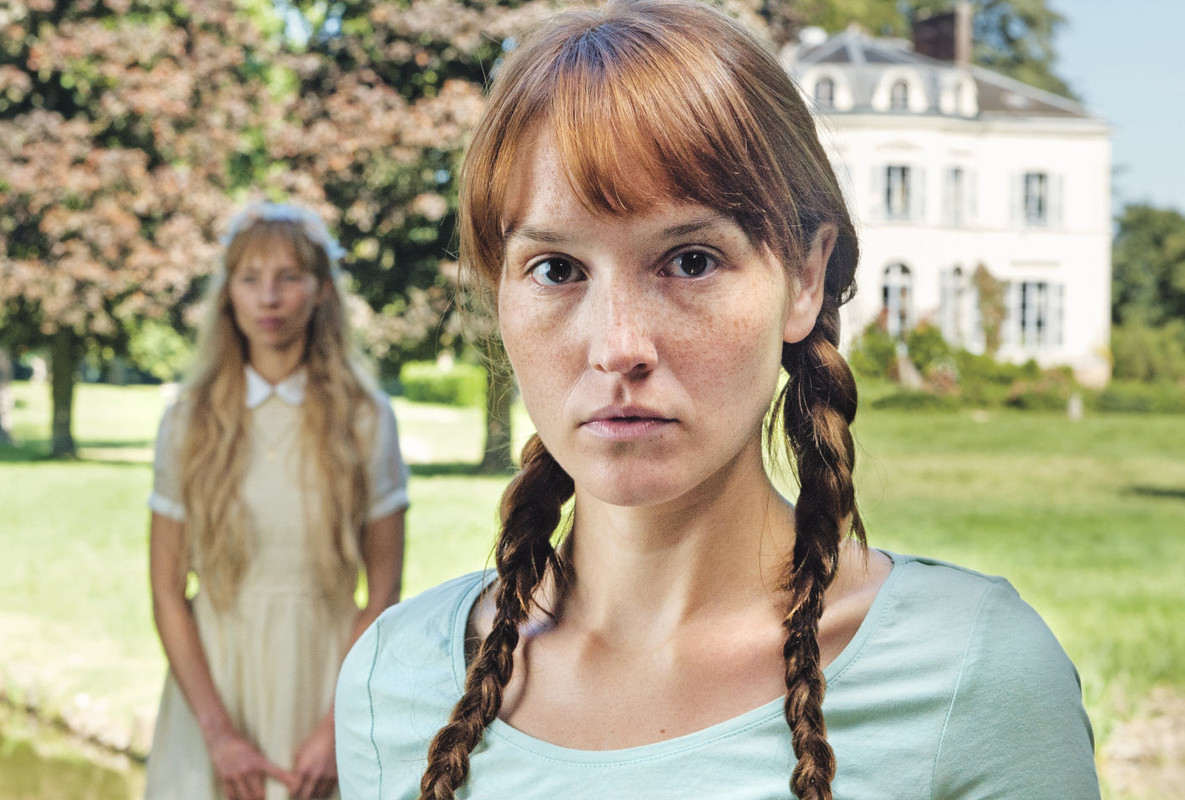
Christian Petzold is a filmmaker who at once wears his influences on his sleeve and remixes them enough to make the resulting films very much his own (consider Phoenix's relationship to Vertigo and Eyes Without a Face, or Jerichow and Yella's riffs on The Postman Always Rings Twice and Carnival of Souls respectively). Undine is loosely inspired by a myth initially found in the alchemical writings of renaissance physician Paracelsus. The myth speaks of mermaid-like creatures who resemble humans but lack a soul, and to gain one they must marry a human, but if the man is unfaithful he is fated to die. As is his usual style, Petzold takes a few of the bones of this myth and embeds them in a story that is very much grounded in the real world.

Paula Beer's Undine is a historian working at a Government office in Berlin, giving talks on the architectural history of the city. On the morning her boyfriend Johannes (Jacob Matschenz) breaks up with her, she goes to find him at their local cafe, but instead encounters industrial diver Christoph (Franz Rogowski). They accidentally smash the cafe's fish tank, soaking them both and cutting Undine. When we next see them, they are in a relationship, which we continue to follow throughout the film.

Their connection perhaps honed through their work together in Petzold's previous film, Transit (to summarise its influences, think 'Kafkablanca') Beer and Rogowski are both excellent, solidly grounding the more fanciful aspects of the film with performances that commit totally to the emotion of each moment, and they have intense chemistry throughout. We meet them the second time when they are clearly relatively newly, but comfortably, in their relationship, and there is a hunger especially about the way Beer approaches it, something we see notably in her initial frustration when Christoph puts the brakes on when things are about to get sexual and asks Undine to give him the lecture she has been practising for the next day. On the surface, Undine may seem slight; a relationship drama that takes a late second act diversion into possible supernatural occurrences and mythical fantasy, but there is perhaps more to it than that.

Undine's lectures look at the changing character of Berlin, from a split city to a whole one and the way that transformed the architecture of the city, even bringing back buildings from the past. I think Petzold wants us to view this as analogous to the shifting states of relationships, from Undine's initial pleading with Johannes not to leave her to her relationship with Christoph. It could also be argued that he's discussing shifting states of being, even beyond the question of the connection between Undine as a character and the mythological figure. Through his work, Christoph is to some degree a being of the water and early on Undine needs to be saved from drowning, which has echoes in later passages of the film.

For all the thematic concerns and all the questions of the relationship between myth, imagination, and reality, at its heart, Undine feels honestly romantic, perhaps ultimately about memory and touchstones (the diver statue that travels through the film, variously with Christoph and Undine). I get the sense that it deliberately doesn't give up all that it's about on a first viewing, and I especially want to pair it with a rewatch of Yella, to examine how each film' and each character's connection with water is expressed. That said, this is still an extremely rewarding and rather beautiful film even without the full context of Petzold's filmography. It's a slow burn, but one worth immersing yourself in.
★★★★

Sep 24, 2017

24FPS @ LFF 2017: Tiger Girl

Dir: Jakob Lass
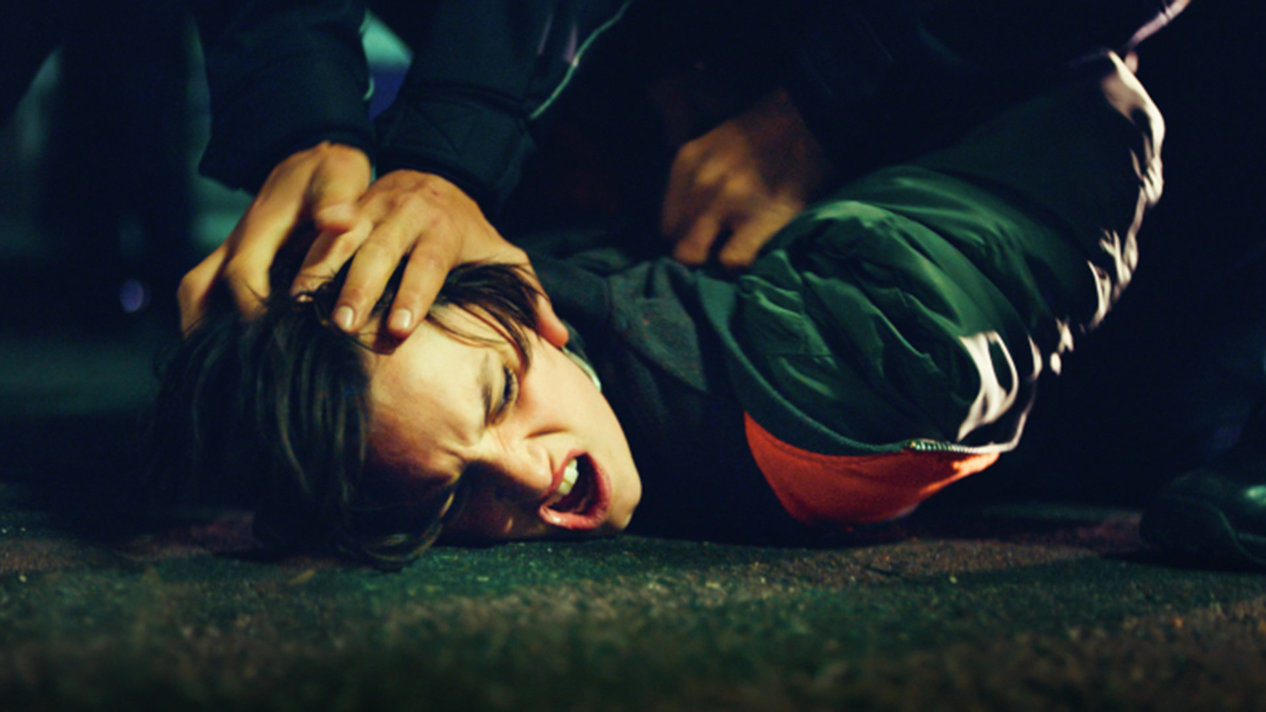
Maggy (Maria Dragus) has recently failed her exam to join the Police but, while she’s waiting to take it again in six months, she’s enrolled on a course to become a security guard. On the first day of her course, Maggy goes out in the evening and is harassed at a subway station on the way home. Tiger (Ella Rumpf) comes to Maggy’s rescue, beating up her attackers. This begins a fast friendship, which begins to lead Maggy down a path of increasing rebelliousness and violence until Tiger is concerned that she’s created a monster.

The brochure blurb on Tiger Girl makes a big play of Tiger as an anti-capitalist and the film as political. I went into it expecting the film to dig into the conflict between political violence and simple lashing out - a sort of Edukators with fight scenes. Unfortunately these themes are more present in the LFF booklet than they are in the film itself.

Tiger does occasionally mention that she only attacks people with power, only steals from the rich, but this reads like self-justification for her mugging people or lashing out violently. That would be interesting if the film gave any indication of making her confront this hypocrisy, but it fails to engage with this even as Maggy becomes ever more randomly violent, to Tiger’s disapproval.

In Raw, Ella Rumpf showed that she has an interesting, edgy, presence about her. Sadly, Tiger Girl doesn’t demand much of her aside from that. The writing is ultimately shallow and we never learn much about Tiger. Rumpf can still hold the camera with a look, and dominates scenes even when outnumbered, useful in a third act scene when she goes to pay off a big time dealer her friends have fallen in with. 

If Rumpf convinces at least with her presence, the same can’t really be said of Maria Dragus, who was so good in Graduation. Dragus always seems like she’s acting, both in the early scenes as she excels in her security course and increasingly so as she drifts ever further into criminality. This is appropriate enough as Tiger goads Maggy into her first acts of rebellion (renaming her ‘Vanilla’), but the sense of both Dragus and Maggy playing a part doesn’t go away. If this is supposed to suggest that Maggy is looking for a sense of belonging and, not finding it, trying to play the role, that’s another theme the screenplay never makes convincing.

The screenplay drags out its various strands in thoroughly expected ways, trying to play off the irony of Maggy’s infatuation with Tiger’s way of life set against her initial ambition to be a cop. It’s entirely obvious where this is going to end up, just as it is obvious how Tiger and Maggy’s friendship will fracture.

Jakob Lass directs competently, if not particularly interestingly. There are a handful of striking images here (the jewelled masks in the still above, for instance) but while the violence is reasonably well shot it seldom has much charge to it. Had the film given more emphasis to the politics we’re apparently supposed to take from it then the violence might have had an interesting moral ambiguity about it, but without that dimension, it just becomes a deadening series of confrontations.

On the whole, this is a disappointing film. It wastes two actors with obvious raw talent and a screenplay that has some ideas, but neglects to explore them in any way that would either inform the characters or prove thought provoking for viewers.
★★

Oct 15, 2016

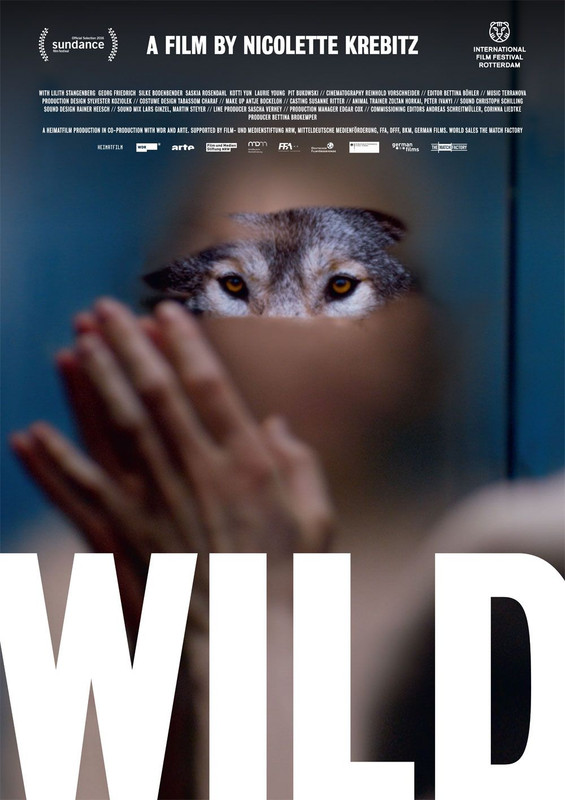
24FPS@ LFF 2016: Wild

Dir: Nicolette Krebitz
Over the eight years since her last film, The Heart is a Dark Forest, I have wondered why it has taken such a long time for writer/director Nicolette Krebitz to follow it up. I believe I now have my answer. Wild can not have been an easy film to set up; a challenging, provocative film that seems destined to upset quite a lot of people, it's both a fitting follow up to The Heart is a Dark Forest and one that confirms that film's promise.

Ania (Lilith Stangenburg) is in her early 20's and living something of a lonely life, stuck in an anonymous high rise, working a decent but soul sucking office job and watching her Grandfather slowly waste away in hospital. One day, as she walks to the bus for work, she sees a wolf emerge from the woods near her home and immediately becomes obsessed. Ania begins desperately looking for the wolf, eventually managing to capture the animal, taking it into her home and beginning a relationship of sorts with it.

Krebitz clearly realises her story may strain credulity, she plays with this idea in two distinct but equally effective ways. Firstly, she builds a credible environment for Ania. Her town, her flat, her job, the hospital, the annoying boss who may have a crush on her, all of these things have a drab, grey reality about them. This credibility grounds the story, but it also provides something that we buy in to Ania being desperate to leave behind; a reason why her encounter with the wolf excites her. 

At the same time, Krebitz implies for a while that this encounter with the wolf may be Ania's break with reality in another way. As she embarks on an initially fruitless quest to see the animal again, it's a distinct possibility that Ania has imagined or dreamed the initial encounter. This would be an interesting alternative route for the film to take, but it's all the more shocking when it becomes clear that this is not what's happening, that both Ania's obsession and the object of it are totally real.

The film's grounding is also aided by an exceptional performance from Lilith Stangenburg. Stangenburg carries the film, with it falling ever more on her shoulders as time runs on and she is more frequently the only person on screen. This would have been an easy role to play badly; just pushing the boat out a bit too far could make the scenes between Ania and the wolf risible. Instead, the inheld but detail rich performance Stangenburg gives makes Ania's loneliness and her pain feel raw and visceral and her gradual withdrawal into this clearly dysfunctional way of coping something we can feel for. Beyond the quality of her work, Stangenburg also gives one of the most daring performances I've seen in a long time, often as physically naked as she seems emotionally and frequently interacting uncomfortably closely with what always appears to be a real wolf. This is one of those performances that makes you sit up and take notice of an actor.

Krebitz gives the film's visuals a washed out colour scheme for the most part, but pulls out some truly striking imagery. A funny shot of Ania, dressed in a homemade protective suit, going in to feed the wolf for the first time since bringing it home sticks in the mind, as does a beautiful and meaningful moment at the film's end when Ania and the wolf take different routes down a hill, their separation speaking volumes. There are plenty more images that I'll struggle to shake, but to talk about them would be to spoil some of the film's most divisive content.

Wild is a bold film and Krebitz clearly as bold a filmmaker, but for all the discussion there will be about the film's content in its more troubling moments, this is ultimately a character study. In this respect Wild is a great film, it does it with an unusual character and through an unusual prism, to say the least, but the feelings it explores - grief, loneliness, a desire to escape - are all but universal. I hope it won't take Nicolette Krebitz another nine years to make her next film, she's too interesting for us to have to wait that long.
★★★★

Nov 11, 2015

From the Verite Archives: Phoenix and The New Girlfriend

I just answered a question on Twitter asking what our favourite films so far this year had been and in answering it I realised that I had not yet run my reviews, originally written for the now defunct Verite magazine, of two of my choices for that list, which seems important given that the questioner had only heard of one of my selections. Thanks, as ever, to Verite for letting me repost these pieces.

There are spoilers in the review of The New Girlfriend.

Phoenix
Dir: Christian Petzold
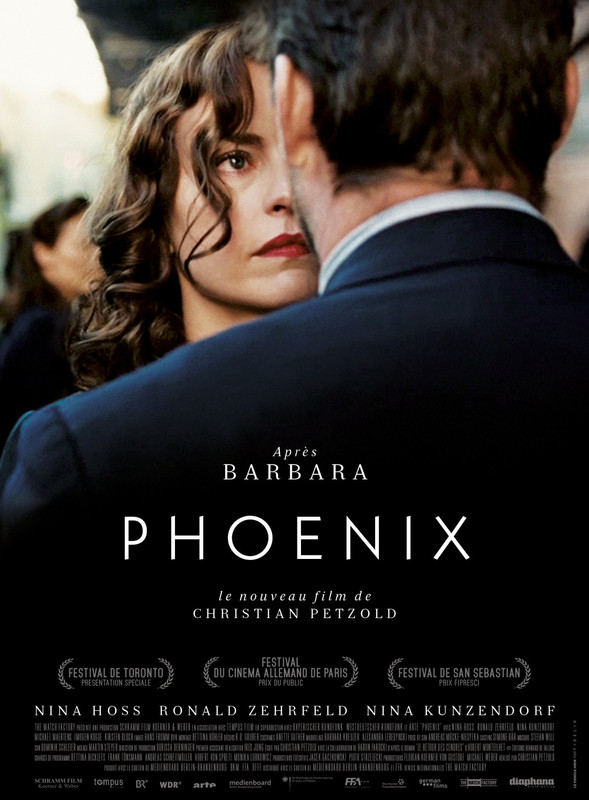
Director Christian Petzold has often drawn on other films for inspiration. Hitchcock has long felt like a key influence on Petzold, bleeding into Jerichow, Barbara, and early TV effort Something to Remind Me, but never has Petzold drawn so heavily on Hitchcock as he does in Phoenix, which is steeped in the influence of Vertigo.

Petzold's muse Nina Hoss (in her eighth collaboration with the director), plays Nelly, a Jewish woman who has survived the concentration camps but, when we meet her, has sustained severe facial injuries. She asks the reconstructive surgeon to make her look exactly as she did before. Nelly then returns to Berlin, looking for her husband Johnny (Ronald Zehrfeld). Nelly's friend Lene (Nina Kunzendorf) claims that Johnny was the one who betrayed Nelly, but she wants to discover if her husband still loves her. When Nelly and Johnny meet again he is struck by the resemblance but appears not know that she is his wife. Instead, he exploits that resemblance, getting her to 'impersonate' Nelly.

There is something disturbing in this story that goes beyond even Vertigo's obsessiveness. James Stewart's Scottie is trying to remodel Kim Novak into someone different, someone she never was. Not so the case here. Whether or not he's aware of it, Johnny is trying to make Nelly become his wife once more, but to his own exacting standards. It's a goal that can't, in either case, ever be achieved, but the impossibility of such perversity is magnified for paradoxically already having been achieved.

This is a film centered on Nina Hoss, specifically on her face. That should be enough to make you want to see it, because Hoss, beyond her obvious talent, has one of the most distinctive and fascinating faces in cinema right now. This is especially interesting in the context of Phoenix, because that very distinctiveness makes it hard to believe that Johnny could fail to recognise his wife. That interesting/frustrating ambiguity lingers for never seeing the full extent of Nelly's facial wounds (only a soldier wincing at them), and all we know of her before her disfigurement is the picture her surgeon is working from that shows Nelly laughing; not something Hoss gets to do much, here or in other films.

Also worth noting about Nina Hoss' face is the depths of its expressiveness and how its surface can shift like quicksilver. Playing two halves of a splintered psyche simultaneously, with only a glance she alternates between a sure-of-herself Nelly, wanting things to return to the way they were (evident early on in that request to the surgeon) and an uncertain Nelly, trying to figure if her husband did, in fact, betray her, and what he thinks of her now they're reunited. She's also Johnny's doll, playing dress up 'Nelly', trying to become the image he has of his wife in the flesh.

Hoss dons the different personas and confused states of minds like masks her character wears uncomfortably; from the bandages of the first fifteen minutes (more than a little reminiscent of Eyes Without a Face) to how the recently reconstructed Nelly now sees herself, and finally, Johnny's idealised version of the wife he recalls—the one that will make their old friends believe she's the 'real' Nelly. It's a performance that, were it in English, would sweep all the accolades come awards season. Hoss shows us the tangled confusion of Nelly's mind with subtle shifts in emotional temperature that are tiny but telling.

Phoenix is an exceptionally strong film and Petzold's direction matches the lead performance. Characteristically, he plays off his influences without allowing the film to become Hitchcock karaoke, and giving 1945 Berlin historical verisimilitude, he uses the camera to be just as true to the emotions of the characters, capturing every moment of exposing vulnerability that Hoss and Zehrfeld contribute to loaded silences, lending their highly dysfunctional relationship an interior richness. Yet all this subtly and intrigue pales next to the mastery of the final scene. Without giving too much away, Nelly's heartrending performance of 'Speak Low', is built off just a few images and a devastating piece of silent acting from Zehrfeld. With this, Petzold draws the themes and all the film's questions together in an astonishing whisper that goes off like a bang. Where Petzold goes from here will no doubt be interesting, but he's given himself a hell of a mountain to climb in having to follow such a powerful ending.
★★★★★


The New Girlfriend
Dir: Francois Ozon
Francois Ozon has brought a new film to the London Film Festival three years running, but 2013's Jeune Et Jolie suggested that a rate of at least one film a year was starting to take a toll on his work - much of which is soufflé light and fancy free, but even for him, Ozon's last was a shallow film crying out for more depth.  

Thankfully, it seems Jeune Et Jolie was just a blip, as The New Girlfriend, adapted from a Ruth Rendell story of the same name, finds Ozon back on form, blending his mischievous side with a substantial (but hardly realistic) story, full of secrets that are practically impossible not to reveal when talking about the film.

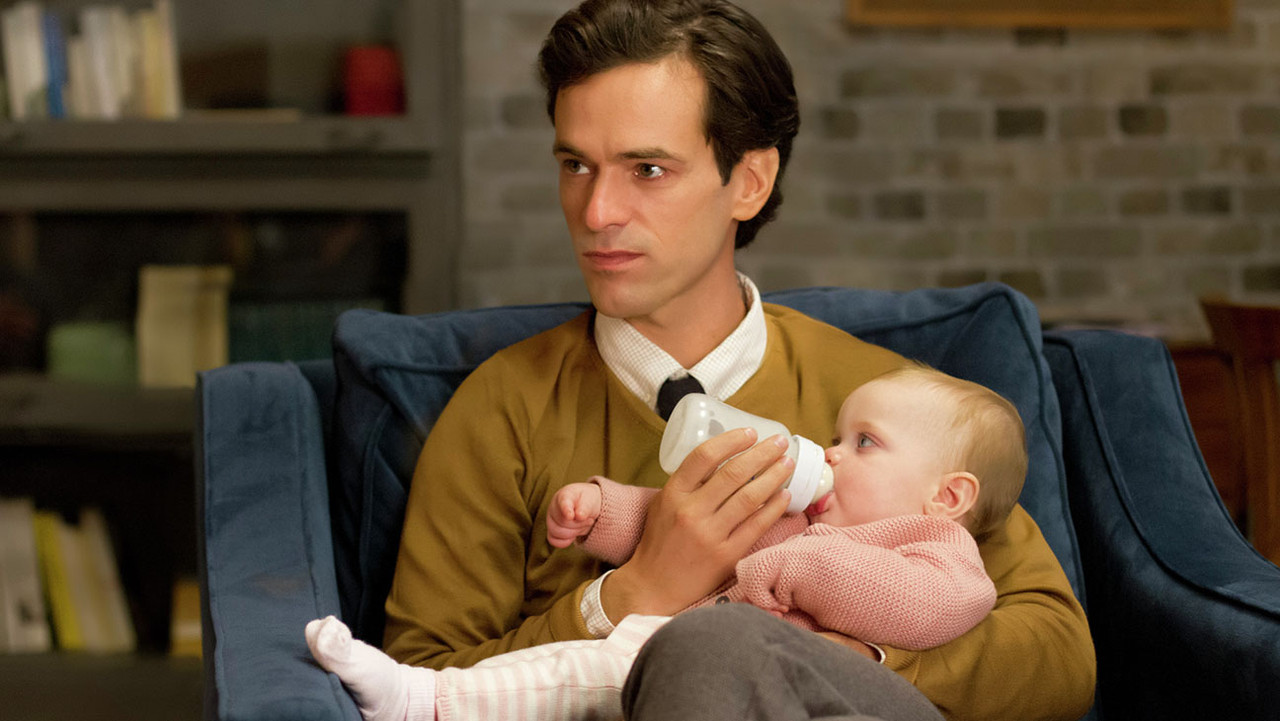
The totally spoiler-free version of the review reads like this. A playful addendum to Ozon's grief trilogy (Under The Sand, Time To Leave and Le Refuge), The New Girlfriend finds husband David (Romain Duris) and best friend Claire (Anais Demoustier) dealing with the death of Laura (Isild Le Besco) in different ways. These coping mechanisms are predicated upon Ozon's chief preoccupation of sexual malleability and confusion. For his fans, The New Girlfriend is full of auteurist traits in the use of colour and offbeat humour, perfectly handled by an outstanding cast.

Discussing the film in any greater detail requires the revelation of a key twist, so stop reading if you want to go in cold, which is my recommendation.

Fifteen minutes in, we discover that David is, in fact, the title character. After his wife's death, he falls back into an old enjoyment of dressing as a woman, becoming closer with Claire as Virginia, a relationship she keeps from her loving but uncomprehending husband Gilles (Raphael Personnaz). Virginia is a persona who grows into a fully realised third main character, with Romain Duris physically, verbally and emotionally defining the split between the two personalities he's playing very capably. Ozon mines much comedy from his star's gender-bending, but its intent and effect are never cruel. The joke is often at David's expense, but Ozon never has us laugh at anything David himself would be upset by. Take for instance an early moment when David is having tea with Claire and his mother in law (Aurore Clement) in his own clothes. Gesturing as if to rub away some lipstick, he forgets he's not dressed as Virginia. Coupled with Demoustier's reaction it's one of many slyly funny, non-verbal embarrassments.

With the less showy role, Anais Demoustier has a grounding effect on the film, lending Claire a straightforwardness that gives us a way in to the characters and the story whenever Duris' dual performance might push the camp factor a little too far out for some. Claire seems a simple character, but her complexities lie under the surface and Demoustier lets them show through slowly. Virginia's observation that her friend often dresses in a masculine fashion is quickly followed by a sex scene in which Claire enacts a masculine cliché; rolling off her husband as soon as she's achieved orgasm and casually asking “did you come?” “No”, he says, “but that's okay.” The gender issues seeded in this scene pay off in a later sex scene between Claire and Virginia/David. Demoustier quietly and heartrendingly articulates Claire's sudden kinship with Virginia. Despite never having been close to David, she like him, is trying to fill the void Laura has left in their lives. 

Laura is glimpsed only briefly (mostly in an opening flashback charting her friendship with Claire that feels like Ozon's take on the opening of Up),  and while Isild LeBesco doesn't have time to give us a rounded character, her radiant presence is more than enough to suggest how much darker the lives of these characters are without Laura in them.

In changing some of its fundamentals, re-calibrating its tone and adding a great deal to Ruth Rendell's ten-page story (including a completely different ending which closes the film out with the most auteurist image of Ozon's career), there's a feeling of a filmmaker at play, despite the grief which subsumes the players. Claude Chabrol's La Ceremonie is more along the lines of what might be expected from a straight Rendell adaptation, but with a distinct lack of foreboding or impending violence, Ozon brings a lightness of touch to even the most dramatic of scenes, enabling him to seamlessly shift from frolicsome scenes such as Claire and Virginia's first outing together and moments suffused with a crippling sense of grief, such as David dressing his wife's body for her funeral. Between these contrasting registers, Ozon's customarily unblinking depiction of sexuality against the hetero-normative grain is evident throughout, with one sex scene in particular, the strangest, most emotionally fraught and complex he's ever directed. Like the sexuality, the film's structure is fluidly subversive. The sequence of Laura being dressed for her funeral is echoed at the end, its second occurrence making poignant use of a song that Virginia and Claire hear a drag act sing at the film's midpoint, movingly literalising its meaning. 

For years, Francois Ozon's films fell into two categories; the playful and the severe. Recently, with In the House and now The New Girlfriend, it's fascinating watching him begin to draw those two sides off his personality as a filmmaker together. The mix is less successful here than it was previously, largely because Claire's husband is rather underdeveloped and one note and the existence of Laura's daughter Lucie is almost entirely forgotten for an hour of the run time. Still, The New Girlfriend is a great film, often moving and amusing in the same moment and boasting two subtly soulful lead performances.

Much more than a return to form, it's a superb reaffirmation of Ozon's status as one of the best directors in world cinema, ranking in the top tier of his own rhapsodically tender and strikingly imaginative filmography.
★★★★★

Oct 8, 2015

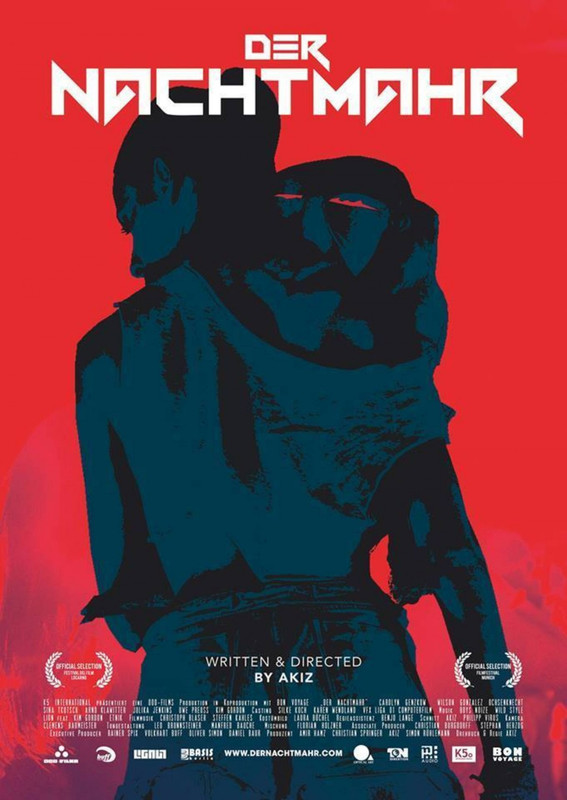
24FPS @ LFF: Der Nachtmahr

Dir: Akiz
There are few phrases that set my alarm bells ringing the way 'artist's film' can. I often end up feeling they are more like misplaced gallery pieces than anything I am interested in as cinema. Happily, this first film by visual artist Akiz, while certainly making a powerful visual and sonic impression and having an artistic eye, is driven first by its characters and their experiences.

Tina (Carolyn Genzkow) and her friends are pretty typical 17-year-olds, when they're not at school they like to party, they dance, they experiment with drugs and they fall into and out of relationships with each other. However, Tina has begun to believe that there is a monster following her around, at first it seems threatening, but it becomes clear that Tina and the monster are closely linked and her relationship to it changes.

Der Nachtmahr is, it must be said, based around a metaphor that it shouts pretty loudly. The monster is a physicalisation of Tina's mental health problems and as those problems deepen the monster becomes more present in her life, closer to her, up until the final shot, which implies that the monster - the illness - is now more in control than Tina is. It's neither the deepest nor the most original of metaphors, but it rings true and is delivered so effectively that it's hard to mind. If you've suffered depression, the idea of it as a grey monster that ties itself more and more to every aspect of your life will likely ring true.

The fact that this comes across as more than a rather facile metaphor is down to how well drawn Akiz' screenplay is and to how well it is matched by the performance of Carolyn Genzkow (who is 23, but whose peculiarly striking face often looks even younger than her character is supposed to be). A dinner table scene shows off both the script and Genzkow's performance to great advantage. The monster is an all but constant presence by this point, but it is shut in Tina's room as she joins her parents (Arnd Klawitter and Julika Jenkins, both very good) for what seems to be an important work dinner for her father. Throughout this scene, Genzkow gives us a palpable sense of the monster gnawing at Tina (metaphorically), as she can hear it upstairs and imagine it scratching at the door. This is an astutely observed depiction of how mental illness can feel in moments of pressure, and Genzkow plays it perfectly.

In scenes that focus on Tina at home, the surreality of the monster (which looks a little like a foetal version of the Pale Man from Pan's Labyrinth) is set against a roomy house that can feel both welcoming and creepy. The solid grounding in reality only makes the monster and its interactions with Tina more unnerving, especially in the scene when it first reaches out and touches her hand as she dozes in her room.

Outside the house, with her friends, the surrealist touches are usually less present (perhaps because, at least to begin with, Tina's illness is dissipated somewhat when she is with her friends). In these scenes, largely set at house parties with pounding music and neon lights, we see why the opening captions, as well as warning of strobe lighting, insist that the film is designed to be played loudly. Der Nachtmahr is seldom subtle, but in these scenes, it can feel outright assaultive. But again, Akiz' choices are effective. These scenes have a real sense of throwing you into the middle of the party with Tina and her friends. If you wouldn't be able to hear the dialogue in that situation, you don't hear it on the soundtrack, it's a visceral immersion in amongst all the bodies on the dancefloor, but with enough distance to give you a sense of the dynamic, for instance of Tina beginning to isolate herself, even in the very first party scene.

The supporting cast are all fine, with and making an impression, as Tina's best friend and sometime boyfriend respectively, and Kim Gordon (who also consulted on and contributed to the film's soundtrack) making a surprising cameo as Tina's English Literature teacher. It's not really suggested by the scene, but if you wanted you could perhaps read this as another of Tina's fantasies, she's deep enough in her mental illness to be hallucinating a lot at this point and hey, what cool indie kid wouldn't like Kim Gordon as their poetry teacher?

Akiz makes a creditable directorial début here. He knows what he wants to say, which does sometimes result in him shouting his point, whether with his visuals or his central metaphor. However, those images are strong, memorable and often echo in interesting ways. One moment the film returns to several times is that of a young woman being hit by a car. This image is played with in time, in memory, and every time it is revisited it's striking in a different way. For me what is refreshing about this as a film by an artist is how much of its drive comes through the characters, and how the images are designed to support those people and their story, it generally tends to be the other way round.

Some will find Der Nachtmahr overly strident, but I've no problem with a filmmaker communicating with clarity (in fact it's a refreshing turn outside the mainstream). It's an engaging film on all levels, driven by an excellent performance from Carolyn Genzkow and marking out Akiz as a director to watch.
★★★★

Apr 7, 2014

This Week I've Been Watching... March 31st - April 6th 2014

Jerichow
Dir: Christian Petzold
I find director Christian Petzold to be one of the most hit and miss filmmakers around.  His work can be alienating; cold and airless in both emotional and visual register, but I keep returning to his films for one reason; his muse, Nina Hoss.

This film, from 2008, is one of Petzold's best and a riff on one of his favourite stories; The Postman Always Rings Twice (which I know only from one distant viewing of the Nicholson film).  Benno Fürmann plays Thomas an unemployed man in debt who lucks into a job driving for local businessman Ali (Hilmi Sözer) and ends up falling into an affair with Laura (Hoss), the young wife of his new boss.  Petzold takes the themes and some of style of noir.  For instance, a shot of Thomas emerging from the darkness to caress Laura, then disappearing when Ali might see him is noir through and through.  However, much of the film is less traditionally noirish; those themes sit under the drama, bubbling away as Ali and Thomas become friends.  This is a good touch, maintaining tension but also giving the film a feel that is different to much neo-noir.

Petzold's camerawork is typically austere, allowing the natural tension of the situation and the down to earth performances to do most of the work.  Fürmann and Hoss have worked together several times and they bounce off each other well here; there is an intensity to their sudden chemistry that convinces and the gaze between them, right from the first time they see each other, is riveting.  Overall Jerichow is a strong and suspenseful low key thriller, recommended for its excellent trio of central performances.
★★★★

Next Door
Dir: Pål Sletaune
A couple of years ago I saw and enjoyed director 
Pål Sletaune's Babycall.  It had a tiny UK release, but nevertheless was, for the most part, a tense little thriller.  This earlier film has much the same mix of elements and also stars the great Norwegian actor Kristoffer Joner.

Joner plays John.  On the day that his girlfriend has left him he meets his strange neighbours, Anne and Kim (Cecilie Mosli and Julia Schacht), who may be sisters.  John is drawn into their apartment when he is asked to help them move a cabinet.  The women try to keep John in their apartment, ultimately resulting in a violent sexual encounter with Kim and from here John's life seemingly begins to unravel.

From the start Sletaune creates an unsettling tone, giving us the feeling, especially once John enters the women's TARDIS-like apartment, that something is off and that we may not be getting all the information.  The answer is obvious quite early on, but that doesn't undermine the tension quite the way you would imagine.  That this is the case is down to the excellent central performances.  Kristoffer Joner has a blue collar feel to him; he's not quite leading man handsome, and when he's as thin as he is here he has a naturally haunted look about him, which in this case works very well for John.  He's a character in whose company you are never quite allowed to become comfortable, and for a while you can't pin down why.

More outwardly menacing, but equally effective, are Mosli and Schacht.  Both beautiful women, they acquire a siren-like quality as you realise that John really shouldn't be going near them, but sense how he is drawn back, over and over.  When the reality of the film becomes clear it morphs into a disturbing character study, and I suspect watching it knowing where it goes will change both the film and the performances.  At just 72 minutes it's a minor investment of time, and one worth making
★★★½

Sep 27, 2012

24FPS @ LFF 2012: Diary - Day 3

Tall as the Baobab Tree
Dir: Jeremy Teicher
Cinema is, it strikes me, the truly global artform, and I do enjoy marking off a new country on the map of places I have seen films from (I'm a nerd, in case we hadn't established that). Tall as the Baobab Tree is my first Senegalese film, and it's one that really plunges the audience into a local culture that many of us will see as not just alien but perhaps even objectionable, the more so for the opening caption informing us that it is 'Based on True Stories'.

On the day that she is collecting her exam results, Coumba's older brother falls from a Baobab tree and breaks his leg, which means not only can he no longer work in the fields, but his parents are facing a medical bill they can't pay.  The remedy they find is to marry off Coumba's roughly 12 year old sister Debo and use the dowry to pay the bill.  Coumba can't accept this, and begins working secretly at a hotel in town, aiming to collect enough money to save her sister.

The film's tone is very subdued, and there isn't a great deal of major dramatic incident, but director Jeremy Teicher largely gets away with this because the story has an in built high stakes drama and interest.  What makes the film especially interesting is the fact that it doesn't make the morals totally black and white.  The sympathy of both (this) audience and the film clearly lies with the sisters, but it doesn't treat the father as a total villain, rather it seems to view him as a man who has been raised with a certain faith, a certain doctrine and a certain way of doing things, who can't really see past tradition in trying to solve his family's problems, and it takes pains to show him as conflicted.  It's a welcome moral complexity in a film that could easily have been far too black and white.

While all this does keep the film watchable, I also found that it kept me emotionally at arms length thanks to the performances.  It's difficult at the best of times to judge performances in a language you don't speak, so it may simply be an issue of unfamiliarity with the structure and sound of Pulaar, but there is a flat feeling to the dialogue, which makes even the high stakes drama feel a bit lifeless at times.  Whether this is my unfamiliarity with the language talking or the performances really are a bit flat and rote, it adds up to the same slightly unsatisfying result.

The thrust of the story is interesting and provocative enough, and the imagery beautiful enough, that Tall as the Baobab Tree overcomes many of its issues, but I still left feeling that it wasn't quite the film that it might have been.
★★★☆☆

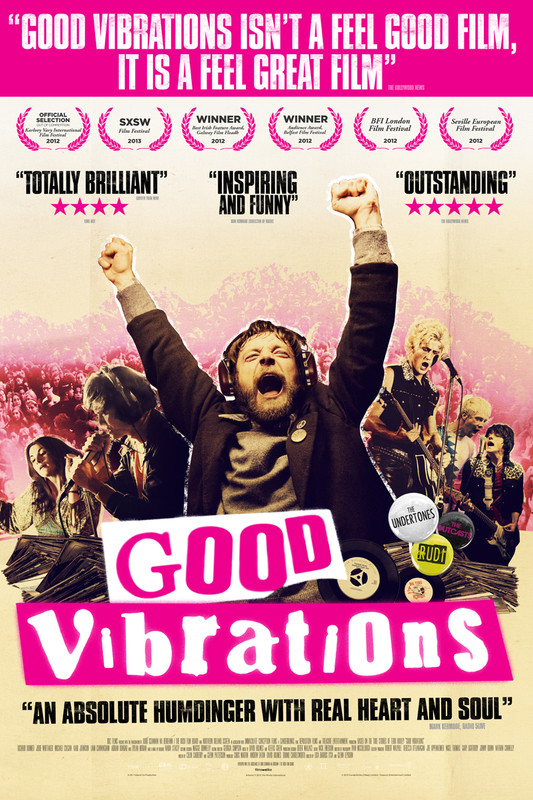
Good Vibrations
Dir: Lisa Barros D' Sa / Glenn Leyburn
I don't read much about festival films before going to see them, and had somehow got my wires crossed and ended up thinking that this film about Terri Hooley, whose Belfast record shop and indie label Good Vibrations seems to have been a very important presence in the Belfast punk scene of the late 70's and early 80's, was a documentary.  It isn't, I really wish it were, because that's a film I'd actually be interested in seeing in place of the perfunctory and forgettable by the numbers biopic we've been given here.

One problem is the simple fact that Hooley (played by Richard Dormer) just isn't especially likeable.  At the very least we should be getting some sense of his passion for music managing to charm people into working with him, but we really don't, and consequently, particularly given what an organisational fuck up he is, it's tough to see how he pulled everything together and managed to convince people (especially his wife Ruth, played by an almost insultingly underused Jodie Whittaker) to stick with him.

The other major issue is one of tone, in that the film doesn't really know which sort of tone it wants to pursue.  Is it a serious film about the way Hooley tried to use music to distract from the Troubles?  Is it a knockabout comedy about a misfit trying to run a record label?  Yes.  Is it a sad story about a guy who puts music above everything, including his wife and baby?  Yes.  It's all of these things and others besides, and the pieces seldom mesh, so the overwhelming feeling is one of the screenplay rolling a die before each scene and letting the numbers decide which tone they'll go for over the next five minutes.

Good Vibrations isn't terrible, Dormer and Whittaker are both fine in their roles, and some of the music is electrifying, but I could never shake the sense that the real story, the real guy, would be more interesting, nor the feeling that this film had been made with some sort of cinematic paint by numbers kit.
★★☆☆☆

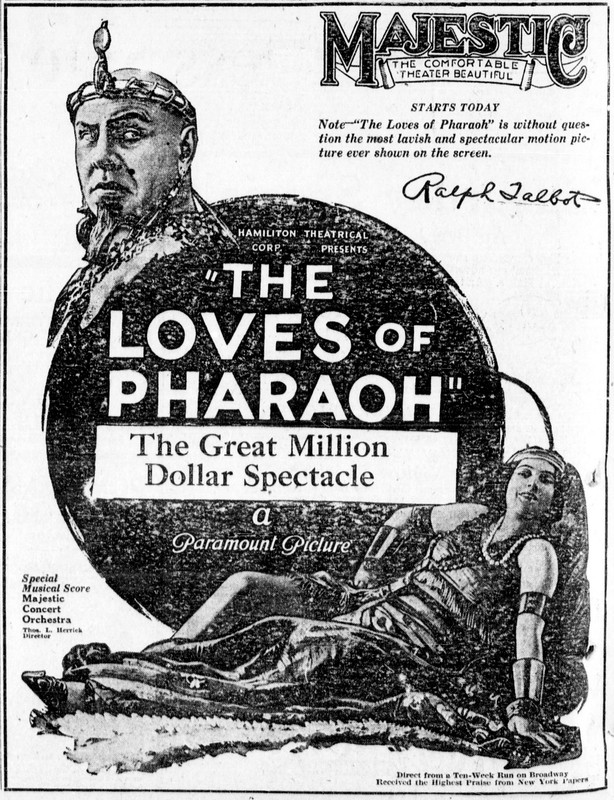
The Loves of Pharaoh
Dir: Ernst Lubitsch
I haven't seen much of the work of Ernst Lubitsch, but even after just a couple of films - The Shop Around the Corner and Ninotchka - I can tell you that this previously lost melodrama from 1922 is neither typical, nor the place to start.

The Loves of Pharaoh has many of the familiar strengths and weaknesses of early and silent cinema.  On the plus side it is remarkable how easily, even in this still incomplete version, the story of a Pharaoh (the great German silent star Emil Jannings) who causes a war in his kingdom when he falls for a slave girl who has recently escaped servitude under the Ethiopian king (played by another star, Paul Wegener, in blackface), is communicated.  It's also a beautiful film, with some remarkably dynamic battle scenes featuring massed ranks of extras, well chosen tints that help communicate both time and mood and many gorgeously lit and framed shots that make the 600 metres still missing feel like a real loss.

On the downside, this is a melodrama, and that's very apparent in the acting, which, sadly, is still stuck in the broad, pantomimic style employed in a lot of early cinema.  Perhaps in 1922 these were great performances, and Jannings does have some subtler moments in which he is great, but for the most part the over-demonstrative work on display from the likes of Dagny Servaes (as the slave girl) and Harry Liedtke (as the other man who is in love with her), just doesn't work, and when Jannings pushes the boat out, especially in the second half of the film, he's comically overblown.

The Loves of Pharaoh is rather good fun; the story and acting are overblown, but if you're interested in film history the beauty of the images and the fluent storytelling do carry it, but it's no lost classic, and really feels more like a curio than an essential addition to most people's experience of silent cinema.
★★★☆☆

Aug 19, 2011

Rammbock: Berlin Undead

Here's a new review from Horror correspondent Steve Chandler. Enjoy.

DIR: Marvin Kren.

Clocking in at a little more than an hour including end credits I hesitate to call Rammbock: Berlin Undead a movie. It is to the feature length horror flick what the novella is to the full length novel. What we have here is a lean, mean calling card that has been stripped clean of anything that could be described as extraneous. In fact it has more substance in it’s short running time than most of what passes for horror cinema these days. As a piece of entertainment it provides substantial reason to mark director Marvin Kren as one to watch. I truly believe this could be his Mulberry Street. Back in 2006 at the Dead By Dawn film festival in Edinburgh I saw Mulberry Street and left the screening thinking “this director is going someplace”. The director in question was Jim Mickle who I recently found guilty of helming one of the best horror movies of 2011; the Zombieland meets The Road genre gem that is Stake Land. Rammbock has me feeling the same flavour of anticipation. I believe that given the opportunity Mr. Kren has a future classic up his sleeve and Rammbock will hopefully catch the eye of someone in the position to give him the opportunity to prove me right.

Rammbock shares a lot of it’s DNA with Mickle’s Mulberry Street. The focus is on a small cast of characters who live in an apartment complex somewhere in Berlin. They find themselves at the mercy of ever growing mob of ravening, bloodthirsty walking dead; victims of a virus that can be transmitted via contact with the bodily fluids of one of the infected. The movie opens with main character Michael (Michael Fuith) arriving unannounced in Berlin to return a set of house keys to the girlfriend from whom he has recently split. It’s obvious from the off that he still has feelings for his ex, Gabi (Anna Graczyk), as he rehearses a halting, ill prepared speech to the taxi driver who has just dropped him off. Michael is pretty far removed from your typical hero. I would place him in his mid to late thirties, with thinning hair and the physique of someone who is less inclined to hit the gym for a workout than he is the couch for a pizza and a few beers. The rest of the characters that inhabit this movie are, likewise, normal everyday people who, when faced with the virus outbreak and the resultant disintegration of society, react in a mostly believable fashion. Some rise to the occasion. Some go to pieces and make stupid mistakes that cost them and sometimes those around them their lives. Some are selfless and given to sudden moments of heroism. Some are revealed as base cowards who look out for no-one but themselves. But most importantly...they feel real.

I should also mention that Rammbock isn’t an zombie movie in the classic Romero sense. The undead here don’t shamble and moan. Instead they attack with the ferocity of a pack of bloodcrazed, wild beasts; emitting terrifying shrieks as they overwhelm any unfortunate soul that crosses their path. They have far more in common with the rage virus casualties of 28 Days Later or the victims of the demonic plague that breaks loose in the REC movies. The writer has also gone to some effort to put his own stamp on the nature of the virus. Once infected the virus lies dormant until activated by the first surge of post infection adrenalin. Once infected, if the virus continues to lie dormant for an undisclosed period the body’s immune system will fight back resulting in a complete recovery. In the event of the world going to hell in a handcart how easy would it be, when faced by such a terrifying situation, to maintain the necessary composure to combat the onset of the full blown virus? It’s this element of the movie more than any other that generates no small amount of suspense.

I mentioned that I don’t consider Rammbock to be a movie because of it’s length. That’s not to say that I think it should be longer. Many other directors would have shoehorned an extra thirty minutes worth of scenes into a story that simply doesn’t require it, in an effort to bring it up to feature length, resulting in an excess of flab. At no point does Rammbock outstay it’s welcome. It moves at just the right pace. Slowing down where necessary for moments of character development then hurtling at breakneck speed during the various set pieces where the survivors come under attack.

Alongside Michael there’s one other main character, a young maintenance worker by the name of Harper (Theo Trebs). They get trapped together in Gabi’s apartment minutes into the movie when all hell breaks loose. Both characters are fleshed out enough that I cared about them when the story placed them in jeopardy. Other characters are set up in a more economical fashion but skilfully enough that I understood who they were and gave a shit whether they lived or died. These are two tricks that many modern horror movies fail to accomplish. I’ve seen far too many horror movies that sacrifice character development on the altar of gore. None of the actors here are especially experienced but each and every one of them acquit themselves well.

Likewise, the direction is solid throughout. There was none of the shakycam nonsense that crops up so often these days to put a dent in my enjoyment. There was nothing showy about the camerawork but I welcomed the fact that I at no point lost track of what was going on.
So what we have here is an fantastic example of low budget horror movie making done right. Rammbock was produced by a group of talented individuals who have clearly seen a lot of similar movies and have succeeded in making something that doesn’t look like an uninspired hack job in comparison. A trap countless straight to DVD abominations all too easily fall into. I will admit that I’m predisposed to enjoy horror movies that stray into apocalyptic territory. I even got through the excremental Nightmare City, a movie that would insult the intelligence of a cabbage, without putting my size ten boot through the TV screen. Regardless of my infatuation with this genre this is an impressive début and I look forward to seeing what Marvin Kren has in store next. There’s nothing here to suggest that given a larger budget he won’t give us horror junkies something to really sink our teeth into. Something similar but on a grander scale would be very sweet indeed.

May 10, 2011

DVD Review: My Friend From Faro [15]

Dir: Nana Neul
Though it's hardly mainstream, the lesbian coming of age movie has, in recent years, become a familiar part of the cinematic landscape, and as such it has laid down many of its own standard forms and clichés, so you have to credit début writer/director Nana Neul for trying to do something at least a little different from the usual coming out story.

The film centres on closeted tomboy Melanie (Anjorka Strechel), who meets Jenny (Lucie Hollmann) after almost running her over. Jenny assumes that Mel is a boy, and Mel, attracted, plays along, claiming to be from Portugal and named Miguel. At the same time, challenged to bring her new boyfriend; Miguel, from Portugal, to a family dinner, Mel hires a co-worker (Manuel Cortez) to pose as Miguel. You can pretty much guess that these lies lead to a lot of confusion and heartache for all concerned.

The obvious touchstone for My Friend From Faro is Boys Don't Cry, or rather the real story of Teena Brandon before the events of that film. Like Brandon, Melanie poses as a boy in order to seduce a straight girl, but in this fictional context it is harder to sympathise with Melanie. The main reason is that we know throughout that Jenny is 14, and though she's told Melanie that she's 16, she looks and seems very much younger, which gives a creepy vibe to the relationship (compounded both by the deception it is built on and by a late revelation about Melanie's age). While it's easy to understand why Melanie lies to Jenny, it's harder to see why she lies to her family and invents a fictional boyfriend, there doesn't seem to be any pressure on her to be 'normal', at least not beyond the fact that they assume she's straight, and while the scenes with Melanie's family are well played, there is little inherent drama to them, as there seem to be no stakes.

On the plus side, the performances are uniformly good, with leads Strechel - who convinces physically as an androgynous figure who could be taken for a handsome young man - and Hollmann both committed and impressive, as hard as it is to really invest in their relationship, you do believe their investment in it. There is also a quickly built but convincing brother/sister relationship between Strechel and Florian Panzner, and an appealing performance from Manuel Cortez as Mel's Portugese co-worker/fictional boyfriend.

Beyond a creative title sequence, Nana Neul doesn't do anything flashy as a director. She keeps the focus largely on her actors, and is served well by their performances. She does, however, develop a few subtle things with her blocking and visuals, notably a close relationship between Jenny and her friend Bianca, which seems to hint at a deeper desire on Bianca's part. There are only a couple of really active scenes in the film, and Neul fumbles both. The car crash and a chase towards the end of the film both play almost completely in reactions, and feel slipshod in terms of both shooting and editing, but at the end of the day these are small problems, and the film's focus is on relationships and conversation, which are well handled by the director.

On the whole, My Friend From Faro is a mixed bag; it's well performed, but hard to connect to, and despite its undoubted qualities and several very good scenes (the family dinner with Melanie's fake boyfriend; Jenny, Bianca and Melanie's night out and Jenny and Melanie's date at the beach all stand out), it ends up feeling a bit inconsequential, especially as it ends on a very open note, but one that doesn't - unlike, say, the ending of Fucking Amal - leave you anxious to know what happened after that last cut to black. There are good things here, and I'll be keeping an eye on both Anjorka Strechel and Lucie Hollmann, but My Friend From Faro doesn't quite come together.

Oct 16, 2010

LFF 2010 review roundup 2

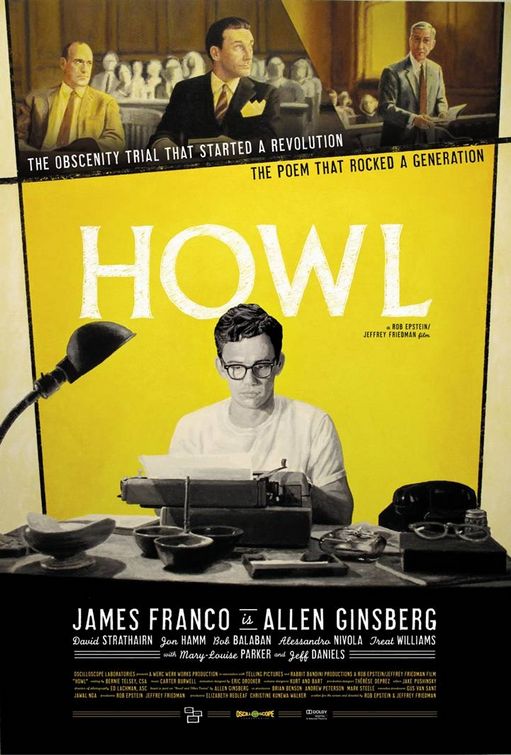
Howl
Dir: Robert Epsitein / Jeffrey Friedman
This biopic of Allen Ginsberg doesn’t, unlike most biographical films, attempt to tell the story of its subject’s whole life. Instead, the film adopts a very specific focus on Ginsberg’s most famous work; the titular, four part, poem Howl. It focuses on Ginsberg (James Franco) as he writes and performs Howl in 1955, and documents events in 1957, as Ginsberg is interviewed while Howl is being tried for obscenity. The dialogue is, apparently, entirely drawn from interviews and trial transcripts. Despite the fact that Howl is unusually specific in the time period it focuses on, the film can still feel rather scattershot at times, as if it is trying to explore this undoubtedly important piece of work from too many angles all at once.

The film largely falls into three parts, which are intercut throughout. The first is a (presumably complete) reading of Howl itself. This was probably my least favourite part of the film, not because Howl is obscene or offensive, more because I found it rather pretentious and self-indulgent. However, that’s mitigated by the way the reading is presented, in that it is rendered with some genuinely beautiful animation, which illustrates, in a slightly abstract manner, Ginsberg’s words. The second major part of the film is the obscenity trial, at which Ginsberg was not present, and it is here that the starry cast make their presence felt. Most of the roles are cameos, but everyone makes an impression, especially Mary Louise Parker, in an atypical role as a very prim high school English teacher and Jeff Daniels as a pompous poetry professor. The trial scenes are, however, dominated by the two attorneys, played by David Strathairn (prosecution) and Jon Hamm (defence). Good though the acting is here, there can’t help but be a slight stiffness to the sequence, shackled as it is to the transcript, and it becomes overtly preachy towards the end of the film.

The one thing you really can’t fault about Howl is James Franco’s performance, which dominates the film despite the interview sequences in which he’s on screen being relatively short. He reads Howl brilliantly, accentuating the percussive language, and completely disappears as Ginsberg. If the film as a whole doesn’t come up to the level of Franco’s performance (and it doesn’t) then it’s not for lack of effort. Howl throws a lot of things at the screen, not all of them stick, but it’s far more interesting than watching one more run of the mill biopic.

Upside Down: The Creation Records Story
Dir: Danny O'Connor

Creation Records, in many ways, defined what my teens sounded like. Oasis were so inescapable in the mid 1990’s that not only did Creation reap truly huge record sales, but every other label began to sign bands who sounded like they should have been on Creation (and, let’s be frank, were in many cases far better than Oasis). That period forms part of the story in Danny O’Connor’s hugely enjoyable documentary about Creation (and, to a large extent, its founder Alan McGee) but what the film is more interested in is the journey to that point.

We discover that that journey was mostly undertaken in haze of drugs and parties, that Creation was always just a half step from bankruptcy, and that it was run not so much by businessmen as by insanely devoted music fans who were simply desperate to help bands release albums and singles they loved.

The story is told in great detail, with warmth and humour, by the people who lived it, notably Alan McGee, co-founder Dick Green, Primal Scream’s Bobby Gillespie (a longtime friend of McGee’s, even before they were playing and releasing music), My Bloody Valentine’s Kevin Shields and Oasis’ unfailingly entertaining Noel Gallagher.

The Creation Records story could easily have been told on television, but director Danny O’Connor’s treatment, though it’s largely just talking heads and clips of bands, feels cinematic. That’s largely thanks to the beautiful black and white cinematography employed for the interviews and to the well designed and dynamic graphics. Archive footage of the bands is used intelligently throughout, adding context to the story rather than stopping it dead for musical interludes (though it has to be said, I’m still of the opinion that ANY use of The Boo Radleys Wake Up Boo, whatever the context and however brief, should be punishable in law).

Of course, music is the heart and soul of the film, and the love of it bleeds through almost every interview, especially McGee’s. The soundtrack is, obviously, stunning, showcasing bands I’d never heard of, bands I need to discover, bands I’d forgotten I liked… and Oasis. At 101 minutes, Upside Down does start to feel a little baggy towards the end, at which point it also seems to rush through the last few years, leading to a few potentially interesting avenues going unexplored (in a film so in thrall to the effects of drugs on music, why is there nothing about the making of Oasis’ coke hazed Be Here Now?).

For the most part though this is a fascinating story, well told, and packed to the gills with great music and well worth seeing for anyone with a passing interest in the indie music scene of the 80’s and 90’s. Beware though, seeing this film may mean that you’ll be spending obscene amounts on albums.

Blessed Events
Dir: Isabelle Stever
It’s not often, you may have noticed by now, that I’m lost for an opinion, but five days after seeing it, and having thought about it a lot, I still don’t know whether Blessed Events is a good film or not.

The film is about Simone (Annika Kuhl) a German woman in her mid thirties who becomes pregnant after a one night stand. When she tells the father to be (Stefan Rudolf) he’s very happy. They start a relationship, buy a house, and begin preparing for the baby. However, Simone doesn’t seem so excited, and as the pregnancy goes on she seems to grow ever more disenchanted with it.

Very little actually happens in Blessed Events, but what keeps it intriguing is the fact that the whole film has an atmosphere of tension and threat about it. It’s acutely felt in Annika Kuhl’s performance, despite the fact that she gives little away outwardly there is an ever present fear that Simone’s detachment is just a few seconds from making her do something terrible to herself and her unborn child. The problem is perhaps that the film explains nothing. Simone’s feelings about the pregnancy are never vocalized, her relationship with a mysterious bearded man who we assume to be an ex (Arno Frisch) is never addressed in any detail and for all the sense of impending horror nothing ever actually happens. As an exercise in extended tension, Blessed Events is interesting, but there’s no payoff.

The performances are strong, especially given the constraints of the often rather banal script, and I suspect that Annika Kuhl, though she doesn’t really have a lot to do here, is a fine actress, but it’s hard to judge when the atmosphere of the film feels so strange and surreal. Isabelle Stever maintains a chilly distance with her direction, and there are some striking visuals here, but there are also some inexplicably odd recurring choices. Why, for instance, are there so many shots in which characters heads are outside the frame? However, Stever does pull out one great moment, with an enigmatic final image, which will have anyone who sees this movie engaged in a raging debate about what happens in the minutes after the credits roll.

Blessed Events definitely isn’t uninteresting, but as to whether it’s any good? I’ll have to see it again and let you know.

Happy Few
Dir: Antony Cordier
It’s not that Happy Few is a bad film, I just feel like I’ve seen it before. This French film about two couples (Marina Fois and Roschdy Zem and Elodie Bouchez and Nicolas Duvachelle) who begin swapping partners on a ‘no rules’ basis just feels so familiar throughout, even down to the fact that it is very easy to see who among the group will be the first to raise a problem with the arrangement, and who will start developing some real feelings. Because of this familiarity and predictability, Happy Few feels pretty long. It’s notable in the film’s last twenty minutes or so, during which I expected the credits at the end of every scene.

The thing is though; this is not a badly made film. Antony Cordier and Julie Peyer’s screenplay establishes four very individual characters, gives them each a personality and has a few witty exchanges (one about sexual feng shui is notable). Cordier’s direction isn’t bad either; as even in the many, many sex scenes he finds a lot of variety in his shots.

Best are the performances, all of which are pretty solid. Zem and Bouchez are well matched; both darkly charismatic, but it is Nicolas Duvachelle and Marina Fois who walk away with the acting honours. Fois is especially good, visibly hiding real hurt beneath a façade of disinterest in what her husband and his lover do and real feelings for her lover beneath a detached pursuit of pleasure. The sex scenes are frequent and exposing (and in one case extremely convincing), and the cast deserve some recognition for their fearless performances.

I want to like Happy Few more, but at the end of the day, good as many of its parts are in and of themselves, the film as a whole is not the sum of them. It just never quite engages you in the drama as it should, largely because it’s always obvious where it is going.

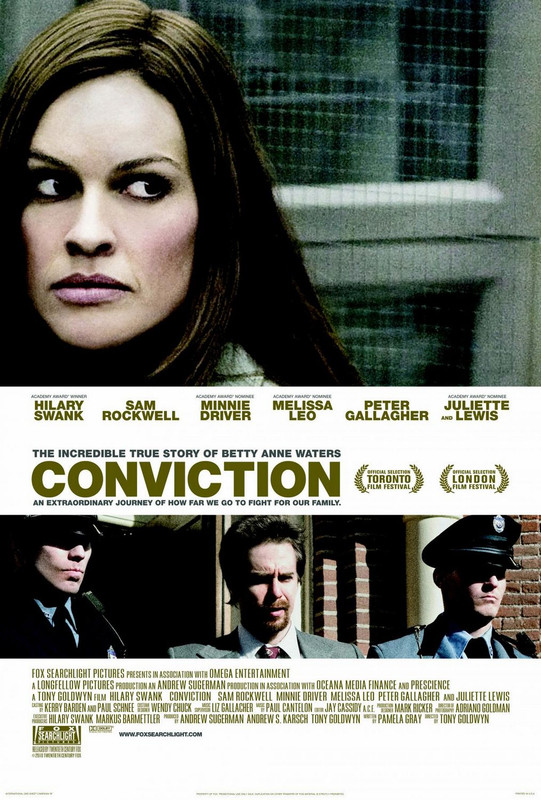
Conviction
Dir: Tony Goldwyn
The story of Betty Ann Waters (played here by Hilary ‘please can I have an Oscar?’ Swank) is amazing. Originally a high school dropout she got a degree and went to law school in her spare time over more than a decade, so that she could attempt to free her brother Kenny (Sam Rockwell) from a life without parole prison sentence for a crime she believed he didn’t commit. It’s an incredible story, and it deserves much more than this overgrown TV movie to tell it.

Conviction (the clanging double meaning of that title really tells you everything you need to know) isn’t ever bad, the problem is that it’s never good either. It’s like a Big Mac; sure it might be satisfying in the moment, but it’s got no nutritional value and it looks, smells and tastes like every other Big Mac you’ve ever had (and it comes with a slice of processed cheese).

The performances are all resolutely average. Hilary Swank acts her hardest as Betty Ann, but she’s never convincing in the slightest, the incredible actor who vanished into Teena Brandon’s skin in Boys Don't Cry appears to be gone and what we have here is a grandstanding 90 minute pitch to the academy, not once did I stop thinking ‘oh look, Hilary Swank sitting the bar exam; oh look, Hilary Swank cooking; oh look, Hilary Swank failing to look like she’s 22’ and variations on that theme. Sam Rockwell is a little better, but again there’s just that sense that you’re watching someone act the whole time, he’s usually such a subtle actor but here, from his accent on down, he’s often cartoonish. It’s nice to see Minnie Driver in a movie again, and she doesn’t seem to have aged at all, which is odd, but appealing as she is she doesn’t have a lot to do, or much of a character beyond ‘supportive friend’.

As a director, Tony Goldwyn doesn’t do anything particularly inventive. He presents the film in a straightforward, evenly lit, personality free way that any Hollywood hack could manage. Unfortunately there are a few areas where he drops the ball quite spectacularly. The biggest of them is the issue of the timeline. The film covers at least 20 years of Betty Ann Waters’ adulthood (it took her 18 to free Kenny) and in that time the sole concession to the passage of time on Hillary Swank’s face is the fact that in the scene in which she’s meant to be in her early 20’s she wears a lot of make up and has big hair. It’s a small issue, but a distracting one because, at a certain point, you begin to wonder where Betty Ann has hidden that picture of Dorian Gray. The age issue and lack of aging make up also results in some other (pretty hilarious) problems, notably Clea DuVall looking about five years older than her screen daughter Ari Graynor and the fact that Betty Ann’s teenage sons don’t age for about six years.

A few of the cameos work well, with Melissa Leo, Karen Young and Juliette Lewis all briefly enlivening this very middle of the road movie, but none of them having enough screen time to make much of an impression on Conviction’s utter, overwhelming averageness. You’ll have seen worse movies, but even in a bad week and certainly at a London Film Festival gala, you can do better.