Showing posts with label Ireland. Show all posts

Oct 14, 2020

24FPS@LFF2020: Wolfwalkers

Dir: Tomm Moore /Ross Stewart

As children, my brother and I were read to every night, and in recent years I've read to friends kids. I've always believed that this fondness for being told stories is where my love of cinema comes from. Few people have ever captured the feeling and texture of those stories and of the books they were read from than director Tomm Moore and his colleagues at Cartoon Saloon.

Wolfwalkers tells what feels like an old Irish folk tale. Set against the English occupation of Ireland in the 1650s, it's about an adventurous young English girl named Robyn (Honor Kneafsey) who longs to go hunting with her father (Sean Bean), who has been charged with clearing the local forest of wolves. On a trip into the forest, Robyn is bitten by Mebh (Eva Whittaker), a young Wolfwalker who is a little girl when she's awake, but a wolf when she sleeps. The bite makes Robyn a Wolfwalker too, and she and Mebh become fast friends and together try to save the wolves and Mebh's mother (Maria Doyle Kennedy) from the Lord Protector (Simon McBurney).

The animation has two distinct styles, delineated between the town and its people and the forest and its residents. The town is all woodcut style; sharp lines and angles both on the buildings and the people. Most of them also move in a distinctly angular fashion, the massed soldiers in particular animated in a slightly jerky but regimented fashion that makes me wonder whether they are animated on twos. The more free-spirited Robyn and her father are similarly styled but move in a more fluid manner that reflects the way they are increasingly caught between the two worlds of the film. In extreme contrast, the forest is all sweeping lines and curves, visibly free brush strokes chosen over ruler-straight lines and circular imagery (Yin and Yang sometimes graphically invoked in the depiction of Robyn and Mebh) rather than sharp angles. Even without dialogue or character, the art choices allow us to immediately understand the opposing forces at play here. The bold style of the animation and the contrasting shapes and movement of the characters make the film a kinetic watch. 

Action sequences later on are marked by the same differences in style choices, with the motion of the wolves feeling as graceful as it does threatening and jagged flames contrasting against the forest. Equally interesting, and somewhat distinct even from the rest of the animation, is how it depicts the way Wolfwalkers see; scent and sound are depicted as sketchy lines of colour, an impression of the real world, or something close to a storyboard in animation, giving a sense of the essential movement without fully rendering it.

All the beauty and meaning embedded in the animation is wedded to a story that is both simple and deep. There are themes here of a father and daughter finding common ground (the sequence in which Robyn begs her father not to kill the wolves is marked by some of the most striking image choices, as the black frame around the film encroaches ever more; shrinking and focusing the image). This theme of a child's love for their parent is also echoed in Mebh's search for her mother, whose human form has been trapped in sleep, leaving her unsure where the wolf part of her is. There are also themes of nature vs encroaching urbanization (the 17th century equivalent of it at least) and of how unlikely friendships can be almost as close as family. Kids likely won't analyse these layers, but without talking down to either them or adult viewers, Moore and Stewart make the ideas plain, without allowing them to overwhelm the essential storytelling.

Wolfwalkers is a beautiful film; visually stunning and meaningful on that level as well as being an enchanting piece of old-fashioned storytelling, a bedtime story that children and their parents can enjoy together and all get something out of.  
★★★★½

Oct 6, 2020

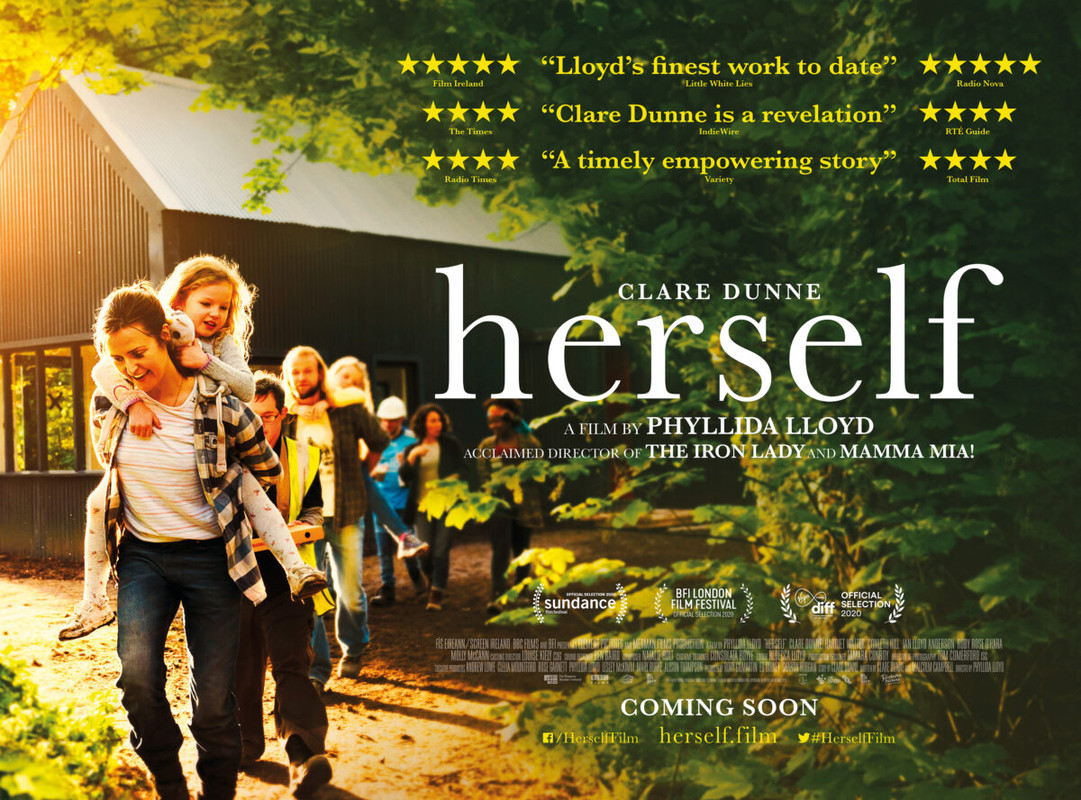
24FPS @ LFF 2020: Herself

Dir: Phyllida Lloyd 

I’d argue that you’d be hard pushed to find a more unlikely subject for a crowd-pleaser than Margaret Thatcher, but since Phyllida Lloyd apparently pulled that trick off with her last film, The Iron Lady, why not one with this subject matter? 

Herself centers on Sandra (the film’s co-writer Clare Dunne) who, in her 30s, finds herself with two young daughters (Molly McCann and Ruby Rose O’Hara), living in a hotel, having left her abusive partner Gary (Ian Lloyd Anderson). Seeking a more permanent fix, she decides that she wants to build a home, getting the space and a loan of the money from one of her employers, Peggy (Harriet Walter). 

For much of its running time, Herself is exactly the film you’d expect it to be given its director’s pedigree (she also directed the first of the Mamma Mia films). Given the storyline it is surprisingly breezy, never quite glossing over the challenges in Sandra’s life, but also generally making sure that easy fixes fall into place as the plot demands. For instance when the council, despite Sandra’s suggestion that they would profit from helping her build the house, won’t even discuss it, an offer of land and a £35,000 loan over “however long we decide” comes within five minutes and two scenes. 

What Dunne and Malcolm Campbell’s screenplay does capture in its lighter than expected tone is Sandra’s effort to always keep a bright outlook for her girls. We’re not seeing the action through their perspective, but wherever they are on screen the characters around them and the film itself seem to make an effort to make the world seem friendlier than Sandra knows it can be. 

As an actor as well as a writer, Clare Dunne impresses, so much so that she makes some of Lloyd’s directorial choices feel clunky. Over and over, when Sandra has a moment of reflection about Gary, Lloyd will cut to a bit of the awful abusive scene we see in the film’s first few minutes. We simply don’t need these cuts, we know exactly where Sandra’s mind is because the story is all there, written all over Sandra’s face. Outside these moments, Dunne gives Sandra a very real and warm relationship with her kids and is convincing as she is both wary of and aware that she might still be somewhat sucked in by Gray, if she were to allow herself to be. 

The acting is good all round, with Harriet Walter increasingly feisty as Peggy and Molly McCann and Ruby Rose O’Hara giving very natural performances as Sandra’s daughters. Compared to these key roles, Gary is rather underwritten, but Ian Lloyd Anderson does what he can with a fairly transparent role. 

As Sandra draws a ragtag band of largely volunteer builders together, things progress more or less as you’d expect. Badly chosen music soundtracks building montages and a couple of accidents, arguments, and one more dramatic, but no less predictable, turn of events raise their heads. It’s all well played and the tone is well-balanced between drama and lighter moments, but I found it all just washing over me. The film’s last ten minutes or so change that, delivering an emotional gut-punch I didn’t expect and finding a final scene that is not only moving but manages to wrap the film’s themes and its message up in a bow without seeming trite or treacly. 

Herself isn’t perfect, but it suggests a successful future for Clare Dunne as both an actor and a writer and it will probably be one of the year’s less likely crowd-pleasers. 
★★★

Sep 20, 2017

24FPS @ LFF 2017: Mini-Reviews 1

So Help Me God
Dir: Jean Libon, Yves Hinant
The true crime documentary is going through a particularly interesting period right now, with series like Making A Murderer and The Keepers and films as straightforward as Amanda Knox or as formally interesting as Casting JonBenet. So Help Me God doesn't break any new ground in the way it's made, but it does show most of us a job within the justice system we're not familiar with, through a highly engaging and interesting woman.

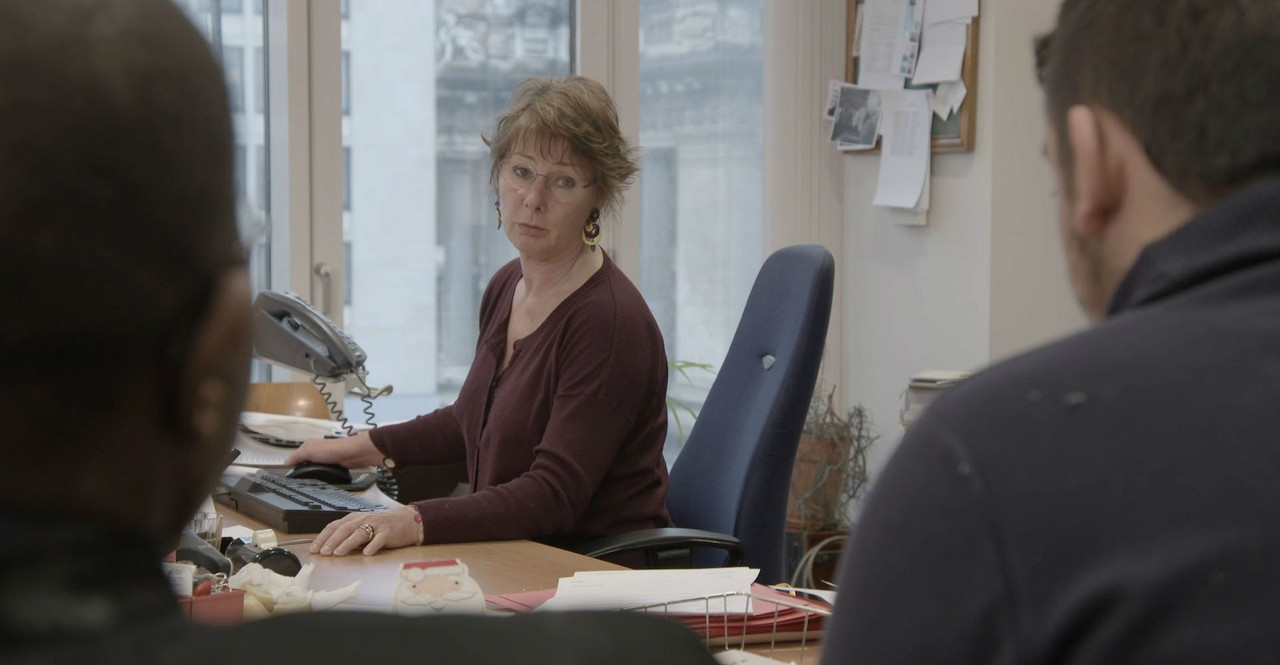
Anne Gurwez is a Belgian investigating magistrate, a job that seems to be somewhere between detective and prosecutor and carries a great deal of influence on how people are dealt with within the Belgian system. The film follows her over the course of several months, as her day to day work on current cases coincides with the reinvestigation of a 20 year old double murder.

Gurwez herself is the best reason to give So Help Me God a look. She seems like she takes a nuanced approach to her work; tough but good humoured, able to be talked round to giving someone a chance if she likes them, but sharp tongued if she detects any hint of bullshit and deadly serious when the situation demands it. This mix often provokes some amusing juxtapositions of the gruesomeness of some of her work and the matter of fact and generally good humoured way she approaches it (see the scene where a body is exhumed in the cold case).

There are many memorable moments here, some are quite light, like the scene in which a dominatrix accused of theft amuses Gurwez by discussing some of the strangest requests her clients have made, but others are much darker and heavier. The film hits hardest in the investigation of a horrifying infanticide, which is immediately followed by a coldly matter of fact confession by the child's mother, who tells a story that suggests insanity in the calmest and most measured tones. It's a truly disturbing scene that nothing else in the film comes close to matching.

Overall, this is a pretty conventional film made engaging by an unconventional personality at its centre and some compelling stories, it's perhaps more suited to the BBC's Storyville than a cinema, but it's well worth a watch if you're interested in true crime.
★★★

Pickups
Dir: Jamie Thraves
Aiden Gillen is one of those actors who can make everything he's in a little bit better. Especially as he's got into middle age, he's become one of those actors who always disappears into a character, and that is the jumping off point for
Pickups, which Gillen co-wrote with director Jamie Thraves.

Gillen plays Aiden, an Irish actor who is well known enough to get recognised regularly, but not George Clooney famous. He's recently divorced and preparing to make a new film, in which he's going deep into preparation to play a serial killer. It seems, however, that he may have got a bit too far into this character.

The premise of Pickups (the title referring both to casual sex and to additional shooting after a film's main production) isn't wildly original; a mid-life crisis coinciding with an actor going too deep into a role, but it should provide ample room for an actor like Gillen to get his teeth into a starring role (he's in practically every frame of the film). Unfortunately, I found the film meandering and lacking much insight. Narration frequently tells us what Aiden is thinking at any given moment, which it doesn't need to do, Gillen is a good enough actor to show us without our needing to be told most of what the voiceover says. Even with this though, everything is on the surface. The disconnect between Aiden's real life – the daughter he hasn't seen for some time back in Ireland – and his work on this character is interesting in concept, but the screenplay doesn't say much that's especially new or insightful about either side of that divide. 

The overarching story never coheres into anything terribly interesting, so what we end up with is more a series of vignettes. Some are interesting enough, interactions with fans often throw up an amusing moment, but even when we're supposed to be unnerved because he's too deep in the character, this doesn't feel like it bleeds over into these interactions. Only one vignette stuck in my mind, a brief moment with Antonia Campbell Hughes as an actress friend of Aiden's, who he suggests should have a part in the film. It's the one moment that chills the blood.

It's interesting to see Gillen play a character whose experiences seem so close to his own, but because of that it disappointing that Pickups doesn't feel more insightful. Ultimately if you want to see a version of an actor blurring the line between life and acting I'd suggest seeking out the underseen I Love A Man In Uniform rather than this.
★★

Mar 4, 2014

Coming of Age Movie Month: Continued: Films 22 - 24

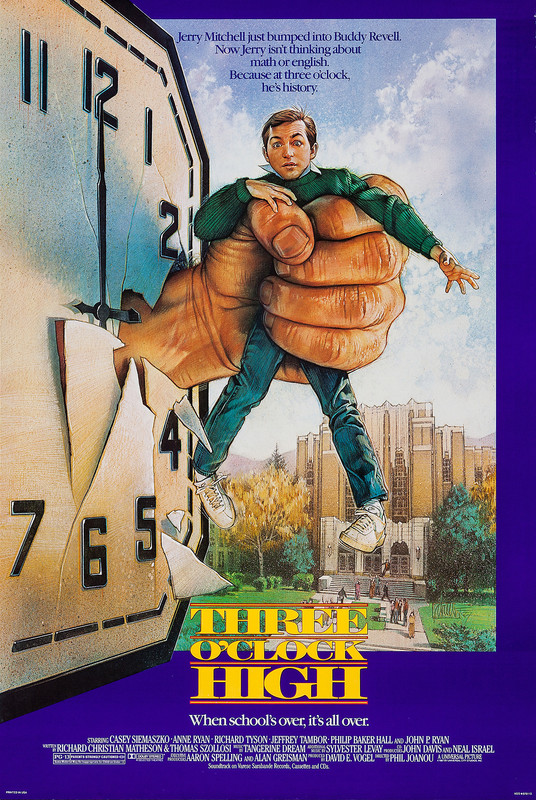
Three O'Clock High
Dir: Phil Joanu
High Noon goes to High School must, surely, have been the pitch for this odd little example of the 80's teen movie.  Casey Siemaszko plays Jerry Mitchell, a nerdy senior who seems never to have been in trouble at school, writes for the school paper and runs the on campus supply shop.  One day Buddy Revelle (Richard Tyson) a new student with a bad reputation arrives and, when Siemaszko accidentally upsets him, challenges him to a fight after school at 3pm.

Three O'Clock High is pretty bog standard nerd comes good stuff.  It hits all the expected beats reasonably well, but does little that is unexpected.  For example, early on we see Jerry driving a pretty female friend (Annie Ryan) to school while clearly crushing on another girl who drives past them.  Guess how the movie ends.  The end result of the central conflict is also never in doubt, which is fine, that's a valid character arc for Jerry to take, but simply resetting it in high school does little to make this old chestnut feel new.

What Three O'Clock High does have going for it is a set of spirited performances.  Siemaszko, who I've not seen much of, is a solid enough lead; nerdy without seeming like he'd be a total outcast and he's a lot of fun as Jerry's attempts to avoid fighting become more outlandish, especially in a scene in which he turns a book report into an exercise in hitting on his teacher (the gorgeous Caitlin O'Heaney) so that he will get detention.  There is a fun performance from Stacy Glick as Jerry's wise beyond her years sister (a role that anticipates Chloe Moretz' part in (500) Days of Summer) and Annie Ryan makes for an appealing love interest.  There is also fun to be had in spotting people in early roles; Jeffrey Tambor appears as a teacher and Philip Baker Hall as a detective.  Unfortunately, there is a problem in the casting with Richard Tyson.  I've only otherwise seen Tyson in Kindergarten Cop and there, as here, he's far too flat a presence to feel truly threatening.  He tries, but you get the feeling that if you messed up his hair he'd run off crying.

The other issue that I had with Three O'Clock High stemmed from the final fight.  Of course we want to see Jerry beat Buddy who, the film establishes, is quite a bully, but Jerry is shown throughout as a thinker rather than a fighter and I would have liked to see him think his way to victory.  Instead, the film's ultimate message seems to be: “Solve your problems: steal a bully's brass knuckles and hit him in the face” which seems... unhelpful at best.  There are a few good things here, but ultimately I think the message is confused and the film is uneven.
★★

Bare Bea
Dir: Petter Naess
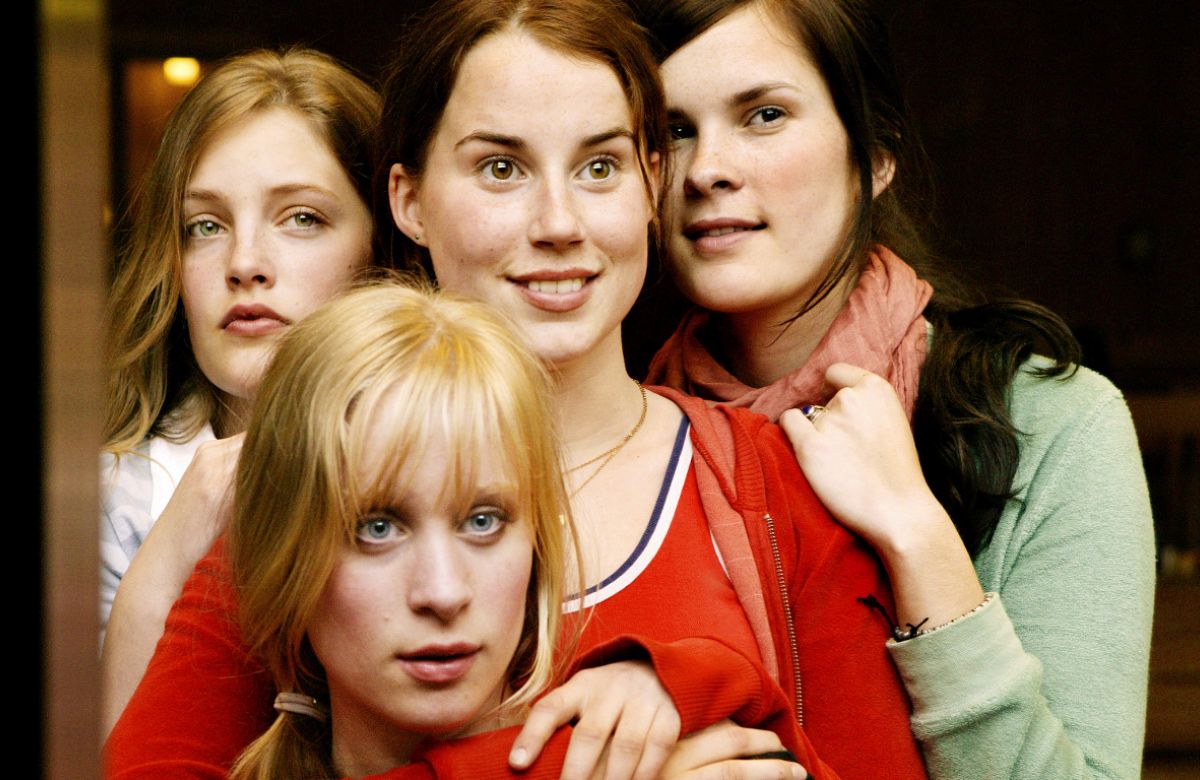
Bea (Kaia Foss) and her friends are all sixteen, but she's the oldest (sixteen and nine months) and the only one of her close group of four to still be a virgin.  When school heartthrob Daniel Vik (Espen Koulman-Hoiner) shows an interest in Bea her more experienced friend Mia (Kamilla Gronli Hartvig) says that before she goes out with Daniel she will need more experience, so she introduces Bea to 19 year old Anders (Kim S Falck-Jorgensen), who is supposed to be there largely for practice purposes, but who falls for Bea, complicating things when she does get together with Daniel.

Scandinavian coming of age movies often deal with some of the harsher truths of adolescence in a way that is more upfront than their American counterparts.  The tradeoff is that this can mean that they can be very dark and depressing.  Bare Bea, for the most part, manages to balance these two issues; it does have a somewhat more realistic take on teenage matters than, say, She's All That, but it also manages to keep the tone quite light (on one occasion to a fault).  It's perhaps best when combining these two facets; slightly exaggerating Bea's anxiousness to be good at sex the first time she sleeps with Daniel, the film has her try to replicate a Kama Sutra position; baffling him and embarrassing her.  This and the chaotic sex scene that follows are heightened, but they capture an essential truth about how awkward and embarrassing a first time can be.

There is a similar balance in how the film portrays the relationship between the four girls.  The group is established well; okay the characters are quite broadly drawn, but the dynamic is well drawn and even if it has third act break up issues similar to those of a lot of romantic comedies, the performances, which feel loose and natural for the most part, pull it through.

Kaia Foss makes for an appealing lead; girl next door pretty and credibly smart (which plays into sub-plot about her wanting to go to Canada for a writing course) you can see why both Anders and the rather more shallow Daniel would be chasing her.  Foss makes Bea sympathetic and when she starts doing a few mean things (running out on Anders to go out with Daniel, for instance) you chalk it up to being naïve rather than pointedly nasty.  Foss makes a creditable debut here, proving adept in both the dramatic and comedic moments, it's a shame she's not gone on to do more in the ten years since.

The support is also largely good.  Kamilla Gronli Hartvig, Ida Thurman-Moe and Maria Brinch all contribute to the convincing group dynamic between the friends, while Kim S Falck-Jorgensen made Anders; the nice guy who seems to have been set up to finish last, a character that I could easily identify with.  Only Espen Koulman-Hoiner really lets the side down, but that might be more the screenplay's fault than his.  At first, Daniel is seen through the rose-tinted glasses that Bea and her friends have on before Bea gets to know him and while he changes once Bea gets closer to him he doesn't really develop much more depth.

For the most part, Bare Bea manages to keep a relative lightness while dealing with some serious issues and quite a bit of disappointment for its main character, but unfortunately it abandons this as the film comes to a close, tying up loose ends in a way that feels unearned, unbelievable and like little more than a cheap way to send the teenage audience that is surely meant to relate to Bea out with a smile on their faces.  It's a pity, because this lapse of consistency aside this is a nicely done, if rather by the numbers, teen movie.
★★★

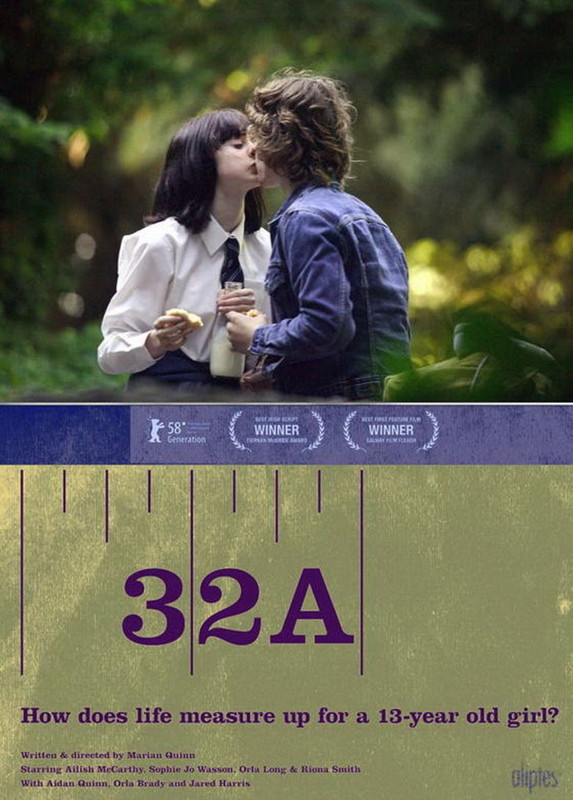
32A
Dir: Marian Quinn
13-year-old Maeve (Ailish McCarthy) and her friends are desperate to grow up.  They're in that place between childhood and starting to deal with adult things, they're changing and that is sometimes testing for friendship, especially when Maeve gets her first boyfriend and it happens to be Brian Power (Shane McDaid), a cool older boy who all the girls admire from afar.  Things come to a head when Maeve blows off her friend Ruth (Sophie Jo Wasson) on the night all the girls are supposed to be supporting her as she's meant to meet her Father (Jared Harris) for the first time in years.

I don't know for sure whether 32A is based on writer/director Marian Quinn's own early teens, but I wouldn't be surprised, even though it's set in Dublin rather than in Illinois where Quinn grew up there is a real feeling here of something personal, perhaps remembered rather than observed.   This sense is particularly strong in the relationship between Maeve and her central group of four friends.  The dynamic between them is extremely well observed, both in their closeness as they go through typical teenage moments like comparing their development, practicing kissing and discussing their futures (a conversation about marriage and kids has a real ring of truth thanks to how OLD they consider 30), and the way that their friendship fractures at times.

I liked that both Marian Quinn and Ailish McCarthy were willing to take Maeve to a place where she is outright unlikeable.  You can see why, in her excitement about being the one who has been chosen by this popular older boy, she acts as she does towards her friends, but that doesn't make what she does to Ruth - even hiding so that she doesn't have to go with her the night she's supposed to meet her Father - any more palatable as a choice.  McCarthy is an engaging presence throughout, and even when Maeve is at her least likeable you root for her, except perhaps when she slaps her adorable little sister in the street.

The drama itself is a little bit by the numbers.  It's obvious that Brian Power won't turn out to live up to the image the girls had of him, obvious how friendships will be broken and mended, obvious how Ruth's storyline with her Dad will end up.  Predictable it may be, but it's tough to mind that much, thanks to a cast who give engaging and realistic performances, a script that, even when it hits cliché, does it honestly and a strong sense of time and place in Marian Quinn's direction.
★★★

Sep 27, 2012

24FPS @ LFF 2012: Diary - Day 3

Tall as the Baobab Tree
Dir: Jeremy Teicher
Cinema is, it strikes me, the truly global artform, and I do enjoy marking off a new country on the map of places I have seen films from (I'm a nerd, in case we hadn't established that). Tall as the Baobab Tree is my first Senegalese film, and it's one that really plunges the audience into a local culture that many of us will see as not just alien but perhaps even objectionable, the more so for the opening caption informing us that it is 'Based on True Stories'.

On the day that she is collecting her exam results, Coumba's older brother falls from a Baobab tree and breaks his leg, which means not only can he no longer work in the fields, but his parents are facing a medical bill they can't pay.  The remedy they find is to marry off Coumba's roughly 12 year old sister Debo and use the dowry to pay the bill.  Coumba can't accept this, and begins working secretly at a hotel in town, aiming to collect enough money to save her sister.

The film's tone is very subdued, and there isn't a great deal of major dramatic incident, but director Jeremy Teicher largely gets away with this because the story has an in built high stakes drama and interest.  What makes the film especially interesting is the fact that it doesn't make the morals totally black and white.  The sympathy of both (this) audience and the film clearly lies with the sisters, but it doesn't treat the father as a total villain, rather it seems to view him as a man who has been raised with a certain faith, a certain doctrine and a certain way of doing things, who can't really see past tradition in trying to solve his family's problems, and it takes pains to show him as conflicted.  It's a welcome moral complexity in a film that could easily have been far too black and white.

While all this does keep the film watchable, I also found that it kept me emotionally at arms length thanks to the performances.  It's difficult at the best of times to judge performances in a language you don't speak, so it may simply be an issue of unfamiliarity with the structure and sound of Pulaar, but there is a flat feeling to the dialogue, which makes even the high stakes drama feel a bit lifeless at times.  Whether this is my unfamiliarity with the language talking or the performances really are a bit flat and rote, it adds up to the same slightly unsatisfying result.

The thrust of the story is interesting and provocative enough, and the imagery beautiful enough, that Tall as the Baobab Tree overcomes many of its issues, but I still left feeling that it wasn't quite the film that it might have been.
★★★☆☆

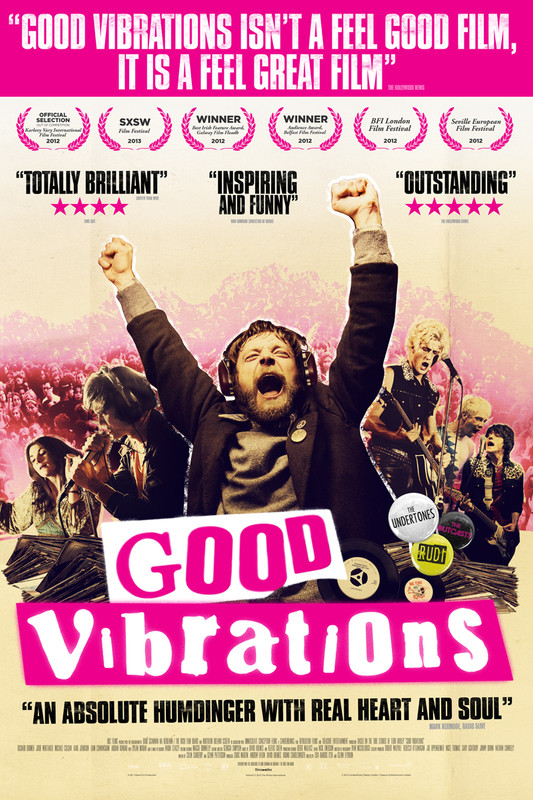
Good Vibrations
Dir: Lisa Barros D' Sa / Glenn Leyburn
I don't read much about festival films before going to see them, and had somehow got my wires crossed and ended up thinking that this film about Terri Hooley, whose Belfast record shop and indie label Good Vibrations seems to have been a very important presence in the Belfast punk scene of the late 70's and early 80's, was a documentary.  It isn't, I really wish it were, because that's a film I'd actually be interested in seeing in place of the perfunctory and forgettable by the numbers biopic we've been given here.

One problem is the simple fact that Hooley (played by Richard Dormer) just isn't especially likeable.  At the very least we should be getting some sense of his passion for music managing to charm people into working with him, but we really don't, and consequently, particularly given what an organisational fuck up he is, it's tough to see how he pulled everything together and managed to convince people (especially his wife Ruth, played by an almost insultingly underused Jodie Whittaker) to stick with him.

The other major issue is one of tone, in that the film doesn't really know which sort of tone it wants to pursue.  Is it a serious film about the way Hooley tried to use music to distract from the Troubles?  Is it a knockabout comedy about a misfit trying to run a record label?  Yes.  Is it a sad story about a guy who puts music above everything, including his wife and baby?  Yes.  It's all of these things and others besides, and the pieces seldom mesh, so the overwhelming feeling is one of the screenplay rolling a die before each scene and letting the numbers decide which tone they'll go for over the next five minutes.

Good Vibrations isn't terrible, Dormer and Whittaker are both fine in their roles, and some of the music is electrifying, but I could never shake the sense that the real story, the real guy, would be more interesting, nor the feeling that this film had been made with some sort of cinematic paint by numbers kit.
★★☆☆☆

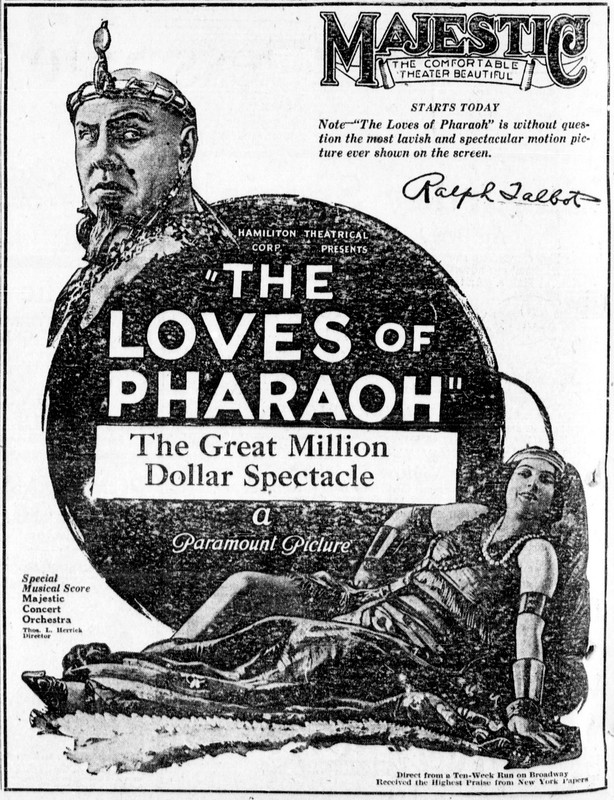
The Loves of Pharaoh
Dir: Ernst Lubitsch
I haven't seen much of the work of Ernst Lubitsch, but even after just a couple of films - The Shop Around the Corner and Ninotchka - I can tell you that this previously lost melodrama from 1922 is neither typical, nor the place to start.

The Loves of Pharaoh has many of the familiar strengths and weaknesses of early and silent cinema.  On the plus side it is remarkable how easily, even in this still incomplete version, the story of a Pharaoh (the great German silent star Emil Jannings) who causes a war in his kingdom when he falls for a slave girl who has recently escaped servitude under the Ethiopian king (played by another star, Paul Wegener, in blackface), is communicated.  It's also a beautiful film, with some remarkably dynamic battle scenes featuring massed ranks of extras, well chosen tints that help communicate both time and mood and many gorgeously lit and framed shots that make the 600 metres still missing feel like a real loss.

On the downside, this is a melodrama, and that's very apparent in the acting, which, sadly, is still stuck in the broad, pantomimic style employed in a lot of early cinema.  Perhaps in 1922 these were great performances, and Jannings does have some subtler moments in which he is great, but for the most part the over-demonstrative work on display from the likes of Dagny Servaes (as the slave girl) and Harry Liedtke (as the other man who is in love with her), just doesn't work, and when Jannings pushes the boat out, especially in the second half of the film, he's comically overblown.

The Loves of Pharaoh is rather good fun; the story and acting are overblown, but if you're interested in film history the beauty of the images and the fluent storytelling do carry it, but it's no lost classic, and really feels more like a curio than an essential addition to most people's experience of silent cinema.
★★★☆☆

Oct 3, 2010

LFF 2010: Mini Reviews 1

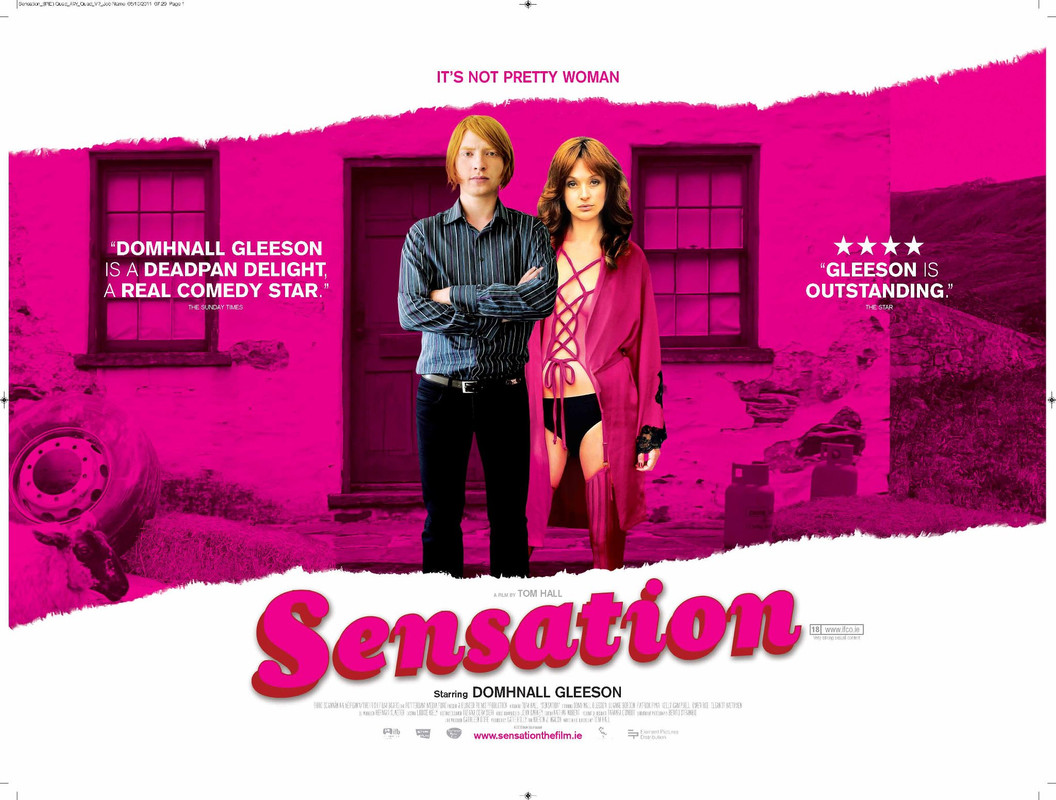
Sensation
Dir: Tom Hall
A low budget, small scale, rather black sex comedy from Ireland. Sensation isn’t bad, or even unoriginal, but though I didn’t dislike the film I never truly engaged with it, largely because I didn’t especially care about any of the characters.

At the film’s centre is Donal (Domhnall Gleeson); a lonely man in his mid to late twenties living alone on a sheep farm in the Irish countryside after the death of his father. From that death Donal inherits both money and the land. Things get interesting when he uses some of the money to hire an escort. Kim (Luanne Gordon) and Donal soon move beyond an escort/client relationship when she hears of his inheritance and they set up a new escort agency together.

You have to give writer/director Tom Hall credit, because Sensation doesn’t deal in the expected.  There are obvious beats to this story; Donal as the pure sap, being taken by this alluring woman, Kim changing Donal’s look, but his remaining the bumbling farm boy and so on. Happily, Hall doesn’t indulge in these predictable moments. The writing of Donal’s character is especially sharp, as Hall moves him credibly from near mute (or on occasion over talkative; his first attempt to pick up local beauty Melanie (Kelly Campbell) is skin crawlingly uncomfortable and very funny) farm boy to snappily styled, smoother talking, small time pimp. The relationship between Donal and Kim is nicely drawn too, and Hall never quite shows his hand in regards to how genuine it is, whether there is feeling there or Donal is just being – pardon the pun – taken for a ride.

The leading performances are strong, with Domhnall Gleeson (son of Brendan) making an especially strong impression as Donal. He makes the character’s transformation credible, while always retaining the impression that, underneath, he’s the same insecure farm boy he always was. Luanne Gordon does a nice job of keeping Kim’s motivations just a little mysterious, and she’s good when Kim is in character as escort “Courtney”.

The problem is that, for me, all these good parts didn’t add up to a great deal. The bottom line was that I didn’t really care how genuine Kim and Donal’s relationship was, because I never really liked or sympathised with either of them, and since that is the central thread of the film it left the whole feeling a little flat for me. That said, there’s enough here that is good to suggest that the cast and director will do better work in the future.
★★☆☆☆½

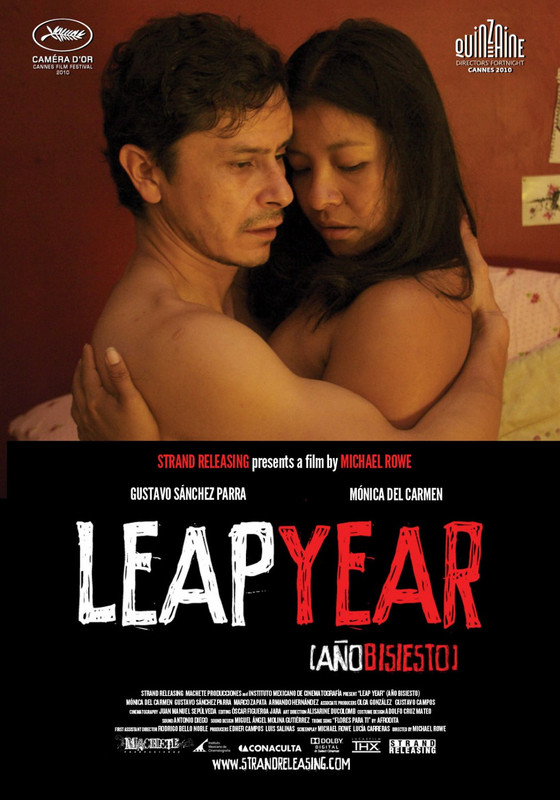
Leap Year
Dir: Michael Rowe
Leap Year focuses on a month (a 29 day February) in the life of Laura (Monica Del Carmen), a journalist living in Mexico. The film takes place almost entirely in her small apartment, where during this month, she conducts an S and M fuelled affair with older man Arturo (Gustavo Sanchez Parra). It begins with a few slaps, and over the course of the relationship escalates to real violence and humiliation. Laura crosses off the days on her calendar, leading up to the 29th, which is coloured in red.

I first heard of Australian director Michael Rowe’s film when it played at Cannes, and won the prestigious Camera D’or prize, and since seeing it at the press screening I’ve heard many other critics speak of it in slightly awed tones. I don’t get it. Leap Year is explicit and disturbing, but to what purpose? I never felt that I knew anything much about either of its characters (there is an implied sexual trauma in Laura’s past, but it is referred to only once, tangentially, and may be made up anyway, since other scenes paint her as a liar) nor that their many totally unerotic sex scenes told me anything meaningful about them, except to set up the film’s rather obvious ending.

The technical elements of the film are largely strong. Rowe finds a great variety of shots in Laura’s apartment, and his repeated technique of shooting each sex scene in a single static take is interesting, as it establishes a visual identity for the film and forces you to dwell in each increasingly nasty scene.

The performances, given the limitations placed on them by the script, which refuses to put much meat on the bones of these characters (especially Arturo), are excellent. Del Carmen gives a brave and exposing performance which hints at deep-seated reasons for her need for this relationship, while Gustavo Sanchez Parra does what he can with a character so thin he’s barely there, drawing a strong distinction between Arturo’s violent and tender sides. There is one especially strong scene towards the end of the film, in which Laura asks Arturo to take their relationship to an even more extreme level. Del Carmen is outstanding in this scene, really bringing across the depth of Laura’s sadness.

Despite the surprisingly strong acting, I found Leap Year boring. After fifteen minutes or so it settles into a rhythm; dry conversation / S and M / dry conversation / S and M. Even as the sex scenes become more extreme their frequency renders them dull, which is a real problem when the film is trying to be shocking. I was also bored because I barely knew who these people were, they are so sketchily defined that there’s little to invest in and even as Laura’s motivation became clear, dramatic as it was, I just didn’t much care, because the film never made her real and rounded enough.
★★☆☆☆

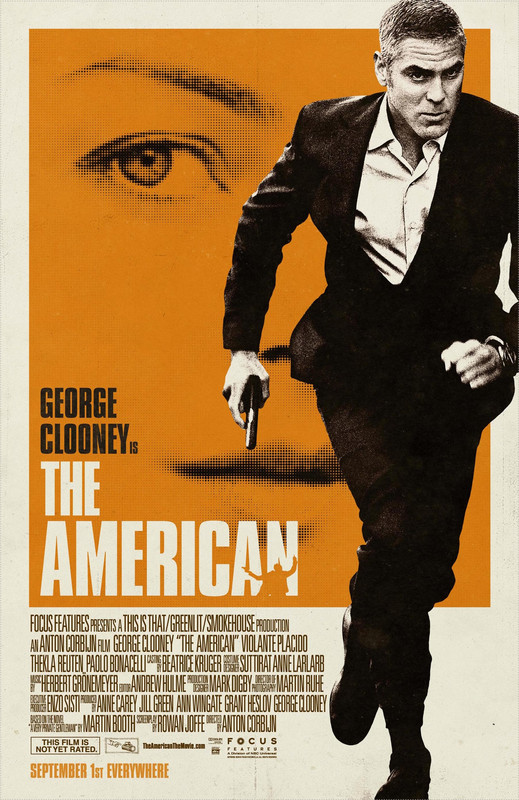
The American
Dir: Anton Corbijn
The American is directed by photographer and music video director Anton Corbijn (making his second film following the slightly overpraised Control), so of course it looks stunning. Everything is beautiful; the Italian countryside, the light, the framing, the women and yet this film is almost painful to sit through, a punishingly boring, predictable, event and investment free 90 minutes of very pretty tedium.

Based on a novel by Martin Booth, the film tells the story of a professional killer (George Clooney), who gives his name as Jack to some people, Edward to others. There is an attempt on his life in Switzerland, but he escapes and agrees to do one last job for his handler; making a special gun for a female assassin (Thekla Reuten). While hiding out in a small rural village in Italy ‘Edward’ falls for a prostitute (Violante Placido), but can he trust her… or anyone

I try not to give spoilers, but I’d be surprised if, from that brief summary, you don’t know who the surprise villain of the piece is. If not, don’t worry, you will, about 75 minutes before ‘Edward’. That’s the problem here, every little beat of this film is predictable, every plot point, every character interaction, every twist is so hackneyed that nothing is a surprise. Long before it played out I had predicted, in some detail, the final set piece.

Characterisation is thin to the point of non-existence. Placido, who isn’t bad, is simply asked to play one more variation on the practically antique character of the hooker with a heart of gold, Paolo Bonacelli’s priest speaks almost entirely in significance laden clichés and Thekla Reuten is a complete cipher. Sadly this is also true of Clooney. ‘Jack’ or ‘Edward’ or ‘Mr Butterfly’ has more names than character traits and, unable to find anything to play, Clooney coasts on his charisma. The effect is not to wrap us up in the story of an assassin doing his last job, but rather to give the impression of looking at George and Anton’s holiday video, because there is never any sense that you’re watching anyone but George Clooney.

Investment in a film’s characters is hugely important, if you don’t have that everything else falls away. Had it been there I might have had some interest in Clooney’s fate, and some level of interest in what happened between Jack and the hooker. As it is the film tries to give this relationship weight, but fails miserably because neither the characters nor the story are interesting. For all its interesting qualities The American may just as well be a film for the Italian tourist board.
★★☆☆☆

Jul 23, 2009

Film Reviews: The Proposal / Kisses

THE PROPOSAL
DIR: Anne Fletcher
CAST: Sandra Bullock, Ryan Reynolds, Mary Steenburgen,
Betty White, Malin Akerman, Craig T Nelson


High-flying executive Margaret (Bullock) hasn’t completed her immigration procedures, and she’s being threatened with deportation from the US back to Canada. Not wanting to lose her job, Margaret blackmails her assistant Andrew (Reynolds) into marrying her. That same weekend the ‘happy couple’ jet off to Alaska, to attend the 90th birthday party of Andrew’s Grandmother (White) and to tell his parents (Steenburgen and Nelson) of their engagement.

I understand that genre films are popular because they are ‘safe’. Audiences go in largely knowing what they are going to get, it’s delivered, and they come out satisfied. Really though, The Proposal is so formulaic that, after looking at that brief summary above, I reckon that any one of you reading this review could tell me almost beat for beat what happens (and if you got it wrong I’m guessing that you’d end up writing a better, more original film). It’s amiable enough, completely inoffensive, and if all you’re looking for is a cookie cutter rom-com that you can turn your brain off to, well you could do worse. It’s just so utterly familiar though, and worse than that it’s a real waste of some very talented people.

This isn’t to say that The Proposal is all bad. It is saved from total worthlessness largely by the presence of its male lead. Ryan Reynolds seems to specialise in taking roles in the worst movies he can find, and then making them watchable through his sheer screen presence. Remember Blade: Trinity, in which his endless wisecracking (including calling Parker Posey a “cock juggling thunderc**t”) was the only thing that stopped me from walking out? Similarly he brought enough presence to the table in ten minutes of X-Men Origins: Wolverine to make a Deadpool movie appear a good idea. To be fair he had an assist from the equally great Anna Faris in Just Friends, but between them they made even that piece of crap watchable. For The Proposal Reynolds turns the leading man charm up to 11, and again showcases his excellent comic timing, making every line, however hackneyed (and they are VERY hackneyed) play, and demonstrating an aptitude for physical comedy. In perhaps the film’s best scene Reynolds is struck dumb when, without having consulted him, Bullock announces to their bosses that they are getting married. He’s not subtle, but he’s very, very funny in this scene, and it's his performance that is responsible for most of the moments that work in the movie.

Bullock can’t really match Reynolds. At a basic level she feels miscast as this supposed hard-nosed business bitch. In the early scenes she just isn’t nasty enough – she seems pragmatic to the point of ignoring anyone else’s feelings, but she’s not the evil dragon that the film wants us to see her as, because it doesn’t want its heroine to be too unsympathetic. Even this level of bitchiness is an odd fit for Bullock, she pulled out a fine dramatic performance in Paul Haggis’ much overrated Crash, in which she was a genuinely awful person, but she just can’t square this character with her bubbly rom-com persona. There’s also the issue of Bullock’s age, she’s 44, just 11 years Reynolds’ senior, and she looks somewhat younger (though the combination of Botox and a very tight ponytail make her look a bit stretched here) and they don’t really seem enough of an odd couple.

Not every film needs to be realistic, but every film does need to feel true within the boundaries of its own world, whether that means documentary style reality or surreal flights of fancy. That’s the major problem with The Proposal; it never rings true. The chemistry between Bullock and Reynolds ought to grow organically, but instead their eventual feelings seem to arise out of nowhere and nothing, making the film’s last reel all but inexplicable. This is also true of much else in the film – the fractious father/son relationship and its resolution both play like lessons out of a screenwriting 101 book, and Betty White’s native American style chanting has clearly been put in purely so Bullock can embarrass herself in the film’s most groaningly unfunny sequence.


There is much talent associated with The Proposal, and most of it is wasted. Most notable is the case of Mary Steenburgen, marooned in a total nothing of a role as Reynolds’ mother. I love Mary Steenburgen; she’s one of those wonderful character actors who you just look forward to seeing because they are always worth watching, even in the worst of movies. She does what she can here, and is an effortlessly warm presence in the movie, but it’s just a shame to see someone so gifted being asked to do so little. I think there’s a much better film to be made with this cast and this premise. Keep Ryan Reynolds where he is, cast Bullock as his older sister, and make Mary Steenburgen the boss, and there, instantly, is an idea more open for comic conflict.

Director Anne Fletcher (Step Up, 27 Dresses) shows little flair behind the lens. One key comic set piece, in which a naked Reynolds and Bullock crash into one another, is fumbled by a mixture of poorly chosen angles and Bullock’s airtight nudity clause, and the rest of the movie looks like a generic sitcom. It’s set in Alaska, but really we could be in Anytown USA, even the opening New York scenes lack a real sense of place. There’s nothing really inept about Fletcher’s direction, but it’s stiff and really rather boring in its phoned in competence.

As a romantic comedy The Proposal fails because it’s totally unromantic and it isn’t all that funny. It’s populated with cardboard characters saying lines and enacting situations we’ve seen spoken and played a hundred times before, and frequently better. Yes Ryan Reynolds saves it from total irrelevance, but ‘not completely worthless’ is hardly a ringing endorsement.


KISSES
DIR: Lance Daly
CAST: Kelly O’Neill, Shane Curry


After hearing her friend Dylan (Curry) have a violent argument with his Father, Kylie (O’Neill) helps Dylan escape his house, and the two ten year olds run away together. Over the course of 24 hours they search Dublin for Dylan’s older brother and try to survive on their own.

Too many films don’t know when to end. Witness the two and a half mind pulverising hours of Transformers. So, at a time when even movies with absolutely no content are becoming endless, it is a joy to find a film like Kisses. Only Director Lance Daly’s second feature, Kisses is a small (72 minutes), but perfectly formed tale of two kids lost in a world too grown up for them to cope with. Unlike most films about childhood Kisses lacks any sentimentality. There is a street level grittiness about this film, a grimy feel that’s never false or forced. This doesn’t make Kisses an easy film to watch, but it does make it a good deal more true, and thus a good deal more affecting, than almost any film you’ll see this year.

I recently heard George Lucas say that most children can’t act, because acting is experience, and children lack experience. Some children, to be fair, can’t act because George Lucas is directing them. But he makes a good point, and perhaps the reason that Lance Daly gets such remarkable performances from his young non-professional leads is that he doesn’t seem to ask them to go far beyond their real experiences, and even when he does, everything here is so solidly grounded in reality that it can’t have been hard for Kelly O’Neill and Shane Curry to put themselves in their characters places.

Those places are seriously dark. Both Kylie and Dylan come from abusive homes, and it’s easy to see why the streets appeal to both of them, despite the dangers out there. Daly is so dedicated to this darkness that you never quite know where the film is going to go next, and at one point it took a turn so unspeakably dark and frightening that I was simply stunned that the film had the guts to go there. I won’t divulge that twist, other than to say that is both a shocking and a thrilling sequence, and one of the moments that will stay with me from the movies of 2009.

Another thing that will stay with me is the acting in this film. Curry and O’Neill both give performances that belie their tender years, and that impress with their unaffected naturalism. There’s a totally unforced chemistry between the kids, a palpable sense of a growing friendship, but what neither Daly’s script nor the actors ever forgets is that these are 10 year old kids, the way they both tease one another feels like it might be improvised. They are, in short, allowed to behave exactly as children behave. They swear, they fight and they tease one another as well as having their moments of closeness, protecting each other and, of course, kissing.

The only artificial moments in the film come not from the kids but from the adults. Paul Roe drops the ball, giving a rather wooden performance as Dylan’s Da, and the rest of the adults in the cast aren’t a great deal better. However, the focus is almost always on Dylan and Kylie, and when that’s the case it is an almost unqualified success.

Daly’s direction is as low key as his screenplay. Shooting handheld, on grainy stock, gives the images a documentary immediacy that makes you feel very close to Dylan and Kylie. The only real directorial trick is in the use of colour, which becomes more saturated the happier Dylan and Kylie are in one another’s company and fades to stark black and white when they are at home. It’s a nice reflection of the film’s mood, and only feels gimmicky once, in the film’s sole soppy moment, just before the credits roll.

Kisses put me in mind of Richard Linklater’s Before Sunrise (if that film were unremittingly dark, and starred sweary 10 year olds); a boy and a girl getting to know one another over a night in a city that is strange to both of them. This is a harsh and difficult film, and it is a bit rough around the edges, but for all its darkness Kisses also charms and, for the most part, is a real gem