Showing posts with label Norway. Show all posts

Jul 9, 2019

The Quake [12]

Dir: John Andreas Andersen
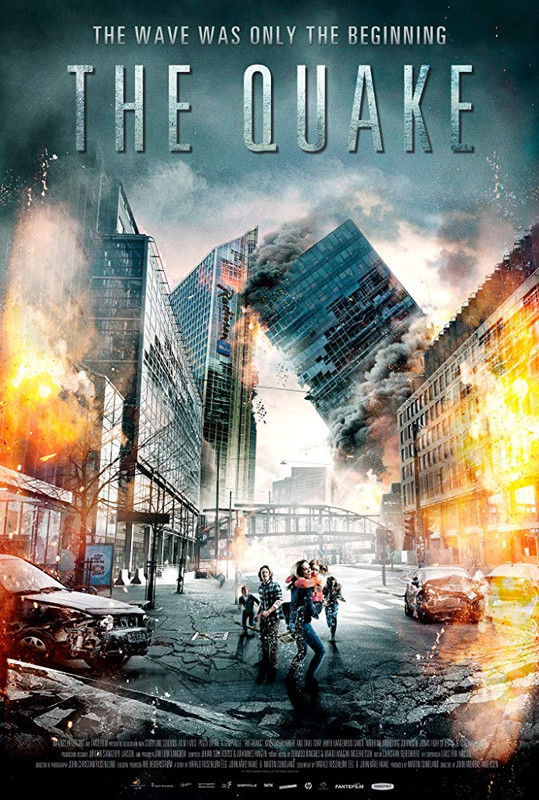
Three years after the events of The Wave, Kristian Eikjord (Kristoffer Joner) is still affected by the disaster. Separated from his wife Idun (Ane Dahl Torp) and distant from his kids, he feels guilty about his warnings not being heeded sooner and thus saving more people, and he’s haunted by fears of fresh disasters. These fears become more present when an old friend dies while examining a tunnel in Oslo and Kristian finds an old letter from him, warning of the potential of a massive earthquake. When the quake comes, will Kristian be able to protect his family?

The Wave did pretty big things for the career of director Roar Uthaug, who followed it up by making his Hollywood debut with the Alicia Vikander starring Tomb Raider reboot. Perhaps disappointingly, it didn’t seem to do the same for the film’s star Kristoffer Joner (a small role, confined to a hospital bed, in Mission: Impossible - Fallout aside). On the other hand, maybe that’s not such a bad thing, because it’s unlikely that a film like The Quake, if made in Hollywood, would have offered him much opportunity to stretch his acting muscles. At 103 minutes, this is a relatively short film, but for over an hour the titular event lurks in the background. For this time, the film does the requisite build up, but what it concentrates on isn’t the charts and graphs but the already shaken man at the centre of the film. 

Kristoffer Joner is a great actor, and he brings his customary dedication and detail to this part, just as he did in the first film. This performance is about trauma; a man haunted by his previous efforts, even though they were genuinely heroic. It’s left him looking bedraggled, almost hollow at times, and even the slightest engagement has become a struggle (in one particularly well acted moment there’s a tiny register of appreciation for the breakfast his daughter Julia (Edith Haagenrud-Sande) has made him, just in his eyes, a second before he says that she should go home). This background is important because it makes the growing threat of the earthquake feel different. By spending real time and effort on the emotional fallout of the previous events, there is always a very credible feeling that Kristian may genuinely just be paranoid. Of course, we know that’s very unlikely to be true, but it’s a testament to Joner that a film that used the title The Quake in a purely psychological sense would be at least as compelling as this one proves.

There are sacrifices made in order to spend this kind of time on Kristian’s character, and sadly they impact mainly on the other characters. There is an emotional short hand with the established characters of Idun, Julia and Kristian and Idun’s son Sondre (Jonas Hoff Oftebro, sidelined here to the point that you’d be forgiven for thinking the first draft forgot he ever existed) but Kathrine Thorborg Johansen’s Marit, the bereaved daughter of Kristian’s friend who first warned him of the quake, is fatally underdeveloped; little more than a plot device with a face. This is where the film’s running time bites. We understand Marit’s actions in the third act as standard disaster response, the way we’d all hope to behave in those circumstances. Kathrine Thorborg Johansen does what she can with what’s on the page, giving a decent performance, but some more scenes between her and Kristian, just to bond the characters a bit, would give us more investment in her in the last half hour. Ane Dahl Torp is also a little limited by what’s on the page, but there’s enough in her performance and the dynamic between her and Joner that we can read what’s happened between Kristian and Idun over the past couple of years without having it baldly laid out in dialogue, and we are very much invested in her fate and that of Julia, thanks to another solid performance from Edith Haagenrud-Sande.

The carnage does, of course, finally arrive and when it does it’s extremely well executed, with effects that rival any $200 million film for roughly $6 million. The scale is smaller of course, but the CG is strong and because it’s linked to physical effects, more credible than in many higher budget films. The major setpiece, in a collapsing tower block, is tense, well paced, and not easy viewing if you have vertigo. Director John Andreas Andersen steals a few things (notably a sequence from The Lost World: Jurassic Park), but he adds his own wrinkles to everything he co-opts. The only issue in this passage is that, once again, the film largely forgets about Sondre, which makes things feel a bit unbalanced.

If you’re going in wanting something like a San Andreas (which, for the record, would be no bad thing, that’s a fun movie), The Quake is going to disappoint. I appreciated the slow and thoughtful start and the way it allows a great actor like Joner room to dig into his character. It has its problems, even at its best it is riddled with cliche, short changes some of its characters and has an ending so abrupt that it’s barely an ending at all, rather than a hard stop. For all those issues though, this is a smarter and more entertaining film than most Hollywood efforts in the genre.
★★★½

Apr 8, 2015

Blind [18]

Dir: Eskil Vogt
Acclaimed Norwegian screenwriter Eskil Vogt makes a strong, darkly playful, directorial début with this drama about Ingrid (Ellen Dorrit Petersen), a 30 something woman coming to terms with the recent loss of her eyesight.

The driving force of Blind lies in Ingrid's attempts to understand the world again and gain the confidence to go back out into it, now that she can't see it.  This is straightforward enough, but it's the way that Vogt elects to tell the story - blending Ingrid's reality ever more freely with a story she is writing - that sets Blind apart.

Initially it seems that two of the film's key characters; sad sack Einar (Marius Kolbenstvedt) and single mother Elin (Vera Vitali) may exist entirely in Ingrid's head.  Ingrid definitely has a degree of control over them.  In an early scene, on a whim, she switches the 10 year old son she had given Elin for a daughter.  However, as the film goes on, and especially as Elin's husband Morten (Henrik Rafelson) is folded into both Einar's and Elin's stories, the lines dividing 'reality' and fantasy blur.

All of this bleeding between 'fact' and fiction, 'real' and surreal, is grounded by the performances.  Vera Vitali, saddled with a character who becomes a sponge for all of Ingrid's negativity, punishment piled on her, does a good job of retaining a sense of a real person who doesn't understand the misfortune that is being visited on her.  In these moments there are more than a few echoes of Stranger Than Fiction, though with decidedly less whimsy.  As Einar, Marius Kolbenstvedt makes his depressive, porn addicted loner similarly recognisable, and while he is pathetic in many ways, Einar also engenders our sympathy, especially when he sits and chats with his old friend Morten.

Henrik Rafelson is more solidly grounded in the film's real world.  The way he articulates both Morten's understandable frustration with his wife's seeming inability to return to any semblance of normal life and his love and concern for her, often in a single moment, is moving.

However, good though they are, all three of these performances are left in the shade by Ellen Dorrit Petersen's work as Ingrid.  Physically fragile looking, her skin almost translucent, it's not hard to believe that Ingrid has been locked in her flat for months.  Her physicality in the performance is brilliant, from the fact that you never see her have her eye drawn by something down to the fact that, even without dialogue, you can see how that hurts her.  This is most notable in a scene in which she tries to seduce her husband, who doesn't seem interested.  It's clear that, at the very least, Ingrid believes this is partly because when she manages to look at Morten now there is no connection, because she is not seeing him.  In an eloquently silent moment we feel just how much this hurts them both.  This is the first I've seen of Ellen Dorrit Petersen.  It will not be the last.

Eskil Vogt gives Blind a stark look throughout, but he does draw a visual distinction between the apartment (perhaps to be seen as Ingrid's interior world) and the world outside those walls.  The apartment and most of its contents are white.  This makes sense because Ingrid says they moved in after she lost her sight.  The implication is that it is so bare (especially what we see of it when she is alone) because she can't visualise what colour it might be or much beyond the contours of the place.  Outside the apartment there is still a harshness to the images, but it seems Ingrid can recall enough to colour this imagined world in at least a bit.  That said, we don't see this outside world romanticised, at least not until the very end of the film, which is literally and figuratively a little sunnier for Ingrid.  The two sides of the film's world do feel visually distinct, but they share enough DNA that they convince as both being a part of the way Ingrid now 'sees' her world.

At times Blind works too hard to be bleak.  Indeed towards the end of the film Vogt has Morten call Ingrid (and by implication Vogt himself) out on this very matter.  It also occasionally strains too hard to shock, notably with an overlong and needlessly explicit montage establishing Einar's porn habit.  For the most part though, Vogt tells what could be quite a familiarly downbeat story in a way that both intrigues and adds to our understanding of the main character.

All this said, even if Blind's other qualities were lesser or more arguable, it would still be near essential viewing just for Ellen Dorrit Petersen's performance.

Apr 7, 2014

This Week I've Been Watching... March 31st - April 6th 2014

Jerichow
Dir: Christian Petzold
I find director Christian Petzold to be one of the most hit and miss filmmakers around.  His work can be alienating; cold and airless in both emotional and visual register, but I keep returning to his films for one reason; his muse, Nina Hoss.

This film, from 2008, is one of Petzold's best and a riff on one of his favourite stories; The Postman Always Rings Twice (which I know only from one distant viewing of the Nicholson film).  Benno Fürmann plays Thomas an unemployed man in debt who lucks into a job driving for local businessman Ali (Hilmi Sözer) and ends up falling into an affair with Laura (Hoss), the young wife of his new boss.  Petzold takes the themes and some of style of noir.  For instance, a shot of Thomas emerging from the darkness to caress Laura, then disappearing when Ali might see him is noir through and through.  However, much of the film is less traditionally noirish; those themes sit under the drama, bubbling away as Ali and Thomas become friends.  This is a good touch, maintaining tension but also giving the film a feel that is different to much neo-noir.

Petzold's camerawork is typically austere, allowing the natural tension of the situation and the down to earth performances to do most of the work.  Fürmann and Hoss have worked together several times and they bounce off each other well here; there is an intensity to their sudden chemistry that convinces and the gaze between them, right from the first time they see each other, is riveting.  Overall Jerichow is a strong and suspenseful low key thriller, recommended for its excellent trio of central performances.
★★★★

Next Door
Dir: Pål Sletaune
A couple of years ago I saw and enjoyed director 
Pål Sletaune's Babycall.  It had a tiny UK release, but nevertheless was, for the most part, a tense little thriller.  This earlier film has much the same mix of elements and also stars the great Norwegian actor Kristoffer Joner.

Joner plays John.  On the day that his girlfriend has left him he meets his strange neighbours, Anne and Kim (Cecilie Mosli and Julia Schacht), who may be sisters.  John is drawn into their apartment when he is asked to help them move a cabinet.  The women try to keep John in their apartment, ultimately resulting in a violent sexual encounter with Kim and from here John's life seemingly begins to unravel.

From the start Sletaune creates an unsettling tone, giving us the feeling, especially once John enters the women's TARDIS-like apartment, that something is off and that we may not be getting all the information.  The answer is obvious quite early on, but that doesn't undermine the tension quite the way you would imagine.  That this is the case is down to the excellent central performances.  Kristoffer Joner has a blue collar feel to him; he's not quite leading man handsome, and when he's as thin as he is here he has a naturally haunted look about him, which in this case works very well for John.  He's a character in whose company you are never quite allowed to become comfortable, and for a while you can't pin down why.

More outwardly menacing, but equally effective, are Mosli and Schacht.  Both beautiful women, they acquire a siren-like quality as you realise that John really shouldn't be going near them, but sense how he is drawn back, over and over.  When the reality of the film becomes clear it morphs into a disturbing character study, and I suspect watching it knowing where it goes will change both the film and the performances.  At just 72 minutes it's a minor investment of time, and one worth making
★★★½

Mar 4, 2014

Coming of Age Movie Month: Continued: Films 22 - 24

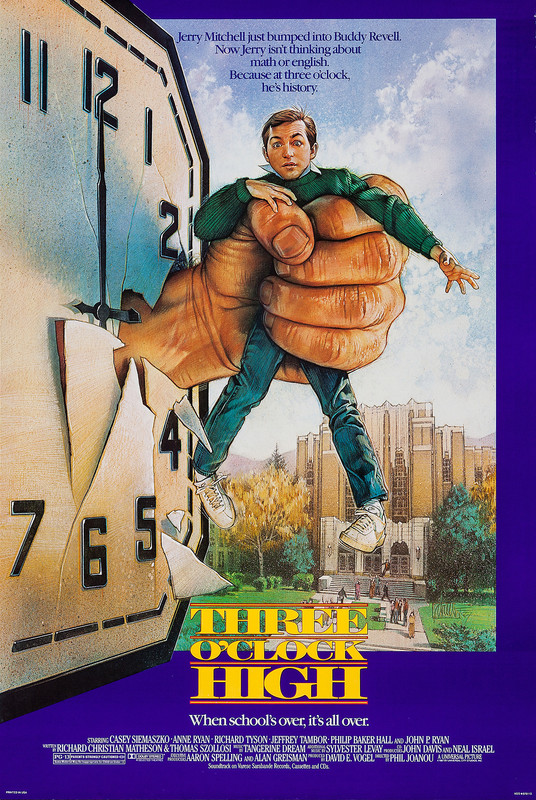
Three O'Clock High
Dir: Phil Joanu
High Noon goes to High School must, surely, have been the pitch for this odd little example of the 80's teen movie.  Casey Siemaszko plays Jerry Mitchell, a nerdy senior who seems never to have been in trouble at school, writes for the school paper and runs the on campus supply shop.  One day Buddy Revelle (Richard Tyson) a new student with a bad reputation arrives and, when Siemaszko accidentally upsets him, challenges him to a fight after school at 3pm.

Three O'Clock High is pretty bog standard nerd comes good stuff.  It hits all the expected beats reasonably well, but does little that is unexpected.  For example, early on we see Jerry driving a pretty female friend (Annie Ryan) to school while clearly crushing on another girl who drives past them.  Guess how the movie ends.  The end result of the central conflict is also never in doubt, which is fine, that's a valid character arc for Jerry to take, but simply resetting it in high school does little to make this old chestnut feel new.

What Three O'Clock High does have going for it is a set of spirited performances.  Siemaszko, who I've not seen much of, is a solid enough lead; nerdy without seeming like he'd be a total outcast and he's a lot of fun as Jerry's attempts to avoid fighting become more outlandish, especially in a scene in which he turns a book report into an exercise in hitting on his teacher (the gorgeous Caitlin O'Heaney) so that he will get detention.  There is a fun performance from Stacy Glick as Jerry's wise beyond her years sister (a role that anticipates Chloe Moretz' part in (500) Days of Summer) and Annie Ryan makes for an appealing love interest.  There is also fun to be had in spotting people in early roles; Jeffrey Tambor appears as a teacher and Philip Baker Hall as a detective.  Unfortunately, there is a problem in the casting with Richard Tyson.  I've only otherwise seen Tyson in Kindergarten Cop and there, as here, he's far too flat a presence to feel truly threatening.  He tries, but you get the feeling that if you messed up his hair he'd run off crying.

The other issue that I had with Three O'Clock High stemmed from the final fight.  Of course we want to see Jerry beat Buddy who, the film establishes, is quite a bully, but Jerry is shown throughout as a thinker rather than a fighter and I would have liked to see him think his way to victory.  Instead, the film's ultimate message seems to be: “Solve your problems: steal a bully's brass knuckles and hit him in the face” which seems... unhelpful at best.  There are a few good things here, but ultimately I think the message is confused and the film is uneven.
★★

Bare Bea
Dir: Petter Naess
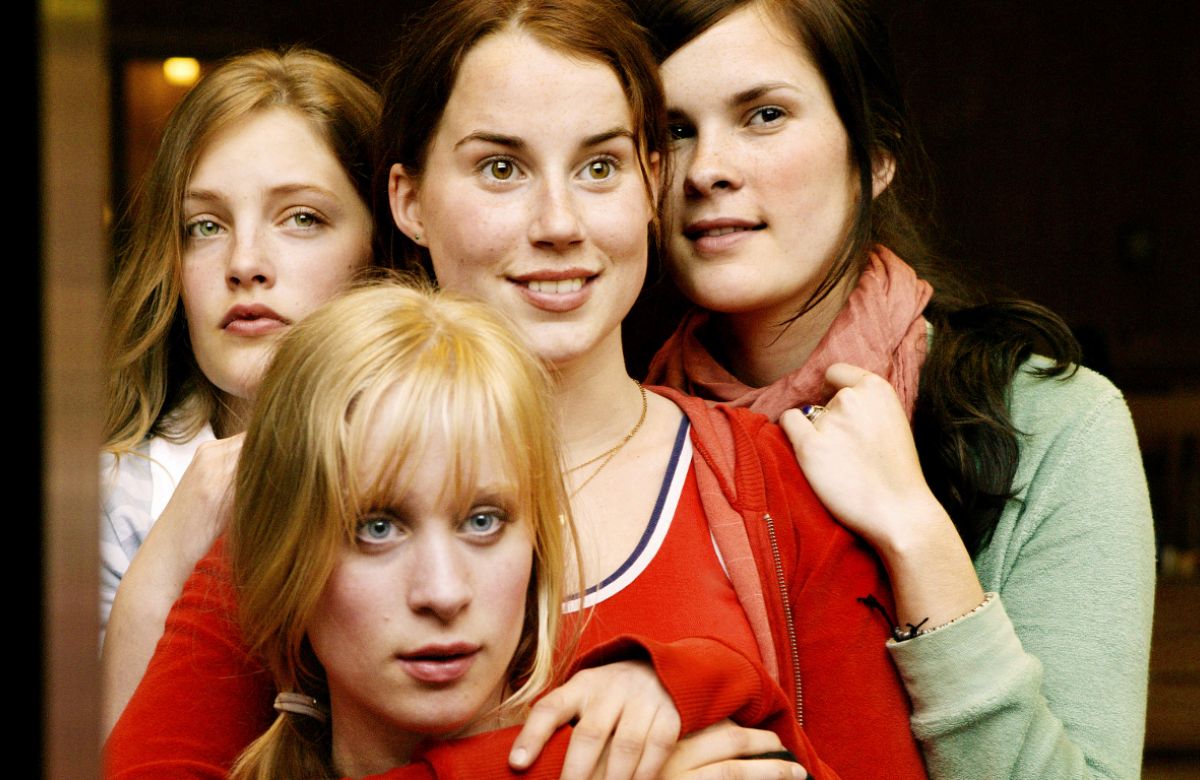
Bea (Kaia Foss) and her friends are all sixteen, but she's the oldest (sixteen and nine months) and the only one of her close group of four to still be a virgin.  When school heartthrob Daniel Vik (Espen Koulman-Hoiner) shows an interest in Bea her more experienced friend Mia (Kamilla Gronli Hartvig) says that before she goes out with Daniel she will need more experience, so she introduces Bea to 19 year old Anders (Kim S Falck-Jorgensen), who is supposed to be there largely for practice purposes, but who falls for Bea, complicating things when she does get together with Daniel.

Scandinavian coming of age movies often deal with some of the harsher truths of adolescence in a way that is more upfront than their American counterparts.  The tradeoff is that this can mean that they can be very dark and depressing.  Bare Bea, for the most part, manages to balance these two issues; it does have a somewhat more realistic take on teenage matters than, say, She's All That, but it also manages to keep the tone quite light (on one occasion to a fault).  It's perhaps best when combining these two facets; slightly exaggerating Bea's anxiousness to be good at sex the first time she sleeps with Daniel, the film has her try to replicate a Kama Sutra position; baffling him and embarrassing her.  This and the chaotic sex scene that follows are heightened, but they capture an essential truth about how awkward and embarrassing a first time can be.

There is a similar balance in how the film portrays the relationship between the four girls.  The group is established well; okay the characters are quite broadly drawn, but the dynamic is well drawn and even if it has third act break up issues similar to those of a lot of romantic comedies, the performances, which feel loose and natural for the most part, pull it through.

Kaia Foss makes for an appealing lead; girl next door pretty and credibly smart (which plays into sub-plot about her wanting to go to Canada for a writing course) you can see why both Anders and the rather more shallow Daniel would be chasing her.  Foss makes Bea sympathetic and when she starts doing a few mean things (running out on Anders to go out with Daniel, for instance) you chalk it up to being naïve rather than pointedly nasty.  Foss makes a creditable debut here, proving adept in both the dramatic and comedic moments, it's a shame she's not gone on to do more in the ten years since.

The support is also largely good.  Kamilla Gronli Hartvig, Ida Thurman-Moe and Maria Brinch all contribute to the convincing group dynamic between the friends, while Kim S Falck-Jorgensen made Anders; the nice guy who seems to have been set up to finish last, a character that I could easily identify with.  Only Espen Koulman-Hoiner really lets the side down, but that might be more the screenplay's fault than his.  At first, Daniel is seen through the rose-tinted glasses that Bea and her friends have on before Bea gets to know him and while he changes once Bea gets closer to him he doesn't really develop much more depth.

For the most part, Bare Bea manages to keep a relative lightness while dealing with some serious issues and quite a bit of disappointment for its main character, but unfortunately it abandons this as the film comes to a close, tying up loose ends in a way that feels unearned, unbelievable and like little more than a cheap way to send the teenage audience that is surely meant to relate to Bea out with a smile on their faces.  It's a pity, because this lapse of consistency aside this is a nicely done, if rather by the numbers, teen movie.
★★★

32A
Dir: Marian Quinn
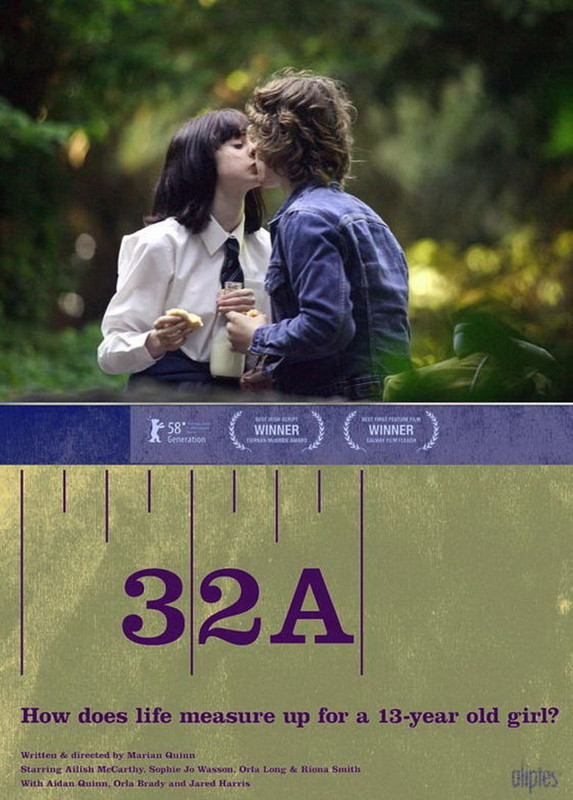
13-year-old Maeve (Ailish McCarthy) and her friends are desperate to grow up.  They're in that place between childhood and starting to deal with adult things, they're changing and that is sometimes testing for friendship, especially when Maeve gets her first boyfriend and it happens to be Brian Power (Shane McDaid), a cool older boy who all the girls admire from afar.  Things come to a head when Maeve blows off her friend Ruth (Sophie Jo Wasson) on the night all the girls are supposed to be supporting her as she's meant to meet her Father (Jared Harris) for the first time in years.

I don't know for sure whether 32A is based on writer/director Marian Quinn's own early teens, but I wouldn't be surprised, even though it's set in Dublin rather than in Illinois where Quinn grew up there is a real feeling here of something personal, perhaps remembered rather than observed.   This sense is particularly strong in the relationship between Maeve and her central group of four friends.  The dynamic between them is extremely well observed, both in their closeness as they go through typical teenage moments like comparing their development, practicing kissing and discussing their futures (a conversation about marriage and kids has a real ring of truth thanks to how OLD they consider 30), and the way that their friendship fractures at times.

I liked that both Marian Quinn and Ailish McCarthy were willing to take Maeve to a place where she is outright unlikeable.  You can see why, in her excitement about being the one who has been chosen by this popular older boy, she acts as she does towards her friends, but that doesn't make what she does to Ruth - even hiding so that she doesn't have to go with her the night she's supposed to meet her Father - any more palatable as a choice.  McCarthy is an engaging presence throughout, and even when Maeve is at her least likeable you root for her, except perhaps when she slaps her adorable little sister in the street.

The drama itself is a little bit by the numbers.  It's obvious that Brian Power won't turn out to live up to the image the girls had of him, obvious how friendships will be broken and mended, obvious how Ruth's storyline with her Dad will end up.  Predictable it may be, but it's tough to mind that much, thanks to a cast who give engaging and realistic performances, a script that, even when it hits cliché, does it honestly and a strong sense of time and place in Marian Quinn's direction.
★★★

Feb 18, 2014

Coming of Age Movie Month Days 15 and 16

Mauvaises Frequentations
Dir: Jean-Pierre Ameris
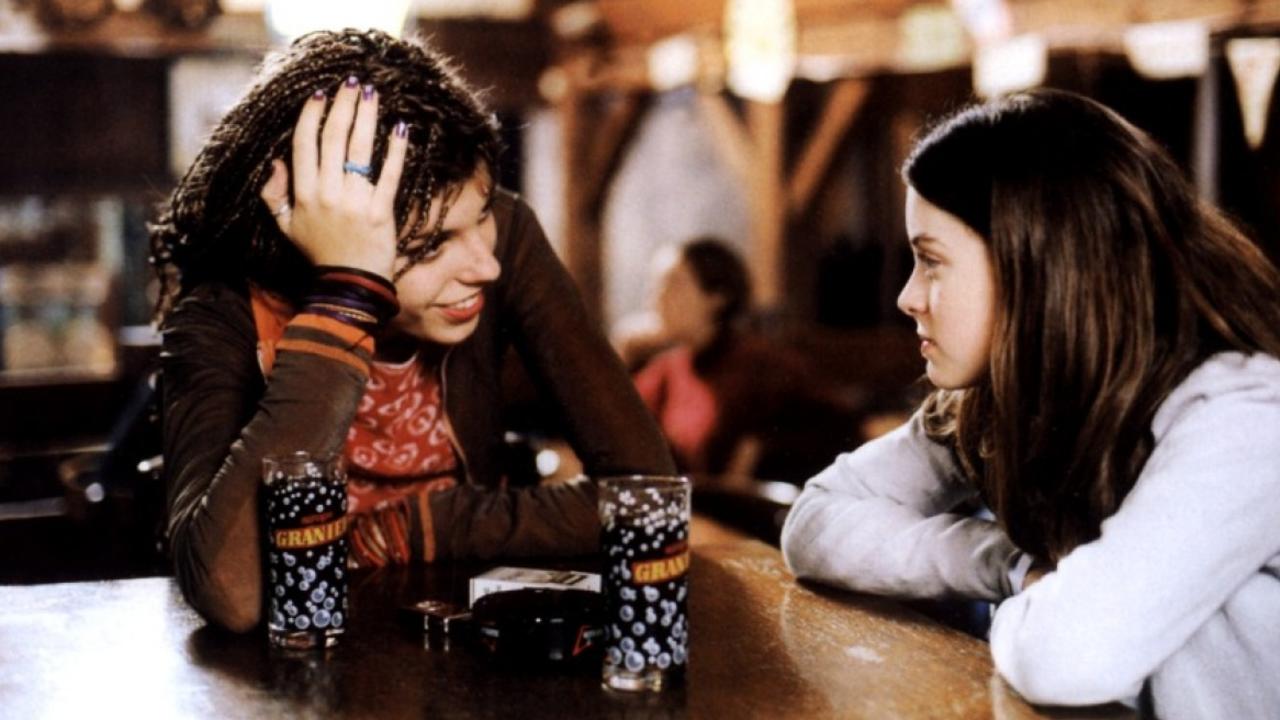
For about 45 minutes this is a fairly typical coming of age movie.  14 year old Delphine (Maud Forget) is something of a wallflower at school, but that changes when new girl Olivia (Lou Doillon) arrives.  Though they're very different the two hit it off and soon Delphine has met and fallen head over heels for Laurent (Robinson Stevenin), who becomes her first boyfriend.  Laurent and his friend Alain, who is Olivia's boyfriend, want to escape to Jamaica and things take a much darker turn when they rope the girls into a horrible plan to get the money for tickets.

I was taken off guard by this film, which doesn't happen often.  After seeing thousands of films over the past 25 years I can usually tell where something is going but from the light, if very well observed, first half of Mauvaises Frequentations I would never have expected the dark and sad turn that it takes in its second half.  What's remarkable is that the change of tone, sharp though it is, is neither cheap nor jarring.

The fact that the two halves gel as well as they do is largely down to three excellent performances from the leads, all seventeen at the time.  Making her debut, Maud Forget is extremely well cast as Delphine.  She's playing fourteen, but her delicate looks often make her appear even younger than that, which makes the film that much more impactful and that much more difficult to watch when she is put in compromising situations.  This delicacy and innocence about Forget plays well for the wallflower that we find her as at the beginning of the film, but her sensitive performance as Delphine falls recklessly and naively in love with Laurent makes the changes that she goes through realistic and moving.  Delphine is an appealing character; even her bad decisions seem to come from an inherent sweetness and a misplaced desire to please, and that only makes the second half of the film all the sadder.

Forget is very much the centre of the film, but the changes her character goes through are extreme and only really believable at a story level because of her friendship with Lou Doillon's Olivia.  That friendship has to work for the film to work.  You can see why Olivia's energy draws Delphine in; Doillon is a charismatic presence, but we get to see that they connect on multiple levels and that Olivia is a good influence on her new friend (I had assumed that she would be the 'Bad Company' of the title, but she's not).  Robinson Stevenin also impresses as Laurent, we can see how he plays on Delphine's naiveté, and the lack of interest in her that he's masking, but we can also see how well he's masking it and how, once he knows that she's fallen for him, he recognises that she is ripe to be exploited.  The dual layers of the performance give us an insight into both his and Delphine's characters.

I don't want to say very much about the second half of the film, because that would kill much of its power, but one thing that comes through strongly in both parts of the film is Cyril Cagnat's performance as Justin; a childhood friend who has been in love with Delphine since they were eight.  I can't tell you how much I identified with Justin (he's also a film buff), or how much one key scene in the film's last half hour broke my heart, but this side story is typical of how well written and played Mauvaises Frequentations is.  I wish I could get into more details, but you'll thank me for not doing so after you watch this one.
★★★★★

Totally True Love
Dir: Anne Sewitsky
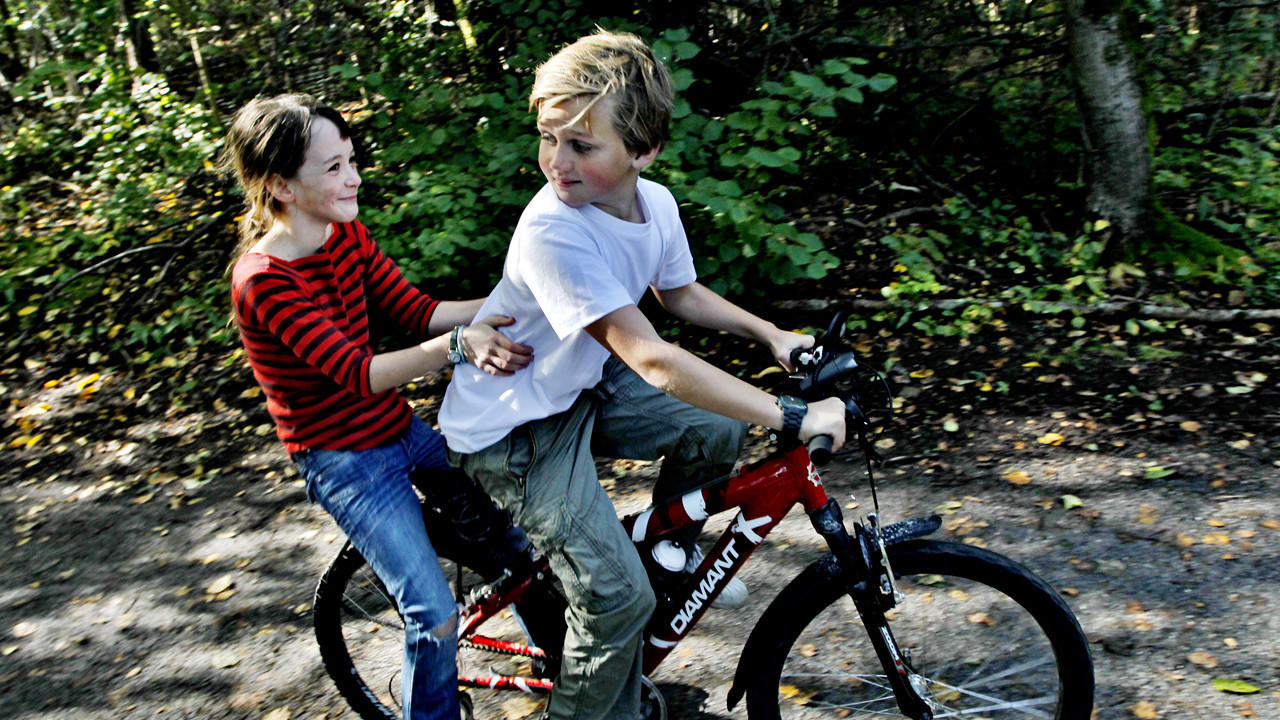
Most of the films that I have been writing about in this series have been about teenagers and largely intended for either a teenage or an adult audience.  Totally True Love is different in both respects.  This Norwegian film is about and seems largely pitched towards ten year olds, but what made it a wonderful experience is the fact that it never assumes that being about or for kids is an excuse to be simplistic. 

Anne (Maria Annette Tanderød Berglyd) is ten years old and despite most of the rest of the kids in her class having boyfriends or girlfriends she's never been that interested, until Jorgen (Otto Garli), the new boy in school, arrives.  When they meet Anne falls for Jorgen instantly but she has a rival in the form of the most popular girl in class; Ellen (Vilde Fredriksen Verlo) so Anne and her friend Beate (Aurora Bach Rodal) hatch a plan to make sure that Jorgen doesn't know Ellen is interested in him.

Perhaps the best thing about Totally True Love is that, unlike many films, it doesn't view kids simply as shorter versions of adults.  These ten year olds get to be ten.  Their concept of love is adorably naive and expressed in love letters that are earnest and innocent in exactly the right way.  The film also absolutely gets the pettiness that little kids are capable of; how friendships can be broken and repaired in days over the tiniest of things.  What it understands best though is how first love, when you're barely even equipped to understand the concept, feels.  In these terms, it's the best film about young love since the much underrated Little Manhattan.

Outside of Anne's lovely voiceover, which is written in a style that totally fits both her age and character, it's hard, at times, to tell how closely written the film is.  There is such a sense here of kids just being kids that many scenes have a natural, almost improvisatory, feel.  Scenes between Anne and her 12 year old brother or Anne and Beate and scenes in the schoolyard are especially strong in this respect.

The film has a great energy, largely provided by Anne.  The first ten minutes set the pace as, via a voiceover that flits from thought to thought and subject to subject in short order, Anne introduces herself, her friends, and her family .  It's funny in the way that kids can be without realising it ("That's my mum. And that's my dad. Dad likes Mum best when she's upset and breaks things.") and is matched by a bright and energetic visual sensibility from director Anne Sewitsky.  This introduction also makes it easy to like and be engaged with Anne, it would be hard not to, Maria Annette Tanderød Berglyd's performance is both fun and emotional; an impressively layered piece of work from such a young actress.

Jorgen is less developed than Anne, but that's okay because Anne's crush on him isn't really based on anything concrete (though a scene where she flips through a photo album he drops is very sweet).  We're supposed to see Jorgen through Anne's eyes and through her imagination, in some very funny fantasy sequences inspired by the reality TV she watches.  For his part though, Otto Garli is solid as Jorgen, giving off a believable vibe as a sincerely decent kid, which is as much as is needed of him here.  All the kids are excellent.  Vilde Fredriksen Verlo has a slightly one note role as the most popular and bitchiest kid in year five, but the film suggests something about why she's like that (without laying it on too thick) and gives her a lovely and amusing final scene.  Perhaps best of the young supporting cast is Aurora Bach Rodal.  Beate's best friends relationship with Anne is beautifully drawn and the scenes between Berglyd and Rodal never strike a false note.

Even though Totally True Love is for kids the fact that it never talks down to them and doesn't shy away from complicated (if juvenile) feelings means that it's just as engaging and just as charming for an adult audience.  If you have kids watch it with them, if not, see it for yourself, it's lovely.
★★★★★

Feb 12, 2014

Coming Of Age Movie Month Days 9 and 10

Jeremy
Dir: Arthur Barron
I hadn't heard of this 1973 film until a few years ago when I heard Mark Kermode talk about how much it had moved him when he first saw it and having a similar experience when he finally saw it again after many years.  Any film that resonates down the years like that must have something worth recommending in it and, even if I can't claim to love it as Kermode does, that's certainly true of Jeremy.

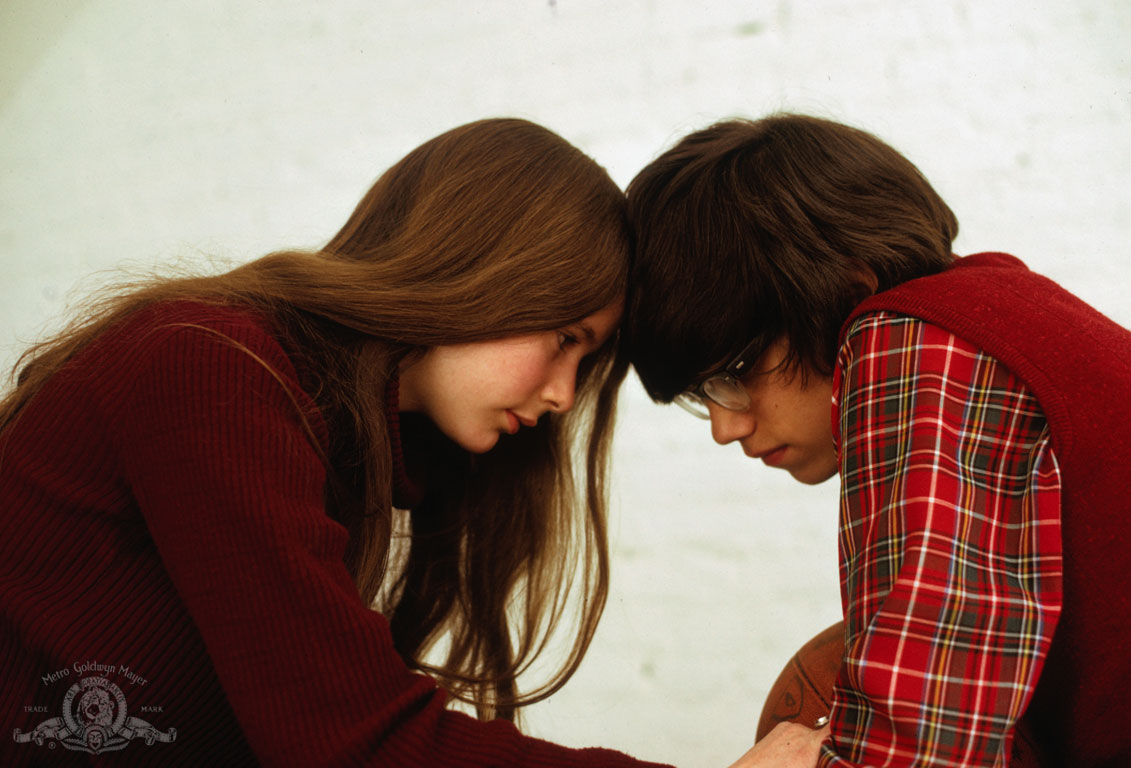
The story is a rather typical one of first love.  The geeky Jeremy (Robby Benson) spots Susan (Glynnis O'Connor) at school and falls for her instantly.  When he finally plucks up the courage to talk to her they start dating, falling into a relationship that becomes serious quite quickly.  Unfortunately, a big obstacle is suddenly thrown in their way when Susan's father gets his old job back, meaning they have to move.

I understand Mark Kermode's affection for this film completely, and I suspect that had I seen it when I was the same age as Jeremy and Susan (who are 15 or 16) it would have become one of my favourite films.  Seeing it now I can still feel a lot of it at a very personal level.  At 16 I was much like Jeremy; a bespectacled nerd pining for the prettiest girl in school.  The scenes where he's trying to call her and ask her out, asking his friend to find out about her, taking her on a date and trying to make small talk, I think we've all lived those awkward moments.  This is what makes Jeremy a film that still resonates; there can hardly be an audience member who hasn't felt like this, and that powers the movie through some of its clunkier moments.

Jeremy is sometimes earnest to the point of being cloying.  This would annoy me more, however, if it were a film about adults, who tend to have a little more perspective on things than teenagers in their first serious relationships.  As grating as they can be, these moments also ring true, catapulting me back in time to similarly over-dramatic conversations I had with friends at that time.  If I'm honest, my engagement with the characters and the relationship was probably also aided by the fact that I too would have been in love with Susan if I'd gone to school with her.

The emotional honesty of the film is thanks largely to its two excellent central performances.  Both 17 at the time and just starting out their film careers, Benson and O'Connor give unforced performances that feel almost improvised.  Their connection is palpable (and indeed genuine, they got together in real life for a time) and the scenes of them spending time together on dates are sweet and heartfelt.  Since this film was made many American teen movies have developed a mean or exploitative streak (and I say that as someone who likes a lot of those films), but what's great about Jeremy is that it gives you two characters who are easy to root for.  They aren't caricatures, just nice kids that you can identify with and even imagine having gone to school and been friends with.  Watching their relationship develop in such a frank way is a pleasure.

As a story about first love, Jeremy has barely dated, but the ending makes it look like something of a relic.  It still has an emotional tug, but I wonder if people raised in the internet age will feel the full force of it because Jeremy and Susan's problem could be so easily fixed today.  Of course, this is not the fault of the film. For me, the melancholy ending is one of the best things about it.  I'm not sure this is quite a lost classic, but I see why people would feel that way, and if you like coming of age films it's an essential one to track down.
★★★

Lakki, The Boy Who Grew Wings
Dir: Svend Wam
I... I have to review this don't I?  

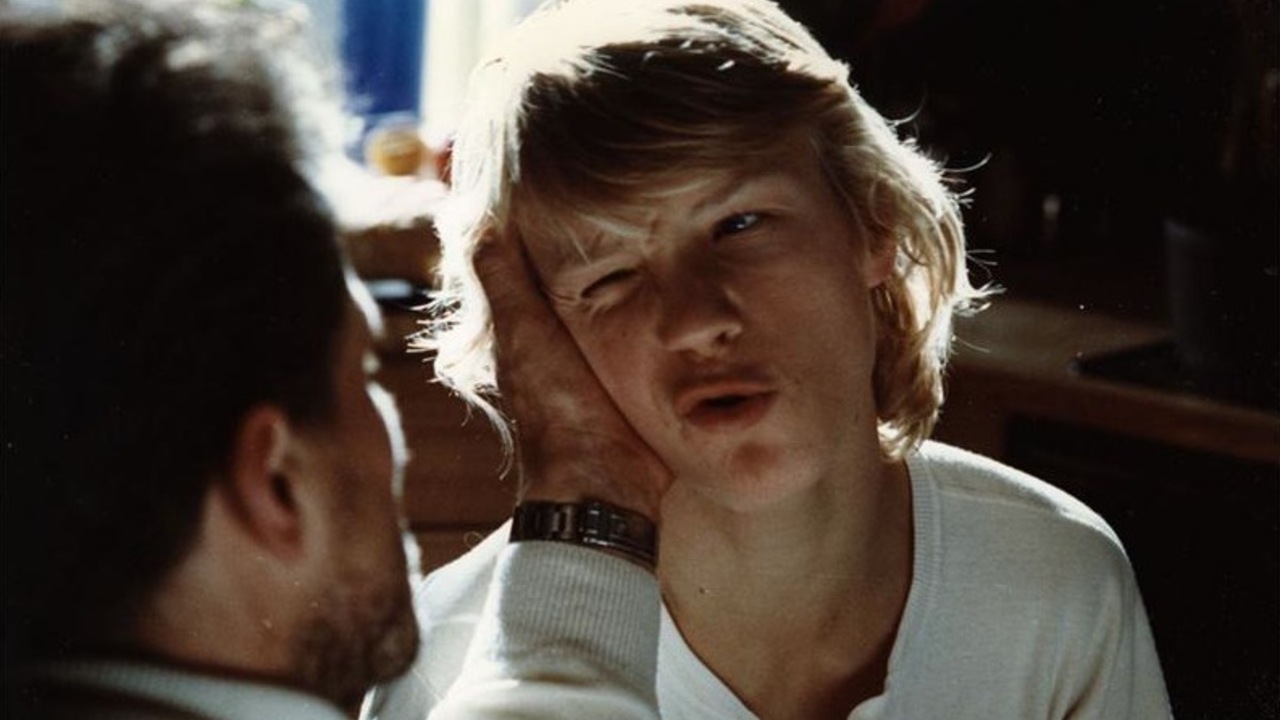
Lakki, The Boy Who Grew Wings would seem to have a lot going for it.  I'm fond of Scadinavian coming of age films, I like the idea of mixing surrealism and social drama (see Francois Ozon's Ricky for a great take on that odd idea) and the idea of a surrealist piece about an abused and neglected 14 year old growing wings to escape his situation is, at the very least, different.  Unfortunately, for me at least, Lakki fails on just about every possible level.

First off, the drama just doesn't work.  The reason that Ricky worked so well for me was that it established a real world, with strong performances, before heading into realms of surrealism.  Lakki doesn't.  From the off the 'real world' scenes feel just as surreal as the fantasies that Lakki has, so we're never sure what's actually happening and what Lakki is blowing out of proportion in his own mind.  This is also reflected in the tone of the performances, which are overblown throughout, further undermining any sense of why Lakki really wants to escape from his life so desperately.  Even when the film tries to rein these excesses in (far too late), the damage has been done and everything rings false.

The surreal sequences do have some striking images (Lakki, having been bullied by his swimming teacher, borne aloft in a crucifixion pose, by his classmates), but they all tend towards beating us over the head with their point.  Frankly the film may as well be called Lakki, The Boy Who Grew An Obvious Metaphor.

I don't really have much to say about this.  I found it irritating and tiresome throughout; a laboured, badly conceived and acted film that bellowed its metaphor at the audience for 105 minutes to little effect.

Jan 23, 2014

Kiss Me, You Fucking Moron

Dir: Stian Kristiansen
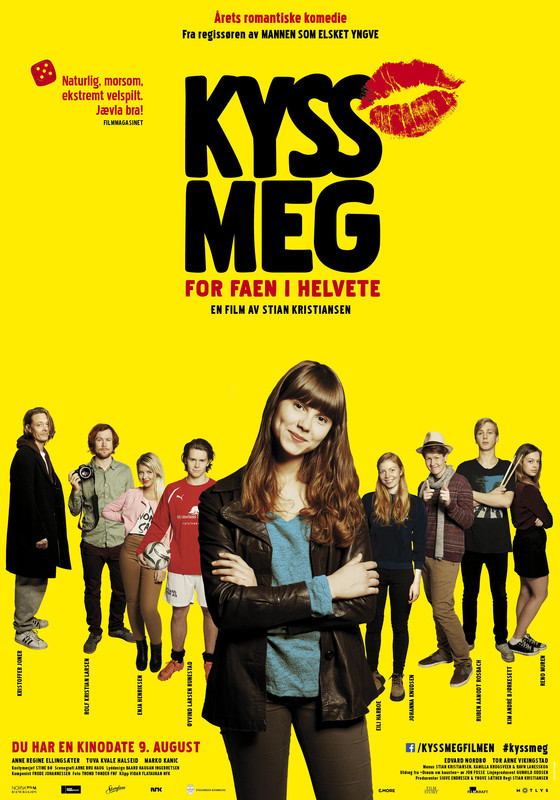
I knew that I had to see this Norwegian coming of age movie as soon as I read the title (which, sadly, seems to have been reduced to Kiss Me, Damn It for international release).  As attention grabbing and as great as that title is, it also primed me to expect something quite different from what I got.  I went in expecting a knockabout teen comedy, what I got tended much more to drama, but it hit me in ways I didn't expect.

Tale (Eili Harboe) is seventeen years old, living in a small rural town in Norway, and wants to be an actress.  She's in an amateur acting troupe with a few friends but they are bored of staging silly revues.  Instead of another revue Tale suggests that the group stage a play by Jon Fosse (a famous Norwegian playwright).  She badgers Lars (Kristoffer Joner), a famous actor who has turned up in town to stay with a friend and deal with a mid-life crisis, into directing them and he insists on casting a local troublemaker, Vegrad (Øyvind Larsen Runestad) as the male lead.  A method director, Lars insists that Tale and Vegard spend time together in order to give better performances.  Guess what happens.

You couldn't call Kiss Me, You Fucking Moron an original film.  It runs through the typical beats of a coming of age movie.  The boy and girl hate each other, they spend time together, find common ground, become friends, some obstacles get thrown up... it's all pretty standard.  I've always said that the fact that a film is generic doesn't have to mean that it's bad.  Genre structure is laid down because it has been proven to work, but conforming to genre does mean that you have to deliver quality work to stand out.  This is exactly what Stian Kristiansen and his cast do here.

The young leads in this film have a difficult job, in many scenes they have to be acting on a lot of different levels; playing actors who are playing a part, to varying degrees of success, but also letting their character's concerns beyond the scene come through and inform the drama outside the play within the film.  This is just one of the ways that Eili Harboe stands out here.  Tale is clearly supposed to be a pretty good actress to begin with, but we have to see both a progression through rehearsals and the crush that she has on Vegard which informs much of the way Tale plays scenes in the second half of the film.  Harboe does all of this beautifully, there's always a lot going on underneath the scenes when Tale is acting, and she has an understated naturalism outside of those scenes that helps the film remain credible when the screenplay is sticking resolutely to genre convention.  It's hard to believe that this only her second acting job, but I really want to see more from her in the future.

If playing a good actor is tough then playing one who starts out bad and then has to progress, while also giving a strong performance outside of acting scenes, must be tougher.   Øyvind Larsen Runestad is excellent as Vegard, particularly as the bravado of the bully we see in the early scenes begins to fade away as he and Tale hang out and get to be friends.  After seeing the first couple of scenes that he appears in and then discovering that he was to be the film's male lead I was concerned that there would be no way to have sympathy for Vegard, but slowly the screenplay and Runestad's performance allow us to warm to him.  This is also helped by the fact that Tale is going through the same process, and Harboe plays it so well that we start to see things through her.

The only name in the cast list that was familiar to me coming into this film was that of Kristoffer Joner, a Norwegian actor who I've now seen in several projects and always been impressed by.  He's got a character actor's face and talent to match, it's really only the lack of a big crossover hit that, I think, is keeping him from being much better known outside of Scandinavia.  Here Joner is typically excellent as the initially reluctant director of Tale's play.  It's as much of a process seeing him warm to the kids in the acting troupe as it is watching the relationships between them.  He doesn't, for the most part, do a lot of heavy dramatic lifting, but there is a rumpled charm to the character and hints of something painful behind why he's ended up in this small town.  Late in the film, we get to hear the story behind this, and Joner delivers it perfectly.  Between his performance and Harboe's as Tale listens and reacts to his story, it's perhaps the best scene in the film.

The lively but believable performances of the leads and the supporting cast really drew me into this film, it's in some of the writing that Kiss Me, You Fucking Moron lets itself down.  For the most part, the interactions between the teenage characters are nicely observed.  This is especially true of scenes between Tale and Vegard as they spend more and more (mandated) time together and we see them grow closer.  On the other hand, there are threads that are left underdeveloped, perhaps falling victim to the film's tight 93 minute running time.  For instance, when we first meet Lars he appears to have an alcohol problem, but this gets shunted out of the way pretty quickly, and a storyline involving Vegard's girlfriend gets an almost insultingly prosaic final scene.  Perhaps the most random, out of the blue, inclusion is a scene in which Tale's previously (and subsequently) unmentioned band play a song, it's a nice scene, and demonstrates that Harboe has another string to her bow besides acting, but it does feel like it's been parachuted in from another film. 

On the whole this is an engaging, involving and charming film.  Stian Kristiansen deftly combines the small dramas that make up Tale's life with a light sense of humour.  There's a good tonal balance here; it's never too knockabout, but never as dark as many of the teen movies we see from Europe and Scandinavia.  On the surface, it seems a little slight at times, but the performances are emotionally engaging and lend a depth to the final film that may not have been entirely present on the page.  If like me, you're a fan of teen and coming of age movies then this is one that you really ought to track down, it's not quite what you'd expect from the title, but that's no bad thing.
★★★★

Apr 3, 2012

24FPS at LLGFF 2012 Part 3

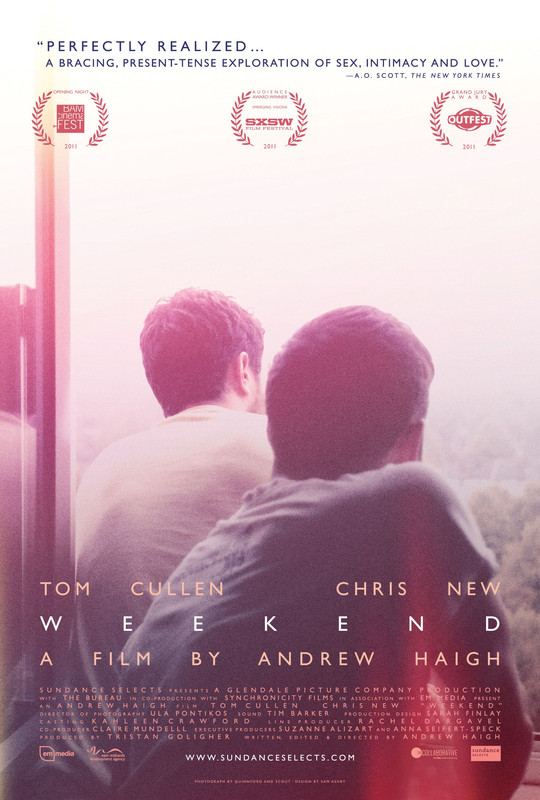
Weekend
Dir: Andrew Haigh
I've been hearing great things about Weekend, from just about all quarters, since last year's London Film Festival, but despite many opportunities, and not by design, I just kept managing to miss it, so where better to rectify that than at LLGFF?

At the Q and A after the film I heard director Andrew Haigh say that he wasn't keen on the many reviews using the word 'universal' to describe the film, as he felt that was a tactic to give straight audiences 'permission' to see the film, which we shouldn't need to do. I agree with the second part. At the risk of upsetting Haigh though, 'universal' was exactly the word that ran through my head, and not because this is a 'gay' film. The specifics of the relationship depicted here aren't something I have experience of, not merely because it's a gay relationship and I'm straight, but because I also happen not to have met someone for a weekend, fallen for them, but had to say goodbye almost as soon as I've met them. What does speak to me, and what will speak to almost any audience member, is the feeling of this film. Who hasn't found someone they think they might love and then lost them? Maybe neither of those things happened with the speed depicted here, maybe they did, but we've all felt like this, and that's why Weekend feels universal.

What is outstanding about Weekend is how emotionally articulate it is. This is largely down to the combination of Haigh's intelligently observed screenplay and tremendously naturalistic performances from leads Tom Cullen and Chris New. Cullen plays Russell, a gay man out to his friends, but not terribly comfortable being out in the wider public. At a gay bar he picks up Glen (New), and what seems likely to be a one night stand ends up developing quickly, even after Glen says that at the end of the weekend he's going to art college in America. Russell and Glen aren't the sort of shells we're now conditioned to accept as characters by most movies; they feel real and rounded, and for everything we do learn about them Cullen and New hint at much more going on beneath the surface. The conversational scenes between the two, particularly a drug aided discussion of marriage, have the loose feel of two people just talking the day or the night away, and that's the feeling of the whole film; it doesn't seem acted but like a little glimpse into 72 hours in the lives of these two people.

Neither Russell nor Glen is perfect, and even in the short time they spend together you can see the things that make them different and why a relationship would be hard, but they are both sympathetic, both people who feel real and who you can identify with, and that makes the relationship one you root for, even if you're reasonably sure how things will end up. To his credit, Haigh employs and plays with cliche beautifully with the film's ending, crafting something that feels both classic and a little different. Nobody needs permission to watch or enjoy Weekend, but if you have yet to, consider this a little friendly encouragement.

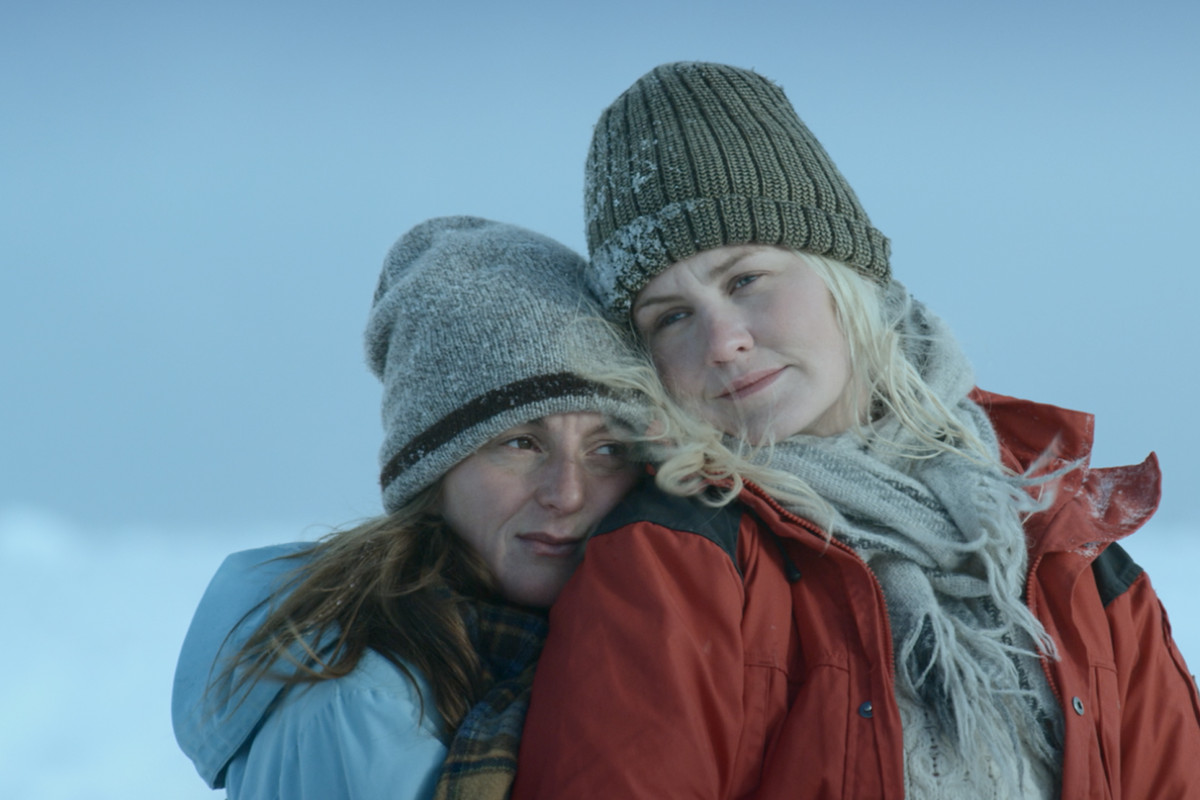
The Mountain
Dir: Ole Giæver
The Mountain of the title is, obviously, one big snowy metaphor. As the film opens we find Nora (Marte Magnusdotter Solem) and Solveig (Ellen Dorrit Petersen) climbing, a long term couple, they are clearly miles apart at the moment, and the film slowly lets us in on why that is and why, with Solveig three months pregnant, she is insisting that Nora join her in this trek.

As the information begins to leak out we can probably put together the story before the film tells it, but then this isn't really about what happened the last time Nora and Solveig were on the mountain, it's about the aftermath, what it has done to each of them and to their relationship. With only two characters in the film, The Mountain hinges entirely on the strength of its performances, and fortunately Solem and Petersen prove more than equal to the challenge of the emotional heavy lifting they each have to do.

The film really passes no comment on the fact that the couple at its centre are both women, it just happens to be so, and the story would be (largely) the same were they a heterosexual couple or two men. That said, the fact that both the main characters are women does give an important extra physical and emotional gravity to what has happened, and tensions between the birth and non-birth mother of the same child is a dynamic I've never seen on screen before. The performances get better and better as the emotions become more and more fraught, and the film is only really let down by an ending that feels a shade against the prevailing tone of the film as a whole. Until those last couple of minutes this is a refreshingly adult drama that deals with a difficult subject articulately.

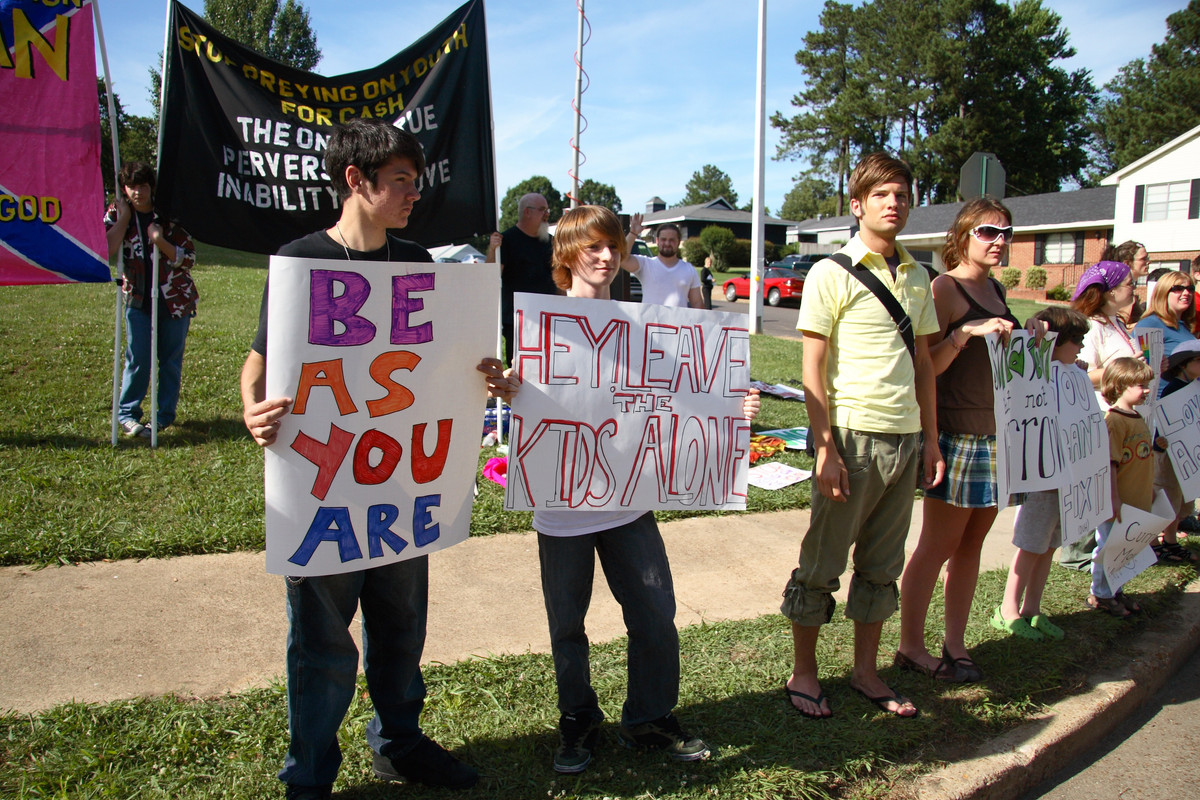
This is What Love in Action Looks Like
Dir: Morgan Jon Fox
Documentaries often tell stories that are harder to believe than fictional films. Even in spite of knowing about it long before I saw this film, I still find myself incredulous at the idea that some parents' reaction when their child comes out to the is to send them, against their will, somewhere like the Refuge camp run by the more than slightly ironically named Love in Action, where they can, potentially, be 'treated' for and 'cured' of their homosexuality.

In 2005, a teenager named Zach Stark was told by his parents that he would be going to one of these camps, he then blogged about it on MySpace (this being 2005), posting the list of rules that Love in Action expected him to obey while he was there. From there the post was picked up, and a small group decided to protest at Love in Action every day that Zach was in there (the film is named for the text on one of the protestors banners), eventually the story was picked up national and international media, and began to make waves.

Director Morgan Jon Fox and his team have spent six years securing an impressive range of voices, from Zach and other people who went to Love in Action, some forced, others of their own volition as well as from the protestors and the former head of the Love in Action ministry. The views are perhaps, ultimately, slightly less diverse than I'd like - it would be good, for instance, to have someone in the film who felt that Love in Action's therapy had worked for them, though perhaps that absence speaks for itself. However, the varying perspectives from both within and without this organisation are always fascinating and sometimes shocking.

This is What Love in Action Looks Like is, or hopefully will be, an inspirational film, because as much as it's about Love in Action, it's also a film about how a small group of people really can make an important change in the world, not by violent means but by simply (and cleverly) saying: 'this is bad, and this is why'. Some technical aspects of the film are flawed (media clips are shown small, and on a background designed to look like the internet in 2005, and the emotive score sometimes overplays its hand when the image alone is plenty powerful enough), but these minor issues are easily overcome by the importance and the interest of this story.