Showing posts with label 2018 Releases. Show all posts

Oct 29, 2021

24FPS @ Raindance: Pause [2018]

Dir: Tonia Mishiali
Over the past few years, there has been a lot of coverage of coercive control relationships and marriages, with the behaviour finally being recognised as the form of abuse that it is. With Pause, her first feature, Tonia Mishali takes a stark look at Elpida (Stella Fyrogeni), a woman in her early 50s whose husband Costas (Andreas Vasileiou), while he goes out to work, controls just about every aspect of her life. 

Mishiali begins by laying out the mundane reality of Elpida’s life. She sometimes looks after her friend’s baby granddaughter, but otherwise passes the days alone in her flat, cleaning and cooking. Repeated shots of her and her husband at the table, only ever speaking for functional reasons, and of them each watching their own TVs (Elpida’s an old CRT that she’s forced to use headphones to watch) hammer home the lack of any affection in the home. We also see that the purse strings are entirely held by Costas, who doles out small amounts day by for groceries. When Elpida asks for money for a haircut, he refuses (“Your hair is fine as it is”).

Elpida’s few escapes from this reality are closed down as the film goes on; Costas taking more and more from her, and Elpida escapes into brief fantasies. In an interesting choice from Mishiali, these moments of fantasy are never cued for us, and as we see more of them even the exits from the fantasy sequences aren’t clear, so while it’s obvious when a handsome young neighbour turns and kisses Elpida in the hallway that it’s not real, a later encounter with a man painting the apartment building is more ambiguous.

The depiction of coercive control feels very real, disturbingly so, and Stella Fyrogeni (also seen in the festival in a supporting role in Patchwork) is outstanding as she plays both Elpida’s near total detachment and her fleeting moments of hope—real or fantasised. While the screenplay has a few clunky moments throughout (the painter’s “Bye bye, Hope” to Elpida is painfully on the nose), there is one moment towards the end of the film that feels very out of place and wildly out of character for Elpida. It’s as if Mishiali decided that she needed one real shock sequence in the film, which is otherwise concerned with the way that implied threat can control someone’s life. It doesn’t work in the moment, but worse than that, for me it unravels some of the good work from before, because that’s the moment it’s building to.

Much of Pause is a hauntingly close up and credible portrait of an abusive relationship, it may stumble badly at its last hurdle, but Stella Fyrogeni’s performance is worth the running time by itself.
★★★

Pause screens at 6:20 on October 31st at the Curzon Hoxton, and online at Curzon Home Cinema from November 1st-3rd

Jul 9, 2019

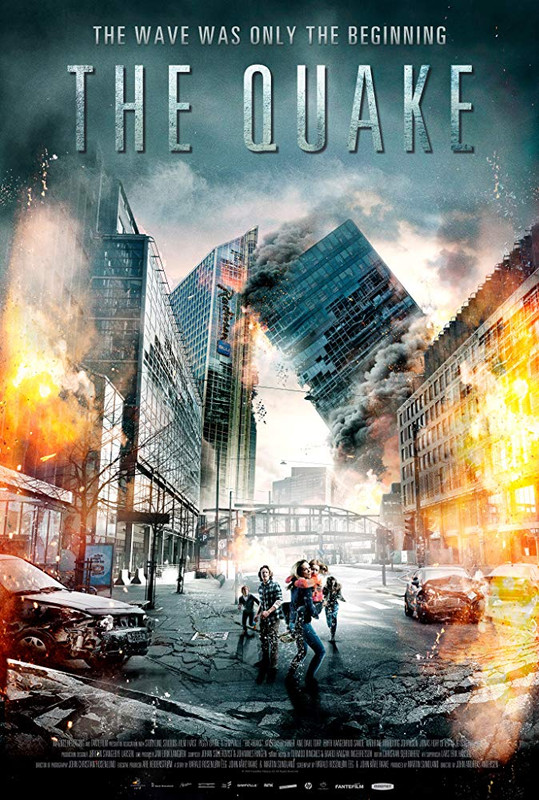
The Quake [12]

Dir: John Andreas Andersen
Three years after the events of The Wave, Kristian Eikjord (Kristoffer Joner) is still affected by the disaster. Separated from his wife Idun (Ane Dahl Torp) and distant from his kids, he feels guilty about his warnings not being heeded sooner and thus saving more people, and he’s haunted by fears of fresh disasters. These fears become more present when an old friend dies while examining a tunnel in Oslo and Kristian finds an old letter from him, warning of the potential of a massive earthquake. When the quake comes, will Kristian be able to protect his family?

The Wave did pretty big things for the career of director Roar Uthaug, who followed it up by making his Hollywood debut with the Alicia Vikander starring Tomb Raider reboot. Perhaps disappointingly, it didn’t seem to do the same for the film’s star Kristoffer Joner (a small role, confined to a hospital bed, in Mission: Impossible - Fallout aside). On the other hand, maybe that’s not such a bad thing, because it’s unlikely that a film like The Quake, if made in Hollywood, would have offered him much opportunity to stretch his acting muscles. At 103 minutes, this is a relatively short film, but for over an hour the titular event lurks in the background. For this time, the film does the requisite build up, but what it concentrates on isn’t the charts and graphs but the already shaken man at the centre of the film. 

Kristoffer Joner is a great actor, and he brings his customary dedication and detail to this part, just as he did in the first film. This performance is about trauma; a man haunted by his previous efforts, even though they were genuinely heroic. It’s left him looking bedraggled, almost hollow at times, and even the slightest engagement has become a struggle (in one particularly well acted moment there’s a tiny register of appreciation for the breakfast his daughter Julia (Edith Haagenrud-Sande) has made him, just in his eyes, a second before he says that she should go home). This background is important because it makes the growing threat of the earthquake feel different. By spending real time and effort on the emotional fallout of the previous events, there is always a very credible feeling that Kristian may genuinely just be paranoid. Of course, we know that’s very unlikely to be true, but it’s a testament to Joner that a film that used the title The Quake in a purely psychological sense would be at least as compelling as this one proves.

There are sacrifices made in order to spend this kind of time on Kristian’s character, and sadly they impact mainly on the other characters. There is an emotional short hand with the established characters of Idun, Julia and Kristian and Idun’s son Sondre (Jonas Hoff Oftebro, sidelined here to the point that you’d be forgiven for thinking the first draft forgot he ever existed) but Kathrine Thorborg Johansen’s Marit, the bereaved daughter of Kristian’s friend who first warned him of the quake, is fatally underdeveloped; little more than a plot device with a face. This is where the film’s running time bites. We understand Marit’s actions in the third act as standard disaster response, the way we’d all hope to behave in those circumstances. Kathrine Thorborg Johansen does what she can with what’s on the page, giving a decent performance, but some more scenes between her and Kristian, just to bond the characters a bit, would give us more investment in her in the last half hour. Ane Dahl Torp is also a little limited by what’s on the page, but there’s enough in her performance and the dynamic between her and Joner that we can read what’s happened between Kristian and Idun over the past couple of years without having it baldly laid out in dialogue, and we are very much invested in her fate and that of Julia, thanks to another solid performance from Edith Haagenrud-Sande.

The carnage does, of course, finally arrive and when it does it’s extremely well executed, with effects that rival any $200 million film for roughly $6 million. The scale is smaller of course, but the CG is strong and because it’s linked to physical effects, more credible than in many higher budget films. The major setpiece, in a collapsing tower block, is tense, well paced, and not easy viewing if you have vertigo. Director John Andreas Andersen steals a few things (notably a sequence from The Lost World: Jurassic Park), but he adds his own wrinkles to everything he co-opts. The only issue in this passage is that, once again, the film largely forgets about Sondre, which makes things feel a bit unbalanced.

If you’re going in wanting something like a San Andreas (which, for the record, would be no bad thing, that’s a fun movie), The Quake is going to disappoint. I appreciated the slow and thoughtful start and the way it allows a great actor like Joner room to dig into his character. It has its problems, even at its best it is riddled with cliche, short changes some of its characters and has an ending so abrupt that it’s barely an ending at all, rather than a hard stop. For all those issues though, this is a smarter and more entertaining film than most Hollywood efforts in the genre.
★★★½

May 27, 2018

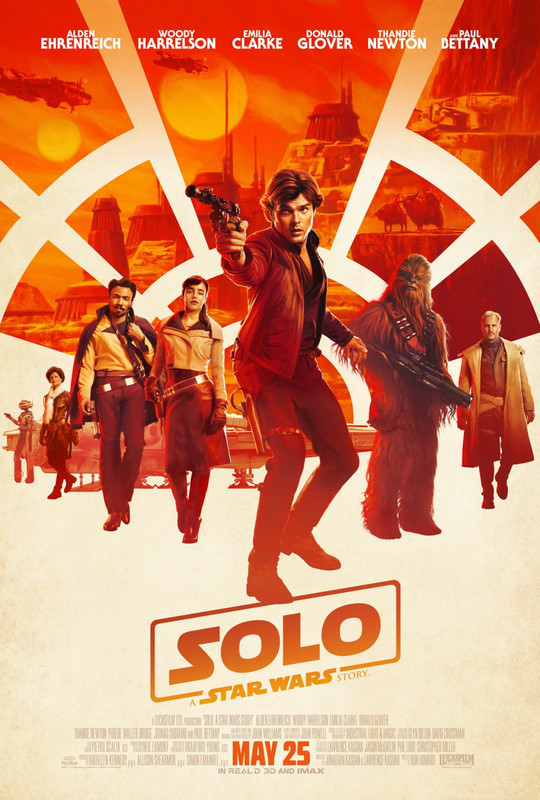
Solo [2D] [12A]

Dir: Ron Howard
I am of a generation that just missed out on seeing the original Star Wars films (in their original versions) at the cinema. When Return of The Jedi came out in 1983 I was two and by the time the Special Editions rolled around in 1997 I was turning sixteen and the films, while I’d seen them many times as a child, were already something I felt myself growing out of. It’s been a sense of duty as a movie fan, more than anything, that has kept me watching the films since the debacle that was The Phantom Menace in 1999. That sense of duty lapsed when it came to seeing The Last Jedi, but the first of the standalone Star Wars Story films, Rogue One surprised me by delivering a compelling side story with a tone different to that of the films in the Skywalker saga. Still, I was more curious than optimistic when it came to the prospect of Solo.

It has been no secret that there were serious bumps in the road to Solo. The film was to be directed by 21 Jump Street and The Lego Movie's Chris Miller and Phil Lord, but they were replaced after, by all accounts, a substantial amount of the film was theoretically completed. It seems the tonal approach they were going for was deemed too far against the grain for the Star Wars brand and Ron Howard - a fine director, but a reliable pair of hands more than he is an auteur - was brought on board. Howard is said to have reshot around 70% of Lord and Miller's material, but that's not to say the film is 30% theirs, as Howard and his team added and altered characters and shot material unique to this version. We'll likely never know what this film might have been, but that's beside the point, let's consider what it is.

Solo picks up with Han (Alden Ehrenreich) as he and his girlfriend Qi'ra (Emilia Clarke) try to escape from their lives as pawns of a criminal gang on Corellia. Han manages to get away, but Qi'ra is captured at the last minute and he vows to get back to her. Three years later Han, wanting to become a pilot, has found himself conscripted into the imperial army but sees another chance to escape and get back to Corellia when he meets Tobias Beckett (Woody Harrelson) and his crew of smugglers. When things go wrong the crew are indebted to Dryden Vos (Paul Bettany), who insists they repay him by taking on a dangerous mission and take along his right-hand woman - Qi'ra.

There is a fundamental challenge in prequels, one that is all the more acute with a series as iconic as Star Wars. Practically every film fan who is in their late 40s or younger grew up, to some degree, with Star Wars. Almost every one of those fans will have placed themselves in the roles of their favourite characters and many of them will have imagined where those characters came from, who they were before we met them. In a lot of ways, Solo is fighting a losing battle from the get-go. If, for instance, they didn't assume it was his given name, fans will have had their own ideas about how Han came by his name, and I bet 99 percent of them were more satisfying than the version we're shown here. The question is so much more interesting than the answer, and that's something the film comes up against time and again.

The other issue with prequels is that they are inherently low stakes. We know there is no actual peril, that things have to go a certain way in order to put us in a position to find the character where we meet them in the films we've already seen. We know how their personality will change, we know who they are going to encounter and how those relationships will play out, we even know exactly how certain events will play down to small details (ask a Star Wars fan about how Han's Kessel run worked out). We know, eventually, we're destined for square one (though this film, to make room for sequels, ends with us on square minus one). For much of its running time, Solo manages its way around these inherent challenges. It's following the formula, it's taking few risks, if any, but it's largely amiable fun. 

You have to feel for Alden Ehrenreich, he's been handed an almost impossible task. Replacing Harrison Ford as Han Solo is about as poisoned as chalices come. If you do an impression and do it well, then all you're doing is an impression, do it badly and you're insulting an iconic performance. Go your own way and even if you're great, you're just not 'Han'. To his credit, Ehrenreich walks this line as well as anyone possibly could. He captures the flavour of Ford's Han without copying him, he has a few moments where he leans in to something close to Ford's voice, but again he never takes it to a place of doing an impression, it's more in the cadence, a hint of Ford's inflections. On his own merits, Ehrenreich is good,  convincing as a roguish character who is generally looking out for number one, but would prefer to basically be one of the good guys along the way. He nails the tone and hits the humour without winking at the audience while proving a charismatic anchor for the film. Where he really convinces as Han is in the relationship with Chewbacca (former basketball player Joonas Suotamo inheriting the hairy suit from Peter Mayhew), which we see the founding of here and which immediately settles in to the dynamic familiar from the original trilogy.
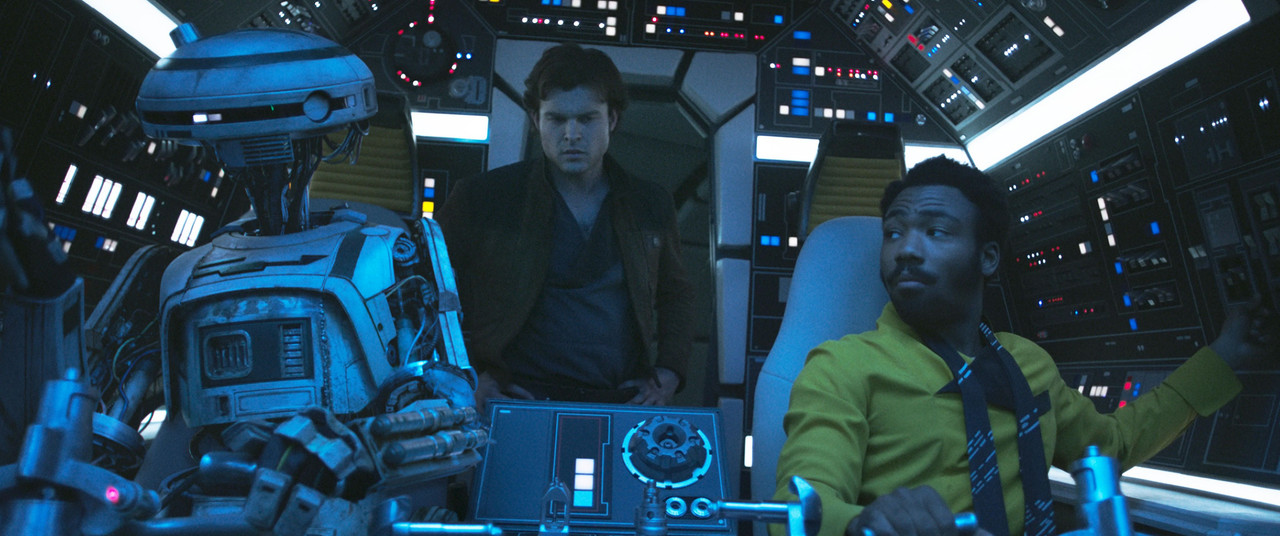
It is perhaps appropriate, given their characters' relationship, that Ehrenreich ends up having quite a few scenes stolen from him by Donald Glover as the young Lando Calrissian. His scenes are probably the film's best, he charms the audience as effectively as he does many of the characters. Also stealing most of his scenes is Paul Bettany, cast by Howard in a role that was apparently filled by a different character altogether (played by Michael K. Williams, who couldn't return for the reshoots) in Lord and Miller's film. His bad guy turn as Dryden Vos is fairly one note, but Bettany plays it with richly apparent relish and gets to take part in the film's best fight. 

Ron Howard keeps proceedings moving, executing the action sequences with the assurance you'd expect. The thing is, Howard doesn't seem to bring much that is individual to the table. The look, the tone, the blend of elements, it's all very safe, very Star Wars. It contributes to the feel of Solo as a content delivery system rather than anything particularly interested in finding its own way within an established world. It's never dull, but even in its best moments, Solo fails to do anything that would grab us and shake us. It never makes us look at an established character differently, nor does its own smaller scale and smaller stakes narrative do anything to truly surprise us.

Perhaps the least 'Star Wars' thing about Solo is Woody Harrelson. His character name - Tobias Beckett - sounds more like the posh kid you went to primary school with than it does a Star Wars character and, while his performance is fine, he doesn't do anything more than play Woody Harrelson. Emilia Clarke's godawful acting is one of the main reasons I haven't watched Game of Thrones beyond the first season. She's improved a bit from that and her disastrous turn in Terminator: Genisys, in that she's not distractingly bad here, but she's also not especially good. She and Ehrenreich have little chemistry and Qi'ra's character development falls flat because that's how Clarke plays everything. Better, but underused, is Thandie Newton as Val, who does convince us of her character's history with Beckett, giving us one of the film's very few emotionally charged moments in the middle of an early action setpiece. I can't decide where I stand on Lando's droid co-pilot, L3. Phoebe Waller-Bridge does a great job with what she's got; she's funny and engaging from the off, but the social commentary the film uses the character for is clangingly unsubtle (which isn't to say it doesn't make sound points). This is the element of the film that seems most likely to have come from Lord and Miller's work - it's not bad, but just feels oddly out of step with the film around it.

The word that comes to mind when I think about this film is 'competent'. It delivers. The action is fun, the comedy largely plays well, the actors give their best and are generally doing a solid job. Bradford Young's cinematography keeps the film feeling like it belongs to the same universe as the others while throwing up some striking images. Towards the end of the film it seeds an interesting idea (no, not THAT twist). It does all this and yet, it all feels inconsequential. This is a film that exists because audience analysis suggested it would be a good idea, financially, if it existed. There's no sense that it adds anything to our understanding of Han or the Star Wars universe, it's hard to invest because we know going in what's likely to happen and which characters are likely to matter in the long term. If you want to know what happened to Han Solo before A New Hope then this could have been a lot worse, but it still, fundamentally, feels less interesting to know than to wonder.
★★★

May 13, 2018

How To Talk To Girls At Parties [15]

Dir: John Cameron Mitchell
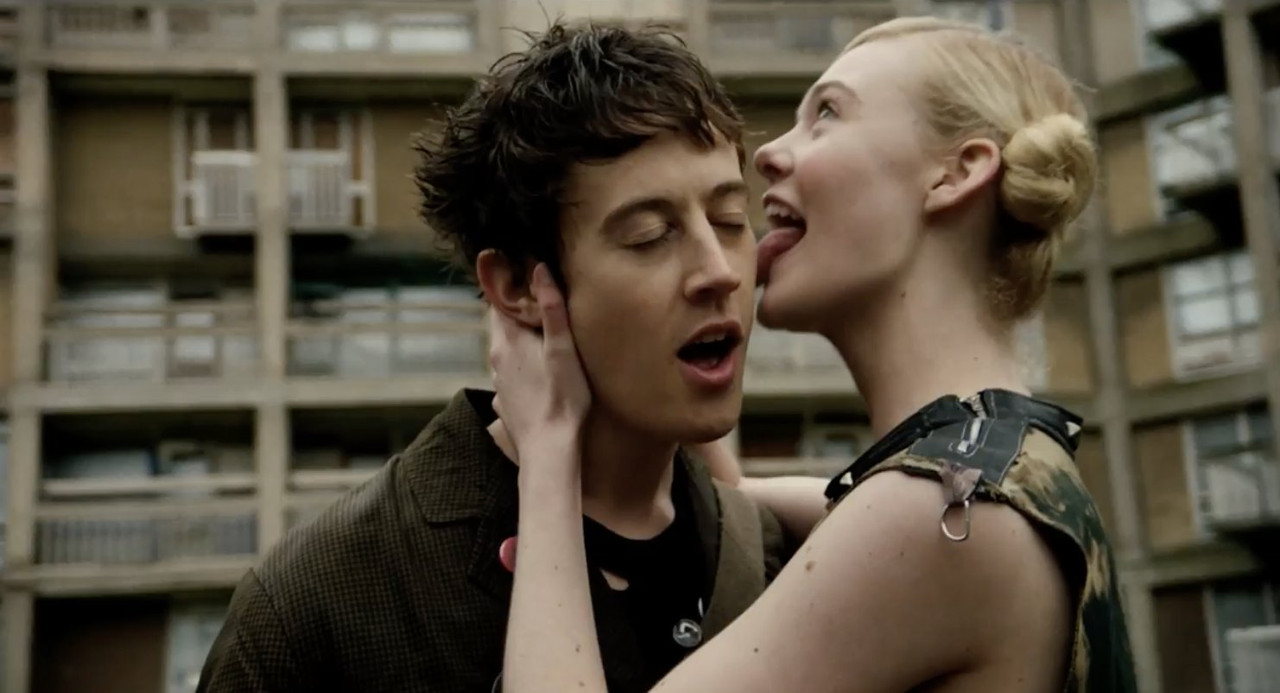
When you’re a teenage boy, girls might as well be an alien species, so the fact that Zan (Elle Fanning) is literally out of this world doesn’t make her any more unusual to Enn (Alex Sharp). Not that he realises she's an alien, he thinks she’s escaping from a cult. It’s 1977 and Enn and his friends are teenage punks in Croydon. Stumbling into what they think is an afterparty for the gig they have just been to, the end up at an abandoned house that Zan and the other beings from the six colonies that make up her species have taken over. When Enn tells her about punk, Zan is fascinated. Rebelling against her colony, Zan leaves the house with Enn, hungry for new experiences in her unfamilliar human form.

John Cameron Mitchell’s adaptation and expansion of Neil Gaiman’s short story is an eclectic mix of genres and influences: a punk sci-fi coming of age comedy, with a sex and kink positive message and, at its heart, a genuinely affecting love story. Mitchell and co-screenwriter Philippa Goslett mash these disparate elements together into a narrative that is sometimes chaotic, but always full of energy and ideas, be they in the film’s story or its wildly colourful and inventive design.

Along with costume designer Sandy Powell, Mitchell creates a distinctive look for the aliens, both as a species and within their individual colonies. All of them are dressed in skin-tight latex, but each has their own colour and their own look. The Stellas are the most sexualised, with the females wearing different coloured material to highlight their bodies, while another group are dressed somewhat more conservatively, the same material fashioned into blue suits. This way of distinguishing between the various colonies extends into their behaviour and even their movement. There are sure to be many subtleties here to pick up on subsequent viewings.

Set against this colourfully strange world there is the Croydon of 1977 (Sheffield subs for the exteriors). In many ways, punk and Zan serve similar functions in Enn’s life; injecting colour and excitement into a dull, grey, time and place. This is where Elle Fanning is perfect casting. I’ve said before that I think Fanning may be the most naturally gifted actress of her generation, and this is one of her best and most finely detailed performances. As she has observed, there is a risk inherent in playing a character who is engaging with the world for the first time that they appear to be stupid, thanks to their misunderstandings of language and social codes. This is not what we get from her as Zan. Yes, there is humour inherent in her telling Enn “I would like to go to the punk now” or telling his mother that she is going to the toilet for the first time, but what we get from Fanning is a sense of Zan’s boundless curiosity and enchantment with everything she is discovering, particularly her own sense of freedom, which is restricted in her colony.

There are the expected broad strokes to Fanning’s performance, but it’s the subtleties that make it. The way she moves is especially interesting; at first there’s a stiffness, she’s getting used to being in this body, but she loosens her physicality as Zan spends more time among humans, both because she is learning to mimic their movement and because she is adjusting to her new form. This is something we also see in the way she observes the world, Fanning has that rare gift of being able to let us see the character thinking. That’s another thing she first shows as pronounced. In the beginning, Zan’s observations are obvious, and often stated as well as simply made, but this is something else that gets naturally folded into her persona, as she becomes more comfortable around people. We get so much of the character through Fanning’s physicality, but she also exhibits great comic timing with her dialogue, and unforced chemistry with Alex Sharp that aids the film’s love story. Sharp also delivers a strong performance, lifted by Fanning and by Ethan Lawrence and Abraham Lewis, who play Enn’s best friends. The dynamic between them is believable and fun and, while it’s a different generation depicted here, there was much in the way they interact that felt familiar from my own teenage years.

In a largely excellent supporting cast, Ruth Wilson stands out as PT Stella, bringing a deadpan comic sensibility that I didn’t know she had. She’s particularly funny at the end of the film when she too begins to rebel. On the downside, there is Nicole Kidman. Tone is important in comedy, and Kidman is the only actor to miss it. As Queen Boadicea she’s a punk matriarch for whom the movement came too late. As an actress, she’s trying too hard. The accent is laughably broad and she overplays every moment to the hilt. It’s especially interesting to see her strain her every acting muscle in her few moments with Fanning, whose unaffected work has much more impact and embodies the character rather than performing it. Only in one moment, a stare down with Ruth Wilson, does Kidman stop working long enough to be similarly effective.

Mitchell and Goslett’s screenplay strikes a good balance between fish out of water comedy and the growing connection between Enn and Zan. The jokes largely hit and the love story is touching and feels organic; as Zan comes to love Earth and people she grows to love Enn in particular. It’s a rather beautiful thing, believing through Fanning’s performance that this is the first time this being, who is likely thousands of years old and has been through many life cycles, has experienced these emotions. The film also hits some truth about our relationship to music; the community that surrounds certain scenes and the sense of belonging that engenders, as well as the transporting nature of finding a song or a band that means something to you. This last aspect Mitchell takes in a way that is both literal and trippy.

I’m genuinely shocked by how divisive How To Talk To Girls At Parties has been. I can see how its tone will either work for you or not. I found it involving and moving as well as very funny. What I can’t see is how you can fail to appreciate how well designed it is, how Mitchell creates a whole offbeat world for his aliens inside their house. Nor do I get how you can fail to appreciate the many deft touches in Elle Fanning’s performance. Ultimately I think this is destined to be a cult item, appreciated by a group of fans I imagine will grow once the film lands on home formats after its disappointingly limited cinema run. At least, I hope that’s what happens.
★★★★