Showing posts with label Biopic. Show all posts

May 10, 2015

Rosewater [15]

Dir: Jon Stewart
Jon Stewart does a valuable thing on TV. For sixteen years he's mocked the powerful and used his comedy as a platform to better inform viewers than many news stations that aren't satirical manage. His first feature film as writer and director seems born out of a desire to more seriously examine what is happening to some journalists who seek to tell the truth. This is an important idea, but Stewart fumbles the ball.

Rosewater is the story of Maziar Bahari (Gael Garcia Bernal), an Iranian Newsweek journalist who was imprisoned and accused of being an American spy after reporting on the Green revolution of 2009. The film largely follows his time - five months - in prison as his interrogator Javadi (Danish actor Kim Bodina) attempts to break him down and make him confess.


Stewart has cast good actors in the leading roles, but the casting itself is problematic. I understand the commercial pressures that mean this film has to be in English, but this is one of many things that make the frequent interrogation scenes feel more like acting exercises than glimpses of what happened to Bahari. This is an Iranian story, the specifics of it have international implications, but it's an Iranian story, about Iranian people.  For me, having it delivered in English casts an inescapable layer of artifice over the whole film. 

Beyond this, there is a stilted quality to the performances; everything feels stiff and stagy.  I'm not sure how Stewart handled directing the cast, but at times it feels as though Bernal and Bodina, who aren't bad despite weak and repetitive dialogue, are crying out for notes. And yet, these may be the strongest parts of the film, so wildly miscalculated do other bits feel. 

While in prison, Bahari hallucinates and has conversations with his late Father (Haluk Bilginer) and Sister (Golshifteh Farahani). These scenes are marked by a drab and overly-literal visual style, and by some terrible dialogue. These scenes should be some of the most impactful of the film, but they ring false throughout, with the same uneasy performances and sense of too loose a directorial grip.  Stewart doesn't seem to know how to, either with dialogue or performances, mine these scenes for genuine emotion. Instead he settles for Bahari imagining his relatives spouting empty clichés and platitudes in his direction.

The setting, mainly inside the prison, gives Stewart a limited and very bare visual space to work with, but he never makes much of it.  We should feel the toll that the very drabness and tedium of his cell has on Bahari (or the ways he overcomes that seeming inevitability), but we don't. The space never feels dynamic; it never seems to press in on Bahari. Stewart never finds an interesting way to shoot the cell or the interrogation room. Limited space can create tension or force a director into interesting visual motifs - look at 12 Angry Men or The Silence of the Lambs - both of these things elude Stewart, and the film is often a dull watch because of it.

When Stewart does try to deploy a few bits of what passes here for directorial style, his inexperience shows through. A sequence of Tehran lighting up with onscreen hashtags feels like a lazy way to depict the Twitter drive of the Green Revolution and the bitty editing that he often employs to show the length and relentlessness of the interrogations is not just ineffective, it actively undermines the point he's making.

One extended moment that does work quite well occurs when Bahari is allowed, for the first time in months, to call his wife.  He's supposed to tell her to stop saying bad things about Iran, but instead, of course, simply reconnects with her and asks how her pregnancy is progressing.  Bernal is effective in this moment, especially when Bodina yells at him that he must 'control this woman' and Bahari laughs in his captor's face, unable to contain his joy at speaking to his wife.  Even here though, problems persist.  The fact the whole film is in English slightly confuses the issue of whether Javadi understands all of what Bahari says to his wife.  If so, why is Javadi passive for so long, rather than insisting Bahari stick to the script?

One scene is truly fascinating, though less for what is happening in front of the camera than what it implies about what is happening behind it.  A restaging of Bahari's parodic interview with The Daily Show's Jason Jones, which was then used as 'evidence' against him by his captors, is decently shot and acted. What makes it more interesting than that is Stewart's tangential involvement. This pervades the film, making the whole thing feel like one long letter of apology to Bahari.

Ultimately, Rosewater is as well-intentioned and sincere a piece of work as that scene implies. Nevertheless, it fails on most counts.  Stiffly acted and poorly directed, it never communicates the importance of its story and never feels like anything more than a scratch at the surface of what happened to Bahari, and continues to happen to many other journalists.  Perhaps Jon Stewart should stick to talking about these issues by being scathingly funny.
★★

Jan 15, 2015

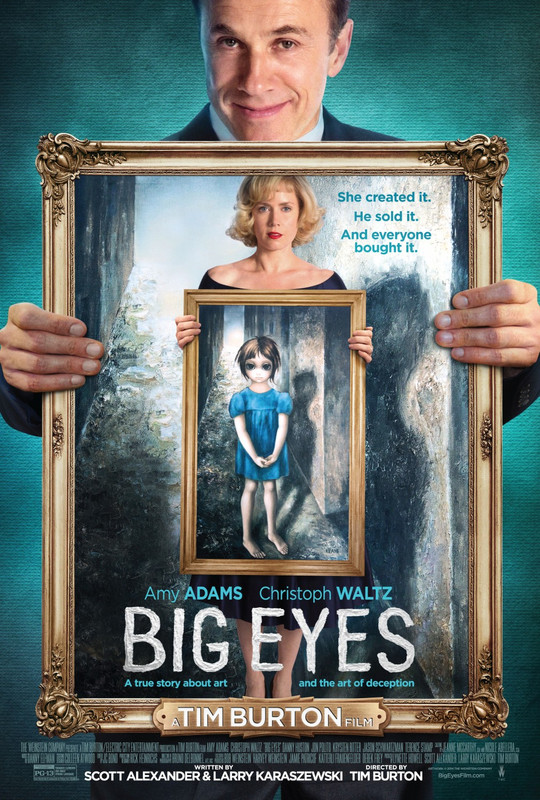
Big Eyes [12A]

Dir: Tim Burton
In recent years watching Tim Burton's films, especially his live action work, has been frustrating more often than it's been fun.  The quirky eye that was novel in his early films became a crutch, as did the frequent presence of his muses, his partner Helena Bonham-Carter and his friend and collaborator Johnny Depp.  Depp, in particular, did amazing work in his early collaborations with Burton, but what was quirksome stagnated and became simply irksome, approaching self-parody.

Big Eyes, then, is in many ways just what the doctor ordered for Burton's live action work.  It reunites him with Ed Wood writers and offbeat biopic specialists Scott Alexander and Larry Karaszewski and removes the twin crutches of Bonham-Carter and Depp.

The film tells the story of Margaret and Walter Keane.  Margaret was the artist behind the paintings of big eyed children which became fashionable in the 60's and were apparently some of the first paintings to be printed and sold to the masses as posters, rather than just to collectors.  Walter, by contrast, claimed to be a painter of landscapes, but was in reality a fraudster.  He convinced his wife to let him take credit for the big eyed children, manipulating her for years.

For the most part, Big Eyes is a sedately shot film, its visual identity coming less from the Burton playbook than it does from the pastel kitsch of the decade between the late 50's and late 60's.  There are, however, a few moments that fit more easily in to Burton's trademark look, be it the impossibly green rolling hills that recall Alice in Wonderland as Margaret drives past them, while leaving her first husband in the film's opening sequence or the surreal sequence of big eyed people staring at her in the supermarket.  However, here these excursions to Burtonville don't feel, as they have lately, like the director running out of ideas and resorting to self-plagarism.

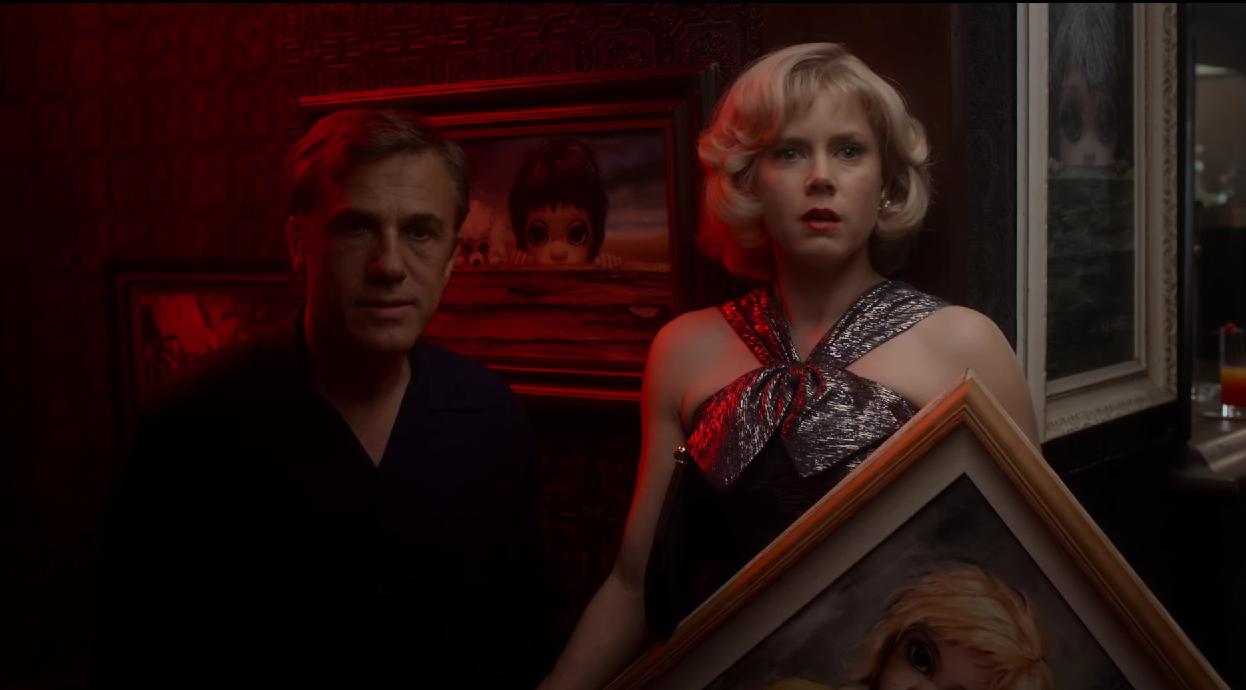
Another thing that seems to refresh Burton somewhat is the presence of Amy Adams.  She's perfectly cast as Keane, looking remarkably like the archive pictures shown with the film's closing captions.  She gives Margaret a delicacy and naiveté that, without making her seem stupid, allow you to believe how she is taken in by the flamboyant Walter.  It's also an interesting quirk of casting that Adams has the sort of wide, open eyes that, as well as letting us see something of what her characters are thinking and feeling, suggest that - at least in the film's reality - Keane's art might have begun as an exaggerated self-portrait.

Adams' performance here is small; detailed but simple, but she has shown in films as varied as Junebug, Enchanted and American Hustle that she can also give big performances that nevertheless ring true.  This doesn't seem to be the case with Christoph Waltz, who plays Walter.  

Waltz came to prominence playing the cheerfully evil Hans Landa in Inglourious Basterds.  That performance was a surprise, a breath of fresh air in a genre that can be rather po-faced and encourage nothing more nuanced than a straightforward officiousness.  Unfortunately, every time I've seen Waltz since he's given basically that same performance.  Waltz never stops seeming actorly.  As Walter he has an energy bordering on mania, delivered with the grinning hammery of a slimy, but very effective, salesman.  This may be appropriate to Walter Keane's real character and might work better if we felt it was Walter who is the one putting on this performance.  Unfortunately, because Waltz has played these beats before, because you can see Landa and Dr King Schultz in what he does here, that distinction falls down and it ends up being Christoph Waltz we see acting, not Walter Keane.

The supporting cast sometimes give Big Eyes more of the feel of a Coen Brothers than a Tim Burton film.  Many players drop in for one or two scenes, most of them at least slightly tongue in cheek.  Krysten Ritter (herself big eyed enough to be an anime character) has a slight part as a free spirited friend of Margaret's, but makes the best of limited screen time.  Erring more on the comic side are Jason Schwartzman; dry and droll as a pretentious gallery owner and Terrence Stamp as an art critic who dismisses Margaret's art as pure kitsch (he's got a point).  Stamp has a lot of fun as the purse-lipped and, the film would seem to suggest, over-serious critic, but he also gets stuck in one of the film's worst scenes as Waltz - hamming to high heaven - berates him for a bad review of 'his' latest painting.

Alexander and Karaszewski's screenplay is played straighter than their Ed Wood or People Vs Larry Flynt work, it's also pretty straightforward biopic box ticking at times, especially in the very minor acknowledgement it gives Margaret's apparently short lived issues with alcohol.  That said, both Margaret and Walter are well drawn (the problems when it comes to Walter are with the performance and with Burton's direction of it) and the dialogue is good, often quite funny.

Big Eyes finds Tim Burton closer to top form than he has been in live action for two decades.  It's certainly not perfect, and the fact that one of the central performances is the film's biggest issue means I can't quite wholeheartedly recommend it, but it's often fun, well played by most of the cast and Amy Adams elevates even its weakest moments.  Hopefully Burton can build on this and deliver something truly great again.
★★★

May 15, 2014

Tracks [12A]

Dir: John Curran
I had an inkling of how good an actress Mia Wasikowska would prove to be right from the start.  I pretty much hated Tim Burton's Alice in Wonderland (as did all right thinking humans), but even in that ugly digital world, there was something about the young Australian actress that stood out, beyond her obvious beauty.  Tracks gives Wasikowska one of her most challenging roles to date.  She plays Robyn Davidson who, in 1977, trekked largely alone across 1700 miles of desert from Alice Springs to the Pacific Ocean.  The film documents her walk and her relationship with National Geographic photographer Rick Smolan (Adam Driver), whose interest in the story made her adventure possible.  

For the bulk of the film's running time, the actress is left alone (aside from four camels and a dog) to carry the film on her shoulders and she does an admirable job.  Wasikowska is a likeable presence and even at her spikiest (generally in the sometimes unwelcome moments that Rick shows up) Robyn remains a likeable character, someone whose journey we are happy to be along for the ride on.  Much of Robyn's journey has to be communicated through Wasikowska's physical performance and this is sometimes just as much the case when there is another character on screen as when Robyn is trekking alone.  Wasikowska is especially good in the scenes opposite Driver, her physical performance full of signs that he, somewhat understandably, misreads.

Driver has the only large role among the supporting cast and while the progression of Robyn and Rick's relationship is hardly a surprise both sides are well played.  Driver has a particularly good moment towards the end of the film, as Rick shows his concern as Robyn embarks on the most dangerous part of her trek.  The rest of the supporting cast largely appear for one or two scenes each, but while they've little time to develop rounded characters there are no performances that let the side down.

There is only so much that can be done with a story like Robyn Davidson's, and John Curran tells it in a very straight A to B fashion, however, this telling suits the story well.  The tale is linear, with bumps and encounters along the way.  Convenient as they may be as narrative stopgaps, Robyn's encounters with other people don't feel shoehorned into the story, and the down to earth performances aid in avoiding much feeling of contrivance.

Curran does occasionally depart from the down to earth style that he lays down, with scenes that are more impressionistic.  The best of these is an almost surreal encounter with a man on a motorcycle trip through the same desert that Robyn is walking.  The abruptness and shooting style leave it up to audience interpretation whether this is a real moment or a mirage.  Less successful are the occasional flashbacks to Davidson's childhood.  They add little and, in one case involving Davidson's beloved dog, serve only to pour sugar on a genuine emotional moment.

Tracks looks pretty spectacular.  That's no real surprise, given the landscape it has to work with, but there are some beautiful choices by Curran and DP Mandy Walker that show off both the terrain and Wasikowska's performance to their best advantage.  The most interesting visual moments often play with the idea of mirage, especially in a sequence in which Davidson is walking naked, but there are also some strikingly stark moments, particularly whenever Davidson has to use her rifle.

This isn't a film that anyone will mistake for being groundbreaking or even adventurous, but that's okay, it's impeccably made and acted and, happily, manages to tell Robyn Davidson's story without turning it into a sentiment drenched 'inspirational' tale.  This is a beautiful and compelling film and there are too few of those about in the mainstream. 
★★★

Aug 29, 2013

Lovelace [18]

Dir: Rob Epstein / Jeffrey Friedman
There are two narratives about the life of Linda Lovelace (here played by Amanda Seyfried), and since both were at some point aggressively promoted by Lovelace herself it is difficult to know which is more credible.  Rob Epstein and Jeffrey Freidman's film certainly knows which story it believes, but it also seems to recognise the difficulty of reconciling the two sides of the story it instead presents them back to back, with the story rewinding at a certain point to show the other side of events we've already seen.

In the first half of the film we see that Linda Boreman is a pretty 21-year-old living a reasonably sheltered life with her parents (Sharon Stone and Robert Patrick).  One day she meets and falls for the much older Chuck Traynor (Peter Sarsgaard).  Linda and Chuck are soon married, but they have serious money problems and in order to solve them Linda agrees to be in a porn film that will show off a special talent she has developed.  That film is Deep Throat, and it makes Linda an overnight star as Linda Lovelace.  In the second half of the film we see these events again, but with a darker side visible.  There are skeletons in the closet of Linda's relationship with her mother.  We see the abuse that is present in Linda and Chuck's marriage from the beginning, the coercion that he exercises to get her into sex work and her attempts to leave him.

Lovelace tells an interesting story and goes about it in a way that is different from other biopics and reflects well the particular challenges of presenting this life in a film.  Overall it boasts quality parts, but there are also problems that dog the film, making it difficult to embrace as a whole.

Amanda Seyfried represents both the best and the worst aspects of the film.  She's good as Linda, and sympathetically puts across her naivete and her reluctance once she's involved in the porn world (hard as it is to take that at face value if you know what the film leaves out).  On the other hand, Seyfried looks absolutely nothing like Linda Lovelace, and putting a frizzy 70's wig on her helps the illusion about as much as painting a greasepaint mustache on me would make me look like Groucho Marx.  This wouldn't matter so much if Lovelace's looks were not so much part of her trade in the film.  Lovelace was notable - outside of her oral talents - for her plain, girl next door look and slender, small chested, body.  It is distracting how little of this Seyfried manages.  Try as she might, she's not plain looking (in fact she looks much more the stereotypical pornstar than Lovelace did) and her body, despite a diet that she has complained reduced her bust size, also looks nothing like Lovelace's.  Were the script or the performance brilliant this might all matter less, but both of those things tend much more toward simple adequacy.

Peter Sarsgaard is a great actor, but he excels at playing bastards, and Chuck Traynor certainly gave him plenty to work with.  Right from the off he suggests something untrustworthy behind the outwardly sweet and smooth guy that Linda falls for.  This is something he shows really well as, over dinner, he manipulates Linda's parents into liking him.  Chuck is too one note to be the film's most interesting personality, but Sarsgaard makes him fascinating, if in no way relatable or sympathetic.

The other supporting performances tend to be broad, whether it's Sharon Stone as Linda's stern mother, Hank Azaria as Deep Throat director Gerard Damiano, an entertaining performance as a man stuck somewhere between sleaze and art or Adam Brody, who has an absolutely brilliant time playing Linda's co-star Harry Reems, and is hilariously funny in the scenes that recreate Deep Throat.  Stuck with disappointingly little to do is the brilliant young British actress Juno Temple, playing a friend of Linda's.  Temple wouldn't be terribly notable here, except that there is a sense that she would have made a much more interesting choice as Linda Lovelace, given her daring as an actress and her (somewhat) closer resemblance to Linda.  A little nuance comes from Robert Patrick, who stands out in a scene where, over the phone, he tells Linda that he saw her movie.  This is also Seyfried's best scene, the mix of emotions quite raw on her face and in her voice.

While their structural ideas are interesting, Rob Epstein and Jeffrey Friedman otherwise struggle for a sense of directorial identity.  The scenes recreating the shoot of Deep Throat have a cut rate Boogie Nights feel to them, and there is little invention in framing, editing or look to enliven the film.  The period detail also feels rather like a surface gloss on the film; as if everyone is playing extremely harrowing 70's dress up.

Perhaps the film's biggest problem is the fact that, at just 93 minutes, it feels as though it has been shaved down to the bone in editing.  This may well explain why the whole thing seems painted in such broad brushstrokes, and why so much detail is left out.  For instance, we have no sense that Deep Throat is not Linda's first porn film, in fact, she was in several 8mm 'loops' in the early 70's, including the charmingly titled 'Dog F**ker'.  At one point during the third act we see Chuck taking Linda to a hotel room to meet some men, I assumed that this would be to film that infamous 'loop', but in fact the film never acknowledges this happening.  Another thing that is brushed under the rug is Linda's brief flirtation with the mainstream, starring in softcore comedy Linda Lovelace for President.  The rush to the credits is most damaging in the third act, which completely leaves out the process of Linda going from porn star to anti porn crusader (Sarah Jessica Parker was cast as Gloria Steinem, but her scenes were cut) and any mention of the comments she made at the end of her life that she often felt used by that movement as well.

Somewhere between this film, the footage on the cutting room floor, the script and the life of Linda Boreman there is likely a great film.  Brief glimpses of it peek through here, but on the whole that isn't the film up on the screen.  It's certainly a harrowing and sometimes well acted piece, but indifferent direction, a rushed - if original - structure and a somewhat miscast lead regularly derail the film.
★★

Jul 22, 2013

The Frozen Ground [15]

Dir: Scott Walker
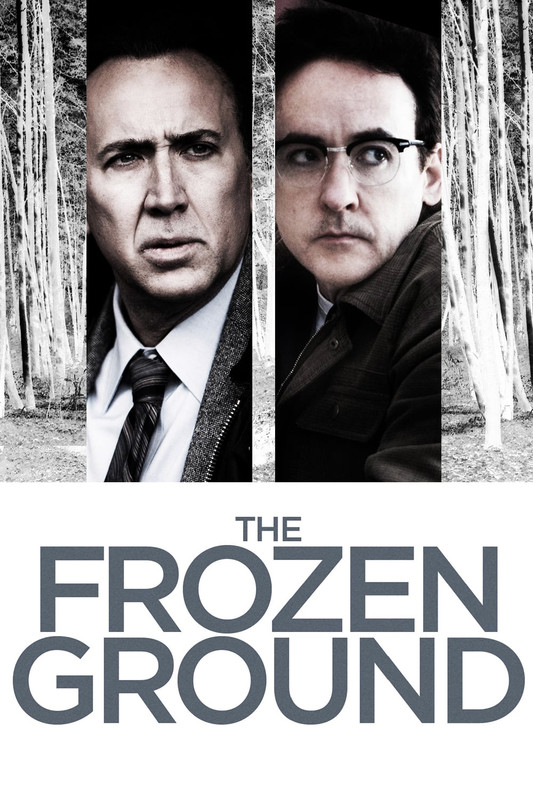
There have been many films made about serial killers. Some are pure fiction, others factually based. Some are brilliant, others godawful. The Frozen Ground takes the true story of the hunt for evidence to arrest serial murderer Robert C. Hansen (John Cusack), who raped and killed at least 17 women, killing them out in the woods in the same manner that he hunted animals, and gives it the blandest, most down the line, most completely average telling that it can muster.

This is a pity, because The Frozen Ground initially seems to have rather a lot going for it, not least an extremely eclectic cast. Director Scott Walker and his casting team have made some interesting choices with their leads, casting the two main figures – Cusack as Robert Hansen and Nicolas Cage as the Alaska State Trooper who believes that Hansen is his man as more and more missing girls fit the victim profile – very much against type. Among a cast that sometimes seems to have been assembled by throwing darts at a list are Vanessa Hudgens, as a young woman who escapes Hansen and helps the troopers, character actors like Kevin Dunn, Kurt Fuller and Radha Mitchell and Curtis ’50 Cent’ Jackson, who is also a producer here.

This eclectic cast isn't used to the film’s best advantage. Among a quality supporting cast, the talented Radha Mitchell is – again – completely wasted on a nothing role as Cage’s wife, but the major problems stem from the leads. Nicolas Cage is one of the oddest people in cinema, but he can rein that in and give intensely serious, emotional performances when that’s what the film demands. That’s certainly what this role demands, but Cage is incredibly subdued. There’s no real personality, not even really much of the intense drive that would have been needed to overcome the seeming bias that many had in believing Hansen when he denied the links being made between him and the crimes. Cage seems disengaged throughout, which is the exact reverse of what we should be seeing from him here.

Cusack is better, and there is a cleverness in his casting, or there would be if the film didn’t make it obvious from the off that Hansen is the killer. Cusack is a trustworthy presence, and that was also why Hansen, despite a nasty criminal history, was not initially taken more seriously as a suspect. He was a baker, a family man, seen as a pillar of the community, but the film only ever plays on the irony of this. Cusack does what is asked of him well, but the portrayal of Hansen is altogether too shifty too soon. Playing off the character against Cusack’s likeable persona would have been appropriate to the facts and would have added a sense of uncertainty and suspense to a film that fatally lacks those ingredients.

Vanessa Hudgens is a reasonably interesting young actress, and once again she does decent work in a rather stereotypical role. The portrayal of Hansen’s escaped victim Cindy Paulson may be very accurate, but it still feels like just one more typical hooker character, and the connection she develops with Cage is never that convincing. Hudgens does what she can with the broad characterisation and familiar situations, but it’s clear she’s better than the role. In another stereotypical role, which sticks out like a sore thumb in the film, Curtis ’50 Cent’ Jackson appears as Hudgens’ long haired pimp. He’s hilarious, entirely by accident. Jackson has absolutely no inflection, and looks like a very uncomfortable man in a bad wig throughout his thankfully limited screentime.

Ultimately this feels like a very surface treatment of Hansen’s crimes and capture. We never get deep into any of the characters and never really get much beyond the clichés of the serial killer film. After Zodiac, this simply isn’t good enough. It’s never incompetent; the story is communicated clearly, the performances are okay for the most part and it doesn’t entirely shy away from the nastier moments, but it feels perfunctory. Walker doesn’t bring any personality to the direction. There’s not a single image here that feels original, nor any stylistic choice that stamps an identity on the film. Without its classy cast The Frozen Ground would likely have landed directly on DVD, and it probably should have anyway.
★★

May 6, 2013

The Look of Love [18]

Dir: Michael Winterbottom
Michael Winterbottom is one of the most prolific directors of recent times, generally completing at least one film each year for the past two decades. As with almost any filmmaker with that sort of work rate, his films have a tendency to be hit and miss, but when he hits his work can be exhilarating, skipping with ease from one genre to another, adjusting his style film by film. Unfortunately, despite many elements that seem promising on paper, The Look of Love represents another off day.

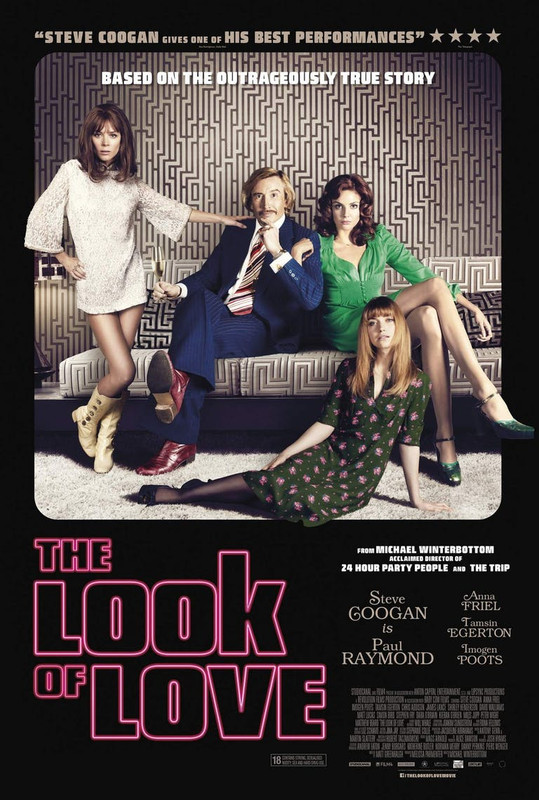
Two of my favourites of Winterbottom’s films; biopic 24 Hour Party People and satirical literary adaptation A Cock and Bull Story, have teamed him with British comedian Steve Coogan. Here the pair re-team, on a project that seems close in spirit to 24 Hour Party People. Coogan plays Paul Raymond; porn impresario, property magnate and one time Britain’s richest man, and the film follows him through about thirty five years, from building up his fortune and then largely through the lens of his relationship with his daughter Debbie (Imogen Poots), who he wanted to make his successor, despite her drug addiction.

The problem with The Look of Love is essentially that it fails to find a consistent tone, veering from farce to serious drama. Winterbottom’s casting hardly helps matters in this respect, as casting a lot of recognisable British TV comedians suggests a comic tone that is sometimes at odds with the content. It especially doesn’t help the few of the comics truly inhabit their characters, David Walliams, for example, could have stepped out of Little Britain as a priest who ministers to Raymond’s strippers. It also gives the film a rather televisual feel, which, despite a decent sense of period, Winterbottom’s direction fails to alter. In these terms, sadly, Steve Coogan is probably the worst offender; he essentially plays Raymond as a variation on Alan Partridge, rather than disappearing into the character the way he did as Tony Wilson in 24 Hour Party People. The overwhelming feeling is one of ‘oh, look, Steve Coogan in a wig’.

In the few scenes where he dials back the Partridge and embraces what is a life story packed with serious incident (family breakdown, drug addiction, terrible loss), Coogan is better and the film more engaging. The overarching story isn’t really that of Paul Raymond but of his relationship with Debbie (and to some degree his lack of a relationship with either of his sons), and it’s in the scenes with Imogen Poots that Coogan and the film are at their best. It’s not delved into with the complexity you might wish for, but the relationship between Paul and Debbie is well played, and Poots’ performance finds a way through the tonal mess and is rather affecting, especially in the way that Debbie is always out to impress and please her doting Father. Poots really excels when playing Debbie’s forays as a performer; being believable as a bad actor and singer is really tough, but Poots makes doesn’t push the boat out too far and make Debbie look comical, instead she gives us someone who is trying her utmost, but just isn’t very gifted. It’s a rather sad performance, and easily the best thing in the film.

The rest of the film essentially pivots around the other major women in Raymond’s life; Men Only columnist and later sexploitation star Fiona Richmond (Tamsin Egerton) and his second wife Jean (Anna Friel). Both are disappointingly peripheral figures, their stories rather rushed through to keep the film at a speedy 101 minutes. It’s a particular shame to see the talented Friel, who I’ve long thought would be a great fit for Winterbottom, in such a perfunctory role and exploited in a scene that documents the fact that Jean posed for Raymond’s Men Only magazine, which the film then does nothing with.

Winterbottom, Coogan and screenwriter Matt Greenhalgh seem to go out of their way to avoid any judgement of Raymond, and that just makes the film rather shallow and dull. In the moments when it attempts to shock us with depravity (for instance Raymond telling Debbie that if she’s going to do cocaine she should at least do the good stuff) it generally fails for the same reason much of the rest of the drama fails; it seems out of kilter with the comedic tone of the rest of the film.

Ultimately, Paul Raymond comes out of The Look of Love looking like a crap parent and a rather sleazy guy, but throw a stone in any town and you’ll be within striking distance of 3 men like that, and what this film doesn’t do is make Raymond seem any more interesting than any of them. It feels like one of Winterbottom’s intermittent nods to the mainstream, but he’s best when he’s riskier, messing with form as he has in his other projects with Coogan. Most disappointing is the lack of emotional engagement, which Winterbottom can do (look at Jude or Butterfly Kiss) and which, given the event this film begins at and subsequently circles back to, should be the centre of the film.

I understand that the film had to be retitled from King of Soho because Raymond and Jean’s son Howard is planning a biopic under that title, but honestly I’d much rather see a film about Debbie next time.
★★

Feb 12, 2011

The Fighter [15]

Dir: David O. Russell
David O. Russell is a unique, idiosyncratic filmmaker, he's a man whose take on the world seems skewed in a way that is genuinely different and refreshing, and he's brought it to life on screen in films like Three Kings and I Heart Huckabees, so it's a real disappointment to see him make something as basic and middle of the road as The Fighter.

There are two archetypal boxing films; Raging Bull and Rocky, most subsequent films on the subject have gone one way or the other; the behind the scenes angst and conflict of the Scorsese or the traditional underdog makes good story of the Stallone. The Fighter attempts to have its cake and eat it by doing both at once. Like Raging Bull the centre of the film is the fraught relationship between two brothers (and, also like Raging Bull, they are real characters and this is a true story). Micky Ward (Mark Wahlberg) is a welterweight boxer in his early 30s who has never quite hit the big time, currently trained by his older half brother Dicky Eklund (Christian Bale), whose career as a fighter is now over and who is in the grip of crack addiction. This relationship is the heart of the film, and for the most part, it is the thing that works best. From Wahlberg (whose remarkable, quiet, performance has been underpraised) you get a real sense of Micky's loyalty to and love for his brother, but also a palpable sense of both his disappointment and his anger with Dicky for potentially flushing BOTH their careers. Bale is also largely excellent, it's clear that Dicky is a larger than life character and obviously, he spends the span of this film in the grip of extreme emotions and substances. For the most part Bale's twitchy, tightly wound, turn is mesmerising, but there are a couple of occasions (generally in scenes with the wider Ward/Eklund family) in which he pushes the boat out just a bit too far, becoming a bit of a cartoon.

Talking of cartoons... Melissa Leo plays Micky and Dicky's brassy mother, a vile woman who seems to want nothing more for her sons than that they be around her all the time. She ignores Dicky's very apparent drug addiction and, though she's his manager, seems to wilfully undermine Micky's career. However, the problem isn't the character, it's how Melissa Leo plays her. Leo is a great actress, and a subtle one (see The Three Burials of Melquiades Estrada, Frozen River and the TV series Homicide for evidence) but here she's turned everything up to eleven in a scenery-devouring monster of a performance. There wasn't a second, not a frame, she appeared in that felt real to me, not a solitary moment that Melissa Leo and her frankly hilarious wig went away and I saw a character. I'm not surprised she's got an Oscar nomination for it, it's exactly the sort of awful showboating that AMPAS loves, but it will be laughable if she wins.

On the other hand, the film's second best supporting actress nomination, for Amy Adams as Micky's fiery bartender girlfriend, is richly deserved. Since Junebug Adams has proved herself likeable and talented, but there has been a question about her versatility, well, she's now answered them. Charlene is 180 degrees from the 'lovely girls' of Junebug, Enchanted and Julie and Julia and Adams is just about flawless in the role. She puts across Charlene's no nonsense toughness effortlessly, meaning that despite her slight build you buy into her ferocity in one key late scene. She's also got convincing chemistry and warmth with Wahlberg, which pays dividends in a funny, sweet, scene that follows their first date.

Though the combination of the more down to earth performances of Wahlberg and Adams with the larger work supplied by Bale and Leo's comic awfulness can create some tonal problems, the dramatic scenes with Micky and Dicky's family often work well, even if there is the sense that we've seen it all before (just because a story happens to be true doesn't mean it isn't cliche).

The other side of the film is the Rocky-esque stuff; the training montages, the fights themselves, and again it's not so much that this is badly done, more that it's been done so many times before, and there's little sense that O. Russell has found anything new to say or do with it. The fact that the fights are shot to look like HBO coverage (even going so far as to use the same cameras as HBO used in the early 90's) is a nice touch, but for the most part these sequences feel like compilations of O. Russell's influences rather than something coming from him.

I didn't hate The Fighter, there are things about it that I admire, but overall the film left me cold. If I really want to see a film about two brothers involved in boxing then I'll just go and watch Raging Bull again. Even recently there has been a much more edifying film about the sport; Fred Wiseman's mesmerising documentary Boxing Gym, which, with none of the histrionics that The Fighter often falls prey to, and none of the clichés either, says more about this sport and its practitioners in five minutes than this film manages in a hundred and fifteen.
★★☆☆☆

Jan 15, 2011

The King's Speech [12A]

Dir: Tom Hooper
This none more British story of our World War II era king George VI (Colin Firth) being given elocution lessons by a maverick Australian speech therapist (Geoffrey Rush) in order to overcome his crippling stammer so that he can make the most important speech of his life, has been a big hit at festivals including Toronto and London and is now being tipped for Oscars (one for Firth is likely assured). I skipped the LFF press show in order to go and see a weird Russian film instead, and I'm glad I did, because while The King's Speech is not a bad film by any means, it is also not a terribly remarkable one.

It's fine. The performances are fine, the screenplay is fine, the direction is fine, but it's never really much more than that, and the overall feeling is of something very safe, very familiar and ultimately more like Sunday evening TV than something that cries out to be in a cinema.

Colin Firth is very good as 'Bertie', more officially known, at least by the end of the film, as King George VI. He's very good at putting across the stammer as something natural; debilitating, but never overplayed, he's clearly done a lot of research and work on the voice, and it pays off. The problem is that this is a performance that works very much on the surface. In both Genova and A Single Man Firth gave performances in which much was apparent but never stated; a whole emotional story bubbling away beneath the surface, creating a full and rounded character. Here we don 't really get that with any of the characters, the script tends to be more about the events and any emotional revelations are spoken rather than suggested. It's not bad, but there's the sense that Firth can deliver a lot more than what is asked of him here.

This is equally true of the rest of the film. The excellent cast is rather under challenged by a script that feels very rote and familiar and offers most of them little to do. Helena Bonham Carter, for instance, is good as Firth’s wife (who later became the Queen Mother and lived to be 101, which makes it very likely that we’ll see Bonham Carter reprise this role in the future) but she doesn’t have much to do after the first twenty minutes other than be encouraging and give the occasional funny line. Among the rest of the supporting cast there is both good; Michael Gambon as Bertie’s father, Guy Pearce as Edward VII, whose abdication places Bertie on the throne and bad; Timothy Spall’s hamtastic Winston Churchill.

Geoffrey Rush, a consummate actor, is as good as ever as Lionel Logue, and his work never feels remotely actorly, he’s probably the most rounded character too, thanks to the fact that we get to see him with his wife (Jennifer Ehle, good in a thankless role) and kids and that we get a glimpse of his failed ambitions as an actor (Rush is especially good playing Lionel as a bad actor).

Tom Hooper’s direction isn’t bad, and the period detail is authentic, but there’s nothing especially cinematic going on here. Visually it’s all, like the writing, just a bit straightforward. On the whole, there’s not much worth shouting about in The King’s Speech for me it was neither particularly bad, it’s a solid effort from all concerned, entertaining enough to pass its running time, but unlikely to trouble either my thoughts or my dvd player in the future. It’s a nice film, more for my parents than for me. When Colin Firth wins his Oscar in a few weeks it won’t be a travesty, but it will be a shame, because good as he is this is far from his best work.
★★☆☆☆

Feb 18, 2009

Notorious [15]

Dir: George Tillman Jr.
As a middle-class white kid from the south east of England it’s probably odd that the first music that ever really connected with me, at the age of fourteen, was gangsta rap. From NWA, to Ice T, to the Wu Tang Clan and the subject of this movie; Christopher Wallace, a.k.a. Biggie Smalls, a.k.a The Notorious BIG, I listened to them all. I remember being played BIG’s debut album, the rather magnificent, and sadly prophetically titled, Ready to Die by a friend, and being amazed by his lyrical talents. It’s a shame that he didn’t get a better biopic.

No biopic can encompass a person’s whole life, but Notorious does represent a shocking whitewashing of Christopher Wallace’s (Jamal Woolard) short and, his music aside, not especially admirable, life. It’s easy to see why this is the case, listed among the producers are Wallace’s mother Voletta (Angela Bassett) and his producer and friend Sean ‘whatever silly alias he’s going by this week’ Combs (played, as a man so close to angelic it’s a shock he doesn’t have wings, by Derek Luke), who both have significant financial interest, and in Combs case possible legal interest, in putting the best face on aspects of Wallace’s life. While Notorious does acknowledge that Wallace was a drug dealer, and a poor husband and father it also makes sure to offer excuses for all these things, and refuses to show any of them as having real ramifications. In the most nauseating moment in the film a woman who we had previously seen Wallace sell crack while she was pregnant, literally skipping along the road with her impossibly cute son, as if to say ‘look, she got clean, so it doesn’t matter what he did in the past’.

This hagiographic tone also means that much of the movie’s screenplay clunks horribly, with some of the most contrived and unnatural dialogue I’ve heard for some time such as, from Combs: “We can’t change the world unless we change ourselves”. It also means that one of the most important events of the story, the east coast-west coast rap feud, which led to the deaths of Tupac Shakur (Anthony Mackie) and Biggie himself in drive by shootings, is almost swept under the carpet. The events of this ‘war’ are still the subject of much debate, and there is still controversy over what Combs and Wallace’s role may have been in Shakur’s death, and the film never acknowledges or engages with this question.

Notorious does occasionally get it right. Most notably with the casting of Jamal Woolard as Wallace, the debuting actor added 50 pounds to an already expansive frame for the role, but it’s not his weight that impresses as much as it is his charisma. Despite how awful a person Wallace clearly was Woolard brings a humour, an affability, that makes you believe why people would have wanted to help him. The big hurdle, the thing that Biggie did best, was always going to be the music, but it’s in these sequences that Woolard’s performance really explodes into life. He’s a strong rapper, and bears a great vocal resemblance to BIG. In the music sequences the film takes off, and you become a member of Biggie’s crowd, transported into the club.

There’s another strong and charismatic performance from Naturi Naughton, whose turn as ‘Lil Kim has angered the rapper herself, but she’s the only person who ever threatens to take attention off Woolard, particularly in her own concert scene. Derek Luke works hard as Sean ‘I’m not going to call him by his nickname’ Combs, but he’s undone by both the fact that he looks so little like Combs that it undermines his work, and that Combs is portrayed in a fashion even more whitewashed than Wallace. Anthony Mackie has perhaps the hardest job in the film, playing Tupac Shakur, whose own searing charisma was an asset to several movies, in this respect Mackie comes up sorely lacking and the performance feels like an enthusiastic imitation done as a party piece. Angela Basset has a hopelessly cliché role as Voletta Wallace, but plays it well, and Wallace’s son with Faith Evans, Christopher Jordan Wallace, does a fine job playing his late father as a child.

George Tillman, Jr hasn’t directed since Men of Honour nine years ago, and it seems to show, because this poorly paced and irritatingly stylised film feels like the work of a rusty craftsman. It’s a shame Notorious isn’t better, because BIG deserves a good movie, but there were other interests at work here.

Milk [15]

Dir: Gus Van Sant
I’ve seen a good few of Gus Van Sant’s films now, from the unspeakably boring Elephant, to the overrated Good Will Hunting and the quite monumentally pointless Psycho remake, so his name on this biopic of Harvey Milk didn’t inspire confidence, but Milk is an intriguing figure; the first openly gay man to be elected to major office in the US, and the assembled cast promised good things.

Directorially Milk is somewhat anonymous. Van Sant puts away the vérité stylings that have marked (and marred) his work since Elephant and opts for a much more conventional approach in both shot selection and pacing. He also makes clever and illuminating use of archive footage, without making its use feel like a gimmick. Van Sant, as a gay filmmaker, could easily have used this film to make a big personal and political statement but, while the film obviously takes Milk’s side in the political conflicts it depicts, it doesn’t batter you with the message.

Perhaps Gus Van Sant’s most valuable contribution to the project is his role in drawing out a set of excellent performances from a large and eclectic cast. Sean Penn is Milk’s best hope for Oscar gold, and it’s hard to disagree with his nomination. The voice sounds like a stereotype, but the performance isn’t. The film may be entirely uncritical about Milk, but Penn manages to step away from the idealisation of the character and make him human. Also, for an actor who appears so aggressively heterosexual both on and off screen he makes for a surprisingly convincing gay man, and has especially strong chemistry with James Franco.

Josh Brolin, whose career has been through a Lazarus like renaissance of late, is also Oscar nominated as Dan White, Milk’s fellow city supervisor and eventual assassin. Brolin is typically excellent as the buttoned down, uptight, fiercely traditional White, but manages to make this bigoted, deeply unattractive, man understandable if not sympathetic. The aforementioned Jamees Franco very nearly steals the film as Milk’s lover Scott Smith, it’s a vibrant and engaging performance from a man who, with every passing performance, is growing into one of Hollywood’s most reliably interesting actors.

Milk has plenty to say, and at a time when a minority has just been elected to the highest office in the land, but a gay rights bill voted down at the very same poll, it’s an extremely relevant work. It’s not an issue movie though; it depicts the issue and the campaign against Proposition 6 (which would have allowed schools to fire teachers purely on the basis of their sexuality) as an event in Milk’s life, rather than using it to lecture the audience. The same balancing act is present with the movie’s depiction of the various gay relationships, and it is just as well struck, with Van Sant neither shying from depicting them nor obsessively focusing on them, instead it’s simply matter of fact.

Moving at a brisk pace, with well-used narration from Penn, Milk is always engaging, particularly if you don’t already know the events of the story. It’s more an actor’s movie than a director’s, but that works very much in its favour, given the excellent performances.

Jan 24, 2009

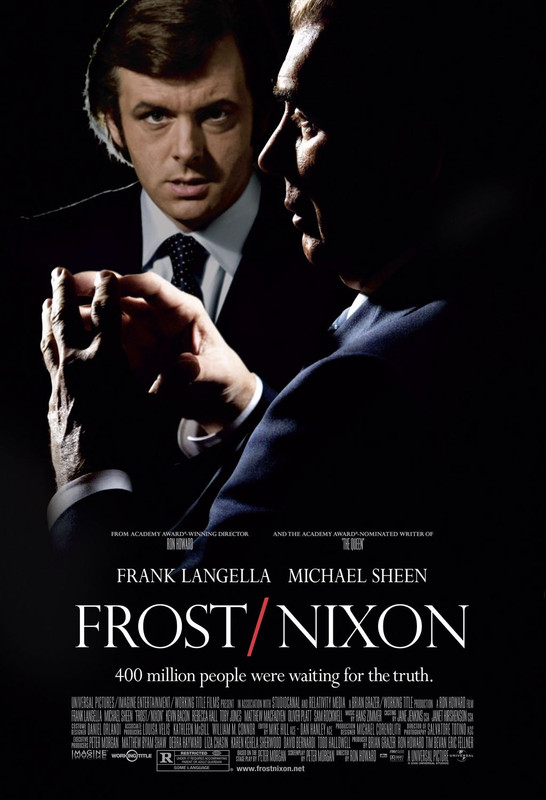
Frost/Nixon [15]

Dir: Ron Howard
Frost/Nixon is an odd fit for the cinema, a story about television, based on a play, the movies wouldn’t seem to be its natural home. However, under the unobtrusive direction of Ron Howard, the story makes a surprisingly natural transition to the big screen. The story is that of a series of interviews with disgraced ex-president Richard Nixon (Frank Langella) conducted by British talk show host and comedy performer David Frost (Michael Sheen). Writer Peter Morgan (who also scripted The Queen) fictionalises the build up to the interviews, and the relationships between the major players on both sides.

As the title implies much of Frost/Nixon rests on the shoulders of its stars. Langella is picking up most of the accolades, including an Oscar nomination, for his Nixon. He looks nothing like tricky Dick, but the gruff voice, and the demeanor of the man, come across brilliantly. Where Langella really excels, particularly given how often Nixon has been portrayed on screen before, is in giving more than just an impersonation of the man, more than a caricature, he manages to make Nixon human, even to make him sympathetic at times, giving a fresh perspective on a man about whom much has been said.

Michael Sheen doesn’t, sadly, come off as well. Sheen has made playing real-life characters something of a stock in trade. He’s done an uncanny Tony Blair, Kenneth Williams and is appearing as Brian Clough soon. Frost seems a bit undefined. He gets the impersonation down in the first few scenes, but then he lets it slide, and ends up slipping into his Blair for a lot of the film, with the notable exception of the last interview, in which the Frost impression returns to full force. The problem is that, unlike with Langella, I could never really shake the feeling that, however good he is technically, what I was watching was Michael Sheen doing impressions.

There is a similar mix among the supporting performances. Former Spooks star Matthew MacFadyen lets his wig do most of the work for him as John Birt, and the talented Rebecca Hall is largely reduced to sitting next to Sheen and looking pretty, while Oliver Platt does his patented comic relief part as well as ever. There are standouts though; Kevin Bacon is excellent as Nixon’s closest aide, particularly in a conversation with Sheen just before the first interview session, Sam Rockwell makes more of his part as a researcher than was likely on the page and Toby Jones, in just a handful of scenes as Nixon’s agent ‘Swifty’ Lazar, very nearly steals the film out from under Langella’s nose.

Stylistically Ron Howard indulges in few flourishes, the use of ‘documentary’ footage of some of the leading players is odd and out of place, and it feels truncated, as if there is an abandoned framing device sitting on the cutting room floor but otherwise his major choice is to make extensive use of tight close ups in the interview sequences, the one thing that theatre can’t do, and a decision that really hammers home what the film is really about; the power of television.

Frost/Nixon is certainly talky, but it’s never dull, screenwriter Peter Morgan combines fact and fiction literately, putting believable dialogue into the mouths of all of his characters, even when some, like Hall’s are left a touch underdeveloped. The major problem with the film is that not all of the performances come up to the high mark set by some of the cast, but the film is still worth checking out, especially if you have an interest in the era, or in politics in general.

★★★

Jan 4, 2009

Changeling [15]

Dir: Clint Eastwood
Clint Eastwood’s latest directorial effort is based on the real case of Christine Collins (Jolie), whose 9-year-old son Walter disappeared in 1928. Five months later a boy the LAPD claimed was Walter was returned to her, and despite repeated protestations that the boy was not her son the Police refused to acknowledge their mistake and resume the search for Walter.

At almost two and a half hours Changeling is something of a marathon, and in it there are probably several interesting films, but this one never quite catches light. It’s not that the pedigree isn’t strong. Eastwood has matured over the years into a fine director, much more interesting behind a camera than he is in front of one. Changeling certainly looks good, the period feel is recreated with great fondness and attention to detail, and there’s nothing that breaks the illusion, while the fluidity of Eastwood’s compositions and easy flow of the editing make it an easy, if traditional, watch.

Outside of the visuals, the film is more of a mixed bag. Jolie’s performance has Oscar bait written all over it, and it’s all the things both good and bad that that implies. There are a lot of scenes in which her quiet conviction is truly moving, but there are also moments (and if she’s nominated I’d bet my house on one of them being her clip) in which she goes a bit overboard, tipping into histrionics. There’s also the ever-present feeling that she’s acting. Perhaps it’s just that Jolie is so all-pervasively famous that it’s hard to see her as anyone but Angelina Jolie, but in Changeling I always felt I was watching Jolie act, rather than watching Christine Collins exist.

Among the supporting cast there are lowlights like Jeffrey Donovan’s Police captain, and his amazing disappearing accent and John Malkovich’s bewigged scenery chewing. Fortunately, there are also compensations. Jason Butler Harner is chillingly unhinged, and also rather funny, as a serial killer and young Eddie Alderson does good work as his coerced accomplice. It’s Amy Ryan who steals the show though, fast becoming one of the most reliable character actresses in Hollywood, she here impresses in a few short scenes as a fellow inmate when Jolie is committed.

The major issue with Changeling is that I often felt we weren’t following the story from the most interesting perspective. It would have been a more original and interesting film viewed from the point of view of the Police, and accordingly, the procedural scenes involving the hunt for Harner’s serial killer are some of the film's finest. It also feels padded, with a good half hour of fat that could quite easily be trimmed.

For the most part, Changeling is an engaging film, especially in its second act, when Christine is desperately trying to convince the authorities that the boy they have returned to her is not her son. This central conflict powers the first half of the film, and when it is defused with 45 minutes still to run much of the wind goes out of the film's sails. Still, there are enough outstanding scenes, like the third act confrontation between Jolie and Harner, or Jolie’s first interview with a doctor after she has been committed and enough good performances in Changeling to make it worth the time.
★★½