Showing posts with label LFF2019. Show all posts

Oct 10, 2019

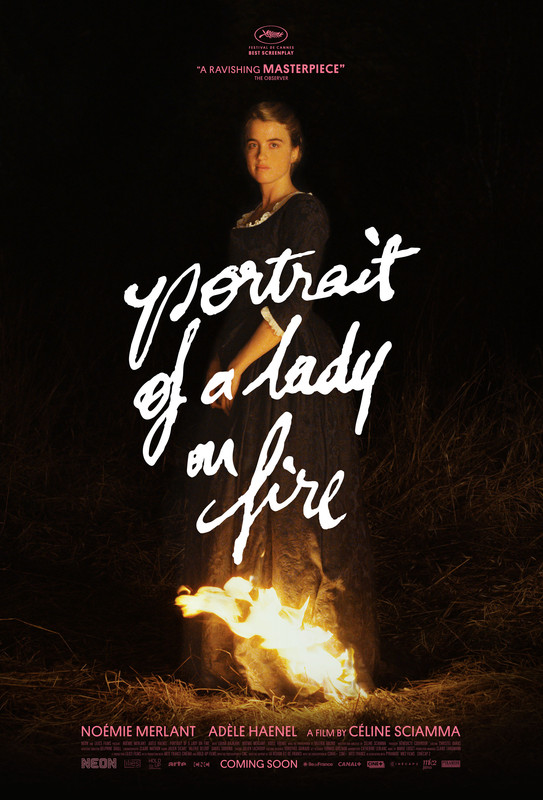
24FPS @ LFF 2019: Portrait of a Lady on Fire

Dir: Celine Sciamma
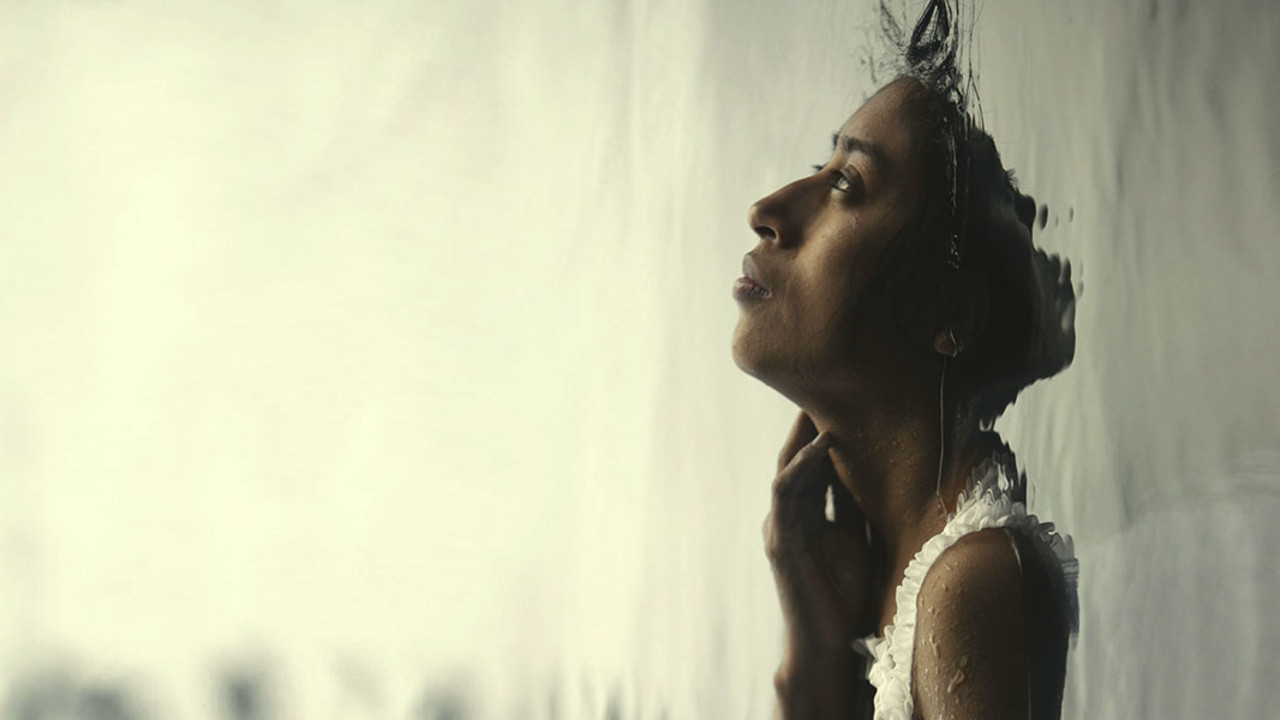
Since 2008, writer/director Celine Sciamma has made her name exclusively in coming of age cinema, with her own films Water Lilies, Tomboy and Girlhood and the screenplays for My Life as a Courgette and Being 17, all five of them among the genre’s best in the past few years. As her first venture outside that genre, Portrait of a Lady on Fire represents a big change, but Sciamma’s cinema, while evolving, as it has with each work, still feels as raw and personal as ever with this move into period romance.

In 18th century France, painter Marianne (Noémie Merlant) is commissioned to paint a wedding portrait of Héloïse (Adèle Haenel). Because she doesn’t want the marriage, Héloïse is trying to avoid the painting, so Marianne must observe her during daily walks and work in secret. As the wedding grows closer, so do Marianne and Héloïse.

Described by Sciamma as a film about the memory of love, the jumping off point is the titular portrait. When Marianne is asked about it in a drawing class where she is both teacher and model we move straight into flashback, finding her arriving on the beach, above which sits the stately home where Héloïse lives with her mother (Valeria Golino) and their young maid Sophie (Luàna Bajrami).

Like many love stories, Portrait of a Lady on Fire is initially a slow burn. In her aim to film the growth of desire, Sciamma uses both this slow pacing and the composition and timing of her images brilliantly. The film is incredibly sensual and tactile, taking in details of form and texture in a way that seems to try to replicate Marianne’s painter’s eye for detail. This is seen in how the camera dwells on things like the folds of a dress, as well as in the way it regards Haenel, taking in every angle and line, allowing her to give a performance that works in tiny nuances, especially during the first half of the film, which is essentially a process of breaking through Héloïse’s shell. The first time Haenel smiles in the film, which is almost imperceptible and almost halfway through, is the first moment that begins to trigger the realisation of the desire and slowly forming passion that Sciamma has been building.

In a film where gaze is paramount, it is fascinating to watch how that aspect evolves. The connection between Merlant and Haenel changes throughout the film, and Sciamma often dwells in those moments, holding on their gaze towards each other, whether the two are in the same frame or not. The way the camera represents how they look at each other comes through in everything. It's there even in the design, the home feeling colder in the beginning of the film and the warmth of the relationship between Marianne and Héloïse seeming to warm up the surrounding environment, at least in the house, as time goes on. The central visual metaphor—Marianne seeing Héloïse standing in the opposite side of a fire at an outdoor party and Héloïse’s dress catching fire, just as the yet unspoken desire is rising on both sides—may not be subtle, but it’s evocative, thanks especially to the painterly texture of the image. This painterly feel is embedded in many of the film’s important images, most notably a recurring and fleeting image of Héloïse in a white nightgown; she seems part ghost, part painting, and that image becomes more affecting every time we see it.

The romance is the centre of the film, but many other concerns run through it as well. As well as being about love, the film features a telling depiction of female friendship and support, as Marianne discovers that Sophie is pregnant and the women try to obtain an abortion for her. That sequence, thanks to one element included by Sciamma, bears such complexity of feeling in a way that never lectures and is entirely fresh. It’s sad yet a victory; tough yet tender. Sciamma also interrogates the place of women in 18th century society. The idea that Héloïse is meant primarily as a bauble, a decoration for her husband to carry around is embedded in the portrait process, and especially in the more idealised image that Marianne paints when her model won’t sit for her. We also see this in Héloïse’s mother—clearly unhappy with her own arranged marriage, but now engaged in making the same bed for her daughter to very literally lie in.

Passionate but never exploitative, it’s obvious that a female gaze is behind the love scenes, but it’s sometimes the painting scenes that feel most telling of the relationship at the heart of the story. As they build to the first kiss, these sequences are as intense and intimate as any in the film, and after the relationship is formed they become playful; the intimacy acknowledged and embraced. Art also plays a part in the film’s most exposing scene, as Marianne draws a self-portrait, a secret thing for her lover to keep, while looking in a mirror she has set between Héloïse’s legs.
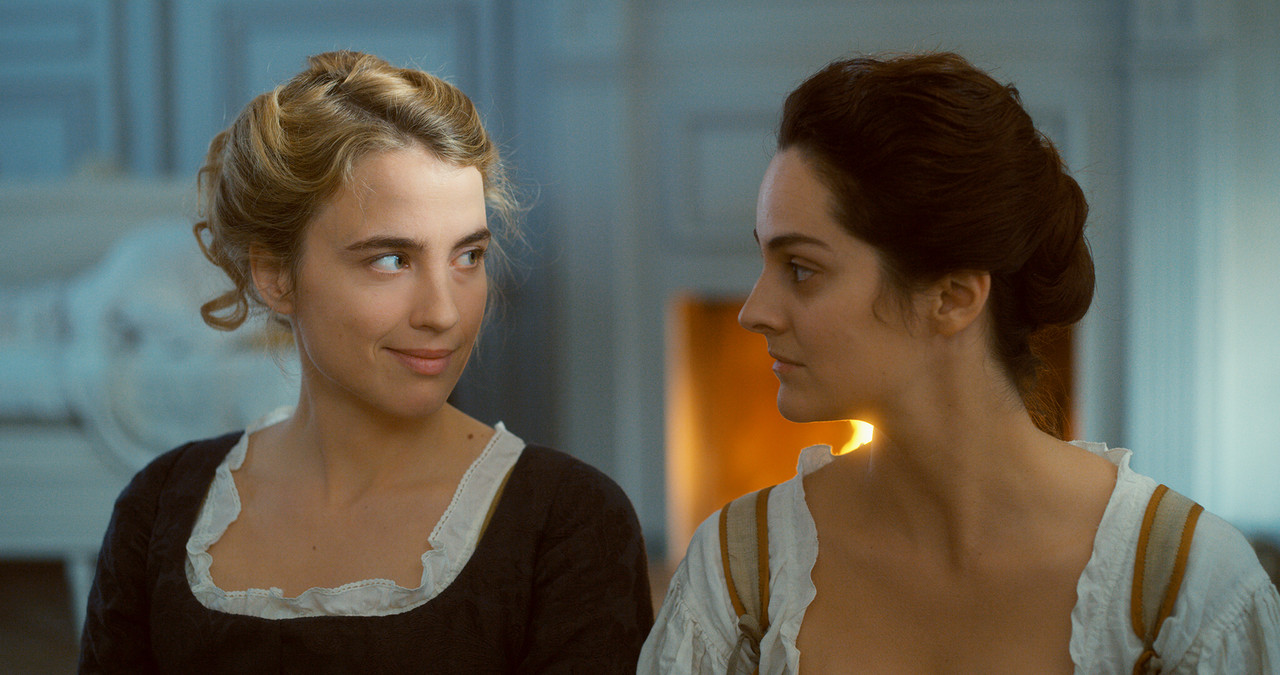
The film is exquisitely crafted, from the impeccable framing that only draws parallels between the arts of painting and cinema to the lack of non-diegetic music, which forces us to dwell in the same space as Marianne and Héloïse, to experience the growth of their love without being instructed by a score as to what we should be feeling. This extends to the work of the actresses (two men appear in the entire running time, each for a few seconds). The supporting roles are well cast, with Valeria Golino again reminding us how good she is, finding layers of sadness in the Countess and Luàna Bajrami making Sophie another interesting and important prong in the way the film looks at female relationships, beyond the romantic and sexual. Of the leads, Noemie Merlant is perhaps easier to read in the initial part of the film, from her emptiness in the opening scene to the way Marianne is progressively drawn to Héloïse, prompted initially by the mystery of what this woman may look like. The study of that face, which grows into a stronger desire scene by scene, is as brilliantly played as it is cued by Sciamma’s camera.

Sciamma has said that this film was made for Adele Haenel, and it’s difficult not to see it through the prism of their working and personal relationship. In many ways it is a film about Haenel’s face and the fascination it holds; for Marianne and, through the lens, for Sciamma. It would be tempting to take this reading further, but for all its clearly personal content there is a universality here. The power of the memory of love is hardly exclusive to any one relationship, and it’s impossible not to connect with the melancholy of that element, especially as the film runs up to the completion of the portrait. Haenel’s performance, even by her own standards, is superlative. The subtlety of what plays on her face, the way she shifts Héloïse’s character as the film goes on. She is perhaps most powerful in her silences, never more so than in the film’s beautiful final shot; a three minute take that simply tracks in on her. Haenel is one of the best female actors in Europe, and this is her finest performance to date.

Portrait of a Lady on Fire is a stunning achievement, rich and detailed in storytelling, metaphor and resonance. It’s proof that Celine Sciamma is more than just an accomplished teller of teenage stories, and further develops her cinema to put her on a level with the great visual storytellers around right now. It’s essential viewing for fans, and maybe even more so if you’ve not yet discovered her work.
★★★★★

Oct 8, 2019

24 FPS @ LFF 2019 La Llorona

Dir: Jayro Bustamante
In present day Guatemala, former general Enrique Monteverde (Julio Diaz) is on trial for genocide he is alleged to have overseen thirty years prior. As the trial comes to an end, and increasingly after a controversial decision prompts protests outside his family home and a new maid arrives on the same day, he becomes convinced that he can hear a weeping woman in the house during the night. The family think he may be imagining things because of his dementia, but he believes it is the vengeful La Llorona.

Doing a little reading around the film, it is clear that it takes many of its cues from fact, with the element of the trial and how it works out based quite closely on the case of Guatemala’s former dictator Jose Efrain Rios Montt. Knowing this, the reckoning with genocide becomes much more than simply window dressing for a horror movie. History hangs over the film, lending its slow-building horror and tension extra weight and power.

Despite this heavy subject matter in the background, director Jayro Bustamante is definitely having fun here. Over and over, he allows the potential for the film to take a very typical genre route, setting up the cliche images of the haunting movie, but over and over again he undermines these banal conventions. Sometimes it is simply in the timing, the fact that a slow build of creeping around the dark house doesn’t lead to, for instance, a cut to an apparition screaming in our faces, but he often directly defuses the images. One great moment has the new maid, Alma (María Mercedes Coroy) her long hair being blown across her face by an unseen force (I think the shot is also very slightly slowed down), then Enrique’s granddaughter steps into frame, and we see she’s drying Alma’s hair. It’s funny, and yet the original image still feels a little creepy, and this is a trick Bustamante manages to repeat several times.

The horror elements of the film are slow, ominous and creepingly effective, growing more so as they become ever more entwined with the history and as we see figures from Enrique’s family in different roles within the flashbacks, likely as a way of underlining their complicity, even if their role wasn’t active. It further defies convention by using no CGI, or even any overt ‘scares’ to effect its horror.

The legend of the weeping woman was, earlier this year, the basis for a weakly received entry in the ongoing series of Conjuring universe films. If you’re looking for the same sort of pop up book boo scares, you’ll probably be disappointed in this. For me though, this is one of the more provocative and interesting horror films of the year, reckoning with real monsters through a legendary one.  
★★★★

24FPS @ LFF 2019: Run

Dir: Scott Graham
Finnie (Mark Stanley) is stuck. He works at the fish factory in Fraserburgh, lives with his wife Katie (Amy Manson) and their children. Their eldest, Kid, (Anders Hayward) is about 17, his girlfriend Kelly (Marli Siu) is pregnant and it looks like he’s about to fall into the same pattern as his parents, whose ‘Born to Run’ tattoos now just look ironic.

Scott Graham’s third film brilliantly captures a very particular kind of inertia. Set over 24 hours, it breaks down into distinct sections, first laying out why Finnie feels so trapped, before allowing him to glimpse a way out and resolving whether he takes it. The first act is simply Finnie’s day to day; an unrewarding and likely fairly low paid job, being driven back and forth by his son, the daily shop for stuff for supper, and a marriage which might have seen better days. It’s notable that this doesn’t seem like it’s the worst day of any of these things, just another day in the slow grind that seems to have been wearing Finnie down. We get it when, after everyone’s asleep, he ‘borrows’ Kid’s car and goes for a spin. Going for that drive leads into the film’s second section, an extended detour with Finnie driving around the town. When she asks where Kid is, he ends up with Kelly in the passenger seat and the two drive around, racing some of Kid and Kelly’s friends, then aimless, waiting for the next race.

The long sequence in the car is ultimately about Finnie recapturing his youth. It’s significant that both the car he’s joyriding in and the girl in the seat next to him are much more connected to his son, Finnie is trying to throw himself back twenty years, when it would have been Katie in the passenger seat. In a way, he’s successful and as the sequence runs on we can see that he’s indulging more and more in the idea of the road opening up in front of him, offering more than a race - the sort of possibilities it might have held when he was Kid and Kelly’s age. The race too feels thematic, speaking of how Finnie has likely tried to escape many times, but found himself always turning the same circle, back to Katie and his kids. This is one of the great things about the film, it’s clearly set on a very significant day, but you can believe that this is just one of many days like it for Finnie; the 24 hours we see feel like a microcosm of a whole life.

As with his previous films, Shell and Iona, Scott Graham achieves a great sense of place in Run. The dialogue is particularly specific, thickly accented and in dialect that takes a little while to settle in to if you’re not from this part of Scotland. This only adds to the very observed feel of the first and last acts of the film, grounding us in the language of Finnie and his family as well as in their lives. Of course, this is also down to the naturalism of the performances. From a technical standpoint, it’s worth noting that few, if any, of the main cast are using their native accents, and all the work in that area is impeccable. 

Mark Stanley and Amy Manson’s performances as Finnie and Katie imply all of the backstory we need. We can see them as young sweethearts, getting pregnant early, putting their lives on hold. We get glimpses that suggest Katie also wants, in her own way, to get out of the ordinary, even if it’s by doing something as simple as wearing a nice dress, though it’s only for a family dinner of fajitas. Because this is largely Finnie's story, Manson is often a more muted presence, but the details of her performance are rich and her scenes with Stanley in the third act have real punch. The two have an interesting energy together, again we can see the couple they might have been in the past, and that things aren’t always so great now. There’s a real sense of shared history between them that gives the film added resonance. It matters that we feel the past while watching these characters' present because the film's last moments might feel trite without it, but the depth of the relationship allows them to work.  

Marli Siu, on the rise after Anna and the Apocalypse and with Our Ladies also in this year’s festival, is also very strong as Kelly. The growing rapport between her and Finnie as they drive around at night has an interesting dual dynamic, as you can appreciate why each of them is being pulled in, but also see that it’s not appropriate. The car sequence is long, perhaps 25 of the film’s 78 minutes, but it’s justified by that growing dynamic and the sense of being caught up in an extended moment, best exemplified when Kelly puts CHVRCHES’ soaring Make Them Gold on the stereo and we’re lost for a few minutes in a classic movie montage.

As Kid, Anders Hayward only comes to the fore in the film’s third act, so talking about his most developed scenes isn’t easy. What comes across again is the authenticity of the family dynamic, especially when Kid and Finnie finally sit down and talk. One particularly strong scene comes at breakfast, with Finnie having to hold up the table because Kid has kicked a leg out from it; you get his frustration with his son, but also a hint that he sees a bit of himself in that action, it’s this back and forth that carries across affectingly a little later on.

I hope a distributor will pick this up soon, because it’s one of the highlights of this year’s LFF and because, three films in, we should be talking more about Scott Graham. Graham has done a great job across his work of digging into the minutiae of ordinary lives and finding stories that feel both specific and identifiable. Run is on those terms perhaps his most developed film, because it could be the story of any numbers of families anywhere around the UK or further afield and yet it grounds you in the specifics of these people and their lives. 
★★★★½

Oct 6, 2019

24FPS @ LFF 2019: The Girl With a Bracelet

Dir: Stéphane Demoustier
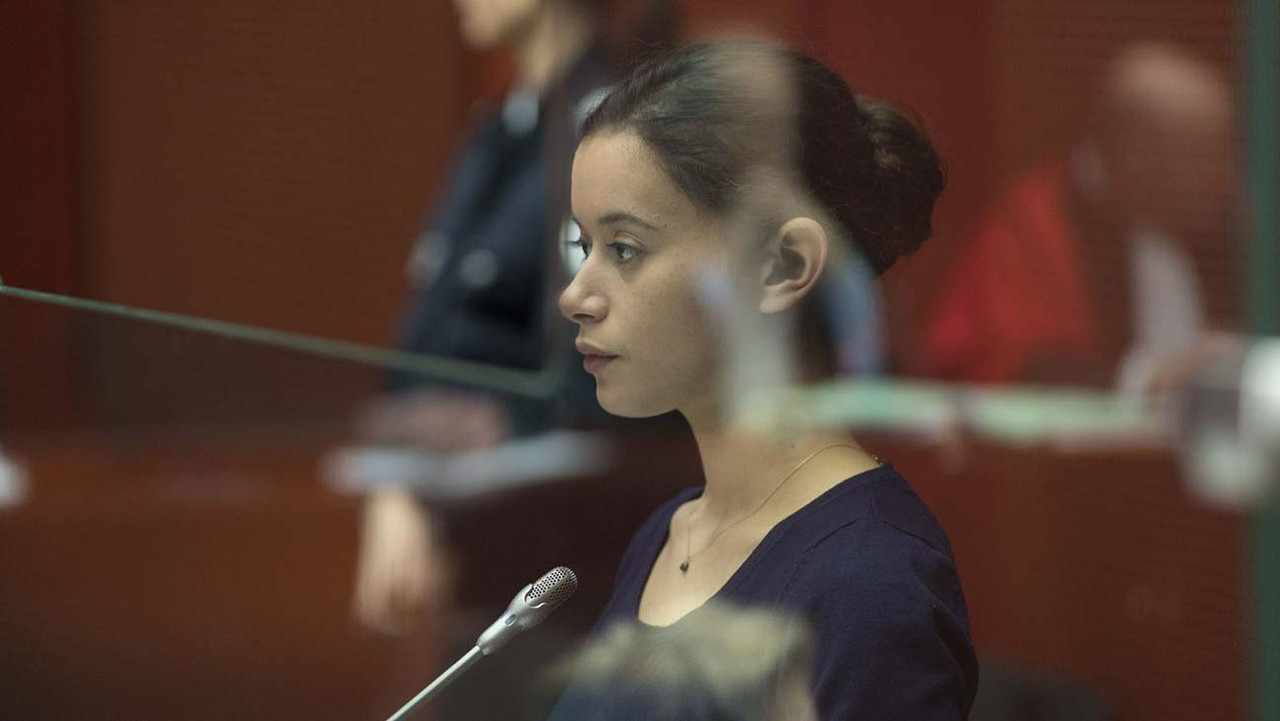
18 year old Lise (Melissa Guers) stands accused of stabbing her friend to death. During her preparation for trial and the process itself, she has been living at home while under house arrest with an ankle monitor. As the trial goes on, her parents (Roschdy Zem and Chiara Mastroianni) hear things they never imagined about their daughter, but are they wrong in their belief that Lise is innocent of the charge against her?

It’s not difficult to see why the courtroom drama has been a reliable staple of cinema for so long. If anything has inherent drama then it is a trial. The battle lines are clear, the heroes and villains can, depending on our point of view, be clearly delineated but also can shift as the drama unfolds. The process also provides ample opportunity for actors to stretch their muscles, with tailor made spaces for grandstanding speeches about important issues. On the one hand, you might expect that getting away from some of these generic touchstones would prove refreshing. On the other, The Girl With a Bracelet often seems to set out to prove otherwise.

Following an articulate silent opening scene, which shows Lise calmly being arrested while at the beach with her family, Stéphane Demoustier’s film is all talk. This is partly mandated by the courtroom setting, but once the trial begins, the film holds us in that setting almost all the time. If the film is accurately representing the French court system (and it does seem to be), then it could perhaps do with being less faithful, because the setup itself, with the lawyers only muted presences next to an examining judge, seems to undercut the drama of the case. 

Some courtroom films allow us glimpses of the various possible ways the case could have played out, given the various theories advanced, or at least show us one of the possible perspectives on the crime. The Girl With a Bracelet does neither, and so the entire film is all talk and no show. This is far less intriguing than Demoustier may have hoped, because the case itself, while lurid, is argued in such a stiff and frankly dull way that even the telling isn’t that interesting. It’s also fair to say that the ending is never in doubt, so even the drama of the verdict lacks punch.

Confined to the courtroom for long periods, the film feels static and stagy, and Demoustier has no tricks up his sleeve either to make things feel claustrophobic or to find interesting angles from which to shoot the proceedings. At times the whole thing is so visually flat it feels like Court TV. So little is said purely visually that with only very minor adjustments, this could be a radio play, and I’m not sure it would be any more entertaining then.

The performances aren’t bad. Melissa Guers has a distant detachment that could be read either as Lise being unable or unwilling to process what is happening to her or that she’s so cold she’s unaffected by it all. The problem is that either interpretation is defined by the same almost affectless performance. Likewise, Anaïs Demoustier (one of the most interesting actors in France and, coincidentally, the director’s sister) has little to work with as the prosecutor in the case. There’s conviction in her final speech to the court, but as a figure within the film she exists solely as a job title. The same, sadly, is true of Annie Mercier as Lise’s lawyer. There are a couple of flashes of interest in Roschdy Zem and Chiara Mastroianni’s performances in the very brief moments that their belief in their daughter’s innocence is undermined, but the film never indulges this for long enough to say anything interesting.

There is always potential in a courtroom drama but the disappointment of The Girl With a Bracelet isn’t so much that it misses that potential as it is that it consistently seems to try to avoid it.
★½

24FPs @ LFF 2019: Lunana, A Yak In The Classroom / Babyteeth

Lunana - A Yak in the Classroom
Dir: Pawo Choying Dorji
Sometimes, all it takes for a film to feel a little different is a change of context. There are more than a few movies about teachers in an unfamiliar environment, from comedic takes like Kindergarten Cop to more dramatic pieces like Dangerous Minds. In most of them, the teacher will find their class or environment something they don’t initially warm to, but eventually will be turned around, learning something about themselves. Lunana, a Yak in the Classroom doesn’t do these broad strokes any differently, but the setting and cultural specificity of it make it feel a bit different.

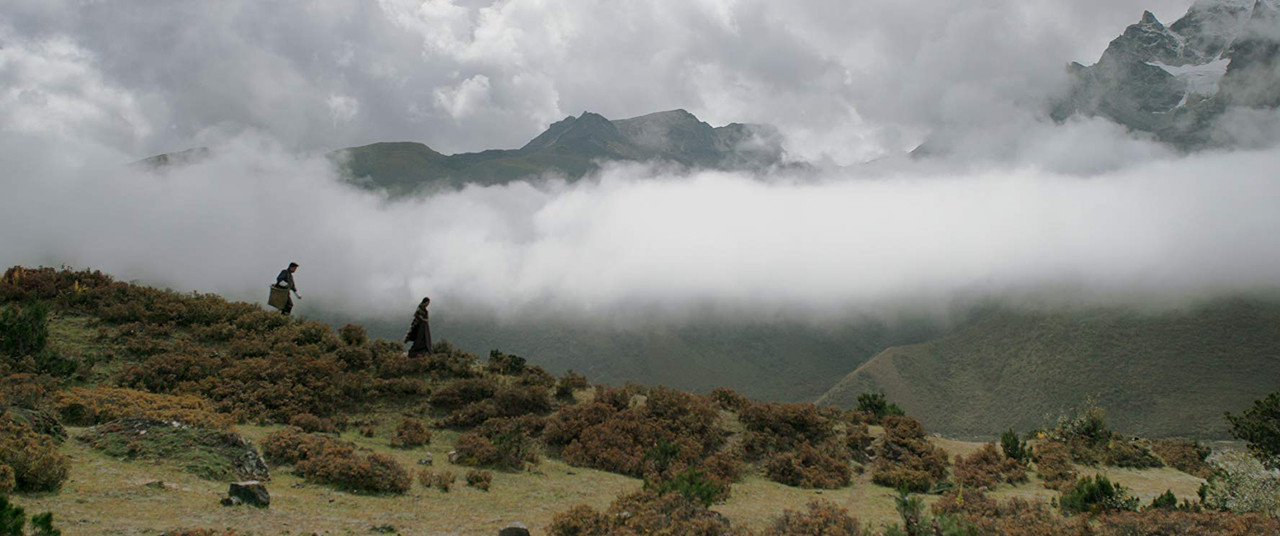
Ugyen Dorji (Sherab Dorji) is in his last of five years of service as a teacher, following his training, and he’s fallen out of love with it. He’s lazy, marking time before he can leave Bhutan for Australia. Ugyen’s boss, sick of his attitude, dispatches him to Lunana and the most remote school in the world, eight days hike across the Himalayas from the nearest town. When he arrives, Ugyen immediately wants to leave, but the villagers and the kids he’s teaching win him round.

There isn’t much unexpected here. Ugyen is slowly inspired by the kids, notably adorable class captain Pem Zam (all the kids use their own names) and sets about doing up the school, for instance having the villagers helping him mix charcoal paint to make a blackboard. A city resident and a modern person, he also has his head turned by traditional culture, notably the songs sung by yak herder Saldon (Kelden Lhamo Gurung). This is where the film marks itself out from the many others like it. Music is a major throughline, Ugyen wants to be a singer when he gets to Australia, and we see him spending much of his time trying to learn a traditional song he hears Saldon singing. The music is soothing, and unlike much we regularly her in the UK.

As well as a beautiful soundtrack, the film makes use of its stunning location to mark itself out. Shot on solar powered cameras 5000 metres up in the Himalayas, Lunana looks like few other films, taking place among the clouds not because it is set in some fantastical realm, but simply because that is where its characters live. The vistas are unbelievable and almost worth the price of admission on their own.

While it never goes anywhere unexpected, Lunana is executed with great charm. The dynamic between Ugyen, the villagers and the kids feels natural and has a warmth that permeates the whole film, in contrast to the mountain weather. This is especially the case in the friendships that develop between Ugyen and his escorts and the potential budding romance between Ugyen and  Saldon.

A sweet natured film about the importance of community and tradition, as well as that of following your calling, whatever that may mean, Lunana is perhaps a bit different to the rest of LFF’s Family programme, in that it doesn’t seem as much aimed at children as suitable for them, just as much as it will be for their parents. It should charm the whole family.
★★★

Babyteeth
Dir: Shannon Murphy
The teen cancer romance has, weirdly, become prevalent enough to be a subgenre all of its own. Generally speaking, I can’t stand them. Most feel like tragedy porn, content to let their characters be defined solely through illness and essentially acting as a big stick, designed to poke you until you cry. The genre’s miserable low is without doubt the vomitously saccharine The Fault in Our Stars. I’m not sure it had a high point until now.

Babyteeth begins with 16 year old Milla (Eliza Scanlen) meeting and falling for Moses (Toby Wallace), he’s older, tattooed, jobless, a small time drug addict and dealer. Milla’s parents, Anna and Henry (Essie Davis and Ben Mendelsohn), understandably, do not approve. It’s only later that we learn that Milla’s cancer has returned. In the throes of first love with Moses, she wants to spend as much time with him as possible, to the point that he ends up living with Milla and her parents as she gets sicker.

There are many things that set Babyteeth apart from the herd of teen cancer movies, most notably the fact that it is not defined by Milla’s illness. This is largely a comedy drama about a dysfunctional family and cancer is only a part of that dysfunction. It’s also only a part of the film. It lurks in the background of the first half, becoming more present over time, much like the progress of the disease. For much of the first hour, writer Rita Kalnejais and director Shannon Murphy push comedy to the fore, with Essie Davis especially priceless as Milla’s anxiety riddled mother, who spends much of her time in a Zoloft induced haze, drugs prescribed by her psychiatrist husband. The scene in which Milla first brings Moses home and there is an excruciatingly awkward family dinner is particularly priceless. What many films about tragic things forget is that, even in the midst of it, not every moment is tragic. By remembering this, the sometimes irreverent humour of Babyteeth conveys more emotional honesty than any of the manipulative set pieces in a more typical teen cancer pic.

Milla’s first romance is obviously unsuitable, but we understand it from all sides, whether it’s Milla's romantic sense of being with the bad boy who’ll annoy her parents or the rather deeper thought that it’s Moses’ fearlessness that first draws her in, perhaps a quality she wants more in herself as her cancer gets worse. Eliza Scanlen is excellent in the part. For a long time we can see her playing Milla as a kid who simply wants to ignore her illness; she hasn’t got any hair, so she’ll wear fun wigs, and she’ll go out and she’ll fall in love with this guy, like a normal kid. We also see and feel the moments that bring that crashing down to Earth, but Scanlen never overplays them. For Moses’ part, there’s a recognition that he too, more experienced if not that much wiser at 23, realises that this crush Milla has on him isn’t entirely healthy, and that he at once has some feeling for her that goes beyond sympathy and yet he’s not immune to exploiting her feelings. Moses, in particular, is a more complex character than we usually see in these films and his shifts in motivation and feeling are given great weight in a deceptively light performance from Toby Wallace.

Initially, Ben Mendelsohn and Essie Davis have broader roles, essentially doing something close to comic relief duty (their first scene, an appointment for sex in Henry’s office, is a good example of this tone), but this recedes as the film goes on and their performances become heartbreaking. Mendelsohn, one of the best actors in movies right now, is especially brilliant when his daughter asks him to smile for a picture; “gimme a second” he says, and the weight of everything in the film is felt in those three words.

Director Shannon Murphy, making her feature debut after several shorts and plenty of TV work, balances the film’s tone beautifully and draws terrific work from her cast, allowing supporting players like Emily Barclay, as Anna and Henry’s heavily pregnant neighbour, to steal a few scenes, but never the focus. I’m not a fan, though, of her aggressive chaptering. The many, many title cards add little and sometimes give the film a bitty feel that undermines an otherwise strong emotional throughline. The nadir of this technique comes when a title card introduces the song a sequence is set to, making that sequence resemble a music video even more, slightly deflating its impact for that.

On the whole though, Babyteeth is a refreshing addition to a genre that has so far given us little to enjoy. The balance of humour and heart is more honest here than in any of its peers, and Eliza Scanlen and Toby Wallace both impress, marking themselves out as names to watch for the future.
★★★★

Oct 5, 2019

24FPS @ LFF 2019: The Lost Okoroshi / Instinct

The Lost Okoroshi
Dir: Abba Makama
Nigerian cinema, while I'm sure it is much more than this, has often been viewed as something of a punchline. Certainly, I’ve only come across it as clips of notably inept Nollywood films or satirical reviews of the legitimately bonkers sounding series of Vultures of Horror films. This all being the case, it’s refreshing to see a Nigerian film that is interesting for more than being crazy or terrible.

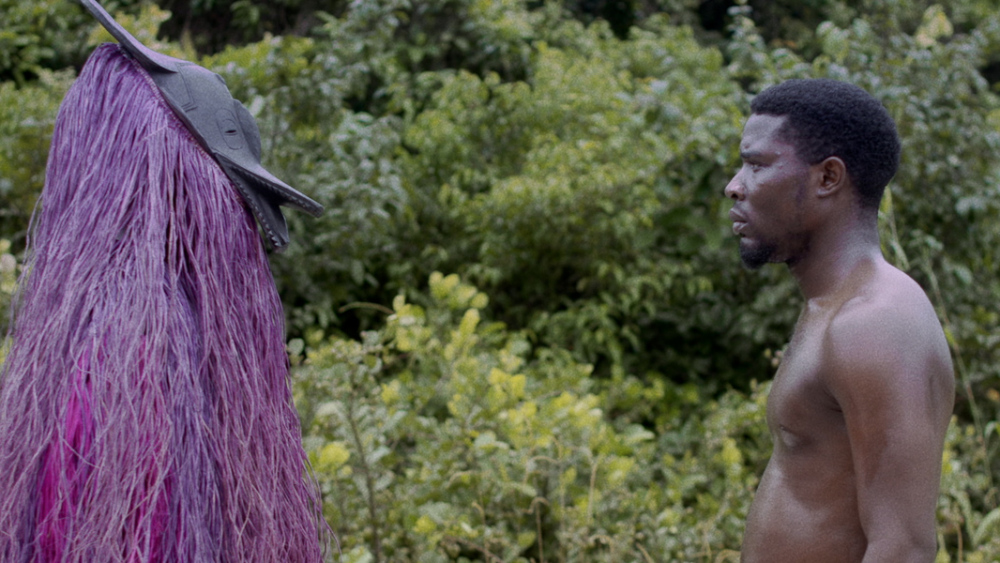
The Lost Okoroshi is a film that is obviously soaked in local tradition and culture. It’s about Raymond (Seun Ajayi), a security guard who wants to go back to tradition and become a farmer. He has a recurring dream of being chased by a masked spirit called Okoroshi. One day, Ray wakes up as the Okoroshi, he can no longer speak or remove the mask. Lost in the city, he is followed around by a kid who wants to be his promoter, then kidnapped by a group who want to use him as an icon to restore Nigeria’s traditional beliefs.

This seems like a deeply personal project and one that may have had to scrape together both funding and equipment. At times it is amateurish, with very rough sound recording and some poor acting (a journalist in the film’s final scene is the worst offender), but it’s clear that many of these issues, though they are a problem, stem more from a lack of resources than the filmmakers not being accomplished.

Things start slowly, with the first act composed of several long scenes of conversation that don’t really go anywhere and, at least for an international audience, aren’t terribly funny. The film picks up hugely once Raymond is transformed, and it builds comic momentum from there. Initially, co-writer/ director Abba Makama gets plenty of mileage purely from the incongruity of the Okoroshi figure walking through modern Lagos; a traditional figure set against a city that now speeds past him. There are plenty of funny moments here, especially when, his ‘promoter’ having collected a bag of money from people watching ‘Raymond’ dance, the Okoroshi hands the money to a hooker. The three of them form a sort of comedic chorus for a while, and again the film mines laughs from the sheer strangeness.

Later, when ‘Raymond’ is taken by the traditionalist group, the film continues to find better and funnier gags as it goes on. The group is clearly inspired by the scenes in The Life of Brian with the People’s Front of Judea and, while Makama and Africa Ukoh’s dialogue never reaches that sort of sublime comic inspiration, he hits on plenty of laughs. The film also looks pretty good, with the costumes for Okoroshi and the other ‘masquerades’ being especially striking.

For all the solid gags, Makama and Ukoh’s screenplay is patchy and disjointed. Beginnings and endings seem to test them, as storylines peter out and Makama simply cuts to the next scene rather than drawing to a satisfying close. This is also a problem with the film as a whole, which closes with several minutes of dry dialogue essentially recapping what we’ve just seen with a professor laying out events for a journalist and suggesting what Raymond’s case may mean for traditional Nigerian practices.

The Lost Okoroshi is seldom less than interesting, and the cultural aspects in particular will mark it out as something different for most UK audiences, but whatever the reasons for its technical amateurishness, that and the sometimes clunky screenplay mean that the several good laughs you’ll get from it never quite manage to paper over the cracks.
★★½

Instinct
Dir: Halina Reijn
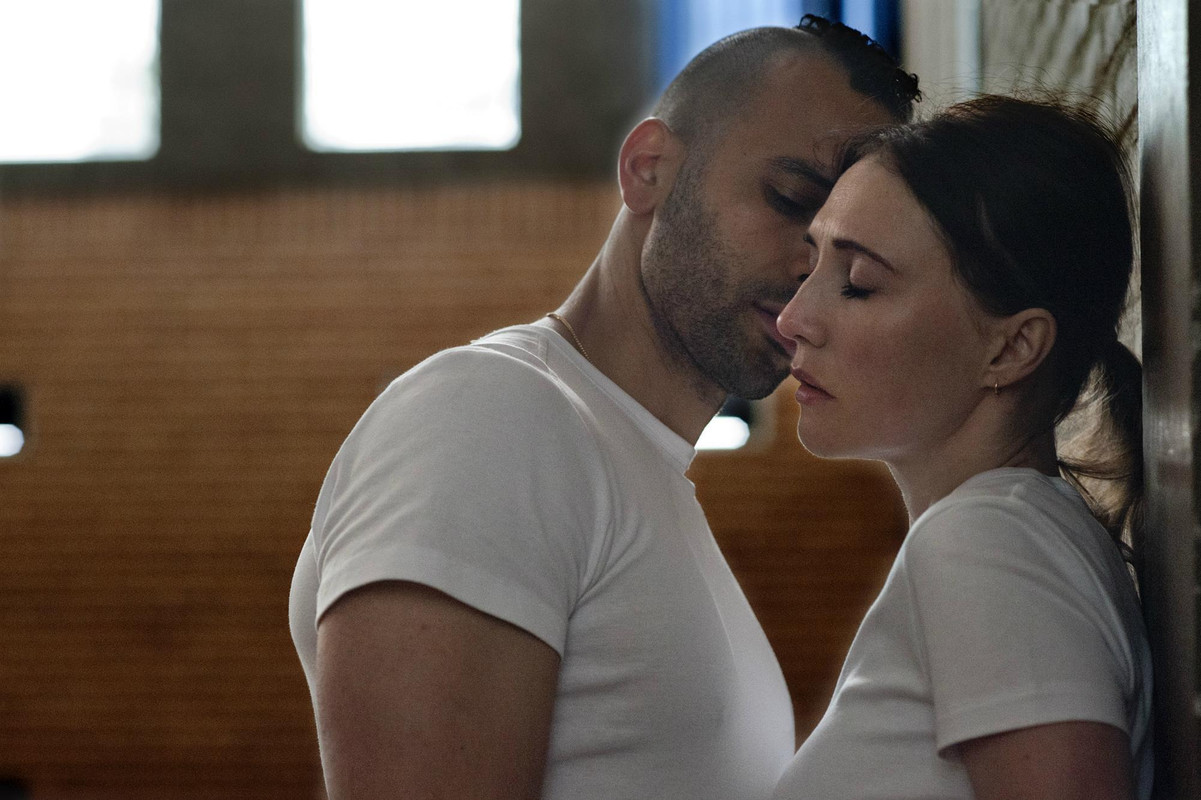
Set in a rehabilitation centre for sexual offenders, Instinct sees Carice Van Houten as Nicoline, a therapist newly assigned to Idris (Marwan Kenzari, familiar from his role as Jafar in Disney’s live-action Aladdin). With most of the staff convinced he’s doing well, Idris is nearing the end of his time at the centre, Nicoline disagrees, but the dynamic between her and Idris is more than therapist/patient, as her manipulative charge perceives that she’s attracted to him.

The term ‘psychological thriller’ is one that has been misapplied through the years, often used as an umbrella term for horror films their makers don’t want lumped in with the Friday the 13ths of the world. Instinct is a true psychological thriller, with all its tension coming from the dynamics and interaction between Nicoline and Idris. On these terms, it often works well. Carice Van Houten delivers her most notable and best performance for some time. Working again in her native language, she delivers a natural and nuanced performance that finds many layers in her character. Kenzari may be even better, always compelling and frightening as he walks the character of Idris along a precarious line between being charming and very obviously dangerous. Watching these two play off each other is often thrilling in itself, as there is palpable chemistry between them which, given the situation and the characters, is always disturbing. 

When Instinct is purely about performance, it can be excellent. This is never more true than in a sex scene between Nicoline and Alex (Pieter Embrechts) who is the basketball coach at the centre. We’ve seen this scene a hundred times, where one of the participants in a sex scene clearly wants it to be with someone else. Many directors would handle this by showing Idris, either in cuts or by having him, at a certain point, replace Alex in the scene. Reijn doesn’t do this, instead trusting us to understand the dynamic through Van Houten’s performance. Her trust in her lead’s skill pays off; the scene is unsettling and complex without simply stating what we’re supposed to read into it. It’s surprising, then, that the direction is increasingly the film's downfall.

The signs are there in the first half, notably in several confused scenes with Nicoline’s mother (Betty Schuurman) which seem to me to accidentally leave it very unclear whether that character is alive in the world of the film. Their first scene, in particular, is almost dreamlike - a quality which, if she’s reaching for it, Reijn never pulls off here. Much of the rest of the first half of the film is solidly grounded (though the fact the rest of the staff can’t see through Idris as easily as Nicoline does strains credulity), and benefits from the excellent central performances, but the film begins to go off the rails once the chemistry between Nicoline and Idris goes beyond an unsettling background simmer.

During a scene when they are alone on the centre’s basketball court, there is an encounter between Idris and Nicoline. Most of the scene is visually muted, but at a certain point the lighting shifts, becoming brighter and more intense. This carries over into the following scenes for about ten minutes. I suspect Reijn would say that this is to suggest that Nicoline is feeling a brighter light on her, a more intense focus. What comes across instead is, again, an uncertainty that I’m sure is unintentional, as to whether we should accept these scenes as reality or see them as something Nicoline is imagining. This also carries over into a scene at the beach, which marks the first moment that the film broke my suspension of disbelief.

The third act increasingly feels less like Reijn is telling her story than advancing an idea about the way people can be attracted to dangerous relationships. This might have worked had she more decisively gone for this approach early on, but next to the very grounded scenes of the first half, it’s an uneasy fit. The scenes themselves aren’t bad - one in which Idris turns up at Nicoline’s flat is interesting in how it tries to boil down an entire abusive relationship into five minutes, but it always feels more like an exercise than something we can believe in the context of these characters and their story.

Halina Reijn shows skill as an actor’s director. This is no surprise, given that she is best known as an actress (in the UK she is most recognised for a supporting role in Paul Verhoeven's Black Book, alongside Van Houten), but her visual and thematic approach is too scattershot for her ideas to engage as they should. The two central performances are too good for Instinct to be a total loss, but the confused direction and screenplay mean that they stand out as far better than the film they appear in. 
★★½

Oct 4, 2019

24FPS @ LFF 2019: Saint Maud

Dir: Rose Glass
Maud (Morfydd Clark) is a recent and zealous convert to Christianity. As a private nurse to Amanda (Jennifer Ehle), who is dying of cancer. Maud does her job trying to look after her patient’s ailing body, but also concerns herself with Amanda’s soul, but her devotion to her religion becomes more extreme and more disturbing with time.

Ever since I was able to really consider the various claims, I’ve found religion less than credible, but I remain fascinated by it and by films about it. The roots of belief, how people engage with it, how it can change them, the actions it can drive people to - for good or ill - are all intriguing and much-explored subjects in cinema. 

We never get to see where Rose’s faith begins, but we meet her as a relatively new convert, which goes some way to explaining how devout she is, seemingly having thrown herself fully into this new faith. Rose Glass seems to set up Maud’s faith as a defence mechanism; a way of her feeling that, in a world where she seems to have few other engagements, she can feel someone always has her back. This is particularly underlined by Maud’s prayers, which are conversational more than they are devotional, and seem to speak of a desperate need for meaning and connection.

This need to make connections, if not for herself then for God, is further underlined in Maud’s relationship with Amanda. She only mentions her religion after Amanda comments on her crucifix necklace, but thereafter is trying, gently but firmly, to win her soul. Boundaries begin to be crossed though, and we see a moralistic side to Maud’s Christianity in her conversation with Carol (Lily Frazer), an escort Amanda hires on a regular basis. 

None of these are bad ideas, but they are all very familiar. The drawing of an increasingly bold connecting line between devout religion and mental illness is a crutch that many films have relied on in the past, as are the handful of moments that equate religious and sexual ecstasy. While Maud is more sympathetically and fully presented than many of those characters, these are still old devices and Rose Glass’ screenplay fails to reinvent them, particularly in the film’s second half. The film’s imagery is impressively mounted, but it’s also rather predictable. Again, this is something especially felt in the film’s back half, as it moves away from the two hander about Maud slowly trying to live up to Amanda’s inscription in a book of William Blake’s paintings she gives her nurse as a gift, calling her her “saviour”. 

The second half trades in more extreme imagery as it depicts the difference between Maud’s image of herself and the world and the reality around her and in almost every instance we can predict what we’re going to see long before Glass shows it to us. This makes the last forty minutes or so much less intriguing than you’d hope. The commentary on religion is obvious and done to death and the progress of the story is a trudge towards a heavily signposted ending. Sometimes, knowing where a film is leading can give it a doomy feel of inevitability (even predestination, given the themes here), but that never clicked for me here, perhaps because the film doesn’t use that ending to say anything it hasn’t been shouting for an hour already.

The one thing that unambiguously works about Saint Maud is the acting. Jennifer Ehle is excellent as a woman constrained before her time by terminal illness, but still as vivacious as ever, bursting with the desire to eke whatever enjoyment she can out of her final weeks and months. As is so often the case in her work, Ehle is a bit underused, but again she makes an impression bigger than her role, which is helpful in keeping Amanda present in our minds in the second half of the film. There are also effective performances by Lily Frazer as Carol and Lily Knight as Joy, who knows Maud from a previous job and seemingly as a very different woman.

The film, though, belongs to Morfydd Clark, whose exceptional performance as Maud lifts the entire enterprise. While the machinations of the character and the story are fairly rote, Clark invests them with such detail and truth that not only can we not help but empathise with Maud, she becomes more interesting as a character because we invest and believe in her psychology thanks to Clark’s work. Along with Glass, she evokes an emptiness that allows us to understand why Maud turned to this extreme piety. There are some extreme moments in her performance; the contorted face and body of the moments that her religious experience seems to turn at first sexual, then for a split second painful or disturbing, but it’s the quieter moments that resonate. This is the aspect of the second half that does work, her silence when Joy turns up at her flat, her serenity in the film’s final scene. It’s great and complex work, it added a star to my grade by itself and serves notice that Clark is a real talent to watch.

I wish Saint Maud were better. The acting deserves a screenplay that does some more inventive things and digs deeper into its themes. Rose Glass serves up some memorable images and conjures a weirdly non-specific but still palpable sense of place, making me wonder what she might do in the future with someone else’s writing. On the whole though, this has to go down as something of a disappointment; a film that can’t as a whole match its best elements.
★★★

Oct 2, 2019

24FPS @ LFF 2019: Jallikattu

Dir: Lijo Jose Pellissery
Years ago, films were often referred to as motion pictures. Today we call them movies. While stillness can be hugely effective and has its own important place in cinema, even the shorthand we use for it recognises that this is, at its very roots, a kinetic medium. Jallikattu is nothing if not kinetic.

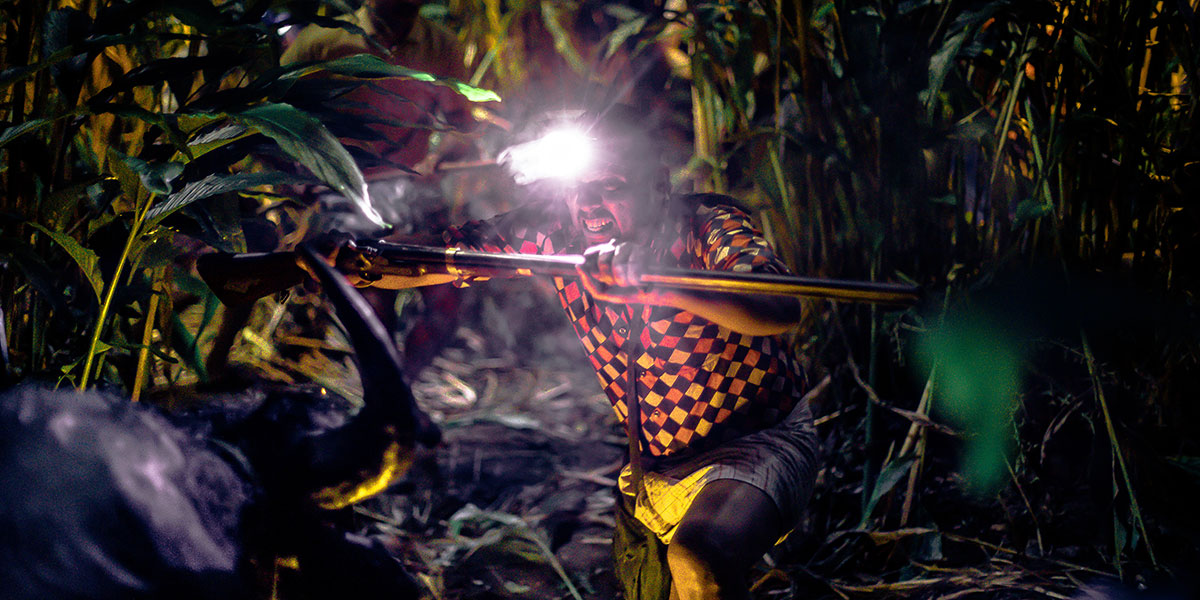
Jallikattu captures the chase to capture and kill an escaped buffalo which has rampaged through a small Indian village, after escaping slaughter. Growing numbers of men join the pursuit, which becomes more frantic and violent by the hour.

Lijo Jose Pellissery’s film is a restless thing. It begins with a loud ticking sound. This carries on through the film’s first five or so minutes, each click cueing an edit, the film building momentum and rhythm as it builds, in tiny snatches, a picture of the bustle of everyday life in this poor village, most especially at its meat market. From there, Jallikattu hardly slows down. Dialogue, when present, flies at 100  miles an hour as men fight among themselves about who gets to kill the buffalo and keep the spoils. There is also minutiae, but it flies by so fast that it’s tough to catch, say, the significance of a conversation about stolen Sandalwood or the origins of a brutal and extended fight that occurs in the third act.

While it is fast throughout, that doesn’t compromise Pellissery’s imagery, which is vivid, brutal and stunning. Massed torches in the forest, figures silhouetted against fires made to contain their prey and the men themselves, ever more animalistic in their pursuit of the beast, are just some of the images that will stick with you here. More than that though, it’s the energy, the primal feel of the film, that pulls it through.

The downside to Jallikattu’s single-minded, single tone, approach is that even at just over 90 minutes, it gets to a point at which the sheer relentlessness of it becomes first a little wearing and eventually almost absurd (a closing sequence which, perhaps unintentionally, draws on the great opening scene of Jackie Chan’s Dragon Lord). It doesn’t help that Pellissery has little to say beyond the very obvious parallels he draws between man and beast when either can be hunter or hunted. This is rammed home even before the film’s very last shot, which feels like a ‘for dummies’ version of that message, just in case it hasn’t already been battered into us.

Jallikattu is admirable for its sheer verve and energy, as well as its brutally beautiful imagery, but it needs to have more than one gear to become more than just a breathless chase movie.
★★★½

24FPS @ LFF 2019: Little Joe

Dir: Jessica Hausner
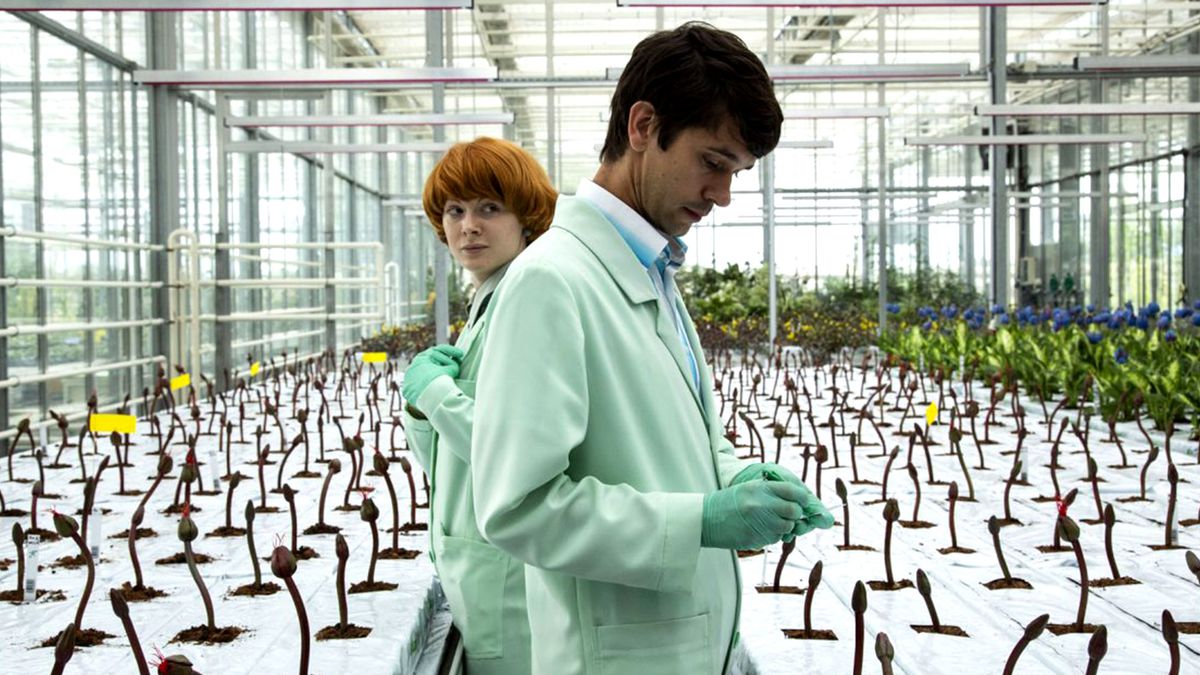
In a lab in London, Alice (Emily Beecham), Chris (Ben Wishaw) and their colleagues work on genetically engineering plants. Alice’s current project is trying to create a flower that smells beautiful and releases pheromones that will make people happier. She seems to be on the verge of success, but another scientist, Bella (Kerry Fox) suspects that the plant - the ‘Little Joe’ of the title - may have some disturbing side effects on those who have been exposed to its pheromones.

Little Joe is both exactly what you would expect Jessica Hausner’s new film to be and a massive departure for the director. It retains all of the signature visual style she has laid down in her four features to date, but applies them in a new context I couldn’t have predicted she’d be interested in: a genre film. 

Certain texts are evergreen, always ripe for if not a direct remake then a reinterpretation. Jack Finney’s Invasion of the Body Snatchers is one of those. It’s not hard to see why, the themes of people being systematically replaced with aliens who, while able to emulate humans, lack qualities like emotion and empathy are powerful and can be applied as a metaphor to many times and situations. Little Joe is essentially Hausner’s slow-burning take on this old, old story. She takes the themes in several directions, playing with our interpretation as the film goes on. For instance, has Chris been changed, or are scientists generally this rigid and unemotional, particularly when a deadline is bearing down? There is also Alice’s 13-year-old son Joe (Kit Connor), is his recent change in attitude towards his Mum driven by the Little Joe she brought home for him, or is he just 13? There is also an overarching theme here about the artificiality of emotion and the irony of the effect Little Joe might be having on people, given that what Alice wants is to promote happiness. It’s only late on that she seems to worry about the sincerity of that happiness.

Generally, what an audience looks for from an actor - consciously or not - is some degree of truth. That makes Little Joe a challenging film to act in, because we are always supposed to be questioning the truthfulness of the emotions of all the characters. In this way, Ben Wishaw probably has the most difficult part, as it is he who we are led to believe might be ‘infected’ earliest. He plays it pitch-perfectly; yes, Chris changes, but the screenplay allows us to question whether that is because of the plant or other more commonplace influences. Emily Beecham achieves a similar balance, making us question more with each passing scene her reactions to what she’s seeing around her, whether her sudden remove from her son is driven by him changing or her sharp focus on Little Joe.

Artificiality is also a concern in Hausner’s style. Both language (Hausner co-wrote the screenplay with her regular collaborator Géraldine Bajard) and visuals are notable for their formalism. The fact Hausner is writing in a second language may partially account for the incongruity of some of the language, for instance, the fact that contractions are almost never used, but this also has the effect of making the film’s world feel a little offset from our own even before we know what may be happening with Little Joe. Visually, Hausner sticks largely to straight lines, sharp edges and splashes of colour, whether those colours are pastels in the background or the vivid red of the ranks of Little Joes. In a way, Hausner’s environment is as controlled as that of Alice’s plants. Everything is designed to precision, from Hausner’s framing to Emily Beecham’s haircut and costumes. The unusual soundtrack also plays a part in this design, with score and sound design blending so seamlessly that separating them is almost pointless. The plucked strings of the score are often set against random noises (particularly various growling and roaring animals) to unconventional and striking effect.

Little Joe is a surprising work from Jessica Hausner, reinforcing her style while diversifying her themes and the move into English has done nothing to diminish her powers as an actor’s director. The themes may not have quite the same immediately apparent, urgent contemporary resonance as some of the official versions of Invasion of the Body Snatchers, but there is a thread here about our disconnected state that is both blackly funny and resonant. The idea may be familiar, but the delivery is truly individual.
★★★★

Sep 30, 2019

24FPS @ LFF 2019: Selected Shorts

It’s a shame we don’t see more short films in general release, but at LFF the various shorts programmes are often a good way to spot new talent both in front of and behind the camera. Here are some appropriately brief thoughts on some shorts I’ve seen recently. These films were viewed on the online press library.
Be Still My Beating Heart
Jericho (Sarah Andrews, Aaron Hopwood), screening in the Family shorts programme on October 5th, is one of the briefest shorts in the festival. Though barely 90 seconds long, it’s still an impressive piece of work. Fluent and high quality CG animation tells the story of a lonely robot trying to build himself a friend. It’s gently funny and rather touching. I do wish it were longer though, as there is potential to mine some more humour out of the situation. Sweet then, but perhaps too limited by its running time. 
★★★

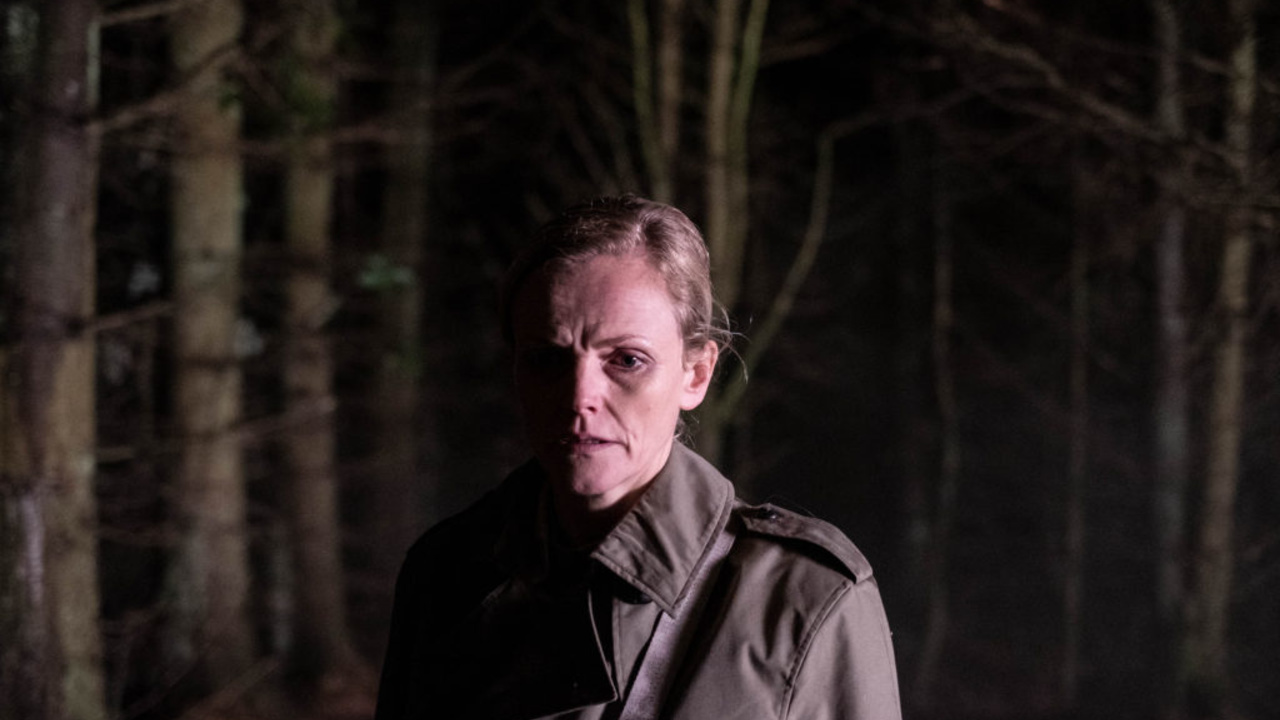
Be Still My Beating Heart (Ruth Paxton) screens in the Cult shorts programme on October 6th and 8th (both sold out). This story of a medical examiner looking after her younger sister who has an unspecified illness benefits greatly from having the always excellent Maxine Peake in the leading role. Peake and Elysia Welch bring dimension to a sisterly relationship that feels sour on both sides, even if it’s loving deep down. Director Ruth Paxton’s imagery veers between the mundane and the primal, and points to interesting things for her future. Unfortunately, the film ends up as less than the sum of its parts. The various ideas don’t knit together in the 25 minute running time and this ends up feeling less like a trailer for a future feature film version of itself (a common issue with shorts) than an impressive showreel for its director. 
★★½

Let's Roll
The Lamb (Nina Volic) screens in the Dare shorts programme on October 10th and 12th. Most boys, when they’re around 12 or 13, start wanting to impress the girls around them. That’s where The Lamb begins, with a boy meeting two girls from his class to show them something. In an incredibly dark turn, ‘something’ turns out to be a black man, tied up and gagged, on his sofa. The way the kids interact with the man is initially not violent, but the immediate and casual dehumanization of this ‘other’ is horrifying, as they treat him as a prop, posing for selfies with him in the background. A deeply disturbing, if extreme, look at how social media has made some of us treat the world as a background image to our lives, The Lamb promises great things from Nina Volic. 
★★★★

Let’s Roll (Chris Thomas) screens in the Thrill shorts programme  on October 5th and 10th. A surprisingly gentle film for its strand, Let’s Roll is a coming of age film set around the Cooper’s Hill cheese roll. Antonia’s brother was a champion, but now he’s away in the Army and her mother is against Toni taking his place. The progression of the film is fairly familiar, as Toni has a friend (who may be nursing a crush) help her train for the cheese roll in secret. The best thing about the film is how much it packs in to 23 minutes, writer Allan Macleod puts a lot of depth into the background in Toni’s relationship with her Mum, both of their implied concern about their brother and son and Toni’s troubled reaction to this stress (we first meet her running from a shop after stealing a magazine). This is also very well played by Amy Bowden as Toni and Zara Ramm as her Mum. There is a lot to build on for a feature version, which I’d happily watch, but the short feels complete in its own right. The only disappointment is the last sequence, which is too obviously documentary footage that Bowden doesn't appear to be in. 
★★★★

Sep 28, 2019

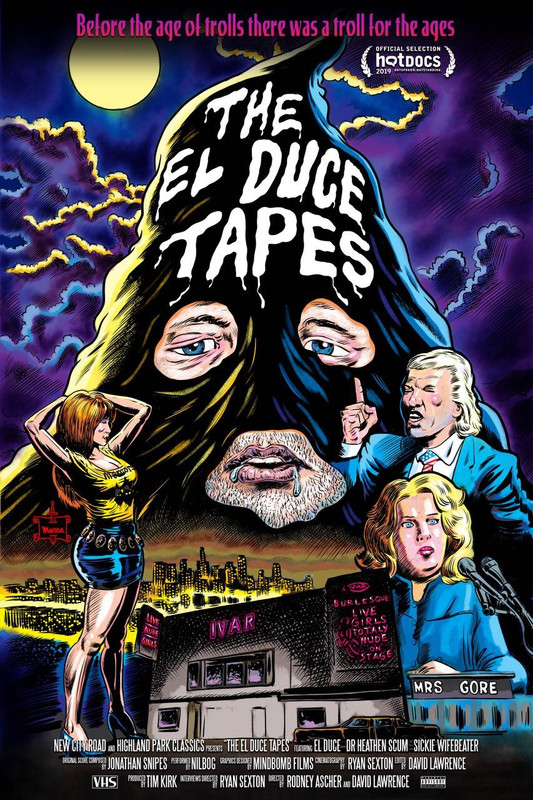
24FPS @ LFF 2019: The El Duce Tapes

Dir: Rodney Ascher / David Lawrence / Ryan Sexton
Composed of documentary and interview footage taken in the early 1990s by Ryan Sexton as he followed extreme punk band The Mentors and their lead singer El Duce, this documentary takes an unflinching look at a man who seems always to have wanted to kick against societal norms. The punk scene has never been my thing, and The Mentors, with their muddy sound and often brutally misogynistic lyrics, aren’t the band to change that but that’s not what makes The El Duce Tapes an interesting film.

Often I’ll say that a film being unsure what it wants to be is a fundamental problem, but in this case it’s perhaps the most interesting aspect of the way that co-directors Rodney Ascher and David Lawrence have chosen to assemble Sexton’s footage (which is clearly out of order). Is it a portrait of a truly disgusting human? Is it about a satirical enacting trolling the world in the pre-internet age? Is it about the sad decline of a man who hid his insecurities beneath extremity in all things? The answer is that it’s probably all of those things, and all the more interesting for that.

El Duce’s real name was Eldon Hoke and apparently he started out as a troubled kid who played the drums to get his aggression out, initially interested in playing jazz fusion music with his high school friend Steve Broy, who became the bassist for The Mentors, under the stage name Dr Heathen Scum. By the time Ryan Sexton began filming him, Hoke was decribing his music as ‘rape rock’, playing in dive bars and small clubs, so drunk that his previously impressive drumming skills would often desert him on stage. El Duce sometimes seems like a persona; a monster that Hoke has created to say the most offensive things his mind can vomit up. Some of that is contained in songs like Four F Club, Free Fix For a Fuck and Golden Showers, extracts of which were read at the congressional that helped lead to the introduction of the Parental Advisory sticker. 

That could be passed off as a pose, but it’s tough to reconcile that with interview footage where Hoke talks about being fine with non-violent rape, gives Nazi salutes and proposes a border plan that starts off sounding like Trumps border wall, then devolves into his voters’ violent wet dream. We never see enough of a gap between this Hoke and whatever ‘real’ person he’s masking to be entirely comfortable with the idea, advanced by the much more outwardly sober and thoughtful Broy, that his friend is purely putting on an act to find an audience for his music.

The part of the film that spends most of its time allowing El Duce to perform, onstage and off, can get wearing. The barrage of disgusting lyrics and hateful bile spilled in the interviews is only slightly leavened by Hoke’s more reflective moments and Broy’s more analytical approach. It’s a surprise, then, that the film does turn inward in its third act. I may not ever have wanted to hang out with Eldon Hoke, but watching his decline as he lurches ever further into the extremes of alcoholism is still sad on a human level. Most depressing are extracts from a videotape made a few years after Sexton stopped filming El Duce, which see Hoke completely out of it at a party, being dragged out of the room, half naked, by his friends. Obviously, the story doesn’t have a happy ending.

What begins looking like a compendium of ugly moments ends up being a surprisingly penetrating and often sad document of a troubled life. It always feels like there’s more to be found out, but Hoke’s walls are too solid, whether it’s consciously a character or not, he’s too hidden behind El Duce for us to ever really know him.
★★★½

Sep 27, 2019

24FPS @ LFF 2019: Burning Cane

Burning Cane
Dir: Phillip Youmans
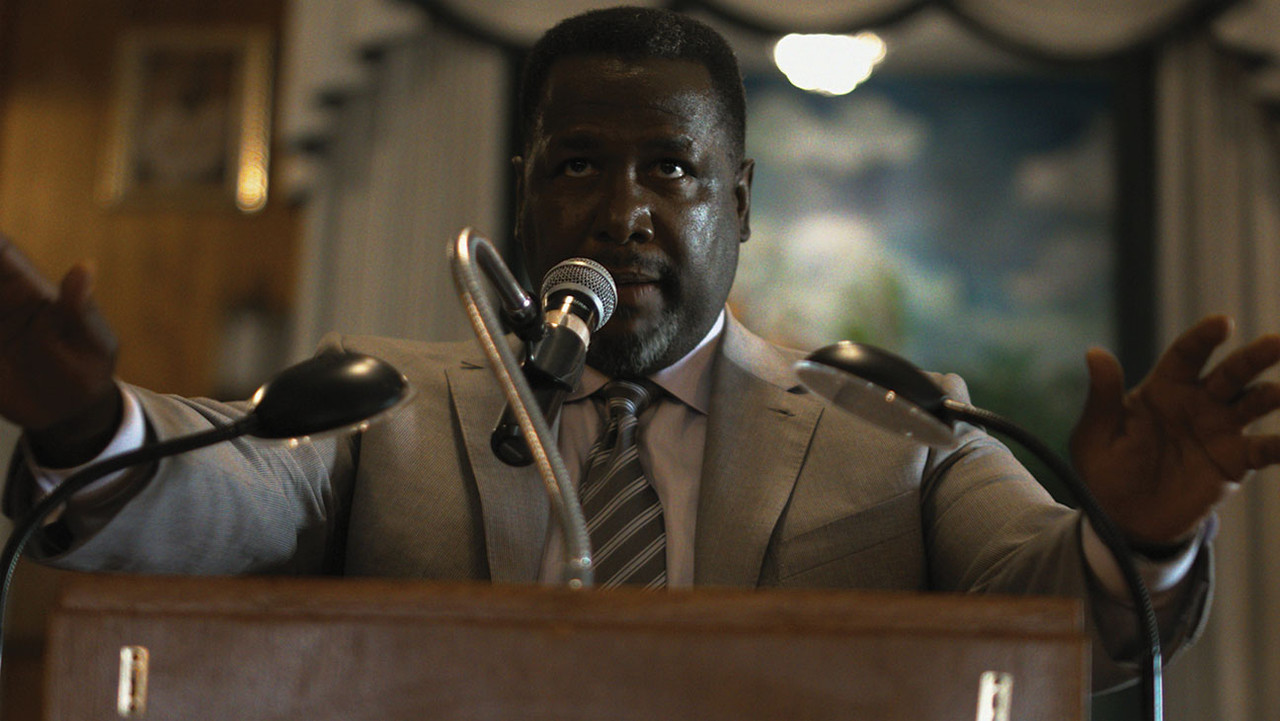
As Helen (Karen Kaia Livers) goes about her morning in rural Louisiana, we hear her describe the many old wives tales she heard and tried to implement—all without success—to cure a terrible rash her dog had. This is just one of the snapshots of Helen’s life in an impoverished town, where the Church is the centre of everyday life. We see her at church and with the alcoholic Reverend Tillman (Wendell Pierce) and trying to reconcile her faith with the troubles her son Daniel (Dominique McClellan), also an alcoholic, is going through.

The influence of Terence Malick and early David Gordon Green hangs heavy over his film,  especially in the use of evocative off camera dialogue and voiceover, often unrelated to much of what we’re seeing on screen. However, writer, director and cinematographer Phillip Youmans also establishes a strong voice of his own with this, his first feature film. Where he departs most from the Malick influence is in his dedication to handheld camera. Alcoholism is all over this film, Reverend Tillman is soaked in drink, to a degree that one could argue Youmans is drawing parallels between religion and booze as intoxicants. That’s not the only thing the film says about alcoholism though as it is also portrayed, through Daniel giving his young son Jeremiah (Braelyn Kelly) a drink, as a generational scourge. The handheld camera gives the whole film a woozy feeling, as if it too is mildly intoxicated in all of the scenes with alcoholic characters, which also lends purpose to moments that drift out of focus.

Youmans also knows when to simply let his camera rest. In one especially striking moment we see Daniel in the very back of frame, being berated over the phone by his mother because he has lost his job, while Jeremiah sits in the foreground, colouring. When you take it together with the shot of Daniel getting his son to drink, there is an enormous sense of foreboding in this image; as if Jeremiah’s future can be seen lurking behind him. It’s a brilliant and shatteringly sad image.

The performances are quietly spectacular. Karen Kaia Livers’ Helen carries world weariness and frustration, both with her son and her pastor, but also strength and caring. The voiceover that begins the film is beautifully written, but it’s her delivery that gives it such punch; the held in desperation of it as she recounts every failed attempt at a cure. We also see this combination of qualities in a scene that has her offering to drive Tillman to the store, because he’s obviously completely drunk. Wendell Pierce has an innate authority that lends itself to the role of a pastor, but the subtle way he plays drunk lies under every scene. Youmans isn’t entirely damning of religion, but he certainly comments on how both alcohol and religion can be enablers in the mistreatment of women, as we see a drunk Daniel hit his wife and later Reverend Tillman telling Helen that this is something that should be dealt with between her and God. If the film hits a stumbling block it is only in the last scene, perhaps an ellipsis too far; the fact we don’t see what happens feels a bit empty, but the rest of the snatches of these people’s lives are so well articulated that this is a very minor issue.

Add Youmans’ beautiful imagery to all this and it would be remarkable enough, but he made this film while he was still in high school. Beyond the maturity of his filmmaking, which is staggering, the understanding with which he writes characters generations older than him is exceptional. The crafting of the film’s language, the control of image and tone, the fact he says so much in just 77 minutes, and the way his elliptical construction of the film draws together so movingly all speak of a filmmaker older and more experienced than his 19 years. This is more than a calling card, it feels like an announcement of a talent we’re going to be hearing about for years to come. 
★★★★½

Sep 26, 2019

24FPS @ LFF 2019: Days 8 and 9

I Lost My Body
Dir: Jérémy Clapin
As a disembodied hand searches for its former owner, we watch in parallel as Naoufel (Hakim Faris) falls for Gabrielle (Victoire Du Bois), who he first meets as a voice on an intercom when he’s supposed to deliver a pizza to her.

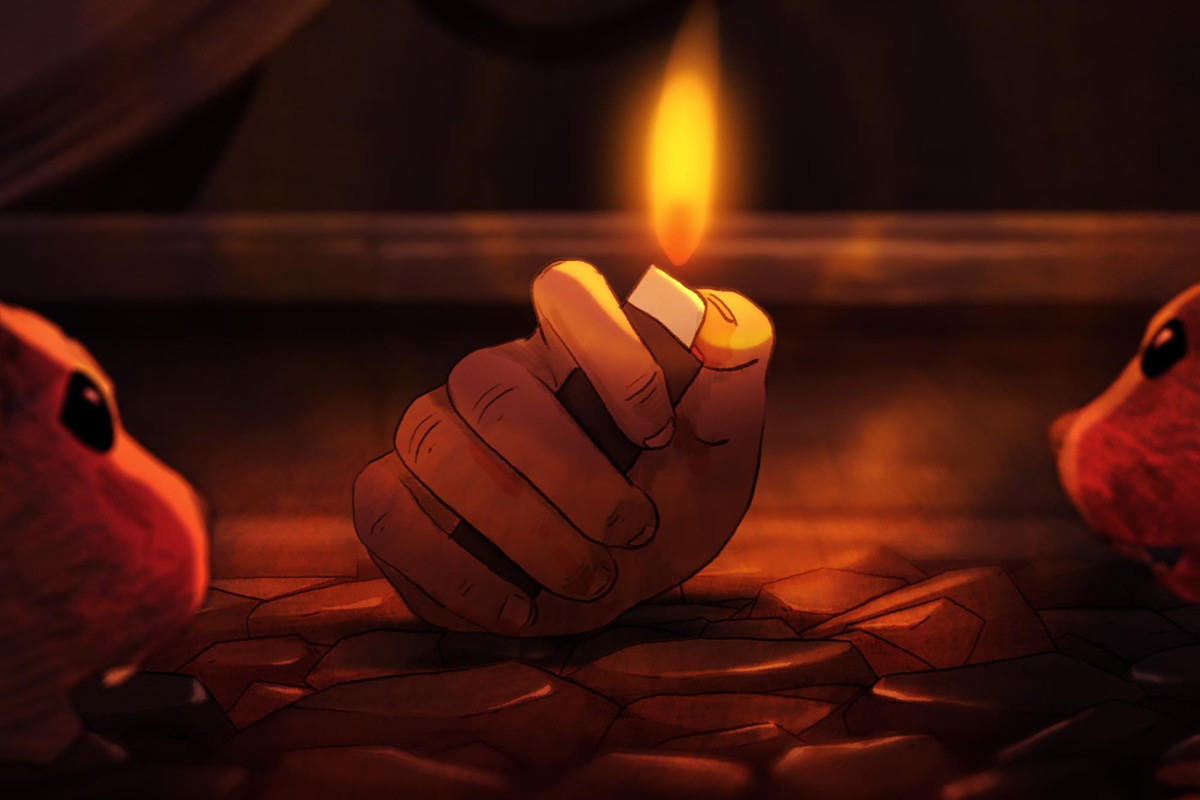
Jérémy Clapin’s first feature is first and foremost a beautiful piece of hand-drawn animation. The human characters are expressive, with a slightly sketchy look but fluid and engaging animation that gives them all character. What is more remarkable though is the animation of the disembodied hand and the world it moves through. Obviously, we are seeing much of what the hand goes through from its level and the realistic drawing of the environment around it and the things it interacts with - notably rats and a pigeon - makes its journey feel all the more perilous and takes us on that journey with it. In addition to that is the brilliance of the animation of the hand itself. Without eyes, a mouth or even an interior voice, the hand feels like a full character. From it, we get a sense of struggle—gripping on to a drainpipe for dear life—and of longing, as it ventures on its long quest. In many ways, it may be the character we end up feeling most empathy for, which is an incredible achievement. 

The relationship between Naoufel and Gabrielle is sweetly drawn. It’s hard not to identify with the slightly inept ways that Naoufel tries to tell Gabrielle who he is, aborting the mission several times through nerves. It’s also interesting and refreshing to see how Gabrielle, and through her the film, views these gestures by Naoufel as compared to how a romantic comedy of ten or twenty years ago might have.

As much as I loved the animation and the expressive but not instructive score by Dan Levy of The Dø, I Lost My Body ends up feeling a bit slight. Once we see how everything connects up, the last ten minutes are a little underwhelming and don’t really deliver the emotional punch the rest of the film appears to have been trying to lead to. There are lovely moments here, and the whole section of the film focused on the hand is remarkable, but ironically it might ultimately be a little less than the sum of its parts.
★★★½

The Antenna
Dir: Orcun Behram
The idea of a government using a broadcast to control its population is barely a sci-fi concept when one considers things like North Korean state TV and even the relationship between Fox News and the Trump administration. The Antenna is set in Turkey and shows us the first night of operations of a new government broadcast from the point of view of a single apartment building where, as soon as the dish to receive the broadcast is installed, escalating chaos ensues.

For his first film, writer/director Orcun Behram draws on many influences. This wouldn’t necessarily be a problem in itself, but he fails to establish much of an identity of his own and so what we end up with is a patchwork of those influences and a film that feels hugely derivative of better things that have come before. The main thrust of the plot is essentially a combination of two David Cronenberg films; the still underrated Shivers and one of his true masterpieces, Videodrome. As the insidious influence of the dish and the broadcast become more present, black sludge begins to ooze out of walls, taps and other outlets, calling to mind the black oil that was such a feature of the conspiracy episodes of The X Files. These are just the most glaring examples, and the ones by which The Antenna suffers most by comparison.

Taken on its own merits, The Antenna does occasionally show that Behram has some visual promise. An early sequence of Mehmet (Ihsan Önal), the maintenance worker who is the first to sense that there is something wrong at the building and that the dish is the cause, walking to work makes striking use of the imposing, towering, straight lines of the buildings he walks past. There are also a couple of standout sequences in the last fifteen minutes or so; an attack, under flickering lights, on Yasemin (Gül Arici) is visceral and brutal, and the long held close up on her in the aftermath is effective. The final sequence also shows some flair, especially in the choice to show one attack from outside the building it happens in, which accentuates the shock by stripping out the sound. 

Unfortunately, the journey to and time between these sequences is filled with long and slow scenes that want to revel in the film’s imagery but do little to repay that investment of time. The pace is often painful, every camera movement is agonisingly slow and the characters seem to move as if they are walking through the black sludge we see so much of. Sometimes a slow pace can work to build tension, but it’s so obvious where the film is going and what it’s trying and failing to say that instead it simply tests the patience. At 115 minutes, The Antenna feels long, and it could lose half an hour just through recutting to quicken the pace. The overarching message is one that has been advanced with more force and clarity in many films over the years, and the screenplay fails to get under the skin of either its central idea or its characters. It is possible there are resonances an English speaking audience will miss unless they are familiar with Turkey and its politics, but even if that’s the case, the film doesn’t deliver much of substance that is accessible to a wider audience. 

There are a few flashes of promise here, but for the most part, The Antenna is a slow and boring slog that will make you wish you were watching any one of the films it so liberally cribs its ideas from.
★½