Accession
Dir:
Michael J Rix
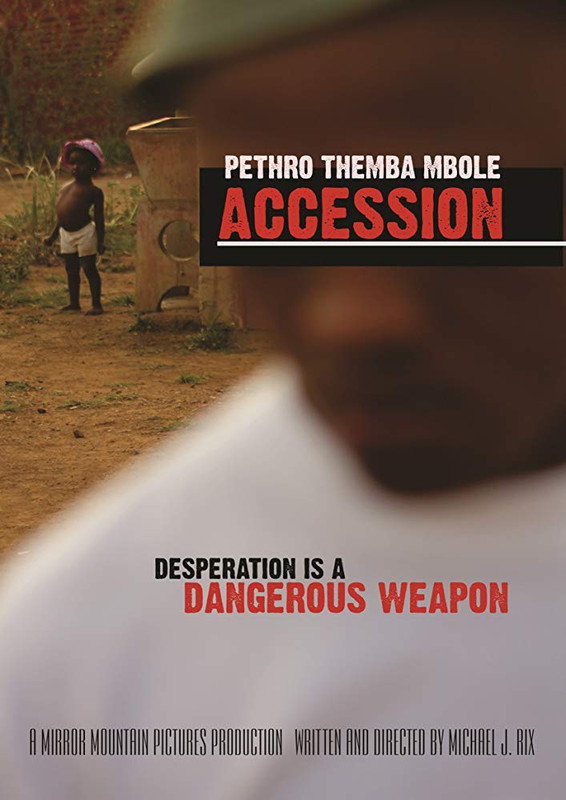
This is probably the film I've had the most trouble getting a critical handle on during this year's festival. I found more than half of it quite painfully dull, but there are moments that are so profoundly, brutally shocking that as someone who finds extreme cinema fascinating I can't dismiss the film as a whole.
John (Pethro Themba Mbole) is unemployed, and spends his days wandering round his small South African town, drinking, chatting with friends he meets and having frequent, unprotected, sex with women he meets. One woman he encounters tells him that she has just been tested and is HIV positive, which makes John sure he must be too. Over lunch a friend says he's heard that sex with a virgin can cure HIV, thereafter John is on a mission.
For about 40 minutes of this 78 minute film all that happens is the handheld camera follows John as he walks from encounter to encounter. Director Rix hardly moves from close ups in this part of the film, almost the sole variation being that some shots are on the back of John's head and others on his face. It reminded me of Gus Van Sant's singularly unedifying Elephant. However, once John hears the gossip from his friend that sex with a virgin will cure HIV this same technique becomes much more interesting. Suddenly, because Pethro Themba Mbole's quiet performance still manages to communicate a lot, the walking, the following, take on an air of menace, because we know deep down that something very nasty is likely coming. This utterly changes the film in it's second half, and your heart is suddenly in your mouth.
There are two scenes that will keep most people from ever wanting to see Accession. I've seen a lot in my time as a movie fan. I watched Salo and happily ate dinner directly afterwards, and I count Cannibal Holocaust and Martyrs among my favourite films. Accession contains nothing as explicit as any of those films, but it does contain a scene which, by showing nothing, manages to be perhaps the most shocking single scene I can recall watching. It's also perhaps the best scene in the film, because Mbole's performance, the process of allowing John to decide to go forward in this hideous moment, is so articulate in its silence.
I would probably 'like' Accession much more as a 40 minute short, because even in the second half there is much that could be tightened, but for all its many problems, this is a film I can't dismiss.
★★★
Everyday
Dir:
Michael Winterbottom
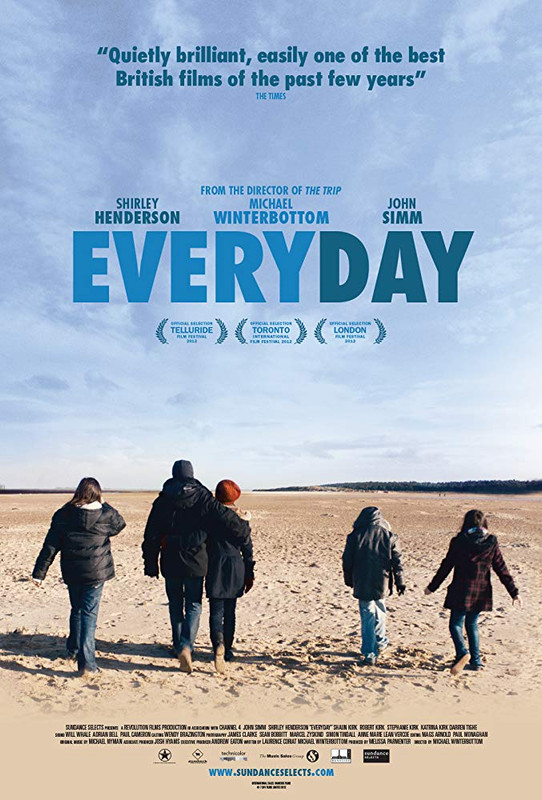
Michael Winterbottom has had a long and prolific career, but there is perhaps no more hit and miss filmmaker working today. He's capable of great things as both a dramatic (Butterfly Kiss, Jude) and comedic (24 Hour Party People, A Cock and Bull Story) director, but when he misses the mark the lows are catastrophically low (I Want You, With or Without You, Code 46).
This lack of consistency is a real concern when you consider that Winterbottom's new film; a drama about a family (Shirley Henderson and the four Kirk siblings) coping with the fact that the father (John Simm) is serving five years in prison, was shot in short bursts between other projects over five years. This was done, as it is being done over twelve years for Richard Linklater's upcoming Boyhood, so that we could see the actors, and particularly the children, grow and change in a completely organic way over the course of the film.
In this respect Everyday is an unequivocal success. The sense of the passage of time – which Winterbottom never flags up with captions -is totally organic. The children obviously change hugely, the eldest ageing from about 8 to 13 and the youngest from around 3 to 8, but we can also see the years adding up in Henderson and Simm (who begins to grey a bit towards the end of the film). It's also a remarkably consistent film given the production period, the untested child actors, and Winterbottom's aforementioned hit and miss filmography. Winterbottom, co-writer Lawrence Coriat and their cast have all managed to find and sustain a very strong tone of low key believability. This is indeed a story you can imagine is happening every day in many parts of the country.
Shirley Henderson has long been one of my favourite actresses, and it's great to see her get another film anchoring role several years after the strong, but almost totally unseen, Frozen. She's brilliant as Karen, giving us both a completely credible portrait of a Mother struggling to raise four kids by herself, to cope with the day to day challenges that come with that and a sense, without ever saying it that her husband Ian's sentence has put her in a kind of prison just as much as it has him. John Simm is equally effective as Ian, and between them he and Henderson feel like a credible couple that has been together for a long time, is enduring a hard time, but fundamentally still love each other. Both excel at the art of understatement, and say a lot with quite limited dialogue during the many scenes in which Karen and the kids visit Ian in prison, suggesting tension, love and the struggle to retain some sort of normality with a few looks and a few exchanges.
The kids aren't hugely stretched, and I had the feeling that most of the visit scenes were only loosely scripted, which, along with the fact that they are real life siblings, and so their relationships to each other are likely very much the same as they are here as in real life, would account for the beautifully unaffected performances that Winterbottom is able to draw from them.
Everyday is a fine film, but there were a couple of things that niggled at me in it. The first was just a question. How, given that she's only shown as working casually, does Karen maintain a reasonably nice house, support four kids, and frequently travel from Norwich to London to see Ian with at least two of those kids in tow? It's hardly a major issue, but it's odd, and when everything else feels so real it would make sense to have an idea of the financial pressures Ian's imprisonment must place on his family. The other issue is much more major, and that's Michael Nyman's score. For long periods the film unfolds without score, but when it comes on it feels as though Winterbottom and Nyman are dipping the film in raw sentimentality. It's especially damaging in the final shot, in which the score is almost begging you to feel something, while undermining that possibility.
Overall though, Everyday is a return to form for Winterbottom and essential viewing for fans of Henderson and Simm.
★★★
After
Lucia
Dir:
Michel Franco
It's
incredible, really, what people will do to each other. It would be
comforting to not believe the things we see in After Lucia happen, but we read about things that aren't far removed from it in the
papers almost every day.
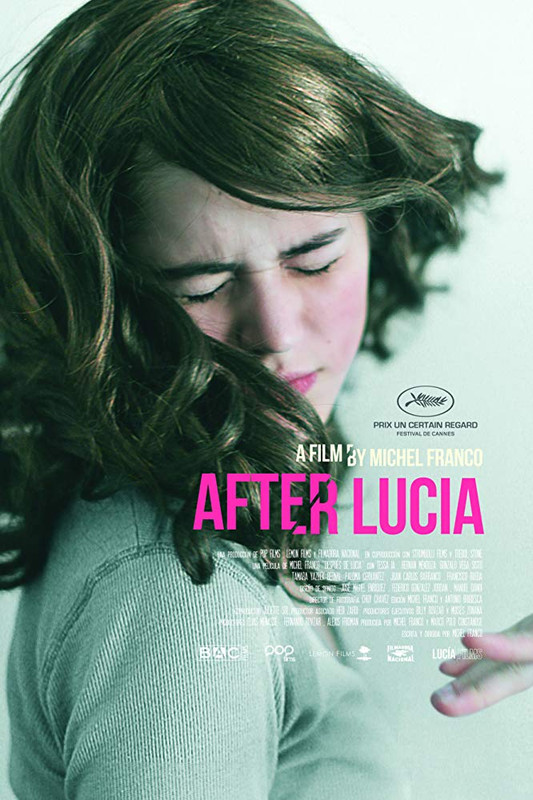
Alejandra
(Tessa Ia) and her Father Roberto (Hernan Mendoza) have just moved to
Mexico City for a fresh start after the death of Alejandra's Mother,
Lucia, in a car accident. At a party with friends from her new
school, Alejandra is filmed having sex with a boy. The video soon
makes its way round the school, and makes Alejandra the target of a
disturbingly escalating campaign of bullying.
If
the content of After Lucia weren't disturbing enough (and, when a
birthday cake made of shit isn't the worst thing to happen to
Alejandra, you can be pretty sure it is) the way the characters react
– or rather fail to react – to it is perhaps more disquieting.
We get the feeling that both Alejandra and Roberto have been rendered
inert by Lucia's death, and perhaps even that Alejandra regards some
of what she's going through as 'punishment' as her Mother was
teaching her to drive when they crashed and she died. Tessa Ia's
performance may be extremely still and quiet, but there is still a
lot of turmoil evident behind her eyes, and it's clear from Hernan
Mendoza's equally detached performance that the reason Roberto isn't
seeing it is that he's really not seeing anything very clearly
through his grief.
The
film begins with a disturbingly real feel to it, and this helps as
the bullying escalates to a point that finally shocks Roberto out of
his stupor. While, happily, Michel Franco largely eschews the
shakycam stylings that have, somehow, become a shorthand for realism,
the performances of the schoolkids are extremely believable, and we
get a sense of the way that each act of bullying makes the next
escalation easier for them. The film does begin to strain credulity,
stopping just short of breaking point, in the climactic school trip.
The
problems in After Lucia are largely confined to the last twenty
minutes, in which the film takes a long expected but too late
executed shift in tone and genre. It's not a bad idea, nor are the
scenes themselves badly executed, but the shift feels like a bolted
on afterthought because it simply isn't given enough time to develop.
Leaving
this last section aside, After Lucia is a compelling and relevant
film, and well worth seeing for Tessa Ia's understatedly affecting
performance alone.
★★★
Four
Dir:
Joshua Sanchez
Telling
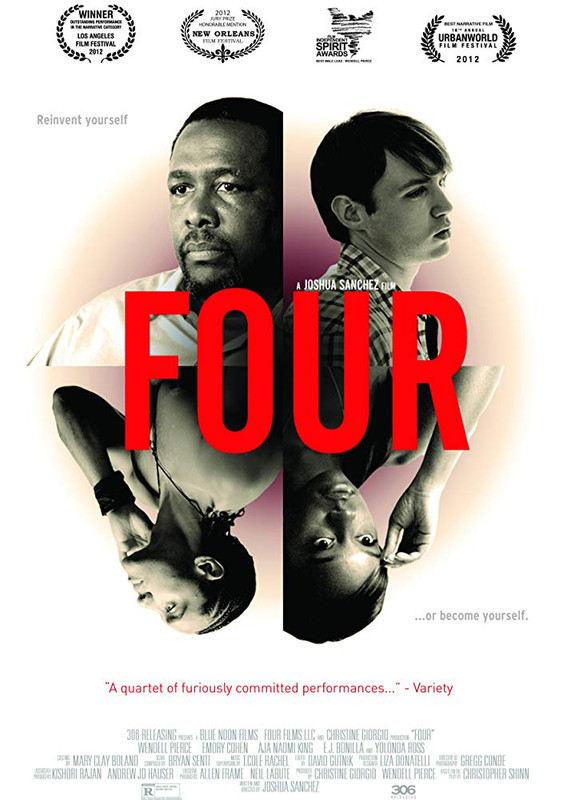
two stories of four people on one July fourth, Four is perhaps more
mobile than a lot of stage adaptations, cutting between its two pairs
of characters as they move through the New York night, but it does
share some of the pitfalls of the filmed play.
Joe
(The Wire's Wendell Pierce) picks up a young man named June (Emory
Cohen) he has been talking to online for a date. Across town Joe's
daughter Abigayle (Aja Naomi King) sneaks out on her duties looking
after her mother for a date with Dexter (EJ Bonilla).
The
film largely centres on the exchanges between these four characters.
Joe and June talk about the fact that June hasn't come out, even
seems afraid of his desire as a boyfriend. Wendell Pierce is
fantastic in these scenes, allowing the subtext of Joe's own double
life (which we see vividly illustrated in one long shot at the end of
the film's second act) to bleed through, even as he forcefully tells
June that he should be fully out, that he should talk to Todd; a
friend he hasn't spoken to since Todd stepped out of the closet in
high school. It's actually a rather sad series of scenes, but the
point isn't beaten into you. Dexter and Abigayle's date night is a
little more typical. You might expect Dexter (who clearly is trying
to seduce Abi throughout) to come across as a bit sleazy, but EJ
Bonilla's sincere performance, and the strength of Abigayle's
character and Aja Naomi King's performance keep that from being the
case.
Neither
story is perfectly realised; Dexter and Abi's goes off the rails when
they get back to her place, and Joe and June's does sometimes feel
like it is reiterating the same (good) scene over and over again.
However, the film is held together, despite a slightly stagy feel to
the long and talky scenes, by impressively lush photography and the
strength of all four leading performances.
★★★
Peddlers
Dir: Vasan Bala
I've only ever seen one Indian film- Shekhar Kapur's debut Bandit Queen – before Peddlers. I've not been actively avoiding them, it's more that the Indian film industry is so vast, and most Bollywood films so impenetrable looking, that I've not really had a clue about a way into them.
Peddlers feels like an attempt to make a 'western' style film, with its 'gritty' subject matter and 'adult situations'. If Vasan Bala was trying here to make an American style thriller that might be a breakout hit then he has failed miserably.
The narrative has two strands. One is about a young man nicknamed Mac (Zachary Coffin), who is called upon to look after a drug mule named Bilkis (Kriti Malhotra), only to fall for her. The other story is about Ranjit (Gulshan Deviah); a cop who is going over the edge in both his work and his personal life as he tries to keep the shameful secret of his erectile dysfunction.
The Indian film industry was famously heavily restricted for a long time – even kissing was only allowed on screen less than 20 years ago – Perhaps Peddlers is the result of liberalisation, because it's a film that speaks to a writer and director with a desperate desire to be edgy and shocking, but with no concept of how to do it. In the roughly 40 minutes in which, across the first two acts, the film deals with Ranjit's erectile problems it does so either with breathtakingly misplaced earnestness or totally overblown shock moments (like the unintentionally hilarious moment in which he force feeds cocaine to a neighbour he's been flirting with and threatens her with arrest if she tells anyone his secret).
By contrast with the hilariously awful Ranjit story, Mac and Bilkis are just a bit dull. We know Mac is in love with Bilkis because he says so, but there's no sense of it in any connection between the characters or in the performances. The film tries to beat emotional involvement out of you with the revelation that Bilkis has cancer, but it doesn't work because it never seems to effect her. There are similar problems with the drug mule side of Bilkis storyline, which is set up, but never seems to go anywhere. The best thing I can really say for this part of the film is that Kriti Malhotra is beautiful.
The third act of the film lurches even further off the rails, finally bringing the stories together in a way so contrived and so misconceived that I wasn't sure whether I should laugh or cry at the ineptitude on display. Again, Vasan Bala goes for brutal and shocking, but has no clue how to do it, and so ends up with unintentional comedy. Peddlers is a terrible film. It's hurt by an abysmal screenplay, performances that suffer from being in a seemingly random mix of barely inflected English and Indian, and a complete miscalculation of tone. It is sometimes quite funny though.
★