Showing posts with label Feature. Show all posts

Jul 2, 2022

Adventures of a new, old, gamer: Finishing (and not finishing) a game

I’m not sure that I’ve ever finished a console game before. When I was playing as a kid and a teenager, I would always get hung up on a certain level, or a certain boss, that I just couldn’t pass. There weren’t enough lives, not enough continues, and inevitably I get frustrated and give in. Today, I finished my first PS4 game—Detroit: Become Human. Or did I?
Connor in Detroit: Become Human
Produced by French company Quantic Dream, and written and directed by David Cage, Detroit: Become Human is about as far from what I would picture as a traditional video game as anything I have played. To a great degree (at least on the setting I played it at for my first run-through), it feels more like an interactive TV show, or a visual novel. The game takes place in 2038. The overarching story sees humanity in a place where ultra-realistic humanoid androids have become commonplace, many are home helps of some sort, while others do menial work and still others provide… more adult services. The narrative cuts between chapters in which you play as three androids (controlling one at a time). Connor (Bryan Dechart) is a detective, brought in to investigate the ‘deviants’, and partnered with an irascible detective (Clancy Brown), who doesn’t like androids. Kara (Valorie Curry) is a domestic model, who breaks her programming when the alcoholic father of the girl she looks after (Alice, played by Audrey Boustani) beats his daughter. Markus (Greys Anatomy’s Jesse Williams) looks after aging, disabled artist Carl (Lance Henriksen), and is prompted to break his programming when Carl’s adult son tries to bully his Dad for money. Within this setup, and the overarching story of an android uprising, there are a multitude of choices of actions that you can take with each character, driving the story in myriad different directions.

Besides setting the difficulty to ‘casual’, I made a few determinations early on. It was clear a lot of the choices the game asked you to make would be about situational morals, and I decided I would chart, where possible, a consistent path with each character on my first playthrough. This wasn’t always easy with Connor, as his arc within the story is often about his moral quandary between doing the job he was programmed to do and being swayed by the deviants. As an overarching principle, I decided that Kara would always try to do what was best for Alice, and that Markus would remain, again as far as he could, a peaceful revolutionary.

The first chapters are fairly simple, even a little dull. Connor has an investigation that introduces the game’s key mechanics, but then Kara has to do housework, and Markus runs an errand and serves Carl’s breakfast. It’s only quite slowly the key themes and action bleed into Kara and Markus’ stories. And yet, mundane as these openings were, they began to effectively ground the characters. This is aided by some exceptional graphical work. This game is four years old now, but as I’ve not seen the PS5 work, it’s probably the best-looking game I’ve ever played. The main characters are astonishing. The textures are lifelike; hair, clothing, and skin all look almost as if you could reach out and touch them, and the animation is nuanced. The facial animation on Connor is especially brilliant, with it and Bryan Dechart’s performance both giving the struggle of the ambiguity of ‘his’ existence real life. The supporting and incidental characters are understandably less detailed, but key ones are close to the same level of detail, and the world they inhabit, while maybe not as bustling as it could be, is well realised.
Kara and Alice in Detroit: Become Human
I don’t want to talk too much about how the story played out for me on this occasion, but even aside from the moment I mentioned in my last piece, where I realised I didn’t want to fulfill a game objective because I had grown attached to the characters, there were many more instances that put my heart in my mouth. Some of these happened because dialogue prompts can be a little vague. During a speech I had to give as Markus, I worried that one button press that ended up saying something other than I intended would undermine the way I’d been crafting the character. Similarly, almost every moment with Kara and Alice as they went on the run was nailbiting. All I wanted was to get them a happy ending, as I found myself ever more invested in that relationship, thanks to a standout performance from Valorie Curry, in one particularly great moment, she had me convinced that Kara was about to cry. At one point, I thought something I had failed to do had scuppered Kara and Alice's chances, and that felt genuinely terrible.

Markus’ section of the story is where David Cage leans hard on allegory, and it’s fair to say it’s not subtle. The civil rights parallels are clearly well-meant, and shockingly prescient at times, but the dialogue laying them out, despite a powerfully restrained performance from Jesse Williams, is often rather clanging and obvious. That said, this section is often the most engaging to play. It seems to give you the greatest chance to shape the direction, and tone, of the story. Let’s just say that there’s a much darker version I might see if I can pull off next time I play.

At the end of each section, you view a decision tree of what you’ve just done and see the boxes indicating things you didn’t do, choices you didn’t make, and paths that are now locked off. It’s tantalising, and will draw me back for more goes at this story. I was always rather skeptical of the potential of computer games as vehicles for storytelling and especially for characters you could really care about. Detroit: Become Human makes me look a little foolish on that score. It’s not a difficult game, but then it’s not meant to be. Deaths, if and when they come, aren’t there to frustrate you and send you back, instead, they fold into the story (not everyone got out of the telling on this run for me), and a subsequent game will allow you the chance to experience the story, be it that element or potentially almost the whole thing, very differently. I elected to get a PS4 because I wanted to see if I could get involved in a game in this way. I’m very pleased I could. I look forward to diving in again, and to picking up the remasters of Quantic Dreams’ previous games, Heavy Rain and Beyond: Two Souls

Nov 1, 2015

The Month In Movies: October 2015

Less to choose from this month, as I've excluded the films I saw at the London Film Festival from the roundup, as they were covered in their own post.

Best Film
Star 80

Worst Film
Cold Prey 3

Best Actor: Bill Hader: The Skeleton Twins / Ben Foster: Ain't Them Bodies Saints
Best Actress: Mare Winningham: Star 80 / Kristen Wiig: The Skeleton Twins
Best Director: Bob Fosse: Star 80
Best Screenplay: Craig Johnson, Mark Heyman: The Skeleton Twins
Biggest Surprise: Spectre
Most Fucked Up Movie: Slaughterhouse 
Best Scene: Lipsync: The Skeleton Twins
Movie(s) I Finally Got to See: Star 80 
Crush of the Month: Lea Seydoux: Spectre

Oct 17, 2014

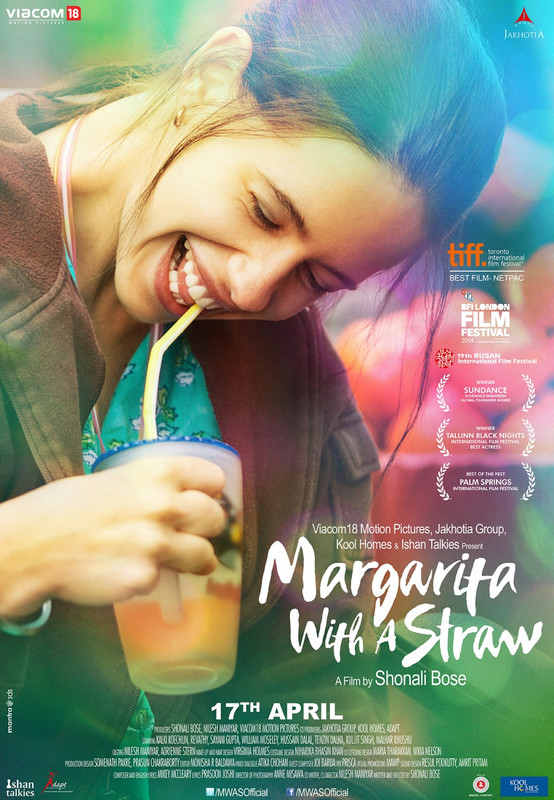
24FPS @ LFF 2014: Margarita, With A Straw

Dir: Shonali Bose
The view we get of modern Indian cinema in the UK is so dominated by the handful of  mainstream Bollywood films that get released here that it can be hard to realise that there is an independent industry there, producing films that are perhaps better suited to export for more general audiences.  Margarita, With A Straw may be a flawed example, but it's certainly an interesting one.

Laila (Kalki Koechlin) is a bright, pretty, 18 year old girl with a talent for music, living in a middle class family in India.  She is also confined to a wheelchair because of a severe case of Cerebral Palsy.  When Laila wins a scholarship to study at NYU she and her mother (Revathy) relocate to the US.  While studying there Laila meets Khanum (Sayani Gupta) a fellow student, who is blind.  The two fall for each other and begin a relationship that could be complicated when Laila has to tell her family she is bisexual.

If there is one overwhelming reason to seek out Margarita, With A Straw then it is Kalki Koechlin.  Apparently she's a major Bollywood star, but I had never seen her before.  I came away hugely impressed.  The details of her performance are so well observed and authentic that I had to do some research to find out whether she was genuinely disabled.  Koechlin brings an effortlessly charming and endearing presence to Laila.  There can be a tendency for either scripts or performances attempting to portray disability to talk down to disabled characters; to assume that they are more different from able-bodied people than is in fact the case.  In this case neither writer/director  or Koechlin make that mistake.  Laila is a well drawn character who has thoughts and feelings that are as complex and treated as just as valid as those of any other character.  

Beyond this, Koechlin gets the tone just right.  It is very easy for a performance like this to fall in to caricature (see Rob Lowe's cringemaking turn in Square Dance for a particularly egregious example) but Koechlin treats the challenges of playing disability much as it seems Laila treats the fact of being disabled; as a part of her reality, but one she's not going to allow to stop her from expressing herself.  On this evidence Koechlin is a real talent and someone I'd like to see more of.

Outside the fact of the physical challenges its main character faces, the story of Margarita, With A Straw is a pretty standard LGBT film narrative. Laila has previously seen herself as straight but falls for a gay character in Sayani Gupta's Khanum; a fun loving girl who compliments Laila well, something also reflected in Koechiln and Gupta's chemistry.  It also hits pretty standard tropes in its coming out story, with Laila worrying about how her parents will react, not without reason, as Khanum has been disowned by her family, this conversation hints at some deeper cultural comment about how sexuality is viewed in India, but the film never really digs into that theme.

Familiar as it is, the story is largely charmingly told.  Revathy is excellent as Laila's concerned and caring mother and their close relationship is nicely drawn, warm, and often quite funny.  You can see exactly why Laila falls for Khanum, thanks to Sayani Gupta's vibrant performance, and she also brings some emotional resonance to the developments of the relationship in the third act, rushed as they are.  

That third act is the film's major issue.  There are bits that clunk earlier in the film; Laila's crush on her British typing aide (William Moseley) falls especially flat and the visual style is never especially dynamic, but the twist that signals the third act comes out of nowhere and is rushed through with unseemly haste.  The reason for this is easy to see.  The mass of dedications on the film suggest that this is a very personal story for writer/director Shonali Bose and that few, if any, of the events are wholly invented.  The thing is, compressing events set over about a year into under two hours sometimes jams too much incident together.  Add in an abrupt change of tone, and your story can quickly lose credibility.  That's exactly what happens here.

Margarita, With A Straw is flawed, but it's warm and engaging despite its problems and whatever else you think of it, it is worth seeing purely for Kalki Koechlin's exceptional performance.

Oct 7, 2014

The Picture Show @ LFF 2014: Interview with Josephine Decker

In this interview special I chatted with writer/director Josephine Decker about her two films: Butter on the Latch and Thou Wast Mild and Lovely, which are playing at the Festival.  In half an hour we covered genre, influences, collaboration, clown school and much more.

Many thanks to Josephine for taking time out to chat with me, as you'll see from her detailed answers there was much more I could have asked.  This interview could easily have been twice as long.

There are NO SPOILERS for either film, so you're safe to listen before seeing them, which I encourage you to do.

You can listen to the show in the player below, or steam or download it HERE

Jun 1, 2014

The Month In Movies: May 2014

Film(s) Of The Month
Under the Bombs / Commando
Both of these films are, to some extent, about explosions and parents looking for their children, but otherwise they couldn't be more different.  Under the Bombs is a quiet and moving drama about a woman searching for the son she fear may have been killed in Israel's 2006 bombardment of Lebanon and the relationship she has to the taxi driver she hires to take her on this dangerous journey.  It's a two-hander, hinging almost entirely on the performances, which, happily, are outstanding.  It's also a striking watch thanks to the setting; shot in the aftermath of the events it depicts, all of the bombed out settings are real and most of the minor characters are non-actors. 

Commando isn't quiet.  I'd seen bits and pieces of this gloriously silly action-fest over the years, but never the whole film.  It is the ne plus ultra of Arnold Schwarzenegger films, boiling down his appeal to its most wonderfully excessive essence.  The action is over the top but brilliantly staged, Arnie has a lot of fun in the lead and the bad guys are variously badass (Bill Duke) and ludicrous (Vernon Wells and his knitted vest).  This is the kind of movie I love despite knowing that it is utter nonsense and a perfect antidote if ever I get too serious about what I do.

Worst Of The Month
Prince Of The Sun / In the City of Sylvia
Another pair of films that couldn't be more different, or included for more different reasons.  Prince of the Sun is many things, but it's not boring.  The ineptitude of the whole enterprise from the fight choreography to the writing to the comedy to the editing right down to the worst dubbing I've ever seen in my life is so striking that it's pretty hilarious, but it's not good.  I keep going to Cynthia Rothrock films hoping one will show her off to the fine effect that Poloce Assassins did.  No luck so far.

In the City of Sylvia, on the other hand, is boring; painfully, excruciatingly boring.  The first five minutes consist of a man sitting on a bed with a notebook.  The next 24 minutes consist of that same man looking at and sketching women at a cafe.  Yes, you read that right, 24 minutes.  It does attempt to develop a story when he begins following one woman (the staggeringly beautiful Pilar Lopez De Ayala) and then, after another 15 minutes of silent walking, tells her he thinks they met here six years ago, but by that point I was a good 54 minutes past the point at which I gave even the tiniest of fucks.

Best ActorGeorges Khabbaz - Under the Bombs
Best Actress
Nada Abou Farhat - Under the Bombs / Doona Bae - A Girl At My Door
Best Supporting Actress: Kim Sae-ron - A Girl At My Door
Best DirectorPhilippe Aractingi - Under the Bombs
Best Screenplay: Hossein Amini - The Two Faces of January
Biggest SurpriseSabotage
Biggest DisappointmentThe Double
Most Fucked-Up MovieSleepaway Camp
“I’m Pretty Damn Sure No One Else Has Seen This” (and they should)The Super Inframan
Best Scene: Frank's likeable song - Frank
“Why Is He/She Still in Movies?”: Robert DeNiro - Hide and Seek
One To Watch: Kim Sae-Ron - A Girl At My Door
Movie I Finally Got to Friggin’ SeeSleepaway Camp

Hottest Lady: Pilar Lopez De Ayala - In the City of Sylvia

May 17, 2014

Cinematters: Cineworld's new seating policy

I spend a lot of my time in cinemas and most of that time, thanks to the godsend that is the Unlimited card, is spent at Cineworld.  I'm now in my seventh year of having a card and it has more than doubled the amount of films I am able to see annually.  Despite the frequent frustrations of attending multiplexes I absolutely love it.  One of the great attractions of the Unlimited card, beyond it making my cinema trips exponentially less costly, was the fact that Cineworld do not allocate seats.  Every ticket has GA [General Admission] printed on it, allowing you to pick your seat as you walk in to your screening.  This has always been, by far, my preferred system but, sadly, Cineworld appear to have decided to switch to 100% allocated seating beginning in June.  I'm, to put it mildly, not a fan of this choice.  Here are a few reasons why.
A screening with allocated seating

I DON'T KNOW ALL THE SCREENS
When you are selecting an allocated seat you are given a diagram of the layout of the screening room.  This is fine as far as it goes but many's the time I've been burned at other venues, thinking I've booked a good seat, but finding on entering the screening room that it is not what I expected.  There are more considerations than the simple issue of where along the X and Y axes you choose to sit.  For instance, what is the rake (the level of the seats relative to each other) like?  One of the Cineworld screens I go to regularly has a very strange, almost undulating, rake, that can be difficult for certain films and even now I would struggle to know from a diagram where I would want to sit in that screen.  There is also the Cineworld screen that has an extremely strange layout, with the screen set off centre in the room, meaning that in certain spots you have to sit to the side of the room to look at the centre of the screen.  This is unlikely to be reflected on a diagram.

These, of course, are issues that I can only point to because I know these (and other) screens inside out, but I go to four Cineworlds regularly.  One has three screens, one has seven, one has ten and the last has another ten, plus a special screen.  I have probably, at some point, been in most of these screens, but I am by no means familiar with all of them and by no means would I always know where I would wish to sit from a diagram.  Sure, the diagram shows me where the screen is, but not how large it is, which has a deciding effect on where I sit most of the time (absent any other issues).  If I don't know the screen well then I won't know where I want to sit until I get in there.

I DON'T KNOW WHO'S AROUND ME
Whenever possible I get to a screening early so that I can stake out the spot I want to sit in.  This generally means that I am among the first people to sit down and that others, as they file in, end up sitting around me.  I'm not a tall man, which sometimes causes problems in screens with a poor rake and the fact that seats are unallocated means that I can move if someone tall ends up sitting in front of me and ends up obscuring my view (I'd say the same goes with talkers, but I tend just to ask them to be quiet).  Even if the seat I want to move into is empty before (or even during) a screening, allocated seating removes this option and would lumber me with an obstructed view.

There are also, on occasion, other reasons that I might wish to switch seats.  From time to time I have ended up sat in close proximity to someone with, shall we say... less than perfect personal hygiene (there's one regular at one of the Cineworlds I go to who wears a suit that looks and smells like it's made out of carpet from the 70's).  Again, in allocated seating you can't move, assuming, of course, that you've sat in your allocated spot to begin with.

I'LL PROBABLY HAVE TO MOVE SOMEONE
Let's say that the stars have aligned and I HAVE booked my ideal seat and that because I know that I have arrived a little later than usual, perhaps skipping the ads and arriving for the trailers.  It's not unlikely that someone is already sitting in my seat, because there are a lot of people who, in my experience, simply don't abide by the allocation they are given.  Sometimes this is through ignorance, sometimes they've not booked ahead and want to sit with someone else, sometimes, frankly, they're just dicks.  None of these makes for an especially comfortable situation.  This is a conversation I've had quite a few times...

Me: Hey, sorry, but you appear to be in my seat.
Them: There's plenty of other seats.
Me: Yes, but this is the one I'm ticketed for.
Them: Just move a couple of seats.
Me: Well, then I might be in someone else's seat, and I chose that one on purpose...

It can get uncomfortable fast, and even when I'm in the right I feel bad about having to do it.  I don't go to the cinema thinking that it'd be brilliant to split up a group of friends who want to sit together (though I have previously said no when, under General Admission, I was asked to shift up 'like, 4 seats' so a group could sit together, because in a smaller screen that was the difference between a good seat and a shitty one), but I still end up having that conversation because several times when I have had to sit elsewhere than my assigned seat I've ended up on the receiving end of the 'Hey, sorry, but you appear to be in my seat' opener.  

LATECOMERS WILL BE MORE ANNOYING THAN EVER
Cineworld now has, on average, 23 minutes of ads, trailers and idents before the film (that's another rant for another time, but trust me, we'll get there), and yet still people often arrive up to 20 minutes late for the feature; a good 45 minutes after the time on their ticket (do they think it's like a gig?)  I can't imagine why they stay, but at least, most of the time, they are forced to sit in the most convenient place, generally towards the side of the screening room, because most people who arrive early or on time gravitate, given the choice, to the centre of the screen.  This is, of course, much less likely to be true with allocated seating.  

How frequently, at allocated screenings, have you seen someone arrive 20 minutes late and then pick their way through half a full, central, row, casting shadows on the screen as they go, to get to their assigned seat?  It's something I see constantly at allocated screenings.  It causes disruption and noise, interrupts both the illusion and the flow of the film and is almost completely avoidable by using General Admission tickets.

THE PEOPLE IT SCREWS MOST ARE UNLIMITED CARD HOLDERS
The selling point of this new policy is that it will apparently cut down on waiting because you can simply book your seats online, know exactly where you are sitting, and then turn up and pick up your tickets more or less at your leisure.  This isn't a bad idea in principal, especially where big releases like the upcoming X-Men: Days Of Future Past, screenings of which are sure to be jam packed, are concerned.  Unfortunately there is a fatal flaw in how the Cineworld website is set up which completely screws Unlimited card holders and renders this selling point entirely moot.

You can only have one screening booked at a time.

Let's assume that you are a relatively normal cinemagoer.  During the summer season there are probably many blockbusters you are excited to see, perhaps two  or three in the same week (Maleficent, Edge Of Tomorrow and A Million Ways To Die In The West all open within days of each other, for instance).  If you want to see all of them then you're out of luck as you can only book one screening ahead of time, meaning that you miss out on the pick of the best seats specifically for the most in demand films.

I'm aware that I am not a normal cinemagoer, and so this new policy screws me in a particular way too.  I live some way outside London, which is where my nearest Cineworld sites are, so I tend to go once a week and spend a whole day seeing three or four films, often at a single site.  Usually I can get all of my tickets at the same time, freeing me up to be able to get to each screening as soon as possible to grab the seat I want.  Under the new system I will be disadvantaged not merely by the issues I set out above but by the fact that since I can only book one ticket ahead of time, I can't set up my cinema day in advance.  The physical queue in the cinema may shrink, but the virtual queue for  seats will be long, and because of this abysmal functionality I will be perpetually at the back of that queue, taking pot luck on the seats that are left.

If this policy is to be implemented this is the first thing Cineworld needs to fix.  Other customers can book multiple tickets ahead, Unlimited customers need to be able to do the same.


So, that's why I don't like this policy change, but I'd love to know what you think.  Are you for or against allocated seating?  Do you agree with my points?  Let me know either in the comments or by tweeting me @24FPSUK (you could also tag @cineworld).

Please feel free to share this article (with proper credit and a backlink).

Mar 21, 2014

The Picture Show: Nymphomaniac

On this episode of The Picture Show I am joined by my regular co-host Mike Ewins and by a first time guest, actress Rebecca Callard, to discuss just one film.  We devoted the whole show to Lars VonTrier and to his new, controversial, two part film Nymphomaniac, starring Charlotte Gainsbourg, Stacy Martin, Stellan Skarsgaard and Shia LaBeouf.

You can stream the show in the player below or download it HERE

Sep 16, 2013

Star Wars Week: Day 1

I am, at best, a lapsed Star Wars fan.  I grew up on the films, and one of my first memories is figuring out that I needed glasses because I was sitting incredibly close to the TV to be able to see A New Hope.  We had the films on VHS when I was young, and I watched them a lot.

As I grew up I began to find Star Wars less interesting, first becoming bored with the more child oriented tone of The Return of the Jedi, and then, especially following the Special Editions, beginning to see increasing problems in the original film.

What really killed the series for me was Episode 1.  I was 18 when the film came out in 1999, and I had been looking forward to it, sure, I had drifted away from the series, but the trailer was great and I had never been able to see the original versions of episodes 4 - 6 in the cinema.  I admit, I got chills when the music kicked in.  And then... well, you know what happened.  That was 14 years ago.  Since then I've seen the subsequent prequels on their cinema releases (I didn't like them much), but otherwise I've not touched Star Wars in all that time.  

So, why revisit them now?

There are few series' of films with anything like the kind of audience love and following that Star Wars has.  These films mean so much to so many, and that level of devotion always makes me wonder, if I am not part of that fanbase, what people see that I don't.  After nearly fifteen years of essentially ignoring the franchise - though the original trilogy is burned into my memory from when I was a kid - I feel that I have an appropriate distance to look afresh at the series and to form a definitive opinion of where I stand on these films as an adult and as a critic, which I was really just starting to be when Episode 3 came out.

I'll be looking at the series this week, covering one film a day.

Episode 1: The Phantom Menace
Dir: George Lucas
It's never a good sign when within 20 seconds of a film starting it makes what seems like a massive miscalculation.  Consider the first two sentences of the opening text crawl of Star Wars Episode 4: A New Hope. "It is a period of civil war. Rebel spaceships, striking from a hidden base, have won their first victory against the evil Galactic Empire."  That sounds pretty cool; civil war; hidden bases; rebels against an evil empire.  Sign me up for some sci-fi action.  Now consider the opening two sentences of Episode 1's crawl.  "Turmoil has engulfed the Galactic Republic. The taxation of trade routes to outlying star systems is in dispute."  Taxation.  TAXATION?!  Have I walked in to the wrong film?  Why the blue hell is Star Wars talking about taxation (and trade blockades)?  That sounds exciting, right?  When you were playing with Star Wars figures as a kid surely you had them sit around and discuss tax policy.  It's not a good sign, and the movie delivers on this astounding lack of promise.

The Phantom Menace makes a two-pronged misjudgement of tone, at once skewed too mature for youngsters, with its endless political machinations and talk of tax and trade and too juvenile for adult fans, thanks to the twin annoyances of Jake Lloyd's Anakin Skywalker and Ahmed Best, hidden behind CGI, as Jar Jar Binks; a crude caricature who descends to near Stepin Fetchit levels of uncomfortable stereotyping.

There's no problem with making a political sci-fi film, even one that is concerned with the machinations of government, as this one is for much of its running time, but George Lucas is not the person to write or direct it.  Episode 1 is hardly The West Wing in space, rather Lucas' bald and expository dialogue, coupled with the determinedly monotone performances of the whole cast make these sequences incredibly boring.  There's a further problem if you don't already know the series, and haven't figured out the 'twist' about the identity of Darth Sidious, because without that foreknowledge even the supposed (but not very effective) sense of menace that should come from the birth of the Empire is totally absent, rendering these scenes even more tedious.

It's not just the political side of the film that is boring.  When Jedi Qui Gon (Liam Neeson) and Obi Wan (Ewan McGregor, doing a decent Alec Guinness, but not being allowed to act beyond that) arrive on Naboo they are stuck there by a deus ex machina that takes nearly an hour of nothing much happening to resolve.  Of course we have to be introduced to Anakin, but it feels so - ahem - forced.  This might be less of an issue if when we met him there was something even semi-competent about the way the character was written and acted, but unfortunately this is un film de George Lucas.  

Anakin is incredibly annoying, and Jake Lloyd gets the performance completely wrong.  Anakin is painted as smart (he built C3PO) and energetic, but Lloyd fumbles both of these basic traits.  To be fair to Lloyd, the fact that you don't buy Anakin's precocious intelligence isn't his fault.  Lucas simply tells us that he's a genius, but never really shows us.  C3PO is already the droid we recognise, and we never see Anakin work on him, nor do we see him build the podracer that figures in a key scene.  The fact we don't buy into Anakin's intellect is perhaps also down to the way Lloyd misses the mark on the character's energy.  Even when he's called upon to shout "Yippee" (which he is all too often), Lloyd delivers his lines as if he's coming round from an anesthetic.

The rest of the acting is no better.  Neeson tries, he can't get much out of Lucas' tin-eared dialogue, but there does seem to be some effort there.  Ewan McGregor is a legitmately great actor, as good as Neeson on their respective best days, but he too is hamstrung both by awful dialogue and by the fact he's shackled to the ghost of Alec Guinness.  Natalie Portman - a variable talent who seems to need strong direction - offers a monotonous drone of a performance in a dual role as Queen Amidala (who is elected, because that's how politics works) and her handmaiden Padme, the drone is on a different register as Amidala, but I suspect there may have been some post production work on that front, so it's hard to credit Portman for it.

The Star Wars films have always displayed a great visual imagination, and if nothing else Lucas has shown himself, in this series, to have knack for world building.  To be fair, much of the new design, especially Darth Maul and the half finished C3PO, is extremely cool.  I'm not a fan of CGI, nor some of the other design work (especially the laugh out loud funny Amidala costumes and make up and the younger version of Jabba, which still has little connection to the amazing puppet in Jedi), but Lucas does capably expand the universe in the visual respect.  

The problem is that there is nothing to engage with beyond the creature design this time.  The main plot is insanely dull, the Jedi plot is stuck in neutral for a good hour (bar the podrace sequence, a boring - if competently executed - scene that seems shoved in because Lucas realised he needed some action) and the sense of a building threat that should come from Darth Maul never does, because he is such a muted presence; anonymous despite his striking look.  When Darth Maul does finally, blessedly, pay off it results in the film's one legitimately decent scene; the three way lightsaber fight between Maul, Qui Gon and Obi Wan.  It's well choreographed and executed, and it's incredibly irritating that Lucas cuts away for minutes on end to the wacky adventures of Anakin and R2D2.  However, in this film every silver lining must have a cloud, and Lucas manages to end that battle in absurdly brief and anti-climactic fashion.

Star Wars Episode 1 is a boring, stupid, annoying, badly written and acted piece of work.  The tone is totally miscalculated, and the attempts to combine the serious and silly sides of the franchise simply don't work.  Had this actually been the first film in a series I would never have had to do a Star Wars week, because it would likely have been - rightly - rejected and forgotten.  To be fair to Star Wars fans, I know that most of what I'm saying about this film won't be very controversial, and that even people who love the series will not often stand up for this film.  I'm just glad that Star Wars week has already hit its low point.

Jul 29, 2013

A Night of VHS at the Prince Charles Cinema

I grew up in the era of VHS and of independent video stores (Upfront Video was especially important as a kid, I went there a lot and discovered a lot of movies through their shelves.  They also used to give away all their promo posters.  I wish I still had those.)

I haven't an instinctive nostalgia for VHS (I'll take the jump in quality and diminished perishability of disc based media over any rose tinted memories of the 90s), but I do still have about 400 tapes and a couple of VCRs because it's an easy and cheap way to check out movies I might not otherwise want to blind buy and because there are still tapes in my collection that aren't available on DVD or Blu Ray.

This was they key reason that, on Saturday night, I - along with my friend and podcast co-host Mike - went to my favourite cinema, the Prince Charles Cinema in London for an all night screening of six VHS exclusive films, all shown from the original tapes.  Three of the films were chosen by Viva VHS, a collector I've known for a while on Twitter, the other three by The Good Bad Movie Club, which holds monthly screenings at the Prince Charles.

We trooped through the rain to the Prince Charles only to find a massive queue (which turned out to be for the other allnighter, a Studio Ghibli marathon), and tweeted Dale (VivaVHS) to let him know we were hanging around and would like to say hello before the screening started.  We had a good chat with Dale and his wife about the movies that were showing that night, exploitation films and video tapes, before heading in to take our seats.

NOTE:  Film titles in Bold are clickable for a trailer.

First up was Enemy Territory, which, like most of the other films on the programme, I'd never heard of, let alone seen.  It turned out to be a 1987 actioner which drew on John Carpenter (Assault on Precinct 13 came to mind) and anticipated the likes of Die Hard and The Raid, while, to be fair, not being as good as any of those films.

Enemy Territory made a great start for the night.  The setup is simple: a white insurance agent is sent into a dangerous building in the ghetto and has to escape when the gang that controls it decides to kill him for a minor insult.  Gary Frank makes for a pathetically weedy lead, but Ray Paker Jr (yes, the Ghostbusters guy) is fun and much more proactive as the phone company worker and (of course) 'Nam vet who tries to help him escape.  In supporting parts we also see a very young Stacey Dash, eight years pre-Clueless and the ever charismatic Tony Todd, menacing as the leader of ridiculous gang The Vampires.

The action is solid, the tension consistent, and everything is drawn together by a fantastic synth laden score that Carpenter himself would be proud of.  It was a great lead off for the night, and a film I'd love to see polished up for DVD or Blu Ray.


Next up was The Taking of Beverly Hills.  I know this is something of a personal favourite of Dale's, and he promised we were going to really enjoy it.  I wish I could have agreed with him.  This action movie has a nice central idea (ex-cops fake a disaster as a cover for a massive heist) but bemulleted lead Ken Wahl simply doesn't have the presence or the appeal of, say, The Rock and the fact that the grating Matt Frewer is second lead really didn't help.

The action is competent, but never really stands out, especially given that this film post dates (and nods to) Die Hard.  Overall I found it very middling and not even particularly interesting as a cheesefest.


After two action films, Dale's final choice was quite a change of pace.  The film was Naked Vengeance, screened from an American tape because the BBFC approved 18 rated cut was 'trimmed' by a mere 24 minutes.


Naked Vengeance is essentially a digest of scenes ripped off from other rape/revenge films (and a few other things for good measure).  The most notable influence (I say notable influence, I mean blatant beat by beat rip off target) is I Spit On Your Grave.  In this film a housewife (Dallas cast member Denorah Tranelli, who in all fairness isn't bad here) goes to stay in her parents house for the first time in years, in an attempt to get away from the fact that her husband has been murdered and the Police can't catch the criminal because witnesses are unwilling to testify.  When she gets back home almost every man in the town responds to her like a rabid, leg humping dog.  Begin rape/revenge movie.

The degree to which I Spit On Your Gave is ripped off is staggering.  An early gas station scene may just be a rewrite of the original, and a later scene in a lake manages to rip off the lake scene, bathroom scene and boat scene from I Spit in barely 3 minutes, admittedly, this is almost impressive.

Naked Vengeance is unpleasant; the massive gang rape scene (which basically combines elements of Straw Dogs with the I Spit homage) is long and brutal, but the idea that 24 minutes had to be cut is ludicrous.  What did the BBFC cut consist of,  a badly acted film about a woman who goes on holiday?

As a fan of exploitation films, and as someone who thinks the rape/revenge genre is extremely interesting, Naked Vengeance is both good and bad.  As a film, it's bad, really quite bad.  The script is ludicrous, with every man in it a slavering dog who immediately sexually harasses Tranelli (and this is a whole town, not the four people we see in I Spit), and the acting (Tranelli, who does what she can, aside) is pretty awful all round.  On the other hand if you know your exploitation and don't treat it seriously then it's pretty good fun playing rip off bingo (Taxi Driver... BINGO!).  I enjoyed it in that respect, but wouldn't recommend it outside that context.


By this time it was about 3am, and I confess I nodded off for much of the running time of The Good Bad Movie Club's first choice, Cellar Dweller.  This is a terrible shame because the premise of a comic book artist drawing a monster that comes to life was extremely cool, as were the bookending scenes that I did see.  I suspect this might have been my favourite film of the night, and I will be finding and watching it ASAP.


Refreshed (somewhat) by a snooze and doses of sugar and caffeine, I stayed awake for the next film, Double Trouble, and was very pleased I did.

Double Trouble is the flat out stupidest film I've seen in ages.  It stars bodybuilding twins David and Peter Paul, one's a cop, the other's a criminal and they have to work together to bring down the criminal's boss.  It's incredibly formulaic, mind-alteringly idiotic, and incredibly entertaining.  The Pauls, better known as the Barbarian Brothers, can not act.  At all.  The ineptitude, the lack of connection to human emotion or the way people talk, is so profound that it almost seems like a studied technique.  The line readings are so terrible, the comic timing so inept and so consistently a beat (or three) off that they enter into a sort of parallel universe of sublime badness, becoming hilarious once again.

The chief problem/asset of the film is the Barbarian Brothers, who are both ludicrously unbelieveable in their roles.  From the moment that one of them (I forget which plays which part, but it really doesn't matter much) appears in a tight, cropped, Raiders T-Shirt with an extravagant mullet and announces that he's a cop it's clear this film doesn't exist in the real world.  The other ridiculously bulky bodybuilder plays a cat burglar, which is perhaps even less credible, given that the chance of him sneaking anywhere is the single funniest joke in the film.  However, this frees you to see Double Trouble as an alternate world filled with hilariously overblown villains, and forget any notion of sense.

A stupid, stupid movie, Double Trouble was perfect for a night of VHS exclusive cheese, and if you're a connoisseur of crap you must seek it out.


The last film of the 'night' (it was 6:30 am by now) was He's My Girl.  A lighthearted ending to the marathon seemed like a good idea, but this choice - a 1987 farce in which a young musician wins a trip to California  from an MTV style TV show, but can only take a girl with him so, 'hilariously', his manager drags up to go with him - really didn't work for me.

The drag comedy was a tired and laboured genre long before this but, despite an energetic turn from T. K. Carter, He's My Girl brings nothing new to the table.  The jokes are older than time, and not executed especially well, and the music plot is both obvious and terrible, thanks to the combination of a wet performance from David Hallyday and the (flaccid) cock rock they have his character play.  The closing number is called Rock Revival, it  made me want to bury the entire genre in a very deep hole, rather than risk its revival (click above to hear for yourselves).

The only really interesting part of He's My Girl was seeing a young Jennifer Tilly, who plays Hallyday's love interest and whose voice is so high here the film makes a joke about it in the end credits.  Overall, even for what it is, He's My Girl was pretty bloody awful.


One extremely crappy movie aside, the night was great fun.  I found a new cheesy favourite, an underrated actioner I'll be sure to show people, and a cool looking horror movie I need to track down.  I also noted some titles from the various trailer reels that I need to see (Wild Thing is top of the list).  It was great to meet and chat with Mr and Mrs Viva VHS (who sat with us for the screenings).  I really hope that, despite the relatively sparse attendance Dale, The Good Bad Movie Club and The Prince Charles will do this again some time soon.

Jul 1, 2013

The Month in Movies: June 2013

Film of the Month
Tuesday, After Christmas
The best older film that I’ve seen this year; a searingly sad film about how a man’s affair with a younger woman tears his family apart. It’s a brilliantly acted and surprisingly low key drama, with a staggering centrepiece in the 15 minute break up scene in the middle of the film.


Worst of the Month
The Last Exorcism Part 2
An idiotic sequel to a film that seemed to commit suicide by illogical ending. The frights are pathetically generic, the writing abysmally poor and even Ashley Bell, so good in the first film, is lost.


Awards

I nicked these awards categories from my friend AJ, who has been asking people to fill them out each month for several years at the joblo.com message boards.

Best Actor: Ethan Hawke – Before Midnight
Best Actress: Julie Delpy – Before Midnight / Mirela Oprisor – Tuesday, After Christmas
Best Supporting Actor: Nathan Fillon – Much Ado About Nothing
Best Supporting Actress: Maria Popistasu – Tuesday, After Christmas
Best Director: Radu Mentuan – Tuesday, After Christmas / Richard Linklater – Before Midnight
Best Original Screenplay: Radu Muntean, Alexandru Baciu, Răzvan Rădulescu – Tuesday After Christmas
Best Adapted Screenplay: Joss Whedon – Much Ado About Nothing / Richard Linklater, Ethan Hawke, Julie Delpy – Before Midnight
Biggest Surprise: Tourist Trap
Biggest Disappointment: Maniac Cop
Most Fucked-Up Movie: Maniac Cop
“I’m Pretty Damn Sure No One Else Has Seen This”: (and they should) In the Dark Half
“Why Is He/She Still in Movies?”: Zack Snyder – Director: Man of Steel
Best Scene: The hotel room – Before Midnight
Movie I Finally Got to Friggin’ See: Tourist Trap
Coolest Title: In the Dark Half
Hottest Lady: Maria Popistasu: Tuesday, After Christmas

Jun 30, 2013

Reading the Movies: Total Recall by Arnold Schwarzenegger

Arnold Schwarzenegger has lived an incredibly interesting and unusual life but, disappointingly, his autobiography is a tedious and one note dud, obviously delivered by a ghostwriter transcribing the Austrian Oak’s monologued reminiscences.

Total Recall is a pretty hefty tome, as you might expect from a man who has been in the public eye – first as a body builder, then as an actor and finally as a politician – for almost fifty years but what really struck me about the book’s relationship to its title was the astounding lack of totality with which it approaches Arnie’s life. Yes, it runs through the major events in chronological order, but whether by Schwarzenegger, his ghost writer or his publishers (I suspect the first) almost anything negative, anything that could paint its subject in a weak or unfavourable light is either omitted or glossed over.

An even bigger disappointment for fans (and I count myself as one, if not one of the biggest, when it comes to much of his on screen work) is the lack of detail provided on all but a handful of films. It is almost as though Schwarzenegger lost interest in discussing his films in detail at some point, as there are good stories about the early days, and especially the acting classes he took at Bob Rafleson’s insistence to prepare for Stay Hungry. There are also some good reflections on the first Conan and on getting the Terminator job, but outside of these his recollections largely extend to bland banalities focused more on his salary (in one crass moment he lists his growing salary demands chronologically from Conan up to his $15 million Total Recall days, though he also glosses here, neglecting to mention the staggering $30m or more he made for Terminator 3, perhaps recognising the obscenity of that price tag in a rare moment of lucid restraint).

Aside from its relentlessly self aggrandising and self promoting tone the biggest problem with the book is its style; there’s no real reflection or insight, just a sense that you are sitting listening as Schwarzenegger loudly informs you of all of his greatest achievements, before expounding at length on his philosophies. It’s undeniable how successful he is, but there’s a really obnoxious feeling to the way that so much of the book is dedicated to a celebration of that. By the same token I admire Schwarzenegger for his hard work and single minded approach, but his philosophy is blinkered and defined by wealth. This may also be why he seems to show little interest in really discussing most of his films, he appears not to concern himself with their artistic merits as much as their receipts and the money he’ll be allowed to demand next time. This is most acutely seen in a caption on one of the photo pages, with posters of all of Arnie’s films, where he says that the first thing he asks about a project is “What’s the poster?”

The same relentless positivity that defines the rest of the book also comes through when it addresses Schwarzenegger’s two terms as Governor of California. Everything feels spun, the brutality of a budget cutting administration that said it wouldn’t raise taxes (but which raised many other costs) goes unacknowledged and political mistakes – like other politically incorrect moments throughout the book – are put down to a lack of understanding (by this time Arnold has been an American citizen for 20 odd years, and politically active for about the same amount of time). He does seem to have accomplished worthwhile political things before, during and after his administration, but it’s hard to sift them from the bluster and spin.

The early chapters, up until the halfway point of the book, when we see Arnold married to Maria Shriver and happily installed as the top movie star in the world, are decent, the passages about his early weight training and competitions are filled with eye rollingly simplistic rhetoric, but at least there’s detail, colour, and a sense of what it meant to him. The back half, in which Schwarzenegger seems ever more concerned with protecting his image, is pretty awful. This is also seen in the chapter regarding his love child. Of how it came about he simply says that Maria and the kids were away and he found himself alone with his housekeeper. That’s IT, he’s clearly sorry in the aftermath, but there’s a sense of entitlement and self aggrandisment even in this.

On the whole Arnold Schwarzenegger doesn’t come out of this book well. He tells an interesting tale in a boring and frequently irritating fashion, and more often than not comes off as avoidant, and, honestly, a bit of a prick. It’s like having a man yell his life story at you and lose interest part way through.

Jun 20, 2013

Mid-Year Favourites

I have, of course, started making my end of year lists of the best and worst films of 2013 (it’s a 12 month process, if it weren’t I’d forget something at the end of the year). Yesterday I voted in Simon Kinnear’s poll to find the best film of the year so far (which is something you should do too).

Given that that idea has already been taken, I thought I’d ask a different question…

What are the Top 5 films NOT from 2013 that you’ve seen for the first time this year?

My list follows below, please add yours in the comments, or tweet it to @24FPSUK or email it to sam@24fps.org.uk. The actual midpoint of the year falls on July 3rd, so soon after that I’ll have a post with some of the recommendations that result from this little survey.

Top 5 NON 2013 releases I’ve seen this year
 5: Onibaba
My first Kaneto Shindo film, and it’s a strikingly creepy, extremely well acted, drama about extreme poverty and jealousy, inflected with supernatural themes.

4: Love in the Afternoon ['72]
A complex and well observed drama about a man tempted by infidelity, despite the fact that he loves his wife. Eric Rohmer directs unobtrusively and offers no easy moral escape for his protagonist.

3: The Place Promised In Our Early Days
Makoto Shinkai weds a big sci-fi concept to an intimately and touchingly observed love triangle plot that makes everything personal, and then shows it to us with images that look like an animated Terence Malick film. Breathtaking.
 
2: Solaris ['72]
Andrei Tarkovsky’s film is far from the austere, remote thing I feared it would be. It moves slowly, but inexorably, using its science fiction concept (and the fantastic performances at its heart) to tell a desperately moving and tragic love story.
 
1: Tuesday, After Christmas
The most brilliantly acted film I’ve seen for a long time; a brutally raw and real film about the breakdown of a marriage after the husband has an affair with a younger woman. It’s full of moments of pain, but equally of moments of joy. The 15 minute break up scene in the middle of the film is one of the best sustained pieces of acting and direction so far this decade.
 
So, those are my choices. What are yours?

Jun 16, 2013

My Top 10 Working Actresses: The Top 3

3: Jessica Chastain
Jessica Chastain only really came to filmgoers attention in 2011, when she had a truly spectacular year, and seemed to be in everything. This was largely because she had been making a lot of films over the previous couple of years, but they all managed to be released in a 12 month period. There were two that really launched her. The first was Terence Malick’s The Tree of Life, which brought her to major critical attention, and the second was The Help, which also brought critical kudos, but was a much more mainstream proposition and gave her wider visibility.

The Tree of Life was where I first saw Chastain, and I was knocked out. Her role in Terence Malick’s film is essentially intangible, yes she’s playing the Mother of the main character, but that’s not really what she’s playing so much as the idea and the personification of grace – an earthbound angel. Malick could not have cast the role better. Beyond her obvious and frankly almost unfeasible beauty, Chastain, in this film, possesses a quality that is almost lit from within, making her seem otherworldly. She makes a role that seems impossible to act feel quite natural, and by the time she’s a levitating vision at the end of the film you simply accept this ethereal quality as part of the character.

In 2011 I also saw Chastain in Texas Killing Fields, Coriolanus, Take Shelter, The Debt and The Help. What really impressed me was the range she was able to show and the variety of characters and tones she was comfortable with. For me though the standout among all of these was Take Shelter. In Jeff Nichols’ film Chastain could easily have been lost playing the worried but ultimately supportive wife who is watching as her husband (Michael Shannon in a towering performance) appears to be losing his mind, but she brings strength and heart to the part, and gives a real sense of the depth of love and commitment between these two people. This could easily have been the most standard role of her breakout year, but she brings such richness to it that it became the standout. Most of Chastain’s 2011 roles saw her in very serious mode, whether as a cop in Texas Killing Fields or as a spy in The Debt, but The Help gave her a chance to flex comedic muscles that you might not have expected that she’d posses as a well meaning but clueless young wife. She was Oscar nominated for The Help; an honour well deserved, but also, typically of AMPAS, given for the least interesting role in a truly great year of work.

What many people didn’t realise was that Chastain had been around for some time, making her debut in a 2004 episode of ER, but more notably had played the lead role in a 2008 independent film called Jolene. It tells a rather familliar story of a young woman (the 30 year old Chastain plays Jolene from 18 to 28) drifting from place to place and relationship to relationship, most of which end in ugly ways. The film wasn’t great, but Chastain was, and made the rather rote drama affecting.

Since that watershed year in 2011, Chastain has continued to challenge herself, and become perhaps the most interesting character actress of her generation; she’s brilliant as a CIA operative who goes from being one of many to a steely and unshakeable battering ram, relentlessly pursuing what she believes to be the key to finding Osama Bin Laden in Zero Dark Thirty, and while the horror film Mama may have shown up one place where she can’t find a comfort zone the upcoming dramatic pair of The Disappearance of Eleanor Rigby: His and Hers should see her back on firmer ground, while future projects like a new adaptation of Miss Julie and Guillermo Del Toro’s ghost story Crimson Peak suggest a desire to not repeat herself, which should see her continue to be one of the more unpredictable and interesting actresses around.


2: Isabelle Huppert
Isabelle Huppert’s career now spans 43 years and 112 credits, which range from work with Jean Luc Godard to a guest role in American TV series Law and Order: Special Victims Unit. Eclectic is perhaps not a strong enough word.

Huppert insists that she has no method, that she doesn’t become or inhabit her characters. If that’s truly the case then she’s well into a fifth decade of having us all fooled, because despite one of the most distinctive faces in cinema, which has only become more so as she has aged (far less than she should have at 60) she seems to me to be the most invisible of performers, the least herself (with the possible exception of the name below). I have more of her work that I’m yet to see than either of the other two women in this post, but still, I feel confident in putting her this high up this list.

Huppert has often said that she chooses her projects largely by the director, and that she likes to take risks on new filmmakers, but this hasn’t stopped her from forming long running relationships with filmmakers either, particularly with Claude Chabrol and Michael Haneke.

She made seven films for Chabrol, spanning 28 years from Violette in 1978 to A Comedy of Power in 2006, and taking in several of her finest roles along the way. Huppert’s best film for Chabrol was La Ceremonie, in which she’s initially an energetic presence who livens up the otherwise rather staid life Sandrine Bonnaire is living as a maid to a rich family, but slowly her motives become questionable, and the character develops a disturbing edge. However, Huppert’s best performance for Chabrol was probably in a historical drama, atypical for the director, A Story of Women. In this Huppert plays a woman who performs illegal abortions, and the last fifteen minutes of the film, between her arrest and execution, are completely devastating as her previously steely exterior begins to dissolve. Her final prayer “Hail Mary, full of shit” is one of those moments that makes the hairs on the back of your neck stand up, and remains with you long after the credits.

The collaboration with Haneke, so far, spans three films, but it was their first film together that gave Huppert perhaps her best role, and prompted a performance I would rank as one of the three greatest I’ve ever seen. The Piano Teacher sees Huppert as a repressed mid thirties woman who teaches at a conservatoire. One of her students (Benoit Magimel) begins to pursue her, not knowing the desires that she has been bottling up. It is one of the saddest and starkest films about relationships and sex, and the way Huppert’s coldness gives way to obsession is brilliantly played. For me though, the best scene is when Huppert lays out her toybox for Magimel. It’s desperately sad; almost childlike in its desire, and Huppert’s lack of comprehension of his emotions is also upsetting, because we know it means that her clearly deep emotional needs will never be met.

Age often reduces both the amount and the range of roles that an actress is asked to play, but Huppert has seemed to buck this trend, becoming ever more adventurous and discovering a sense of fun that she could have been accused of lacking in her earlier career. It was a real surprise to see her sending up her extremely severe and serious image in David O’Russell’s madcap metaphysics comedy I Heart Huckabees and Francois Ozon’s camp Agatha Christie style musical 8 Women and simply enjoy herself in the likes of Copacobana (opposite her daughter Lolita Chammah) and Hong Sang-soo’s In Another Country. For the most part Huppert’s roles remain more serious, but they also remain diverse, whether it’s as a plantation owner in White Material, a middle aged woman running away from her life in Villa Amalia, a mother who walls herself and her family into their house rather than move in Home or a woman taken hostage while on holiday in Captive. There is a restlessness to Huppert, she works constantly, and despite her insistence that she never prepares, simply acts the part scene by scene, she continues to seem endlessly and increasingly creatively inspired.


1: Jennifer Jason Leigh
I could write a book about why I think Jennifer Jason Leigh is – at minimum – the greatest actress working. Hell, in the nearly fifteen years I’ve been writing criticism of some kind and the twenty I’ve been making notes on movies for myself I’ve probably at least begun to write it. The challenge, at this point, is finding new ways to say it; new superlatives for an actress who routinely defies them.

The amount of work that Leigh puts into her roles is legendary. She amasses binders full of research (an entire file on 19th century etiquette for Washington Square), immerses herself in the roles she’ll be playing (she visited a sex phoneline for Short Cuts) and writes in character diaries for every role. This pays off in performances that seem to me not so much like acting as they do full on possession. In one of her earliest notable roles, the classic teen movie Fast Times At Ridgemont High, the then 19 year old Leigh played an innocent, virginal, high-schooler so convincingly that Roger Ebert took offence to the many sordid and exposing situations that she’s put in in the film, not knowing that, if anything, the film didn’t go far enough for Leigh, and that he was inadvertently reviewing the character rather than the performance. That, for me, ends any discussion about how good she is in that film.

Fast Times is essentially an exploitation film lifted out of its genre by some strong performances, and for a while Leigh seemed to specialise in bringing exploitation cinema a level of engagement it seldom saw from actors. She was remarkable as a deaf and blind woman stalked by a murderer in Eyes of a Stranger, more than the plot device she might have been in The Hitcher, a kidnap victim who uses her sexuality to scheming advantage in Paul Verhoeven’s American debut Flesh and Blood and, along with Bridget Fonda, brought class to trashy roommate from hell potboiler Single White Female.

Of course exploitation was not all that Leigh did, and she demonstrated her talent and versatility in a massive variety of projects. In a single year (1991) Leigh was a drug addicted undercover cop in Rush, the hooker with a heart of gold who dreams of a fairytale life with criminal Alec Baldwin in Miami Blues and the lead in the searing, deeply upsetting, Last Exit to Brooklyn. The last of these contains some of her best work, especially in the scenes after her character Tralala is left by her squaddie boyfriend and goes to a bar, where she essentially invites every man in the room to rape her. The desperation of her performance, and the way that she’s more broken almost scene by scene, her porcelain doll looks smashed by the end, is genuinely hard to watch.

The best performance I have seen from Leigh – and including films and TV work I’ve seen more than 50 – came in 1995′s Georgia, written by her Mother Barbara Turner and co-starring her longtime friend Mare Winningham. Leigh and Winningham play sisters, both singers. Winningham’s Georgia is a country star with a stable home life, while Leigh’s Sadie is a drug addled fuck up who performs in dives. Leigh totally disappears into Sadie, she dieted her slender frame down to barely 90lbs, rehearsed with her band in the film, and played all of the gigs we see for real, with no backing track. It is searing work, her performance delivered as if Sadie is not so much a person as an exposed nerve, feeling everything acutely and unable to filter what she puts back into the world. This is most thrillingly realised when she gets to play as Georgia’s support act at a huge concert, and then spends 9 excruciating minutes delivering Van Morrison’s Take Me Back with such venom that it’s almost an assault on her audience.

Liegh has worked less over the last few years, but she has still turned in some fantastic performances, notably as the hooker (she’s played quite a few) in a relationship with Christian Bale’s sleepless protagonist in The Machinist and as one of the iterations of the Aviva character in Todd Solondz’ Palindromes. She’s especially brilliant in the latter, seemingly shrinking into herself to convincingly play a 12 year old when she was 42.

2013 and 14 should be exciting times for Leigh fans, as she has several films in which she’s near the top of the cast list either doing the festival circuit or in post production. I wouldn’t dare predict what she’ll do next, but I’ll be at the first screening I can get to, I promise you that.