Showing posts with label Top 10. Show all posts

Dec 24, 2019

24FPS' Top 25 films of the decade

I wrote a little bit about No's 25-11 on Twitter [@24FPSUK], and you'll also find those notes on this Letterboxd list, but before we get to the Top 10 in more depth, here's the list of titles.

25: Before Midnight [Richard Linklater, 2013]
24: Confessions [Tetsuya Nakashima, 2010]
23: Summer 1993 [Carla Simon, 2018]
22: Tuesday After Christmas [Radu Muntean, 2010]
21: We Are The Best! [Lukas Moodysson, 2013]

20: The Babadook [Jennifer Kent, 2014]
19: Vox Lux [Brady Corbet, 2018]
18: Phoenix [Christian Petzold, 2014]
17: Mustang [Deniz Gamze Ergüven, 2015]
16: Beast [Michael Pearce, 2017]

15: Alps [Yorgos Lanthimos, 2011]
14: The Spectacular Now [James Ponsoldt, 2013]
13: Heal the Living [Katell Quillévéré, 2016]
12: Melancholia [Lars Von Trier, 2011]
11: Hounds of Love [Ben Young, 2016]

10: Evolution [Lucile Hadzihalilovic, 2015]
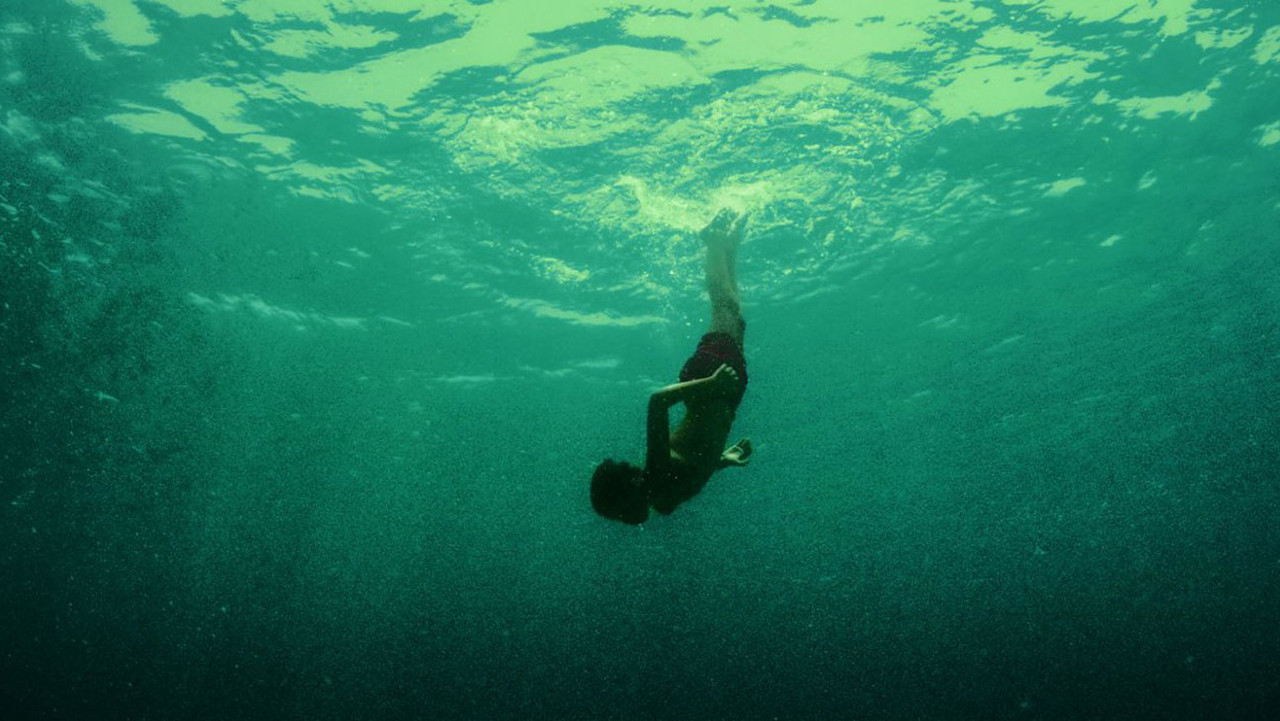
It took Lucile Hadzihalilovic a decade to follow up her haunting debut, Innocence, and Evolution is the perfect title for her second film. Beyond its own themes, it represents a companion piece to and a refinement of many elements of Innocence, being set again in a community largely composed of children (this time all boys rather than all girls), cut off from any recognisable real world and monitored only by women. 

What could seem like an idyllic existence: kids running free on a beautiful island, soon becomes creepy as we are taken into its inner workings and begin to see strange experiments being conducted on the boys, one of whom forges a connection with one of the nurses (the striking Roxane Duran). Hadzihalilovic's images often have a dreamlike beauty to them, but the evidence of influences like David Cronenberg and Guillermo Del Toro often reshapes that dream into a surrealistic nightmare. Elliptical, strange and disturbing, Evolution gets into your head, inviting many different readings, and repaying multiple viewings. 

9: Leave No Trace [Debra Granik, 2018]
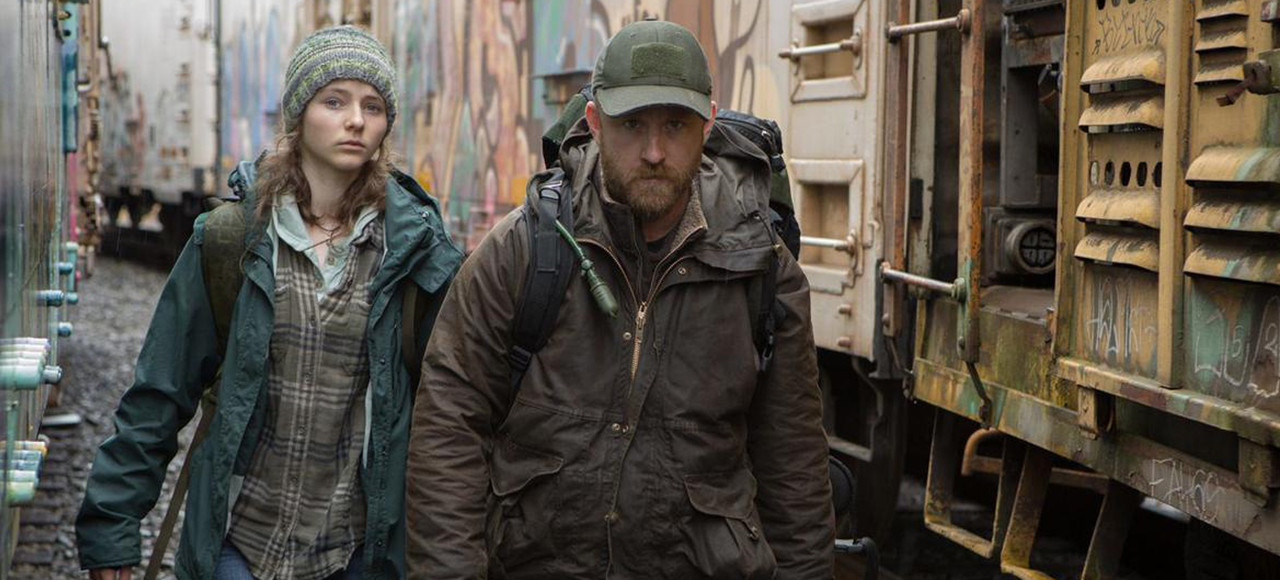
Like Lucile Hadzihalilovic, it took Debra Granik a long time to follow up her previous film, which is baffling given that Winter's Bone was successful and launched Jennifer Lawrence's career with an Oscar nomination. Like that film, Leave No Trace - the story of a war veteran father with PTSD and his 13-year-old daughter living off the grid - introduced someone we're going to be seeing a lot more of in New Zealand actress Thomasin McKenzie. 

Granik's images are beautiful, she emphasises both the beauty and harshness of nature, but even the toughest aspects of the forest are deliberately contrasted with the hard edges and cold spaces of the towns and cities we see.

McKenzie plays brilliantly off Ben Foster, perhaps the most underrated American actor of his generation, creating a father-daughter relationship that is unconventional but close and caring. Granik often cuts dialogue to the barest minimum, allowing them to communicate largely through looks and gestures, giving us the sense of a deep understanding between the two, even when what they want becomes more in conflict as the film goes on. This may be a simple, quiet film, but it speaks loudly about things as diverse as the love between families, nature and mental illness.

8: In The House [François Ozon, 2012]
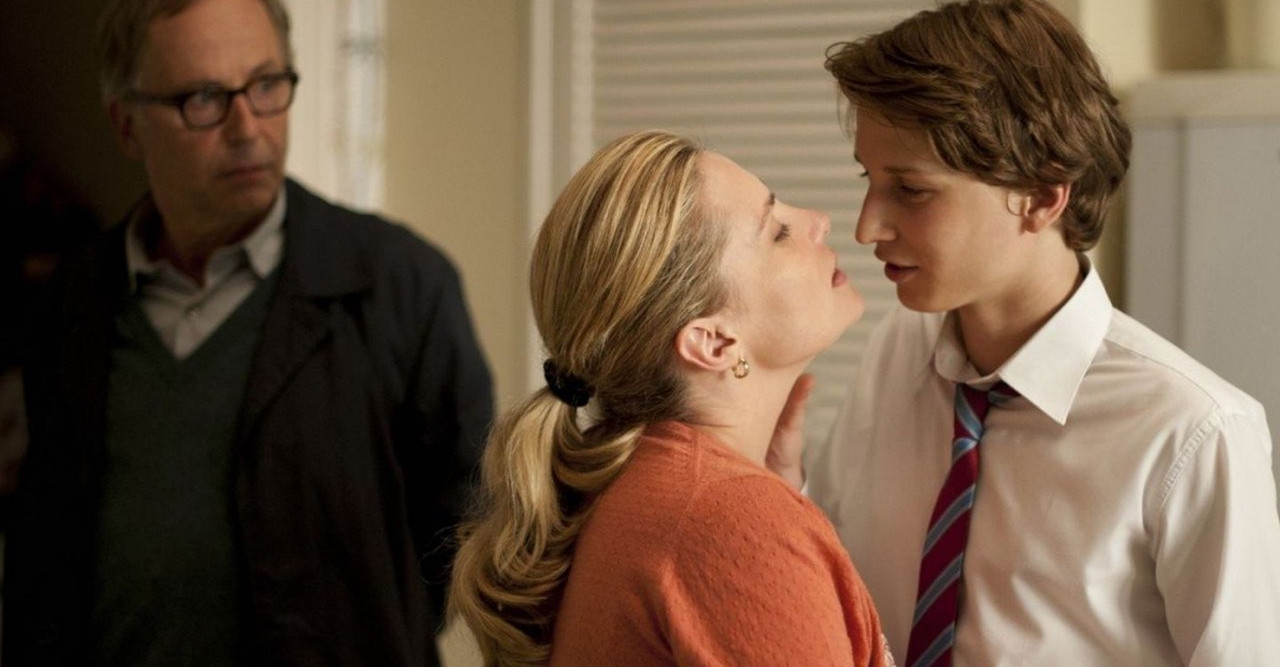
François Ozon is often at his best when indulging his playful side, and this mischevious riff on Hitchcock, Chabrol and ideas of storytelling is one of his very best films.

Ernst Umhauer is excellent as Claude, a student who begins writing stories about his middle class school friend and his parents (Emmanuelle Seigner and Denis Menochet), drawing his literature teacher Germain (Fabrice Luchini) into the narrative. As teacher and student begin to shape the story, we become less able to tell which of the film's events are the result of Claude ingratiating himself into this richer family's home and which he simply conjures whole cloth on the page.

Ozon makes sly commentary on class, both through Claude's story and by contrasting Germain and his wife (Kristin Scott Thomas) with the couple they are avidly reading about, as well as making broad jokes about storytelling, particularly as Germain increasingly pops up in Claude's stories, suggesting changes even as we're watching what he's relating unfold. Witty, rigorous, sometimes sinister and cleverly constructed, this is a wonderful tightrope walk of a film.

7: Hagazussa
 [Lukas Fiegelfeld, 2017] 
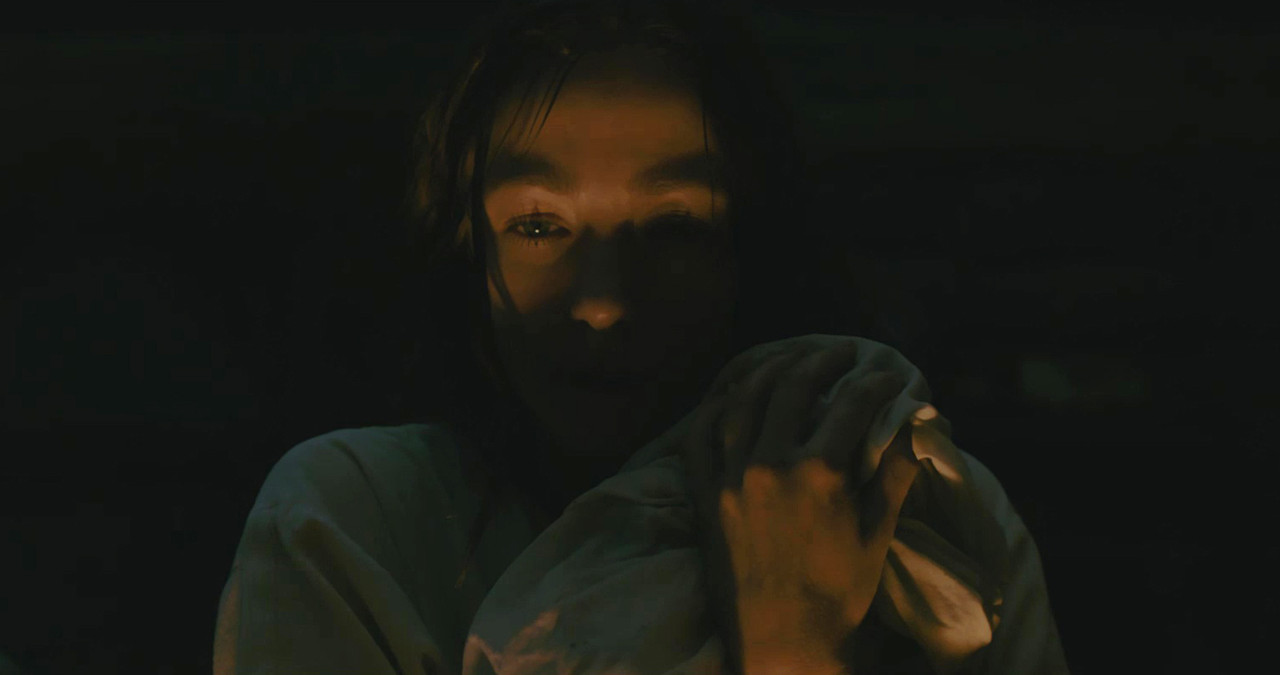
The best pure horror film of the decade is not just a debut but the film school graduation project of its writer/director. For me, this is a film that serves notice of a truly formidable talent who I can't wait to see develop into the 2020s. The story is fairly skeletal: Albrun (Aleksandra Cwen), a young woman living in the Alps in the 15th century, is believed to be a witch. Fiegelfeld takes us from the natural beauty of the mountains to the depths of surreal horror as Albrun seeks revenge on the villagers around her after she is raped and then ingests psychoactive mushrooms.

The imagery is stunning yet unsettling. The beauty set against the horror is perfectly captured in one cross fade, after Albrun visits a local church made largely from bones the image of a skull dissolves into a wide shot of the mountains, and from there the film becomes ever more reliant on image over dialogue. The unsettling nature of the film is enhanced by a droning score from MMMD, which compliments the increasingly dark and doomy feel that Fiegelfeld's images impart. For me this isn't so much a film about story as it is about mood, image and effect. It should be seen on a big screen, so the atmosphere can envelop you, and once it does it truly gets under the skin. 

6: Girlhood [Celine Sciamma, 2014]
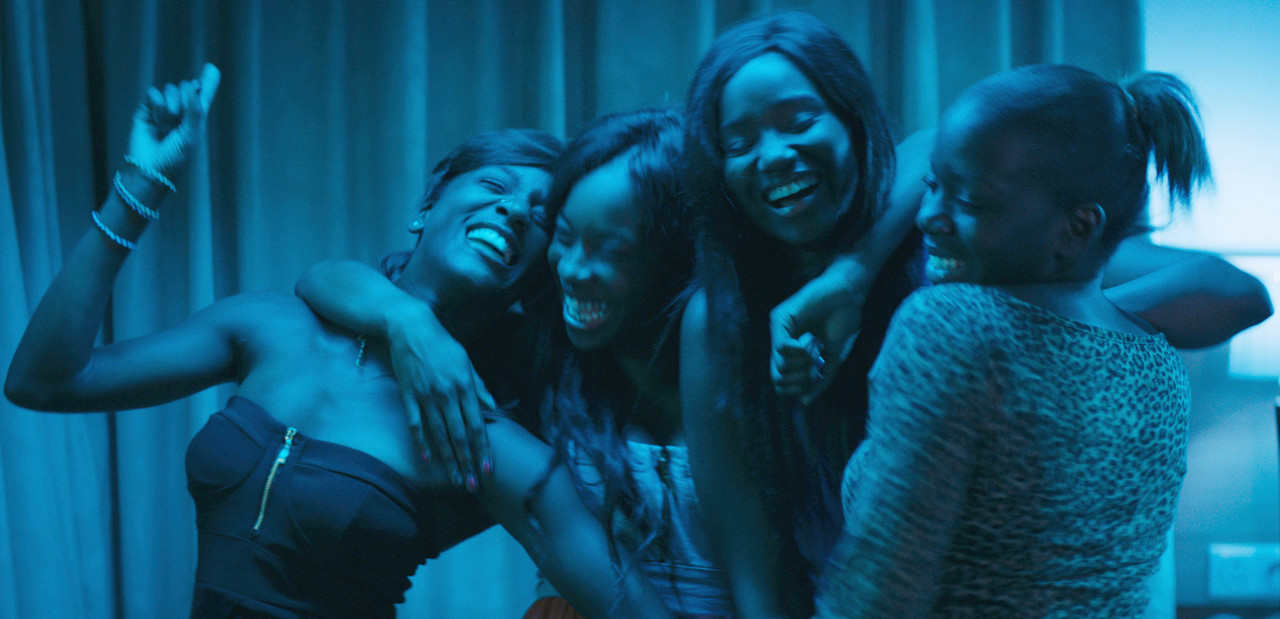
Celine Sciamma has had an astonishing decade and had her new film, Portrait of a Lady on Fire, opened in time it would be even higher up this list. Girlhood closes her coming of age trilogy. Perhaps less personal than her earlier coming of age films, given that it takes place in a black community in the Paris banlieues, this film shows Sciamma's growth as a director, being easily her most visually accomplished work to this point.

Most films about youth gangs are about crime, but Sciamma is more interested in exploring female friendship and group dynamics here, as we see Marieme (Karidja Touré) slowly get absorbed into a small gang led by Lady (the hugely charismatic Assa Sylla). Throughout the first hour of the film we see Marieme become more and more part of the group, a sense of camaraderie grows with every passing scene up until the film's centrepiece; a sequence in which the girls, all dressed up in a hotel room, dance and mime to Rhianna's Diamonds. It's a perfect encapsulation of the process we've seen in the film so far and a perfect, but passing, moment.

Sciamma structures the film brilliantly, with each of the five acts finishing on shots that rhyme with each other, building her main character up, evolving her scene by scene, but never forgetting that coming of age is a process, and one that isn't done in the film's final frames, which are in some ways triumphant, but also, to my mind, showing someone still torn and with doubts. It's a complex and compelling moment to leave a character at, and a great encapsulation of the film. 

5: Love Like Poison [Katell Quillévéré, 2010]
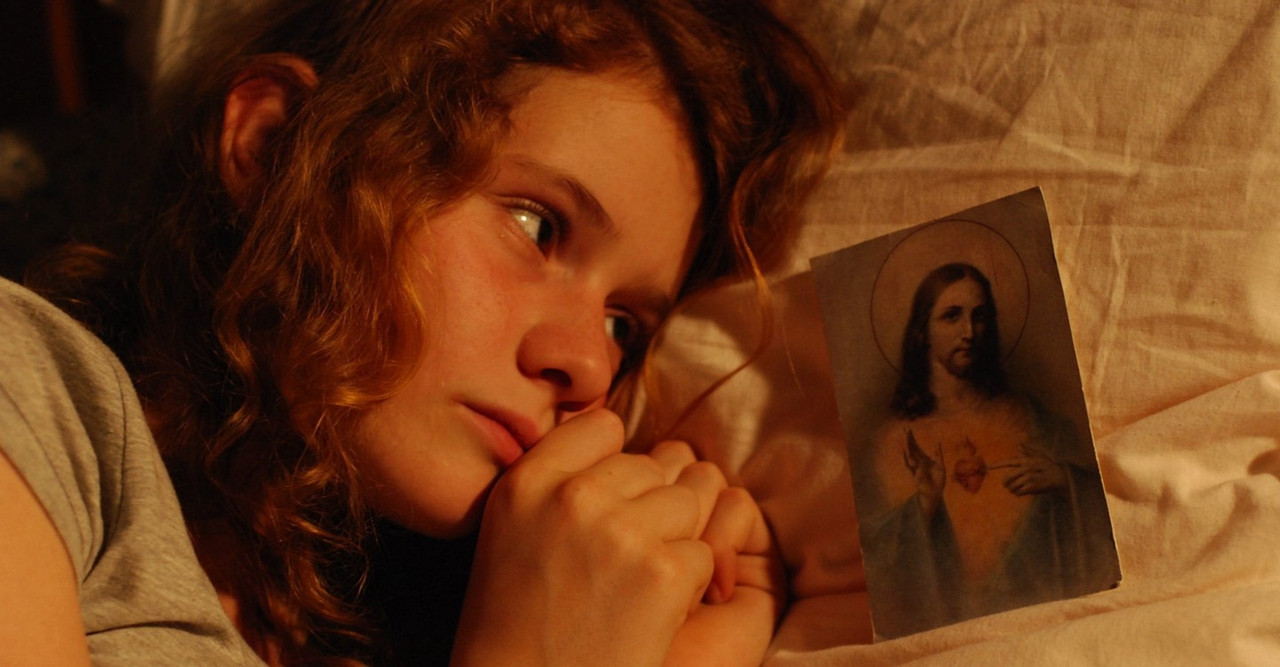
Katell Quillévéré's second entry on my top 25, her debut and, in a great decade for French and female directed coming of age films, the best of both. A deeply personal film that draws on her own experiences, Love Like Poison sees Clara Augarde's Anna deal with her grandfather's illness, her first crush and her changing relationship to her and her family's catholic faith in the run up to her confirmation. In the background is another moving story of her priest (Stefano Cassetti) who seems to be going through his own crisis of faith.

Quillévéré balances the story's many elements beautifully and draws sensitive and unaffected performances from her cast, giving the whole film a very intimate and observed feel. At the same time though, there is an impressive sense of visual composition. There are moments of quiet anger directed at the church and its attitude to young girls going through the moments Anna is experiencing, but it's never hectoring. In the tradition of many of the best coming of age films, Love Like Poison's dramas are everyday, but powerfully felt in the filmmaking.

4: Stop the Pounding Heart [Roberto Minervini, 2011]
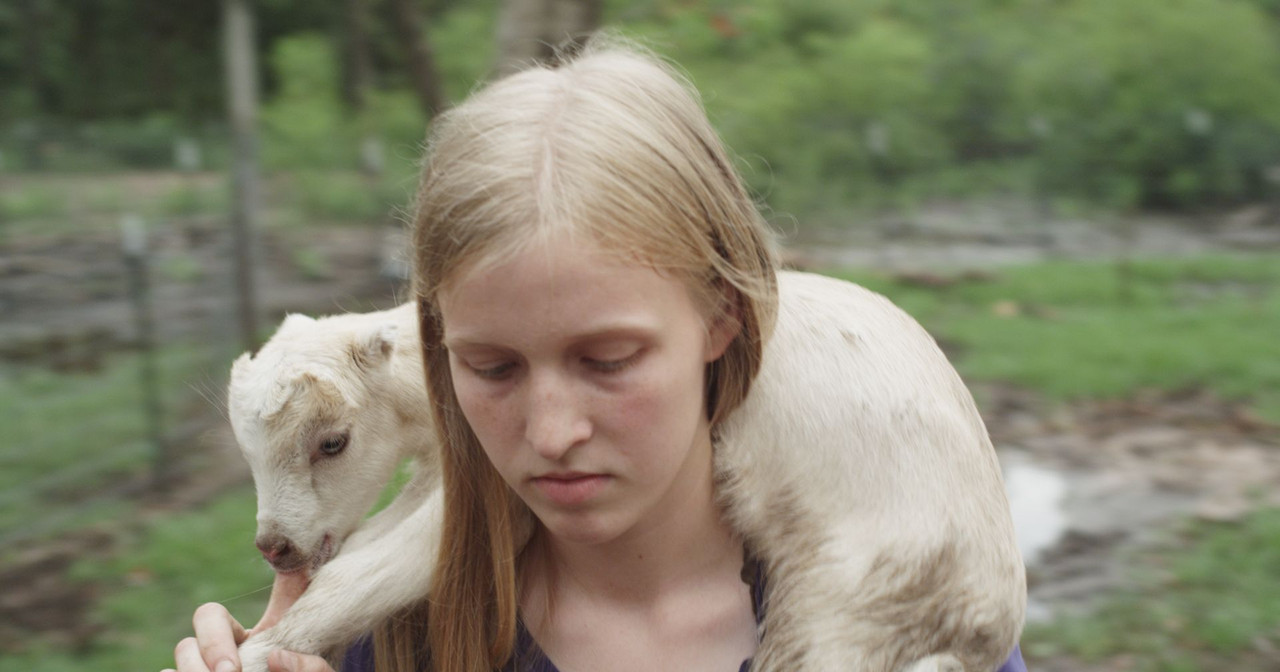
Roberto Minervini looks at rural America with a curious but never condescending eye in this documentary that feels so much like a coming of age story you could mistake it for a brilliantly acted fiction film. Sara Carlson lives with her fundamentalist Christian family in Texas. She's been homeschooled and is now helping teach her many younger siblings the same lessons in the Bible and in how to work the goat farm they live on, producing milk and cheese for farmers markets. We watch Sara and her family go about their daily lives and while Sara seems mostly content, there are moments that she has questions about the beliefs she's been raised with, perhaps some of them coming from what seems to be a burgeoning attraction to Colby, a kid from the neighbouring farm.

Minervini's style; artistically and beautifully framed, but also with a great sense of unobtrusive observation, allows us to simply drop in on this family's life, and those of the people around them. The film feels like a pointed lesson in empathy. I imagine I'd find little in common, politically or in any other philosophical sense, with the Carlson family, but still, there is the overwhelming sense of good people doing the best they can for their children. This does sometimes rub up against what many of us, myself included, might see as damaging teachings but even when, late in the film, the conversation that gives it its title occurs, the feeling is more one of sadness, and of fear that a young person as vibrant and curious as Sara may be missing out on so many experiences, rather than one of judgement. For a film as unobtrusive as it is on face value, Stop the Pounding Heart is a complicated watch, and all the better for it.

3: Jess + Moss [Clay Jeter, 2011] 

Jess + Moss feels as delicate as the grainy, expired, super 16 stock it was shot on. That visual choice gives Clay Jeter's film a timeless feel, it could be set any time from the 70s onwards, and feels like a hazy reminiscence of a summer remembered fondly; the last moments of childhood, just getting a little fuzzy from the view of an adult trying to recall them (memory being a recurring theme).

The friendship between Sarah Hagan's Jess, who is probably supposed to be about 17, and Austin Vickers' roughly 11-year-old Moss is at once slightly odd and very real. We get the sense that Jess is trying to stay a kid just a little while longer and that Moss is longing to grow up just a little, their dynamic meeting in the middle. The two are also pulled together by the fact their parents are missing, and this motivates both of them in ways that ring true for their larger characters. Again, this isn't a film big on incident, the moments are small and intimate, but the performances and Jeter's imagery (owing more than little to Terence Malick) make them vivid and transporting.

2: The Neon Demon [Nicolas Winding Refn, 2016]
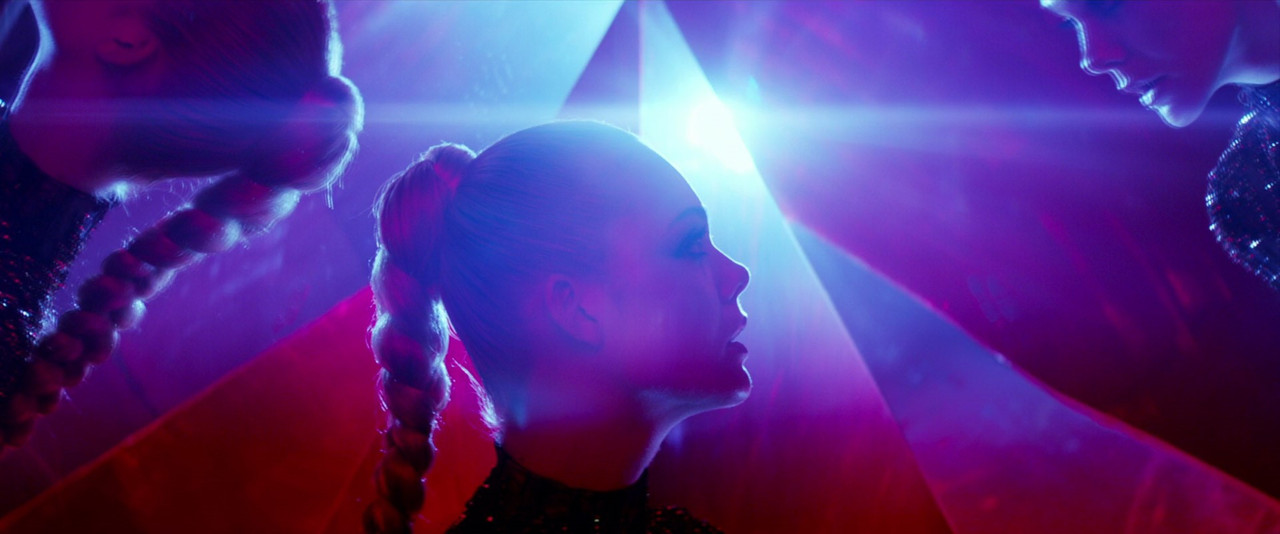
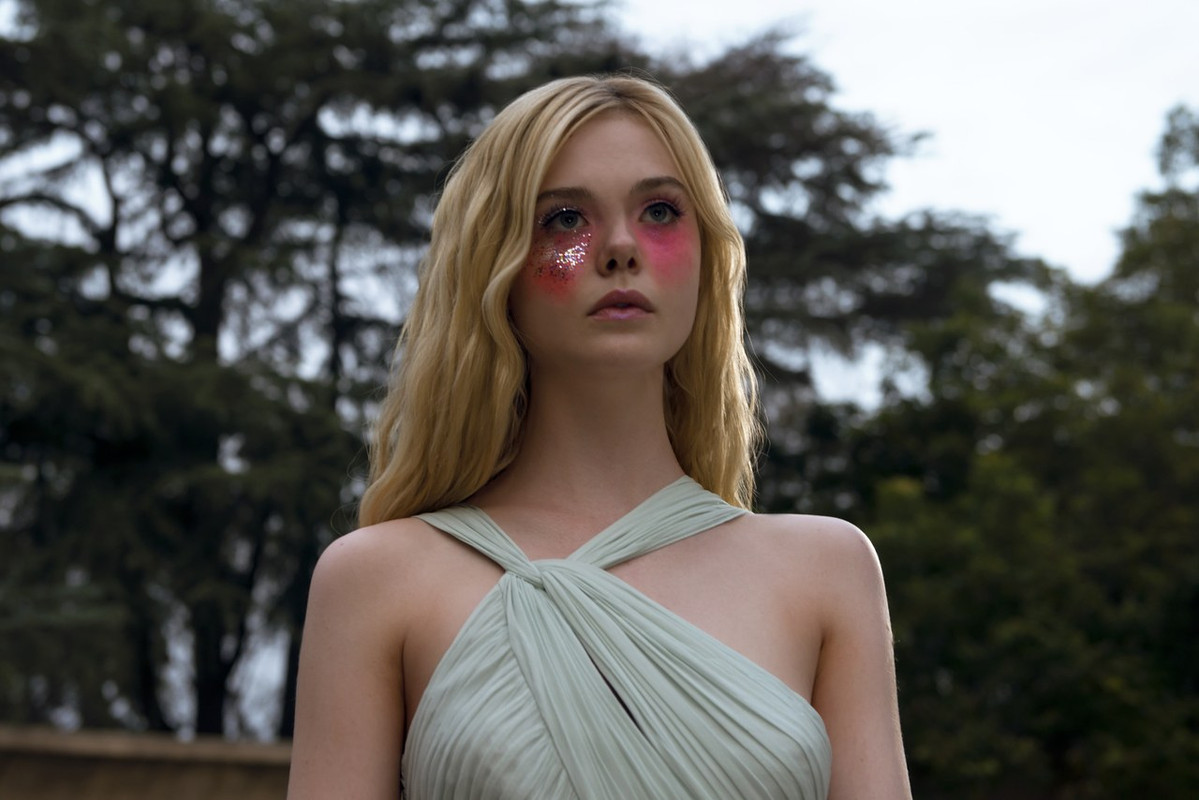
In some ways I'm surprised to find this so far up my list. This is the only film of Nicolas Winding Refn's I'm a fan of, but where most of his work screams style over substance to me, the setting and subject matter of The Neon Demon - the story of a young model (Elle Fanning seduced and swallowed up by the LA fashion industry, rendered as a neon-lit Giallo homage - means that its style is what gives it substance. In many ways Refn's stylistic verve set against what I see as the emptiness of the others I've seen of his films is what makes him the perfect fit for this one: he IS the problem he's diagnosing here.

As incredible as the stylisation is here, as much as Cliff Martinez pulsating electro score adds, as effective as the Cronenberg and Argento homages are, the film would be nothing but a shell without Elle Fanning's incredible performance. Just 16 at shooting, she's convincing as the innocent sucked into the seedy belly of a beast that must be fed, but also compellingly evolves until she has to some degree become that beast; a process we can imagine that her fellow models (Abbey Lee and Bella Heathcote, also excellent) must have gone through just a few years ago. Refn's metaphor here isn't subtle or novel, but it's effective and wrapped up in the creation of a whole world. It may just be that all the right ingredients - even ones that don't usually work for me - came together perfectly here, but The Neon Demon has never stopped evolving as I watch it over and over and that why it's landed where it has on this list.

1: The New Girlfriend [François Ozon, 2014]
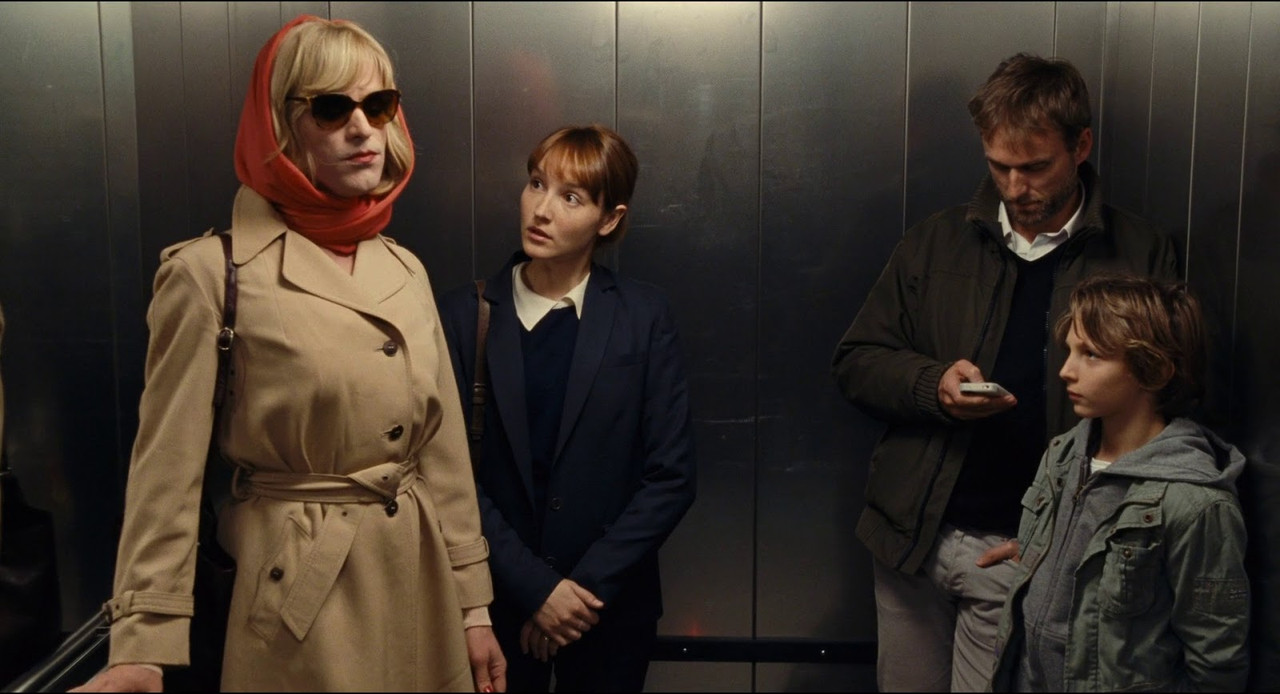
The prolific François Ozon had a weird decade. After many years of being a huge fan, I found him stumbling many times, delivering several of his very worst films (though he's recovered some form with the solid if anonymous By the Grace of God), but in between those he made his two best films, both in this top 10. The New Girlfriend feels like a culmination the ultimate evolution of every theme Ozon has been playing with throughout his career.

The dynamics of the story (adapted from a short story by Ruth Rendell) are complicated. When Claire's (Anaïs Demoustier) lifelong best friend Laura (Isild LeBesco) dies, Claire discovers that Laura's husband David (Romain Duris) has again taken up a habit of dressing as a woman. Soon, Claire and David, in his female persona of Virginia, begin getting closer and David begins to feel more comfortable as Virginia than he does as the man he's always presented as. 

Ozon's slipperly approach to gender and sexuality is on full display here, not just in the David and Virginia personas, but in the film's design (Claire is almost always dressed in trousers and a collar; a more stereotypically masculine look than the outwardly glam Virginia) and in several of the scenes between Claire and her husband (Raphaël Personnaz), notably a sex scene in which Claire takes care of her own pleasure, then simply rolls off him to go to sleep. Most significant though is a sex scene between Claire and Virginia, which becomes essentially a two person threesome. It's a stunning moment; a masterclass in using intimacy to advance story and character and a sequence shot through with Ozon's auteurism.

The film has scenes that hit you in the heart (Demoustier singing a song to Durris, for instance), but Ozon remains playful, light and funny as well, capturing the thrill of this new person that Claire suddenly has in her life to fill the void that Laura has left, which is something we appreciate through the film's first 10 minutes, which feel like Ozon's take on the beginning of Up and are just as joyous and as sad. While Duris has the showier part, and is brilliant, never overplaying, repeat viewings reveal the subtle work that Anaïs Demoustier does as the film's lynchpin. She can draw a laugh or a tear with a look, delivering huge amounts of character information in small adjustments.  

There is simply too much to say about how great this film is, and it's another that only grows and reveals more on each rewatch. It is, and on recent evidence is likely to remain, Ozon's masterpiece.

Dec 31, 2016

2016 in Review: 24FPS' Top 10 Films of 2016

Note: Potential spoilers for all listed films.

This list is composed of films that premièred theatrically or on home formats in the UK in 2016, and films that screened at UK festivals in 2016, but which currently have no UK distribution in place.

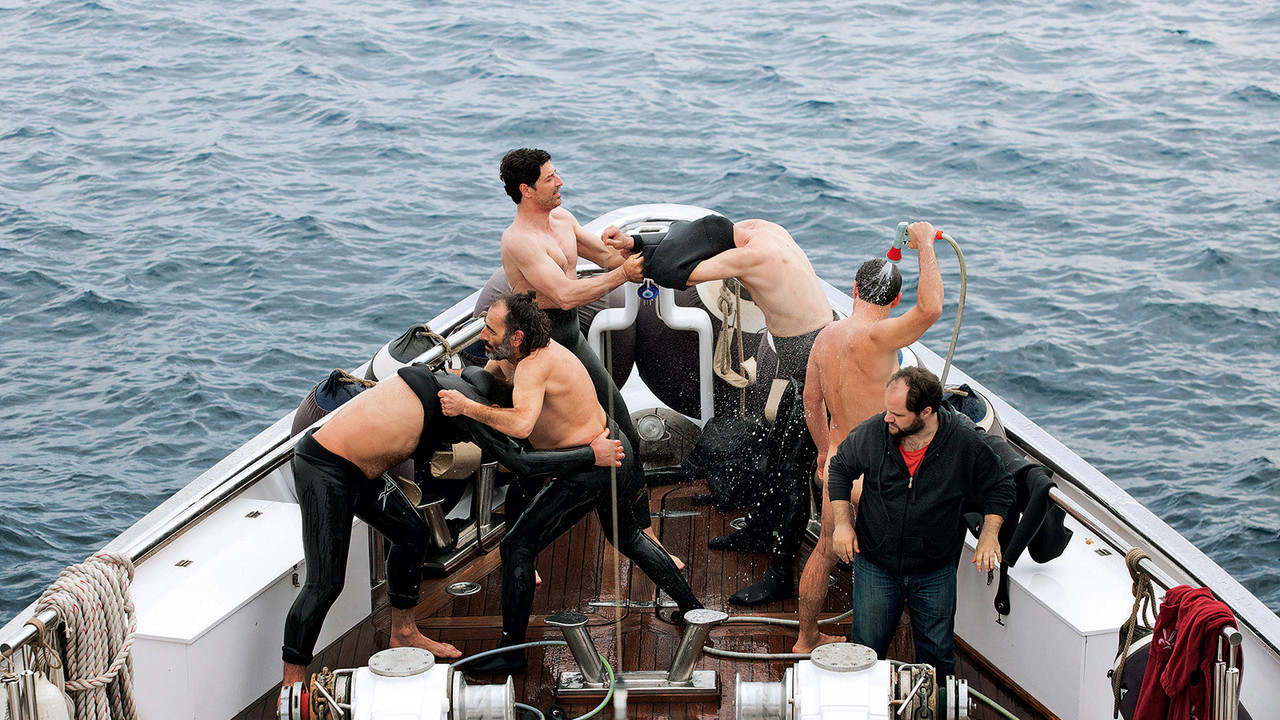
10: Chevalier
Athina Rachel Tsangarai's brutally funny satire of male insecurity was a hit on 2015's festival circuit, but only opened in the UK this year.  The film is confined to a boat where six men, ranging in age from mid 30s to mid 60s, are taking a short holiday. Bored one night, they decide to play a game to discover which of them is 'the best'. Each man must set a challenge and the results of those, along with points awarded for any number of arbitrary reasons - from the position someone sleeps in to their hairline - will determine the victor.

Tsangarai's first feature film was called Attenberg, a deliberate mispelling of the naturalist David Attenborough's name and, like that film, this one applies something like his sense of curiosity at the observation of the animal kingdom to people. These men could almost be seen as creatures in the wild, each competing to lead their pack. Tsangarai and co-writer Efthymis Filippou (also the co-writer of The Lobster) skewer their subjects in brutally funny style, satirising the way that as the men get more and more determined to assert their dominance they become ever more pathetic and seem ever weaker, more insecure and, ultimately, sillier.

This is both hilarious and sometimes uncomfortable to watch, as it's likely that many of us will see things reflected back at us that we really wish we didn't recognise. The jokes range from the puerile to the satirical to one wonderfully incongruous, almost surreal, sequence set to Minnie Ripperton's Loving You. All of it is played with admirably straight faces by the cast, all of whom are outstanding. Chevalier, though, is ultimately Athina Rachel Tsangarai's show, as it marks her out as one of the most original and articulate writer/directors when it comes to analysing people, rather than merely using them to facilitate a plot.


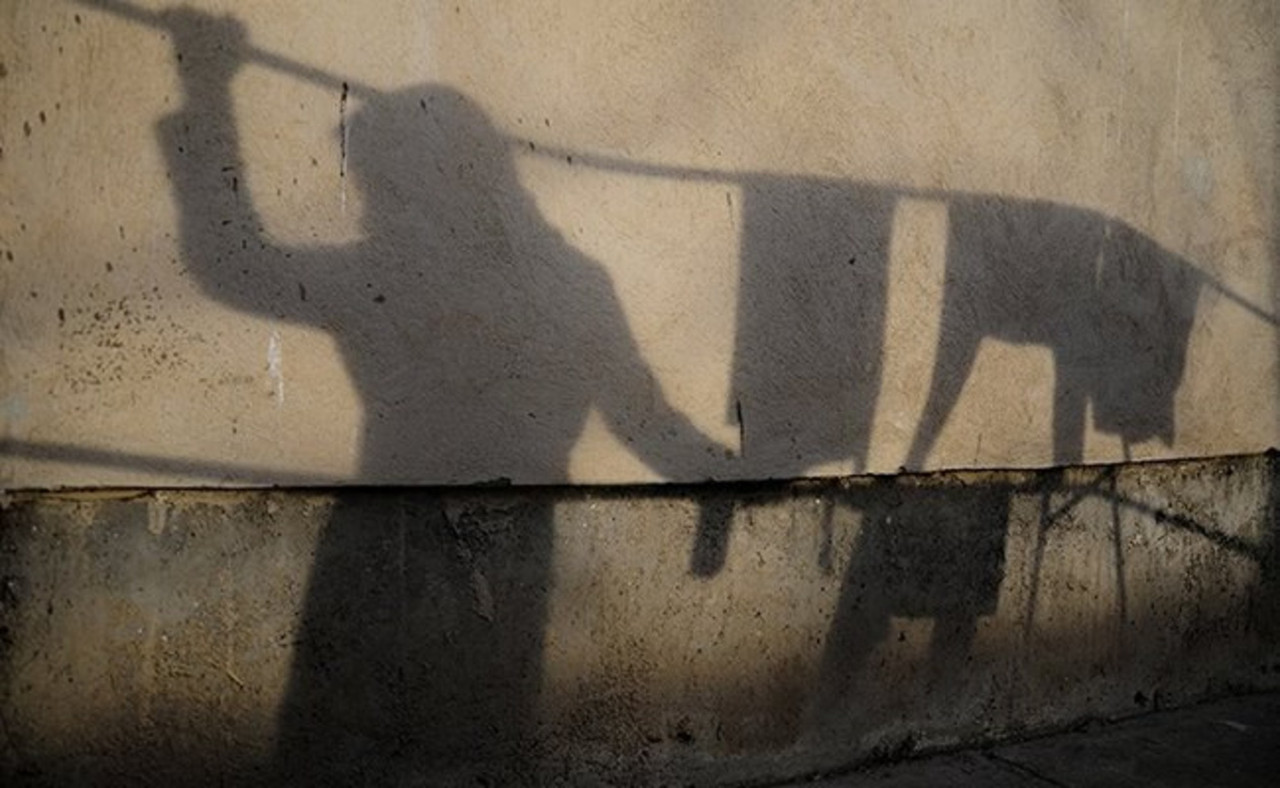
9: Starless Dreams
I'm not the biggest fan of documentary as a cinematic form. I often find myself saying of even the most compelling that, good as they may be, they seem to me to inherently belong on television. That's not untrue of Starless Dreams, but this is a film urgent and enveloping enough to warrant being seen anywhere possible.

The film is set in an Iranian prison for young women. Their crimes aren't always discussed, but the ones we hear about range from drug possession and prostitution to murder. I went in to Starless Dreams expecting it to be tough to watch, and it is, but not for the reasons I expected. I was expecting this to be a tough critique of a harsh regime, but we see little evidence of that. Instead what we glimpse is largely a self-sustaining society; the young inmates supporting each other and forming a sort of family. This is perhaps because, from what we hear, few of them had any sort of normal family life on the outside.

Some scenes are endearing, even funny. One when two girls interview each other in a parody of sorts of director Mehrdad Oskouei begins this way, but this and other moments of lightness often give way to devastating moments. The 'interview' strikes a heartbreaking balance; the girls' bright tone and laughter set against the abuse, addiction and suffering they discuss.  Other moments don't have even this chink of light. One girl, asked what she wants most, says "Death". Another is under that sentence, having killed the father who 'bothered' her (a euphemism we hear a lot). For some there may be hope, for others, notably one girl we see released, sent back to a family who will likely treat her much worse than the one she's leaving, there seems not to be.

Starless Dreams is a crushingly sad piece of work, but it's also a rare, valuable and surprising insight into a place and an experience few of us will have even thought about before. If that's not what documentary does at it's best then I don't know what is.

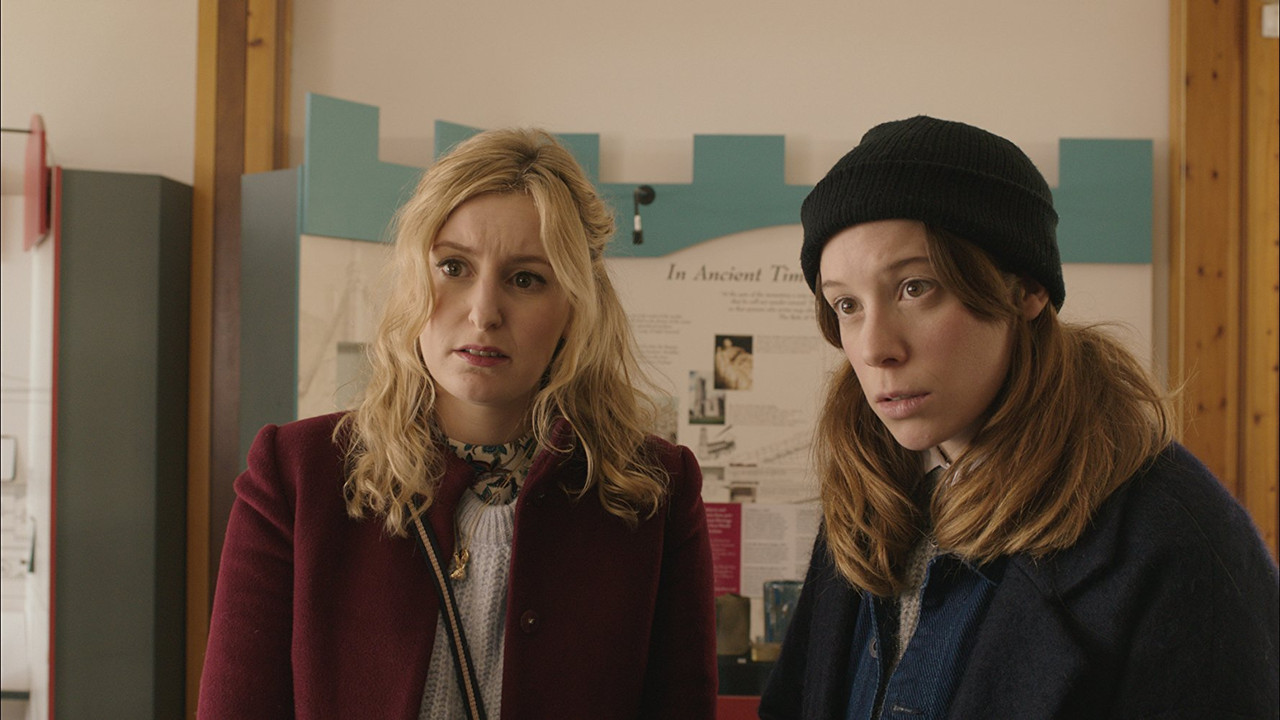
8: Burn Burn Burn
Burn Burn Burn took some time to emerge from the festival circuit, finally landing on our screens just over a year after it premiered at 2015's London Film Festival (which was where I first saw it). 

This story of Seph and Alex two friends (Laura Carmichael and Chloe Pirrie) taking the ashes of their mutual friend Dan (Jack Farthing) who has recently died from cancer on a road trip, so they can scatter him in 4 places that meant something to him, could have been just one more in a recent line of hideously treacly movies to use cancer as a plot point. Happily, the film dispels this fear with its very first line, which sets out the dry, darkly funny, tone perfectly.

The tonal balancing act here is a very delicate one, and it's executed perfectly by the cast as well as by screenwriter Charlie Covell and director Chanya Button. The film's emotional scenes, especially one where Dan berates his friends from beyond the grave, hit hard, but a laugh is never far behind, and neither the drama nor the comedy feel unearned. The film is perhaps at its best when it combines its comedic and dramatic sides, particularly as Pirrie delivers Alex's most emotionally fraught speech while standing in the middle of one of the film's best visual gags.

Burn Burn Burn is an odd film; a feelgood film in which of the main characters dies a premature death before the story starts, but it works. Whatever sentimental moments it has come out of honest character writing, not out of the plot turning the screws to make you cry, and even if you are crying, you'll probably be laughing in the same moment.

7: Wild
The third feature from writer/director Nicolette Krebitz (following her brilliant second film, The Heart is a Dark Forest) took nine years to emerge, but, like another project on this list that was gestating for years, it was well worth the extended wait.

Wild is an unusual, but ultimately hugely affecting, study of loneliness. It centres on Ania (Lilith Stangenburg), a young woman working in a soulless office job, living in a high rise in a bleak town, with few connections to speak of. One day, on her way to work, Ania locks eyes with a wolf, living wild in some woods near her building. She instantly becomes obsessed, devoting her time to tracking the wolf down, then capturing it and keeping it her home. The relationship she forms with this wild animal is at first curiously close, then becomes more and more disturbing and destructive.

Stangenburg here gives what may be the year's most fearless performance. Stripped down emotionally and often physically, she shares many of her scenes only with the wolf. The connection between them has to feel visceral, immediately the most important thing in Ania's world, and Krebitz and Stangenburg have clearly worked hard to forge a physical connection between actress and animal. There is a palpable edge of danger to many of the scenes, and your concern for the safety of Stangenburg easily bleeds over into a concern for the character of Ania. It's a great performance, expressing more with physicality than with dialogue, especially towards the end of the film, as Ania becomes more feral scene by scene.

Nicolette Krebitz' visuals are cold and stark. Ania's world is rather blank; all concrete box buildings and grey weather. It's perhaps not the most subtle way to show that, until the wolf arrives in it, her life is colourless and passing in something of a disconnected haze, but it's effective and leads to many memorable images. 

Wild is a deeply sad film that ends up being about the search for connection in a distant and anonymous society and while Ania's way of finding that connection is, to say the least, unconventional, it also ends up being oddly moving. Wild doesn't currently have UK distribution in place, I hope the German Blu Ray will be English friendly.

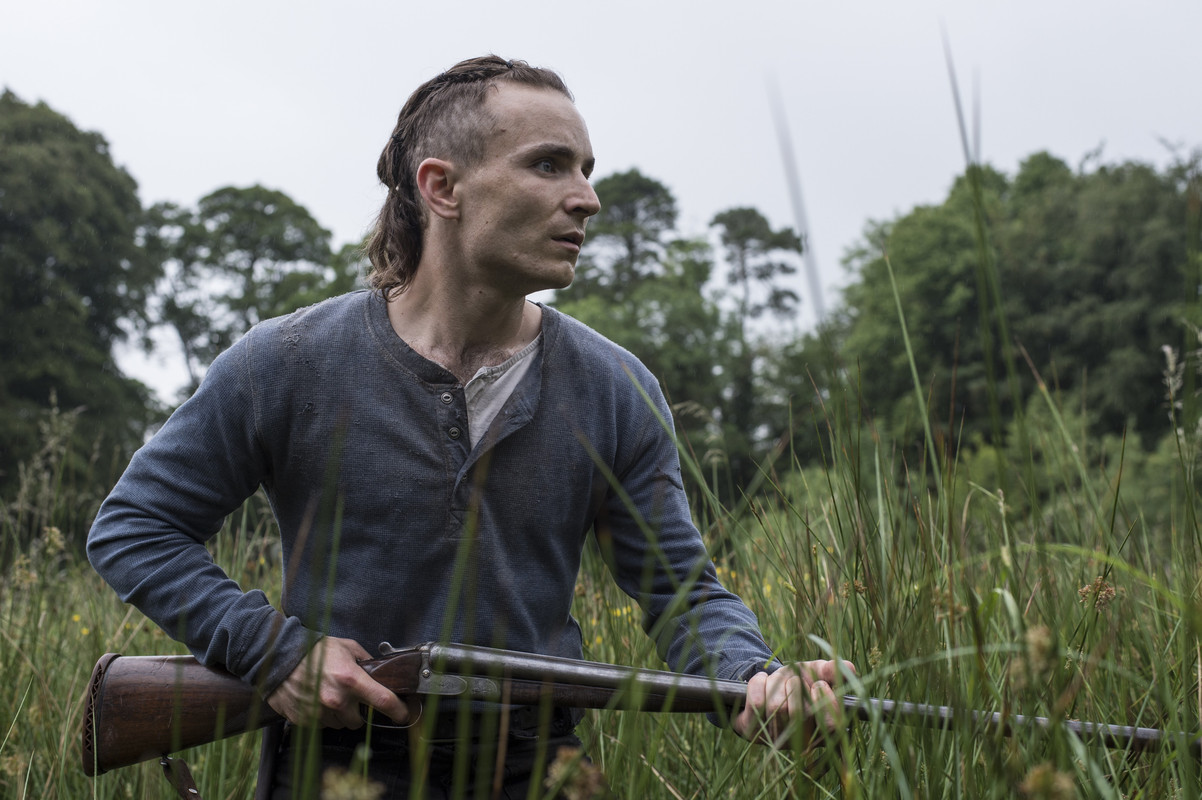
6: The Survivalist
Cinema has seen many apocalypses, they have been caused by zombies, disease and war among other things. The presumed apocalypse that precedes the events of writer/director Stephen Fingleton's feature début is explained only by two lines, charting the growth and then the drop in the world's oil production and its population. 

The Survivalist (Martin McCann) lives alone in a shack hidden in the woods. He grows vegetables to sustain himself and keeps a shot gun on him at all times, in case of unwelcome visitors. One morning he wakes up to find two such visitors; Kathryn (Olwen Fouere) and her late teenage daughter Milja (Mia Goth). They ask for food, which he warily exchanges for sex with Milja. From here a power game begins to emerge, as Kathryn and Milja become 'houseguests', working the land, but ultimately planning to take it from their reluctant host.

Perhaps the most impressive thing about The Survivalist is the palpable confidence with which Stephen Fingleton executes it. He gives us little background, then opens the film with twenty silent minutes of his protagonist going through his daily routines. He sets us down in this world and expects us to live in it, in much the same way as you suspect his characters were asked to, some years before the narrative begins. Once Kathryn and Milja arrive there is some dialogue, but it is minimal, and ultimately less expressive than the way Fingleton shoots the film and the silent performances of his three key cast members. 

One brilliant sequence goes from Kathryn and Milja plotting to kill their host (with him to the side of frame, unaware), to an incredibly tense sequence in which The Survivalist saves Milja from another man who is about to rape her. All of this plays out without a single word, and in an age when most cinematic action is a clusterfuck of inter-scene geography, Fingleton's use of space is not only clear, it deepens the tension.

The performances are outstanding. McCann's constant watchfulness, Fouere's just under the surface willingness to kill to survive and Goth's possibly shifting loyalties play off against each other in many quietly nailbiting moments. Each of them is also called upon to go to some tough places, both emotionally (Kathryn's realisation that things haven't gone as she'd planned) and physically (Milja's trading of her sexuality, and an unbearable attempt at self surgery). All three are excellent.

This is a truly exciting first film, I only hope that Stephen Fingleton can follow it with something similarly distinctive and gripping.

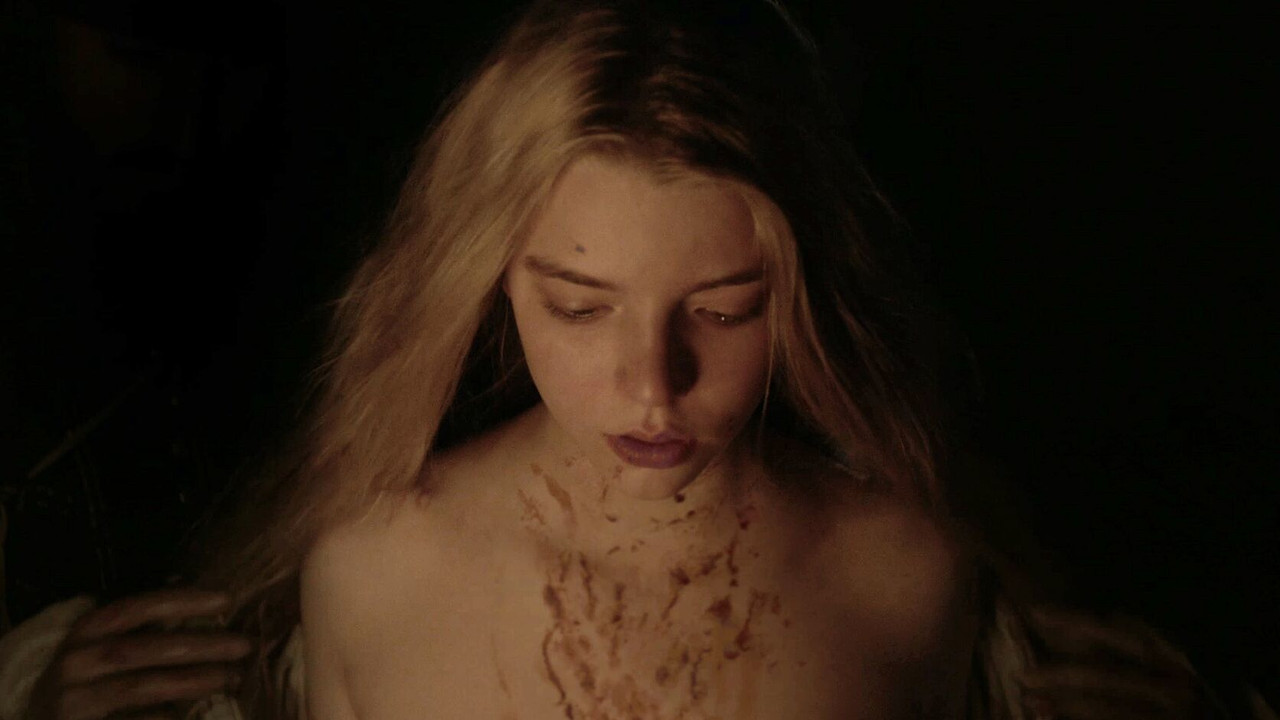
5: The Witch
It's unusual that one of the first things you should note about a horror film is its language, but The Witch is an unusual horror film. Verisimilitude seems to have been writer/director Robert Eggers' watchword here, and the film's language - authentic 17th century dialect, much of it drawn from writings of the time - is the starting point for that.

The Witch is deliberately low key in its horror. For most of its running time it deals in the horror of the everyday, the horror inherent in the conviction of religious fundamentalists. In this case that horror takes root in a family that comes to believe their teenage daughter Thomasin (Anya Taylor Joy) has caused the family to be overcome by demons, resulting in the youngest child disappearing and their crops failing.

Shot in a tight ratio of 1.66:1, with largely natural light, the film feels grounded in the real world. It's often dark and grim, reflecting a harsh and difficult way of life as well as the darkening of the mood in this isolated house. As well as the dialogue and the visuals, the performances help the film create a sense that we're watching something real. Ralph Ineson and Kate Dickie make for a credible Mother and Father; loving but tough, grief stricken and perhaps motivated as much as that as by their beliefs in they way they treat Thomasin. However, their actions remain extremely disturbing.

Dread seeps into the film, paying off in the final scenes in a way that might seem a little abrupt, but is actually well seeded throughout the film. I found it flowed more naturally on a second viewing, while retaining the shock value it possessed first time round. The Witch is a great film to demonstrate that horror doesn't have to mean either gore or rote jump scares. It's so nice to have a truly intelligent and scary new voice in the genre, I only wish his next film wasn't a remake.


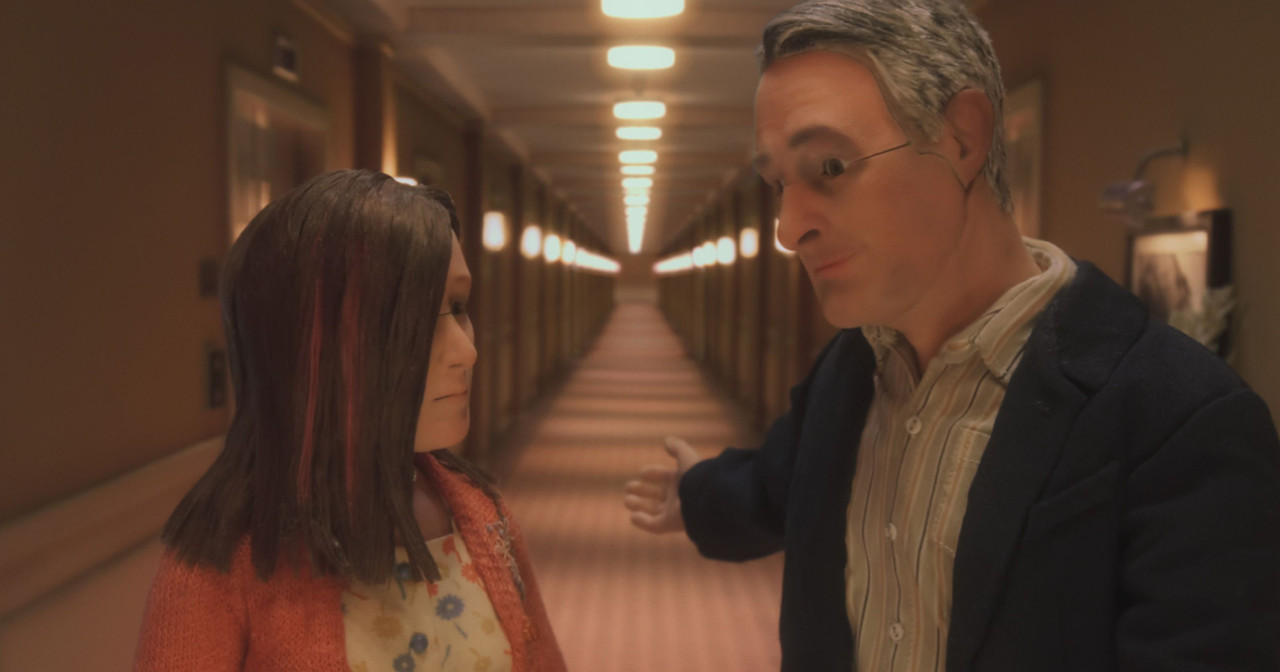
4: Anomalisa
I've always struggled with Charlie Kaufman's films, and especially with his third acts, which I've often felt have struggled to deliver on his brilliantly weird, but paradoxically insightful, premises. Anomalisa doesn't have that problem.

In many ways this is Kaufman's most down to Earth film; it doesn't have the sci-fi concept of Eternal Sunshine, it doesn't play the self-referential games of Adaptation. Anomalisa is simply a very human story. This is a film about loneliness, but typically of Kaufman he finds a device through which he finds a new way to express a common emotion. Michael (voiced by David Thewlis) interacts with quite a few people on his one night stopover in a hotel in a city where he's due to deliver a sales seminar, but his world has become so colourless, so isolating, that to him they all speak in the same voice (that of Tom Noonan). After a while we begin to slip in to the same kind of limbo as Michael, craving a new voice, and this is when he hears Lisa (Jennifer Jason Leigh).

I may well be the world's biggest Jennifer Jason Leigh fan, but this film showed me a new side of her in the way that it used her voice. That voice has always been a versatile instrument, but it never quite struck me as distinctive in the way that some of her character's voices (Dorothy Parker, Amy Archer in The Hudsucker Proxy) have been. The thing is, if Lisa's voice were hugely unusual - if the character were played by Jennifer Tilly, for instance - Anomalisa would be less effective. The whole idea is that Michael hears a thing of unexpected beauty, that he can't explain why this voice, of all of them, cuts through the endless drone of the world.

The stop motion animation is beautiful; as sensitive and expressive as the vocal performances, and it's the perfect medium. If the film were live action it would take much longer to adjust to the same voice coming out of multiple people. I think we would also see that effect as something literal, rather than the singular metaphorical experience it clearly is in this form.  However, as you'd expect given the film's premise, it's the sound that is really key here, especially in the moment in which Lisa's voice is lost to the surrounding noise. When Leigh's voice is slowly replaced by Noonan's, it is one of the most devastatingly effective evocations of depression I can think of.

Despite not featuring a single human on camera, Anomalisa is one of the most painfully human films of 2016.


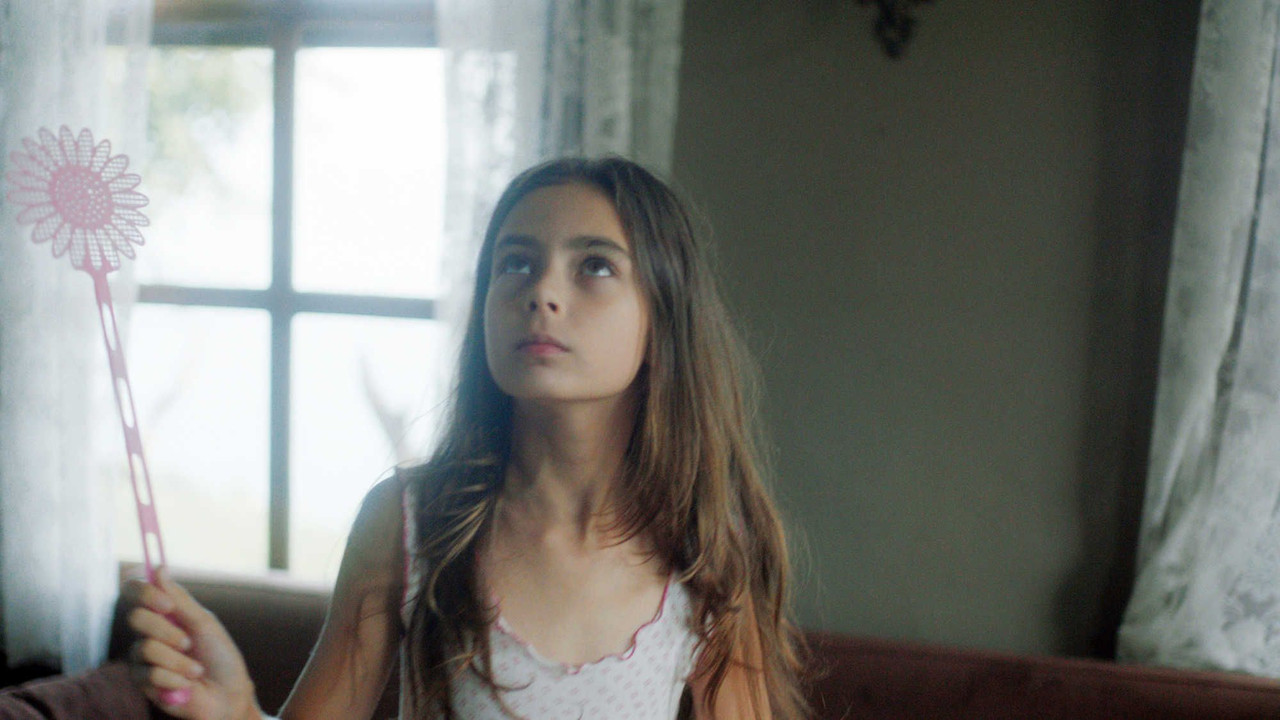
3: Mustang
Mustang was perhaps the surprise of the year. I had no frame of reference; no actor, writer or director I knew. I was in the increasingly rare and welcome position of knowing nothing about it, other than its glowing critical reputation, before seeing it. In a strong year for coming of age cinema (Sing Street and Everybody Wants Some would make my Top 15), this was the standout.

There is something so alive about this film, and you see it right from the opening scene, as the five sisters that the film centres on celebrate the end of a school year by playing in the sea with friends. This moment, so carefree and spontaneous, becomes the thing that traps them as their furious uncle begins to shut them in the house and start marrying them off, eldest first.

Cinema can open up worlds and ideas to us, and that's what Deniz Gamze Erguven did for me here. The idea of young girls forced into marriage, of the way that religious fundamentalists control their families, especially the women, is something I know happens, but which largely exists in the abstract. Just as Starless Dreams did, Mustang took that abstraction and made it something present and real.

The film does this through Erguven's sensitive writing and direction, but perhaps especially through the performances of her five young actresses, most of whom had never been on camera before. The casting is perfect, the girls not only look similar enough to be sisters, the dynamic works too. So much of this is found in the incidental details, such as scenes of them playing together, or the youngest, Lale (Gunes Sensoy), stealing her oldest sister's bra and playing dress up. The naturalism in the way they relate makes everything hugely affecting.

Erguven's visuals sometimes have a romanticism about them (the opening scene, Sonay (İlayda Akdoğan) watching her boyfriend through the window), but she sets this against the way that the girls uncle becomes ever more controlling, and visual signs of that control creeping in to the home (the bars, the repeated imagery of tea as marriages are arranged). It's a balance that feels honest to the girls lives; yes, there are many things that are very wrong in their home, but they find little avenues of escape too.

All the girls are good, but Gunes Sensoy, who slowly emerges as the lead, is exceptional. We watch her grow up, increasing in her understanding, her fear, and ultimately her confidence scene by scene. It would be a terrible shame if this remarkable young actress didn't go on to a lot more work. 

In the performances and in the film as a whole, Erguven balances tension, sadness and some brief chinks of light (the sequence in which the girls sneak out to go to a women only football match is joyous), making a subject that might be oppressively dark into a film that has a genuine feelgood quality, even when acknowledging its sadness.


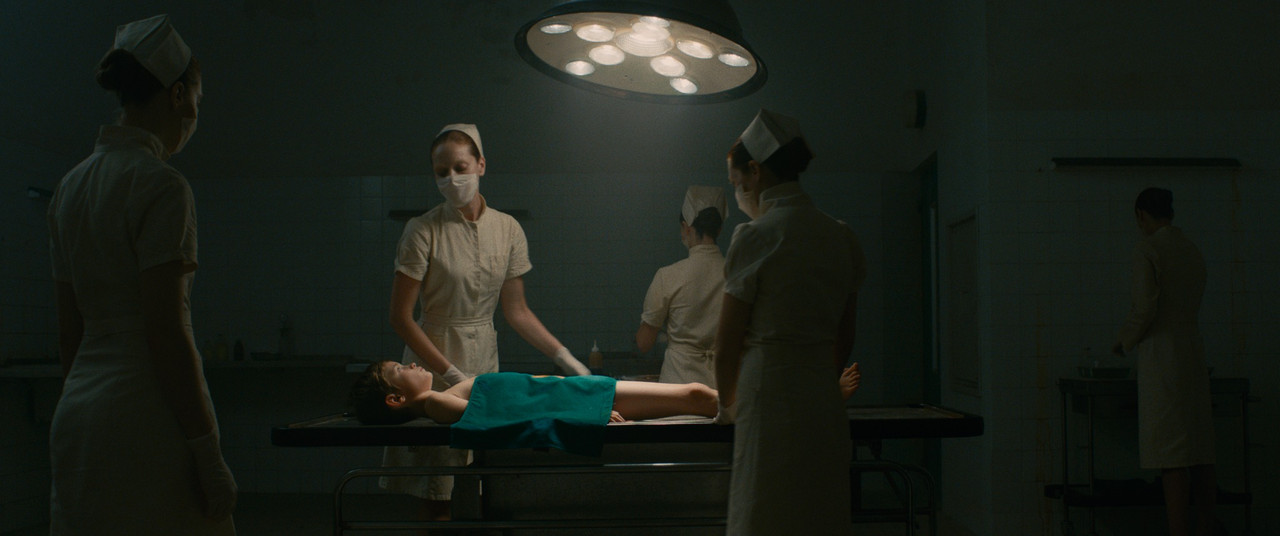
2: Evolution
Like Wild, this has been a film I've been awaiting for a long time, without knowing anything about it until it was announced for the London Film Festival. Evolution is a perfect title as, ten years after her beautiful, beguiling, début Innocence, Lucile Hadžihalilović delivered a second film that seems both a big step on from and a spiritual twin to her first.

The film asks similar questions about how the society it takes place in, seemingly cut off from the rest of the world (here an island in place of Innocence's boarding school), functions. On this island a group of women, all roughly in their mid 30s, live with their children, all of whom are boys of around 10. In a hospital on the island the boys are experimented on. There is only a loose sense of structure and story here, with Hadžihalilović sucking us into this slightly surreal world through one young boy, Nicolas (Max Brebant) and his connection with one of his nurses (Stella, played by the ethereal Roxane Duran). Evolution is fascinating because, as with Innocence, Hadžihalilović leaves many interpretations open, both at story and metaphorical levels. 

The imagery is stunning, creating distinct moods from the cold, solid, real feeling of the beaches and houses on the island, to the twin oneric worlds of the ocean (a dream) and the subterranean 'hospital' (a nightmare). With a striking focus on water and nods to, among others, Guillermo Del Toro, David Cronenberg and Andrezj Zulawski, the film serves up many memorable, beautiful and disturbing images.

Like Innocence before it, I only found that the ending of Evolution left me with more questions, wanting to dive back into the film and see if I could find new answers, or confirm the ones I had after my first viewing. I hope we don't have to wait ten more years for another glimpse into Lucile Hadžihalilović's imagination.


1: The Neon Demon
This wasn't supposed to happen, and very nearly didn't. I'm not much for Nicholas Winding Refn. I liked Drive a lot, and then I saw it a second time and found a stylish husk of a film, whose soundtrack I got a lot more from than anything else about it. I didn't need a second viewing to think the same of Only God Forgives. I wouldn't have seen this, the third in what I've taken to calling Refn's electro trilogy, had it not been for the fact that Elle Fanning - for my money the most naturally talented young actress working right now - is the lead. Still, I wasn't optimistic.

At that first screening I liked the film, cautiously and with reservations, but even by that evening I was beginning to think that I'd missed something, that this was a much better film than I had thought. I saw it twice more at the cinema, then a fourth time on Blu Ray, and with each screening it burrowed further into my brain, inching its way up this list as it did so.

The Neon Demon is the film that has been most present for me in 2016. I've been equally stuck on its big themes as I have been on some of its tiniest moments. Yes, this is at least partly to do with its style and its beauty, but even when I find myself thinking about it for those reasons that leads me back into its larger themes. Where Drive and Only God Forgives struck me as the definition of style over substance, The Neon Demon is, among other things, about style as a replacement for substance and the horror we should feel at that.

In stylistic terms, Refn here draws on many influences from fashion photography to filmmakers like Dario Argento (the lighting is often pure Suspiria) to David Cronenberg, who seems as much a thematic influence as he does a visual one. However, Refn doesn't just ape the filmmakers he's drawing on, he remixes them into something distinctly his own. The visuals feed into the film's themes. The obsessively composed frames reflect the film's and the character's concern with visual beauty and there is also much visual reference to the theme of consumption, which is a key idea here, be in Jesse's (Fanning) eventual - metaphorical - consumption by the titular Neon Demon or Jesse's fellow model Sarah (Abbey Lee) desperately licking the blood that drips from Jesse's cut hand, as if determined to ingest some of her essence, and with it her success.

For a film so concerned with the big picture, it's perhaps surprising how many of The Neon Demon's finest and most telling moments are its very smallest. Elle Fanning gives a remarkable performance, surely her best screen work to date. Every tiny adjustment, from her attempt to fiegn sexual experience in front of Sarah, Gigi (Bella Heathcote) and Ruby (Jena Malone), to the way she absent-mindedly rotates her foot, drawing focus as Alessandro Nivola is talking in a key scene, speaks volumes about her character and how it is shifting from naïf to manipulator. This richness of detail is also there in the other performances, be it the way Ruby watches Jesse, or the tiny twitch of Abbey Lee's lip, which gets the biggest laugh in a film that has a strong streak of pitch black humour.

I feel like I've barely scratched the surface of the film; there is much to say about Keanu Reeves, amusingly overblown as an uber-sleazy motel manager and about Desmond Harrington as a cadaverous fashion photographer and about why those characters might look as they do. I'm beginning to feel like I could unpick just about every shot of this film and find something to write a paragraph about, and that, ultimately, is why it tops this list. It's the 2016 film that continues to grow in the fascination it holds for me.

Jun 16, 2013

My Top 10 Working Actresses: The Top 3

3: Jessica Chastain
Jessica Chastain only really came to filmgoers attention in 2011, when she had a truly spectacular year, and seemed to be in everything. This was largely because she had been making a lot of films over the previous couple of years, but they all managed to be released in a 12 month period. There were two that really launched her. The first was Terence Malick’s The Tree of Life, which brought her to major critical attention, and the second was The Help, which also brought critical kudos, but was a much more mainstream proposition and gave her wider visibility.

The Tree of Life was where I first saw Chastain, and I was knocked out. Her role in Terence Malick’s film is essentially intangible, yes she’s playing the Mother of the main character, but that’s not really what she’s playing so much as the idea and the personification of grace – an earthbound angel. Malick could not have cast the role better. Beyond her obvious and frankly almost unfeasible beauty, Chastain, in this film, possesses a quality that is almost lit from within, making her seem otherworldly. She makes a role that seems impossible to act feel quite natural, and by the time she’s a levitating vision at the end of the film you simply accept this ethereal quality as part of the character.

In 2011 I also saw Chastain in Texas Killing Fields, Coriolanus, Take Shelter, The Debt and The Help. What really impressed me was the range she was able to show and the variety of characters and tones she was comfortable with. For me though the standout among all of these was Take Shelter. In Jeff Nichols’ film Chastain could easily have been lost playing the worried but ultimately supportive wife who is watching as her husband (Michael Shannon in a towering performance) appears to be losing his mind, but she brings strength and heart to the part, and gives a real sense of the depth of love and commitment between these two people. This could easily have been the most standard role of her breakout year, but she brings such richness to it that it became the standout. Most of Chastain’s 2011 roles saw her in very serious mode, whether as a cop in Texas Killing Fields or as a spy in The Debt, but The Help gave her a chance to flex comedic muscles that you might not have expected that she’d posses as a well meaning but clueless young wife. She was Oscar nominated for The Help; an honour well deserved, but also, typically of AMPAS, given for the least interesting role in a truly great year of work.

What many people didn’t realise was that Chastain had been around for some time, making her debut in a 2004 episode of ER, but more notably had played the lead role in a 2008 independent film called Jolene. It tells a rather familliar story of a young woman (the 30 year old Chastain plays Jolene from 18 to 28) drifting from place to place and relationship to relationship, most of which end in ugly ways. The film wasn’t great, but Chastain was, and made the rather rote drama affecting.

Since that watershed year in 2011, Chastain has continued to challenge herself, and become perhaps the most interesting character actress of her generation; she’s brilliant as a CIA operative who goes from being one of many to a steely and unshakeable battering ram, relentlessly pursuing what she believes to be the key to finding Osama Bin Laden in Zero Dark Thirty, and while the horror film Mama may have shown up one place where she can’t find a comfort zone the upcoming dramatic pair of The Disappearance of Eleanor Rigby: His and Hers should see her back on firmer ground, while future projects like a new adaptation of Miss Julie and Guillermo Del Toro’s ghost story Crimson Peak suggest a desire to not repeat herself, which should see her continue to be one of the more unpredictable and interesting actresses around.


2: Isabelle Huppert
Isabelle Huppert’s career now spans 43 years and 112 credits, which range from work with Jean Luc Godard to a guest role in American TV series Law and Order: Special Victims Unit. Eclectic is perhaps not a strong enough word.

Huppert insists that she has no method, that she doesn’t become or inhabit her characters. If that’s truly the case then she’s well into a fifth decade of having us all fooled, because despite one of the most distinctive faces in cinema, which has only become more so as she has aged (far less than she should have at 60) she seems to me to be the most invisible of performers, the least herself (with the possible exception of the name below). I have more of her work that I’m yet to see than either of the other two women in this post, but still, I feel confident in putting her this high up this list.

Huppert has often said that she chooses her projects largely by the director, and that she likes to take risks on new filmmakers, but this hasn’t stopped her from forming long running relationships with filmmakers either, particularly with Claude Chabrol and Michael Haneke.

She made seven films for Chabrol, spanning 28 years from Violette in 1978 to A Comedy of Power in 2006, and taking in several of her finest roles along the way. Huppert’s best film for Chabrol was La Ceremonie, in which she’s initially an energetic presence who livens up the otherwise rather staid life Sandrine Bonnaire is living as a maid to a rich family, but slowly her motives become questionable, and the character develops a disturbing edge. However, Huppert’s best performance for Chabrol was probably in a historical drama, atypical for the director, A Story of Women. In this Huppert plays a woman who performs illegal abortions, and the last fifteen minutes of the film, between her arrest and execution, are completely devastating as her previously steely exterior begins to dissolve. Her final prayer “Hail Mary, full of shit” is one of those moments that makes the hairs on the back of your neck stand up, and remains with you long after the credits.

The collaboration with Haneke, so far, spans three films, but it was their first film together that gave Huppert perhaps her best role, and prompted a performance I would rank as one of the three greatest I’ve ever seen. The Piano Teacher sees Huppert as a repressed mid thirties woman who teaches at a conservatoire. One of her students (Benoit Magimel) begins to pursue her, not knowing the desires that she has been bottling up. It is one of the saddest and starkest films about relationships and sex, and the way Huppert’s coldness gives way to obsession is brilliantly played. For me though, the best scene is when Huppert lays out her toybox for Magimel. It’s desperately sad; almost childlike in its desire, and Huppert’s lack of comprehension of his emotions is also upsetting, because we know it means that her clearly deep emotional needs will never be met.

Age often reduces both the amount and the range of roles that an actress is asked to play, but Huppert has seemed to buck this trend, becoming ever more adventurous and discovering a sense of fun that she could have been accused of lacking in her earlier career. It was a real surprise to see her sending up her extremely severe and serious image in David O’Russell’s madcap metaphysics comedy I Heart Huckabees and Francois Ozon’s camp Agatha Christie style musical 8 Women and simply enjoy herself in the likes of Copacobana (opposite her daughter Lolita Chammah) and Hong Sang-soo’s In Another Country. For the most part Huppert’s roles remain more serious, but they also remain diverse, whether it’s as a plantation owner in White Material, a middle aged woman running away from her life in Villa Amalia, a mother who walls herself and her family into their house rather than move in Home or a woman taken hostage while on holiday in Captive. There is a restlessness to Huppert, she works constantly, and despite her insistence that she never prepares, simply acts the part scene by scene, she continues to seem endlessly and increasingly creatively inspired.


1: Jennifer Jason Leigh
I could write a book about why I think Jennifer Jason Leigh is – at minimum – the greatest actress working. Hell, in the nearly fifteen years I’ve been writing criticism of some kind and the twenty I’ve been making notes on movies for myself I’ve probably at least begun to write it. The challenge, at this point, is finding new ways to say it; new superlatives for an actress who routinely defies them.

The amount of work that Leigh puts into her roles is legendary. She amasses binders full of research (an entire file on 19th century etiquette for Washington Square), immerses herself in the roles she’ll be playing (she visited a sex phoneline for Short Cuts) and writes in character diaries for every role. This pays off in performances that seem to me not so much like acting as they do full on possession. In one of her earliest notable roles, the classic teen movie Fast Times At Ridgemont High, the then 19 year old Leigh played an innocent, virginal, high-schooler so convincingly that Roger Ebert took offence to the many sordid and exposing situations that she’s put in in the film, not knowing that, if anything, the film didn’t go far enough for Leigh, and that he was inadvertently reviewing the character rather than the performance. That, for me, ends any discussion about how good she is in that film.

Fast Times is essentially an exploitation film lifted out of its genre by some strong performances, and for a while Leigh seemed to specialise in bringing exploitation cinema a level of engagement it seldom saw from actors. She was remarkable as a deaf and blind woman stalked by a murderer in Eyes of a Stranger, more than the plot device she might have been in The Hitcher, a kidnap victim who uses her sexuality to scheming advantage in Paul Verhoeven’s American debut Flesh and Blood and, along with Bridget Fonda, brought class to trashy roommate from hell potboiler Single White Female.

Of course exploitation was not all that Leigh did, and she demonstrated her talent and versatility in a massive variety of projects. In a single year (1991) Leigh was a drug addicted undercover cop in Rush, the hooker with a heart of gold who dreams of a fairytale life with criminal Alec Baldwin in Miami Blues and the lead in the searing, deeply upsetting, Last Exit to Brooklyn. The last of these contains some of her best work, especially in the scenes after her character Tralala is left by her squaddie boyfriend and goes to a bar, where she essentially invites every man in the room to rape her. The desperation of her performance, and the way that she’s more broken almost scene by scene, her porcelain doll looks smashed by the end, is genuinely hard to watch.

The best performance I have seen from Leigh – and including films and TV work I’ve seen more than 50 – came in 1995′s Georgia, written by her Mother Barbara Turner and co-starring her longtime friend Mare Winningham. Leigh and Winningham play sisters, both singers. Winningham’s Georgia is a country star with a stable home life, while Leigh’s Sadie is a drug addled fuck up who performs in dives. Leigh totally disappears into Sadie, she dieted her slender frame down to barely 90lbs, rehearsed with her band in the film, and played all of the gigs we see for real, with no backing track. It is searing work, her performance delivered as if Sadie is not so much a person as an exposed nerve, feeling everything acutely and unable to filter what she puts back into the world. This is most thrillingly realised when she gets to play as Georgia’s support act at a huge concert, and then spends 9 excruciating minutes delivering Van Morrison’s Take Me Back with such venom that it’s almost an assault on her audience.

Liegh has worked less over the last few years, but she has still turned in some fantastic performances, notably as the hooker (she’s played quite a few) in a relationship with Christian Bale’s sleepless protagonist in The Machinist and as one of the iterations of the Aviva character in Todd Solondz’ Palindromes. She’s especially brilliant in the latter, seemingly shrinking into herself to convincingly play a 12 year old when she was 42.

2013 and 14 should be exciting times for Leigh fans, as she has several films in which she’s near the top of the cast list either doing the festival circuit or in post production. I wouldn’t dare predict what she’ll do next, but I’ll be at the first screening I can get to, I promise you that.

Jun 9, 2013

My Top 10 Working Actresses: The Runners Up

Following on from last month’s list of my Top 10 directors, me and a few fellow bloggers have decided that we will try to come up with similar lists on a different topic each month.

This has been an incredibly difficult list for me to make for several reasons. First of all, as with the directors list, I have been looking for consistency in a filmography, but it’s much harder to come by with actors, who tend to work much more frequently than filmmakers because their commitment to a project is much shorter term. Another problem of this is that it often means that there are large proportions of a contender’s filmography that I haven’t seen (with one notable exception), and so choosing and ranking them is difficult. While I’ve seen a lot of films from across the lifetime of cinema, I have most experience and knowledge of cinema since the 1970′s. Because of this, and because when I was looking for ‘classic era’ actresses to include I had to reject most of them because I had seen only a handful of their extensive work, I have decided to cheat, and refocus this list to be about actresses who are currently working. I promise to go away, do some homework, and come back with a classic era list in the future.

All this has made ranking a real struggle, and so what I have decided to do is post, in alphabetical order by surname, seven ‘runners up’ in this first part of the list, and my Top 3, ranked, in the upcoming second part.


Laura Dern
Laura Dern started early, appearing as an extra in Alice Doesn’t Live Here Anymore, which starred her mother, Diane Ladd, but she got a proper start in the film business in 1980 in Foxes. As I’ve seen more and more of Laura Dern’s earlier work – when she was playing leading roles with greater frequency – I’ve always been impressed with her range. Her slightly gawky prettiness lent itself well to roles that required an innocence and openness, such as she has as the blind girl who falls for Eric Stoltz in Mask, but she also grew into roles with a fierce sexuality; sometimes knowing, as in Wild At Heart and sometimes more naive, as in Rambling Rose.
 
All the best actors are versatile, and Dern is no exception, but if there is a theme that runs through many of her characters it is perhaps a rather matter of fact, down to earth nature. The title character in Rambling Rose is a great example of this for me. She turns a family upside down with her sexuality, but does so not maliciously, but simply by being her simple, straightforward, self. In a totally different way this is also common to a lot of her more recent performances, in which she’s often employed in supporting roles. One that works really well is her performance as an inspirational teacher in October Sky, her role could be the height of saccharine, but Dern plays it with such sincerity and simplicity that it works.
 
Dern’s best work, and perhaps her most wide ranging, has been for David Lynch. She went from good girl in Blue Velvet to femme fatale in Wild At Heart, before turning in a career best performance in INLAND EMPIRE. Playing both a successful actress and (probably) a character that she is slowly becoming, Dern is absolutely extraordinary, and, in the second half of the film, completely inverts her usual approachable persona in the most venemous, spittle flecked performance she’s ever given, reaching both its nastiest and its saddest moment as ‘Susan’ relates the story of what she did to a rapist to her psychiatrist (“fucker been sowing some pretty heavy shit”). That performance should have brought her the Oscar that Lynch campaigned for her to get (by sitting outside with a cow, because he’s David Lynch).
 
For me, Laura Dern continues to fascinate because she’s never settled into any particular type of role and whether she’s working on a huge canvas like Jurassic Park, where could be playing second fiddle to the effects, putting in a short performance in a film she isn’t the focus of, as in The Master, or trying to bring a real person to life as in the TV movie Recount, she brings the same level of engagement and reality to bear.


Elle Fanning
I debated with myself for some time about whether it was too early to put Elle Fanning on this list (she is just 15 years old), but then I thought back over the performances I’ve seen her give. The younger sister of Dakota Fanning, Elle seems to possess none of the obvious precociousness that came through in many of her sibling’s performances, instead what I see in her is a relaxed and easy naturalism; a sense that she’s hardly acting at all.
 
That sense, however, is something you are disabused of both by the range she is able to show and by her giggly, bubbly, personality in interviews, which is a million miles from her largely much more reserved and serious characters. Her first really notable role was at 4, when she played the young daughter of Jeff Bridges’ character in The Door in the Floor, and she turned in good, natural, work in the likes of Babel and The Nines before winning a first lead in Phoebe in Wonderland.
 
I sat up and took notice of Fanning in The Curious Case of Benjamin Button, in which she played the younger version of Cate Blanchett’s character, and then became a big fan – just as everybody else did – when she appeared in Sofia Coppola’s Somewhere. I found that film a tedious and testing experience as a whole, but Fanning brought energy to the otherwise somnambulant proceedings, with a mature and complex performance as a daughter warming, scene by scene, to a Father she doesn’t know all that well. Somewhere marked a real shift in Fanning’s career, and since she seems to have gone from strength to strength, picking a succession of intelligent and challenging roles.
 
For me, one of her finest moments comes in Super 8, in a scene when her character, Alice, is playing a zombie. She asks for some help in figuring out what a zombie should be like, takes the direction and then, before our eyes, transforms. The layers in that scene are many and she plays every one of them. What’s most impressive is that when she slips into zombie guise it feels like we’re still watching Alice, rather than Elle, act. There are many more impressive moments in Super 8, which makes it a bit disappointing when it becomes a monster movie.
 
The thing that really seems to mark Fanning out for me (and which was exploited to great effect by Sally Potter when she cast the then 13 year old as a 17 year old coming of age and protesting the cold war in the early 60′s in Ginger and Rosa) is an understanding beyond her years. It’s a trait that has served her incredibly well, and should continue too if, as her upcoming slate suggests, she continues to pick interesting and challenging roles. It may be early to put her on a list like this, but no other actress of her age – and few of any age – has recently put up as impressive a run of performances.


Nina Hoss
There are many reasons that I’m disappointed that we don’t see more world cinema getting a UK release, but one of the big ones recently has been the fact that when I say the name Nina Hoss to people their usual reply is “who?”
 
I first saw Hoss in Yella, one of her several collaborations with director Christian Petzold, and while I wasn’t overly fond of the film (largely because I spotted the ‘twist’ several hundred miles off), I was knocked out by Hoss’ performance, and by her unique, angular, beauty. Only a few of her films have achieved a UK release, and for a while she seemed to be that great actress who was always stuck in films that weren’t as good as she was. Atomised was notable. In this Hoss is seen in flashback as the flighty and irresponsible mother of the main character, and is the complete reverse of her cold, distant character from Yella. She was the only fun thing in a very dull film, and it was great to see that she could go 180 degrees away from the last film I had seen her in.
 
The other work I’ve seen has continued to show that versatility; she has an enormously good time camping it up as a lesbian vampire in Dennis Gansel’s dumb but fun We Are The Night, but she’s best when she’s more inheld, as in Petzold’s tense DDR thriller Barbara and the still undistributed in the UK The Heart is a Dark Forest, in which the discovery that her husband has another family a few miles away leads Hoss’ character on a surreal journey.
 
Her finest hour to date comes in Anonyma: A Woman in Berlin (which may have the least representative DVD art of any UK release). Hoss plays a woman who forges a relationship with a Russian officer in order to avoid the fate of many of her peers; random and repeated rape by the conquering army. It’s a deeply upsetting film with a fine ensemble cast, but Hoss’ dignified performance of improvised strength in the face of unimaginably horrendous circumstances is the stuff awards are made of (or would be, were it in English). I only wish more people knew how remarkable an actress she is.


Noomi Rapace
I’m really hoping that Noomi Rapace goes back to Scandinavia soon. Let me be clear about this; I wish nothing but the best for her, and it’s nice that she’s getting jobs in the US where I’m certain she’s making better money, but in terms of her work, the performances she turned in back home and those she’s giving in Hollywood simply don’t compare.
 
Like everyone else, I discovered Rapace through her role as Lisbeth Salander in The Millennium trilogy, in which she gave a fierce, feral and typically insanely committed performance, essentially transforming herself physically and mentally into the character for the duration of the shoot. Rapace is electrifying as Salander; there’s a dangerous energy about her that comes through even when, in the third film, she spends most of her screentime sat silently behind a desk. Rooney Mara’s take on the character seemed to me like a stroppy emo teenager, while Rapace gave off the truly unpredictable energy that made Salander so compelling in the books.
 
Sadly her Scandinavian work outside of the Millennium films has not traveled so extensively, and so most haven’t seen her as a young mother trying to come to terms with her memories of her own alcoholic mother as the older woman is dying in Beyond, or as a mother totally obsessed with the safety of her young son in Babycall, or in her frankly astounding performance in Daisy Diamond.
 
Daisy Diamond is a film that doesn’t quite earn its lead performance; it’s a bit obvious as it batters tragedy upon tragedy into us and into Rapace’ character; an aspiring actress who keeps failing auditions because her six month old daughter won’t stop crying. The thing that keeps it from being mere misery porn is Rapace, who was hospitalised after the shooting, with bleeding ulcer apparently brought on by the stress of the role and the diet she went on for it. She takes us down Anna’s horrendous spiral with total conviction, especially during the nightmarish first half, in which the question isn’t what will happen but when. It’s a jaw dropping, utterly fearless, emotionally and physically naked piece of acting that is among the best performances I can remember seeing, and it alone would put her on this list. I really hope she’s got another performance like that in her.


Kristin Scott Thomas
Hugh Grant['s character] is a fucking idiot. I mean honestly what kind of moron, given the choice, would pick tedious more-hair-than-personality Carrie (Andie McDowell) over the dryly witty, ridiculously good looking, clearly head over heels for him Fiona (Scott-Thomas) in Four Weddings and a Funeral? When I first saw the film, aged about 14, that – even more than the literally and figuratively wet ending – was the big problem with it. Kristin Scott-Thomas was simply, clearly, more interesting, and I couldn’t imagine why the floppy haired walking stutter would pass her up.
 
Scott-Thomas has not always been well served by the British film industry, but has been much better used, especially in recent years, in France, where she has lived and raised her children for many years. The life cycle of a successful actress generally dictates that they rise in their twenties, plateau in their thirties, and find themselves slowly relegated to more or less interesting mother and grandmother roles as the decades roll on, but Scott-Thomas is one who has really bucked this trend, getting many of her best parts and doing much of her best work in her forties and now into her fifties.
 
There is often a sense with Scott-Thomas that her outward appearance; sharply beautiful, but often suggesting a reserve or a coldness, is hiding things that are dying to get out. Roman Polanski capitalised on this in Bitter Moon, in which she is the half of an upper-class, very reserved, couple that ends up sleeping with Emmanuelle Seigner, despite the fact that it’s her husband (Hugh Grant) who has been tempted throughout the film. The same sort of pattern is seen in her more notable performances in The English Patient and the more recent Leaving, in which she falls into passionate affairs with, respectively, Ralph Fiennes and Sergi Lopez.
 
This isn’t to say that Scott-Thomas is limited. In recent years she’s excelled as a kidnapped woman going through Stockholm syndrome in In Your Hands and as a journalist investigating an almost forgotten story from the holocaust in Sarah’s Key, and she’s apparently striking as Ryan Gosling’s mother/Oedipus complex in the forthcoming Only God Forgives.
 
However, for me Scott-Thomas’ best role, and the one that really shows what a sensitive and nuanced actress she is is in I’ve Loved You So Long, in which she plays a woman recently released from a long prison sentence and struggling to put her life back together. Both film and performance hold their cards close to their chest, and when we finally find out what she’s been in prison for it’s devastating, but Scott-Thomas plays everything with a barely held in emotion that makes her whole performance feel like she’s like a raw nerve, being exposed to the world for the first time in years, but trying not to show how hard it is for her. It’s a remarkably controlled and intricate performance from an actress who seems to specialise in them.


Juno Temple
Juno Temple may be young (23), but she’s already established what is for me a very well deserved reputation as one of the most fearless and most interesting actresses around. You could easily suggest that, as the daughter of Julien Temple, her career has been the result of the usual nepotistic tendencies of Hollywood, but for the fact that she’s worked her way up from small parts – making a big impression in only her second film, Notes on a Scandal – to her current status as one of Hollywood’s busiest indie character actresses.
 
I think, though it’s far from being her best film, the role that really solidified Temple’s place on this list for me was Dirty Girl (which is, thus far, unreleased in the UK). She plays a rebellious high schooler who takes a social misfit under her wing and goes on a road trip with him to find her Father, who she always thought was dead. It’s a rather cliche ridden buddy road movie, – fun at times, but no great shakes in any respect – but Temple simply storms away with the film, giving a performance that is rich in character and blazes with charisma.
 
Another of the things that marks Temple out for me is the amount of layers that she manages to give her characters. In Dirty Girl, for example, she’s rebellious and promiscuous, but also just crying out to be loved, mostly by her unknown Father. She’s even more interesting in Cracks, as the former apple of teacher Eva Green’s eye, who turns scheming and nasty when she’s deposed by new arrival Maria Valverde. However, Temple’s finest hour to date came with her performance in William Friedkin’s brilliant Killer Joe, which, for me, she manages to steal from under the nose of a spectacular, career redefining, performance from Matthew McConaughey. As trailer trash teen Dottie, Temple initially seems like a vulnerable doll, being passed as a bargaining chip between the men in the movie, but Temple suggests that Dottie is not as naive as she seems, and that by the end she may well have contrived to have things work out best for herself.
 
Temple works constantly (indeed I have her next film, Magic Magic, to review soon) and she continues to carve a path that embraces tiny esoteric films (indies like Small Apartments, The Brass Teapot and others), offbeat higher budget work (the upcoming horror Horns), daring, exposing roles (the aforementioned Killer Joe and Greg Araki’s apocalypse comedy Kaboom) and the occasional blockbuster (The Dark Knight Rises, and next year's Maleficent). It’s a smart career plan, from a smart and endlessly interesting actress.


Kate Winslet
I wasn’t quite old enough to be the first at the party as far as Kate Winslet was concerned. I remember reading about her first film, Heavenly Creatures, when it was released when I was 13, and being desperate to see it, but it was an 18, and I looked about 9 at that time. I also remember a particular magazine photoshoot, and deciding, based on that, that it was probably worth looking out for Winslet in the future. Then I saw Titanic, and am not embarrassed to admit (no, that’s not right… I’m entirely embarrassed to admit) that I was completely taken in by the spectacle, and by Winslet.
 
I moved on from Titanic to some of Winslet’s better work, looking back to Michael Winterbottom’s heartbreaking Jude and forward to the idiosyncratic choices she made after starring in the highest grossing film ever made. Soon after that, Heavenly Creatures came on TV (I couldn’t buy or rent the video, because I still looked 9), and I taped it and watched it with my best friend. We were both knocked out by the film, and by both central performances. Winslet may have had little on camera experience, but she held the frame like an old fashioned movie star and delivered a knockout performance that was funny, unnerving and real. 19 years on from its initial release the film still plays brilliantly, and still resides in my top 20.
 
It would have been easy for Winslet to take the blockbuster route, but instead she has always stretched herself as an actress, largely at the expense of box office success. Okay, so she made the resolutely formulaic (and awful) The Holiday, but that’s more than offset by one of the most offbeat romantic comedy dramas ever made; Eternal Sunshine of the Spotless Mind, in which, it’s important to remember, she’s playing not a real person, but Jim Carrey’s memory of that person, as he tries to take back his decision to have that memory erased. It’s a complex film, and Winslet gives Clementine a suitably complex and sometimes extreme (in the way that memory can exaggerate a person’s traits) personality.
 
It’s not easy to pin down an essential Winslet character, and that’s perhaps what’s so good about her. Many of the women she’s played share a certain forcefulness (which, if you’ve seen her interviewed, almost certainly comes straight from the source), but it’s always nuanced, always adjusted to the character, and muted when that’s appropriate. It’s perhaps most accented in Holy Smoke, in which she’s outright combative as a former cult member being de-programmed by Harvey Kietel.
 
After six nominations, Winslet finally won an Oscar for… The Reader. Yeah. I’m not going to dispute that she’s very good as a former Nazi party member on trial for her part in a holocaust atrocity, but the film just felt wrong to me; a German story that really needed to be in the German language, and that she and Ralph Fiennes both seemed somewhat adrift in. It was also a nonsense that she won for that film because she was far, far better that year in her then husband Sam Mendes’ Revolutionary Road, which re-teamed her with Titanic co-star Leonardo DiCaprio as a 1950′s couple whose marriage is falling to pieces. It’s a brutal film, despite it featuring no physical violence, and Winslet and DiCaprio are both near their best. I still don’t know what the Academy was thinking that year.
 
Since this, Winslet has worked less, but impressed me playing a truly awful woman in Roman Polanski’s black comedy Carnage, and she now has a few more films in the can. I’m looking forward to seeing her on screen on a more regular basis, and perhaps to her recapturing the risk and excitement of the first decade or so of her career.