Showing posts with label Period Drama. Show all posts

Sep 17, 2021

The Mad Women's Ball [Le Bal Des Folles]

Dir: Mélanie Laurent
Eugénie (Lou de Laâge) is the daughter of a well off family in 19th century France. An independent spirit, she’s sometimes prone to embarrassing her father and brother, but the last straw comes when she begins to believe she hears the voices of the dead. Institutionalised, she slowly convinces head nurse Geneviève (Laurent) that she’s not crazy and is telling the truth.

Over the past decade, and now five films, French actress Mélanie Laurent has quietly built a low-key but high-quality directorial career. Here she reunites with Lou de Laâge, one of the leads from her 2014 film, Breathe and takes the other lead role herself. Laurent surrounds herself with talented collaborators. Emmanuelle Bercot brings experience and authority as a much less empathetic nurse, who runs the isolation cells in the hospital. On the other hand, Lomane de Dietrich makes a big impression in her first feature as Louise; a fellow patient of Eugénie’s who thinks her relationship with one of the junior doctors will be her route out of the asylum. The supporting cast, filling out the background in the asylum, give the place a sense of life; sometimes nightmarish but also often as somewhere that the inmates—many of them not ill at all by today’s standards—find camaraderie. The supporting players don’t have much development, but they give a feeling that there are stories behind each of these faces and why they are in this place, it’s just that we’re following Eugénie’s experience.

The screenplay layers in a feminist point of view, about how a society controlled by men locked women away rather than deal with their problems, real or imagined. It’s not difficult to see contemporary resonance here in how women may not be institutionalised for such prosaic reasons anymore, but are still frequently dismissed as ‘hysterical’ as a way to avoid dealing with what they are saying. It’s also interesting that the story (adapted by Laurent from a novel by Victoria Mas) chooses not to entirely heroise Geneviève by making her awakening about being a moderniser in how they treat the patients as a whole, but because she comes to believe in Eugénie’s contact with the dead when she passes a message from her deceased sister. Where the writing, and the film as a whole, falls down, is in giving the story real force. While it drives the narrative, and in one scene Laurent movingly plays Geneviève’s gratitude at what she believes is contact with her sister, we don’t get a lot of sense of the background of the tragedy. This lack of weight is also present in the other sibling relationship in the film, between Eugénie and her brother Theo (Benjamin Voisin). He appears a couple of times, once to beg Geneviève to give his sister a book, but the sense of the guilt the character presumably feels for being in on the plan to commit his sister or the scheming to save her just isn’t there. Perhaps the best-developed relationship in the film is between Eugénie and Louise, and fittingly Lou de Laâge and Lomane de Dietrich (a name to keep an eye on in the future) give the film’s most complete performances and play off each other very well.

Where Laurent excels here is often in the film’s imagery. Not only does she create a world that feels definitively removed from the outside within the walls of the asylum, but she and DP Nicolas Karakatsanis also capture the different aspects of that world viscerally, from the cold greyness of the ice bath treatments to the strange spectacle of Louise being hypnotised until she has a seizure in front of a group of doctors who stroke their beards, talk around her and ignore her distress. The ball of the title has a feeling that captures a sort of pantomime version of the opulence of the opening scenes with Eugénie and her rich family but has an edge of danger that the scenes between the inmates only otherwise have when the staff; uniformed and stern-faced, come to take one of them for a treatment. Worse than all of this is the featureless dungeon of the isolation cells, which Laurent makes claustrophobic in a way none of the rest of the asylum feels. On top of the well-drawn environment, there are some sharp editing choices here that draw parallels between various different characters and moments. Most effective is a cross-cut of Eugénie and Geneviève each removing their corsets; the patient in her dungeon and the nurse in her bedroom.

The Mad Women’s Ball isn’t so startling a film as Laurent’s last directorial effort, Galveston. There’s nothing here that marks her work out quite so much as that film’s extremely tense third act tracking shot of Ben Foster trying to escape a warehouse. That said, even if bits don’t hit with the impact you might hope for, this is still a fine showcase for Mélanie Laurent the director. She draws excellent performances from her whole cast, herself included, and makes her visuals appropriately alternately rich and dingy, rhyming those choices intelligently in the structure. I wish there was a little more to make us feel these events the way the characters do, but this is still engaging, quality filmmaking.
★★★½

Oct 10, 2019

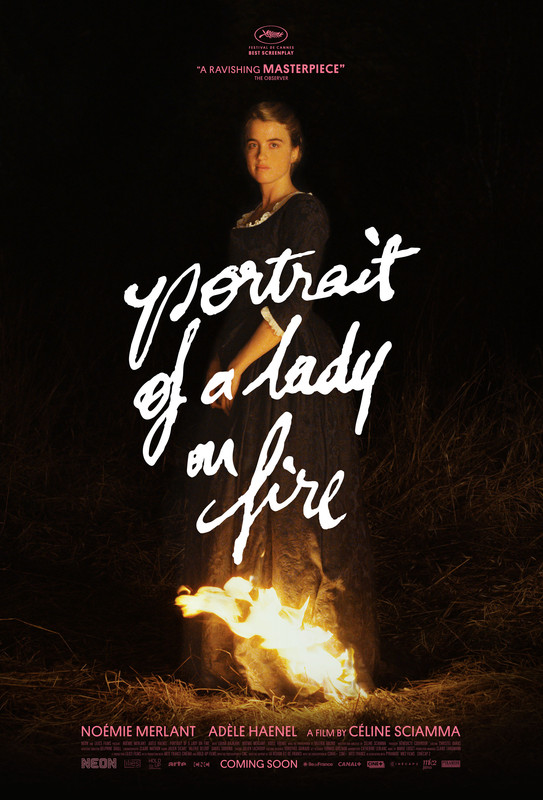
24FPS @ LFF 2019: Portrait of a Lady on Fire

Dir: Celine Sciamma
Since 2008, writer/director Celine Sciamma has made her name exclusively in coming of age cinema, with her own films Water Lilies, Tomboy and Girlhood and the screenplays for My Life as a Courgette and Being 17, all five of them among the genre’s best in the past few years. As her first venture outside that genre, Portrait of a Lady on Fire represents a big change, but Sciamma’s cinema, while evolving, as it has with each work, still feels as raw and personal as ever with this move into period romance.

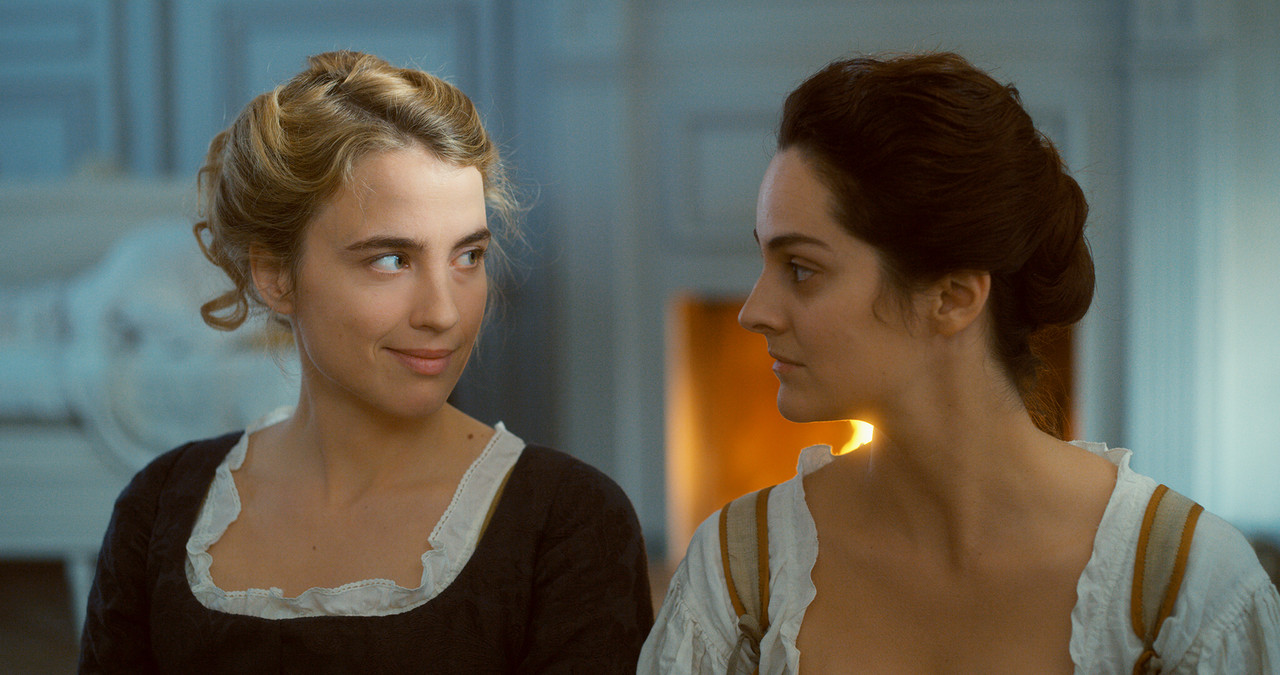
In 18th century France, painter Marianne (Noémie Merlant) is commissioned to paint a wedding portrait of Héloïse (Adèle Haenel). Because she doesn’t want the marriage, Héloïse is trying to avoid the painting, so Marianne must observe her during daily walks and work in secret. As the wedding grows closer, so do Marianne and Héloïse.

Described by Sciamma as a film about the memory of love, the jumping off point is the titular portrait. When Marianne is asked about it in a drawing class where she is both teacher and model we move straight into flashback, finding her arriving on the beach, above which sits the stately home where Héloïse lives with her mother (Valeria Golino) and their young maid Sophie (Luàna Bajrami).

Like many love stories, Portrait of a Lady on Fire is initially a slow burn. In her aim to film the growth of desire, Sciamma uses both this slow pacing and the composition and timing of her images brilliantly. The film is incredibly sensual and tactile, taking in details of form and texture in a way that seems to try to replicate Marianne’s painter’s eye for detail. This is seen in how the camera dwells on things like the folds of a dress, as well as in the way it regards Haenel, taking in every angle and line, allowing her to give a performance that works in tiny nuances, especially during the first half of the film, which is essentially a process of breaking through Héloïse’s shell. The first time Haenel smiles in the film, which is almost imperceptible and almost halfway through, is the first moment that begins to trigger the realisation of the desire and slowly forming passion that Sciamma has been building.

In a film where gaze is paramount, it is fascinating to watch how that aspect evolves. The connection between Merlant and Haenel changes throughout the film, and Sciamma often dwells in those moments, holding on their gaze towards each other, whether the two are in the same frame or not. The way the camera represents how they look at each other comes through in everything. It's there even in the design, the home feeling colder in the beginning of the film and the warmth of the relationship between Marianne and Héloïse seeming to warm up the surrounding environment, at least in the house, as time goes on. The central visual metaphor—Marianne seeing Héloïse standing in the opposite side of a fire at an outdoor party and Héloïse’s dress catching fire, just as the yet unspoken desire is rising on both sides—may not be subtle, but it’s evocative, thanks especially to the painterly texture of the image. This painterly feel is embedded in many of the film’s important images, most notably a recurring and fleeting image of Héloïse in a white nightgown; she seems part ghost, part painting, and that image becomes more affecting every time we see it.

The romance is the centre of the film, but many other concerns run through it as well. As well as being about love, the film features a telling depiction of female friendship and support, as Marianne discovers that Sophie is pregnant and the women try to obtain an abortion for her. That sequence, thanks to one element included by Sciamma, bears such complexity of feeling in a way that never lectures and is entirely fresh. It’s sad yet a victory; tough yet tender. Sciamma also interrogates the place of women in 18th century society. The idea that Héloïse is meant primarily as a bauble, a decoration for her husband to carry around is embedded in the portrait process, and especially in the more idealised image that Marianne paints when her model won’t sit for her. We also see this in Héloïse’s mother—clearly unhappy with her own arranged marriage, but now engaged in making the same bed for her daughter to very literally lie in.

Passionate but never exploitative, it’s obvious that a female gaze is behind the love scenes, but it’s sometimes the painting scenes that feel most telling of the relationship at the heart of the story. As they build to the first kiss, these sequences are as intense and intimate as any in the film, and after the relationship is formed they become playful; the intimacy acknowledged and embraced. Art also plays a part in the film’s most exposing scene, as Marianne draws a self-portrait, a secret thing for her lover to keep, while looking in a mirror she has set between Héloïse’s legs.

The film is exquisitely crafted, from the impeccable framing that only draws parallels between the arts of painting and cinema to the lack of non-diegetic music, which forces us to dwell in the same space as Marianne and Héloïse, to experience the growth of their love without being instructed by a score as to what we should be feeling. This extends to the work of the actresses (two men appear in the entire running time, each for a few seconds). The supporting roles are well cast, with Valeria Golino again reminding us how good she is, finding layers of sadness in the Countess and Luàna Bajrami making Sophie another interesting and important prong in the way the film looks at female relationships, beyond the romantic and sexual. Of the leads, Noemie Merlant is perhaps easier to read in the initial part of the film, from her emptiness in the opening scene to the way Marianne is progressively drawn to Héloïse, prompted initially by the mystery of what this woman may look like. The study of that face, which grows into a stronger desire scene by scene, is as brilliantly played as it is cued by Sciamma’s camera.

Sciamma has said that this film was made for Adele Haenel, and it’s difficult not to see it through the prism of their working and personal relationship. In many ways it is a film about Haenel’s face and the fascination it holds; for Marianne and, through the lens, for Sciamma. It would be tempting to take this reading further, but for all its clearly personal content there is a universality here. The power of the memory of love is hardly exclusive to any one relationship, and it’s impossible not to connect with the melancholy of that element, especially as the film runs up to the completion of the portrait. Haenel’s performance, even by her own standards, is superlative. The subtlety of what plays on her face, the way she shifts Héloïse’s character as the film goes on. She is perhaps most powerful in her silences, never more so than in the film’s beautiful final shot; a three minute take that simply tracks in on her. Haenel is one of the best female actors in Europe, and this is her finest performance to date.

Portrait of a Lady on Fire is a stunning achievement, rich and detailed in storytelling, metaphor and resonance. It’s proof that Celine Sciamma is more than just an accomplished teller of teenage stories, and further develops her cinema to put her on a level with the great visual storytellers around right now. It’s essential viewing for fans, and maybe even more so if you’ve not yet discovered her work.
★★★★★