Jul 21, 2019

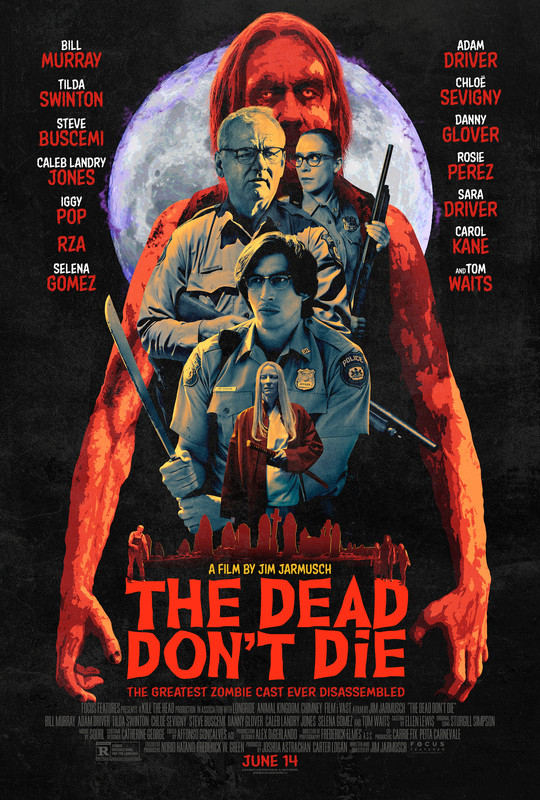
The Dead Don't Die [15]

Dir: Jim Jarmusch
Jim Jarmusch is an acquired taste, one I never discovered with the exception of Only Lovers Left Alive. Having liked that and being a big horror fan, I was quietly encouraged by Jarmusch returning to the horror genre and by the fact that many fans haven’t liked The Dead Don’t Die. On this occasion, the fans were right.

In the town of Centerville, the dead are coming back to life. Police Chief Cliff (Bill Murray), his officers Ronnie and Mindy (Adam Driver and Chloe Sevigny) along with several townsfolk, including the scottish samurai (Tilda Swinton) who has just taken over the funeral home, must fight back.

It takes a while for The Dead Don’t Die to become a zombie movie. Before it does, Jarmusch trades in comedy so deadpan that it feels inert. It might be interesting that the townspeople all speak in the same near monotone and that everything feels so low energy if that played in to the horror aspects of the film, but if Jarmusch is trying to do this it simply doesn’t come across. The overwhelming feeling is one of awkwardness. Things are static, with characters often standing in place and seeming to deliver lines in the manner of a first table read. This does not help even the better jokes play, and makes every scene feel as if it lasts twice as long as it actually does. Again, if this felt intentional, like a satirical take on the monotony of life in a town as small and, one assumes, quiet as Centerville, it might be slightly more amusing. That’s a reading you could impose, but for me it’s not something Jarmusch ever actually indicates. This also makes it difficult to say anything about the performances, because they all occupy this same monotonous space and are so obviously directed that even the film’s best actors come off as stiff.

Beyond this, The Dead Don’t Die is simply poorly crafted. Multiple plotlines and characters go absolutely nowhere and disappear rather than ending. Selena Gomez appear as one of a group driving through Centerville on a road trip. They decide to stay the night, but have precisely no effect on the story and nothing to mark them out as characters. Endings seem to be a major issue for Jarmusch, the way he wraps up Swinton’s story screams desperation, grabbing an idea from thin air whether it makes any sense or not. A group of teens from the juvenile detention centre in town are particularly redundant, they also have nothing to do with the overarching story and the screenplay doesn’t even attempt to pull an idea out of thin air for them, instead they just run off screen, never to be seen again. Another in the grab bag of ideas that go nowhere involves Ronnie’s recurring line “This is going to end badly”, the reveal of how he knows this has some potential, but again, Jarmusch throws the idea out and never does anything with it, except to have one brief exchange in which Murray and Driver wink so hard at the audience that you worry they’ll burst a blood vessel.

Horror cinema is often dismissed by people who don’t see a lot of it. Yes, there are horror movies that just do what they say on the tin, but the genre as a whole is seldom simply about vampires or masked killers, or zombies. Horror is rich in metaphor and commentary, it looks at the world through a skewed lens and uses the terror of the unknown to pass comment on the world. This is another of the many areas in which The Dead Don’t Die is a dismal failure. If Jarmusch has a point to make here it’s one that is painfully out of date. George Romero’s Dawn of the Dead posited that consumerism was turning us into zombies as far back as 1978, all Jarmusch ever does here is reiterate that with slightly updated references, his zombies moaning “WiFi”, “Coffee” or “Fashion”. As dated as his point is, Jarmusch also uses it extremely poorly. I’ve always found the metaphor at the heart of Dawn of the Dead a bit laboured, but at least Romero commits to the idea, Jarmusch’s zombies simply mutter the words he’s given them, they don’t lead to any larger point or clever setup. This same problem persists with how the zombie apocalypse has come about here, there’s a reference to fracking, but again, it doesn’t play in to either the satire (if satire is even being attempted) or the horror, it’s just a buzzword. 

The Dead Don’t Die is a graveyard of ideas. Time and again, Jarmusch introduces a character or a notion only to let it sit there and rot. The comatose delivery he’s shackled his cast to kills the comedy deader than the film’s completely uninteresting zombies. Watching this film I simply can’t tell why Jarmusch, or anyone else for that matter, wanted to make it and that doesn’t translate into something I’d recommend you spend any time watching.

Jul 20, 2019

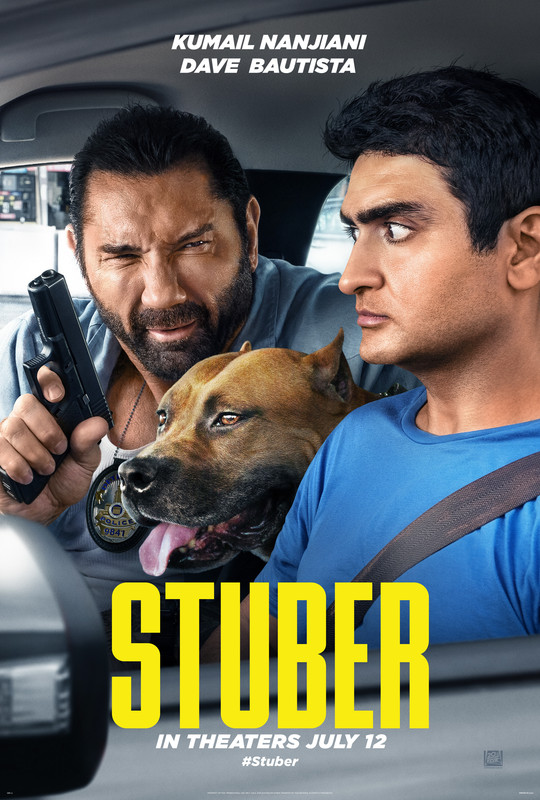
Stuber [15]

Dir: Michael Dowse
A few weeks ago, Dave Bautista ruled out the idea of being in future entries in the Fast and the Furious franchise because “I’d rather do good films”. Stuber is not the film you want to be releasing after that comment. 

Bautista plays a cop hunting the drug dealer (Iko Uwais) who killed his partner (Karen Gillan). Taking the day off for lasik surgery, he still springs into action when he gets a tip telling him a huge deal is going down. Because he can’t see, he orders an Uber and ends up dragging the driver, Stu (Kumail Nanjiani) into his pursuit of the dealer.

An action comedy that largely fails in both parts of that equation, Stuber has some talented people involved in front of the camera, but flagrantly wastes all of them. Bautista made a strong impression as Drax in the Guardians of the Galaxy and Avengers films, showing a knack for comic timing that makes the fact Stuber isn’t funny both more disappointing and more puzzling, but he’s also shown some hints of dramatic chops in the likes of Blade Runner 2049 and Bushwick (not a great film, but a decent performance). Here he seems adrift. He doesn’t have much of a character to grab on to with his more serious dramatic intentions, just a cliche story of a cop so obsessed with a case that he neglects his family (Natalie Morales as the daughter whose art opening is the same day he’s scheduled his eye surgery). His jokes fall flat too, with far too much emphasis put on slapstick that he carries off with little grace, blundering through scenes in much the same way the screenplay does.

In any mismatched buddy movie, chemistry is key; the way people play off each other should get us invested, as the film runs on, in their getting along eventually, and once they do we should invest in the partnership and feel how the experiences up to that point have helped forge it. That doesn’t happen between Bautista and Kumail Nanjiani. I liked The Big Sick well enough, but always felt that the sequences of Nanjiani performing comedy were its weakest aspect, he doesn’t land many laughs here either and alongside Bautista he helps form a grating pair: the angry cop and the annoying driver, unfortunately, the film takes much too long to advance them beyond these points. The rest of the cast is both underused and badly used. Betty Gilpin may have literally phoned in most of her role as the college friend Stu has long nursed a crush on (a relationship that doesn’t make Stu any more likeable) and Mira Sorvino, while it’s nice to see her, could have had a much more interesting role as Bautista’s boss (those scenes may well be on the cutting room floor because Stuber is at least short). Karen Gillian is as winning as ever in a tiny part and her opening scene with Bautista is easily the most fun the film ever has, their relationship is hardly original, but it's a dynamic I suspect I’d have enjoyed watching for another 90 minutes. Perhaps the most wasteful use of a co-star is reserved for Iko Uwais. His character is never given a personality, but much more criminal is how badly director Michael Dowse handles his two fights with Bautista. I’d happily sit through an even worse version of Stuber if these fights were handled well, but instead Dowse shoots them with a chaotic camera that never lets us see the action. Dowse does a little better with the action when Bautista and Nanjiani fight (in an overblown sequence that would almost certainly kill at least one of them), but that’s not the main attraction here.

Only once does everything come together and allow us to glimpse the kind of fun action comedy this might have been. For one blessed shootout sequence the film uses the blindness conceit well, finds a way for Nanjiani to be useful in the action, shoots things competently and has a couple of funny gags. It lasts about three minutes. That’s not enough for me to recommend this. Bautista looked pretty foolish when that comment about the Fast and the Furious came out, but having seen this and trailers for both Hobbs and Shaw and Bautista’s upcoming My Spy in the same screening, he looks even sillier now.
★½

Jul 19, 2019

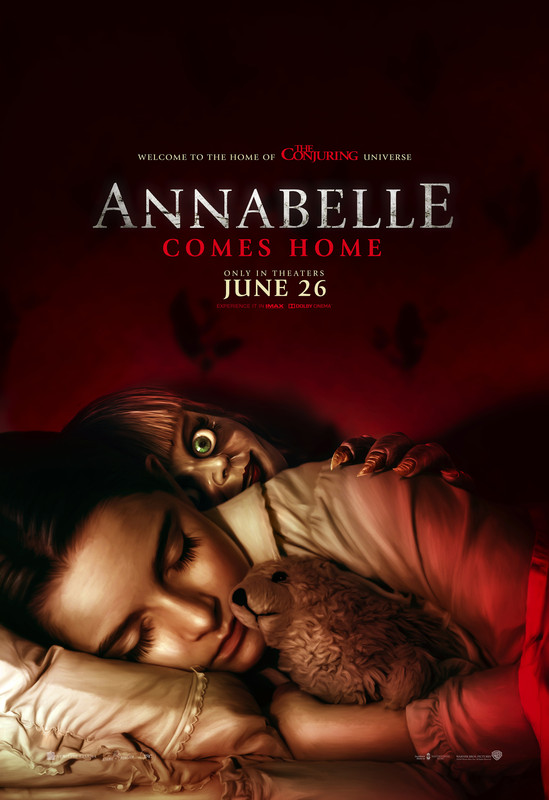
Annabelle Comes Home [15]

Dir: Gary Dauberman
I haven’t followed The Conjuring universe. I saw the first film largely on the strength of a cast that was more interesting than that of most modern ghost stories, with great character actors like Vera Farmiga, Patrick Wilson and Lili Taylor. That film was fine, lifted by its performances and better than average direction from James Wan, but it was at heart still just the standard issue haunting movie. I saw little reason to give the sequels or spinoffs any of my time. That said, I’m trying to write more, trying to cover more mainstream cinema and as a horror fan I feel I should try to get something out of both the biggest contemporary horror franchise and a subgenre that I generally don’t enjoy. This wasn’t the film to win me over to either.

As the film begins, Ed and Lorraine Warren (Wilson and Farmiga in brief cameos) are taking Annabelle, a doll possessed by an evil spirit, home with them to be kept where they can keep it from harming anybody. A year later, the Warrens are going out of town and leaving babysitter Mary Ellen (Madison Iseman) to spend the night watching their 11 year old daughter Judy (Mckenna Grace). Mary Ellen’s friend Daniela (Katie Sarife) also comes over and, curious about the room where the Warrens keep their occult artefacts, accidentally unleashes Annabelle, which also frees many other ghosts and other entities. 

This isn’t a bad premise. As I understand, each of the Conjuring spinoff films so far has largely focused on a single ghostly or otherwise demonic figure, so unleashing them all together in Ed and Lorraine Warren’s house has promise. Unfortunately the film does almost nothing with this idea. Far from reinventing the wheel, it simply rolls out as many wheels as it can, before proceeding to spin them for an hour.

Annabelle Comes Home is an extremely competent film. Mckenna Grace builds on good performances in the likes of Gifted and I, Tonya with equally solid work here while Madison Iseman, funny as the vain Bethany in Jumanji: Welcome to the Jungle, is about as effective as she could possibly be in a role that increasingly asks no more of her than wandering around slowly and looking scared. Katie Sarife’s role as Danielle, though only third lead, has a bit more of an emotional component to it, and she does well with that. Equally, the cinematography, if overly dark at times, is generally decent and writer/director Gary Dauberman, making his debut behind the camera after handling writing duties for many of the other films in the franchise, does a solidly decent job, ticking his way through the list of expected elements without making any terrible mistakes. The problem is that while there’s nothing, bar the thin screenplay, that stands out as notably bad, there is also little that makes you sit up and take notice. One sequence of shots in the middle of the film, revealing progressive forms of Annabelle in silhouette as the various colours of Judy’s bedside lamp shine on her in turn, looks very cool indeed and is genuinely creepy. That is perhaps 30 seconds of screen time, and it’s the only notably interesting image or series of images in the film. One other recurring image, involving a TV, does threaten to be interesting but Dauberman uses the device too often, so by the time the twist on how it has previously been used comes, you’re way ahead of the film on that too.

The rest of Annabelle Comes Home is paint by numbers filmmaking. It’s all creaky doors and floors, torches being shone in dark corners (before going out at a key moment because we can’t miss one of the points on the list of cliches), shots of empty spaces when you expect a scare and then, of course, shots back for the boo scare. Often, this is less a film than it is a pop up book, with some omniscient hand opening the flaps to scare you, and it’s just as grindingly predictable as that sounds both in terms of its content and its timing. If this is what you want from your horror, then the film will likely prove satisfying enough, if incredibly familiar, but these tricks have seldom worked for me even when they are done brilliantly. Annabelle Comes Home is, at its infrequent best, workmanlike. It generates no atmosphere, there’s no real threat from any of the various entities in the film, any actual peril or injury is undercut within seconds so the film - while there is sometimes a little apprehension as we tense for the next noise or jump scare - is never actually scary. If this represents what's popular in modern horror, I might just stick with the independent scene.
★½

Jul 13, 2019

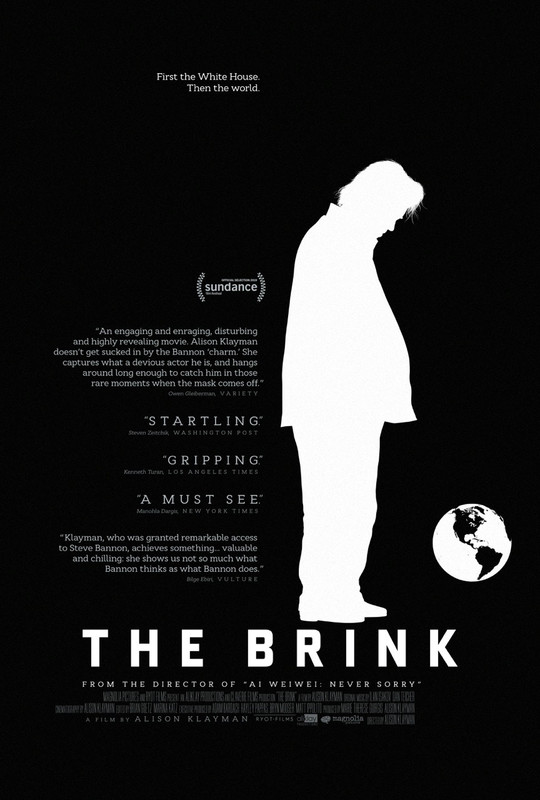
The Brink [15]

Dir: Alison Klayman
To me, the title of Alison Klayman’s documentary about Steve Bannon speaks to where we are as a planet. We’re walking up to the line in so many ways, and on the political side, it seems Bannon exists to give us that one last push over the edge.

Bannon is a far right strategist who co-founded Breitbart News in 2007 and became a late addition to the Donald Trump campaign in 2016, coming in as campaign CEO. He now credits himself with Trump’s win, as do many people, to be fair to him. For most of The Brink, Klayman follows Bannon after he has left the Trump administration, as he begins to form what he and his allies call ‘The Movement’; an initiative to unite the far right parties across Europe to increase their influence.

Bannon is a loathsome human, he looks like a thumb that gained sentience and that’s the least ugly thing about him. However, he does have an ability to wrap the vileness of his politics in an outward veneer that, when you put yourself in the shoes of the people who believe the poison that emanates from him, you can see why they are drawn to him. For most of the film, Bannon speaks outwardly reasonably, he’s not screaming in the faces of his opponents, indeed in a debate with David Frum he appears to have an easy - if not especially insightful - humour to his delivery. This difference between tone and content is what makes him dangerous.

This is where Klayman’s approach works well. She’s not a Michael Moore, deftly picking the worst moments her subject exhibits and drawing them together, she at least appears to be trying to show a fuller picture of Bannon. What emerges is a slippery character. Whenever another person on camera with him begins to push the rhetoric too far, Bannon will end filming, but again, the framing is interesting with him often saying something like “You’ve got everything you need here?”, when he clearly doesn’t mean the question mark. This is one of a couple of recurring refrains that seem designed to allow Bannon to play the nice guy while clearly manipulating people. The other happens every time he poses for a picture with a man and a woman, putting the woman in the middle saying “a rose between two thorns”. Both of these repeated phrases, in a way indicative of how Klayman allows Bannon to make himself look bad, end up feeling very sinister.

Another sinister and slippery side of Bannon, and of his influence, comes across whenever he’s challenged or things look bad on his side. Bannon himself seems most uncomfortable when the inherent racism of his views is questioned. He knows that if he wants to win more people to his cause that there HAS to be plausible deniability on this point (a way, at least, for supporters to say “I’m not racist, but”), the thing is that he hasn’t developed an answer beyond flat denial, it’s one thing he simply doesn’t have an argument on. We see some of this attitude reflected in his staff after the arrest of Cesar Sayoc, who sent homemade bombs to a number of prominent left wing figures and lived in his van, which was covered in Trump paraphernalia, as one of them - again without quite coming out and suggesting a ‘false flag’, says that he finds it surprising, that he’s not sure the bombs were real, and that the left is so much more violent before going on to invoke no true Scotsman over Timothy Mc Veigh. It’s in exchanges like this that we see Bannon’s ideas reach fruition.

That carries over into The Movement, whose meetings of rich white men conspiring to freshly empower the worst of the far right make for the most frightening segments of The Brink, especially in light of the recent success of the Brexit Party and the resurgence of Bannon cohort Nigel Farage. We see Bannon challenged, particularly robustly by Guardian reporter Paul Lewis, and we see him take losses like the US Midterms, but there’s definitely a sense of the momentum going his way overall. That’s why The Brink is more terrifying than a film that would set out to ‘take down’ Bannon more overtly: it shows how horrific his ideas are, how proudly he embraces them and their associations (“How would Leni cut it?” he says of a trailer for a film he’s making, half joking, half winking) and how, if he’s not entirely winning, he’s also not losing.
★★★★

Jul 9, 2019

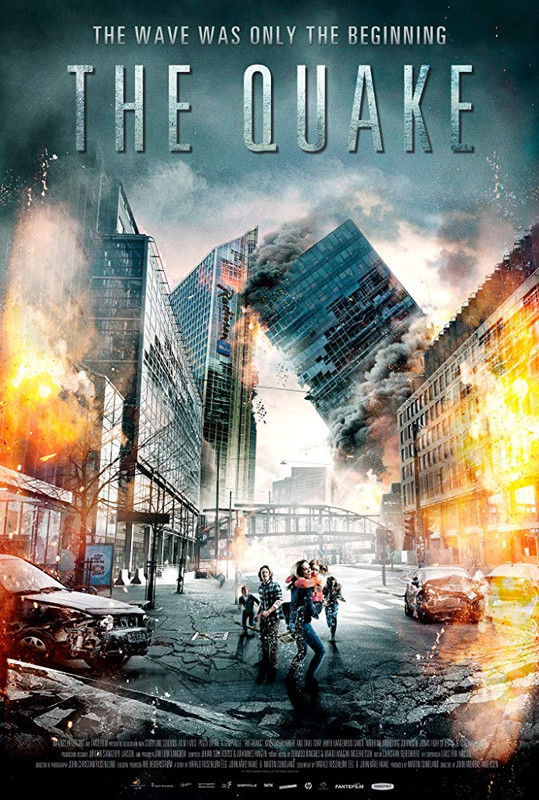
The Quake [12]

Dir: John Andreas Andersen
Three years after the events of The Wave, Kristian Eikjord (Kristoffer Joner) is still affected by the disaster. Separated from his wife Idun (Ane Dahl Torp) and distant from his kids, he feels guilty about his warnings not being heeded sooner and thus saving more people, and he’s haunted by fears of fresh disasters. These fears become more present when an old friend dies while examining a tunnel in Oslo and Kristian finds an old letter from him, warning of the potential of a massive earthquake. When the quake comes, will Kristian be able to protect his family?

The Wave did pretty big things for the career of director Roar Uthaug, who followed it up by making his Hollywood debut with the Alicia Vikander starring Tomb Raider reboot. Perhaps disappointingly, it didn’t seem to do the same for the film’s star Kristoffer Joner (a small role, confined to a hospital bed, in Mission: Impossible - Fallout aside). On the other hand, maybe that’s not such a bad thing, because it’s unlikely that a film like The Quake, if made in Hollywood, would have offered him much opportunity to stretch his acting muscles. At 103 minutes, this is a relatively short film, but for over an hour the titular event lurks in the background. For this time, the film does the requisite build up, but what it concentrates on isn’t the charts and graphs but the already shaken man at the centre of the film. 

Kristoffer Joner is a great actor, and he brings his customary dedication and detail to this part, just as he did in the first film. This performance is about trauma; a man haunted by his previous efforts, even though they were genuinely heroic. It’s left him looking bedraggled, almost hollow at times, and even the slightest engagement has become a struggle (in one particularly well acted moment there’s a tiny register of appreciation for the breakfast his daughter Julia (Edith Haagenrud-Sande) has made him, just in his eyes, a second before he says that she should go home). This background is important because it makes the growing threat of the earthquake feel different. By spending real time and effort on the emotional fallout of the previous events, there is always a very credible feeling that Kristian may genuinely just be paranoid. Of course, we know that’s very unlikely to be true, but it’s a testament to Joner that a film that used the title The Quake in a purely psychological sense would be at least as compelling as this one proves.

There are sacrifices made in order to spend this kind of time on Kristian’s character, and sadly they impact mainly on the other characters. There is an emotional short hand with the established characters of Idun, Julia and Kristian and Idun’s son Sondre (Jonas Hoff Oftebro, sidelined here to the point that you’d be forgiven for thinking the first draft forgot he ever existed) but Kathrine Thorborg Johansen’s Marit, the bereaved daughter of Kristian’s friend who first warned him of the quake, is fatally underdeveloped; little more than a plot device with a face. This is where the film’s running time bites. We understand Marit’s actions in the third act as standard disaster response, the way we’d all hope to behave in those circumstances. Kathrine Thorborg Johansen does what she can with what’s on the page, giving a decent performance, but some more scenes between her and Kristian, just to bond the characters a bit, would give us more investment in her in the last half hour. Ane Dahl Torp is also a little limited by what’s on the page, but there’s enough in her performance and the dynamic between her and Joner that we can read what’s happened between Kristian and Idun over the past couple of years without having it baldly laid out in dialogue, and we are very much invested in her fate and that of Julia, thanks to another solid performance from Edith Haagenrud-Sande.

The carnage does, of course, finally arrive and when it does it’s extremely well executed, with effects that rival any $200 million film for roughly $6 million. The scale is smaller of course, but the CG is strong and because it’s linked to physical effects, more credible than in many higher budget films. The major setpiece, in a collapsing tower block, is tense, well paced, and not easy viewing if you have vertigo. Director John Andreas Andersen steals a few things (notably a sequence from The Lost World: Jurassic Park), but he adds his own wrinkles to everything he co-opts. The only issue in this passage is that, once again, the film largely forgets about Sondre, which makes things feel a bit unbalanced.

If you’re going in wanting something like a San Andreas (which, for the record, would be no bad thing, that’s a fun movie), The Quake is going to disappoint. I appreciated the slow and thoughtful start and the way it allows a great actor like Joner room to dig into his character. It has its problems, even at its best it is riddled with cliche, short changes some of its characters and has an ending so abrupt that it’s barely an ending at all, rather than a hard stop. For all those issues though, this is a smarter and more entertaining film than most Hollywood efforts in the genre.
★★★½

Jul 5, 2019

Midsommar [18]

Dir: Ari Aster
Ari Aster’s first film, Hereditary was, for me, a very well made piece with two excellent central performances and one truly great shock, but it also felt very long and wandered off into silliness as it approached its third act, before collapsing completely in the last ten minutes. Little has changed.

After losing her whole family in a tragic incident, Dani (Florence Pugh) tags along with her boyfriend Christian (Jack Reynor) and his friends (William Jackson Harper, Will Poulter) to a once in 90 years summer festival held by the extended, cult-like, family of their Sewdish friend Pelle (Vilhelm Blomgren). Once they are there, things go quickly from intriguing to increasingly disturbing.

For about ten minutes, I thought I was going to love Midsommar. The opening sequence is extraordinary; a gripping introduction that establishes the long running stress and incipient trauma that Dani is going through, as well as how it impacts her relationship with Christian and, further, his relationship with his friends. It also serves up the most disturbing and quietly brutal imagery of the whole film. That imagery recurs occasionally, as do the relationship issues, but otherwise the film leaves most of this behind once it lands in Sweden. 

What the film quite quickly becomes once we reach the commune is The Wicker Man in slow motion (Aster is so indebted to that film that he even inserts what appears to be a direct nod to Neil LaBute’s awful remake of it). For the bulk of the near two and a half hour running time, we plod through the nine day festival, with exposition conveniently unfolded courtesy of two of the Americans writing their thesis topics on it. There are, to be fair, some disturbing sequences, but everything is so heavily signposted that even these become frustrating as we wait for the inevitable dropping of the other shoe (for instance, it takes about ten minutes to get to the end of a marathon maypole dance, when we know exactly who is going to be left standing from the first second). 

As with Hereditary, the further Aster gets into his running time, the sillier his film becomes. The over the top gore of the first scene that alerts the new arrivals to exactly what is going on in this community is probably supposed to be funny at some level, I’m less convinced that’s true of the sex scene in the third act, or the climactic moments of the film, but both produced more sniggers than screams in my audience.

With all that said though, Midsommar is also proof that Ari Aster is a formidably talented filmmaker. For all that the pace doesn’t work for me, there is a precision to it and to everything else in the film that speaks to a writer/director with an instinctive control over his work. There are some wonderful little moments, like the simple cut that takes Dani from Christian’s apartment on to the plane to Sweden, but what is most striking is the overall design of the film. Though he draws heavily from The Wicker Man, Aster does also establish a distinctive look for his commune, with runic design everywhere in the set and prop design and a precision in his framing that makes that design all the more striking. This is also aided by an unnerving score from The Haxan Cloak. Further to his credit, Aster has assembled an excellent cast, with the gifted Florence Pugh turning in another superb performance in the lead and Jack Reynor continuing to prove that he’s among the most interesting actors in his age group. Those two, in particular, play off each other very well, and William Jackson Harper and Will Poulter help build a believable dynamic between the guys. 

As with Hereditary, I can see and acknowledge all these strengths, but I also have to acknowledge that, as a whole, Midsommar simply doesn’t come together for me. While the first ten minutes are full of raw emotion, that almost vanishes once we reach the commune, and it certainly isn’t felt in the third act. One of the great and paradoxical qualities of The Wicker Man, for me, is that it’s ending always seems both the only logical conclusion to the film and something I can’t believe I’m seeing. That’s not the case here for me. The final act - in general, if not in all its specifics - is one that seems a foregone conclusion from the very earliest scenes in the commune, and that drains it of almost all power.

Midsommar pales next to great recent folk horror like Robert Eggers’ The Witch and Lukas Fiegelfeld’s brilliant Hagazussa, which both look to the history of the genre without so specifically evoking a single film. There’s no question that Aster is a talent but at this point, he seems to be one whose films are, quite simply, not for me.
★★

Jul 3, 2019

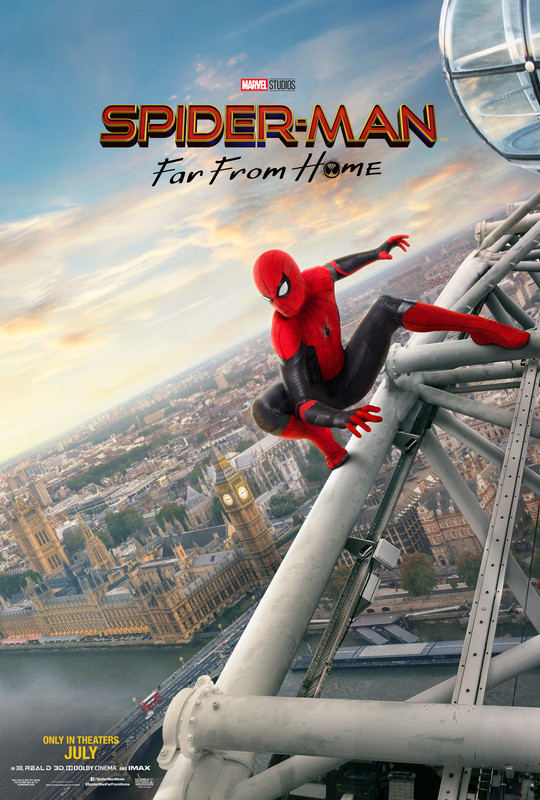
Spider-Man: Far From Home [12A]

Dir: Jon Watts
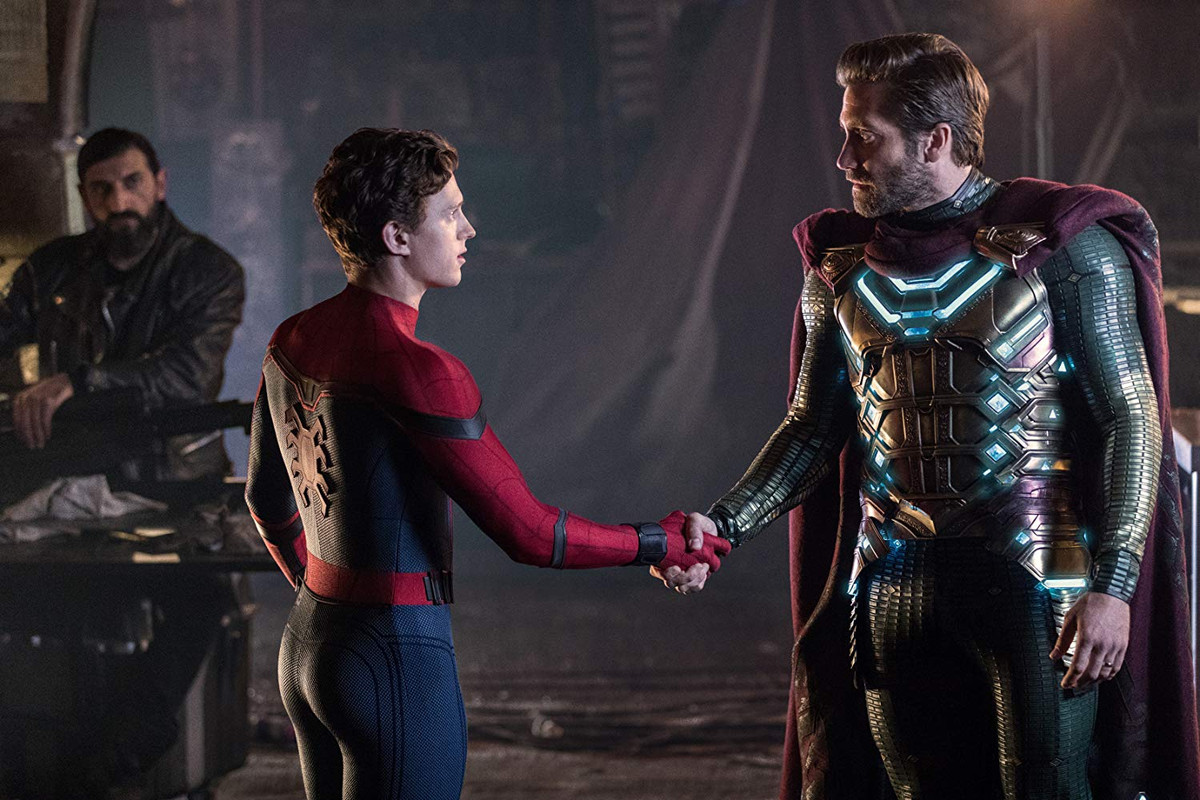
The second of the MCU’s Spider-Man films, and the closing film of Marvel’s Phase 3, Spider-Man: Far From Home picks up after the events of Avengers: Endgame. With Tony Stark gone, the world is looking to other heroes, as is Nick Fury (Samuel L Jackson). When reports begin of massive beings called elementals and of Quentin Beck (Jake Gyllenhaal), a soldier from another dimension trying to fight them, Fury calls in Spider-Man to assist. At least, he tries to. Peter Parker (Tom Holland) has a lot on his plate, juggling being a superhero with his life after the blip; most pressingly a school trip to Europe and a plan to tell MJ (Zendaya) how he feels about her. He doesn’t have time for Nick Fury, especially with this new hero, quickly nicknamed Mysterio, on the scene.

I’d call myself a casual observer of the Marvel Cinematic Universe. With a little distance from them, it’s probably only the first two Captain America films and Spider-Man: Homecoming that I’d say are, qualitatively, anything more than solid pieces of blockbuster filmmaking. On the other hand, I love Spider-Man. I always have. I love the 70s series with Nicholas Hammond in all its cheesy crappiness. I love the 90s cartoon. I love a lot about Sam Raimi’s trilogy of films, and... almost nothing about The Amazing Spider-Man reboots (reviews here and here). Homecoming was pretty much everything I ever wanted from a Peter Parker Spider-Man film, and the first film to manage to square the circle of the character and get both Peter and Spider-Man right, at least for me. Then Into the Spiderverse raised the bar. I didn’t have much investment in Miles Morales going in, having stopped reading Spider-Man books a few years before he came along, but I certainly had that investment on the way out (as well as an appreciation for the film’s dazzling art style). That film and Avengers: Endgame present challenges for this film, challenges it never manages to overcome.

Homecoming had a studiedly low key feel to it. As we first met Holland’s Spidey in the midst of a big action sequence in Captain America: Civil War, his own film deliberately foregrounded the idea of Peter as a relatively nomal teenager and of Spidey as ‘Your Friendly Neighbourhood Spider-Man’. It did the big action well too, and had a menacing villain in the shape of Michael Keaton’s Vulture, but the largely ground level feel of it (depsite the web slinging) was a great plus. With that groundwork laid, the mix doesn’t work the same way this time out. We don’t feel the effects of ‘the blip’ (the five year gap between the people who survived Thanos’ snap and those who didn’t) enough. Rather than just have one third string character be that much older, would it not have been interesting for  the dynamics of their relationship if Ned had survived the snap and was now several years further on than his friend Peter? Certainly it would be more interesting than Ned’s storyline, which screams that screenwriters Chris McKenna and Erik Sommers couldn’t think of anything to do with him. 

Homecoming, not having to do an origin story, got its feet under it immediately, but the emphasis on the teen comedy aspect and the high school trip to Europe (which is so nakedly a plot facilitator that at a certain point the film doesn’t even bother pretending about it) means that as a Spider-Man film Far From Home is a slow starter. Even when there are action scenes, for much of the first half of the film, Mysterio is the driving force. Jake Gyllenhaal is a bit of a casting coup for this film, and he brings his customary dedication to the role, dealing well with the several gigantic exposition drops he has to do, while also managing to create an interestingly nuanced character and draw a relationship with Holland which, though close to what Sam Raimi did with Dr Octopus in Spider-Man 2, carries weight for Peter as he looks for a new mentor in the wake of the loss of Stark. Of course there is another mentor figure available in Nick Fury (both Jackson and Cobie Smulders as Maria Hill have an increased presence here), but without Peter ever saying it, I think it’s that Beck shows himself as a scientist as well as a warrior that means Peter is drawn to him. He sees an older version of himself there - or at least a version to aspire to - in a way that he doesn’t in a top spy like Fury.

Jake Gyllenhaal also helps bring out the best in Holland's performance, we can feel his pride when Beck tells him never to be ashamed of being the smartest person in the room, how it fuels that desire to see Beck as a mentor, and how this desire might not make for the best judgement. That said, it’s only in the second half of the film that we see Mysterio used to his full potential. The first action scene that deploys his illusions in their full force is absolutely fantastic. Jon Watts and the crew find some wonderful and very comic book inflected images and have great fun pulling surprises on the characters and on us. This and other sequences in the second half also use the connection we’ve seen built between Peter and Mysterio effectively, giving some emotional power to underlie the action.

In its first half, the film does mark time. Ned’s story with Betty Brant (Angourie Rice) is notable here. Rice is well cast, and fun in the newscast that opens the film, but both she and Jacob Batalon (who still has nice comic timing, especially opposite Holland) are underserved by a story so prosaic that the film explicitly declares that it’s abandoning it before the end credits. This is also true of a lot of the class trip stuff, like the fairly unfunny dynamic between Martin Starr and JB Smoove as the teachers and Tony Revolori’s one joke version of Flash Thompson. It’s also the case with a weirdly misplaced action sequence. Yes, Peter’s carelessness is a theme here, but it’s a bit overegged at one particular moment, especially given that the film has other instances that trade on the same idea, but feel much more in character for Peter. The only part of the class trip narrative that really engages is the dynamic between Peter and MJ. Zendaya is definitely a departure from the traditional MJ, in both look and attitude, but it completely works for me; she gets bigger laughs with a withering look than almost any of the film’s one-liners, and her ability to throw Peter off balance is always funny (the exchange at the opera, when Peter tells MJ she looks beautiful, is perfectly timed and played). For all the sarcasm she throws his way though, there’s a genuine sweetness about Peter and MJ too, it’s a different take, but a smart and well-executed one.

The best things in the film come in the third act, which ups the action to an epic scale, but it’s a challenge to discuss any of it because every part of it is predicated on massive spoilers. Suffice to say that the idea that has defined every version of Spider-Man is that ‘with great power comes great responsibility’ and that in these sequences Spidey is feeling that at a very personal level. It’s a classic hero's journey all about the choice this young kid has to make in embracing his role, his responsibility. It’s not something we haven’t seen in cinematic Spider-Man stories, but it’s still effective thanks to Holland’s performance and in no small part thanks to the stunt teams and digital artists who help create Spidey, whose movements have never felt more fluid.

It’s worth briefly addressing the first of the two post-credits scenes (stay for both, by the way). As a fan, I was at once elated at a certain piece of casting and somewhat thrown off by the depiction, which feels like a departure from the principals of the character, if only because of what the iconography suggests it’s referencing. I’m not sure how I feel about it, but along with the other things this sequence throws up, we’ll surely be dealing with it in the next film.

Then there are, of course, those twin problems of Into the Spiderverse and Endgame. As a Spider-Man film, Far From Home simply can’t help but feel like a damp squib after the blisteringly inventive Spiderverse (especially as it seeds a similar idea early on), it’s got fun action and is incredibly well executed, but the sheer visual verve of that film is nowhere to be found, nor is there a single image with a tenth of the power of the shot of Miles falling upwards through the frame. Equally, as a closer for Marvel’s third phase, it can’t help but feel like an anti-climax next to the monumental (though flawed) Endgame. All that said, though it does take a while to plod its way there and too many characters seem stuffed in just because they were there in the last film, rather than because there’s a great need for them here, once it kicks into gear, Far From Home is a highly entertaining, very well acted and sometimes thoughtful Spider-Man film. I had a great time with it in its second hour and again loved the depiction of both Peter and Spidey throughout, but I can’t deny it failed to give me the charge of excitement I had after Homecoming.
★★★

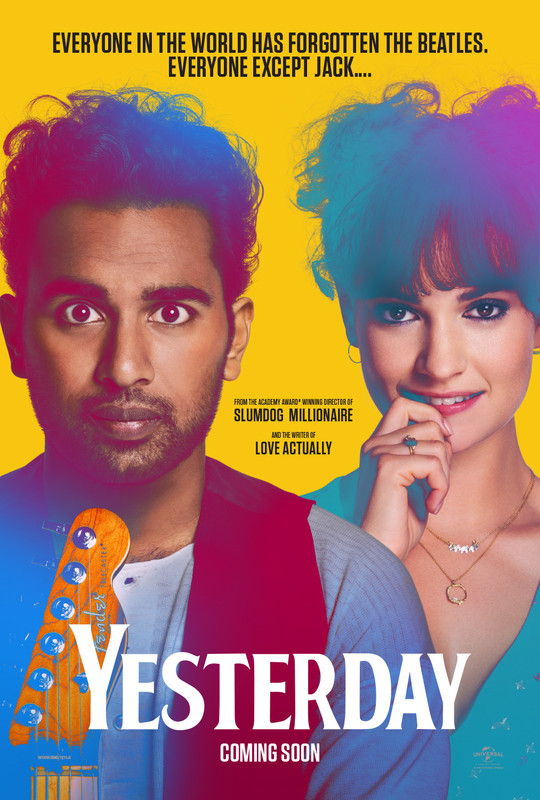
Yesterday [12A]

Dir: Danny Boyle
I remember having an argument with a co-worker who said “The Beatles were shit”. I explained to them that, no, they weren’t. It’s perfectly fine not to like The Beatles, but they demonstrably weren’t shit, because while there are clearly talentless people who make shitty music or shitty movies yet still meet with success, no truly shit band could do what The Beatles did. They changed the very fabric of pop music. What pop music would look like without their influence is all but unimaginable. That’s why the basic concept behind Yesterday is so exciting.

Jack Malick (Himseh Patel) is an unsuccessful singer-songwriter, toting his guitar from tiny gig to tiny gig with the help of his manager and friend Ellie (Lily James). One night, as he cycles home, there is a worldwide power cut, during which a bus hits him. When he wakes up, Jack discovers that only he can remember who The Beatles were and he begins to use their songs and pass them off as his own, meeting with massive success thanks to this ruse.

Imagine a world without The Beatles, it’s full of possibilities if you try. The problem here is that screenwriter Richard Curtis (working from a story by Jack Barth) only ever uses the concept in the most route one way possible; spinning yet another of his increasingly tired collections of rom-com tropes out of it. There is an early gag, as Jack googles to find out if any other bands have vanished from history, that tells us Oasis no longer exist. Good for a chuckle, but that’s the only time the film even nods to the idea of what music would be like without this most important of bands (it’s certain, for instance, that Pet Sounds wouldn’t exist). Would pop music even sound the same? There’s an angle here that could have seen Jack cherry picking missing songs (if we can argue the world NEEDS Ob la di, Ob la da then it definitely needs God Only Knows). On the other hand, the film could have delved into how the modern musical landscape would try to change The Beatles. Again, Curtis strikes a glancing blow here, with Ed Sheeran (in a brutally extended cameo) suggesting that Jack change the lyrics of Hey Jude to Hey Dude, but it’s not particularly convincing that Sheeran or some other trendy producer wouldn’t try to make the songs sound more modern and, without that, it’s tough to buy the overnight success Jack meets with. Yes, the songs are great, but that’s not all it takes.

But instead of any of this, we have a tediously predictable story of Jack feeling guilty over taking ownership of the songs and realising that maybe he shouldn’t have left Ellie behind. In fairness to them, Himesh Patel and Lily James do what they can with stock characters and a screenplay so obvious that you could write every beat in your sleep. Together, they do have a certain amount of natural charm and chemistry. Patel, in his first film role, does a solid job as Jack. With better gags and a more nuanced relationship story to play, he’d probably be effective. He does perform the songs well too, there’s nothing remarkable about his singing voice, but that may be intentional because this is all about the songs themselves more than the person delivering them. Unfortunately, it’s only on Help, rendered as a scream of frustration, that Curtis and Boyle use the songs to bring anything deeper out of the character; another missed opportunity. 

The gags are middle of the road (Jack’s family and their friends continually interrupting as he tries to play them his ‘new’ song, Let It Be)  and the characters broad, especially Kate McKinnon as Jack’s money obsessed new manager and his friend and ‘road manager’ Rocky (Joel Fry), who is as thick as two short planks and plays like a rewrite of Rhys Ifans in Notting Hill. The romance, similarly, is tough to care much about because it’s so clear where it’s all headed (especially given the use of one line, from very late in the third act, in the trailer). Lily James is radiant, and it’s easy to be drawn to her just by that, but she doesn’t have anything to play except the supportive ‘friend’ holding a torch. Once again, the frustration is that you suspect there’s so much more she could be doing.

Danny Boyle has always delivered striking visuals, think about Renton sinking into the rug in Trainspotting or the shots of an empty London in 28 Days Later. Aside from the sequence of all the world’s lights clicking off at once and some nice renderings of Jack's attempts to remember the lyrics to Eleanor Rigby, none of that style is in evidence here. Yesterday is as flat visually as it is dramatically and comedically. The biggest miscalculation in script and direction comes in a cameo (played by Robert Carlyle), which manages to be both saccharine and unbearably crass. The latter problem could easily have been avoided by choosing another figure to cameo, the former only by deleting the entire scene (which has no impact on anything in the larger story).

Overall, Yesterday is a terrible disappointment. It takes an incredible songbook and does nothing with it. It takes a great idea and engages with it only for a couple of fairly obvious gags, rather than digging into it. It takes a couple of charming actors and sticks them with very little to play and it takes Danny Boyle and sucks out most of his style and energy. It’s not the worst thing you’ll ever see, and yes, The Beatles are still great, but given that you could just put the Red and Blue collections on, this doesn’t need to exist.
★★

Jul 1, 2019

The Month in Movies: June 2019

Watched: 33
First Viewings: 23

Best Films
A Vigilante / Dirty God / We The Animals
These three films are all, at their core, character studies. A Vigilante and Dirty God are both about women dealing with trauma. Olivia Wilde's character in A Vigilante has escaped an abusive relationship and takes violent action to help other abused people get out of their situations, while in Dirty God Vicky Knight's acid attack victim turns to faint hopes of treatment in Morocco along with drinking, drugs and sex to help her numb her trauma. Two excellent films about people in extreme emotional situations, and two of the year's best performances so far.

We the Animals is a little different; a coming of age film about a young boy coming to terms with his sexuality, while witnessing the fractious (and, again, often abusive) relationship between his parents in between fighting and playing with his brothers. It's a low key story, realised through poetic imagery and unaffected performances.

Worst Films
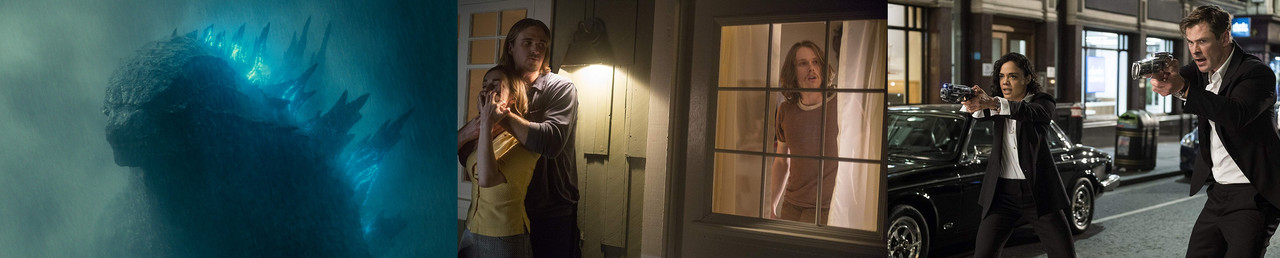
Godzilla: King of the Monsters / Wolves at the Door / Men In Black International
Summer 2019 hasn't been great for blockbusters, but Godzilla: King of the Monsters and Men in Black International are both especially bad. Godzilla is choked with exposition and characters we couldn't give the tiniest of shits about and almost entirely forgets about its raison d'etre, shrouding what monster fights it does have in so much dust and debris they're barely visible. Men in Black International, on the other hand, seems destined to become a byword for soulless reboots; it's a film that almost announces that there's nothing behind it except the fact that someone thought the property could make some money.

Wolves at the Door is the odd one out of this group; a painfully inept riff on the Manson family murders, done in the style of The Strangers. It would just be a poorly made and excruciatingly dull home invasion movie, but the use of documentary footage at the end is so unearned that it retroactively makes everything else in the movie offensive. 

Best Actor: Emil Jannings - The Blue Angel
Best Actress: Olivia Wilde - A Vigilante / Vicky Knight - Dirty God 
Best Ensemble: We The Animals 
Better Than The Film: Julianne Moore - Gloria Bell 
Best Director: Josef Von Sternberg - The Blue Angel / Jeremiah Zagar - We The Animals
Ones To Watch: Sacha Polak (Director) - Dirty God
Best Visuals: We The Animals
Biggest Surprise: A Vigilante 
Biggest Disappointment: Incident in a Ghostland / Brightburn 
I'm Pretty Sure No One Else Has Seen This: Raze 
Movie I Finally Got to See: The Child