Showing posts with label RomCom. Show all posts

Jul 3, 2019

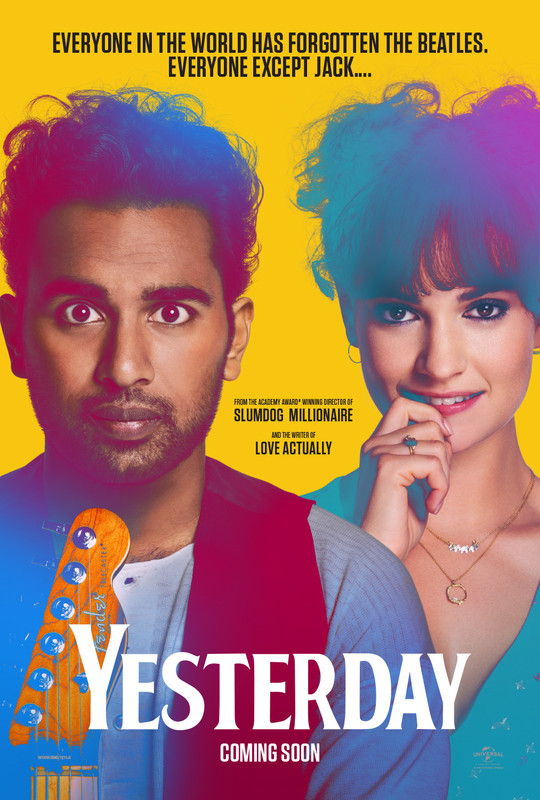
Yesterday [12A]

Dir: Danny Boyle
I remember having an argument with a co-worker who said “The Beatles were shit”. I explained to them that, no, they weren’t. It’s perfectly fine not to like The Beatles, but they demonstrably weren’t shit, because while there are clearly talentless people who make shitty music or shitty movies yet still meet with success, no truly shit band could do what The Beatles did. They changed the very fabric of pop music. What pop music would look like without their influence is all but unimaginable. That’s why the basic concept behind Yesterday is so exciting.

Jack Malick (Himseh Patel) is an unsuccessful singer-songwriter, toting his guitar from tiny gig to tiny gig with the help of his manager and friend Ellie (Lily James). One night, as he cycles home, there is a worldwide power cut, during which a bus hits him. When he wakes up, Jack discovers that only he can remember who The Beatles were and he begins to use their songs and pass them off as his own, meeting with massive success thanks to this ruse.

Imagine a world without The Beatles, it’s full of possibilities if you try. The problem here is that screenwriter Richard Curtis (working from a story by Jack Barth) only ever uses the concept in the most route one way possible; spinning yet another of his increasingly tired collections of rom-com tropes out of it. There is an early gag, as Jack googles to find out if any other bands have vanished from history, that tells us Oasis no longer exist. Good for a chuckle, but that’s the only time the film even nods to the idea of what music would be like without this most important of bands (it’s certain, for instance, that Pet Sounds wouldn’t exist). Would pop music even sound the same? There’s an angle here that could have seen Jack cherry picking missing songs (if we can argue the world NEEDS Ob la di, Ob la da then it definitely needs God Only Knows). On the other hand, the film could have delved into how the modern musical landscape would try to change The Beatles. Again, Curtis strikes a glancing blow here, with Ed Sheeran (in a brutally extended cameo) suggesting that Jack change the lyrics of Hey Jude to Hey Dude, but it’s not particularly convincing that Sheeran or some other trendy producer wouldn’t try to make the songs sound more modern and, without that, it’s tough to buy the overnight success Jack meets with. Yes, the songs are great, but that’s not all it takes.

But instead of any of this, we have a tediously predictable story of Jack feeling guilty over taking ownership of the songs and realising that maybe he shouldn’t have left Ellie behind. In fairness to them, Himesh Patel and Lily James do what they can with stock characters and a screenplay so obvious that you could write every beat in your sleep. Together, they do have a certain amount of natural charm and chemistry. Patel, in his first film role, does a solid job as Jack. With better gags and a more nuanced relationship story to play, he’d probably be effective. He does perform the songs well too, there’s nothing remarkable about his singing voice, but that may be intentional because this is all about the songs themselves more than the person delivering them. Unfortunately, it’s only on Help, rendered as a scream of frustration, that Curtis and Boyle use the songs to bring anything deeper out of the character; another missed opportunity. 

The gags are middle of the road (Jack’s family and their friends continually interrupting as he tries to play them his ‘new’ song, Let It Be)  and the characters broad, especially Kate McKinnon as Jack’s money obsessed new manager and his friend and ‘road manager’ Rocky (Joel Fry), who is as thick as two short planks and plays like a rewrite of Rhys Ifans in Notting Hill. The romance, similarly, is tough to care much about because it’s so clear where it’s all headed (especially given the use of one line, from very late in the third act, in the trailer). Lily James is radiant, and it’s easy to be drawn to her just by that, but she doesn’t have anything to play except the supportive ‘friend’ holding a torch. Once again, the frustration is that you suspect there’s so much more she could be doing.

Danny Boyle has always delivered striking visuals, think about Renton sinking into the rug in Trainspotting or the shots of an empty London in 28 Days Later. Aside from the sequence of all the world’s lights clicking off at once and some nice renderings of Jack's attempts to remember the lyrics to Eleanor Rigby, none of that style is in evidence here. Yesterday is as flat visually as it is dramatically and comedically. The biggest miscalculation in script and direction comes in a cameo (played by Robert Carlyle), which manages to be both saccharine and unbearably crass. The latter problem could easily have been avoided by choosing another figure to cameo, the former only by deleting the entire scene (which has no impact on anything in the larger story).

Overall, Yesterday is a terrible disappointment. It takes an incredible songbook and does nothing with it. It takes a great idea and engages with it only for a couple of fairly obvious gags, rather than digging into it. It takes a couple of charming actors and sticks them with very little to play and it takes Danny Boyle and sucks out most of his style and energy. It’s not the worst thing you’ll ever see, and yes, The Beatles are still great, but given that you could just put the Red and Blue collections on, this doesn’t need to exist.
★★

Oct 12, 2014

24FPS @LFF 2014: Roundup

Some reviews from the last week at LFF.

Spring
Dir: Justin Benson, Aaron Moorhead
There are many things that are great in isolation, but combining them with other great things, interesting as the idea may be, doesn't always lead to a third great thing.  That seems to be what has happened here.  You have to give Spring the daring and originality of its concept; filtering Before Sunrise through a Cronenbergian monster movie is an intriguing idea but in the hands of writer/co-director Justin Benson and co-director Aaron Moorhead the execution is less satisfying than the concept.

After his mother dies Evan (Lou Taylor Pucci), finding himself aimless and wanted after a bar fight, decides to use his inheritance and gets on a plane to Italy.  There he meets and falls for Louise (Nadia Hilker), but this new romance is complicated when it turns out that she is not just the beautiful woman she appears to be.

For most of it first hour, Spring keeps its cards very close to its chest, not even giving away the genre of the film it becomes.  For a while it simply follows Evan; home from the bar after his mother's funeral and then to Italy, where he meets two boorish Brits who take him on a booze fuelled road trip.  This is all pretty engaging, because it allows us some time to get to know Evan and because Lou Taylor Pucci, unrecognisable with close cropped hair and clean shaven, makes him amusing and enjoyable company (the same can not be said of the Brits, Tom and Sam, who are cliché irritants).  By the time Evan meets Louise we're as ready as he is for things to switch gears, and they do, into a rather endearing, if not unfamiliar, getting to know you style romance.

The body horror movie Spring eventually becomes (and if that constitutes a spoiler you're making the wrong assumptions about the Cult strand of the festival) needs this slow burn approach to work, but it's a mixed bag.  Charming as Evan is and gorgeous and interesting as Louise is for the third act to work you have to believe that there is deep, deep love between them.  I just didn't buy it.  A connection, both sexual and as people, sure, but that's different and given the stakes of the ending I found this lack of belief in the depth of their relationship a near fatal flaw.

On the plus side the performances are good.  Pucci believably charms Nadia Hilker's Louise and she, even before we know the true scale of things, is someone who you can buy into any guy falling pretty hard and fast for.  The script in their early scenes together is light and fun (their first meeting, which ends with both of them a little confused, is especially amusing) and you do warm to them as a couple.  Then, when the film springs its surprise, which has elements of Cronenberg and more than a few visual echoes of Possession it does turn your head and change the direction of the film.

Unfortunately the third act never quite delivers on this promise.  The interplay between Evan and Louise is all too often reduced to Louise expositing at him.  Of course it's important to establish certain rules, but spending so much time on raw exposition not only somewhat over explains things but also leads to the very problem that means that the film's final shot lands, at least for me, with a bit of a thud.

There is much to like here.  Benson and Moorehead deliver main characters worth investing in, who both have actual personalities (a rarer quality than I'd like) and when they steal they steal with taste and manage to put a spin on their influences.  There is some striking imagery here too, especially in the transformation sequences.  It's just a shame that, after holding two seemingly disparate ideas together for an hour they can't balance them for the last third of the film.  That said, Spring remains an interesting and original piece of work and it's worth checking out, because we'll be hearing from Benson and Moorehead again.

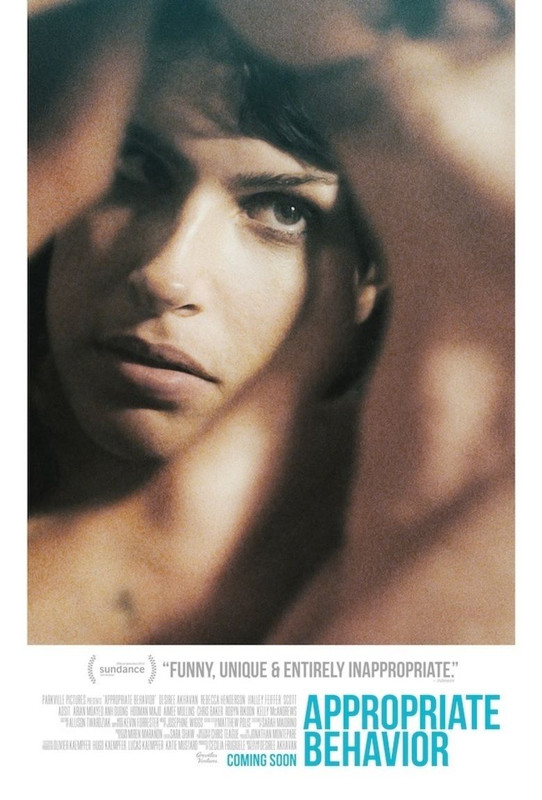
Appropriate Behavior
Dir: Desiree Akhavan
Not quite a rom-com, Appropriate Behavior nevertheless concerns itself with modern romantic relationships and has a whole lot of good jokes along the way.

Shirin (writer/director Desiree Akhavan) has just split up with her girlfriend Maxine (Rebecca Henderson) and through the course of the film we see her trying to adjust to being single, get over Maxine and figure out how to tell her Iranian parents that she's bisexual without being disowned. 

Several things mark Appropriate Behavior out but perhaps the most striking is its viewpoint.  I don't know how closely Akhavan is drawing on her real life here, but this feels like a very personal film, especially when it comes to Shirin's interactions with her family and with Maxine.  The flashbacks to the various stages of Shirin and Maxine's relationship capture in short order both the thrill and fun of falling in love and the sting of it ceasing to work.

The side stories provide some fun jokes too, especially when Shirin gets a job teaching a filmmaking class to 5 year olds. Scott Adist of 30 Rock scores a laugh with every line as her boss, and the finished films riff nicely on pretentious video art and on the kind of movie a 5 year old would actually want to make (it's about farts).

Despite a few dark turns, Appropriate Behavior is quite a light film.  Arkhavan's direction is pretty unobtrusive most of the time, though she does use the camera well to suggest the discomfort of an impromptu threesome that Shirin finds herself in, she fares well as an actor's director, doing strong work herself and helping the rest of the cast find a very natural register that suits the story and style well.  Akhavan is particularly well matched by Rebecca Henderson, who can be caustic as Maxine, but also lets us see why Shirin is drawn to her.  There's also a fun supporting part for Halley Feiffer, very funny as Shirin's fickle straight friend Crystal.

Appropriate Behavior may not be the most groundbreaking of films, but it's funny, intelligent,well acted and points to an interesting voice with a particular viewpoint in Desiree Akhavan.

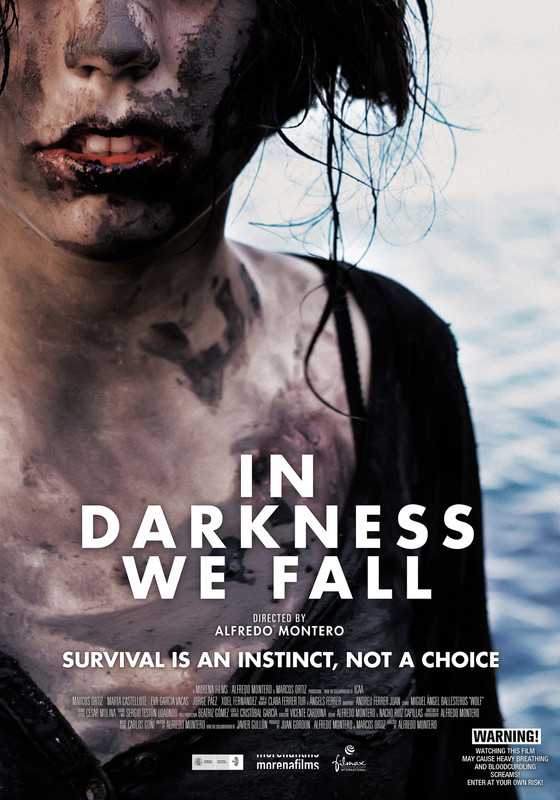
In Darkness We Fall
Dir: Alfredo Montero
It has always puzzled me why so many filmmakers seem to think that populating their horror movies with total arseholes is the way to get us to care whether the characters live or die.

In Darkness We Fall follows Carlos (arsehole who films absolutely everything all the time), Jaco (alpha-male arsehole), Ivan (arsehole who shags the girl he knows his friend has been after), Carlos' girlfriend Celia and her friend Bego on a camping trip.  One morning they decide to explore a cave.  They find themselves lost and things go from bad to worse while they are trapped.

For most of its first hour, In Darkness We Fall (a better title than the Spanish original: La Cueva) is annoying.  The characters aren't fun company and the group dynamic between them doesn't really work (especially in relation to Jaco, who'd go on holiday with that guy?)  That would be fine if they were interesting, but they aren't.  Writer/director Alfredo Montero is apparently operating a strict 1 trait per character limit.  So we follow these people who are largely stupid (because they leave no track behind them when exploring a cave) and unpleasant and watch on shaky found footage cam as they get lost and crawl around in circles.

The third act does herald the film's one would be interesting scene, in which there is a debate that has an interesting moral, and indeed practical, question at its heart and the horror of the situation is heavily ramped up.  But it's undermined by the fact that I don't care who lives or dies.  This is also true of the final setpiece, which, to be fair, has one very effective jump scare, but is also the film's most implausible moment.

For a film shot as found footage In Darkness We Fall doesn't look bad and the cave does have some atmosphere though the film is never, despite trying hard to be, as claustrophobic as The Descent.  In the end, In Darkness We Fall has the same problem as Open Water.  There I was rooting for the sharks, here I was rooting for the cave.

Apr 14, 2014

This Week We've Been Watching... April 7th - 13th 2014

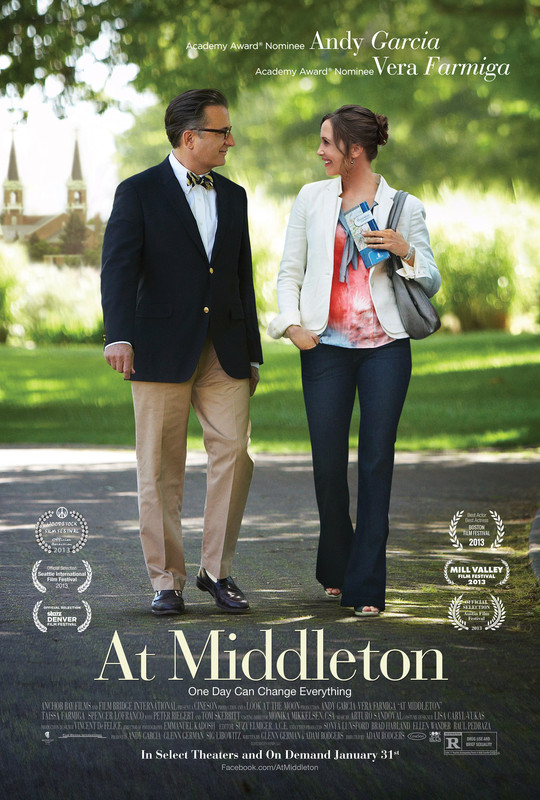
At Middleton
Dir: Adam Rogers
The romantic comedy has, of late, been in the doldrums as a genre.  It has largely descended into the act of watching people you hate make terrible jokes while falling into laughably unconvincing relationships with one another.  I was hoping that, given the participation of Vera Farmiga and Andy Garcia, At Middleton would break that mould.

Farmiga and Garcia each play parents bringing their children to an open day at Middleton college.  They meet early in the day, argue but then hit it off and end up separated from the tour group, spending the day getting to know each other and perhaps falling for each other.  For about an hour this has a level of charm about it.  Farmiga and Garcia are both fine actors and while they are saddled with rather cliché characters (Garcia the uptight Dad, Farmiga the free-spirited Mom) they spark off each other quite nicely.  The chemistry works and so do many of the jokes, especially a scene in which the two stumble into an acting class and end up improvising a scene.

The cuts back to the kids storyline (despite a decent performance from Tassia Farmiga, Vera's much younger sister, as her daughter) never generate much momentum and in the first hour they drain a bit of the energy that is being built up.  This becomes a much bigger problem as the film segues into its long third act.  At 100 minutes At Middleton could be cut by a fifth and lose very little.  The last 40 minutes drag out, especially in an interminable scene in which Garcia and Farmiga get stoned with a couple of college students only to end up shouting "The ballsack is life" over and over.  Remarkably this is not the worst line in the film.

Towards the end At Middleton also develops a sentimental streak a mile wide, which meant I stopped believing in the connection between these characters.  Worse, it provides the film with one of the most vomit inducing lines of 'romantic' dialogue since the ending of Four Weddings, as Farmiga turns to Garcia, whose character is a heart surgeon and says "I thought you fixed hearts".  As I said, Garcia and Farmiga are both very fine actors, but you can't expect anyone to make that line, nor quite a few of the others this script puts in their mouths, work.  They try hard, but the last third of the movie finds them increasingly defeated by the material.

At Middleton is actually one of the better American romantic comedies of recent years, but sadly that speaks to the catastrophic state of the genre more than it does the qualities of this film.

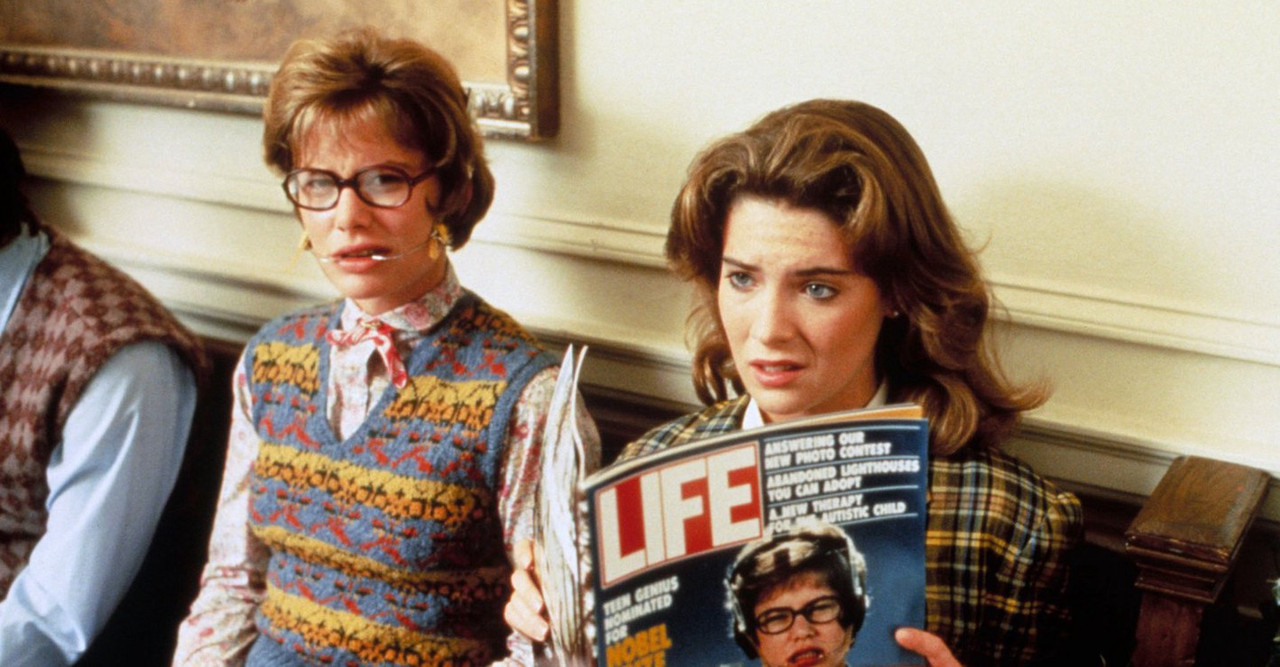
How I Got Into College
Dir: Savage Steve Holland
Savage Steve Holland is one of those filmmakers that I have always wished was given the opportunity to work more at feature length (since this film he has been plugging away in kids shows and TV movies), his anarchic take on the teen movie in Better Off Dead and One Crazy Summer marked him out as an individual voice in a scene that threatened to become stale, and this film is one with the same wonderfully skewed view of the world.

The plot is incredibly simple; High School senior Marlon (Corey Parker) is in love with Jessica Kailo (Lara Flynn Boyle) and his college plans revolve entirely around getting into the same school as her, as he's convinced that once she sees him as a grown up he might have a shot.  They're both trying to get into a small but prestigious school.  At the same time a young member of the admissions board (Anthony Edwards) is arguing that the school should look beyond grades when recruiting students.

Now, I understand that that doesn't sound that crazy, but it's not so much the structure as the approach that Holland takes to it that is so offbeat.  The surrealism begins from the first frames, with a question on Marlon's SAT's personified by two characters, A and B, who are endangered by Marlon's inability to get the right answer.  This is a comic device that just keeps on giving throughout the film.  How I Got Into College is not as fast with its jokes nor as incredibly odd as Better Off Dead, but it trades that off for a slightly more involved story, liberally sprinkled with gags (a running joke about the college admissions officer who accepted a fake application 'from' a pig is a particular joy).  

Corey Parker may not be the most charismatic of leading men, but his Marlon comes off as a likeable goof and a decent centre for the film's crazier moments to spin around.  Similarly, Lara Flynn Boyle is no Diane Franklin (though she appears briefly in a priceless bit as Marlon's young stepmother), but she's attractive and appealing enough to convince us that Marlon would want to follow Julie to college.  That story could be creepy, but by the end it has developed an essential sweetness.  As the college recruiter Anthony Edwards has that down to earth decency that has always served him so well on screen, as well as pretty spot on comic timing.  The rest of the cast are largely cameos, but everyone has enormous fun (watch for Better Off Dead's Curtis Armstrong in a typically offbeat moment).

How I Got Into College may not quite be the lost classic that Holland's debut is, but it's a wonderfully inventive, silly and often gut-bustingly funny film of the like you simply don't see anymore.  Seek it out.

Apr 1, 2011

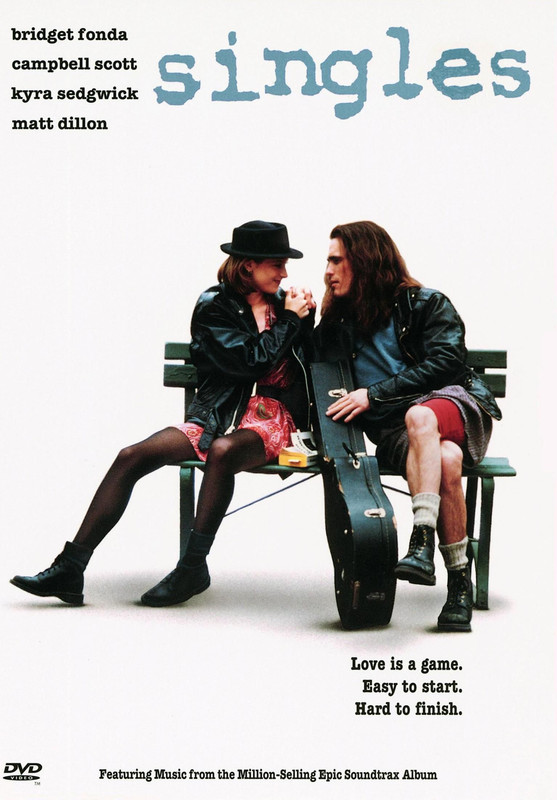
Bring Back Bridget Fonda: Singles [12]

Dir: Cameron Crowe
Cameron Crowe's second film as writer and director is a curious thing; it's so evocative of a specific time, yet it has ideas and moments that will resonate with any audience, even those born after the cultural context in which the film takes place had run its course. Nearly 20 years on from its release, and probably 15 years since I last saw it, Singles played not as dated but as nostalgic.

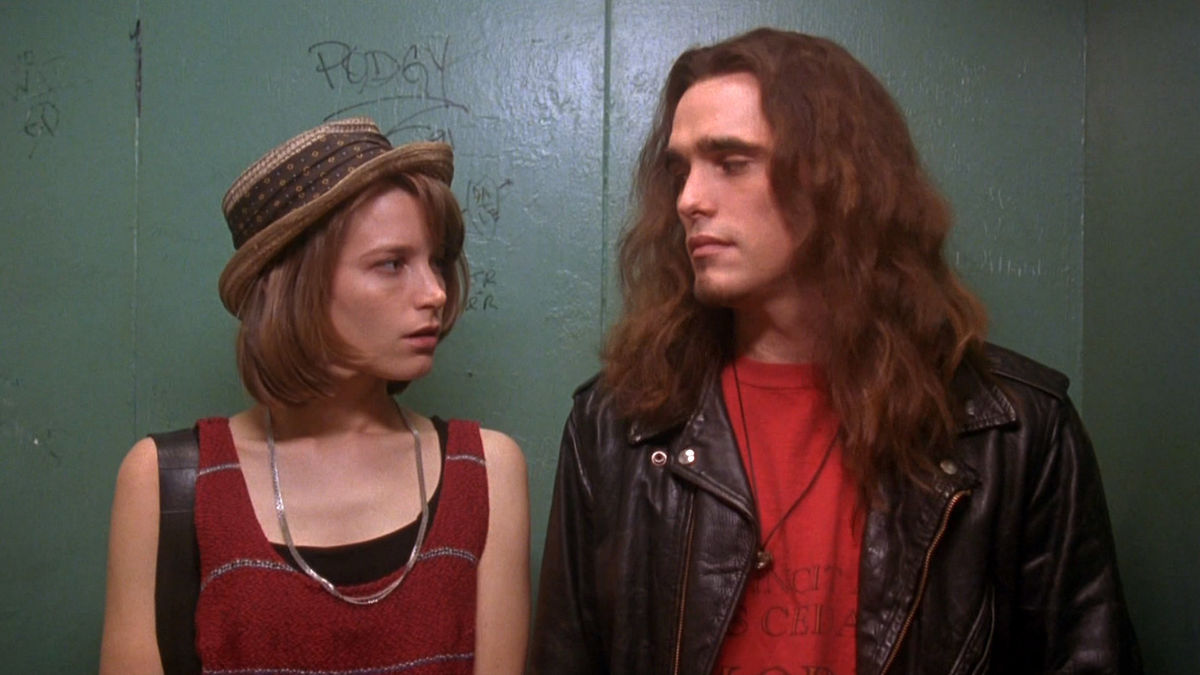
The film is set in an apartment complex - a set of 18 single units - in Seattle in the early 90's and charts the ups and downs of the relationships of the people living there. Among them are Steve (Campbell Scott), a yuppie with a looming important presentation; Janet (Bridget Fonda), a sweet girl so hopelessly in love with her musician boyfriend Cliff (Matt Dillon) that she's considering a breast enlargement so that he'll be more attracted to her and Debbie (Sheila Kelley), a brassy maneater who hires a director for her video dating ad. We also meet some people from outside the apartment complex, notably Linda (Kyra Sedgwick), who Steve meets at a concert and swiftly begins dating.

Singles is, like a lot of great films, about things that, in the grand scheme of events, are small, but which feel huge for the people living them. That's probably best expressed by Janet's story. Cameron Crowe's script paints her as a girl to whom the little things are terribly important; notably the moment that she realises that her insensitive boyfriend doesn't say 'bless you' when she sneezes. In other hands this might come off as twee but  Crowe writes her, and Bridget Fonda plays her, as a creature of simple sincerity, and rather than irksome she's adorable. At one point in the film, Campbell Scott's Steve says of a girl he's just met "If I had a personal conversation with God, would ask him to create this girl", and at a certain point I found it hard not to feel that about Janet. Obviously she looks like Bridget Fonda, which is a fine starting point, but what really makes her so lovable is the way she reacts at her lowest point. Even as she's deciding whether to have (totally unnecessary) breast surgery she sees that the surgeon accessing her, played by Bill Pullman, is feeling down, and she takes time to be kind and funny and sweet to him even at that moment. I love Janet, and I love Bridget Fonda's performance because you believe in that fundamental goodness she gives the character.

Fonda is not alone though, all the performances are excellent. In the lead Campbell Scott is quietly brilliant as Steve, who seems to mask real insecurity with outward self confidence, but, for the most part, do it well enough that people don't see the mask. It's a testament to how fine an actor Scott is that he's able to communicate this to the audience while credibly not letting other characters in. Along with Crowe he also crafts a guy who is desperate for connection, in a way that feels much more real to me now than when I last saw Singles aged 15. It's both sad and funny how recognisable Steve is. Matt Dillon has done a lot of nice work over the years, but when somebody says his name to me the first thing that always comes to mind is Cliff Poncier; stuck up singer of middling grunge band Citizen Dick (who are filled out by members of Pearl Jam). He's incredibly slappable in the role, largely because the girlfriend he's so inattentive to is the adorable Janet, but again, though it's a smallish part, Cliff isn't a caricature, Crowe's script begins, late in the day, to peel back this guy's layers and show the slow process of his realisation of how he's behaved, and of course up to that point Cliff's always good for a laugh, especially when he's talking about the title of his band's signature song 'Touch me I'm Dick' to a journalist played by Crowe.

The film's women fare slightly less well, with Kyra Sedgwick (another in this films veritable parade of underrated actors) has perhaps the least defined character, which is odd given that she's really the female lead, Crowe's written an independent 90's woman here, who isn't sure if she wants commitment, or even a relationship, when she falls into something serious with Steve, but she's not very specific, feeling more of a type than a really rounded character. Her flipside is Debbie; Sheila Kelley's hilarious, orange haired, man hungry caricature. She's a cartoon, but Kelley plays the cartoon to perfection, never more so than in her dating video, and while Debbie isn't terribly real she's certainly a good deal of fun.

One of the defining features of all of Crowe's movies is the use of music (from the sublime moment with In Your Eyes in Say Anything to the ridiculous road trip soundtrack in Elizabethtown). Singles doesn't have a single iconic musical moment, but weaves the Seattle grunge scene through the movie as the characters experience it; as the soundtrack of their lives. It meant little to me last time I saw the film, because music only became a big part of my life in my 20's, but on this viewing it leaped out at me how the music - both the songs and the score by Paul Westerberg - becomes a character, tying the people and the setting together. If you're informed about the scene there are also a lot of treats scattered through the film in the form of cameos from the aforementioned Pearl Jam, to Alice in Chains playing in a dingy club, to Chris Cornell (of Soundgarden) as a friend of Cliff's and probably more I didn't spot. Speaking, by the way, of cameos, Singles is packed with 'it's that guy' moments, all of which are fun; Paul Giamatti has one line, Jeremy Piven and Eric Stoltz have one scene each, Tim Burton plays the director of Debbie's dating video and Bill Pullman is notable as Janet's smitten plastic surgeon.

The main thing I really liked about Singles this time was the tone. It's reflective, but never melancholy. It's funny, but never knockabout or silly. It's serious, but never solemn. The dialogue, in typical Crowe style, is specific, smart, sharp and witty (Janet: "People need people, Steve. It has nothing to do with sex. OK, maybe 40 percent. 60 percent. Forget it.") I also like its untidiness, Crowe isn't afraid to let the loose ends hang as the credits roll, we get a sense of where things might go, but this isn't a biography, it's a glimpse of a few months in a few people's lives, and that means that things aren't neat, because things aren't over. It would be interesting, I think, to revisit these characters, to find out who they are in their mid 40's, whether they still know each other, if Janet's still so sweet, if Cliff's still making music, to me, that would be far more interesting than Thor 2, or Ice Age 4.
★★★★☆

Mar 25, 2011

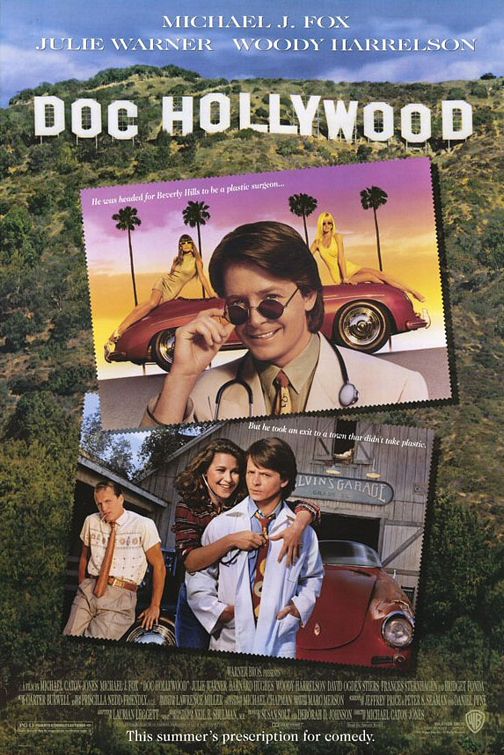
Bring Back Bridget Fonda: Doc Hollywood [12]

Dir: Michael Caton Jones
It's a strange film to have an attachment to, but I will always have a bit of a soft spot for Doc Hollywood, if only because it was where I first saw breasts. Thanks, Julie Warner. Memorable moments for an eleven-year-old aside, however, the film does have other things going for it.

This is a Capraesque tale of a young surgeon (Fox) who is waylaid on his way to a big plastic surgery job interview in LA when he crashes his car, demolishing the fence of a small town judge. He's sentenced to community service as the town's doctor, and immediately all the residents begin working to try to ensure that he stays there. There's a romance with the local ambulance driver (Warner) and a flirtation with the Mayor's daughter (Fonda) makes one of the locals (Harrelson) very jealous.

Doc Hollywood is gently funny and doesn't lack for charm, but it's hard to shake the feeling that it's a little empty. Michael J. Fox was never the world's best actor, but he can be magnetic, unfortunately, he's not great here, he's a little miscast as a soon to be high-flying doctor who is more than a bit of an asshole, but worse he just seems to be coasting here, and the growing relationship between him and Julie Warner - who is perfectly good as Lou the ambulance driver, but is outshone by another performance we'll come to - never really convinces.

What works better is the depiction of this bible belt town and its inhabitants. The script and direction poke gentle fun, never pretending that this depiction of Grady is of a real place as much as it is of a romantic cinematic vision of a small town. Though the characterisations are broad, outside of the rather drippy main story, everyone is having fun. David Ogden Stiers is blustery and funny as the mayor desperate to keep this new doctor in town, while Woody Harrelson does his patented 'amusingly dim, while a side of menace' thing to perfection.

Bridget Fonda reunites with director Michael Caton-Jones, who gave her a big break in Scandal two years before. Here she plays the mayor's flirty and oversexed daughter, who wants Fox to take her away from the provincial life to the bright lights of LA (and this, for me, is where the story strains credulity, because really, who could resist?) It would have been easy for this role to have been played as no more than a punchline, but as ever Fonda invests her character with a real spark, she's effortlessly likeable, and that as much as her beauty makes her a much more interesting potential match than Warner. Saddled with a thankless role, Fonda makes much more of it than was likely on the page, it's both one of the film's greater qualities and eventually one of its greater failings.

You'd be hard-pressed to dislike Doc Hollywood, it's too amiable for that, and for all its problem it is frequently funny, and its gentle charm does end up rubbing off on you, even if, at the end of the day, you know it's not especially brilliant.
★★★☆☆

Feb 23, 2011

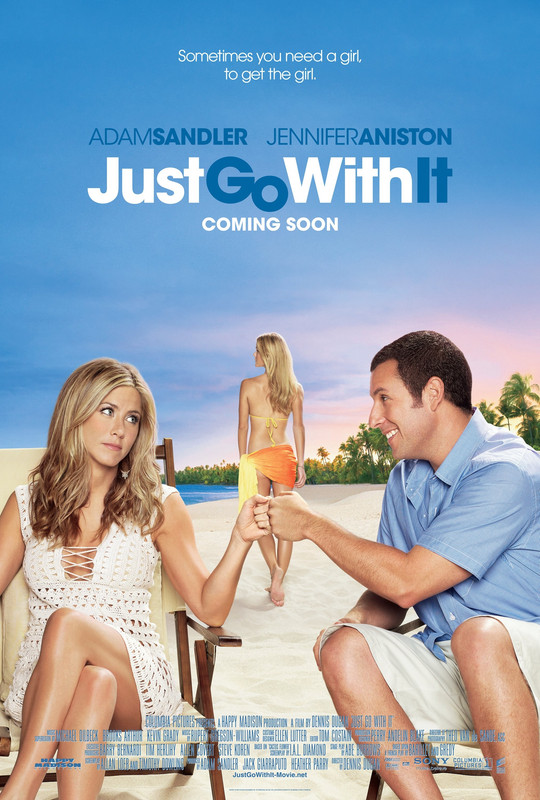
Just Go With It [12A]

Dir: Dennis Dugan
I've mentioned before, I think, how much I love my job, and I mean it. I get to watch movies, talk about movies and write about movies and call it work, which it barely is. Except on days that I end up sitting through the likes of Just Go With It, a film so hideous that it undermines, if only briefly, not just my faith in cinema but my faith in humanity as a whole.

Just Go With It is another in the long recent lines of so called romantic comedies which are neither romantic nor funny, and whose main characters, whose relationships we are supposed to be interested in, are among the top 8 percent of the planet's most loathsome non-genocidal people. Adam Sandler (never a good start) plays a plastic surgeon (remarkably this is not the joke) who, after being jilted, wears a fake wedding ring in order to seduce a succession of young women who he never has to call again - RELATEABLE! NOT AT ALL DESPICABLE! Only, guess what, he's fallen for latest one (played by the lovely Brooklyn Decker, who somehow escapes this stinkbomb with a smidgen of dignity). Anyway, she thinks Sandler's married, so he has to get his receptionist (Jennifer Aniston, more entirely plausible casting there) to pose as the wife he's divorcing, and her children to pose as their children. 'Laughs' ensue.

I despise the characters in this film. I hate Sandler's character, yes we've all exaggerated things about ourselves to get close to people we're attracted to, but this guy's entire life is a tissue of lies. Then there's the fact that he's perfectly happy to bribe others into perpetrating this colossal fountain of bullshit with him (all, let's remember, so he can fuck a woman 20 years his junior who thinks he, and everyone in his life, is someone else entirely). The relationship that Sandler's character has with Aniston's children is also troubling; the whole premise of what he involves them in is mentally abusive, and there are a few incidents too where his behaviour comes close to crossing the line into physical abuse - child endangerment; LOL.

Aniston's character is painted as the point of identification for the film's female audience, yet she's just as bad. Not only does she go along with this plan, and her children's participation in it, but she also ends up inventing one of her own when her old college rival (played by Nicole Kidman, demonstrating the comic grace and timing of a smashed cuckoo clock) also happens to be in Hawaii at the same time as Sandler, herself, 'their' kids, Decker and Nick Swardson as  Sandler's cousin (pretending to be Aniston's new German boyfriend - something else she goes along with) are there. It might not be so unbearable sitting through this turgid load of old shit if Sandler and Aniston demonstrated even a scintilla of magnetism, charm or chemistry, but they don't. I don't believe that they even like each other, not least, in Aniston's case, because the script gives her no reason to like Sandler.

This is also a problem when it comes to Brooklyn Decker's character. Decker, a model, works hard in her first substantial role, and she comes off okay; she's great to look at and if the script weren't so fundamentally broken she might be somewhat engaging on screen. Unfortunately... Decker and Sandler have the chemistry of oil and water (best evidenced by the extremely small amount of actual contact they share in the film) and, again, the script gives no reason for these two to be so drawn to each other. They have less than nothing in common, and yet the script insists they are in love, as if it were magic fucking fairy dust that got sprinkled on them (actually, that makes MORE sense than the idea that these people are organically attracted to one another). Of course Decker's character doesn't matter anyway (hence the lack of personality beyond a slightly simpering niceness and a parade of late 90s pop culture jokes - take THAT, 12 years ago!) and as soon as the laughably unconvincing romance between Sandler and Aniston starts brewing she's shunted aside like the magnificently breasted macguffin she is.

The jokes just depress me. Pratfalls, 'funny' accents (including one that pretty much destroys the performance of the usually excellent child actress Bailee Madison) and the expected parade of non-sequiturs and gross out bits (how is it that in less than a year I've seen two movies with a 'comic' set piece revolving around one person shitting in another person's hand?) all make their dreaded regularly scheduled appearances with both the predictability and the comedic effect of a metronome.

Every time I see a film like Just Go With It (a title, or what Dugan said to Sandler about the script?) I die a little inside, because I remember that romantic comedy used to mean The Philadelphia Story, or Sabrina, or When Harry Met Sally, or Say Anything... and now it's not so much a genre as it is a pit into which Hollywood vomits all the worst jokes from decades worth of chewed up scripts, before pouring the resulting slop into 100 minute moulds and excreting them monthly into cinemas. Yeah, sometimes I hate my job.
★☆☆☆☆

Feb 1, 2009

Nick and Norah's Infinite Playlist [12A]

Dir: Peter Sollet
Cool. Some people are simply cool, I’m not one of them, but I know this much, trying to be cool only demonstrates, and ensures, that you aren’t. Nick and Norah’s Infinite Playlist would have done well to learn that lesson, because for its entire 90 minute running time it strives desperately to be cool, only to end up underlining how utterly unremarkable it really is.

The story is breathtakingly simple. Nick (Michael Cera) was dumped by his girlfriend (Alexis Dziena) a month ago, and his bandmates (Aaron Yoo and Rafi Gavron) are sick of him being depressed so when Nick meets Norah (Kat Dennings) after his gig his friends contrive to get them to spend the night together in New York. It’s Before Sunrise for indie kids, only not very good.

The main problem with Nick and Norah’s Infinite Playlist is how completely contrived it all feels. The main characters first meeting, for example, has Dennings simply walking up to a random guy to kiss him, proving to Dziena that she has a boyfriend and, guess what, she happens to pick on Cera, Dziena’s ex. Yes, the ‘meet cute’ is always contrived, but this one especially so. It doesn’t help that there is no chemistry between Cera and Dennings whatsoever, be it romantic or comic. Both have shown themselves to be capable and charming comedians before, but here they flounder, and rather than spark off one another they end up dampening down both the humour and the romance.

The other big issue with the leading performances is their familiarity. Cera has now played the same nerdy stereotype in three films on the trot (Superbad, Juno, and this), while Dennings gives the exact same performance she did in both The 40 Year Old Virgin and Charlie Bartlett. There is nothing terribly wrong with the acting (though Dennings’ nasal voice is an irritant), except that we’ve seen them both before, recently, and better.

The Infinite Playlist of the title is provided by an endless array of indie bands, whose music underscores every scene. Director Peter Sollet doesn’t have much idea how to use the music, so he leans on it as a crutch, letting the soundtrack tell us how to feel. In its quest for cool points the film also shoehorns in awkward cameos for the band Bishop Allen and Devendra Banhart. The one smart musical decision the film makes is that it never shows us the band that Cera, Dennings and their friends spend the whole night trying to find. Where’s Fluffy? (which, by the way, almost beats It Hugs Back for the title of worst band name of all time) would have to have the messiah on vocals to be even half as good as the film implies, so it’s a relief we never see them.

The film unfolds exactly as you’d expect. They meet, they don’t like each other, then they like each other, then they have an incredibly forced falling out, then they like each other again. It’s just so rote, but the problem isn’t that it’s rote, it’s that it’s utterly unconvincing. The fact there’s no connection between the actors means the relationship never works, and you never care if Nick and Norah hit it off, rather you wish they’d just hurry up and kiss so that the music can swell on the soundtrack and you can leave.

There are a handful of good lines, but Cera and Dennings’ monotonous performances never really sell them, but Ari Graynor does well in a thankless role as Dennings’ drunk friend, and Aaron Yoo and Rafi Gavron manage not to make their gay characters mere stereotypes. But these are small victories in a film that fails to work as a whole.
★★