Showing posts with label South Korea. Show all posts

Oct 9, 2017

24FPS @ LFF 2017: Short(ish) reviews.

Little Crusader
Dir: Václav Kadrnka

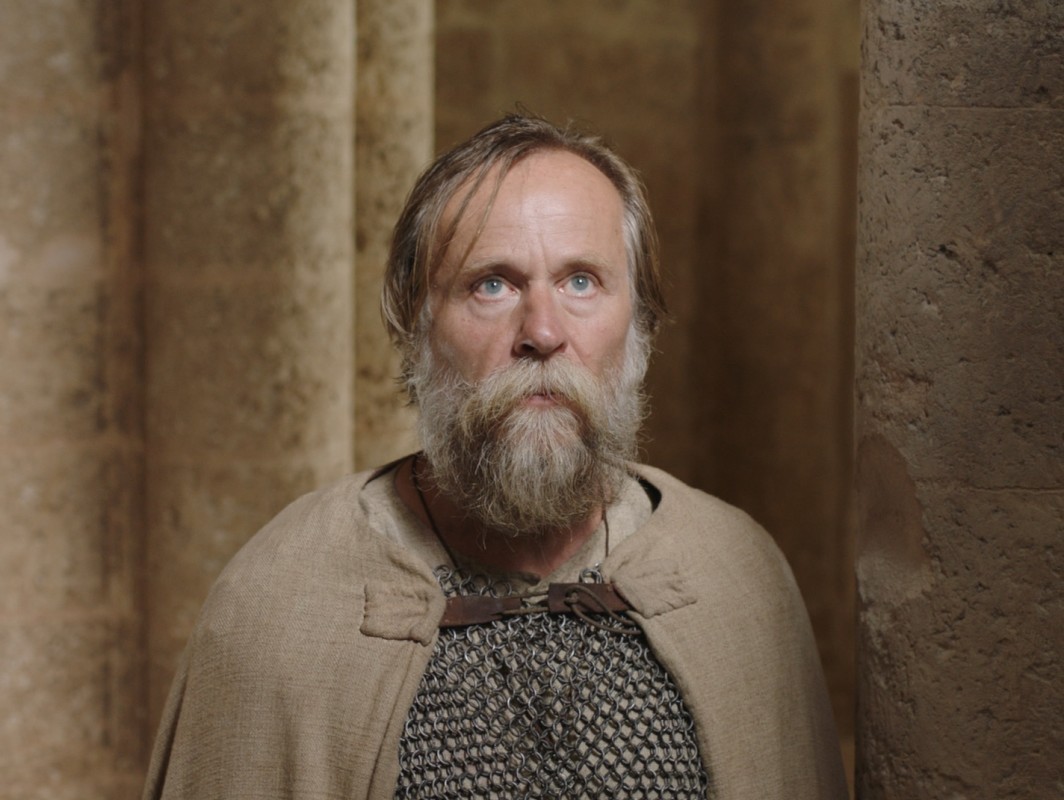
Set during the crusades, Little Crusader follows Borek (Karel Roden) on a near silent quest to find his young son (Matous John), who has run away and apparently vanished into the war.

The film opens with a silent ten minute sequence following the young boy. He puts on his tiny armoured breastplate, hangs his sword on his belt and moves around the castle where he lives and the surrounding area, before lowering the drawbridge to let two men in and walking off on his own. This sequence has some of the film’s most arresting images, not least the first, as an expanse of white gives way to show a Knight walking towards the camera. At first I thought this white was snow, but it turns out to be a pair of curtains, the crack between them flapping in the light breeze.

The film is stunningly composed throughout, with Vaclav Kadrnka making striking use of the 4:3 frame, particularly in long held shots. In one of these we see Borek finally arrive in the thick of the Crusades. In one unbroken shot he marches across the desert, cutting down one enemy after another. Another especially memorable long take has the medallion belonging to Borek’s son passed through what seems like an unending parade of children’s hands, searching for its owner. These and other shots do a hugely effective job of communicating the film’s story through pure imagery. The other notable thing about the imagery here is how incredibly textured it is. Every detail - hair, tree bark, the blades of swords, the fabric of a boat’s sail, feels like you could reach out and touch it. I don’t know how the film was shot, but if it’s digital then it’s some of the most detail rich digital I’ve seen.

The problem is, simple as the film is and short as its running time may be, I’m not sure it’s much other than stunning looking. In the first ten minutes we develop an attachment to Borek’s son and not seeing his side of this story seems a shame. The film is gorgeous, but emotionally it kept me a little distant. Still, if you’re fond of slow cinema, of following a character on a very literal journey, Little Crusader has some great rewards in store.
★★★½

Memoir Of A Murderer
Dir: Won Shin-yun
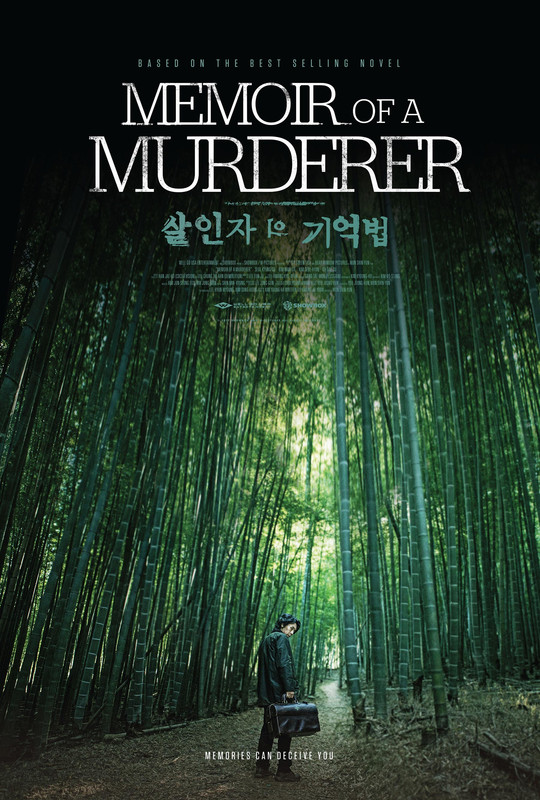
It’s always useful to have a high concept, a brief logline that can tell a film’s potential audience what they’re in for. Whatever else you think of Memoir of a Murderer, you have to admit that ‘Memento, but with two serial killers, one of whom has dementia’ is a hell of a high concept.

Buyng-su (Kyung-gu Sol) has recently been diagnosed with alzheimer's, possibly as part of the after effects of a car accident 17 years ago. As his memory begins to go, two things remain: his love for his daughter Eun-hee (Seol-Hyun Kim) and his sense memory, the reflexes honed in a career as a serial killer, which ended the day of the accident. When he’s involved in another accident Byung-su comes to believe that the other driver, Tae-ju (Nam-gil Kim) is an active serial killer of young girls. Unfortunately Tae-ju is a cop, and Eun-hee’s boyfriend.

Memoir of a Murderer uses its killer hook to fine effect for most of the running time. Kyung-gu Sol pitches his performance as Byung-su expertly, vacillating between making the character a somewhat pitiable old man struggling with a disease and allowing us glimpses of the organised serial killer who says he only killed ‘bad’ people but, one suspects, is simply self-justifying. The film unpacks the facts about Byung-su, who is by his nature as both a serial murderer and a dementia sufferer a deeply unreliable narrator with patience, managing to land most of its twists as true surprises. Equally good is Nam-gil Kim, whose performance becomes ever more gleeful as he realises that he can let his true nature slip in front of Byung-su, because he’ll soon forget anyway.

Won Shin-yun balances tone well, undercutting the horror with some very black humour. As the film ramps up to its most operatic moments towards the end, it also hits on the best comedic use of Byung-su’s memory problems coming suddenly into play, combining a laugh and a scare in one moment. Won, however, isn’t a stylist on the level of a Park Chan-wook or a Kim Jee-woon and though the film has an effectively cold style and is well shot throughout, it’s not exactly shot through with personality. At just a shade under two hours, the pace flags a few times and the ending, in particular, could probably be tightened, which would also mean the film could pull back on some overblown moments that, for me, slightly sour the effective chill of the rest of the film.

Memoir of a Murderer is an entertaining ride, a little bumpy at times, but it’s got some thrills, some chills and more than a few guilty laughs. It’s worth a look.
★★★

Sep 30, 2014

24FPS @ LFF 2014: 29/9

Kelly And Cal
Dir: Jen McGowan
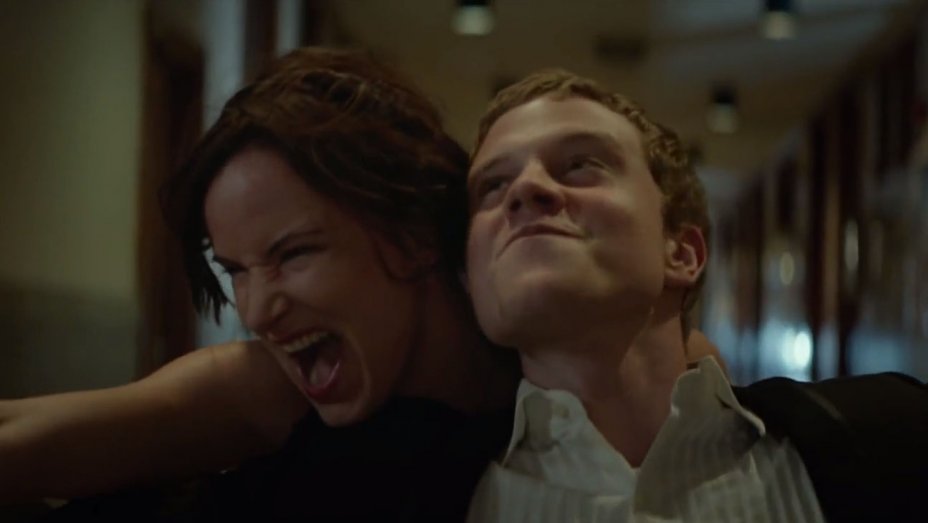
Casting is a strange sort of alchemy.  Sometimes you can imagine all sorts of alternatives in roles, other times, there seems only to be one correct choice for a part, and that's very much the case with Juliette Lewis in Kelly And Cal.  It's tough to imagine any actress in Hollywood better suited to the part of a former riot grrrl turned suburban housewife in her late 30's, struggling with a new baby, distant from her husband, who finds a connection with a disabled teenager (Cal, played by Jonny Weston) who lives next door.  This connection leads to trouble when Cal falls for Kelly and begins acting out.

Juliette Lewis is one of those actresses whose talent has often outstripped her roles, it's been too long since we've seen her in a lead, with a part she can get her teeth into.  She has that in Kelly, and she grabs it with both hands.  Lewis' offscreen persona plays into the part.  There has always been an edge to Lewis, it has been seen in dangerous roles (most notably Natural Born Killers), but latterly she has channeled it into fronting a rock band, and this gives an authenticity to Kelly's past.  The little we hear of Kelly's former band, Wetnap, is good and Lewis is clearly doing the vocals, which lends a multi-layered energy to the scene where she first plays their tape for Cal.  This energy also allows us to buy in to why Kelly is drawn to Cal.  He's rude and surly, but she seems to recognise a little of the rebellious streak that she has had to mute in herself, and perhaps the chance to recapture it in some small way.  Lewis is also very good at playing Kelly's struggles with being a new parent (she may even have post-natal depression, though the film never comes out and says that).  It's easy to read and to sympathise with her frustrations and Lewis carries herself with a weariness common to most new parents.

Jonny Weston is also good as Cal, but he's not quite up to some of the dramatic challenges posed by Cal's more extreme acting out towards the end of the film (this is also partly the fault of Amy Lowe Starbin's screenplay).  In the first two acts Weston impresses, making Cal's bluntness understandable and his fumbling, obvious, crush on Kelly just the right side of charming rather than creepy.  In one of the film's best sequences he takes her on a surprise date, a sort of replacement for her rubbish prom of 20 years ago and the one he won't be attending.  It's cheesy in just the right way; you can believe this earnest kid trying to impress Kelly this way.  It also has the film's biggest laugh, if you're old enough to remember a certain song from the first time round.

Unfortunately the film never matches up to these performances and begins to collapse around them come the third act.  The other characters (Kelly's solidly decent husband, her stereotypically interfering mother in law and sister in law) are lightly sketched and feel more like dramatic props than real people.  This also begins to sneak in to the writing of Cal, whose personality switches quite dramatically after his and Kelly's 'date'.  This all conspires, along with director Jen McGowan's competent but rather unexciting visuals, to make Kelly and Cal less than it could be.  It's a strong showcase for Juliette Lewis and it's great to see her back, front and centre of a film, but the film itself ends up being quite forgettable.
★★★

El Niño
Dir: Daniel Monzon
How many films have you seen where a driven cop has been going after bringing down a target for years and knows he has one last shot, or he's going to get fired?  How many films have you seen where a young upstart criminal (who's not so bad really, all he wants is some startup cash so he can sail off into the sunset with his girlfriend), gets caught between that cop and his target?  Yes, I've seen about 200 of those as well.  Here's another.  It's in Spanish this time.

El Niño isn't a terrible film.  It's got a solid cast.  The cops are led by Luis Tosar; as forceful and no bullshit as ever, anchoring the movie with his down to earth grit and his boss is played by Sergi Lopez, clearly not stretched here, but still one of Spanish cinema's most reliable talents.  Equally decent work is put in by Barbara Lennie as Tosar's partner and Jesus Castro, Jesus Carroza and Saed Chatiby as the three young small-timers caught between a cop and a hard place.  These performances basically sum up the movie; they are all technically decent, but there's nothing terribly exciting, nothing new, in any of them.

Daniel Monzon and co-writer Jorge Guerricaechevarría  could use some work on their pacing.  After a strong opening that introduces Tosar's Jesus and his driving ambition to bring down this drug dealer Monzon allows him to vanish for some time as he sets up the three young dealers.  This would be fine, except that every beat is so hackneyed, so utterly standard, that it feels like being shown the Cliff Notes on lazy character development for half an hour rather than being introduced to three distinctive characters.

When Monzon starts to draw the stories back together and to inject a little more pace and action into the narrative, El Niño does briefly catch light, particularly with a chase between a boat and a helicopter which ends with a pretty spectacular underwater sequence.  This feels like, and probably should be, the climax, but Monzon drags his feet, bolting on another 40 minutes of padding, taking what might have been a bog standard but inoffensive 95 minute film to a bloated and wheezing 135 minutes of creaky cliché.

I'm quite surprised to see this film in the festival.  It's a barely competent genre exercise, the fact it's not in English doesn't change that.
★★

A Girl At My Door [This review was previously published during Cannes]
Dir: July Jung
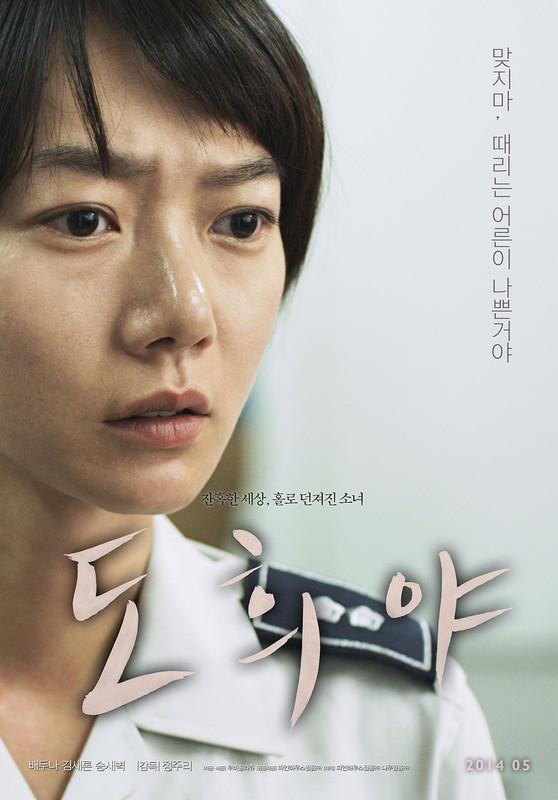
Like many fans of South Korean cinema I have, over the past decade, been charmed and impressed by Bae Doo-Na, who is one of the biggest stars in her home country.  It is fair to say, however, that Bae has a rather set onscreen persona; playing the charming, slightly kooky ingenue in many of her films.  That's no bad thing, I've frequently compared Bae's onscreen charm and magnetism with that of Audrey Hepburn, which isn't something I do lightly.  However, A Girl At My Door (Dohee-ya in Korean) seems to mark a real shift.  At 34 Bae seems to be wanting to finally play a real grown up and this often tough drama offers her that chance.

Bae plays Young-Nam, as the film begins she is moving to a small town to become their Police chief.  There are hints throughout the first half of the film that this is because of a problem in her past, which saw her sent away from Seoul.  When she arrives Young-Nam soon meets 13 year old Do-Hee (Kim Sae-Ron), who is picked on by the local kids and abused by both her father Yong-Ha (Song Sae-Byeok) and her grandmother.  Doo-Hee becomes very attached to Young-Nam and, after an especially bad beating, Young-Nam takes the young girl in.  This causes tension in the town, especially when Young-Nam's past comes home to roost.

A Girl At My Door, with its non-descript title and (relatively) lighter first hour, managed to trick me when it came to what kind of film it would be.  For ten minutes at the beginning we might be about to watch a fish out of water comedy about a big city cop coming to a backwater.  Then there is a turn for the dramatic as Young-Nam's problem drinking is revealed, but as the story between her and Do-Hee takes centre stage it seems as though we're actually going to be seeing a film about how an unexpected surrogate parent comes into the life of a troubled kid.  None of these ideas is especially original, and nor, really, is the direction of the film's third act, but the way that writer/director Jung manages to continually set us up for one thing before turning in a slightly different direction keeps things interesting and works to the film's advantage.

Towards the start and the end of the film, Jung slathers on the abuse just a little hard, it's not that graphic until one late scene that I'm surprised she even got away with a clear implication of, but it comes up so regularly at times that there is a slight tragedy porn feeling.  What saves the film in these moments, as well as from a rather OTT performance from Song Sae-Byeok, is the fact that the two leads are outstanding.

Bae seems to have made a conscious choice here to shift her image and while Song spends most of his scenes yelling abuse at whoever he's sharing the screen with at that moment, she dials everything back for a reserved performance that is sometimes resolved and sometimes porcelain fragile.  There is no coasting on her looks and her charm here, even as Young-Nam comes to care for Do-Hee there is a sense that the older woman is putting up a wall (why she may be doing so is another of the interesting shifts in the film).  Throughout, Bae does some wonderfully subtle physical acting, whether it's to do with Young-Nam's relationship to Do-Hee or to alcohol.  We see the complexities etched in particularly fine detail in what emerges as one of the film's key scenes, when Do-Hee asks if she can get in the bath with Young-Nam.

Bae might simply have walked off with the movie thanks to her performance, but 13 year old Kim Sae-Ron, who may be known to western audiences as the little girl in The Man From Nowhere, gives her a serious run for her money and establishes herself as an actress to keep an eye on as she and her roles mature.  What Kim manages to capture with great clarity here is the sense of a child suddenly growing up very quickly, perhaps thanks to a new influence in her life, perhaps due to the temporary absence of an old one.Jung's screenplay and Kim's performance both advance Do-Hee's character and her process of growth incrementally.  It's incremental enough that it's not that noticeable from one scene to the next, but it's credible that she changes as much as she does.  There is also a sense, which towards the end of the film another character also gets, that there is something underlying the broken exterior of the Do-Hee we first meet, and this is something that Kim puts across subtly but strongly.  All in all  it's a remarkably nuanced piece of acting for such a young performer.

While this is a creditable feature debut for July Jung there are still a few cracks that make it feel like a debut.  Visually the film is strong, and even if it doesn't yet speak to a deeply personal eye it has several very striking images (a repeated motif of Do-Hee dancing outside, for example).  The screenplay can be more problematic.  For instance, Young-Nam's drinking feels like it should be a major theme, but it is largely shunted aside; serving mostly as a misdirection early on.  Also problematic is the fact that when, with about 35 minutes to run, the film takes a not entirely unexpected turn into very dark territory it doesn't quite have the courage of its convictions.  This means that it strains credulity more than a little in both the speed and the ease with which it finds its ending.  It's not ruinous, but it's less complex than I'd like, given the preceding 100 minutes.

Overall, A Girl At My Door has its flaws, but when it concentrates on its two central performances it absolutely commands the attention and it's well worth seeing, especially for fans of Bae Doo-Na who want to see her branch out.
★★★

Sep 22, 2014

24FPS @ LFF 2014: The Satellite Girl and Milk Cow

Dir: Chang Hyung-yun
One of the problems with being a film critic is that, quite often, it can feel like we've seen it all.  And here we go again... just one more story about a broken down satellite that turns into a girl when it hears a young man singing.  Falling to Earth, she finds the young man, who, broken hearted, has been turned in to a cow.  Together, along with a wizard who has been turned into a magical roll of embossed toilet paper, they must evade a sentient monster incinerator and a man with a magical plunger who wants to steal the cow's liver.  

You know.  That old story.

The Satellite Girl and Milk Cow is a film as odd as its title, and that's where it draws a lot of its fun from.  You could call it a fish out of water comedy, with Il-ho (the satellite) taking human form and having to learn how to deal both with interacting on Earth and with the complicated reality of human emotion, both hers and Kyung-chun's (the cow).  There are plenty of laughs to be had in this side of the film and while many of them (Il-ho breaking down when she eats some of Kyung-chun's grass, for instance) are designed to appeal to young kids, they're also likely to make parents laugh.  Merlin, the wizard turned into a luxuriously soft roll of embossed toilet paper, is an especially reliable source of laughs.  The film seldom uses him for toilet humour, instead getting laughs by juxtaposing what he looks like with his very serious and forceful personality.

The film also has a poignancy about it.  This isn't always its strongest suit, but to the film's credit there is a sincerity to the way it wears its emotion on its sleeve, and it can be forgiven for feeling a little rushed and simplistic given that it is pitching at 8 year olds.  That said, you would have to be a hard person indeed for the shifting relationship between Il-ho and Kyung-chun not to tug your heartstrings even a little bit.

The animation here is good, somewhat Miyazaki inflected, but not quite up to those technical standards, nor can it quite match the deft mix of brilliant animation and emotion in the films of Makoto Shinkai or Mamoru Hosoda.  However, the character design is engaging and appealing, and director Chang Hyung-yun finds many funny and moving images throughout the film, particularly as it comes to a crescendo in the last ten minutes.

The Satellite Girl and Milk Cow is ultimately a bit lightweight for an adult audience, it suffers, a couple of times, from going for a musical montage over a more complex emotional payoff.  It should delight its target audience though, and if you do take your kids to see it you will be rewarded with a fun, silly, strange film that, at the very least, will tell you a story you haven't heard before.
★★★

May 23, 2014

Cannes 2014: A Girl At My Door

 Dir: July Jung
Like many fans of South Korean cinema I have, over the past decade, been charmed and impressed by Bae Doo-Na, who is one of the biggest stars in her home country.  It is fair to say, however, that Bae has a rather set onscreen persona; playing the charming, slightly kooky ingenue in many of her films.  That's no bad thing, I've frequently compared Bae's onscreen charm and magnetism with that of Audrey Hepburn, which isn't something I do lightly.  However, A Girl At My Door (Dohee-ya in Korean) seems to mark a real shift.  At 34 Bae seems to be wanting to finally play a real grown up and this often tough drama offers her that chance.

Bae plays Young-Nam, as the film begins she is moving to a small town to become their Police chief.  There are hints throughout the first half of the film that this is because of a problem in her past, which saw her sent away from Seoul.  When she arrives Young-Nam soon meets 13 year old Do-Hee (Kim Sae-Ron), who is picked on by the local kids and abused by both her father Yong-Ha (Song Sae-Byeok) and her grandmother.  Doo-Hee becomes very attached to Young-Nam and, after an especially bad beating, Young-Nam takes the young girl in.  This causes tension in the town, especially when Young-Nam's past comes home to roost.

A Girl At My Door, with its non-descript title and (relatively) lighter first hour, managed to trick me when it came to what kind of film it would be.  For ten minutes at the beginning we might be about to watch a fish out of water comedy about a big city cop coming to a backwater.  Then there is a turn for the dramatic as Young-Nam's problem drinking is revealed, but as the story between her and Do-Hee takes centre stage it seems as though we're actually going to be seeing a film about how an unexpected surrogate parent comes into the life of a troubled kid.  None of these ideas is especially original, and nor, really, is the direction of the film's third act, but the way that writer/director Jung manages to continually set us up for one thing before turning in a slightly different direction keeps things interesting and works to the film's advantage.

Towards the start and the end of the film, Jung slathers on the abuse just a little hard, it's not that graphic until one late scene that I'm surprised she even got away with a clear implication of, but it comes up so regularly at times that there is a slight tragedy porn feeling.  What saves the film in these moments, as well as from a rather OTT performance from Song Sae-Byeok, is the fact that the two leads are outstanding.

Bae seems to have made a conscious choice here to shift her image and while Song spends most of his scenes yelling abuse at whoever he's sharing the screen with at that moment, she dials everything back for a reserved performance that is sometimes resolved and sometimes porcelain fragile.  There is no coasting on her looks and her charm here, even as Young-Nam comes to care for Do-Hee there is a sense that the older woman is putting up a wall (why she may be doing so is another of the interesting shifts in the film).  Throughout, Bae does some wonderfully subtle physical acting, whether it's to do with Young-Nam's relationship to Do-Hee or to alcohol.  We see the complexities etched in particularly fine detail in what emerges as one of the film's key scenes, when Do-Hee asks if she can get in the bath with Young-Nam.

Bae might simply have walked off with the movie thanks to her performance, but 13 year old Kim Sae-Ron, who may be known to western audiences as the little girl in The Man From Nowehere, gives her a serious run for her money and establishes herself as an actress to keep an eye on as she and her roles mature.  What Kim manages to capture with great clarity here is the sense of a child suddenly growing up very quickly, perhaps thanks to a new influence in her life, perhaps due to the temporary absence of an old one.Jung's screenplay and Kim's performance both advance Do-Hee's character and her process of growth incrementally.  It's incremental enough that it's not that noticeable from one scene to the next, but it's credible that she changes as much as she does.  There is also a sense, which towards the end of the film another character also gets, that there is something underlying the broken exterior of the Do-Hee we first meet, and this is something that Kim puts across subtly but strongly.  All in all  it's a remarkably nuanced piece of acting for such a young performer.

While this is a creditable feature debut for July Jung there are still a few cracks that make it feel like a debut.  Visually the film is strong, and even if it doesn't yet speak to a deeply personal eye it has several very striking images (a repeated motif of Do-Hee dancing outside, for example).  The screenplay can be more problematic.  For instance, Young-Nam's drinking feels like it should be a major theme, but it is largely shunted aside; serving mostly as a misdirection early on.  Also problematic is the fact that when, with about 35 minutes to run, the film takes a not entirely unexpected turn into very dark territory it doesn't quite have the courage of its convictions.  This means that it strains credulity more than a little in both the speed and the ease with which it finds its ending.  It's not ruinous, but it's less complex than I'd like, given the preceding 100 minutes.

Overall, A Girl At My Door has its flaws, but when it concentrates on its two central performances it absolutely commands the attention and it's well worth seeing, especially for fans of Bae Doo-Na who want to see her branch out.

Oct 19, 2012

24FPS @ LFF 2012: Diary 17/10

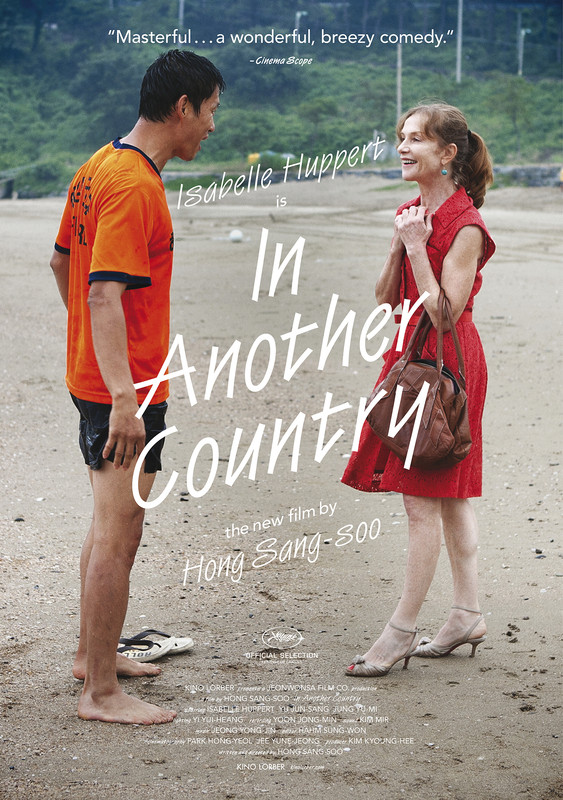
In Another Country
Dir: Hong Sang-soo
Despite my long-standing fondness for South Korean cinema, I've never previously seen any films by one of its most prominent auteurs, Hong Sang-soo. I've often meant to see his films when they have come to previous LFF's, but never quite got around to it, but I knew I'd be seeing this one as soon as it was announced that he had cast Isabelle Huppert in the leading role.

In Another Country is really three short films more than it is a feature, with Huppert playing a different French woman alone in a small Korean town, interacting with the same small cast of characters (some of them in slightly different roles from piece to piece) in each of the shorts. In the first part Huppert is a famous film director, in the second she's a woman awaiting the arrival of her lover; a famous Korean director and in the third she's alone after her husband (who may be a director in this part, it's not quite clear) has left her for a younger Korean woman.

After, for the first time, finding her on autopilot in another of her four LFF films, Dormant Beauty, I was really hoping that In Another Country would find Huppert on form again, and it largely does. Huppert has a reputation as a stern and icy presence (and to be fair, few people do stern and icy as well), but here she's clearly having a lot of fun, putting on a flighty turn as the various incarnations of Anne enjoy flirtations with Korean men (her host/lover and a lifeguard) or ask inappropriate questions of Buddhist monks (“What is sex for you?”). There's a sense that Huppert is relishing the (slightly mannered) silliness of the script, and particularly of the many scenes in which the same dialogue is used, slightly tweaked to the different situation, scenes in which she seems just a small step away from winking at the audience. It's a very different Huppert than we're used to, and a welcome change. The other performances are equally good, particularly a turn full of nervous energy from the actor playing the lifeguard [IMDB lists actor names but not who plays who for this film], who is uproarious in the first section, when he writes a song for Anne (“Anne, Anne, this is a song for you”).

Hong Sang-soo's direction is as intentionally mannered as his script, with Anne's changing character indicated largely by her changing dress, along with a few other physical indicators – hairstyles, clothes – that serve to show that the other actors are playing different people in each short. As constructed as it is though, the film is always fun, with Hong using a few dream sequences and wry match cuts as much as he does the dialogue in order to get laughs.

In Another Country is insubstantial. It plays with narrative amusingly, if less assuredly than In the House does, and the performances are all perfectly pitched. It's a fun confection which has encouraged me to try some more of its director's work, but it could do with being a little more substantial.
★★★

Bayou Blue
Dir: Alix Lambert / David McMahon
I've always been interested, perhaps because it's very far from my experiences growing up in a very safe corner of the South East of England, in the darker side of life. We all are to a degree – why else is 90% of the news in our papers bad news? But even at that ratio, the papers can't contain all the horrible things that people do to one another, and such was the case when it came to a relatively recent series of serial killings of young men down in the bayou around the New Orleans area.

Between about 1998 and 2006 Ronald Dominique raped and murdered 23 men, most of them not yet out of their twenties, and for some reason, even regionally, the story was hardly picked up. This was one of the worst serial cases in US history, and it was all but unreported. Bayou Blue looks mostly at the later cases, the ones that led two local Sheriff's office detectives from two different parishes to finally catch Dominique. Directors Lambert and McMahon talk to the detectives, to victims families and, in one very striking interview, to a man who seems to have come very close to making the victim tally 24.

It's a fascinating case, and the story is told with assurance by the filmmakers and passion by the interviewees but, while there are some nice visuals of New Orleans bayou, the pressing issue is really that there's no reason this should be on a cinema screen rather than on TV. There is also something of a lack of focus, as if this reasonably short film has used up all its most interesting information in the initial hour, and has to overextend itself for the last twenty minutes, touching on things like media and coastal erosion, which have little to do with the case at the film's centre.

On the whole, Bayou Blue is well made, interesting, television, but I can't shake the sense that it is television.
★★★

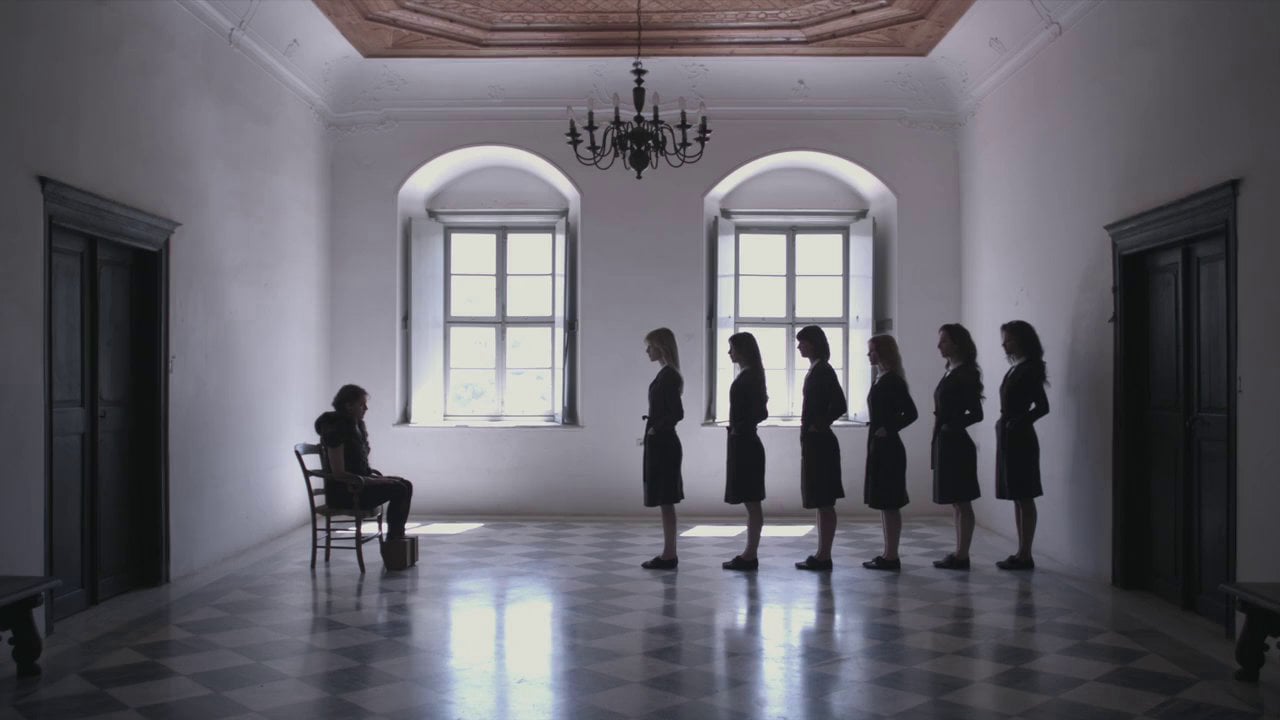
The Capsule [Short]
Dir: Athina Rachel Tsangarai
Athina Rachel Tsangarai follows her striking feature debut Attenberg, unusually, with a 35 minute short. The film seems to take place at a castle in a completely deserted landscape, where six young women (including up and comer Isolda Dychauck and Clemence Posey) are put through a series of bizarre scenarios by a beautiful authority figure (Tsangarai's Attenberg star Ariane Labed). They lead Goats around on leashes, they dance as Labed sings A Horse with No Name, they make confessions and are punished in odd ways (one girl has her hair tied in a knot across her face). These things are also interspersed with a handful of animated sequences (such as a topless Daychuck pulling her chest open, her crudely animated guts spilling out).

The Capsule is a film awash in film knowledge and references, and it recalls everything from Lucille Hadzihalilovic's Innocence to Lynch, to Bunuel and even, in its frequent focus on bodily detail and strange movement, David Cronenberg. The meaning is elusive, but it hardly matters, because the imagery is so strange and riveting (thanks in part, it has to be noted, to the strange beauty of each of the actresses Tsangarai has cast). This gorgeous, baffling, film makes me sad that the distribution routes for shorts are so limited, because it's a hypnotising film, and one of the best I've seen at LFF this year.
★★★★★

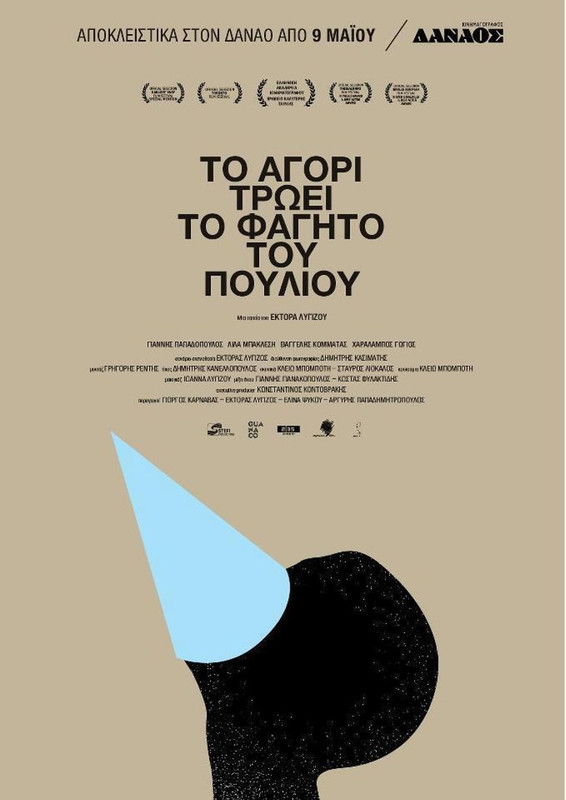
Boy Eating the Bird's Food
Dir: Ektoras Lygizos
I'm – annoyingly for a writer – at something of a loss for words. How do I even begin to go about itemising all that I hated about Boy Eating the Bird's Food? I wonder, in all honesty, if when he hoped we'd “enjoy the next 80 minutes of our lives” before the film, the producer was being ironic or facetious, because even if you see value in it (and I don't, and nor do I understand how anyone might), this is hardly an 'enjoyable' film.

The story is basically covered by the title. The lead character (Yorgos Karnavas) seems to be in his mid to late twenties and lives alone with a pet bird. He eats bird food and other things he finds, he stalks a girl who works in a hotel, visits an elderly man who lives beneath him and generally walks around a lot. NONE of his behaviour is given reason, little of it is shown to have consequences. Showing a character doing stuff, then expecting us to fill in every detail besides, is not a story and it certainly isn't a character study. It's merely stuff.

There is little on the technical side of the film to get excited about. It's largely shot in that irksome handheld 'look at me I can't hold the camera still so my film must be super realistic and smart' style that has become so prevalent of late and it's impossible to tell anything about the acting, because we know nothing about what this character is supposed to be like (we don't even know his name until it is randomly blurted out perhaps 15 minutes from the end of the film by an unseen character).

As well as being boring the film is also often disgusting, most notably in an utterly gratuitous scene, apparently staged for real, in which the main character jerks off in his hand before licking it clean, as well as in its apparent suggestion that if you stalk a girl long enough she'll eventually let you get intimate with her, and even pack up your dinner for you so you can take it away. As much as I was hating the film before, it really lost me half way in, when the main character danced to a song on Itunes, and chose Broder Daniel's Whirlwind, the theme tune of one of my favourite films of all time; Lukas Moodysson's Fucking Amal.  Here's a tip for makers of future meaningless, character free, badly filmed pieces of cinematic dung like this: DO NOT remind me how much I'd rather be watching one of my favourite movies.

My parents have often asked me why I watch some of the films I choose to watch (horror, exploitation, etc etc).  I'd really like to ask Ektoras Lygizos why he thinks we should watch this.  Why for 80 minutes we should watch a character do nothing more than wander around, eat rotting food and occasionally stalk a girl.  Why does he feel we should see this and learn nothing about him?  What does he think we'll gain in insight?  Does he expect us to make up a backstory, given that the only clue we get as to why the character is how he is is a brief and singularly unedifying phone call to his mother?  What the hell is he trying to say with any of this?  I don't care, at the end of the day.  Boy Eating the Bird's Food is a waste of my time and even of the memory on the digital cameras used to shoot it.  I'll be stunned if I see a worse film this year.
★

Sep 26, 2012

24FPS @ LFF 2012: Diary - Day 2

Here and There
Dir: Antonio Mendez Esparza
I don't mind slow films, in fact there are many that I like a great deal, but there has to be some sort of reward; tension, whether it pays off or not; a feeling that you're seeing into an interesting or different life; anything to mitigate the fact that the story you're following isn't especially eventful.

Here and There doesn't deliver any of that. A while back, Total Film used to have a 'predicted interest curve', a graph depicting the highs and lows of some of the films they were reviewing. The biggest problem with Here and There is simple; that graph would be a straight line. This is an incredibly flat film. We should be engaged by the life of the Mexican family at the centre of the film; a mother and father who seem to be in their mid thirties and three daughters of about 15, 12 and 1 year old but the ups (the father's band playing a gig with a well known local musician) and downs (the youngest child becoming ill) are all treated with the same lack of engagement by filmmakers and characters alike. There is never an ounce of passion shown in the film, creating an overwhelming feeling of flatness and disengagement. The performances don't help matters much as, while there is a strong family dynamic created, none of the actors ever rises above a mumbled monotone.

There is one caveat that I must mention: I fell asleep for about twenty minutes during the middle of this festival of tedium. These were easily my favourite twenty minutes of the film, and I suspect that what I missed wasn't a sudden lapse into genius, but I have to allow for that possibility. That said, even if that were the case I still couldn't recommend Here and There, which will surely mount a robust challenge to be noted as the single dullest film at this year's festival. Avoid it with extreme prejudice.
★☆☆☆☆

Save Your Legs
Dir: Boyd Hicklin
From its awful title on down, Save Your Legs is just dire. It's not so much a film as it is a selection box of sports movie clichés, with the scrappy little team from the minor leagues (Aussie park cricket team the Abbotsford Anglers) taking on a challenge they are clearly not up to (a tour of India). Oh just guess the plot. Hell, guess every scene and every joke, if you're wrong you'll write a better film than Boyd Hicklin has.

For an alleged comedy, Save Your Legs is notably short on jokes, well, unless you find poo inherently funny, which, no longer being five, I don't. The characters are all desperately one note; there's the one who won't grow up, the drunk, the egomaniac, the nerd (who might have a crush on one of the others), the philosopher, the young upstart and the fat bearded one. There are more, but they don't even register that much personality. As the only woman in the film, Pallavi Sharda registers, but only thanks to her beauty, the film tries to work her into the climactic scenes, but then forgets to give her anything to do.

Save Your Legs is insultingly lazy. The jokes basically hit the peak of their inventiveness at 'Indian food gives you the trots', the 'bromance' between the team is laughably thin, and the lessons learned prosaic, unimpressive (apparently when you're 35 you might want to grow up, thanks for that movie) and predictable and the cricket sequences are unimpressively shot and totally devoid of tension, because even before you've seen a frame of them you know almost to the last beat how each of them will play out.

This is a terrible film, disregard its advice, if it comes to a choice between seeing it and running away, do not Save Your Legs.
★☆☆☆☆

Doomsday Book
Dir: Yim Pil-Sung / Kim Jee-Woon
Portmanteau films are, by their very nature, hit and miss, but this sci-fi triptych from South Korean directors Yim (Hansel and Gretel) and Kim (the better known, director of A Bittersweet Life and A Tale of Two Sisters) works better than most. For years two stories sat on the shelf, but production problems meant the third had not been shot, well, now it has, with the directors collaborating on the third short.

Every viewer will have a story they prefer and one that they perhaps don't like as much, and it will differ and provoke much discussion. Personally I liked the bookending efforts, which seem to match up better in tone than Kim Jee-Woon's solo entry in the middle. The film opens with Yim's hilarious The New Generation; a vision of a zombie apocalypse, which blends absurd humour, bloody violence, environmental commentary (it's very concerned with recycling) and a little romance to fine effect. The compressed nature of the story actually makes it all the more fun, because it becomes hilariously overblown in a very short space of time.

Kim Jee-Woon's story of a robot that becomes self aware, and a Buddhist, causing an existential crisis for itself and for many humans, didn't work as well for me. To some degree the problem is likely that I don't know much about or really understand some of the ideas running through it, I also rather missed the more markedly anarchic tone of the first film, and thanks to the very familliar design of the robot I just couldn't shake the expectation that it was about to begin singing Bjork song at any moment. This film; The Heavenly Creation, may be the one that really grows on a rewatch, certainly it's the deepest and most thoughtful of the films, but it's definitely the one I found least rewarding on a first look.

The closing collaboration, Happy Birthday, is the best of the shorts for me. It takes the anarchic apocalypse comedy of The New Generation and turns it up to eleven, with the story of a family (including The Host director Bong Joon-Ho) hiding underground from a potentially world destroying meteor, which turns out to be something they may have caused (I don't want to spoil it any further than that). The end of the world newscasts are absolutely priceless, and the short's almost surreal last moments - which to some degree recall the botched ending of Save the Green Planet - really surprised me by working very well (and hey, if nothing else it's always nice to see Bae Doo-Na, if only for a few minutes).

Doomsday Book is never less than engaging, and I'm sure that anyone will find at least two of the three shorts highly entertaining.  
★★★☆☆

Oct 24, 2009

24FPS at LFF: Day 4

마더
[MOTHER]
DIR: Bong Joon-ho
CAST: Kim Hye-ja, Won Bin


When mentally disabled Yoon Do-joon (Won) is arrested and charged with the murder of a schoolgirl his mother (Kim), convinced that her son is innocent and the confession coerced from him by the police is false, turns private detective, vowing to find the real culprit.

With acclaimed films like The Host and Memories of Murder, Bong Joon-ho has shown himself to be something of a genre buster. Mother is his fourth film, and it continues to show that Bong is ploughing the same furrow; combining serious dramatic events with slapstick absurdity. Whatever the qualities of this film, it suggests that Bong is something of a one trick pony. That said, Bong is clearly a filmmaker of some considerable talent. Mother looks great, and several of the less serious moments really stand out, memorable by their sheer strangeness. One of the most striking of these is the opening, which sees a very serious looking Kim Hye-ja standing in the middle of a field, and then beginning to dance for no apparent reason. It’s totally out of step with the film, and seems to have no relevance to the character at all, but it’s so weird that it stands out.

While Bong’s style is sometimes slyly amusing, it doesn’t really mesh with the more noirish thrust of the story. Both styles are fine in and of themselves, but watching Mother can be a schizophrenic experience. The problem with the film’s detective story is pretty simple; the answer is obvious and predictable. Bong does lead us down a couple of blind alleys, but they are pretty easily spotted.

The one thing that really stands out about Mother is the acting. Whatever critics have so far had to say about the film as a whole, they’ve all fallen over themselves to praise Kim Hye-ja. I’m not going to break with that tradition. Kim is brilliant as the panic-stricken, over-protective mother who must focus herself and try to find a way to help her child who can’t help himself. It’s a performance that begins with a maternal warmth, but slowly and credibly the character becomes colder, more ruthlessly focused until, towards the end of the film, ice appears to run in her veins. It’s a nice, subtle, piece of character acting and Kim carries the entire film on her shoulders, elevating something that without her would be entirely unremarkable.

For his part, Won Bin also does fine work as Do-joon. It’s a smaller part than you might expect, and for an hour in the middle of the film he all but vanishes. When he’s on screen though Won gives good account of himself, with a performance that suggests he’s put a lot of work into studying the behaviour of adults with profound learning disabilities. The way he, panic stricken, keeps playing with his phone at a vital point, not knowing whether or not to call his mother, is an especially well-acted moment.

It’s not that Mother is a bad film, it just feels very clunky. The gear changes don’t work, and the mystery at its centre just isn’t mysterious enough to sustain the interest. It is barely 24 hours since I saw the film, and already it has all but completely slipped from my mind. However, Kim Hye-ja is so good that to write it off entirely would be a shame.


CHLOE
DIR: Atom Egoyan
CAST: Julianne Moore, Amanda Seyfried,
Liam Neeson, Max Thieriot


Remakes are everywhere, but this one seems to have ducked in under the wire, without the internet baying for blood. This is perhaps because Anne Fontaine’s Nathalie, on which Atom Egoyan’s film is based, is neither a horror film nor an avowed classic.

I haven’t seen Nathalie, so obviously I can’t compare the two films, but for the first hour of its running time I really thought Chloe was going to be great. It really is a crying shame that as the film enters the home stretch that is its third act the wheels fall off in rather spectacular fashion. The basic story sees Catherine (Moore) beginning to suspect David (Neeson), her husband of twenty years, of having affairs. To test him she hires Chloe (Seyfried) to approach him, and report back to her on what David does. As Chloe relates the affair that she’s begun with David, Catherine also finds herself drawn to the beautiful young woman.

Six or seven years ago you could probably have fairly described me as one of the world’s biggest Julianne Moore fans. It wasn’t hard to imagine why; between 1993’s Short Cuts and The Hours in 2002, Moore was on a winning streak as big and impressive as any in film, giving brilliant performance after brilliant performance, and seeming like a totally different person every time she stepped in front of a camera. Since then, a very brief cameo in Children of Men apart, it’s just been awful. The succession of turkeys, and the laziness of the performances by an actress so obviously gifted, is staggering. See, or don’t, such films as Laws of Attraction, Freedomland, Trust the Man and Next for proof of how the mighty can fall. It’s been a rough few years as a Julianne Moore fan. Fortunately - finally - Chloe marks a proper return to form. For the first time in a very long time not only did I not feel like I was watching Julianne Moore, rather than her character, I couldn’t hear the wheels turning. There’s nothing here that feels calculated or contrived (not, at least, in Moore’s acting). Every nuance, every flicker of emotion is out there for us to read on her face, and yet she’s not actorly, she’s not over-emoting; she squares the circle of making Catherine an open book to us, but closed off emotionally to the other characters. This is fantastic, detail-oriented work. Welcome back Julianne. I missed you.

When Julianne Moore is on this sort of form it’s a big ask of any actor to hold their own against her. Liam Neeson, by virtue of the script rather than his performance, largely blends into the background, but he and Moore play off each other well, and the slight chill and distance between them creates a believably strained relationship such as you might expect between a couple drifting apart after 20 years together. The film was finished after the death of Neeson’s wife Natasha Richardson, and it’s a testament to his talent and professionalism that you can’t see that join.
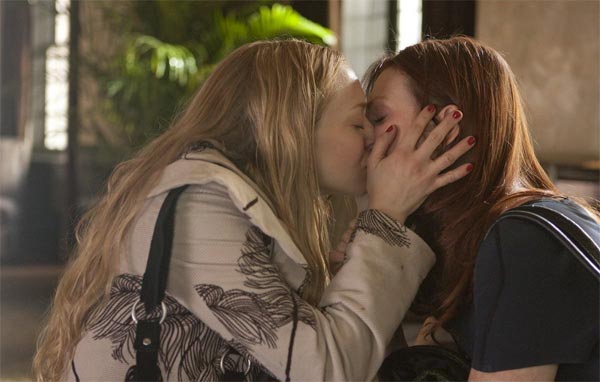

The younger performers are more problematic. Max Thieriot flounders in what, to be entirely fair to him, is both an underwritten and a cliché laden role as Moore and Neeson’s surly teenage son. Amanda Seyfried has a demanding role, and initially she does well. There’s an effective unknowability about her Chloe, and a harsh, dispassionate tone that means that you feel Catherine’s hurt as Chloe relates her encounters with David, especially when, in a hotel room, she describes to Catherine the sex she’s just had with her husband.

Unfortunately, though it is also very much the fault of the screenplay, Seyfried’s performance is much of the reason that the film falls apart in its last half hour. There is a key shift in Chloe’s character and Seyfried just doesn’t have the chops to pull it off, which renders many late scenes, particularly one in Moore’s office, laughable.

With his last couple of films the normally rather austere Atom Egoyan has embraced on screen sex with some gusto. Where the Truth Lies was eventually notable almost solely for its sex scenes. That’s not the case with Chloe, but you can bet that when it opens many column inches will be devoted to the copious nudity and to the brief, but pretty explicit, sex scene between Moore and Seyfried. It has to be said that the two women have fantastic chemistry, right from their first scene together there is an undercurrent of barely repressed sexual tension between them, and when it boils over at the end of act two it does so in a scene as memorably sexy as the much remarked upon lesbian sex scene in Bound. It’s refreshing to see such an uninhibited take on sex in a relatively mainstream American film. Like many of his other films, Egoyan’s work in Chloe has a very designed feel to it (Christine and David’s house, for example, always feels like a set, as does Christine’s glass walled office). There’s little naturalistic here, but it’s hard to complain much about that when Egoyan’s shots are as beautifully designed and well thought out as they are here.

In the excellent first hour of the film there’s only one real issue, and that’s that there’s nobody to root for. Catherine, David and Chloe all come off as fundamentally self-serving and unsympathetic, but you forgive the film because you get sucked into both the fine character driven drama and the sexy erotic thriller undertone. Unfortunately, in the last half hour, the film goes bonkers. Suddenly the measured, almost cold, pace and tone of the film is gone, the ending of the script we’ve so far been following seemingly replaced by the last 40 odd pages of generic erotic thriller 2b. Julianne Moore remains excellent, and if she notices how silly things have become then she doesn’t show it, the same can’t be said for everyone else. Seyfried goes from giving a decent performance to being hilariously bad, and for his part Egoyan trades his artistically composed frames for some jaw-droppingly stale clichés straight out of the how to shoot a straight to video erotic thriller handbook. It’s a terrible shame, and undermines what really should have been, if not an especially original film, a notably high quality and truly adult drama. Still, see it for Julianne Moore.


PARTIR
[LEAVING]
Dir: Catherine Corsini
Cast: Kristin Scott-Thomas, Sergi Lopez, Yvan Attal


Though she’s flirted with the mainstream, and had large roles in such popular fare as Four Weddings and a Funeral and The English Patient when you mention the name Kristin Scott-Thomas you’ll mostly see blank faces staring back at you. That’s a terrible shame, because she’s among the best actresses working in world cinema.

Like last year’s I've Loved You So Long, Catherine Corsini’s film finds Scott-Thomas acting in flawless French. As Suzanne, an English woman married for some 20 years to Samuel (Attal), but now embarking on an affair with Spanish builder Ivan (Lopez), leading to a messy and bitter divorce, Scott-Thomas is just brilliant. Her dialogue is beautifully delivered, and filled with expression and meaning. This, of course, is an actor’s job, but so frequently when they are working in a second language their performances can seem rote and bereft of expression, that’s absolutely not the case with Kristin Scott-Thomas. That isn’t all that makes her performance special though. Great actors are great listeners, and when you watch her reacting to what other people say there is such richness, such emotion in her silent reactions. This is a performance played as much in the physicality of its relationships and in what plays behind the eyes as it is in the dialogue, and that’s what makes it truly special, a real, three-dimensional portrait.

I’ve seen Sergi Lopez act in three languages now; his native Spanish, French and English, and in each he’s been outstanding. He’s an actor who seems to change completely in each role. It’s genuinely difficult to connect Ivan with Capitain Vidal from Pan's Labyrinth, or with Harry from Harry, He’s Here to Help. Lopez has often played bad guys in the past, but though Ivan is an ex-con (we never discover what he did) he’s no villain. Instead Lopez plays him as a very genuine, very normal man, largely driven by circumstance - that circumstance being that he and Suzanne have fallen in love. It’s tough to play very ordinary people, because they don’t tend to have the operatic notes that it’s rather easy to reach in acting. Instead roles and films like this demand smallness, subtlety and intricacy, and Lopez delivers beautifully.

These two outstanding performances tower over the film, and that’s probably a good thing, because frankly Catherine Corsini’s screenplay and direction, though there’s nothing wrong with them, are pretty generic. We’ve seen this tale told a thousand times, and we know pretty well where it’s going to end up (though Corsini doesn’t help that with a structure that opens proceedings with a moment that takes place about five minutes from the end of the film).

Scott-Thomas and Lopez also threaten to drown out Yvan Attal’s performance. Samuel isn’t as well written as Suzanne and Ivan, and Attal ends up having to spend most of the film playing a single note. He does it well, but the character is just too thin to really register. However, when the focus is on Suzanne and Ivan, as it is for much of the 85 minute running time, Leaving is strong stuff. The chemistry between Scott-Thomas and Lopez is electric; their sex scenes pulse with energy, and whenever they share a scene once their relationship has begun you can feel that hunger for one another, especially in Scott-Thomas’ last few scenes in the film.

Leaving certainly isn’t perfect, but it’s pretty well made on the whole, and though it is short it doesn’t feel compromised by its length. The characters are strong and individual (even if Samuel isn’t the most rounded of characters) and the ending is near perfect, leaving us on a note of some ambiguity, rather than spoon-feeding us for an extra 10 minutes. The film is only really lifted out of the ordinary by the two leading performances, make no mistake though, those two performances make Leaving a must see.

Oct 7, 2009

Review Post 50: Thirst

박쥐
[THIRST]
DIR: Park Chan-wook
CAST: Song Kang-ho, Kim Ok-bin,
Shin Ha-kyun, Kim Hae-sook


Park Chan-wook’s latest has accidentally caught the zeitgeist, but he’s been planning this vampire movie for a decade.

I’ve wanted to see Thirst ever since I heard about the idea, just after Oldboy was released. Back then the only details available were that it would be a vampire film starring Park’s close friend and frequent collaborator Song Kang-ho (Sympathy for Mr Vengeance, Memories of Murder) and that it would be called Evil Live. The title may have changed, but in those ten years the central idea of a Catholic priest who struggles to retain his faith when he becomes a vampire has remained. While retaining this basic central idea Park has wedded it to an adaptation of Zola’s Therese Raquin. I’ve not read the novel, but I understand that several of the characters (notably the older woman played by Kim Hae-sook) have direct parallels and that some key events, particularly a sequence in a fishing boat, are lifted from it. It’s to Park’s and co-screenwriter Jeong Seo-kyeong’s credit that the vampire story and the adaptation meld so beautifully.

Song Kang-ho is a wonderfully versatile actor, a favourite of Park and of Bong Joon-ho. He’s able to be the everyman, but also to convincingly go out on a limb. As Sang-hyun, Song does some of his best work to date. His struggle with his nature, his desire to embrace his vampirism and yet retain his Catholicism, to attempt not to sin, seems deeply felt and is beautifully played. I wonder if there has been some subtle effects work done on Song’s appearance, as the 42-year-old actor seems more youthful than he lately has on screen. Certainly he seems to have done some exercise for the part, losing much of the paunch he displayed in The Good, The Bad and the Weird. This really helps to sell Sang-hyun’s newfound vampirism. He’s a credible physical threat, without looking like an action hero. But it’s Song’s performance, rather than his look, that really carries Thirst. He gets the tone of the part absolutely right, playing absolutely straight even though the film is a very black comedy, and thus allowing us to get sucked into the character of Sang-hyun, and through him the story.

Blood isn’t the only thing that tempts Sang-hyun after he becomes a vampire; there is also sex, in the form of Kim Ok-bin as Tae-ju. Tae-ju is married to an old friend of Sang-hyun’s (eccentricly played by Shin Ha-kyun of Mr Vengeance and Save the Green Planet), but she begins an affair with the priest and soon persuades him to turn her into a vampire. Kim Ok-bin steals the whole movie. Tae-ju is a wonderful character; outwardly sweet and quiet, but underneath that she’s a scheming, slightly psychotic (witness the scene where she repeatedly pretends to stab her husband as he sleeps), temptress, and that’s before she becomes a vampire. When that happens Park lets her run riot, she lets herself off the leash completely, giving a wonderfully funny and creepy performance as a woman revelling in her vampirism. Sang-hyun has always taken his blood from a friend lying in a coma, and has been careful not to kill, but Tae-ju kills with giddy abandon, saying that it’s more fun, and besides, it tastes better.

Kim Ok-bin’s performance helps make the last third of Thirst its funniest passage, but the entire film has a rich vein of comedy running through it. This is one of Park’s trademarks; he freely mixes deadly serious ideas (here murder, relationships and the nature of faith) with absurd moments. The funniest thing in Thirst is Kim Hae-sook’s performance in the last part of the film. After Tae-ju becomes a vampire her mother is paralysed, but she still has all her wits about her. In one riotous scene Tae-ju’s mother tries to tell the friends that Tae-ju and Sang-hyun are playing Mahjong with that her daughter and the priest are killers, using only her one mobile finger and her eyes.

Oldboy may have announced Park Chan-wook on the international stage, but his work both before and since that film confirms his status as one of the major talents in world cinema. To say that Thirst doesn’t represent his best work is true, but hardly an indictment. The only moment at which Park’s control of the film seems to slip is late in the second act and early in the third, when it runs a little off the rails and a couple of plot points go under explained. However, with the help of his excellent cast, he recovers and takes the film out with half an hour of brilliance. All Park’s films are beautiful, and this is no exception. The colours are extraordinary, with Tae-ju’s blue dress (an homage to one of Park’s inspirations; Andrzej Zulawski’s Possession) and the impossibly vivid red of blood on the brilliant white floor of Sang-hyun and Tae-ju’s lair standing out in particular. CGI is sparingly used, and the effects are always used to a purpose and extremely high quality. It’s hard to describe why Park Chan-wook’s films are such a pleasure to look at, because there is just so much to talk about. Every one of his frames is suffused with diverting and beautiful detail, so much so that you could probably watch this film without its soundtrack and still get a great deal out of it - not something that can be said about most movies.

Thirst is a rich, tasty, treat for horror fans. Park doesn’t stint on the sex and violence that you expect in the genre, but he delivers it with intelligence and wit, and in conjunction with a literate, thoughtful, script and performances of great depth and quality. Make no mistake, even though this film isn’t quite up to the amazing standard set by Oldboy and Lady Vengeance it still offers further proof that Park Chan-wook is one of the great filmmakers of our time, and I suspect it will only become more rewarding with repeat viewing.

Feb 8, 2009

The Good, The Bad and The Weird [15]

Dir: Kim Jee-Woon
Kim Jee-woon is one of South Korea’s most eclectic filmmaking talents. His movies range from the bloody gangster drama A Bittersweet Life to the dark comedy of The Quiet Family and the acclaimed ghost story A Tale of Two Sisters. His latest, as if the title didn’t tip you off, pays homage to Sergio Leone, the film is described in its end credits as an oriental western. But to see it only as that is to do The Good, The Bad, The Weird a disservice, because Kim blends the western with large scale action scenes, and an offbeat slapstick sense of humour in a highly original mix.

The story sees the three title characters, along with the Japanese army and various bands of thugs and gangsters all chasing after the same McGuffin, a ‘treasure map’ said to lead to untold riches. It’s paper thin, but provides enough of a framework for Kim to hang his blistering array of action and comedy set pieces on, while maintaining enough of a through line to make the story worth trying to follow. Trying is the operative word here, because the major problem with The Good, The Bad, The Weird is that its story flies off the rails early, descending into a confused mess that leaves you baffled as to each characters motivations, but it doesn’t matter all that much, because the ride is just such fun.

The film begins with, literally, all guns blazing, in a breathlessly exciting train hold up which sets out the film’s stall in combining action and comedy from the off. Song Kang-ho, probably best known to western audiences as the father in The Host, and a frequent collaborator with Kim, gets the plum role in this respect, playing the Weird character to the hilt. Song’s Yoon Tae-goo is a bumbling bandit whose luck and perseverance, more than any real aptitude, have made him a survivor and a great gunfighter. Song plays him like a Looney Tunes character, which should be a grating choice but because it fits the exaggerated tone of the film, and because Song’s comic timing is dead on, it works beautifully and Tae-goo provides a laugh in almost every shot.

Lee Byung-hun is the biggest star in Asia, and its not hard to see why, beyond his undeniable extraordinary handsomeness Lee is also a charismatic and versatile actor. He’ll soon show up as Storm Shadow in Stephen Sommers’ GI Joe: The Rise of Cobra, but here you can catch him as a lead, and as Park Chang-yi (The Bad) he commands the screen despite having a very thin character to work with. Much of this performance is in Lee’s physicality – he’s not built like Schwarzenegger, but he’s still got an air of danger about him – but it’s in an animalistic moment of violence that he really makes you believe in, and fear, Chang-yi.

Completing the central trio is Jung Woo-sung as The Good, a bounty hunter named Park Do-won who is using Tae-goo so that he can finally capture Chang-yi. Jung has the blandest character, but he brings great magnetism and personality to Do-won, as well as a fundamental decency that should really win an audience over to him.

Good as the actors are this is really the Kim Jee-woon show, and he goes all out. The film careens from set piece to set piece, each larger, louder and more impressive than the last. Besides the train heist there is a long gunfight in an outlaw town, which sees Tae-goo clad in some interesting armour. Then there’s the hilarious sequence that sees Tae-goo rescuing some children from an opium den, and the gigantic battle between the Japanese army, a gang of bandits duped by Tae-goo, Chang-yi’s bandits and Do-won and Tae-goo. That, of course, is all before the film calms down, and serves up the final shootout.

What’s really remarkable about all this is how well Kim juggles the tone, the comedy and the action gel beautifully, neither taking away from the other, which is all the more impressive given that the violence is bonecrunching and bloody, pushing the 15 certificate to its very limits. He also manages to make each set piece feel distinctive, which means that though, at 139 minutes, the film is long it’s never dull.

The only real problem is that the film’s episodic structure means that there is plenty of fat in those 139 minutes, whole sequences and characters could easily be excised and you’d not feel their absence. That might have been a good idea too, because by the end the film is rather too busy, and a lot of the motivations are unclear. Still; The Good, The Bad, The Weird is a highly enjoyable film, a rollicking good time at the movies and if it’s a little self indulgent, well, that’s forgivable.
★★★★