Showing posts with label Blogathon. Show all posts

Jul 19, 2015

Childhood Films Blogathon: How I became a movie nerd.

Since I agreed to take part in this blogathon, I have been wondering how I should engage with the subject of films and childhood. Should I talk about the films I still love from that time in my life? Should I, conversely, talk about the films I have grown out of and am unlikely to ever rewatch? Should I chart a middle path and revisit some long abandoned films that I barely remember from my childhood? Or should I just write, once more, about the enduring work of genius that is Indiana Jones and the Last Crusade, how every time I watch it I am 8 years old again, and that it is my go to film if ever I need reminding of why I first fell in love with movies?

If you'll excuse and indulge me, I've decided to take a different and more personal approach. 

Star Wars: The first film I remember seeing.
Part of the problem I have here is that my memories of my childhood are very hazy. This is partly because I have a bad memory for anything apart from useless movie trivia and partly due to an event that was central both to my life and to my burgeoning love of cinema. My few remaining early memories are centered on film: sitting close enough to Star Wars that it made my parents realise I needed glasses; hiding under the seat at Indiana Jones and the Last Crusade, then sneaking into as many screenings of it as I could when it was the film on a ferry we were taking to Holland. While that screening of Last Crusade at 8 was a seminal moment for me; the moment I knew I LOVED movies, the obsession wasn't allowed to grow until a few years later.

When, 25 years ago, we first moved to the house where my parents still live, we didn't have a TV, let alone a VCR. My step-dad was a farmer, and my parents wanted us to play outside on the land we had. Things changed irrevocably with the event I've already alluded to.

I was born with a liver disease called Billary Atresia, and it was always known that I would need a liver transplant. That need became urgent when I was 10, and I got lucky, I spent only a week on the transplant list before I got a donor. Things didn't go perfectly: I never even woke up before I the first transplant failed and I needed a second. I was sedated in intensive care for three weeks, which is why my memory is so hazy until after this period; it was wiped out by industrial strength opiates. When I came round I was in an isolation room. I couldn't go to the hospital's school and only my parents and doctors and nurses could enter. Even if I had been writing at that time, I couldn't have done so; I'd not used my limbs for weeks, and eventually had to re-learn the physical process of holding a pen and writing. The only thing in the room aside from the machines keeping me alive was a TV and VCR supplied by my school, so I got Mum to go to the video shop down the road.

I devoured movies. I was isolated for eight weeks, and consumed films at a rate of perhaps three a day. I went through much of the suitable, and some of the unsuitable, stock at the local shop. Before my transplant I had seen, and been a HUGE fan of, Robin Hood: Prince of Thieves. On the back of that had become a big fan of Christian Slater. He was my first favourite actor, and was kind enough to send me a signed picture with “Hope, Strength, Courage” inscribed on it, something I hope I can thank him for in person some day. I have vivid memories of seeing both the slightly unsuitable Kuffs and the highly unsuitable Pump Up The Volume (which, thanks to a certain scene, gave me quite a crush on Samantha Mathis) in my hospital room. There was much I didn't understand in the latter (the 'eat me, beat me lady', for instance), but there was definitely a thrill about it because of that. I began to run out of movies to rent from the local shop, this was before Blockbuster made it to the UK, and there was often a small selection in local rental stores, so the doctors and nurses began bringing me films, Home Alone and Ghost are two I remember seeing in this way. 

Samantha Mathis: Yep, still got that crush.
To me, it's not important that the individual titles aren't all burned on my brain. I'm sure they included the likes of The Goonies, Honey I Shrunk the Kids, whatever Disney was available and a good selection of Spielberg, but the point is not one film but the way film came to help me cope with what I was going through. My doctors and nurses were brilliant, as were my family, but however bearable they try to make it, hospital is a shit place to be, and it's worse when you're 10, and when you're spending your 11th birthday in a cubicle (I was allowed out for the very first time that day). 

Film became the thing that took me away from that reality. This is something I have always valued in cinema, perhaps more so because of how I came to it, and something I have also found useful in dealing with depression. When things in the real world aren't as you want them, cinema allows you an escape valve from that real world. When I was watching a movie I didn't have to think about the syringe automatically pumping drugs that made me itch into my arm; I didn't have to think about my stitches – unless it was a comedy, because they made laughing painful, not that that stopped me asking for Ghostbusters again.

My transplant was a transformative experience in a lot of ways. It gave me a life I wouldn't have had otherwise, it made me look different, for 10 years I had a yellow pallor and an enlarged stomach area, but more than this it gave me something to occupy the life it handed me. By the time I left hospital it was clear to me and, I think, to everyone else that movies were just going to be a part of my life. Initially I wanted to act, then to write and direct, but I feel I have found my niche writing about films. 

Everyone's childhood leads them to become who they are as a grown up, but I wonder whether without that hospital stay, without liver disease, without the transplant, even without the complications that stretched out my stay, then saw me watching movies from a hospital bed 13 times in the 12 months immediately after my transplant, I would have written a single word of what's on this site. 

I'm sorry this hasn't really been about the movies themselves, but when I think of my childhood experience of cinema, this is it, and it means everything to me.


PS: If you want to know more about childhood liver disease, and to help kids dealing with it, visit the Children's Liver Disease Foundation.  Cheers.

Jun 22, 2014

The Films of 1967 Blogathon: Viy [12]

When Rosie asked me to take part in this blogathon I took it as something of a challenge.  Next to our host and, I'm sure, the other writers my knowledge of 60's cinema is decidedly limited.  Growing up as a movie fan I seldom found myself reaching back farther than the 70's, and I still consider myself a bit of a novice before the movie brats era really kicks off.  That said, I still wanted to pick something for this series that the other contributors would almost certainly not have seen and very possibly never have heard of.  I suspect that I've managed this with Viy; a pseudo-folkloric piece of surreal horror cinema from the Soviet Union.

Insofar as you can take its story at face value as it is presented,  Viy is about a seminarian named Khoma who, along with two friends, finds himself lost one night while on leave from his studies.  The three are given shelter by an old woman, who turns out to be a witch.  Disgusted when she uses magic on him Khoma beats her, only refraining from a killing blow when she turns into a beautiful young woman.  Later Khoma is summoned to a remote village to say prayers for a young woman who is dying.  It is the witch, and as Khoma prays over her body across three nights she returns to torment him.

Viy has the feeling of being an old, old story; something handed down by word of mouth through generations, perhaps to scare children into staying in bed ('if you don't go to sleep the witch will get you').  In fact the story was published in Nikolai Gogol's 1835 collection Mirgorod, but there has apparently been nothing discovered to substantiate his author's note that claimed the tale as one from Ukrainian folklore.  However, Gogol appears to have captured that tone so completely that his story became what he initially pretended it was.  The film has clearly influenced many since it was made, but Gogol's story has also been reinterpreted; as Mario Bava's Black Sunday, as a ghost story in dialogue in Joe Dante's Piranha and in a recent Russian remake, in 3D..

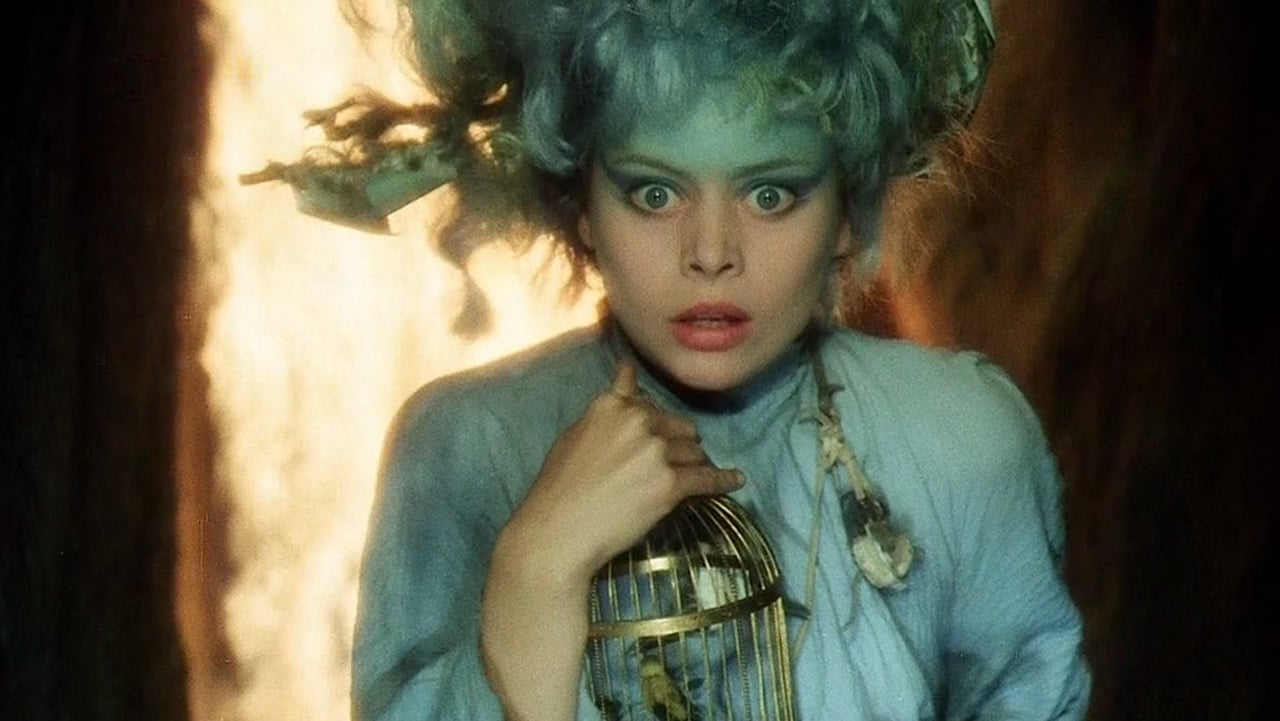
This was the first horror film of the soviet era to be released in the USSR, and co-directors Konstantin Yershov and Georgi Kropachyov apparently found their way around censorship rules by invoking the tale's folkloric history.  That said, the film is mild by today's standards.  There is little violence and no blood at all, however, despite their frequently crude realisation (even by 1967 standards), there are images here that remain creepy after more than 45 years.  Beautiful as Natalya Varley is, there is something haunting about her here, her face covered in white make up (it's possible that this was also an influence on Helena Anýžová's look in Valerie and Her Week of Wonders) and the crude special effects prove oddly effective because when Varley is superimposed into the shots to make her appear to fly there is a sense of dislocation and other-worldliness imposed by the fact that the join between the shots is obvious.  Varley's creepiest moment comes on the first night, as the witch wakes and advances on Khoma, who rushes to draw a protective sacred circle before she can reach him

The film has a growing surreal feel to it throughout, but it is the final scene, in which Khoma, cowering in his protective circle of chalk, is beset by demons who climb, seemingly endlessly, out of the walls and floors that proves most memorable and most chilling.  Again, the effects and costumes are unmistakably a little cheap and of their time, but the creakiness of them is more effective than any CGI because they have real physical presence.  The designs are striking, and this is another point at which the film seems to have had an influence on later work.  I'd be shocked if Guillermo Del Toro doesn't know Viy's last ten minutes by heart.  Without any explicit violence or blood, there is a real sense here of something coming up from the bowels of hell, and it's all the more effective because the film has patiently built to this moment throughout, especially during its second half.

Viy doesn't, at least not obviously, reflect much about its time.  It's not stylistically in keeping with the much parodied image of the summer of love and it couldn't be further from the aesthetic of the nascent New Hollywood.  It's possible that there are political allusions if you know more about the USSR of the time, but it's also possible that all the film was intended as was what I enjoy and admire it as; a creepy and surreal piece of horror cinema that has been influential enough to feel familiar but remains entirely its own beast.  You'll have to invest some time and effort to seek this one out, but it's worth the chase.
★★★★

You can find the rest of the articles in the Films of 1967 Blogathon at The Rosebud Cinema

Dec 13, 2012

It's a Mad Mad Mad Mad World Cinema Blogathon: The Little Mermaid

So, for the second week of the Blogathon, Marcey has sent me to Czechoslovakia, to check out a surrealist film.  Here's why..

"Czech films of the 70’s are usually worth your time, and I happened to come across this one, based upon the story by Hans Christian Andersen. I am a huge fan of the story, and yes I do enjoy the Disney film but this is a fantastic adaptation. The visuals here are stunning; my eyes were treated to such beauty when I first watched this. There is a unique way of telling the story here, the under water scenes are done on sets and they look beautiful. This is exactly what I want out of the story, and I certainly hope Sam enjoys this. I know he shares a love with Czech cinema with me, and this is a must see."

The Little Mermaid ['76] 
Dir: Karel Kachyna
The first thing that came to mind as I watched this film wasn't the fairy tale, but rather a film that I had recommended to Marcey a couple of years ago; the Czech surrealist film Valerie and Her Week of Wonders.  Both films exist in a dreamlike state, but use it to tell what is a very simple story of a young girl's coming of age (in the case of Valerie the film is triggered by her first period, The Little Mermaid hinges on first love).  I LOVE Valerie, but The Little Mermaid, if not as immediately seductive, is not embarrassed by the comparison.

Disney's film must be one of the first I remember seeing at the cinema, but I also remember being read the real story; the sad story, when I was a kid, and thinking as I grew up that it was a shame nobody had filmed that version.  Turns out they had.  From my hazy 20 plus year old memories, this would seem to be a pretty faithful adaptation of Hans Christian Andersen's story of a mermaid (who saves and falls in love with a prince, then sells her voice to a witch, and agrees to endure enormous pain in order to appear human and have a chance to win his heart, only to fail, and decide to die rather than kill him and live).  It's a beautiful story, and Kachyna tells it well, with both the romance and the tragedy coming through affectingly.

The visuals are unusual and gorgeous, particularly the design of the underwater kingdom of the Sea King, and of the Mer people themselves, who are all dressed in the different colours that the sea can appear to be, and seem to have ocean debris tangled in their hair.  The set design is also stunning, and really contributes to the way that the film creates a whole and credible feeling undersea world.  I like the little details too, like the way that Mer People never appear wet, even after emerging from the water.  Kachyna builds the world well in the film's first half, making it seem idyllic at first, but revealing the ways it holds The Little Mermaid (Miroslava Safránková) prisoner bit by bit.

The standout moment of the film is the scene in the cave of the Sea Witch, which really lays out just how huge a sacrifice is involved for the Princess to even appear human, here the film combines horror with the development of a strong character (another thing that's good about the story as a whole; all the choices are the Princess' own).

The only major criticism is really that the film somewhat rushes through the story once the Mermaid gets to look human, but Safránková's convincingly alien and rather soulful performance help the emotion of the story's third act stick, as does the still dreamlike imagery.  This is a hypnotic and beautiful film, one I'll come back to, and one that, just as Valerie And Her Week Of Wonders did, has made me anxious to see more Czech surrealism.
★★★★

Dec 7, 2012

It's a Mad Mad Mad Mad World Cinema Blogathon: Yossi and Jagger

During December my good friend Supermarcey and I are doing a blogathon, and rather than do the same thing a lot of movie blogs will be doing this month, we thought we'd avoid anything Christmas related.  Instead we're looking at world cinema and, each week, each of us will assign the other a film from a non English speaking country.  Each of the four films has to be something the viewer hasn't seen before, and each has to be from a different country.  For me, thanks to Marcey, the journey starts in Israel.

Here's why Marcey picked Yossi and Jagger for me:

The Jewish International Film Festival was just in town here, and I reviewed one of the films playing called Yossi. I thought it was a fantastic film and I actually had no idea it was a sequel to director Eytan Fox’s debut film Yossi & Jagger. I immediately went to seek it out and I thought this was an excellent film. In simple terms the film is about a romance between two soldiers, they are two very different men, and they are stationed out near the Lebanese border.  I think Yossi is a slightly better film, but this is a raw film and it really did hit me hard. In choosing this for Sam, I wanted to give him something that actually hit me.

Yossi and Jagger
Dir: Eytan Fox
I should say as a caveat to everything that follows that
Yossi and Jagger may have the very worst official DVD release I have ever seen.  There's probably not a huge amount that can be done with the picture, but it definitely shouldn't look this bad: every edge is jagged with pixellation, and in long shots the characters look like 8 Bit game sprites.  It's so bad it makes the film nearly unwatchable.  TLA releasing should have been ashamed to put it out.

At just 64 minutes, Yossi and Jagger feels incredibly slight, and that's probably its biggest problem.  The extreme compression of the narrative (such as it is) means that we get very few scenes in which to establish the strength and history of the relationship between Sergeant Yossi and his subordinate Jagger.  However, Ohad Knoller and Yehuda Levi just about pull the film past this issue with their strong performances, which say as much or more with looks and gestures as they do with words.  An early scene where the two sneak off, apparently on a recon mission for that night's potential ambush, but actually play and make love in the snow, is perhaps a little idealised, but it's the only chance we get to see the two characters be entirely themselves.

Too much of the rest of the film's running time is spent just waiting for the ambush.  There's a neat little side story about a female soldier (Aya Steinovitz) who is in love with Jagger, and the tense scene where she asks Yossi if she should act on her feelings is another of the strong moments, but overall there's not enough focus on the main relationship for the film's middle half hour to make it hit quite as hard as it should.

The film feels cheap and small scale, but never so apparently as in the ambush scene, which does look more than a little like it was shot in someone's back yard, but does throw up one of the film's most touching moments.

Ultimately Yossi and Jagger is very much a debut film, it suggests that Eytan Fox has a way with actors, as there's an easy reality to all of the performances, but the film feels incomplete; racing for the finish line from the very first frame, very much to its detriment.  Another twenty minutes might have coloured in the relationship at the film's centre a bit more, and made the final scene, which is easily the film's best, even more affecting.  I'd like to see Yossi, and see how Fox has grown as a filmmaker in ten years, but this is a mixed bag.
★★

Marcey's review of my first assignment for her; Japanese teen comedy Linda Linda Linda is posted HERE

Dec 2, 2012

Blogathon: The Water Engine

I've got seriously behind on November's Underrated 90's blogathon thanks to illness and deadlines, but the reviews for the last two films I've been able to watch (Mike hasn't sent me his selection) are coming.  Here's the first...

Here's what AJ said about his selection for me:

"David Mamet is my favorite writer. It's hard to execute a style that sounds absolutely nothing like how real people speak and still absorb you in its structure/timing/verbiage, but Mamet does so like a pro. But speech is only part of the equation, and thankfully, the man can tell a damn good story to boot. The Water Engine is much in the style of Mamet's The Spanish Prisoner and Homicide, in that it's a con game that explores mankind's penchant for evil more than it engages in frivolous cinematic sleight-of-hand. It's a fascinating subversion of the American Dream, wherein a nobody schmoe with a great, revolutionary idea is targeted by forces that represent capitalism at its darkest and most sinister. It can be a heavy story at times, but The Water Engine still flies, thanks to the quality of writing and superb ensemble cast."
Dir: Stephen Schacter
I'm a big fan of David Mamet for the reasons that AJ enumerates in his introduction above, but also because, not quite uniquely  but certainly more scarcely than should be the case among writers, you get the sense that Mamet simply LOVES language, that he likes to play with it, to craft it and mould it into new, jagged edged forms.  That's on display to some degree in The Water Engine, but so are some of the drawbacks of Mamet's style.

With any writer who has a very particular style there is a danger that all their characters will end up talking the same way, and while that's not usually such a problem for Mamet as it is for, say, Quentin Tarantino - who can only write, it seems, in his own voice - it was something I felt more than a few times in The Water Engine, especially as people line up against William H Macy's main character, who has invented an engine that runs solely on water, to try and take his creation away from him for their own purposes.  The dialogue is as strong as you'd expect from Mamet, and the cast, largely composed of the writer's stock company, does good work, but there is a bit of a feeling of a singular voice.


This feeling is accented by the fact that the film's origins as a stage piece are all too evident.  Director Stephen Schacter isn't able to open the film up as you might hope, but neither does he capture the sort of pressing claustrophobia that can really work for thrillers that originated on stage.  The best thing he does is to really put the performances front and centre and use them as the engine of the film.


The performances are where the film excels.  Macy is as fantastic as ever as the slightly befuddled ordinary Joe who just happens to have invented something so extraordinary that it's dangerous, and he's a solid and sympathetic centre for the film, without ever being the weak or stupid character that he could easily have been written as.  I still think of John Mahoney as Martin from Fraiser, so to see him playing such a manipulative and nasty character as the lawyer that Macy goes to to protect his idea is still a bit of a shock, but as ever when he's playing nastier characters (think too of Say Anything), Mahoney's way of letting the true personality of his character show through a more approachable exterior is very effective. In one excellent scene Mahoney performs as if he's offended by Macy's suggestion that he was involved in the ransacking of the lab where the engine had been stored, it's a good performance, but easy to see through, and Mahoney plays those layers really well.  Also excellent is Mamet regular Joe Mantegna, as a lawyer/enforcer who chillingly lays out for Macy just how limited his options are.  Mantegna too has the knack of appearing both helpful and threatening in the same moment, and the scene in which he first meets Macy is a taut little delight.


For me though, the film runs out of steam in the last twenty minutes, when it goes towards some very by the numbers thriller tropes and cuts down on dialogue (even if some of it sounds a bit samey at times, the dialogue is the true star here).  This also means that a lot of the ideas that AJ rightly points out in his introduction above also fall by the wayside a bit.  This isn't one of my favourite Mamet thrillers, in fact it might be his weakest, but David Mamet having a little bit of an off day is still more interesting than most writers on their best day.  The Water Engine is worth seeing, but I'd suggest it for fans rather than newcomers.

Nov 8, 2012

Blogathon: Brother's Keeper

During November I'll be watching films that have been assigned to me by four of my fellow critic friends; Marcey Papandrea and Bede Jermyn of Supermarcey.com, AJ Hakari of Cineslice and Mike Ewins of E Film Blog (and my co-host on The Picture Show).  Each of us has assigned films to each of the others, and as well as reviewing their choices for me I'll link to their reviews of the films I've assigned to them.

I'm tackling the films in an entirely random order, and first up is Bede's pick.  He sent me a little paragraph, detailing why he chose this film for me.

"Even though Sam and myself may have our disagreements when it comes to certain films, but if there is one series of films that we do have common love for and that's the PARADISE LOST documentary series by directors Joe Berlinger & Bruce Sinofsky. So I knew for certain that he would be interested in checking out BROTHER'S KEEPER, which was Berlinger & Sinofsky's debut doco. Interestingly enough this documentary does share some similarities with the PARADISE LOST series as it also an unbaised look at a crime in a very small country town in US, but what makes this one different are the facinating family of brothers that are our film's focus: The Ward brothers. It's a exceptional documentary that I'm pretty sure that Sam will love". 
Brother's Keeper
Dir: Joe Berlinger / Bruce Sinofsky


Bede's correct (not words you'll hear me use together all that often), I love the Paradise Lost series, and I've been wanting to see Brother's Keeper for ages, but since it never seems to have a had a UK release tat hasn't exactly been a simple thing to do.

Shot in 1990 and 1991, the film follows three brothers.  The Ward boys, Delbert, Lyman and Roscoe are all farmers living in rural New York state, each with a lack of formal education and only a very basic ability to read or even, really, to interact with the modern world.  As we meet them a fourth brother, William, has died in suspicious circumstances.  Delbert is accused of the murder, and signed a confession at the police station, but he's now denying the murder and the town, which previously saw the Ward brothers as outcasts, has rallied round Delbert, raising funds for his bail and defense.


As with the first of the Paradise Lost films, there are many theories under discussion about the crime that is central to Brother's Keeper; did Delbert and Lyman plan to kill William because he was sick and in pain?  Did Delbert kill William after an incestuous encounter went bad?  Did William simply, after an extended illness and at a frail looking 64, simply die in his sleep.  Berlinger and Sinofsky conspicuously refuse to have the film take a position, perhaps more so than with even the first PL film, because looking at it from a distance, this case is much less clear cut.


Without lecturing us, Brother's Keeper throws up - as a lot of films about American justice seem to - uncomfortable questions about interrogations and confessions.  Should Delbert have ever been allowed to waive his rights?  One of the Policemen interviewed says Delbert (whose IQ is at one point quoted as being 63, and who seems, if anything, he most alert of the living Ward Boys) understood his rights, and was able to quote them from TV shows, but the Delbert we see both in and out of court is clearly slow and vulnerable, and doesn't ever seem to grasp the gravity of his murder trial (he sees fundraisers for his defense fund as parties, and seems unaware of the larger purpose).


Delbert may necessarily be the focus - the axis around which the film spins - but the strength of this film, one that Berlinger and Sinofsky would carry forward into their subsequent projects, is the sense of the world that surrounds these events, not on a large scale, but at a local level.  There is a fascinating picture built up of a community that seems almost to have arrested its development at some time in the late 40's (the Ward boys still have no electricity or running water, and live in a filthy shack, sharing beds).  Delbert's brothers, Lyman and Roscoe seem even slower than he is, and 66 year old Lyman, who looks about fifteen years older than he is, seems very much affected by what his brother is going through.  Whatever the reality of what happened to William, watching Lyman so frail, struggling first to hear and then to understand proceedings as he's put on the stand during Delbert's trial, is heartbreaking.  We also get a sense of the characters that surround the brothers; family, friends and neighbours, and of the way the community looks out for its own (one elderly couple say they hardly know the Ward boys, and would avoid sitting near them because of the smell, but they still gave $1000 for Delbert's bail).


Brother's Keeper is a much gentler film than Paradise Lost, it doesn't have the outrage that powered that film, but that's because this case doesn't really need outrage; it's a tangled web, characterised by confusion and uncertainty, and Berlinger and Sinofsky, while they show us that picture compellingly for 105 minutes, don't attempt to sift through that uncertainty.  Ultimately that's the right choice, because any attempt to try to discover what really happened would only obfuscate what is most effective as a character study of the way a community unites behind one person.  It's a fine debut from two filmmakers who would go on to do greater things.

Jul 19, 2010

BLOGATHON: Jake Riley on Equilibrium

I tried to watch Equilibrium once, and I never made it through, but it does seem to have a hell of a following, and I suspect that we can add Jake's (also known as Jake Likes Movies) name to its expanding list of fans. check out his take on this cult item here.

Jul 16, 2010

BLOGATHON: Aaron Elliott on Dahmer

I knew immediately why Supermarcey picked this film as her recommendation in the blogathon... after all, Jeremy Renner is one of her (apparently many) husbands. Here Renner's playing a gay cannibalistic murderer... whatever flaots your boat Marcey. Anyway, you can find out what Aaron made of it in his review for his excellent new 'blog Islanded in a Stream of Stars by clicking here

Jul 15, 2010

BLOGATHON: 24FPS on 11:14

Here's my contribution to the blogathon. Thanks... or acknowledgement at least... to Jake Likes Movies at the Joblo forums for this recommendation


11:14
DIR: Greg Marcks
CAST: Patrick Swayze, Hilary Swank, Shawn Hatosy,
Rachel Leigh Cook, Colin Hanks, Henry Thomas


11:14 focuses on two interrelated car crashes, which apparently happen at the exact same instant, barely a mile apart, to people who not only know each other but are related, in Los Angeles. So already you can probably tell the credibility isn’t exactly high on writer/director Greg Marcks’ list of priorities. Sadly neither is a decent screenplay, or believable characters (or, indeed, characters), or performances of a higher standard than poor community theatre.

Like Magnolia and Short Cuts, 11:14 uses its central events to explore the lives of related sets of characters, each of whom have one storyline in which they dominate, while cameoing in the other stories. To say that this film falls short of its inspirations is to dramatically understate the case. Magnolia and Short Cuts are defined by their graceful editing; the way that the stories organically flow into one another, making you believe that these characters interrelating is just the natural way of things. 11:14, by contrast, feels contrived from the get go. In the first of the film’s five (mercifully) short segments Henry Thomas is involved in a car accident. Barbara Hershey drives by, and offers to help him. When the Police (in the form of Clark Gregg) arrive, Thomas runs… and ends up, by ridiculous, odds defying, coincidence at Hershey’s house (to tell you the other colossal contrivance in this sequence would be too big a spoiler).

It’s hard to explain why exactly the contrivances of the relationships don’t work in this film, as they do in Magnolia, but the fact that Marcks’ screenplay gives none of its many, many protagonists any real character surely doesn’t help matters. The dialogue is tin-eared. It’s not that he’s trying to be self-conciously cool, more that quite often characters just use one too many words. Hershey, early on, says to Henry Thomas that she can call the Police for him “I’ve got my new cellphone here”. It’s not a terrible line, but it just feels written, like she’s giving him just a little too much information. That’s a real pattern with the dialogue here, it’s just that little bit too written.

The characters don’t have time to become people (the film is, after all, barely 80 minutes long… small blessings), so we get types. That said, you do see performances where a great actor takes something that’s thin on the page and makes it real, makes it live. Not here. If anything the cast seem to be competing to see who can secure themselves the Worst Supporting Actor/Actress Razzie. It’s hardest to blame Rachael Leigh Cook, who is just completely miscast as a manipulative slut, playing several boyfriends off at the same time. Cook is just too cute, too perky, and her limited acting chops can’t overcome her butter wouldn’t melt look. Terrible in grander, more impressive ways are Colin Hanks and Shawn Hatosy, who surely must share the wooden spoon for worst achievement in line reading, each contributing several efforts that made me laugh out loud, while two time Oscar winner Hilary Swank utterly humiliates herself, playing a dumb as a brick convenience store clerk, as well as executive producing the film.

I knew 11:14 was going to be bad barely a minute in in, as it opened with a drawn out title sequence, with the credits going around a series of roads, crossing paths every now and then, all rendered in sub-playstation CGI, to Clint Mansell’s hilariously inappropriate upbeat score (which makes the film’s many chase scenes play more like a segment of the Benny Hill Show). I’m completely unsurprised that this film, produced in 2003, went unreleased in the UK for three years. Would that it had languished on a shelf for much, much longer.

Like many of the world’s stupider films, 11:14 seems entirely convinced of its own cleverness, catastrophically unaware that we’ve seen ALL of this hundreds of times before, usually done much better. Don’t waste your time on this car crash of a movie.

BLOGATHON: Supermarcey on Dogtooth


When I drew Supermarcey for the blogathon I knew that I wanted to give her a bit of a challenge, to have her watch something that she probably wouldn't get to off her own back, and, of course, to recommend her something brilliant.

I settled on the second best film of 2009 (she's seen Martyrs). DOGTOOTH is one of most striking, most original and frankly most troubling films I've ever seen, and I was fascainated as to what she'd make of it.

So, here's the first review in the blogathon series, Supermarcey on DOGTOOTH

Jul 2, 2010

Blogathon Titles


You know, one of the major reasons I love the Joblo forums is that we've just got a great class of movie fan there, one that's genuinely curious about all sorts of cinema. Sure, some of them like Michael Bay, but most of them also like Alfred Hitchcock, or Park Chan-Wook. They enjoy Will Smith and Bruce Willis, and Phillip Seymour Hoffman and Edward Norton. They're smart and eclectic in their taste, and I think that's been borne out in the selection of titles we'll be looking at in this blogathon.

Everyone will post their reviews at their own sites (though I will link to every review from here). The exception to that is God of War, whose review will be featured here as a guest review.

Sam Inglis: 11:14
AJ Hakari: Freaked!
God of War: True Stories
Jake Likes Movies: Equilibrium
Supermarcey: Dogtooth
Tyler_Durden_208: Dahmer

So, everything from an absurdist comedy co-directed by Alex Winter (Bill of Bill and Ted) to an extremely disturbing Greek arthouse hit to a Matrix style actioner featuring Emily Watson. Have I mentioned that I love the guys at the Joblo forum?

P.S.: If you guys like this blogathon I've got a more thought out, more ambitious, idea for the next one.

Disclaimer
I should say at this point that the only connection Joblo.com has to this project is that it's where all of us writers know each other from. Joblo and the site staff haven't endorsed either this blogathon or our sites.

Jul 1, 2010

Blogathon


An exciting little announcement for you today. Over the next few weeks I, along with five other bloggers I know from the forums at joblo.com, will be working on a special project. We're getting together for a blogathon; a series of linked reviews that will be spread across each of our blogs.

It came about because someone brought up another bloggers Shatnerthon, that one wasn't for me, but in a rather half-hearted, tossed off, sort of way I proposed a Joblo Blogathon, suggesting that we keep it very simple and just do a sort of round robin with each of us recommending a film to one other participant. I really didn't expect anyone to run with it, but they did, so here we are.

Since this was pulled together in such a slapdash fashion there's no real theme to the recommended films. The closest I got to instructing the others was to say that they should see it as giving a present, in the form of a great movie, to the person they are recommending to. Also, as a bit of fun, I've kept the participants in the dark about who recommended them their films, largely to see whether they can guess. The others will be reviewing one film each, but I've decided to do something a touch different. I'll have a full review of the title I get recommended but I'm also going to watch, and write mini-reviews of, the other titles.

Should, hopefully, be a lot of fun, so keep an eye out.

Thanks to God of War (of the excellent MOVIE GIFS NET) for the banner.