Showing posts with label 2020 Releases. Show all posts

Dec 8, 2020

2020 Catch Up: Vol 2

Madness in the Method
Dir: Jason Mewes
It’s probably fair to say that Jason Mewes largely lucked into his 25-year career as an actor. When Kevin Smith made
Clerks, he cast his friend as Jay simply because Mewes made him laugh. While Mewes has done plenty of other acting work, he’s never really escaped the character of Jay (playing him again in the upcoming Twilight of the Mallrats) and that is the jumping-off point for this, his feature directorial debut.

The screenplay, by Dominic Burns and Chris Anastasi has Mewes playing himself as an actor who wants to break out of playing Jay and other assorted stoner roles by landing the lead role in The Odyssey, an Oscar-tipped production that will be the directorial debut of Clerks actor Brian O’Halloran (just go with it). To that end, he’s introduced to a book on method acting, but as he goes ever more method he descends into madness.

The idea of an actor getting too into a part has been mined for chills before, but Mewes tries to lean into the comedy of the idea. To be fair, he finds a handful of laughs. A scene with former TV Superman Dean Cain is pretty funny; Cain is portrayed as always fearful of fans coming up to him and being disappointed that he’s not actually Superman, there are a few amusing lines here and Cain seems to be on board with poking fun at himself. Unfortunately, the funny moments are few and far between, otherwise largely confined to scenes of loose, possibly improvised, banter between Mewes and Kevin Smith (also playing a version of himself).

The problem is largely that Mewes doesn’t exactly have the A list to choose from in his casting. Vinnie Jones is as charisma-free as ever, even when playing himself; Gina Carano is wasted, not even getting to fight as Mewes’ girlfriend, despite the fact that there’s a scene late on where her doing so could be pretty funny and Blake Harrison is woefully unfunny as a stereotypically gay entertainment reporter. Most of the rest of the cast are restricted to cameos, clearly working just a day or two and seemingly putting in all the effort that would suggest, Teri Hatcher’s scene, for instance, looks like it could have been tossed off in a few minutes in her home office.

Mewes’ direction and performance are both perfunctory. It’s ironic that by playing an actor desperate to break character he ends up showing that he’s a bland presence outside that character. He doesn’t convince in the scenes where he’s going mad. This might have played if he was able to start out that way and then evolve to become more convincing as his character kept reading about the method, but Mewes simply doesn’t appear versatile enough for this. Directorially the film is largely flat looking, with daytime scenes like the Hollywood party he finds Smith at being especially televisual. When Mewes gets more ambitious things hardly improve, with a couple of nonsensical musical fantasy interludes (happily Mewes doesn’t sing) being the nadir, at least until Danny Trejo shows up in a feather boa, perpetrating another awful gay stereotype because he too has gone method. 

Madness in the Method isn’t a terrible idea, but sadly it doesn’t reveal any untapped potential in Jason Mewes and without doing that it should lean much harder into the essential ludicrousness of its central premise for most of its gags to land. As it is, this hits neither humour nor chills and fails to point to an interesting directorial career for its star.

Mulan [2020]
Dir: Niki Caro
The Disney renaissance started at the right time for me, I was 8 when The Little Mermaid came out, 10 for Beauty and the Beast, but by the time Mulan rolled around in 1998 I was 17 and probably thought I was too much of a sophisticated cinephile for another Disney princess movie, and I still haven't got around to filling that gap in my viewing. 
Coincidentally, right around the time the animated Mulan was coming out, I was just starting to discover martial arts movies, which remain one of my great loves. It was this that drew me to this live action take on the material, not only because of the trailer, which suggested a definite leaning in to the action side of the story, but also the casting, including legends of martial arts cinema like Donnie Yen, Jet Li and Cheng Pei-pei.

I've not been a great lover of Disney's recent run of live-action versions of their animated classics. Up until now only Pete's Dragon has struck me as much more than a very expensive form of karaoke. For the most part, Mulan squares the circle of being both a traditional Disney fairytale and a martial arts action film well. The first act is focused on building the themes of family, self-belief and exceeding the expectations set out for you. We see Mulan as a little girl being mischevious, energetic and showing promise in martial arts, but her father (Tzi Ma) and Mother (Rosalind Chao) make it clear to her that, as a girl, she is not meant to fight and her role is to find a suitable match (facilitated by a matchmaker played by Cheng Pei-pei). When, years later, the Emperor's army comes looking for recruits, Mulan (now played by Yifei Liu) sneaks away to take the place of her father, disgusing herself as a boy so that she can join the regiment led by Commander Tung (Yen) and fight against the rebellion led by Bori Khan (Jason Scott Lee) and his sorceress Xianniang (Gong Li)

The sections with Mulan training and bonding with her fellow recruits are fun, combining a playful sense of growing camaraderie, especially with Chen Honghui (Yoson An) with a real sense of them being prepared for battle in martial arts training montages led by Yen. However, it's when the war starts that the film takes off. Caro and her stunt team marshall some great battle scenes. The large scale sequences are an excellent synthesis of real stunts and high quality CGI, with a strong enough sense of space and flow that we never lose the detail of what's going on. When we zoom in on individual moments, fight coordinators Nuo Sun and Heidi Moneymaker deliver action that can stand comparison with pure martial arts films. The fights may not be as hard-hitting as some, and clearly there is never any blood, but neither do they come off as cartoony. This Mulan, with animal sidekicks and songs stricken from the adaptation, definitely has a somewhat harder edge than I might have expected.

This also comes through in the villains, with Jason Scott Lee forceful as Bori Khan. His story is fairly one-dimensional; he's the bad guy out for revenge on Jet Li's Emperor. A version of this film from another studio might have dug more effectively into the moral ambiguity of the history between the two, but Disney does like its morals painted in black and white. A more effective villain storyline comes from Gong Li and how her attack on Mulan brings out the courage in her to reveal her identity to Tung and the other recruits and step up as a leader in the film's third act. The scenes between Gong Li and Yifei Liu bring out the most nuance we see in Liu's leading performance, which can be a bit flat, as she seems to be the only member of main cast who struggles with her English. These sequences are also some of the most visually impressive, thanks both to the settings and to the striking design of Li's makeup. The message delivered in their last scene together is a little rushed and rather predictable, but it does knit the film's themes together well.

On the whole, Mulan delivers. It serves up some simple but effective morals for the family audience, but it's also visually interesting, with beautiful scenery and design throughout. The action is what marks the film out as different from many other Disney efforts, it wears its influences on its sleeve, nodding especially at the martial arts films of Ang Lee and Zhang Yimou. It may never hit those heights, but Niki Caro and the stunt and fight teams deliver consistently thrilling, good looking, action that flows well both narratively and visually. Along with Pete's Dragon this is, flaws and all, one of the high watermarks of Disney's live action remake era.
★★★½

Dec 1, 2020

2020 Catch up: Folklore: The Long Pond Studio Sessions

Dir: Taylor Swift

Taylor Swift usually works to a relatively regimented schedule; a roughly two-year album cycle with a tour in between records. Coronavirus threw a lot of people’s schedules off in 2020, and Swift responded with an unexpectedly early eighth album so secret before its July launch that even her record company didn’t know about it until a week before.

Of course, touring Folklore isn’t an option in the near term, especially given the size of shows that Swift is now accustomed to playing, so we’ve got this; the first venture in her new deal with Disney+ and her first feature as a director. She had dipped her toe in directing with some early music videos but, unsurprisingly for an artist who has so carefully crafted her image and had hit a few controversies around her Reputation album, she assumed directorial control over all her videos starting with Me!, the first single from 2019’s Lover album.

The Long Pond Studio Sessions isn’t a film that screams directorial vision, rather its use of remote-controlled cameras and simple setups that generally just show the musicians in a couple of solo shots each and occasionally take in a wider angle on the studio seem designed to allow you to slot into the intimate atmosphere of this simple performance of the tracks from Folklore, all played in the order they are presented in on the album.

Between tracks, we have brief behind the scenes chats with Swift and co-writers/producers Jack Antonoff and Aaron Dessner. The three, in various configurations depending on which of them wrote on each song, discuss Folklore’s lyrical themes, the process of composing while all of them were in lockdown, the pseudonymous contribution of Swift’s partner Joe Alwyn to tracks Exile and Betty, and much more. Perhaps most interesting among it all is the way Swift talks about wanting to move away from writing about things fans can read about in the tabloids and more into storytelling, singing in the voice of different characters, and crafting a three-part teen romance narrative that plays out across the record. It’s a good insight into her process and backs up just how well written the songs on Folklore are.

Stripped back, sometimes with little more than an acoustic guitar and Antonoff on a brushed snare drum, Swift is in fine voice throughout. She clearly loves these songs and the way the collaboration has pulled each track together. When she’s not singing, or when she delivers a few lines that she’s mentioned having in a note on her phone for years, the satisfaction with the process and the result is written all over her.

Of course, your reaction to this film will be the same as your reaction to Folklore. I thoroughly enjoyed the album, and the intimacy of these performances (especially the remote duet with a masked Justin Vernon on Exile) and the stories behind the tracks has only deepened my appreciation of it. If you’re not a Taylor Swift fan, this clearly isn’t for you. The only caveat for fans is that, being on Disney+, there is one compromise. Folklore is the first Taylor Swift record with a Parental Advisory sticker, and the occasional dropping of the F-bomb is muted, which sadly neuters the chorus of Betty (my favourite track). I can only hope we’ll see an uncut version, whether as an album, a Blu Ray or uploaded to Youtube. Otherwise, this is a lovely and often insightful version of a terrific album and a safe but solid directorial debut for Taylor Swift.
★★★★

Nov 25, 2020

2020 Catch Up: Vol 1

As this long, generally awful, and for cinema notably strange year starts drawing to a close, I come to a familiar part of my process: list time. Each year around Christmas I put out my personal best of the year, and each year I try to play catch up with some of the releases I either missed or need to revisit before finalizing the Top 10 or 20 (probably 20 this year), so here is the first of what should be a series of short(ish) reviews of some of those catch up screenings.

Legacy of Lies
Dir: Adrian Bol
I'm not going to pretend that Scott Adkins the actor can do the kind of emotionally heavyweight work that, say, a Michael Shannon can. On the other hand, in his niche of direct to video action films, he's one of the best. He's got more acting range than a Jason Statham and is considerably more accomplished in the action scenes, he really should be a more mainstream name. That's not to say Legacy of Lies is the best argument for that idea.

The plot, on the vanishingly small off chance that you care, is the usual guff about the bad guys (Russians and/or the CIA in this case) wanting 'the files' that Adkins' Martin, a secret agent turned MMA fighter/bouncer was tasked with protecting 12 years previously. On that mission, Martin's partner was killed, which has left him with a now 12-year-old daughter, Lisa (Honor Kneafsey), who is kidnapped by Suzanne (Andrea Vasiliou), in order to bribe him to get the files.

Shot in Ukraine, Dutch director Adrian Bol's second feature doesn't appear to have the budget to elevate itself much beyond typical DTV fare, though some location shooting does at least give us a bit of a sense of place for Kyiv (the same is not true of any attempt to convince us we're in London in the first act). Adkins doesn't stretch his acting muscles much here, but Honor Kneafsey, so good in the lead voice role in the forthcoming Wolfwalkers, is pretty good as Lisa and she brings a little more emotion out of him in some of their scenes. The bad guys, and Yuliia Sobol, as the daughter of another of Martin's former fellow spies, don't have much opportunity to do more than advance the plot with Bol's generic dialogue.

All this said, Legacy of Lies is still a fun watch. Adkins is seldom less than an engaging presence, and he carries this nonsense fairly well. What matters though, is the action. Fights pepper the movie throughout, with a decent mix of gunplay and martial arts, but definitely more emphasis on the latter, playing to Adkins' strengths. An early MMA bout serves little plot purpose but is one of the film's better punch ups and a mid-film set piece pitting him against (I think) one of the CIA guys is also particularly solid. The editing could be a little more sedate, but the fights are generally well shot; punches and kicks feel like they land hard, and we can generally see what's going on.

When it comes to a film like this, I'm not overly demanding. Legacy of Lies doesn't have the most riveting plot, but it's well enough acted not to be risible, has enough action that it's never dull and is shot proficiently enough that watching the fights is fun. That's doesn't put it up with the Ninja films, Avengement or the peerless among DTV actioners Universal Soldier: Day of Reckoning among Adkins' best, but it's enough to recommend it to his fans.
★★½

Blackpink: Light Up The Sky
Dir: Caroline Suh

It's fair to say that in the last couple of years, having had a brief flirtation with the mainstream back in 2012 with Psy's huge hit Gangnam Style, K-Pop has become a massive force in global pop culture. This can largely be put down to the massive crossover success of the boyband BTS, whose fans apparently sabotaged one of Donald Trump's rallies earlier this year by booking tickets en masse, making him humiliatingly take down an 'overflow' stage outside the venue. No other group seems to have achieved this sort of cultural crossover
—at least to someone like me, who hasn't followed mainstream pop music closely in at least 15 yearsexcept possibly Blackpink.

Caroline Suh's documentary catches Jisoo, Jennie, Rosé and Lisa on the cusp of and during their 2019 world tour, but also takes a look back, filling in the background of each of the girls and their training under the YG Entertainment system, as well as capturing the relationship between them as bandmates and friends.

Glimpses of the girls auditions, their stories of the gruelling training regime at YG, with 14 hour days spent drilling the same routines and songs prior to a monthly ranking, and the archive footage showing their development over as much as six years before Blackpink's debut is the most interesting content here. It's the point at which we sense the least filter, and yet it still feels as though these sequences only scratch the surface of the story behind the factory-like atmosphere at YG and other talent agencies like it. Several of the girls talk about having felt lonely, or sad at knocking their friends out of the process, but there is definitely a whole film to be made diving more deeply into this world.

The rest of the film is really for fans. Jisoo, Jennie, Rosé and Lisa all come across well, their friendship shines through in all of their interactions, with each of them often running into the others as they finish each others sentences. The bits on their background give some insight into why they might have bonded so quickly, with Rosé and Lisa both coming from overseas (New Zealand and Thailand respectively) and Jennie having lived and gone to school in New Zealand for five years, giving them an international makeup that apparently isn't common among K-Pop bands. It's also clear that they work ridiculously hard, which shows in the footage from their accomplished live shows, and particularly the one at Coachella; their first in the US.

At 79 minutes, Light Up The Sky is brisk and breezy. There are glimpses beneath the surface, but there is definitely a feeling that this is argely a PR product. The girls talk about beng tired and having to make sacrifices to work so hard, but little is allowed to puncture what is a very light and sunny tone. I wonder if, some years down the line, we will see a more warts and all portrait of what goes in to making Blackpink the hugely successful machine it is. Still, this film will be enough of a look into their world to delight fans and perhaps to win them a few more, if what relatively little of their music we hear grabs a few casual viewers.
★★½

Nov 15, 2020

Recent Viewing: Cutterhead / I Spit On Your Grave Deja Vu

Cutterhead
Dir: Rasmus Kloster Bro
A multi-national crew is cutting a new tunnel for the Copenhagen metro and Rie (Christine Sønderris) has been sent to take pictures of the workers and do puff piece interviews for a PR campaign. While she's watching Ivo (Kresimir Mikic) and Bharan (Samson Semere) change one of the cutters there is a fire in the tunnel and the three are trapped in the pressurized chamber that houses the cutterhead. With oxygen and water both running low, they try to decide if they should wait to be rescued or attempt to escape.

There is something almost inherently tense about a confined thriller like Cutterhead. The fears behind it are primal; claustrophobia, the idea that with each breath you are eating up an increasingly finite resource. In this case that is only added to by the literally as well a metaphorically high-pressure atmosphere, which means that even though the door can be opened, the physical effects of doing it quickly might debilitate the person chosen to leave the capsule. The first act establishes a quick but comfortable dynamic between the three characters, Rie may be doing her job, but she appears to be interested in the processes and to like the two guys, who we quickly establish are friends as well as co-workers. This, of course, is all strained by the situation.

This isn't the most eventful film, a lot of it involves the crew simply waiting to be rescued, but the little moments of levity, paranoia, and of betrayal are all well played and these small moments, as well as the sense of time passing and the space feeling ever smaller and more dangerous adds up to a growing, grinding, tension—think The Descent without monsters. Things do shift somewhat for the third act, though the thrills remain claustrophobic and intimate, with the last ten minutes, in particular, taking a dark direction, leading to a final scene that is tense and airless in an entirely different way to the rest of the film.

This isn't a showy feature debut from Rasmus Kloster Bro, but it does demonstrate an ability to take a limited set of ingredients and find a way to stretch their inherent heart in mouth qualities across the film's 84 minutes. If you're claustrophobic this will be a nightmare, but even if you aren't you're likely to feel Cutterhead gripping your nerves more and more as it runs on.
★★★½


I Spit On Your Grave Deja Vu
Dir: Meir Zarchi
Shot in 1976, first released in '78 and finding a wider audience in grindhouses and on video in the early 80s, I Spit On Your Grave has been notorious for four decades. Meir Zarchi's original film still stands as one of the most powerful and visceral rape-revenge films ever released. A sequel was first mooted in the mid 80s, but that film dropped the link to I Spit, and became Savage Vengeance. Between 2010 and 2015 a trilogy of increasingly terrible films, begun with a remake, was fairly successful in the direct to video market. It must have been that which finally got Zarchi the green light to make this, his first film since 1985's dreadful Don't Mess With My Sister.

You get the sense that Zarchi had a certain pent-up energy as a filmmaker. In his early 80s when making the film, and having not directed in almost 35 years, there is a feeling in the rampantly excessive 148 minute running time that he is simply using this one last opportunity to dump every idea he's had about this series of films since 1978 on to the screen. Unfortunately, most of those ideas involve copying his previous film very, very slowly, introducing overblown religiosity to the villains, and a broken timeline to tie the plot in with the original.

Jennifer Hills (Camille Keaton) has just written a book about her ordeal and her vengeance. Taking a break from promotion, she's having lunch with her daughter Christy (Jamie Bernadette). In the car park after lunch, two 'fans' pull up and while Jennifer is signing her book, kidnap them both, setting off a chain of events that take Jennifer back to the events of the first film and end up with Christy fighting for her life and fighting back.

Things start as they mean to go on: slowly and with terrible dialogue. The original film is recapped in a laughably written radio call-in show with Jennifer responding to questions about her memoir (curiously it's not here that we discover that she was cleared by a jury of any crimes she committed in the vengeance section of the first film, which is a stretch). We also discover that Christy is the world's most in-demand model, and that she just turned down a million dollars to shave her head and pose topless for a magazine cover. This is all delivered in clunky lines by Keaton and an at this stage fairly wooden Bernadette.

Things get turned up to eleven once the kidnapping happens and we meet what is at first a gang of three, all related to Jennifer's tormentors from the first film, there is Johnny's wife Becky (Maria Olsen), Scotty (Jeremy Ferdman), who is the cousin of Andy and Kevin (Jonathan Peacy), who is Stanley's brother. Maria Olsen, in her mid 50s, is clearly too young to have been Johnny's wife (she's roughly the same age as Zarchi's kids, who make cameos to reprise their brief roles as Johnny's children). More puzzling is Scotty's assertion that he grew up around Andy when he was obviously born, given the film never indicates that it is set any other time than when it was shot, at least 10 years after the events of the first film. This, along with other revelations, makes the timeline very difficult to unpick. All three of these performances, along with that of Jim Tavaré as Herman (who we're told is Matthew's Dad, despite the fact he's several decades too young for that) are overplayed to the hilt, with Olsen and Peacy seeming to be in some kind of contest to see who can chomp more scenery.

This would be less of a problem had Zarchi not written a lot of drawn-out dialogue for the villainous characters, but the speeches go on and on, running over and over the same two ideas: that the relatives want 'justice' and that God is going to help them extract it from Jennifer and Christy. The fact that Camille Keaton, so great and unaffected in the first film, never manages to find that same performance is probably down to the writing as much as her work, but she is visibly unenthused and appears to know the dialogue isn't up to par (and that there is too much of it). Only when Jennifer is told to dig her own grave does Keaton find a moment with an ounce of the resonance the 1978 film had throughout. 

The structure of the film is clunky. Not only is it brutally overlong, but the pacing issue isn't simply that a scene here or there needs to be cut, it's that every moment is twice the length it needs to be. There was apparently a lot of back and forth about whether the 2010 I Spit On Your Grave should be a sequel or a remake. In some ways Deja Vu, as suggested by its subtitle, is an attempt to square that circle. The first 50 minutes or so are a direct sequel, then we move into a section which is a fairly close remake, with Christy in her Mother's role. The rape scene can't help but be upsetting and it is in this section that Jamie Bernadette's performance comes closest to matching Keaton's power in the original. As with that performance, it's probable that there isn't much acting involved here, there's a certain level at which what we're seeing is just what's happening and it's not easy to watch.

The third act moves into the vengeance phase. Again the film is fighting with itself over being a sequel or a remake. One revenge sequence directly mirrors a famous scene from the '78 film, which only diminishes this one, because the fact we've seen it before, the cartoony nature of the actor's performance up to that point, and the extended running time means it never captures the shock and horror of its antecedent. Zarchi tries to introduce some twists into the narrative in the last half hour of the film, but he only succeeds in adding more terrible monologues, hammy performances, and timeline confusion to the mix.

I Spit On Your Grave Deja Vu is more than a disappointment, while it's sometimes weirdly reverent of the first film, even to the point of the director reprising his cameo as a church organist, it also feels like its rejecting much of what it meant. It's almost a desecration. When characters repeatedly literally spit on the graves of deceased characters you can't help but feel it represents a certain aspect of its attitude to what has gone before. The original film is a grindhouse classic, but it's more than that, it's still a truly impactful and provocative work. Deja Vu never achieves that, Jamie Bernadette does what she can and, mainly in moments where she doesn't have to wrestle Zarchi's dialogue, has moments that impress. On the whole, though, the film is by turns too silly and too boring to even approach that kind of lasting power.

Apr 1, 2020

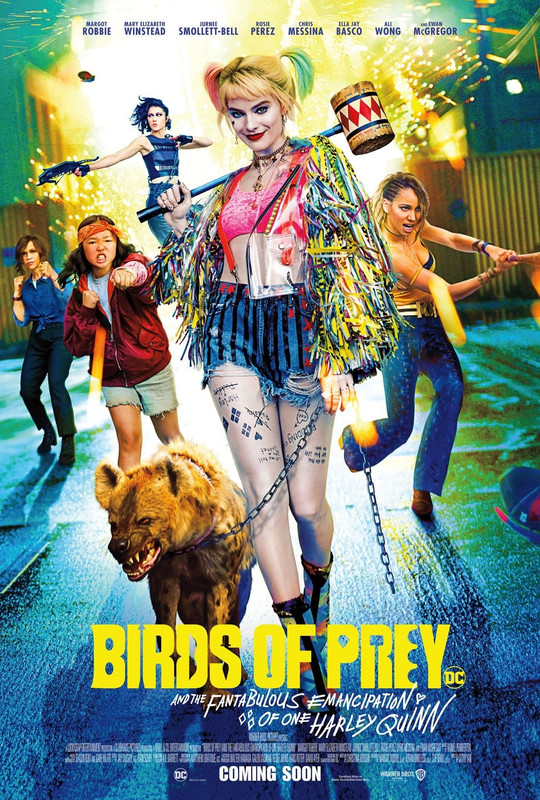
Birds of Prey and the Fantabulous Emancipation of One Harley Quinn [15]

Dir: Cathy Yan
The Marvel Cinematic Universe has changed cinema. I’d argue that one of the main reasons it managed to do so - even with its early stumbles and subsequent formulaic nature - is that it has been meticulously planned. From right at the beginning, it was clear there were two things at the heart of the MCU: vision and patience. By contrast, DC’s cinematic universe has always felt chaotic. The DCEU, whatever its merits, has never found the clear overarching identity the MCU has. It has taken a scattergun approach to universe building, and still doesn’t seem to have got its feet under it.

Suicide Squad was a mess. It promised something relatively novel: a team of villains becoming reluctant and sardonic heroes. It had a good trailer, but it was undone by a screenplay that made little sense and an obnoxious montage structure that meant the film spent what felt like half of its running time just introducing the characters. The one thing that did work, and the breakout success of the film, was Margot Robbie’s funny and mischievous performance as Harley Quinn, who she made both dangerous and entertaining. It’s no surprise that the first thing to come out of Suicide Squad was - almost - a solo film for her.

Christina Hodson’s screenplay picks up with Harley very much a solo act, her break up with the Joker has made her a target for the whole Gotham underworld and particularly for Black Mask (an over the top Ewan McGregor with a shaky accent). Given a day to recover a diamond taken by a young pickpocket (Ella Jay Basco), Harley ends up teaming with Black Canary (Jurnee Smollet-Bell), Huntress (Mary Elizabeth Winstead) and an ex-cop (Rosie Perez) to take down Black Mask.

Much like its title, this is a film of two halves. It begins with the Fantabulous Emancipation of One Harley Quinn. She is cut loose not only by the split with Joker enabling her to become more than a muse and homicidally crazy sidekick, but by the film itself. The rating is bumped up to an R. This allows for more graphic violence (Harley jumping on a man’s outstretched legs, breaking them) and for her to finally be “Harley fuckin’ Quinn”. This section of the film is fitfully funny, but there are a lot of scenes that play variations on a theme. It’s fairly slow going, but invigorated by Margot Robbie’s boundless energy and her sheer commitment to the bit. Things pick up in the second half, as the Birds of Prey form. Harley is an entertaining character, but she’s a little tiring on her own, giving her a gang adds some variety and the all female ensemble steps up with a combination of toughness and wit. None are better than Mary Elizabeth Winstead, whose two action roles of the past six months (this and Gemini Man) have finally delivered on the promise of the Die Hard sequels that underused her. She’s great here, whether stabbing a henchman as they ride down a funhouse slide or repeatedly getting cut off as she tries to dramatically announce her supervillain name.

It’s notable that much of the creative team here is female. Birds of Prey is hardly a political statement, but the difference is easily seen, with Robbie far less objectified here than she was in Suicide Squad. That said, it’s fair to say buns are still fetishised, only this time—in one of the film’s funniest moments—it’s a bun holding Harley’s ideal breakfast sandwich. In only her second feature, Cathy Yan makes an effortless transition to big scale filmmaking, marshaling better action scenes than most of her male competitors in recent superhero movies and Christina Hodson delivers another quality blockbuster script, following her work on the underseen Bumblebee.

One of the major problems of superhero films is that so many end the same way: a skybeam and a few blobs of CGI fighting. Yan and the action team do a fine job evading that cliché. Throughout, the fights are impressive and manage to throw some laugh out loud moments in with the violence. The combination never works better than in the third act funhouse fight, which plays as an excuse for all the departments: set design, props, stunts to throw everything at the wall and, as long as it can be done practically, see what sticks. It’s shot and edited with a sense of flow, shows clearly that the cast are doing as much stunt work as possible, and jammed full of great gags.

Birds of Prey has its issues (a weak villain and a relatively slow first act), but the pared down  (yet more impressive) action, Robbie’s performance and chemistry with her cast mates, and the sheer sense of fun make them feel pretty inconsequential as you’re watching it.
★★★½

Mar 1, 2020

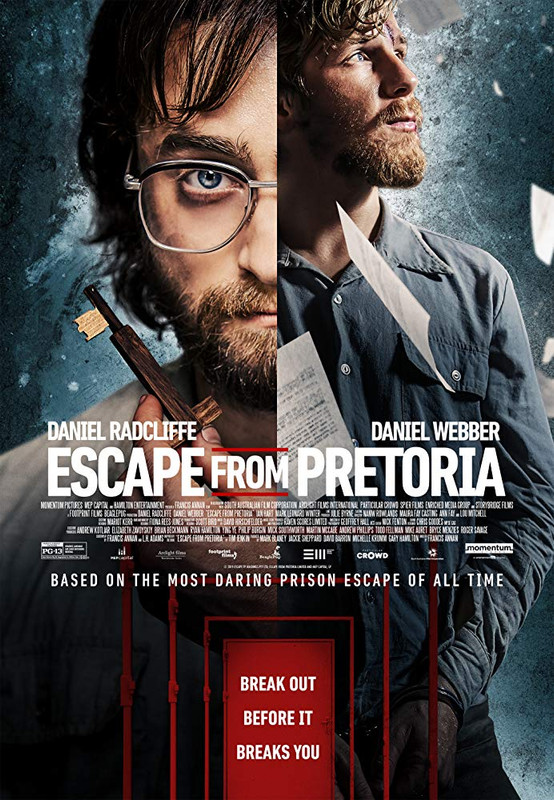
24FPS @ Glasgow Film Festival 2020: Escape From Pretoria

Dir: Francis Annan
In 1978, ANC members Tim Jenkin and Stephen Lee (Daniel Radcliffe and Daniel Webber) were sent to Pretoria Prison in South Africa for a series of leaflet bombings in protest against the government and its apartheid regime. They immediately began plotting their escape; observing the guards keys and cutting wooden replicas. 

You couldn’t accuse Francis Annan’s film (his first widely released feature, following shorts and TV work) of lacking focus. The preliminaries are dealt with quickly, with Jenkin and Lee’s last leaflet bombing, their arrest and their trial all neatly dealt with within the first 12 minutes or so. The politics are given context just as quickly, but the film assumes you understand what apartheid was and settles into its main focus; the meticulous preparations for the escape of Jenkin, Lee and Leonard Fontaine (Mark Leonard Franklin), a fictionalised version of third escapee Alex Moumbaris.

The process scenes are interesting; the trial and error of making keys precise enough to work and finding ways to hide the various implements needed for the escape. Annan is also able to leech painful tension out of practice runs of the escape. Because the replica keys are made of wood there is a constant, gnawing, nervousness that one might break off in a lock, and in one sequence the tiny creak of a cupboard door is enough to set us on edge. What we miss is some of the behind the scenes process, which could have added greater context to a film that often makes it feel as though this plan was entirely, if meticulously, improvised. A little reading demonstrates that’s far from true.

In focusing in so completely on process, Annan and his co writers sacrifice some character writing. Tim is the stoic hero whose resolve and planning are carrying the day, Leonard the family man missing his kid. Stephen Lee on the other hand, almost entirely disappears. Daniel Webber is fine in the role, but I couldn’t tell you much about Lee’s personality. Radcliffe is also pretty good, his accent wobbles from time to time, but his natural nervous energy works particularly well in a scene in which the keys are almost discovered, as we can see his Jenkin holding panic just below the surface.

The issue with Escape From Pretoria isn’t that it’s a bad film, it has a few standout moments (the use of a plunger to add tension in the final scene comes to mind), but most of it feels pretty standard issue. Everything; acting, camerawork, writing, is solid but there is little inspired here, little we’ve not seen before. At its best the film resembles Escape From Alcatraz, but that’s not entirely to its benefit, because it never meets that level and doesn’t really utilise some of the meatier political context available to distinguish itself from that or many other prison break movies.
★★½

Feb 7, 2020

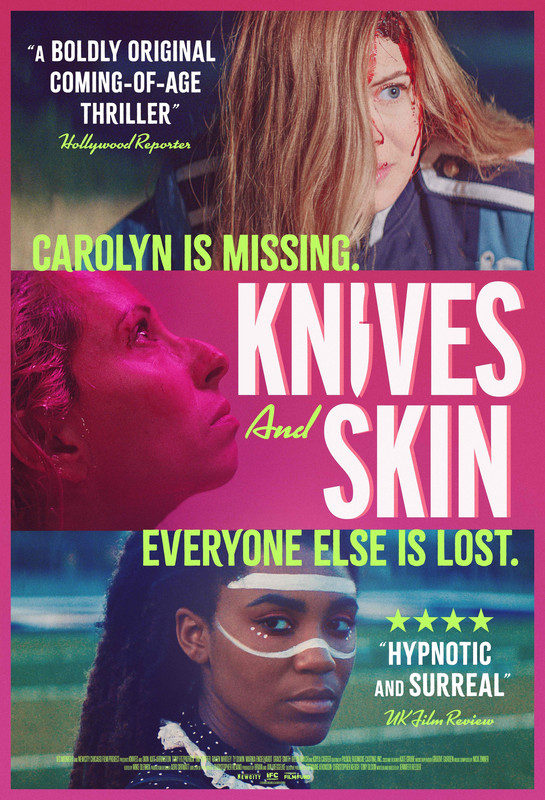
Knives and Skin

Dir: Jennifer Reeder
I’ve only seen a handful of Jennifer Reeder’s short films, but this feature feels like a logical extension of them. Those shorts screened in the London Film Festival’s Experimenta programme, but I always believed I saw Reeder’s interest in genre trying to force its way through her more abstract imagery. The images may lean more towards traditional narrative cinema here, but the tone remains deliciously off-kilter, in a way that draws us into what feels like a reality-adjacent world where Reeder is in full control.

15 year old Carolyn Harper (Raven Whiteley) has gone missing, and the film explores the aftermath of her disappearance and its effect on the small town she lives in; her peers at school, as well as her mother, Lisa (Marika Engelhardt) and the other adults in the community.

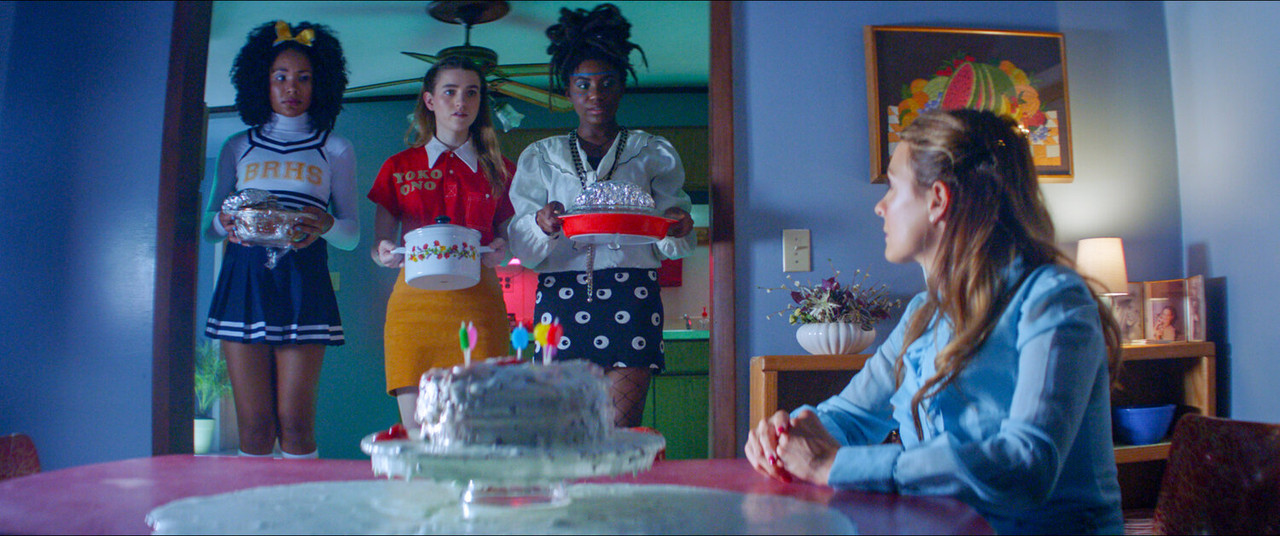
As befits a director with Reeder’s experience, Knives and Skin is, from the first frames, a supremely confident film. We are thrust straight into its neon-dipped world, discovering Lisa looking for her daughter, knife in hand, then pulling on one of her daughter’s dresses when she finds her gone. This sets a mood for the next 110 minutes, establishing the slightly off feeling of the film’s world, the bright and bold look and the way it mixes a wide streak of humour into its overwhelmingly melancholy tone. There is so much going on here, so much that Knives and Skin is about. On the surface, it’s largely about how a single death—even that of a person who may not have been especially popular—can echo through a community, but look beneath that and there is a film about girls and women, about feminism and representation, about relationships, about high school and about high school movies. Even that list doesn’t cover all the bases. 

Everything is filtered through Reeder’s dialogue, which has a very specific feel. It takes a moment to adjust to at first, but soon we and the film settle into its rhythm. Soon after her daughter has disappeared, Mrs Harper is talking with the local Sheriff, who says that he’ll get his wife to make her a casserole “I don’t think it’s time yet for casserole”, she replies. This moment distills the dialogue style beautifully; the cadence is slightly off, but the words themselves are expressive and full of underlying meaning. We know from the start that Carolyn is gone but in this moment her mother isn’t ready to give up hope that her daughter will be okay.

Other themes are also explored. The film is timely in its feminist approach. Early on, Reeder looks to reclaim the depiction of girls in teen movies. As Joanna (Grace Smith) and Jesse (Robert T. Cunningham) discuss their relationship to Carolyn he says “She could be pretty mean, so can you”. “That’s all we’ve got”, comes the reply. This feels like a direct riposte to the stock character of the popular bitchy girl, and also an acknowledgment of how women, whatever age, are judged more harshly for not appearing ‘nice’. We don’t actually see much meanness between the girls, but Joanna has a hard side, expressed to exploitative men in her life—a line about a sandwich near the end of the film is, remarkably, both laugh out loud funny and properly rousing. The film’s thesis statement about high school girls, if it has one, comes towards the end when Laurel (Kayla Carter) tells her soon to be officially ex-boyfriend “I’m not a bitch, I’m not a slut, I’m not a tease. You treat girls like shit”. It’s a powerfully blunt statement, later underlined in a perfect visual moment.

These are just some of the ways in which Reeder tries to get us to look askance at high school movies of the past, while also making clear her respect for the genre. Much of the film’s last fifteen minutes seems dedicated to this idea of depicting familiar moments but putting a twist on them. For instance, there is plenty of buildup to the homecoming dance, but it’s a performance by Charlotte’s band, rather than the date the film has been setting up, which ends up being the most important part of the scene, while a potential suicide scene becomes one of the film’s most hopeful and funniest (Joanna: “Please don’t jump, you’ll make a mess down here and it’s already such a fucking mess down here”) 

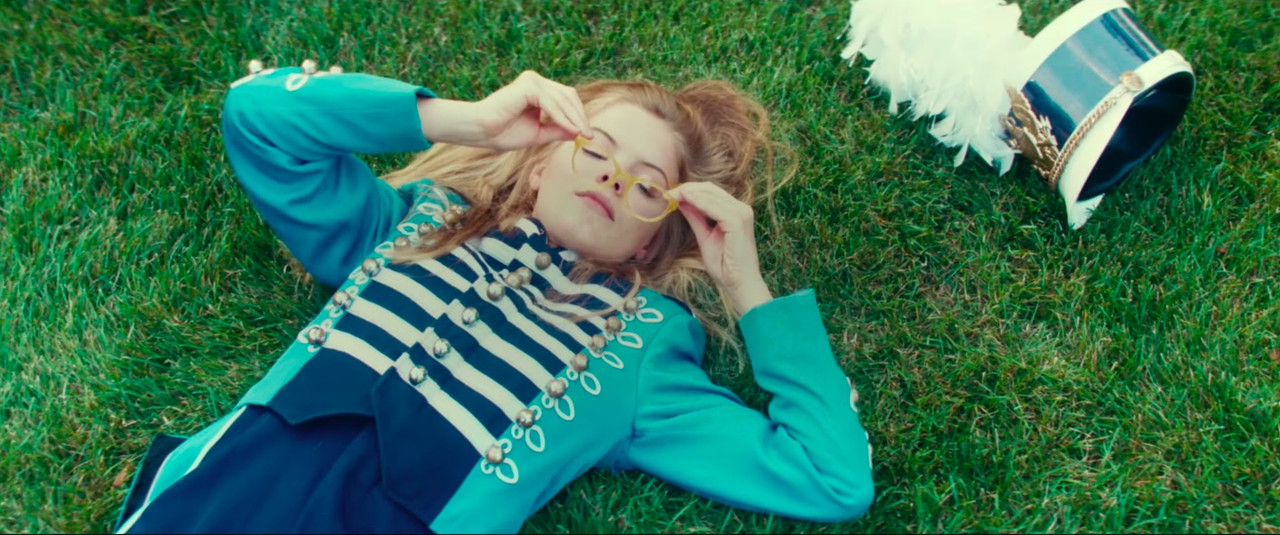
Of course, meaning is unpacked in the visuals as much as in the dialogue. Clothing, in particular, is given great significance. Several things related to Carolyn (her blood, a scratch she makes on her would-be boyfriend) glow, but it’s her glasses that become something of a talisman, spending the majority of the film shut away in a school locker, emanating a neon light, like the last piece of energy left from Carolyn trying to reach out into the world. For the other characters, clothes are a signifier of who they are (or would like to be), whether it’s Joanna’s T-Shirts, all monogrammed with the names of women like Angela Davis, Yoko Ono or Joan of Arc, her mother’s (Audrey Francis) Lion T-Shirt, or Charlotte’s (Ireon Roach) striking make up, and eventual acceptance of a pink homecoming dress. This is perhaps a little on the nose when it comes to Joanna’s dad; a literal sad clown who is cheating on his wife.

The use of music is striking throughout. Nick Zinner’s electronic score has a chilled ambiance, which pairs beautifully with the melancholy of the film. It’s not what you’d expect from the Yeah Yeah Yeahs guitarist, and is more reminiscent of Para One’s score for Celine Sciamma’s Water Lilies. However, the most daring use of music comes through the songs Reeder uses, largely 80s new wave hits sung by a choir coached by Carolyn’s mother. Some are staged simply as the choir rehearsing, but the use of Modern English’s I Melt With You is especially beautiful, as it’s sung by two girls falling in love, their faces and voices cross-fading into each other. These sequences are peppered throughout the film with such regularity that you could almost call it a musical, with each song serving a different emotional purpose within the narrative.

The performances from, at least to me, a largely unknown cast, are outstanding all round. Reeder has found memorable faces who deliver performances of great nuance. It’s worth noting Raven Whitely as Carolyn who, though she has relatively little presence in the film, establishes her character quickly in the opening scene and then haunts the movie, her presence hanging over it throughout. However, the two major standouts here are Grace Smith as Joanna and Marika Engelhardt as Lisa. Smith puts across a character who is extremely smart and uncompromising in her dealings with others, willing to exploit them, but there’s also a chink of warmth we can see under that shell, especially for her parents. It’s a terrific performance and should bring Smith a lot more work. Engelhardt’s performance is raw and vulnerable, dazed by concern but also trying to hold it together (“People keep asking me how I’m doing. It’s really annoying, but I know eventually they’ll stop asking, so I’m trying not to be an asshole about it”). Her best scene, and maybe the movie’s, comes when she gets into a boy’s car, believing she can smell how her daughter used to smell. It’s at once uncomfortable, deeply sad and blackly funny and Engelhardt hits every note perfectly.

There is so much still to say about Knives and Skin, whether it’s the production design (the tinfoil wrapped pillows Joanna’s mother sleeps on; Reeder's nod to her short Blood Below the Skin) or the darkly comic incidents (the reveal about the sheriff’s wife’s pregnancy). On an analytical level, I’ve only scratched the surface of what I have read into it, and I’m sure further viewings will prompt more ideas. This is all to say that this isn’t just a great film (though it is), but that it’s an interesting and deeply rewarding one that will have you turning its images and ideas over in your head long after the credits roll. Seek it out immediately.
★★★★★

Jan 31, 2020

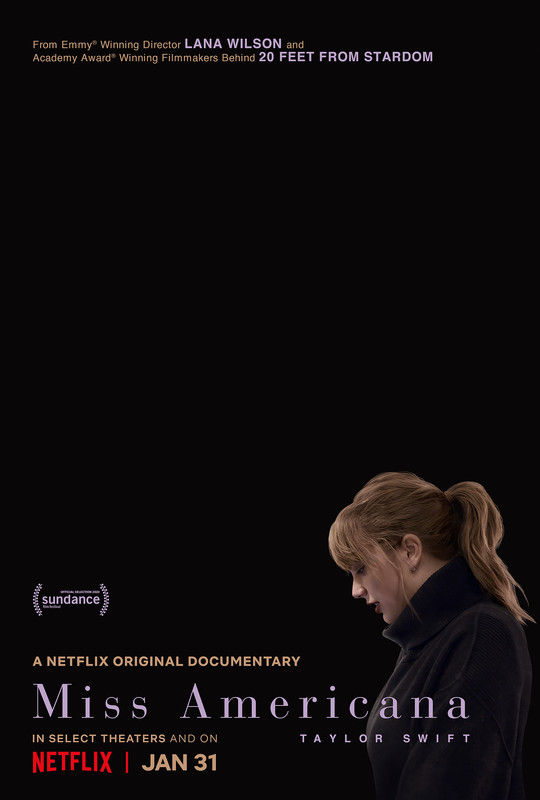
Miss Americana

Dir: Lana Wilson
Among my peers, being a Taylor Swift fan is perhaps not the most fashionable position I hold. I am a fan though. Particularly since her third album, Red, I’ve found her a talented songwriter with a knack for a well-turned lyric and, even when the record doesn’t work (as Reputation, for me, largely didn’t), her tendency to wear her themes on her sleeve means that she’s seldom less than interesting.

Lana Wilson’s documentary picks Swift up after the release of Reputation, and follows her through some of that tour and the writing and recording of her most recent album, Lover, while also looking back at her whole life as a performer. It’s a lot to try to do in 85 minutes.

Surprisingly for a film about someone who has spoken on a global scale for over a decade, Miss Americana’s overarching narrative is largely about Taylor Swift finding her voice. Swift has always been confessional in her songs, writing about boyfriends and breakups, about haters and feuds. Despite this, until an intervention in the 2018 midterm elections, she’d never (aside from supporting her LGBTQ fans) taken clear political positions, leading some on the right to assume that she was on their side and simply afraid to say so, because of potential backlash. 

Some of the film’s most interesting material addresses this shift in Swift’s public engagement. We’re told how the sexual assault court case, in which she counter-sued a DJ who had been fired after he inappropriately touched her during a meet and greet, and then sued her for damages, was the tipping point for her wanting to speak out on politics on a bigger scale. This sequence leads into one of the few extended performance clips in the film, of Reputation highlight Clean. That song was always clearly about the case, but seeing them juxtaposed so closely lends even greater power to the performance. 

We also see how nervous this new political engagement makes Swift’s team, with memories of what happened to the Dixie Chicks’ career after they said a single sentence speaking out against George Bush, and the eventual result when she does put out a statement. This material is some of the film’s most honest, and it really does seem as though a switch has flipped in Swift when she’s talking about it. Early interviews (often used as voiceover) say all the right things, as she talks about always looking for—living for—approval, but these interviews feel a little stiff, like she’s trying very hard to make sure that every word sounds right. Later scenes and later interviews make very plain why she is so on guard. It feels as though a breakthrough comes in the writing of The Man, a standout track from Lover that imagines how people (the press in particular) might talk about Swift if she did all the same things, but were male. Set against an interview used as voiceover late in the film about the pressures and requirements that come with being female in the entertainment industry, that song gains even greater resonance as a woman working out what she wants to simply say, in the mode she’s always been most comfortable communicating in.

This material is honest, and shows a side of Taylor Swift that we’re not used to seeing. She also exposes other vulnerabilities she hasn’t acknowledged before, notably an eating disorder, which she now appears to be dealing with in a healthy way. For all the honesty though, this film does still feel like it is maintaining a carefully curated image. It plays like an approved product, eliding over some more uncomfortable moments (notably much of the Famous controversy with Kanye West) and not delving into the degree to which Lover feels like a naked course correction from the darkness, and sometimes the pettiness, of Reputation. This isn’t to say director Lana Wilson fails to get her subject to open up, but it does have a feeling of butting up against how much Swift wants to reveal: thus far, Miss Americana (both film and person) says, but no further.

The only times the film and Swift seem to fully escape this feeling of stage management is when they are fully embedded in the making of music. This is when we see Taylor Swift, seemingly, truly happy; humming melodies for producers to help her work on, filling in missing bits of lyrics, and the moments of joy when she feels she’s hit on something. Whether her music is for you or not, I think it would be tough to watch these sequences and say she doesn’t work hard at her craft or that she’s not doing exactly what she does best.

Neither Taylor Swift or Miss Americana are perfect, but they both have something to say, and they will likely both speak to a big audience who might not otherwise engage with these ideas in the same way. There’s a lot to be said for that.
★★★½

Jan 25, 2020

The Grudge [2020] [15]

Dir: Nicolas Pesce
Horror moves in cycles. I really thought the Japanese ghost girl had been consigned to history, but here we are in 2020 and she’s back, once again in the form of a remake of Takashi Shimizu’s bafflingly popular Grudge series.

There are, to be fair, reasons for optimism. This is the third, and easily the highest-profile, film from director Nicolas Pesce. His first two—The Eyes of My Mother and Piercing—were each among the most visually striking horror films of the past five years, evidence of a genuinely exciting voice who, in Piercing, filtered Ryu Murakami's novel through Argento, but shot with a striking formalism and fashioned those influences into something perverse, funny, creepy and genuinely all its own. There is also the presence of British actress Andrea Riseborough; a performer of formidable natural gifts who should be a star, and might be but for her often terrible nose for screenplays. 

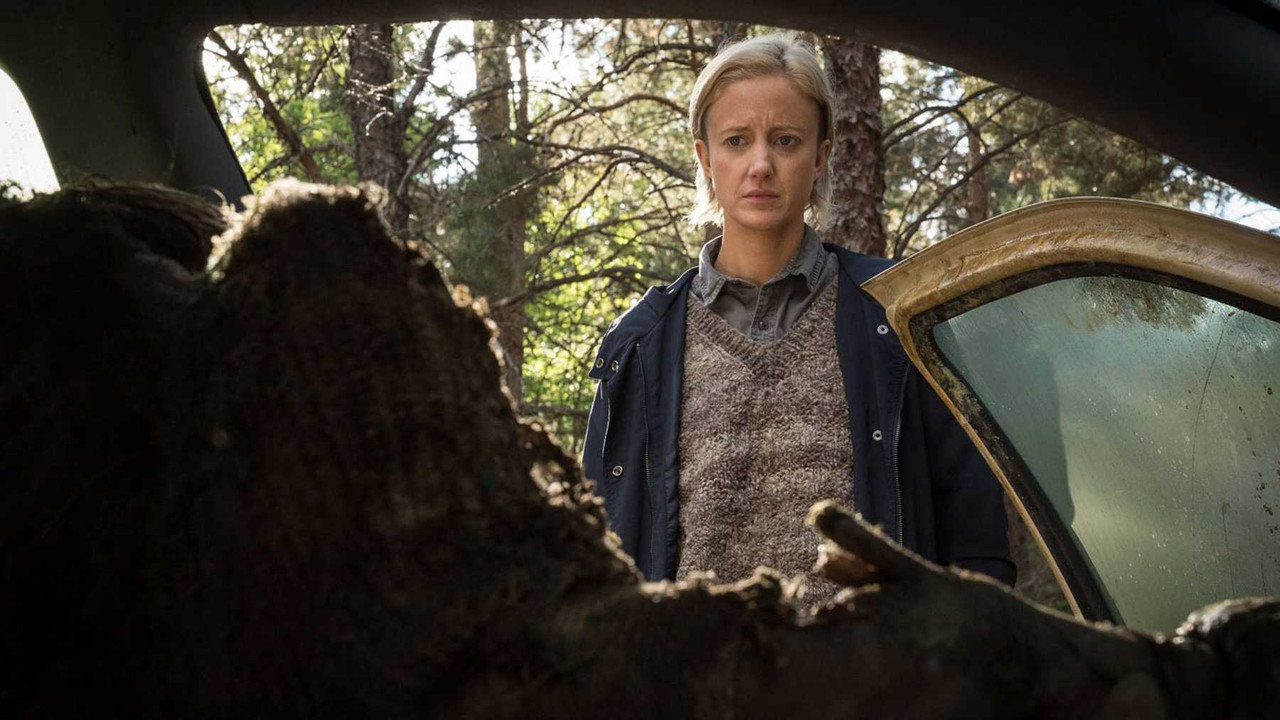
Riseborough plays Muldoon, a cop who, following the death of her husband, has recently moved to a small town with her young son. With her new partner Goodman (Demian Bichir) she is assigned to a dead body found in a car. Discovering that the body is that of a woman who went missing from a house where an entire family previously died violently, she goes to investigate. After she leaves the house she can’t shake the feeling that something has followed her.

Splitting his narrative into three strands, set in 2004, 2005 and 2006, Pesce has plenty of plot to unfold (much of it, in the 2006 story, told largely unbidden to Muldoon by a character we’ll simply call ‘Exposition Cop’), but that’s not to say that he finds any new ideas here. The stories don’t really join up. We get no sense of what initially brought the spirit from Japan to this house. Despite setting up a couple of interesting ideas around possible deaths, be it a couple’s (John Cho and Betty Gilpin) option to abort a baby that is likely to have birth defects or a long married couple (Lin Shaye and Frankie Faison) looking into assisted suicide for the cancer stricken wife, the writer/director does nothing to tie these ideas into the film’s threat. 

Pesce displays so little interest in the why of the ghostly presence that we never have any idea of what the scares mean. Is this a vengeful presence? If so what does its vengeance mean when taken out on the random people who happen to move into this house? Does the presence simply want the house to itself? This doesn’t seem like the answer, because the film implies that further victims are also tied to the house. These questions aren’t particularly novel or interesting, and nor are the prospective answers, but at least attempting to answer them would give the film something to be about.

As it is, Pesce works his way, seemingly wearily, through the playbook. Things go creak, things go boo, things grab at people from bathtubs full of dirty water, long haired girls stand menacingly with their hair over their faces. For the most part, the film looks drab. It has none of the sharp lines, inventive framing or stylistic verve of either of its director’s previous films. The last ten minutes bring a handful of shots, most notably some violence that looks like it’s out of a graphic novel, framed against a window with stained-glass detailing, that feel like they find Pesce firing on at least a few cylinders. Otherwise, this is the most complete subsuming I've seen for years of a promising director’s personality beneath the mediocrity of a project.

The supporting cast are, to their credit, trying. Lin Shaye and Frankie Faison are an interesting enough pairing and the basics of their backstory are touching enough that you wish that this couple could have been characters in a different movie, and John Cho and Betty Gilpin’s story has similar promise, one scene, of the two of them on the phone discussing whether to keep their baby suggests, like Shaye and Faison’s story, a more interesting film we could be watching. Unfortunately, both of these storylines are interrupted at regular intervals by rote jump scares, because this is a Grudge movie and the wheels of the Scare O Matic must turn.

The main storyline is the weakest section of the film. Riseborough and Bichir have no chemistry, build no relationship we can invest in, and both seem like deeply substandard cops (the plot point of Goodman having ‘investigated’ a previous case in the haunted house without ever entering it is risible). The investigation narrative goes nowhere, the flashbacks to the past of the house are never triggered by anything Muldoon or Goodman do. This is painfully lazy screenwriting, simply neglecting to do the most basic of jobs. This also applies to the depiction of Muldoon’s son (John J. Hansen), who is such an afterthought that the movie forgets about him for ages, then, to remind us he exists, inserts an otherwise purposeless scene of Muldoon bringing him to work, Goodman gives him 48 Hours to watch, then the scene ends. It does nothing within the narrative and doesn’t even have the excuse of being funny to fall back on. 

For me, the entire ghost girl sub-genre was always difficult to take seriously, and after Sion Sono’s wicked parody Exte (which also works as maybe the best and creepiest ghost girl film I’ve seen), it seems even more redundant. This umpteenth revisitation of The Grudge does nothing to change that. Sadly, the only thing of note it manages is tarnishing the reputation of one of horror’s most talented and promising young filmmakers.

Jan 18, 2020

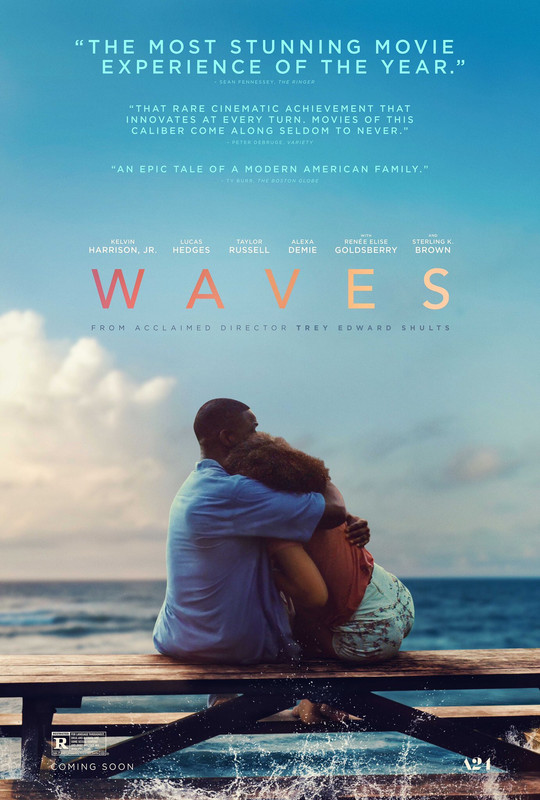
Waves [15]

Dir: Trey Edward Shults
Writer/Director Trey Edward Shults impressed me with his second film, the low-key horror inflected family drama It Comes At Night. His third, as its title might suggest, is bigger and more expansive, yet it remains focused on the small dramas of a family in Florida, dramas which sometimes boil over into life altering moments.

Tyler (Kelvin Harrison Jr) is from a solidly middle class family; a good student, wrapped up in his beautiful girlfriend Alexis (Alexa Demie), and a star on the high school wrestling team. He’s also often under pressure from a demanding father (Sterling K. Brown) and a combination of injury and unexpected news begins to send him off the rails. In the second half of the film, Tyler’s sister Emily deals with her own pain and guilt through a relationship with one of Tyler’s teammates, Luke (Lucas Hedges).

Waves are unpredictable and, like its namesake, this film moves in different ways through its 135 minute running time. At times, it crashes relentlessly; all furious noise and violent emotion, in other moments it gently rolls; time passing in something like a distracted haze. Shults balances these different moods beautifully. He evokes them through the use of his camera, for instance, the endless spinning of the opening sequence throws us into the noise of the lives of its young protagonists, while the off balance stalking quality of a sequence at a party strikes a note of foreboding that turns Waves into a horror film for about ten minutes. The shot composition is often masterful, and called particular attention to by the shifting aspect ratios which move us between the acts. The first of these is especially striking, as in one instant a single act metaphorically shrinks the world in which Tyler, and consequently his family and friends, exists, sending the film into 4:3 ratio. The ratio continues to shift throughout the film. Remarkably, Shults manages to do this without it feeling trite, rather each time it happens - always preceded by a brief blackout - the film is taking a breath and resetting; into panic as walls instantly close in the first instance, and later to a more expansive experience and finally back to the sure footing of the first ratio we saw. It becomes a key part of the film’s emotional journey, both for the characters and for us.

While Shults’ visual craftsmanship is often what commands the attention, it is underpinned by some outstanding performances. Sterling K. Brown plays Tyler and Emily’s father as a man we are given to believe has pulled himself up through hard work, and is sometimes too tough on his son in his desire to bring that same commitment out of him. This toughness is what we see for the bulk of the first act (which takes up the first half of the film), but the second and third reveal it as a shell that can be cracked, in some of the film’s most emotionally wrenching scenes. Good as Brown and Renée Elise Goldsberry (as Tyler and Emily’s stepmother) are though, this is largely a coming of age story, and as such it centres on the younger actors. Kelvin Harrison Jr gives a performance of building resentment as Tyler’s denial about his terrible shoulder injury builds and his anger at his father and at his girlfriend; one for pushing him too hard the other for, in his mind, pushing him away. It would be easy to hate Tyler, but the film establishes him initially as a nice kid, we can understand if not sympathise with his denial and his rage - at least towards his injury - up to a point. The final moments of the first act are brutal; a momentary act that echoes throughout the film and will do for all the characters long past the credits, and the second, third and fourth acts all ask us to dwell in the aftermath of that act from an angle we don’t often see. Harrison is outstanding in the part, the pressures Tyler feels and the sense of loss at what to, whether it’s to avoid disappointing his dad or to win back Alexis, is always at boiling point inside him.

The second half of the film, broken into its last three acts, largely turns the focus on Emily and on her budding relationship with Luke. Taylor Russell and Lucas Hedges establish a warm and naturally growing chemistry, begun with a perfectly awkward scene of Luke asking Emily out, which seems designed to play as the direct antithesis of Tyler and Alexis’ fast burning and eventually angry story. This is certainly a more typical coming of age story than is presented in the first half, but it too is suffused with the striking colours and inventive camerawork that Shults brings to the telling. Russell and Hedges are both wonderful, and it’s the first time I’ve really bought into the hype around Hedges. That said, the standout scene of the second half isn’t between them but between Russell and Sterling K. Brown, as Emily and her father finally talk about the emotional fallout of what happened with Tyler and Alexis.

Waves isn’t perfect. Shults’ Malickian shots of people leaning out of car windows and his colour wash transitions can feel a little self-indulgent at times, and much of the final section of the film is spent on a storyline that has barely been seeded and feels like a digression from the main thrust of the film. However, if the film doesn’t hit the bullseye on every emotional target it takes aim at, those it does strike resonate powerfully and for a long time.
★★★★