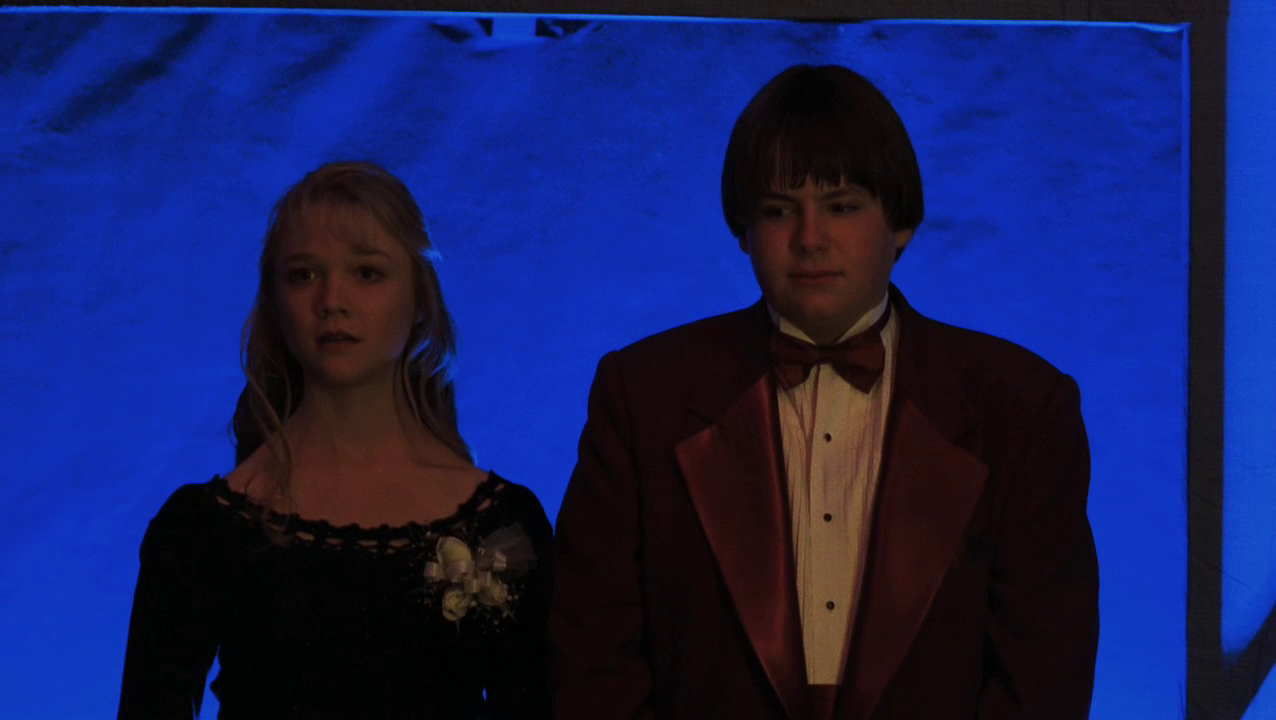
Showing posts with label Teen Movie Thursdays. Show all posts

Jun 7, 2018

Teen Movie Thursdays: Nordic coming of age movies

Right On, Man
Dir: Tapio Suominen

This realist Finnish coming of age film, with what seems to be a largely non-professional cast, doesn't appear to have traveled much, but it will be of interest to fans of Aki Kaurismäki, because it features the screen debut of his frequent collaborator Kati Outinen, though in a relatively small part.

The film focuses on a secondary school class for problem kids, all of them boys except for Outinen's Lissu. Initially, it explores the dynamics between the class, but as the film goes on the focus narrows to concentrate first on the dynamic between Jussi (Esa Niemelä) and Pete (Tony Holmström), as they drift further from the class and from their families, then solely on Jussi, as he isolates himself more and more, before potentially looking to Lissu to find a way back in.

Right On, Man paints a fairly bleak picture of teenage life. You get the sense of these kids as drifting, even before we spend an extended evening with Jussi and Pete, as they roam the streets, drinking and spending the proceeds of a robbery that Jussi pulled off. What hits home, even through sometimes uncertain performances, is the credibility of the whole thing. The dialogue has a natural feel, from the way the kids relate to each other to their dismissive attitude to their teacher (Lissu has a habit of walking away, so much so that in the class portrait that gives us the actor's names in the opening credits, Outinen's is over an empty chair).

Tapio Suominen gives the film a strong sense of time and place. We get a feel for the environment these kids are growing up in and the sense that they probably don't see particularly prosperous future. The dramas here are small, but Suominen builds a couple of threads that run through the narrative, even though they are largely off screen. The bad impression Jussi makes on a beat cop and Jussi's potential interest in Lissu (and hers in him) are both seeded early, only to come back around in a sequence that draws together well.   

If you're coming to the film for Kati Outinen, it's worth noting that she's barely in it until fifteen minutes from the end, when Jussi and Lissu re-connect. It's a lovely sequence and Outinen is charming and natural in it, it's easy to see why she might have been noticed, but this is a very small part. Fortunately, Right On, Man offers many other rewards; it's a well observed teen movie with a sense of verisimilitude and an unobtrusive style that draws you into the story and characters. It deserves to be better known.
★★★

Lars Ole, 5C
Dir: Nils Malmros
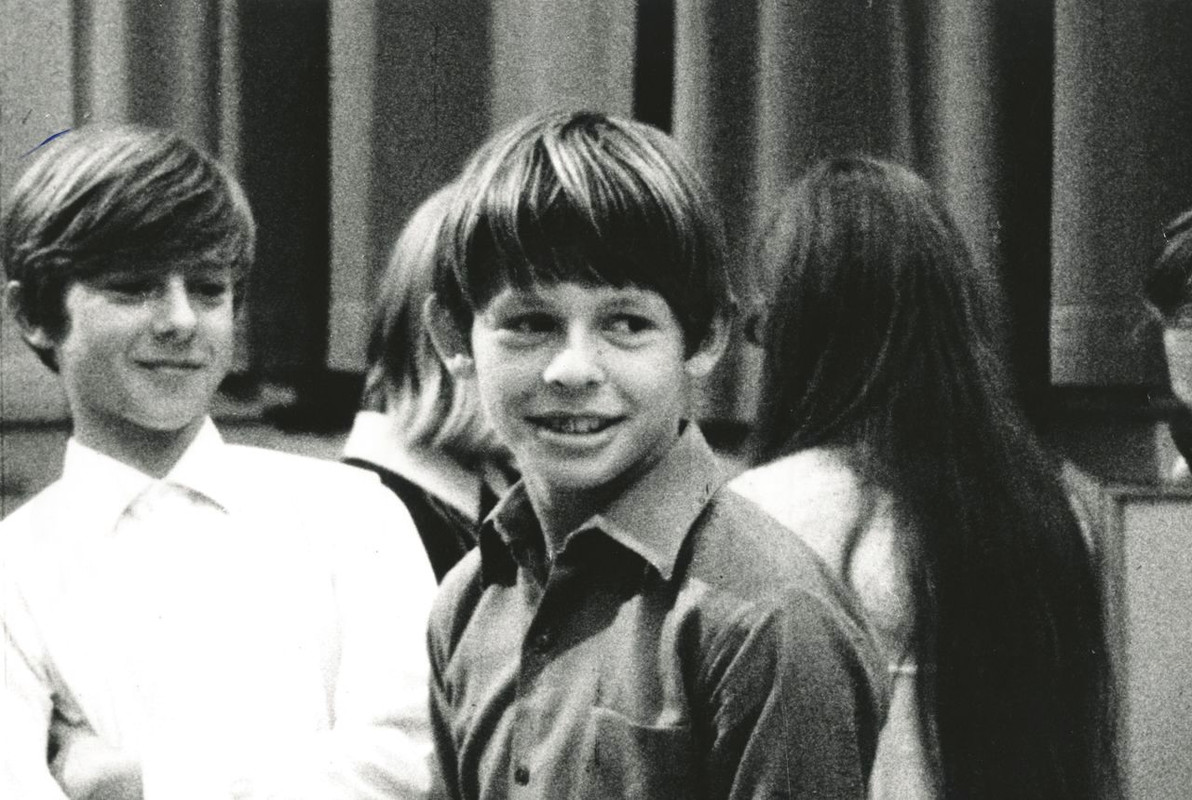
As far as I can tell, Nils Malmros is barely known among English speaking audiences. That needs to change. While he has moved outside the genre, Malmros has, for fifty years now, specialised in coming of age films. The best known is Kundskabens Trae (Tree of Knowledge), listed by the Danish Film Institute as one of the country's 100 greatest films, but this - his second feature - seems to be the film that established Malmros' reputation.

Drawing heavily from his own life, Malmros tells a low key story of 12 year old Lars Ole (Søren Rasmussen) and his classmates. There are petty rivalries, first crushes and moments of childlike mischief, but Malmros' concern isn't big events but the tiny things that shape day to day life when you're somewhere between childhood and adolescence.

Shot on grainy black and white 16mm, the film has a feeling of something observed more than it is staged. Frequently, moments that would have much more emphasis in another film are allowed to play out quietly, often in the background. A good example of Malmros' restraint comes when Lars Ole is being a pain, playing the wrong notes while his sister is practicing the piano, when he makes her cry, the camera views her through the door, before silently showing Lars Ole realising he's upset her more than he meant to. It's a beautifully subtle bit of acting and camerawork that makes us feel as if we are privy to a real moment.

We see a lot of these subtleties in the way the film depicts the politics of the playground, the games of tag and which kids are allowed to play or not, the dominance that older kids are able to exert. This is never more felt than in the way relationships are navigated. Early on we see that Lars Ole has a crush on Inger (Judith Nysom), who is 'dating' Hanse (Lars Randrup Mikkelsen), the way the camera often dwells on the space between them is clearly designed, yet feels totally natural, even in the final sequence when, at a dance, we see Lars Ole join in a square dance, changing partners as he goes and waiting for his brief chance to dance with Inger.

The relationships between the kids, whether it's the rivalry between those who live in a certain apartment complex and those who don't, the pettiness of who is allowed to play tag or not or the teasing and games in the classroom, ring completely true. The performances - all by non-professionals who seem not to have acted again - feel completely unforced, nobody seems to be playing a character or reaching for an emotion at any time.

I've now seen six of Malmros' films, and this is early evidence of his instinctive feel for how to tell a story from a young person's point of view. It's a beautifully constructed film, you feel Malmros' direction rather than seeing it, in that his choices are affecting and clearly purposeful, but barely seem designed. If you have even a passing interest in coming of age cinema, this is a filmmaker you need to discover and Lars Ole, 5C is a perfect entry point to his exceptional filmography.
★★★★★ 

Jun 22, 2017

Teen Movie Thursday: Two Remakes

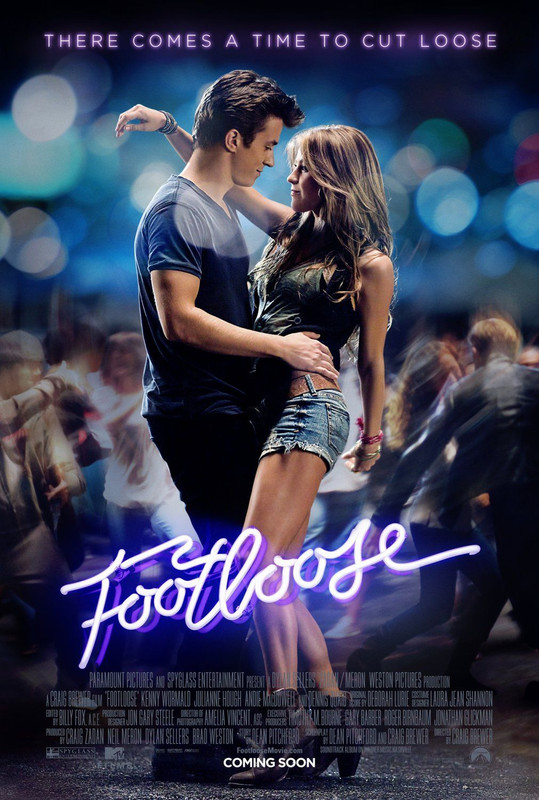
Footloose [12] [2011]
Dir: Craig Brewer
Remakes, one of several crutches on which Hollywood is currently propping itself up. It seems as though any film with a slightly recognisable name can now be reconfigured for a modern audience and let's just say that the resulting films haven't always been noted for being better than those they're inspired by. Footloose is an interesting choice for dusting off. In some ways it makes perfect sense. The High School Musical and Step Up films showed that a young audience has an appetite for seeing dance on the big screen and both music and dance have moved on significantly enough since 1984 that the film's big moments could avoid repeating those of the earlier version. On the other hand, does the story make sense in a modern context?

To its credit, the film works hard to lend some credibility to the idea that in 2011 there would be an American town that outlaws public dancing. The car accident that closes the film's exuberant opening credits is a shocking moment and it's not that much of a stretch to see a town whose lawmakers are especially conservative react to it with legislation that is both draconian and missing the mark in terms of what was actually to blame for that accident. You make the choice to go with it or not, if you can this version of Footloose has its rewards.

The basic story still sees rebellious teen Ren McCormack (Kenny Wormald) coming to town and butting heads with local preacher Rev. Moore (Dennis Quaid) over both the law against dancing and the fact that Moore's daughter Ariel (Julianne Hough) is showing a lot of interest in this boy from out of town. The characters are rather basically sketched, there are a lot of Hicksville stereotypes, including Miles Teller in Chris Penn's role as Ren's friend who does not dance and Patrick John Flueger as a woefully broad asshole boyfriend that we all know Ariel will leave for Ren. There's also a thin role for Andie MacDowell as Quaid's wife. Even if you've not seen the original you know where this is going: Ren will get the girl and get the town dancing, it's really about execution and on that front there's good news and bad.

There is a gaping hole at the centre of this version of Footloose. Kevin Bacon was nobody's idea of a great dancer, but he is a great actor and more than that, simply by dint of his unique look, he's an interesting and memorable presence. Kenny Wormald is a very, very good dancer. How good? He used to be a backing dancer for Justin Timberlake. Unfortunately he looks like he rolled off the production line in a factory where Hollywood makes cute guys you can't tell apart. His acting doesn't help. It's not that he's bad, he's just clearly not been cast as an actor first and his work is flat and bland. This bites hardest when Ren goes up against the town council. When he should be fired up and getting the crowd, if not the council, behind him, Wormald just doesn't have the presence to pull it off.

I can't help but feel that Miles Teller, who is able to carry himself on screen with an arrogance that would work for the way Ren initially looks at this hick town he's ended up in, and who is a proper actor, would have made for a better lead. He's clearly not the dancer Wormald is, but he acquits himself well enough in the last number that it seems likely he could have picked up those skills. As it is, Teller is in appealing mode here and he has fun, making an appropriate analogue for Chris Penn. 


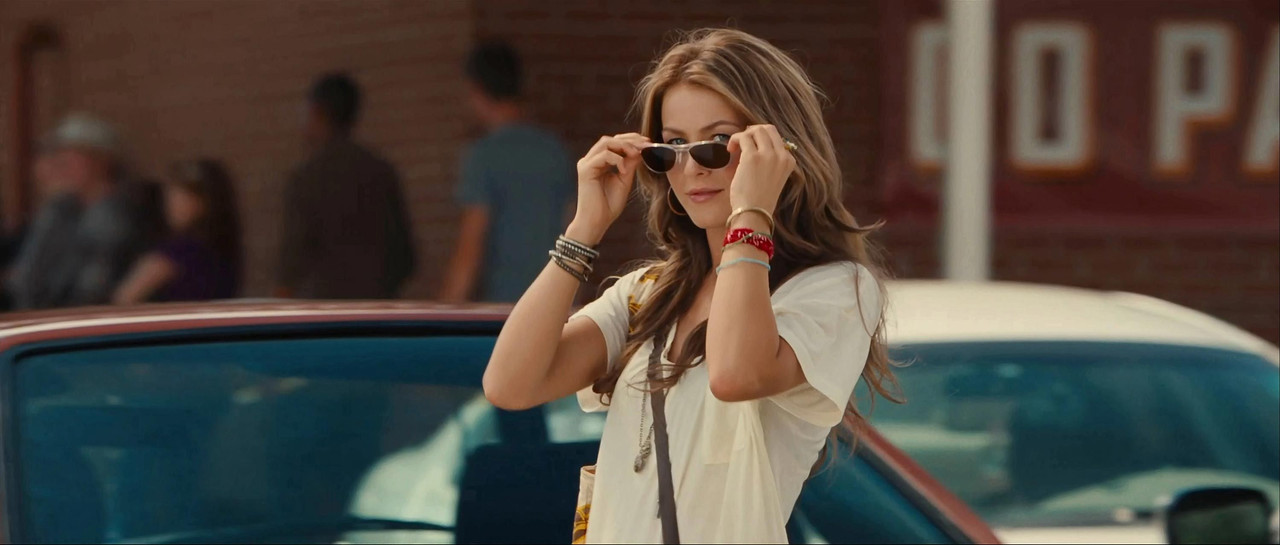
As with Wormald, you suspect that Dancing With The Stars pro (and now judge) Julianne Hough was cast for her dance background and small town Barbie look rather than strictly for her acting, but she does more than Wormald can with a thinner part. When there's finally a proper dramatic note for her to play, Hough is pretty good as Ariel confronts her Father, in his church, after she's been assaulted by her now ex boyfriend. Dennis Quaid is one of the better things here on an acting level. He's got a sliminess to go along with his charm that suits this part well. You can believe him as a preacher and as convincing speaker on the town council. He's one of the things that makes the anti dancing law feel somewhat plausible, because you can see how he could talk people round to his rationale for it. The character is on the two dimensional side, but Quaid is always worth watching.

The dancing, more than any of the actors, is the star of the film and Craig Brewer gives those moments prominence and makes each feel a little bit different. There's hip hop dancing in an early scene where Ren and Ariel first spot each other, line dancing at a club and Ren has a contemporary number when he's trying to get out his frustrations. It's all well executed, impressively choreographed and entertaining. Wormald and Hough both communicate as much character through their dance numbers as they do through any dialogue, more in Wormald's case.

Footloose is a pretty middle of the road film, slightly less interesting than the original as a piece of drama but probably better if you're coming to it purely for the dancing and the music. It can stand relatively well alongside the 1984 film, but I'm not sure its generation will end up holding it in quite the nostalgic glow the original has around it.
★★★

Prom Night [15] [2008]
Dir: Nelson McCormick
The slasher often seems seems the laziest of sub-genres. Get a bunch of attractive young people, put them in an isolating situation, add someone with a signature weapon (mask optional, but encouraged) and stretch as hard as you can until you reach 85-90 minutes. Job done. Perhaps lazier still is the slasher remake. The groundwork has been done, the situation exists and, depending how faithful you are being, so do many characters and even specific sequences. A remake in name only, Prom Night relies on its source film less than many, but make no mistake it remains a profoundly and painfully lazy enterprise.

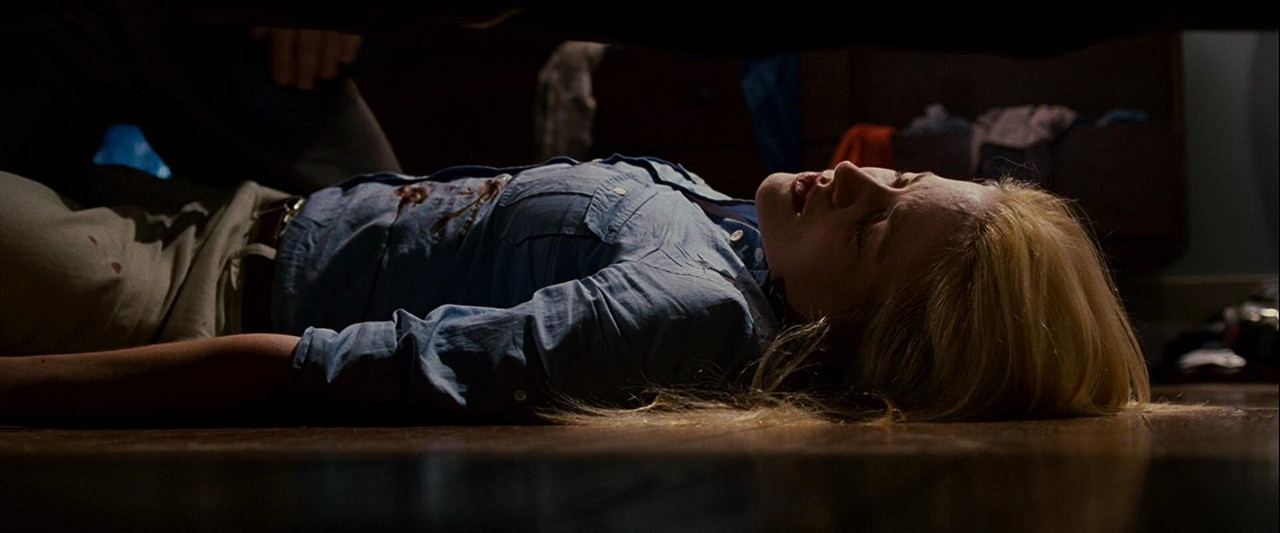
The film opens with a flashback to three years previously when a teacher (Jonathan Scheach) with an obsession with one of his students (Donna, played by Brittany Snow) murdered her entire family. The rest of the movie takes place on prom night, during which Donna's teacher escapes the asylum he's been confined to and plans to kidnap her from her prom. I'd have warned you of spoilers at the top of that paragraph but for two things: first, I would heartily discourage you from seeing this piece of shit and second, the blurb on the blu ray box also tells you the entire story, if they don't care why should I?

It's not necessarily the worst idea for a slasher to tell us who the killer is upfront. Genre classics like Halloween and A Nightmare on Elm Street don't trade on mystery, but they have killers who are terrifying and characters around them who are interesting, to say nothing of masterful, visionary filmmakers behind the cameras. Prom Night 2008 has a collection of pretty young ciphers and Nelson McCormick, a TV director making an almost determinedly anonymous feature début. 

The screenplay by J.S. Cardone, whose own first directorial feature The Slayer featured on the Video Nasties list back in the 80s, is terrible in every respect. The characters barely deserve that designation. Often in teen movies characters have to make do with traits (the Jock, the Bitch, the Brain etc) rather than full personalities. Cardone doesn't even grant his characters that. Brittany Snow's Donna is blonde. Her friends Claire (Jessica Stroup) and Lisa (Dana Davis) are brunette and African American respectively. Lisa's eye for men (“one of 'em was knida cute” she says when a group of men in their 30s or 40s hits on them) is the only thing I can remember as a defining trait for any of them. Donna is perhaps especially bland, and she's supposed to be our Final Girl. The supporting cast; the girls' boyfriends, Idris Elba as Detective Exposition and Jonathan Scheach as the murderous teacher, are no further developed. 

Cardone has one early idea that, while not overly original, might enliven proceedings. Donna is supposed to be traumatised by her experiences and is on anxiety medication. Just before she goes to prom we discover that she has been off her meds for a week. This could easily have been exploited to good effect: an anxiety ridden Donna, having actually seen her teacher, trying to convince her friends – who know her history – that he's really there and it's not the lack of pills talking. Cardone and McCormick could also have used this to create a sense of uncertainty in the audience, but this information is forgotten and swept under the carpet the second it's revealed.

As director, Nelson McCormick seems to go page by page through The Complete Hack's Guide To Making Your First Horror Movie. There are several jump scares in mirrors, two dream sequences, a series of repetitive, boringly shot murders and several iterations of the pulling back the shower curtain scare. This film could have been made by AI if you'd fed it the most repeated moments from the last 30 years of slasher movies.

The acting is bad, though perhaps not entirely the fault of the cast. Brittany Snow could have suggested her character's heightened anxiety, making something of the dropped plot point about Donna's meds, even if Cardone and McCormick forgot about it. Unfortunately this eludes her, as does any semblance of personality or much in the way of expression. Idris Elba is clearly paying his rent. He contributes a solid accent and says his dialogue out loud. The rest of the cast don't have to do accents, but manage the saying things out loud part of the equation. 

There wasn't much here for anyone to work with in order to turn in a good performance, but surely Jonathan Scheach should at least be able to seem creepy. He doesn't. We barely see him interact with Brittany Snow. His obsession isn't a strong thread at all. We should be feeling him in every shot, but instead he spends most of the film confined to the upstairs of the hotel where the prom is happening, pointlessly knocking supporting players off, which makes zero sense if we're to believe his objectives and that he has a plan to kidnap Donna.

Prom Night 2008 is an excruciatingly dull film. It pales next to its much more inventive source (and even more so next to the hugely fun, initially unrelated, sequel Hello Mary Lou: Prom Night 2). It's poorly directed and written, and acted by a near comatose cast. The audience will be in the same state by the end of this cinematic anesthetic. 

Nov 19, 2015

Teen Movie Thursday: I Declare War and High School Musical

The review of I Declare War was originally written for Verite. Many thanks to them for allowing me to reproduce it here.

I Declare War [15]
Dir: Jason Lapeyre / Robert Wilson
“What are you doing after the war?”  

“You're coming over, we're eating pizza and watching a movie”.  

With this early exchange, I Declare War establishes the offbeat comic tone with which it will bend a host of war movie clichés, affectionately riffing on the pre-teen politics of friendship and the primitivism of the playground. 

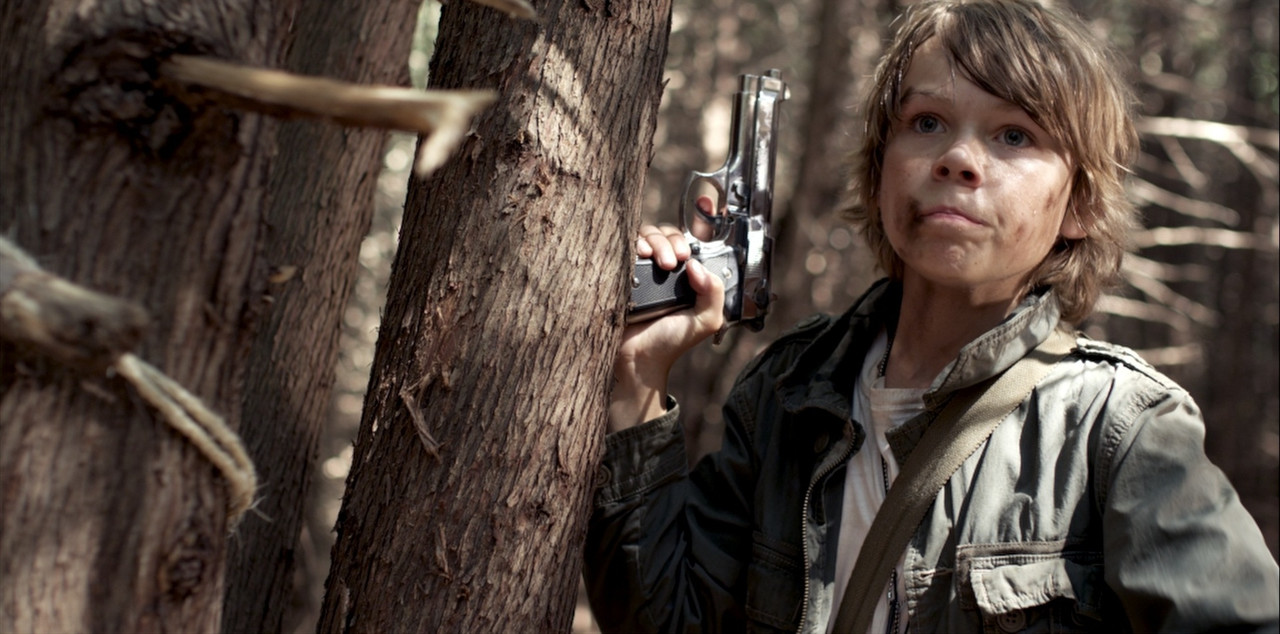
In a backwoods playground during summer vacation, two teams of twelve and thirteen-year-olds play a game of war. The goal is simple: find the enemy base and capture their flag. PK (Gage Munroe) is the fearless veteran who’s never lost a war, and doesn't intend to start, now that Skinner (Michael Friend) has assumed control of the other camp in a coup and taken PK's best friend Kwon (Siam Yu) prisoner. In his ruthless desperation to win the game and PK’s respect, Skinner is beginning to take the game too far.

The best coming of age films take us back to experiences we’ve all had during our formative years, and the stylistic choices made by directors Jason Lapeyre and Robert Wilson will have every member of the audience reminiscing about the self-seriousness of building forts and planning sieges in the fields behind their homes.  

Plunging us into the fantasy war of the players’ imaginations rather than the actual reality of a game played by children, guns made of sticks tied and taped together become the M16s of Full Metal Jacket or the M60 machine guns of Platoon; while paint filled water balloons become intestine-mangling explosives. In one of the film's most knowing details, Wesley (Andy Reid), is seen in his first 'war' with a fake gun and ammo belt full of batteries, right until the final battle, when he gets fully swept up in the illusion and importance of being base camp’s last line of defence. The 'real' guns hint at the cruelty kids are capable of while also accentuating the absurdity of the fact that getting shot means only having to stop moving and count to ten before re-joining the game. In the age of Kermode's six-laugh comedy, I found myself laughing out loud much more than that, especially at a moment where Frost (Alex Cardillo) finds a big stick and becomes overwhelmed with all the possible firearms it could be turned into (“I'm in love with this stick”).  


This insight into the way that kids play informs much of the character development, and while a few are a little broadly drawn, the dialogue and performances are, for the most part, engaging and believable. Especially strong in the ensemble is the double act of Sikorski (Dyson Fyke) and Frost, a chattily hyperactive, rather irritating little runt who thinks Sikorski is his best friend, completely missing the tight-lipped, much bulkier boy’s evident irritation with him, resulting in some of the film’s funniest scenes. 

Pulling on lots of movie military speak and genre archetypes, the dialogue has a keen awareness of guns, glory and growing pains, drawing distinctive voices for each of the kids, PK in particular, who’s obsessed with the film Patton and talks in warriorisms like a pint-sized George C. Scott. The only element that occasionally clunks is how PK and Skinner are drawn as such polar opposites, even though they were once supposedly friends. As Skinner edges ever closer to apparent psychosis, the film begins to strain even the credulity of its own invented reality, but Michael Friend finds layers in Skinner that enable us to still feel sorry for the bully, especially when you view his behaviour through 12-year-old eyes.

Filtering the usual coming of age themes through a tongue in cheek use of war movie clichés, Lapeyre and Wilson have come up with something witty and original that rings true of the outdoor games of that age. A small pity then that the film's realistically salty language means the BBFC don't consider children the same age as the characters mature enough to see it.
★★★★

High School Musical [U]
Dir: Kenny Ortega
I'm 34 and male, so I'm aware I'm not the audience for this, but that said I like a lot of things I'm not the primary audience for (other teen movies, for example) and part of my job as a film critic is to place myself in that designated audience and at least attempt to assess what value a film has for that audience. I can, for example, see why young kids might get more out of Cars, while when it comes to Pixar Toy Story 3 speaks more directly to me. 

I have tried looking at High School Musical from this perspective, and while I can see why the audience that grew up with it might have some residual affection for it, the way I do for certain TV shows from the 80s, I really can't imagine why they would consider it good, on any level. However, if I'm going to look at modern teen movies in any kind of detail, this film and its sequels need to be part of that, as their blockbuster success is all but unprecedented for what started out as a relatively modest TV movie.

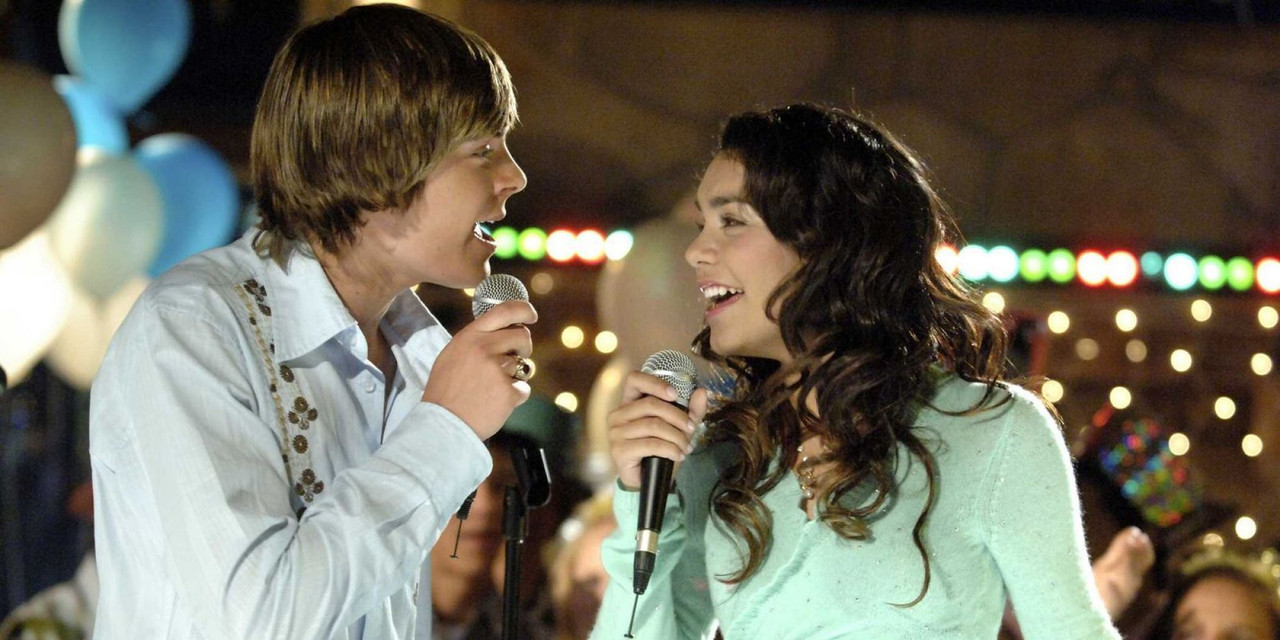
As you might expect of a Disney Channel Original movie, the setup is very simple. Troy (Zac Efron) and Gabriella (Vanessa Hudgens) meet and swap numbers when they sing karaoke together at a New Year's Eve party. A couple of weeks later, Gabriella transfers to Troy's school. Troy is a basketball star and Gabriella a brain, but both are secretly good at and passionate about singing and they're inevitably torn between their other activities and auditioning for the school musical.

The film adds complications; best friends (Corbin Bleu and Monique Coleman) who think Troy and Gabriella should stick to their established cliques and bitchy Sharpay (Ashley Tisdale) and her brother Ryan (Lucas Grabeel) who rule the roost in the school musicals. Each of them, like Troy and Gabriella, has a few bare traits in place of a personality and is ultimately as dull as the film's music.

I was expecting High School Musical to be awful. Really awful. Awful in a way that would prove unintentionally entertaining and allow me to fill this review with jokes about how extravagantly shitty it is. It's not that bad, and that qualifies as a problem, because at least if it were that awful I might have had some fun watching it, but as it stands it's just dull.

The songs are leaden; processed uninspired crosses between the most mainstream tween pop 2006 had to offer and a series of underwritten showtunes (just listen for how many times 'Get'cha Head in the Game' repeats its title). If the music were live then it might at least have a little charge to it, but not only is everything performed to a track, Zac Efron's vocals are largely performed by another singer (Drew Seely) and autotune is detectable during just about every song, especially Tisdale and Grabeel's performance at the callback auditions.

Efron and Hudgens deserve better. At the very least both are likeable and the fact they were dating off screen comes through, with a genuine and rather sweet chemistry between them. The rest of the cast overplay to the hilt, sometimes the film seems to become a contest to see who can deliver the worst and least subtle performance. Tisdale, flouncing her way through every scene like Regina George without even accidental wit, challenges, but it's Alyson Best (as the school's drama teacher) who triumphs, thanks largely to her grating pronunciation of 'Musicale'.

The message - be yourself, even if you think you might make a fool of yourself - is telegraphed and delivered with sledgehammer subtlety, but at least it's a positive thing to say to the kids that this is aimed at. This is the focus of the only sequence in the film that stands out from the otherwise overwhelming tedium. 

'Stick to the Status Quo' isn't a brilliantly written song, but it has a decent concept - kids emboldened by Troy saying he likes to sing confess their unexpected passions, only to be told they should stick to their cliques if they want to be accepted socially - and is the only moment that the film takes to set out its message by doing something other than simply stating it. It's still not anything I'd ever consider listening to, but at least, cliché and overstated as it is, this song speaks a little truth about the tribal mentality that can be seen at high school.

If you're ten and into the tween pop that High School Musical pedals, I could see why you'd have fun with it, or look back at it with an affectionate nostalgia if you saw it at that stage, but it's not good. The songs are weak, the jokes are lame (Corbin Bleu's line about Sharpay spending her time "shopping for mirrors" is a low point), the characterisation is beyond broad and the performances are almost uniformly dreadful. This high school movie will have nothing to say to you by the time you can go to high school, never mind when you're 34.
★★

Nov 12, 2015

Teen Movie Thursday: Paper Towns and Angus

Paper Towns
Dir: Jake Schrier
Based on the novel by John Green. That set alarm bells ringing. I'm not a great fiction reader these days, so my only experience of Green's work had been with the adaptation of his novel The Fault In Our Stars which, even among the generous recent crop of bad movies based on young adult novels, stood out as a special kind of awful. Was it just a bad adaptation?  John Green didn't seem to think so, nor did his fans, and that rather put me off Paper Towns

What drew me to the film was the casting of Cara Delevinge. I wouldn't have called myself a fan, but Delevinge is a presence you can't easily avoid if you spend your life online and I confess I find her intriguing; a quirkily beautiful woman, seemingly with a similarly offbeat personality. On screen I first saw her in a small role in Michael Winterbottom's The Face of an Angel; an appallingly bad film, but one that demonstrated that at the very least Delevinge has presence to burn; the kind of screen charisma you can't teach. I still wasn't expecting much from Paper Towns, but I was hoping her presence might mitigate against its problems, even if I hated the rest of it as much as The Fault In Our Stars.

Paper Towns is a pretty conventional coming of age story. Q (Nat Wolff) has been in love with Margo Roth Spiegelman (Delevinge) since her family moved in across the road when they were seven. Now in the last weeks of their senior year, the two haven't spoken for years, until one night Margo asks Q to drive her around while she plays a series of revenge pranks on her cheating boyfriend. After this one exciting night, Margo vanishes but Q, determined to find her, pieces together clues to where she is and embarks on a roadtrip with his friends Ben and Radar (Austin Abrams, Justice Smith) as well as Radar's girlfriend Angela (Jaz Sinclair) and Margo's former best friend Lacey (Halston Sage).

The film is at its best in the early going. Margo and Q's night of pranks has a real charge to it, you get caught up in the excitement both of breaking the rules and of living with Q in that moment when the one person you desperately want to notice you finally does. The characterisation isn't terribly deep, but you understand why, beyond her beauty, Q - who lives largely by the rules - would find Margo seductive and want to go along with her. There is a sense of possibility, almost of magic, to the whole twenty minute sequence. It captures one of those rare moments when, in the middle of something happening, you suddenly become aware that this is a moment you're going to remember forever.

The reason this part of the film works so well is not that it offers a breathtakingly original insight into what it's depicting. It's Cara Delevinge. That same quality that makes her intriguing as a model comes through in Margo. In her work and in her interviews, Delevinge comes across as fun, spontaneous and off the wall, as someone it would be both entertaining and exciting to be around. It would be silly to pretend that her beauty, offbeat though it is, isn't part of the allure she has, but it's much more than that.  The unpredictability of both character and actress lends an electricity to every scene in this first act, be it the pranks or the slower and more tender moments, such as when she and Q dance to muzak in a deserted office building. 

When Margo disappears from the film, Delevinge largely does too, but only in presence. She may not appear in the film's middle hour, but her charisma is still the driving force of it. For it to work at all you have to believe that Q would need closure, that he would consider it worth the bother to find Margo, that she would linger that long in his mind. Green and screenwriters Scott Neustadter and Michael H Weber give her little personality beyond her quirkiness and spontaneity, so it is purely Delevinge's work that powers this, and she is interesting enough - an individual and compelling enough presence - to carry it off.

The film's second and third acts are less compelling than its opening, but that's not to say they aren't fun. Nat Wolff, Austin Abrams and Justice Smith are lumbered with stock characters (especially Abrams as the horny kid who can't get a prom date), but they're pretty good in their parts, creating a believable group of friends. Neustadter and Weber give them some amusing dialogue - Radar's relationship with his girlfriend is especially strong in this respect - and again there is an energy to the dynamic between them that helps power the film along.

There are some standout scenes along the way, the obligatory party scene is good, particularly in a downbeat conversation between Q and Lacey, which is well written in that it feels like several broadly similar conversations I had at parties when I was a teenager. Things tick up a gear once the roadtrip gets going. A funny scene at a gas station injects some comic pace, while a break in the trip after the car spins off the road leads to some character beats between Radar and Angela and  Ben and Lacey, which work better than perhaps they should, given what stock figures they are to this point.

Some have said that the ending is anticlimactic. I didn't find that, in fact it was one of my favourite aspects of the film. The bulk of the film feels a bit of a fairytale, it's saccharine at times, and seems on track to end in the most sugary, cloying, way possible. The fact that it doesn't is commendable. Ultimately it strikes me as a moment that says that people aren't always what we imagine or want them to be, but that that's okay. Green's message; that it's the journey and what sends you on it that matters more than the destination, is rather trite, but it's pretty well delivered here. Paper Towns is no classic, it's not a profound film, nor an original nor even a particularly great one, it coasts by on charm and is powered, like the story itself, by the charismatic wake of Margo and of Cara Delevinge. That's just about enough to make it worth seeking out.
★★★

Angus
Dir: Patrick Read Johnson
Many high school films co-opt the Pygmalion plot, making over a character who is considered deficient until they fit in.  This is generally laughable, She's All That's attempt to convince us that Rachel Leigh Cook is some sort of social pariah until she removes her glasses being perhaps the most risible example. It can also be uncomfortable, a way to strip a character of what makes them individual (Ally Sheedy in The Breakfast Club, for instance)  Angus initially seems like it's going to take this route, but it ends up going in a slightly different direction.  

Angus (Charlie Talbert) is a freshman in high school.  He's a fat kid who's good at science, and despite his prowess on the football field he's ridiculed by jock Rick Sanford (A pre-Dawson James Van DerBeek) and his friends.  Angus has been in love with cheerleader Melissa Lefevre (A post Jurassic Park Ariana Richards) since they were eleven, but has never plucked up the courage to speak to her.  As a prank, Rick fixes it so that Angus and Melissa are made King and Queen of the Winter ball.  With the help of his geeky friend Troy (Chris Owen, later American Pie's Shermanator), Angus calls Rick's bluff and goes to the dance.

The metaphor of Angus' science experiment about an alien body being destroyed by a complex system is a little hamfisted, but essentially this is a film about difference being okay and, eventually, about even the people you think are perfect having their problems, which aren't resolved as the credits roll.  That's a different route for an American high school film, and one that speaks more honestly, at least to me, about what that time in your life is like.  The film does take a more familiar turn at its big prom set finale but it has felt pretty honest up to that point, and still takes a few risks both during and after the prom, so you can forgive it that.  

While Angus isn't perfect it gets by on a level of charm that papers over some of the cracks, nowhere is this more true than in Charlie Talbert's lead performance.  Happily, the producers didn't insist on casting either a precocious child actor or a kid who is, for want of a better term, a Hollywood misfit.  Talbert is a big awkward goofball, which is perfect for Angus.  He may not be the world's greatest actor, but he raises his game in scenes with the great George C. Scott (playing his Grandfather) and you buy in to his awkwardness around Ariana Richards.

George C. Scott was an old pro with a 45 year career behind him, and he brings that experience to what could have been a throwaway part. As Angus' grandpa he does the gruff but caring thing we see in so many movie grandparents beautifully. Scott gives us a real sense of a man who wants to seize what time he has left and, as exasperating as he might find a 14 year old, loves his grandson and wants to impart genuinely useful advice. These scenes are some of the best written in the film; touching but never cloying, their advice perhaps obvious, but never tritely expressed.

The other performances are sometimes more spirited than brilliant, but everyone falls well into their role.  After seeing him as the simpering Dawson it might seem an odd fit to see James Van Der Beek as a bully, but he does it well, and seems to have fun, while Chris Owen capably fills the same kind of geeky comic relief part that he's continued to be cast in. 

Ariana Richards quit acting in 2001 and has become a painter instead. That's a bit of a shame.  Her role is initially just to be the girl Angus has a crush on, you certainly believe that; she has an almost stereotypically All American prettiness, and since Angus has never spoken to Melissa, a physical attraction is all we need to buy into. This does mean though that at both a script and an acting level, Melissa has quite a lot of ground to make up as a character in the film's last fifteen minutes. Richards does this capably, the idea of the perfect girl turning out to be not so perfect isn't that original, but the scenes Melissa and Angus share are well written, and Richards and Talbert are both touching in them.


Angus combines funny and moving moments with a deft touch. In one of the film's best scenes Troy dresses a blow up doll as Melissa so Angus can practice his dancing, but when Troy focuses the conversation on Melissa's body, Angus stresses that there's more than that to why he's attracted to her. The visual of Angus making a fool of himself while trying to learn to dance is funny, but what lies behind the scene has some emotional weight to it, this is a pattern that writer Jill Gordon and director Patrick Read Johnson manage to repeat throughout. 

This isn't a film about the good guy waltzing off into the sunset with the girl nor is it a film that rips out your heart and stomps on it.  I like that it's not about Angus becoming a different person so he can fit in, I like that the perfect girl isn't, and if it still finds time to contrive a teen wish fulfillment of giving the bully his comeuppance, that's fine.  

20 years after it was made, Angus looks more and more like a lost minor classic among American teen movies. Made at the tail end of a lull in the genre, when it was trying to find an identity after the end of the 80s cycle, Angus probably got lost in the shuffle after Clueless, which opened 2 months before it in the US, managed to set the template for the rest of the 90s teen movie cycle. This is a film ripe for rediscovery, perhaps someone should try to set up a 21st anniversary screening next year.
★★★★