Showing posts with label Thailand. Show all posts

Sep 19, 2019

24FPS @ LFF 2019. Days 2 and 3

Love Me Tender
Dir: Klaudia Reynicke
The second fiction feature by Swiss director Klaudia Reynicke, Love Me Tender is a strange and changeable beast. 

At the outset, this seems a largely serious minded look at a young woman named Seconda (Barbara Giordano) and her struggle with agoraphobia. We don’t know why she stopped going outside, but when we initially meet her she hasn’t left the apartment in nine months. When her mother dies and her father abruptly leaves, Seconda is trapped. With only answerphone messages from an increasingly abusive debt collector for company, she begins to think about ending her life. This is the unlikely cue for the film to begin to slip ever further into absurdist comedy.

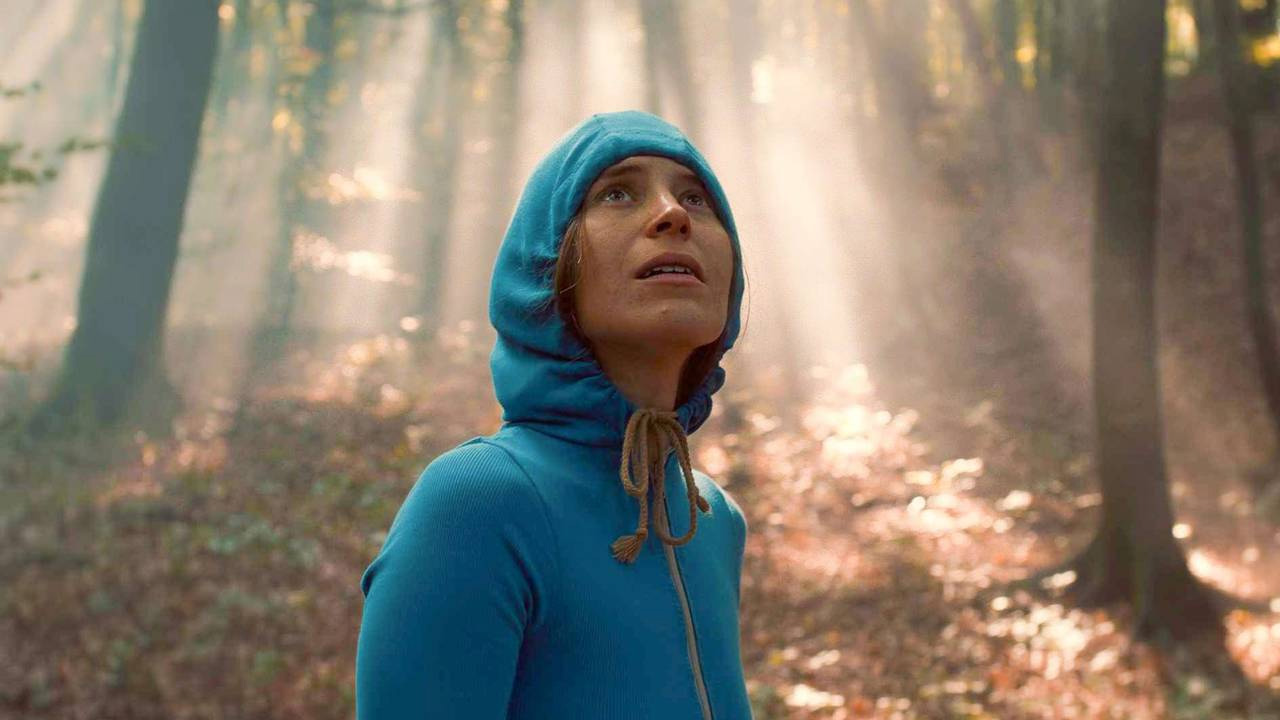
Though it is about its main character’s psychology, Love Me Tender communicates largely through physicality.  Barbara Giordano’s performance is striking from the very start, as we see her manically dancing in the living room she shares with her parents. This is one of several behaviours that seem to have been carved out as a way to find comfort. For the first half there is a somewhat greater degree of comfort to Giordano’s performance, as the character and the film are confined to the flat, it’s when we finally see Seconda pull on her ‘armour’— a blue onesie—and venture outside that we see the character at her most vulnerable and the performance at its most extreme. Outside, Seconda seems to shrink; a slender woman anyway, she seems to pull every part of herself inwards to take up as little space as possible and walks in a fast straight line, never engaging with the world around her unless it directly intrudes. It’s a funny visual, but also a great evocation of somebody profoundly uncomfortable in their surroundings, which is a line Giordano’s performance walks brilliantly throughout.

A few more people are drawn into the narrative in the film’s second half. The debt collector shows up at Seconda’s door and there is an instant and very funny twist in that relationship. Then there is Santo (Antonio BannĂ²), who knocks at the door asking if there are any bottles he can take to sell. This is the first person Seconda has engaged with in the weeks since her dad left, and she immediately draws him in and asks if he’ll kill her (“unfortunately I have a strong survival instinct”). The film sometimes veers quite quickly in tone, from a sequence that threatens to recall Lucky McKee’s May, to a late moment in which every character in the film appears in the apartment, dressed in Seconda’s blue onesie, which is straight out of Being John Malkovich. It’s a bit messy at times, but the shifts are unexpected enough to be amusing and they do all contribute to the larger picture of Seconda as a character. 

You can probably watch Love Me Tender as a character study of a woman trying to get over her childhood trauma or as an absurd, drily witty, black comedy. For me, the combination of its two sides worked well, largely thanks to the deft work of Barbara Giordano; rooted in the character’s psychology but unafraid of being big and even occasionally silly. It’s an odd film and the peculiarly shifting tone won’t be for everyone, but if you go with it there are many rewards to be had.
★★★½

Hope Frozen
Dir: Pailin Wedel
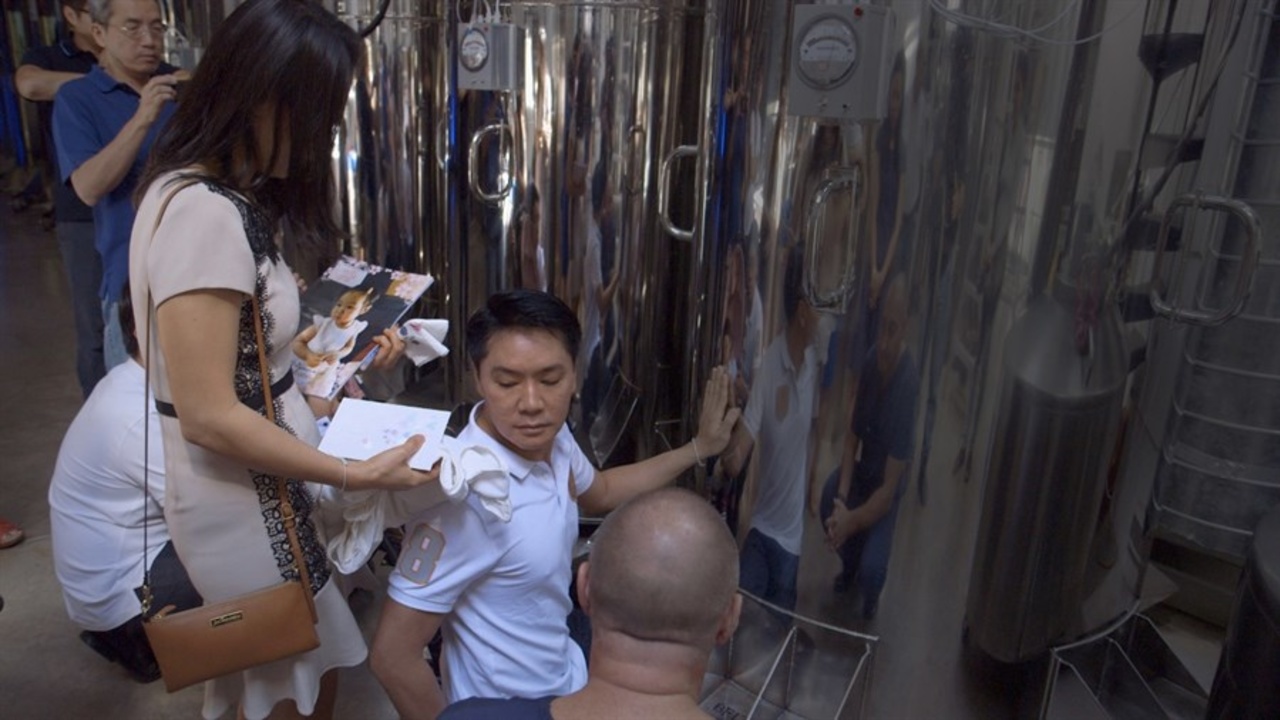
We all want the best for our children. We imagine who they’ll be, what their lives will be like, what they’ll achieve. Sometimes we don’t get those answers at all because they are cruelly snatched away from us. For the family in Hope Frozen, that happened with their two-year-old daughter Einz, when she died of an especially virulent form of brain cancer. Scientists, they decided to cryopreserve her brain, in the hopes that in the future she would be able to be brought back and to have the life that was taken from her this time.

There’s not much that is formally notable about Hope Frozen. It’s a fairly standard issue documentary construction, with observed moments combined with talking heads to tell the story and the fact it runs just 73 minutes is another thing that would make it ideally suited, eventually, for the small screen. That said, the film loses little by this, indeed its impact may be heightened by the fact that the filmmaking is fairly simple as, by this choice, director Pailin Wedel places the focus squarely on the story and on the family going through it, allowing us a window into their grief and the way they are trying to use science to help them work through it and find a glimmer of hope.

There is an added wrinkle in that the family are Thai and Buddhist. Reincarnation is a central tenet of their religion and the film hints at some controversy around that in Thailand, with commentators asking if Einz, rather than being preserved to potentially be saved, is trapped; her soul unable to enter a new body. As with the other questions in the film, Einz’ father, mother and brother find beautiful words to explain their decision, saying that their loved one’s soul is still around, in everything and everyone she touched.

Religion plays a part, but the film, like the family, is largely rooted in science. Einz’ older brother Matrix is pursuing studies that will allow him to work on finding some way to bring his sister back, something he initially feels might be close, but both he and the film are brought down to Earth with a bump at a certain point. It’s only in this moment that his father’s hope seems to move into a sort of strident faith, though the film never draws a connection to religion.

It’s impossible not to be moved by Hope Frozen. You can’t help but feel the raw heartbreak of this family, or be roused by their moments of joy (especially one that forms the coda of the film), but it’s also clear that their hope seems distant, dim, and perhaps destined to remain in stasis. 
★★★½

Apr 3, 2012

24FPS at LLGFF 2012 Part 2

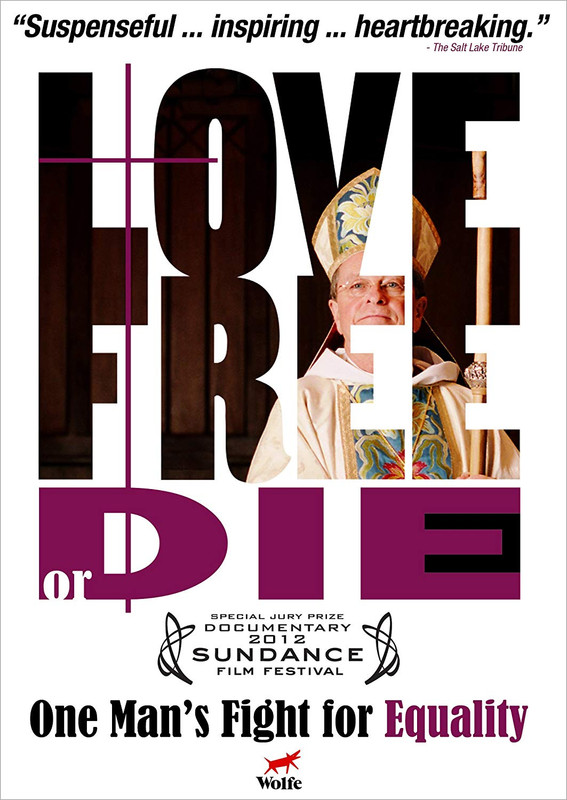
Love Free or Die
Dir: Macky Alston
With the Christian Church mounting a robust resistance to the possibility of gay marriage, it is perhaps the perfect time for this documentary about Gene Robinson, the first gay bishop in the Anglican communion.

The film begins telling Robinson's story at the Lambeth Conference in 2008, to which he was the only Bishop in the whole Anglican church not invited. You could forgive Robinson if he'd thrown a fit and started shouting into the nearest microphone about injustice. Instead, he spent the time the other Bishops were meeting and talking meeting and talking with Parish priests, congregations and other members of society, Christian and otherwise, that he would not otherwise have had a chance to meet or minister to during his time in England. He handles himself with great good grace, even when a protestor begins yelling at him as he begins a sermon in a London church, which visibly and audibly upsets him.

The bottom line is that Gene Robinson comes across as a good man, and one who does is job extremely well, it just so happens that his partner is named Mark, not Mary, and that one fact makes him an outcast from the people he shares his vocation with.

Love Free or Die engages with issues surrounding equality within the church for LGBT people, but it doesn't become an advocacy film. Director Macky Alston takes a stance in his presentation that clearly favours Robinson and his argument with the church, but Robinson and other commentators make the case (and some also try to refute it).

To some degree I stand apart from these issues: I'm not a Christian, nor am I a member of any LGBT community. I don't need convincing on Robinson's agenda. Instead, I saw Love Free or Die as an engaging film about a man whose beliefs I may not share, but who seems to represent the best version of what the church supposedly preaches. The film represents his message without feeling like it is bellowing it at you relentlessly, and gives us a rounded view of him as a person, a priest and a political activist. Often intensely moving, this is an affecting and hopefully will be an effective film.
★★★½

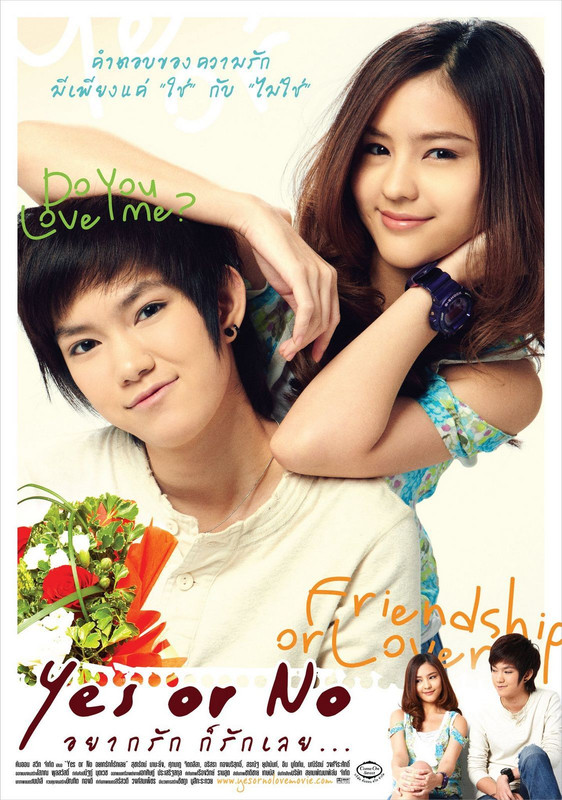
Yes or No
Dir: Sarasawadee Wongsompetch
Thailand's first lesbian themed film is a well-meaning, but confused and sometimes condescending, mess. When Pie (Aom Sucharat Manaying) begins her life at university she discovers to her horror that her roommate Kim (Supanart Jittaleela) is a tomboy. At first, Pie insists they divide the room, but soon the two girls become closer, and even begin a relationship, but Pie's disapproving Mother, and her own fears, may get in the way.

Overlong at nearly two hours, Yes or No starts out neatly enough, with a madcap comic tone which, while a little sugary and broad for my tastes, does provoke some laughs. It goes off the rails, however, in an interminable and increasingly awful second hour, which is horrendously preachy, explicitly telling the audience that there's nothing wrong with being a tomboy, or being gay, in a way that feels - with a view from the West - like a public service announcement from 30 years ago. It doesn't help that the leading performances simply can't meet the dramatic demands of the film. The chemistry is all but non-existent, and come the long waited for kiss both Manaying and Jittaleela seem very uncomfortable.

The characters are appealing in the first half and, in a supporting role as a friend of Kim's who is hopelessly in love with her, Arisara Thongborisut gives a charmingly batty performance, but ultimately the film trips over its own tonal confusion and morass of preachy cliches.
★★

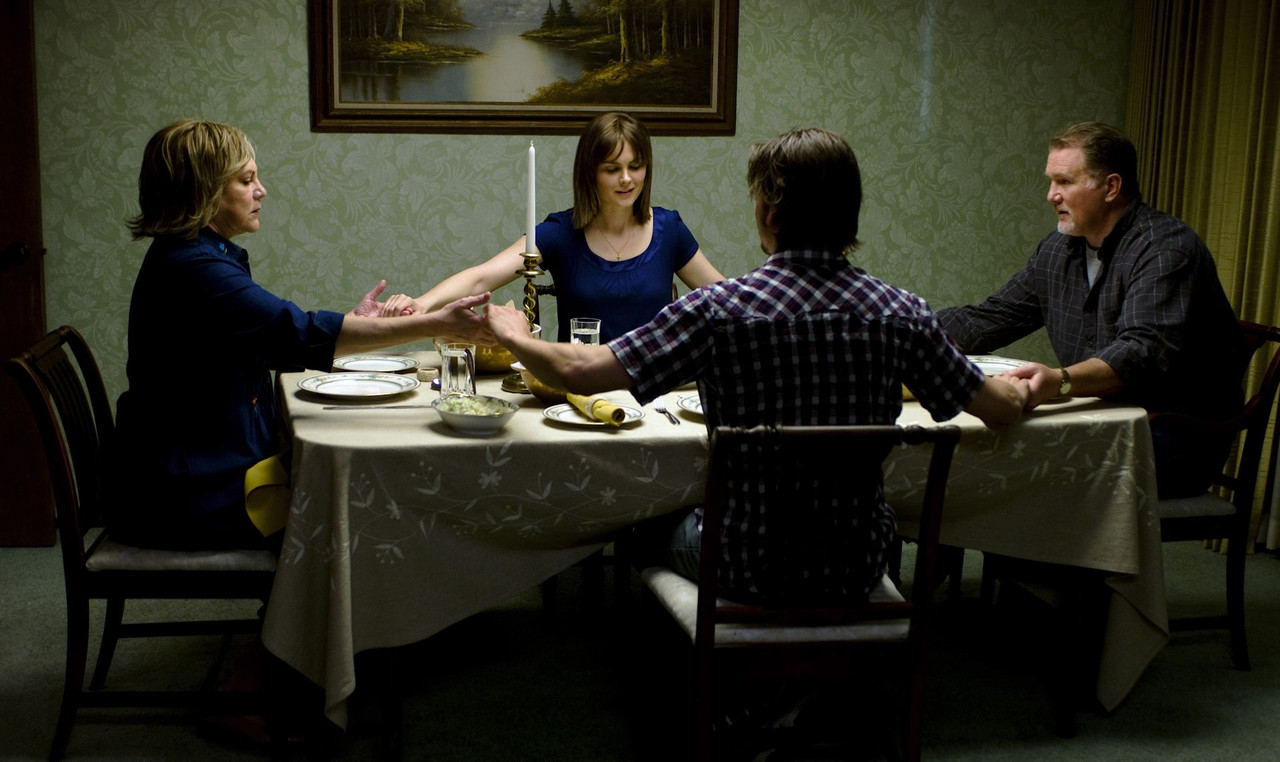
The Perfect Family
Dir: Anne Renton
Anne Renton's feature directorial debut isn't especially groundbreaking, and doesn't hit any really unexpected story beats, but it still remains a sharp little comedy that deals amusingly with some pressing issues in modern society. Eileen Cleary (Kathleen Turner) has just been nominated as Catholic Woman of the Year by her local church, and is desperate to win. The judging panel (including the Archbishop of Dublin) are going to make a home visit to meet her 'perfect' family, including her former alcoholic husband (Michael McGrady) her son (Jason Ritter), who is getting a divorce, and her daughter (Emily Deschanel) who has just announced that she is A: Gay, B: Engaged and C: Pregnant.

While it does draw much of its comedy from the contrast between Eileen's dedication to a strict interpretation of her religion and the way her children's lives have turned out, The Perfect Family doesn't portray Eileen as unthinking, unfeeling, or a villain. She clearly cares about her kids, but the way she interprets what is 'best' for them is totally bound up with 60 years of moralistic teaching, and still she does try. It's nice to see a film from this perspective present a (reasonably) even-handed portrait of a deeply religious person.

At the heart of the film is Eileen's relationship with her daughter Shannon, and Turner and Deschanel are both excellent, giving the drama, despite its predictability, appreciable emotional weight. When the film goes broader it hits most of its comedic targets. Turner relishes the humour, as does a brassy Elizabeth Pena (as Shannon's new Mother in Law), who lends Eileen a tracksuit which gets perhaps the film's biggest laugh. Sharon Lawrence also stands out among the supporting cast as Eileen's seemingly perfect rival for Catholic Woman of the Year.

I wish at least one moment, one plot point, had gone in an unexpected direction, but The Perfect Family is fun and well made, and while it perhaps won't stick long in my mind, I had fun watching it.
★★★

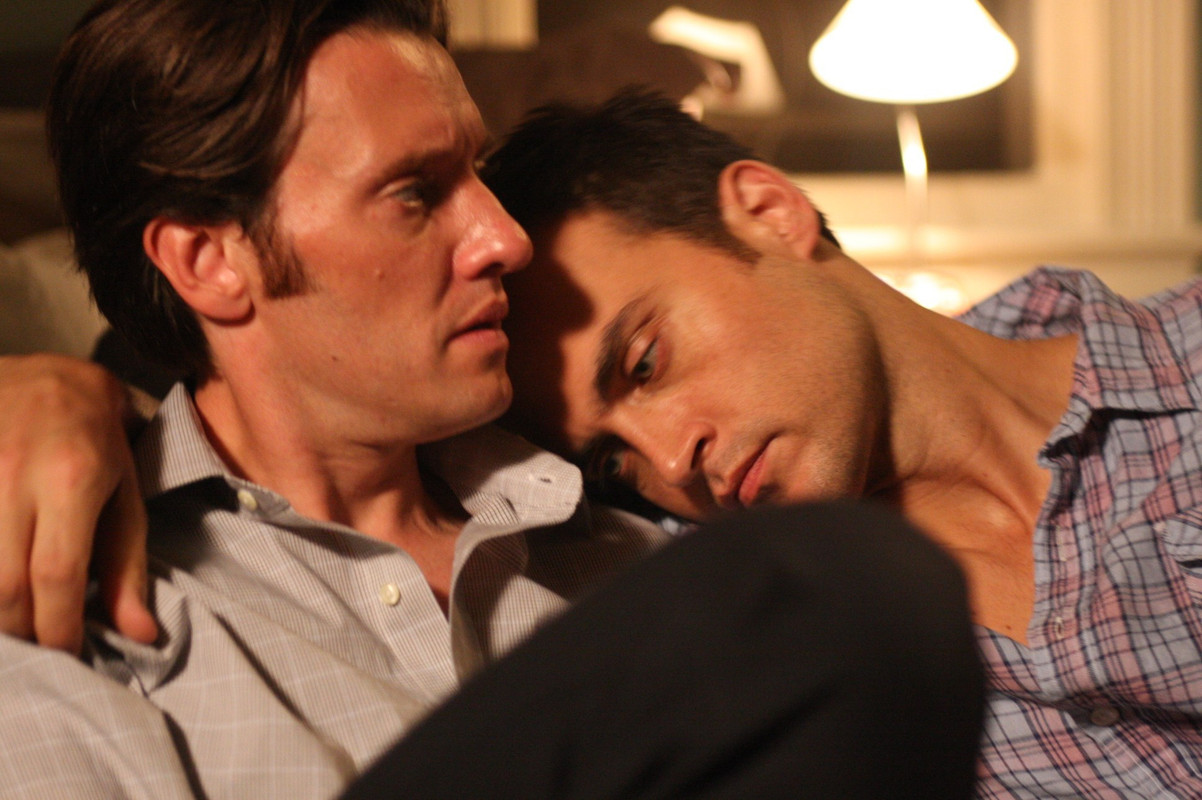
The Green
Dir: Steven Williford
I saw much, MUCH worse films at LLGFF than this one, but not one that proved as disappointing. The Green is about a teacher named Michael (Jason Butler Harner) whose livelihood and relationship with long term boyfriend Daniel (Cheyenne Jackson) are both threatened when he's accused of an inappropriate relationship with one of his students (Christopher Bert). The small town he lives in rejects Michael, and even friends begin to become suspicious of him.

The Green, for its first hour, is a film about mess; about how one event - tiny and misinterpreted - can spiral out of control and come close to destroying a person's life. It's an incredibly relevant tale, given the paranoia that often surrounds male teachers and the sensationalism and witch hunting that even a whiff of an accusation of paedophilia can arouse in sections of the press and media. Jason Butler Harner, who impressed in Clint Eastwood's underwhelming Changeling, is excellent as Michael, giving an utterly compelling portrait of a man who can't understand how his life has begun to fall apart around him, and Cheyenne Jackson lends equally nuanced support as the boyfriend who wants to believe him, but struggles with that and with what the situation is doing to their lives. More impressive support comes from the film's women; Illeanna Douglas as Michael's best friend, Julia Ormond as his lawyer, and Karen Young as the Mother of his accuser.

Disappointingly, immediately after its very best scene, the film utterly collapses, with a storm outside providing an incredibly forced metaphor, and the film subsequently rushing to tie up every loose end in a credulity straining series of events that ignores every shred of the quiet drama with which it had treated its subject matter up to that point. It is a truly spectacular unravelling, and very nearly destroys every bit of good will the film had built up. I'm baffled that the first sixty and last thirty minutes of the film could have come from the same hands, but for those first sixty minutes The Green is still (JUST) recommendable.
★★½

Aug 24, 2010

Martial Arts Mini-Reviews

MAGNIFICENT WARRIORS
DIR: David Chaing


This directorial effeort from Chaing (more frequently a cinematographer) probably has more weight if you know some Chinese history. It's set during World War 2 and has a small group of resistance fighters opposing the Japanese army, who want to set up a poison gas factory in a small, newly occupied, town. The performances are broad; shining heroes vs eeevil Japanese baddies, but MAGNIFICENT WARRIORS has quite a bit going for it.

Chaing keeps the pace up, close to frantic at times, and in 88 minutes doles out a lot of action both violent and comedic. Despite the rather perfunctory story and performances, the cast are also quite engaging, getting by more on charm and charisma than any real acting ability. Richard Ng is fun as a drunk who gets swept up in the action, the beautiful Cindy Lau has some great moments to show off her martial arts, and makes for a sweet, if not helpless, ingenue and Derek Yee is solid and charming as the hero.

However, it's Michelle Yeoh, in an early starring vehicle, who holds the attention. She's very young here, but already the charisma that she'd bring to films like WING CHUN and CROUCHING TIGER, HIDDEN DRAGON shines through. Though she's not a trained martial artist Yeoh's on screen fighting is fluent and hard hitting (her prop use is especially brilliant), her years as a dancer and talent for physical mimicry (as well as a willingness to do her own stunt work) serving her well.

MAGNIFICENT WARRIORS isn't quite a classic, but it's an enjoyable movie. There are some technical failings (even in the Cantonese version the dubbing is appalling, and some of the editing isn't great) but the action is great and the film as a whole is always engaging.


ONG BAK
DIR: Prachya Pinkaew


Martial arts films have often been laughed aat for the thinness of their stories, but Tony Jaa's movies really deserve those giggles. Okay, ONG BAK (village boy goes to Bangkok when his village's idol is stolen, retrieves it through kicking people) has a more complex story than TOM YUM GOONG ("Give me back my elephants!"), but not by much.

The thing is, to denigarte ONG BAK for its lack of little things like a well thought out story, compelling performances, or any sort of dramatic weight would be to completely miss the point. This isn't so much a story as it is a breathtaking showreel for tsar Tony Jaa, his stunt team, action director Panna Rittikrai and director Prachya Pinkaew. After 30 minutes or so of exposition and scene setting, ONG BAK explodes into life, and though it becomes little more than a series of tenuously linked fight and stunt sequences the invention, style, skill, and power on display is such that the story could involve the reading of the Thai phone book and it this would still be thrilling cinema.

The action is among the best ever filmed. An early chase sequence shows off Jaa's amazing agility and timing (catch the awesome flip he does between two sheets of glass), but it's the raw power of the Muay Thai fighting style, perhaps best seen in what has been called the Fight Club sequence that was really new and excting when this film was first released.

As an actor, Jaa's flatness can be forgiven, but sadly he lacks the presence of a Jackie Chan or a Bruce Lee, and much of the time you do feel that you're watching a stuntman rather than a star. The support is better; Petchai Wongkamlao and Pumwaree Yodkamol are both funny and charming as the city slickers along for the ride with Jaa, and that keeps the downtime between the action scenes bearable, if never especially engaging. Fortunately the film is chock full of action, so it never slows down long enough to get really dull.

For me, ONG BAK has since been bettered by the same team's vehicles for Jeeja Yanin, especially the jaw dropping CHOCOLATE, but this was the west's introduction to Thai martial arts cinema, the film from which the rest have flowed, and as well as bringing us alot of quality films since, ONG BAK holds up as a genuinely astonishing showcase for thai martial arts, if not a great film.


CLIPS


Aug 3, 2010

Martial Arts Month: Chocolate

My review of Chocolate can be found here, so rather than rehash it and tell you again how amazing this film is, I'm just going to let you see for yourselves. You're welcome.


And that's just little taste.

Aug 1, 2010

Martial Arts Month: Raging Phoenix

RAGING PHOENIX
DIR: Rashane Limtrakul
CAST: Yanin Vismistananda [Jija Yanin], Patrick Tang


A couple of years ago 24 year old Jija Yanin made an auspicious film debut in Chocolate, starring as a young autistic girl who learned her movies from watching the likes of Bruce Lee, Jackie Chan and Jija’s own mentor Tony Jaa. It would have been easy to just allow Yanin to repeat herself, to make Chocolate over and over again, but instead Raging Phoenix finds her changing her martial arts style and stretching her acting muscles a little more.

The story, such as it is, has Yanin as Deu, a young rock drummer who seems to have very few people in her life. While she’s hungover a gang attempts to kidnap her, but she’s saved by a mysterious martial artist (Tang) who, along with the other members of his gang, then teaches her their form of fighting; a blend of drunken boxing, muay thai and moves based on hip hop dance moves. Once she’s trained up, the gang seek to extact revenge on a people trafficking ring.

Simplistic doesn’t even begin to describe the story and screenplay, but as with any martial arts movie, that’s not what this one is about. It’s about feet and hands and elbows and knees. Thee fights are the centre of the film and though the martial arts style remains largely the same the tenor of the fights ranges from the comedic (the first time we see the whole of Tang’s gang, in a fight scene in which they use Yanin as a sort of deadly rag doll) to the brutally bruising (the entire last twenty minutes, including an especially jaw dropping sequence across rope bridges on three levels). There’s also a great training sequence, very reminiscent of those in Drunken Master, only with the pretty, petite Yanin standing in for Jackie Chan.

Whatever your feelings about Raging Phoenix as a whole (and it is a rather slapdash affair in many ways) there is one thing in it the brilliance of which it would be churlish to deny, and that’s Jija Yanin. She’s a movie star through and through, possessed of screen searing charisma, which, along with her cute face and awesome athletic prowess, draws you both to her character and into the story. She’s not the world’s best actress, but while we’re not exactly talking Isabelle Huppert with Muay Thai skills, Yanin can act. There is one particular scene, on that bridge towards the end of the film, where she really seems to dig into deep emotional reserves and find something that really feels quite raw and real. It’s not what audiences will be coming to the film for, but it certainly makes it more involving, and suggests that Yanin can have a long career.

If the film is not quite as astonishing as Chocolate (and it’s not) that’s really for two reasons. First off, Raging Phoenix doesn’t have that incredible shock of the new, that sense of discovery that Chocolate did and perhaps more problematically the story this time out is so threadbare that the stakes feel rather lower. That said, this is still one of the best martial arts films of the last few years, and comfortably puts Jaa’s Warrior King and Ong Bak 2 in the shade. The pupil has outshined the master, I can’t wait to see what she does next.

Jan 24, 2009

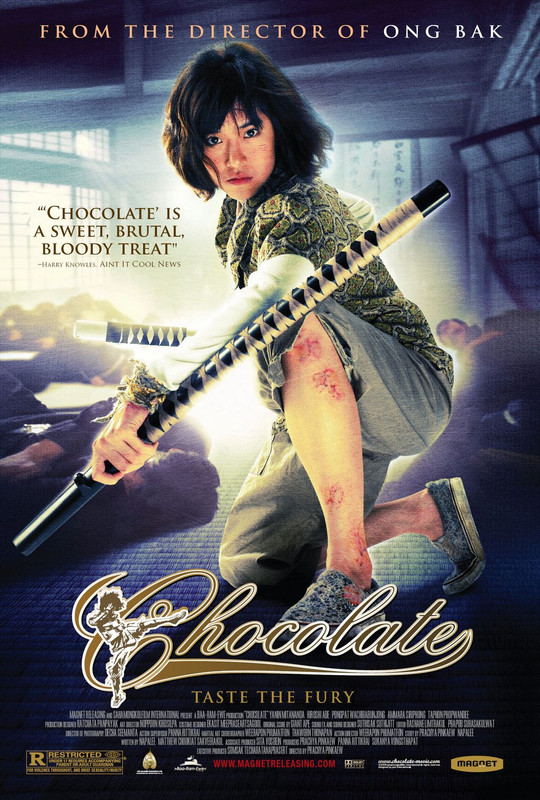
Chocolate [18]

Dir: Prachya Pinkaew
All martial arts films have the same story. Character wants something, other characters won’t hand it over, kicking ensues. Chocolate doesn’t break the mould, it doesn’t even dent it, but it’s one of the best martial arts movies to have come along in a very long time. The story has young Zin (Jeeja Yanin) trying to collect on debts owed her former gangster mother (Ammara Siripong), who is now in hospital with an unspecified cancer and has bills piling up. The twist is that Zin is autistic, but has learned martial arts through an amazing aptitude for mimicking the action stars she’s seen on TV.

Chocolate, like director Pinkaew’s other films (Ong Bak, Warrior King) has a sentimental streak, and takes a little while to really ramp up into the action sequences, but like Ong Bak, once the action does arrive it is absolutely awe inspiring. As usual, the first fight scene, which comes 18 minutes in, is more a preview than anything, it lasts barely a couple of minutes, and the choreography is pretty simple, but even this early there are moments and moves that will find you picking your jaw up from the floor. Jeeja Yanin trained for two years before shooting, which then took another two years (the film is just 93 minutes long), and you can see the result of those endless hours of work as you watch Chocolate, there’s not a missed step, not a move that looks sloppy, you can feel the blood, sweat and tears in every frame.

Jeeja Yanin, like Tony Jaa before her, is an extraordinary discovery. A tiny young woman of just 22, she looks as if the wind might blow her away, at times watching her fight is like watching a pixie try to beat up a giant. If, of course, the pixie was unspeakably hard. The speed of Yanin’s moves is just astounding, but you’d expect that from a whippet thin girl, what’s more surprising is the sheer amount of power she seems to have. At first the idea of a tiny autistic girl being able to take on armies of fighters seems outlandish, but as soon as that first fight is over you immediately buy into the idea.

About half of the film's brief running time is given over totally to fight sequences. There are several major set pieces and Pinkaew and his team make sure each is inventive and distinctive. There is the brief street fight, a warehouse set fight which sees Yanin dodging through railings and shelves, an ice factory set homage to The Big Boss, in which Yanin even echoes Bruce Lee’s whooping vocalizations. There’s a blistering fight in a meat market, involving knives and staves, there’s a rooftop fight, half of which is fought crouched, there’s the 12 against 1 hand to hand fight, and Yanin fending off samurai swords with the aid of two sheaths. Then there’s the unbelievable final fight, which begins on the side of a railway bridge, and ends up being fought across street signs and the side of a building. Through all of these, the choreography stays highly inventive, and every single fight throws up at least a few moments you’ll have to rewind, just to believe they happened (Yanin kicking another girl into a pipe)

Aside from her physical prowess, and her girl next door beauty, Jeeja Yanin stands out in Chocolate because she also gives a decent dramatic performance, she’s actually fairly convincing as an autistic young adult, and that helps keep the film engaging between fights. Chocolate is a martial arts fan’s dream, and a film you must see if you even remotely enjoy the genre.
★★★★★