Showing posts with label 2017 Releases. Show all posts

Jul 31, 2017

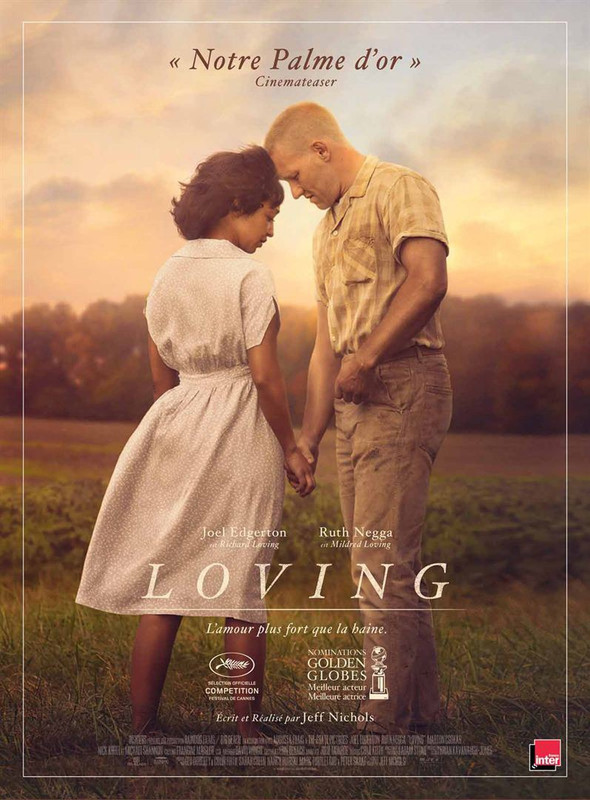
Loving [12]

Dir: Jeff Nichols
"Mr. Cohen, tell the Court I love my wife, and it is just unfair that I can't live with her in Virginia." It's a simple statement, from what seems to have been a straightforward man who simply wanted to live his life with the woman he loved, despite the fact that he was white and she was black. Richard and Mildred Loving never appeared to want to be heroes, or to make history. Jeff Nichols' sensitive film reflects that, while acknowledging that that's exactly who they were and what they did.

In 1967, the supreme court case of Loving v Virginia overturned the miscegenation laws that prohibited interracial marriages in the southern states, but Nichols is much more interested in who Richard and Mildred were and how they lived. The result is a beautifully understated film that resists any grandstanding and is all the more emotional for it.

The film opens with 18 year old Mildred (Ruth Negga) telling Richard (Joel Edgerton) that she's pregnant. We don't need the preamble of their meeting and early dating, just the simple matter of fact way that Richard tells her, after a long moment, “Good. That's good.” speaks volumes about both of them and how they are as a couple. This moment sets the tone for the film. Nichols keeps things low key and intimate throughout, relying on his actors ability to show us a great deal more than they articulate in dialogue.

Ruth Negga's Mildred is hopeful but pragmatic, it's her letter to Bobby Kennedy to ask for help overturning a judge's ban on her and her husband being together in Virginia that sets the case in motion and we can see how her gentle strength gets her husband and herself through the difficult moments. Like Edgerton, much of her emotion is played close to the chest, but it's moving when it seeps through the cracks, particularly when she takes the call about the Supreme Court decision. 

Edgerton, even more than Negga, has to do a lot with a little. Richard Loving seems to have been a man of few words, but every one he does speak resonates. The sense we get is of a man trying to remain stoical, his emotions boiling just under the surface. The moment he is told how the state of Virginia will argue against his marriage at the Supreme Court and his firm “We don't need to do that” when he's asked if he will be at the hearing are the perfect encapsulation of this: it's clear he's afraid he won't be able to listen to that argument without either breaking down or saying something back. It's perhaps the best moment of a performance that is a masterclass in being expressive yet inheld. These two remarkable performances are perfectly balanced by Negga, Edgerton and Nichols, creating a couple you truly believe in because you see how they complement each other.

As this is a Jeff Nichols film there is also a striking performance from Michael Shannon, who has just one scene as the Life photographer who took a series of photos of Richard and Mildred. The moment we see the most famous of those pictures, with Richard resting his head in his wife's lap, the two of them laughing as they watch TV, is one of the film's most moving, especially as it cuts to Shannon, subtly framing that image.

Loving isn't too concerned with the big consequences of the Loving v Virginia case, nor with anything but the broad strokes of its argument. Nichols instead focuses on the personal moments of beauty in Richard and Mildred's everyday life, from standing together on the sidelines at a drag race to the birth of their children. There are no grandstanding moments in court, no shots of the couple in front of an American flag while inspiring music plays, the inspiring moments come in the determination and courage of these two people simply to live their lives together. Nichols captures it beautifully, crafting resonant imagery without it feeling like he's trying to squeeze this story into a cookie cutter Hollywood biopic. This might be his best film to date.
★★★★

Jul 30, 2017

War For The Planet Of The Apes [12A] [2D]

Dir: Matt Reeves
Blockbuster cinema has been in something of a rut for some time now. It has often seemed that, generally speaking, the higher a film's budget was allowed to climb the lower its IQ would sink in response. The Planet Of The Apes series has always been an uncommonly smart one for blockbuster cinema. The original series was rich in political allegory, using that to remain both relevant and interesting as the budgets sank and the films could no longer trade on the first film's remarkable make up. Tim Burton's remake was a stumble, but the rebooted series begun with Rise Of The Planet Of The Apes was a grounded reinterpretation with big ideas, which then expanded into Dawn Of The Planet Of The Apes, a step up in quality from a strong first installment. 

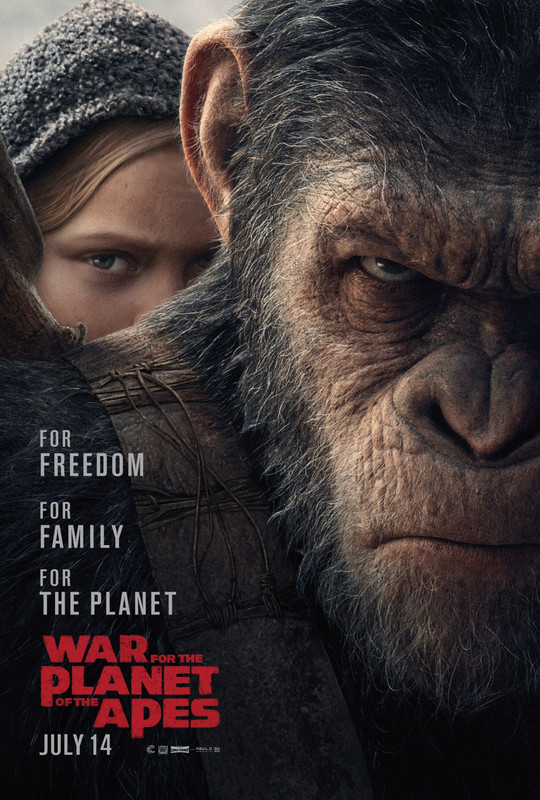
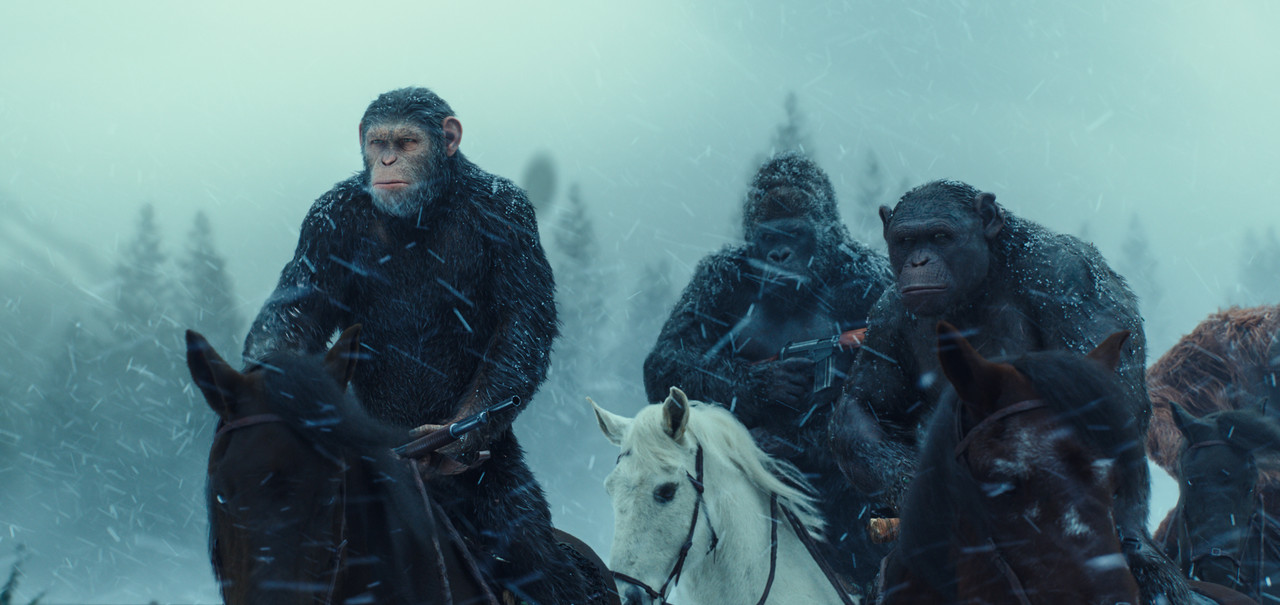
War For The Planet Of The Apes picks up not long after Dawn left off, with Caesar (Andy Serkis) and his clan now hunted by human forces led by a fanatical Colonel (Woody Harrelson). After his wife and elder son are killed by the Colonel and his forces, Caesar and his closest associates set out for revenge, while sending the rest of the apes on a journey to a new home. On their journey, the apes are captured and Caesar must re-evaluate his priorities.

The first warning sign that War For The Planet Of The Apes might not be the equal of its predecessor comes with its opening image; a blurry forest over which expository text is superimposed. Compared to the montage that filled in the plot at the beginning of Dawn, and that film's opening close up of Caesar's eyes, pulling out to reveal him in battle make up, this feels graceless and underwhelming. The action scene it evolves into isn't bad, but does feature the first of quite a few instances of unconvincing CGI in the film. You can almost hear the computers wheeze during the frequent appearances of massed ranks of apes on the screen.

Both Rise and Dawn were notable for the amount of mileage and expression they got from Andy Serkis' reticent performance as Caesar. It was one of the first and only instances in which the uncanny valley effect went away and allowed me to accept a CGI character as real in a film that wasn't entirely computer generated. Some of this is still true in War. Serkis remains a remarkably effective physical actor and the technology still brings Caesar vividly to life. The problem is that Caesar now talks a lot, and with a great deal more ease than in the previous films. In Dawn, while there was a fair amount of dialogue, Caesar chose the moments he actually spoke very carefully. It always felt like an effort as well, as if the words had to be squeezed from from deep part of his mind. This time, Caesar's words come more fluently, in what feels like a big jump in the relatively short time since the last film – one we don't see in the other ape characters around him. What's more galling though is the fact that Caesar now seems to speak even when he doesn't need to and that he often has to deliver a dump of exposition (which makes up most of the film's dialogue).

This is a problem on two levels, first it makes the film feel much more conventional. The second problem is more fundamental. Andy Serkis just isn't as good at delivering dialogue as he is at physical performance. With more speaking to do the illusion of the performance capture is broken much more frequently. Serkis can be heard more clearly in Caesar's now easier speech and at times it is like watching an overlay, rather than the complete performance of the previous two films. This is even more true of Steve Zahn's irksome performance as Bad Ape, a new character who helps Caesar, Rocket and Maurice find the compound where their friends are captive.

Among the human characters, Woody Harrelson does a typically solid job as the Colonel, and manages to makes something resonant of the huge and unwieldy infodump in which he explains his motivations to Caesar, but outside of that scene there's not much dimension to the character. More problematic is Nova (Amiah Miller), a mute girl of about 11 who Maurice insists the apes take with them, after Caesar is forced to kill her father. It's not Miller's fault, but the wide-eyed, open mouthed performance she's been directed into contributes almost nothing to the film. It's the shallowest, most manipulative way possible to try to wring emotion from us. It doesn't even manage that, as the character feels so shallow, so nakedly a prop.

At 140 minutes the film is overlong and often both slow and tedious. Consider the title War For The Planet Of The Apes. That implies high stakes – war for the planet itself – but we never feel that. If anything the battles of Dawn, both with the humans who were scratching for survival and within the ape community for control over the direction of leadership was much more consequential than what we get here, which boils down to the apes being caught between two largely faceless groups of humans, one of which appears almost literally out of nowhere. This film may nod to a lot of war movies ('Apepocalypse Now' graffiti. Droll.) but it isn't one itself. The idea of Caesar as a general was much more developed in Dawn, even in Rise. The 'battle' is underwhelming at best, and comes only after two hours largely dominated by talk. The action scenes at the beginning and end of the film are reasonably well done, but they lack the intimacy of the previous films. We don't get to know any new ape characters apart from Bad Ape, surely developing one of the traveling group would have invested some emotion into their capture and knowing of their capture before Caesar learns of it might have added some tension to the film.

Matt Reeves is a perfectly competent director, and he continues down the gritty visual path set by the first two films. What he lacks here are the moments of visual resonance the previous films gave us. There is nothing as striking as Kubo riding through fire, an automatic rifle in each hand and many of the images that reach for an epic feel are undermined by the effects work (just look at the ape bodies falling in the opening action scene, they don't have the weight that the close up performance capture achieves).

There are some good ideas in War For The Planet Of The Apes, the seeding of human devolution is interesting, as is the implication of further intelligent ape tribes, but these things are pushed largely to the sidelines (or, in the former case, sentimentalised in Amiah Miller's character) for a plodding main narrative that is neither as technically impressive nor as resonant as the previous films, and fundamentally fails to deliver the central promise of its title. Overall, it's a big disappointment in a blockbuster trilogy that had previously been the high watermark for the concept of rebooting franchises.
★★

Apr 1, 2017

Power Rangers [12A]

Dir: Dean Israelite
I was just a bit too old for Power Rangers. I remember it coming on UK TV in the mid 90's, when I was 13 or 14, and feeling that I had aged out of the audience by a few years. That said, I ended up watching quite a lot of the early series' because my brother, 4 years younger, was a huge fan. I was a fan of Amy Jo Johnson's Kimberly, rather than of the show. I didn't have much investment when approaching this reboot, but as a fan of teen movies and of martial arts films, I was hoping for something I could enjoy, even if at the purely silly and superficial level on which the show functioned. It's weird to feel disappointed by a film you went in with no real expectations for.

The film retains the basic setup of the show. Five teenagers from Angel Grove, California, discover coins that give them access to an ancient power. At a command centre Zordon (Bryan Cranston) and Alpha 5 (voice of Bill Hader) inform these new Power Rangers – Jason (Dacre Montgomery), Kimberly (Naomi Scott), Billy (RJ Cyler), Zack (Ludi Lin) and Trini (Becky G) – that they are now tasked with protecting the universe from Rita Repulsa (Elizabeth Banks), who has just awakened after 65 million years and now seek the Zeo Crystal, with which she can destroy all life on Earth.

There are a couple of new ideas introduced to the backstory here. The first – that Rita was a Power Ranger who went bad – has promise. This makes the conflict between Rita and Zordon more personal, or it should, but like much of the rest of the story here it's stated rather than explored. Another new idea is connected to how the Rangers morph. The handheld morphers are gone, replaced with some vague babble about only being able to morph when they are 'thinking only of each other'. It's this second idea that encapsulates what's wrong with Power Rangers 2017.

There seems to be a feeling, especially in reboot culture, that audiences won't invest emotionally in a story unless it is dark and po-faced. Power Rangers sticks resolutely to this model for a good 80 percent of its needlessly lengthy running time. The rangers aren't friends as the film begins, instead they're all outcasts to a certain degree. Jason is a sports star who messed up his chances of playing in College with a stupid prank. Zack looks after his ailing Mother and cuts school a lot. Billy is an autistic genius with a tragic dead father backstory. Kimberly did something awful to a friend (it sounds like she shared some revenge porn, but this is a 12A, so the film never says that). Trini doesn't get on with her Mum and it's implied that this might be because Trini is gay (there's a vague reference to 'girlfriend problems'). The film spends a lot of time on this teen angst bullshit, but it never does anything more than skim the surface of the issues it brings up. It puts a moody face on, but nothing more. If the film committed to these themes, if it used them, as it aspires to, to bring the Rangers closer, to make them knit together as a team and as friends, that would be something. Unfortunately, it's just not well enough written or, for the most part, acted for that to work. What we get instead is a film whose storytelling is as downbeat and grey as most of its look. An hour in I wanted to yell at the screen, to grab the screenwriters and scream “have some fun, it's Power Rangers”.

The acting is as problematic as the writing when it comes to how the tone of Power Rangers fails. RJ Cyler runs away with the film, occasionally finding some levity as Billy and being the one person whose excitement at suddenly being a superhero seems real and investable. The other Rangers are stunningly dull. Writer John Gatins seems to have taken one personality type ('rebel') and handed it to both Trini and Zack. Neither Becky G nor Ludi Lin has much to do (indeed Trini isn't named until almost an hour in, so much of an afterthought is she), but they don't elevate the material either. As Jason and Kimberly, Dacre Montgomery and Naomi Scott have bigger parts, but their personalities are just as small. The film can't decide what to do with them either, at one point it seems to imply that Billy might have a crush on Kimberly, but neither this nor the equally briefly and randomly hinted at attraction between her and Jason comes to anything. There is little to no sense of them as a group, so a would be emotional end of act 2 beat, in which they all say they would die for each other (they've known each other a week) is rendered laughable.

The supporting roles are equally mixed. Bill Hader contributes an Alpha 5 you won't want to strangle, which is progress, but Bryan Cranston can't find anything to hold on to as Zordon. On the plus side there's Elizabeth Banks. Banks seems to be in the Power Rangers movie I might have enjoyed watching. She chomps ever increasing amounts of scenery with a glee that seems to grow scene by scene. It was nice to see someone having fun with what should be a fun concept.

Power Rangers is ugly in the way most blockbusters are ugly now. The film it looks most like is Transformers, like that series it takes something that was bright, bold and colourful and renders it mostly in shades of grey. This is most notable the first time we see the Rangers in full costume as a group. They get a Right Stuff shot, it should be the moment all our childhoods come flooding back, but the shot is so dark that you can barely see the differences in the colours of their costumes. This is also a problem with the Zords, which look like rejected models for Michael Bay's next Transformers movie. The action is slightly more coherent than I expected, but it's disappointing not so see more martial arts before we get to the big CGI smackdowns of the Zord vs monster fights.

In its last 20 minutes, the film changes tone quite radically. It seems to remember which TV show it's adapting and decide that, it's time to cut loose a bit. In the daytime set fight scenes there's finally a bit of colour to the Rangers' look and there's finally a sense of teamwork and of the team enjoying discovering their powers, while recognising the stakes of what they have to do. It's the best part of the film, but it sits awkwardly with the preceding 90 minutes. The last fight and, to some degree, the earlier scenes of Elizabeth Banks having a grand old time as Rita, feel like they belong to another film; one that found the sweet spot between the corny show and original film and something that brings a little more credibility to this idea, updating it for a new time. If this tone is what the whole of the inevitable sequel ends up going for then I could imagine watching it. If it's more of the Sour Rangers stuff we get here, count me out.
★★

Jan 15, 2017

Live By Night [15]

Dir: Ben Affleck
As a director, one of the main jobs you have to master is getting all of your talent in the right place; casting the right actors for each role, helping to hone the screenplay, assembling and guiding the technical teams who are bringing your film to life. With Live By Night, his fourth film turn behind the camera, Ben Affleck shows that he's able to get a lot of these things right, but the one or two he gets wrong are big problems that ultimately hobble his film.

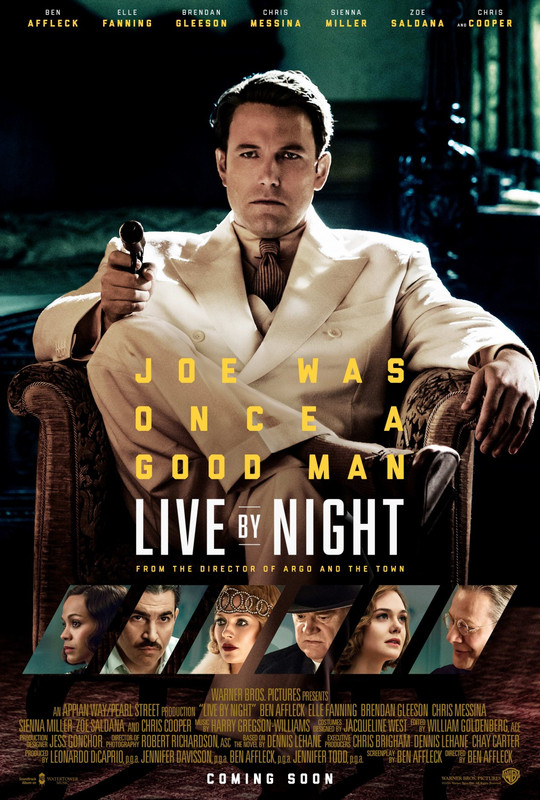
Based on a novel by Dennis Lehane (author of the source book for Affleck's directorial début, Gone Baby Gone, as well as Mystic River and Shutter Island), the film tells the story of Joe Coughlin (Affleck), who returns from World War One determined never to follow orders again and chooses a life of crime. Following a heist gone bad, and under threat from the head of the Irish mob, Coughlin lends his services to the Italians, who send him to Florida to run their rum operation and work on building a huge casino.

Affleck is a perfectly solid actor, but he's a better director and here his biggest mistake is in casting himself as leading man. For one thing, at 44, he's more than a little old for the character in the film's first act. Here Coughlin is a relatively young man (context suggests late 20's) coming up in the underworld. Yes, the story spans a long period (seven years seems a fair estimate, at least before the coda), but we never get a sense of a young man growing to fill ever larger shoes, which we might have with a younger actor. I wonder if Affleck recognises this, because early in the film he does look surprisingly fresh faced, whether through good lighting, make up work or a little CGI assist.

However, age is not the only problem. Affleck has said this was a passion project, the one he picked when he could essentially have decided to do anything, so it is truly bizarre that his performance is so low energy throughout. He's clearly going for sense of underplayed menace but maybe he's too successful at underplaying. There is a sense of Affleck giving the sort of performance he'd give while off camera even when he's on camera; it's barely inflected most of the time, robbing the relationships with Coughlin's lovers (Sienna Miller and Zoe Saldana) and his right hand man (Chris Messina) of any charge. His off camera work is even less energised, resulting in the most reluctant sounding voiceover since Harrison Ford's in Blade Runner.

Affleck leaves the focus closely on himself (he's in practically every shot), and in doing so he shortchanges many other characters, especially the women. Sienna Miller has fun in a ten minute turn as a gangster's moll embroiled in a dangerous affair with Danny, but she's little more than a cliché in human form. Still, that's more than can be said for Zoe Saldana, who should be an interesting character. When she meets Danny she, along with her brother (Miguel), is running much of the rum trafficking in South Florida. Within a couple of scenes she's Danny's Girl and from there on all she has to do is be hot (check) and look concerned.

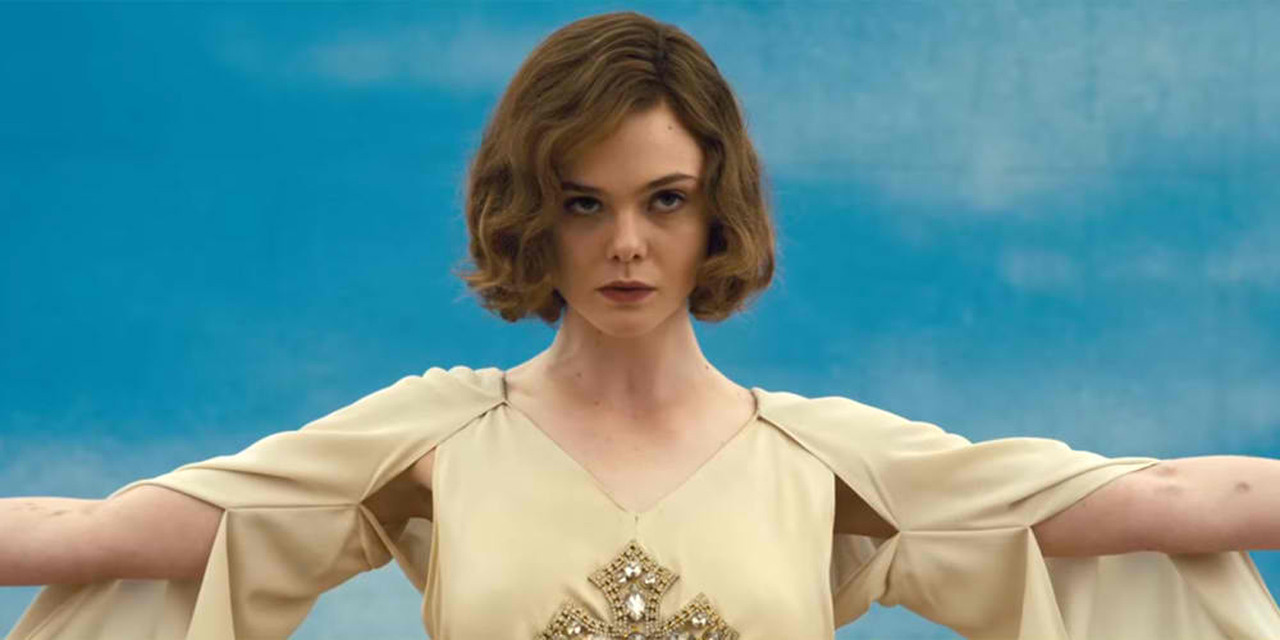
Similarly shortchanged in terms of screentime, but able to make much more of the little she has to do is Elle Fanning. A great actor can take a part of any size and make you want the whole film to be about that person, that's what Fanning does here. Her character - the daughter of a cop (Chis Cooper) that Danny has to get the nod from in order to do business - is a failed actress who (offscreen) falls into sexual exploitation and drug addiction, only to come home, become a preacher, and speak against Danny's casino application. There's a film in that character, and thanks to Fanning's typically nuanced work it's one I'd pay good money to see. The material she's working with is unexceptional, what she does with it is purely a testament to her talent.

The rest of the supporting cast have similar problems, trying to make the best of roles that are either underwritten despite extensive screentime (Chris Messina, who does a good job with what he has), underwritten because of lack of screentime (Chris Cooper, Max Casella as a thuggish relative of Danny's boss) or laughably broad caricatures (Matthew Maher as RD, a KKK member who shoots up Danny's speakeasys in protest at his relationship with a black woman). Affleck appears, whether at screenplay stage or in the editing room, to be feeling the need to get things done, at least for the theatrical cut, within two hours. It all ends up rushed, thin and over familiar.

Courtesy of cinematographer Robert Richardson, Live By Night often looks good, but again, some of Richardson's work is undermined by his director's choices. But for a couple of brief moments - a shot from behind of Elle Fanning preaching, arms outstretched, for instance - Affleck's glossy framing throws up few memorable images, and never feels especially authentic. Perhaps it's the crisp digital sheen of the thing, but there is an overwhelming feeling here of watching people play dress up, rather than being sucked in to the mid to late 1920s. This incongruity hit me right from the start, when the studio logos came up sepia toned and with superimposed CGI film scratches. It all felt so transparently fake, and I never shook that feeling.

Live By Night wants to pay tribute to the classic gangster films of the 30s and 40s, but while Affleck has the budget to have all the trappings of those films, he shows little understanding of how they worked. The profane dialogue lacks the snap of the best of Warner's gangster films. The images, while technically decent, don't evoke the feeling of either the films or the period and the film as a whole feels long despite also clearly having gaping holes in characterisation, which are surely filled by things sitting on the cutting room floor. It's a pity, because Affleck is a capable filmmaker, but perhaps all the freedom that Argo has afforded him meant that nobody was able or willing to tell him that there were decisions he should have reconsidered on this project.
★★

Jan 3, 2017

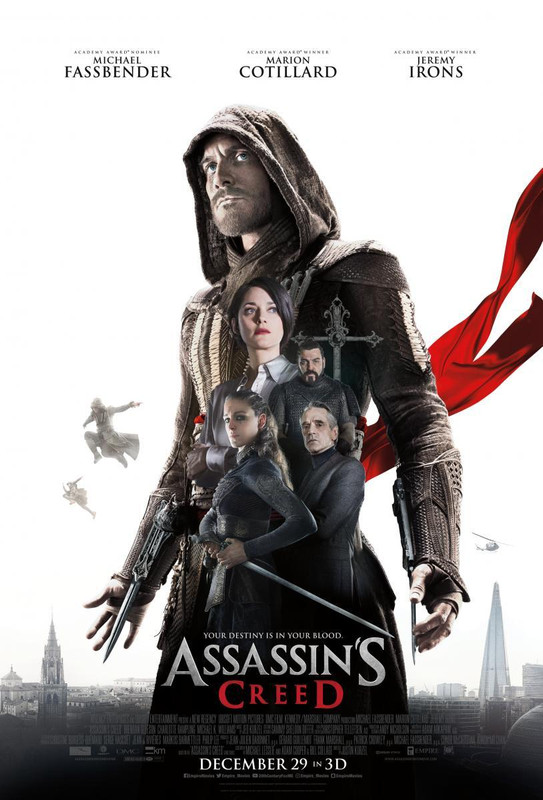
Assassin's Creed [12A] [2D]

Dir: Justin Kurzel
I often find myself asking "what's wrong with mainstream Hollywood cinema right now"? The answer is complex and multi-faceted, but I think I can now boil it down to two words: Assassin's Creed. This borderline unwatchable film epitomises so many of the problems I have with mainstream cinema right now that it almost seems to have been made as a how not to guide for other filmmakers. It is as fundamentally broken as any film I've seen recently, and yet its most frustrating aspect is how easy it is to see how it could be at least partially fixed.

Not having played any of the Assassin's Creed games, I don't know how accurately the film represents them, but even if it is extremely unfaithful to the series that, I'm confident, is the very least of the film's problems. One of the larger problems is the screenplay, which manages a trick you would imagine was difficult, but is all too often achieved; being insanely intricate and complicated, but also  dumber than a box of rocks.

Michael Fassbender plays Callum Lynch, a death row prisoner who wakes up from his 'execution' to find that he's in a facility where scientists led by Marion Cotillard's Sofia want to plug him into a machine called the Animus. Using this machine they will allow (read force) Cal to experience the memories of his ancestor, an assassin named Aguilar, in order to find the Apple of Eden, which supposedly contains the genetic code that will allow control of humanity's free will. How will this genetic code actually be used? Here are some keys, watch them jingle. The intricacies of this plot dictate that roughly 97% of the dialogue is unspeakable technobabble. The other 3% is the phrase "Apple of Eden" and no, it never sounds any less silly.

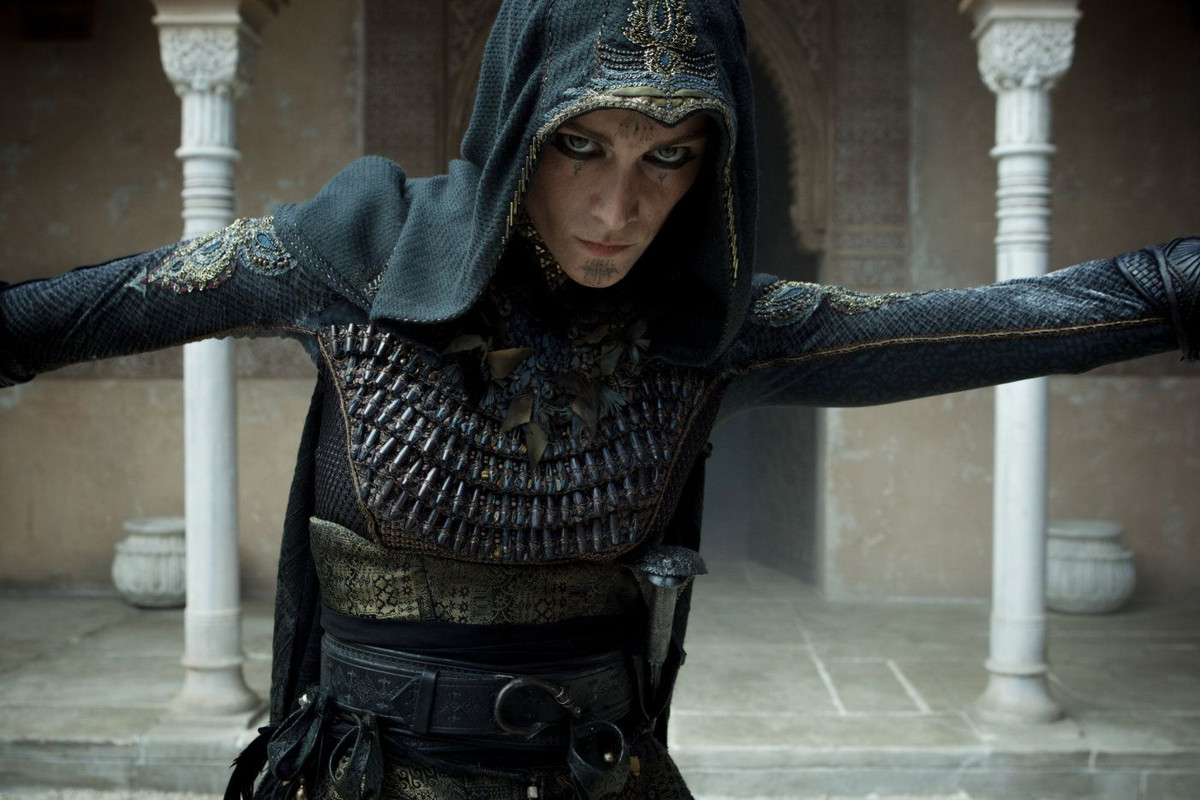
Fassbender and Cotillard are merely the tip of an overqualified iceberg when it comes to casting. Other unfortunates chewing their way through the dialogue include The Babadook's Essie Davis, brilliant French/Greek actress Ariane Labed, Michael K. Williams, Brendan Gleeson, Denis Ménochet and Charlotte Rampling. Every single one of them is totally wasted on a screenplay that has no time for such niceties as characterisation, indeed in the case of the people Cal is imprisoned with at the facility it actively avoids giving them any life, rendering the third act totally inert. Outside the action scenes, Fassbender couldn't seem any less engaged, but he qualifies as one of the film's harder workers, Rampling and Cotillard often seem slightly perturbed to have been woken for their scenes. It's a particular shame to see Ariane Labed, one of the most interesting young actors in European cinema, given so little to play. She has a few lines (all in Spanish), but mostly just has to look stern. She does it well enough, but I wanted so much more for her in her first big budget film.

I could forgive many of the film's sins if the action were better. To be fair, Fassbender and Labed (who plays a female assassin working alongside Aguilar) each get a couple of extended moments to show that they did at least some of their own action. The rest, however, seems heavily doubled, is largely shot with shakycam and often cut to ribbons. It's just not very involving, because you can seldom see a single action all the way through. It's also hamstrung by the 12A certificate, which means that a climactic slashed throat can hardly be seen to bleed. Adam Arkapaw's cinematography, accomplished as it is, also creates problems for the action. Arkapaw and director Justin Kurzel's frames are, in the 1492 set action scenes, so dusty and misty that it's often tough to see much of what's going on, even before the camera motion and editing become an issue.

To be fair to the screenplay, it has a beginning and a middle. Unfortunately what it lacks is an end. After about 110 minutes the film appears to decide that it, just as we have, has had enough of this crap and it stops. To say that it ends wouldn't be true, that would suggest that there was some sort of climax or resolution. It stops, as abruptly as if the projector had broken, inviting a sequel we'll almost certainly never see. 

However, I've saved the film's biggest problem, its figurative raised middle finger to the audience, for last. It's one line of dialogue. Introducing Cal to the Animus, Sofia tells him that while he's experiencing Aguilar's memories "you can't change anything". This is a calamitously stupid idea. It means that for a full third of the running time we're watching a foregone conclusion. Yes, we keep cutting back to Cal, going through the actions we see Aguilar doing, but because his actions have no bearing on the action scene, what it amounts to is watching a man get overly animated in his involvement with a video game cut scene. The other problem with cutting frequently back to Cal is that it seems to happen every time the action threatens to develop some sense of flow. Another great decision there.

When the action scenes finally move to the present day, with Cal actually doing something, it is no more involving, because the people fighting alongside him are total non-entities. Michael K. Williams has said a few lines, but the rest are just bodies, occasionally glimpsed in the background. The stakes are non-existent, the plan they're trying to stop is so vague despite having been discussed endlessly, and the final action scene is a total anti-climax. It doesn't even manage to have the coolest moves in the film (those belong to Ariane Labed in one of the 1492 sequences).

I said that I could see an easy way to fix Assassin's Creed, at least to some degree. It's this: set the whole film in 1492. Immediately the action is more involving, you lose the impenetrable technobabble and reduce the film down to a focused conflict between good (Assassins) and bad (Templars). This would also mean there would be more space to develop the relationships, especially between Aguilar and Labed's Maria, adding weight to the action scenes. I don't know if that would make the film more or less faithful to the games, but I do know it would make it a better film. It might even mean it could have an ending.

Justin Kurzel began his career with the brilliant true crime tale Snowtown. A film that gave us  3 dimensional, portraits of a range of often terrifying characters, a film that told a complete and horribly compelling story, a film that stuck with you. I'm not sure what he and his cast saw in this material, but he certainly doesn't deliver on whatever promise he felt there was here. The film doesn't look bad, but it's not got any imagery that will stick in my mind either. I hope this is just a blip for Kurzel and Arkapaw, who are much more talented than this dreadful, boring and very, very stupid film suggests.
½★