Showing posts with label 2010 Releases. Show all posts

Dec 18, 2010

Tron: Legacy [PG]

Dir: Joseph Kosinski
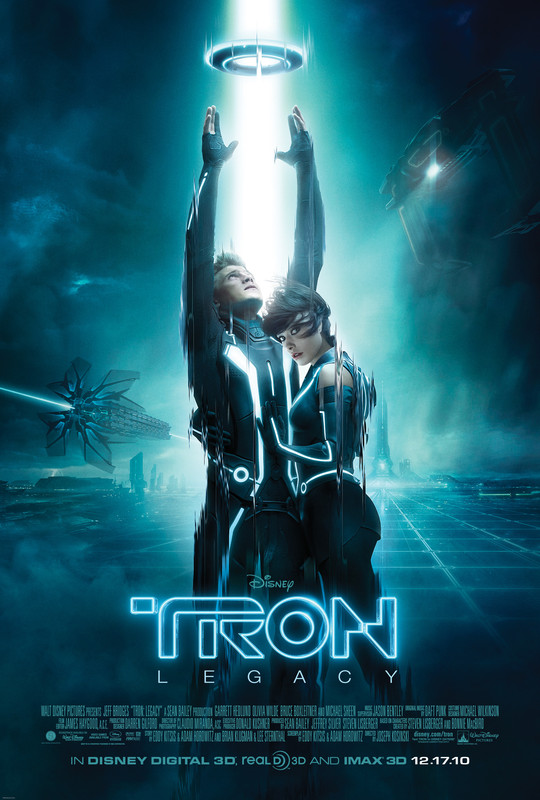
I’m not the biggest Tron fan, but in watching this movie I felt bad for them. I can’t imagine the level of disappointment I’d feel if I really had been waiting with anticipation for 28 years for Tron to have a sequel, and then this was what was delivered. I don’t say that because Tron: Legacy is awful, but because it is mediocre, and because you can see how it might have been far better.

The original Tron was the first film to use computer-generated imagery, and it did so brilliantly. As basic as the CGI was (a few very simple polygon forms) it was used to enhance live action footage, and to give a genuinely new and otherworldly look to the film. Legacy picks up the story 28 years later, and focuses on Sam Flynn (Garrett Hedlund), son of the original’s main character Kevin Flynn (Jeff Bridges) who has grown up without the father who disappeared 20 years ago (as is explained, along with the events of the first movie, in a graceless ten minute infodump at the beginning of the film). When Flynn’s old partner Alan Bradley (played again by Bruce Boxleitner; a good actor who really should get more work) receives a page from Flynn’s office he tells Sam, who goes to investigate, discovers his Dad’s secret office and soon finds himself on ‘The Grid’, a digital world ruled over by Clu (Bridges, with the assistance of the next generation of the technology used to make Brad Pitt appear young in The Curious Case of Benjamin Button).

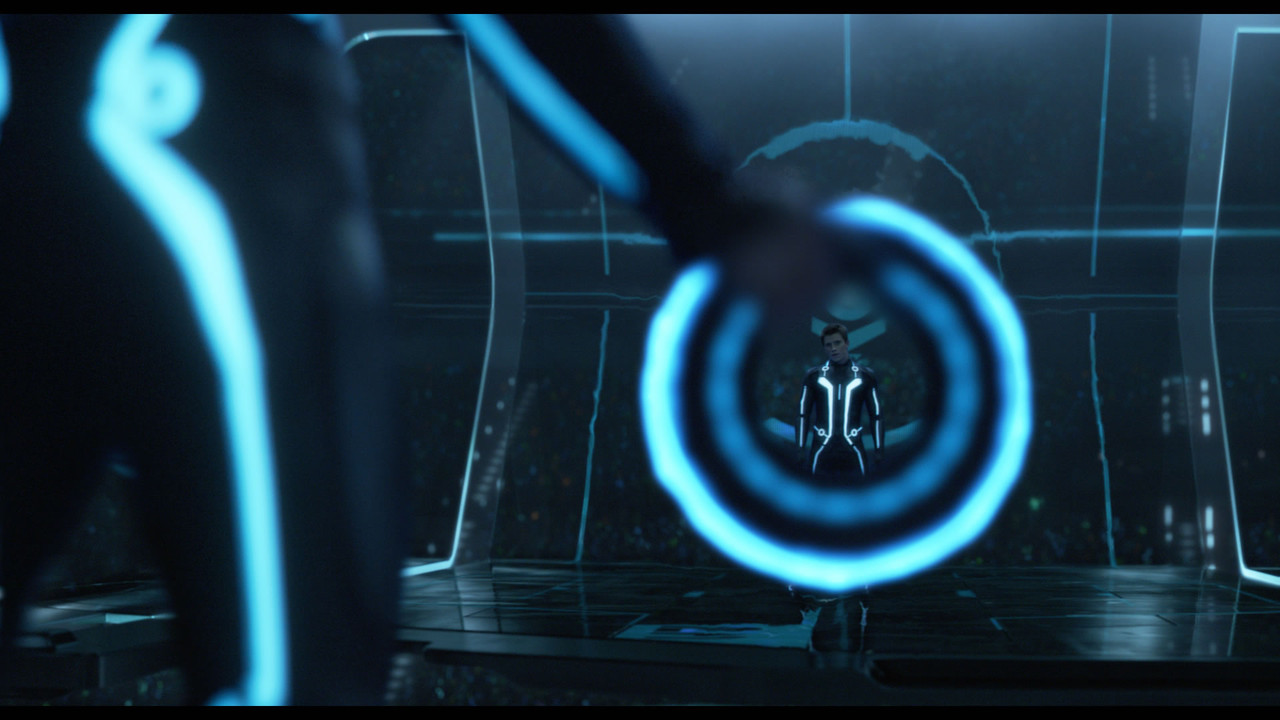
That’s just the setup, but lets be entirely honest, the story isn’t what’s really important about Tron: Legacy, what people are coming for, what they’re hoping to be sucked in by, is the design. It’s not quite the triumph it should be. The 2D trailers blew me away with their visual beauty, but for me, as with so many other films, the 3D process not only fails to add to the visual splendor, it detracts from it. Joseph Kosinski has deliberately made The Grid a dark world; dark blues and blacks dominate, highlighted with glowing lines of sky blue or white (for goodies) or orange (for baddies). This is pretty poorly served by the 3D process, which casts a murky grey sheen over everything and desaturates all colour. Add to that the fact that the depth is no more impressive (except for the title card, which does look amazing) in the 3D segment of the film than it is in the 2D real world scenes and I’m hankering to see this again in 2D.

Another problem with the 3D is that fast motion still doesn’t quite work; it retains a blurry and indistinct quality, which made the otherwise excellent lightcycle scenes difficult to understand, for the most part I couldn’t tell who was driving which lightcycle, and the geography of each of those scenes (thanks largely to the many transparent layers of the grid) is incredibly hard to follow. This said, the design is astounding, the grid is beautiful and the effects work is, for the most part, very strong. Kosinski has, at least, succeeded in credibly updating the look of the grid we saw in the first Tron and showing us an evolution and expansion of that world.

Quite apart from being something that people had never seen before, Tron had ideas that were incredibly ahead of their time. The idea of people having a digital presence that is as much themselves as their real life presence is a reality now (though not in the same way as Tron depicts it) and the concept of digitizing objects (again, not quite so literally) is also a huge part of how we live. What Legacy fails to do is have similarly ambitious ideas and subtext, at one point Bridges’ Kevin Flynn observes of wireless communication between digital devices “I thought of that in 1985”, and that’s really the problem, it doesn’t feel like Legacy brings anything new to the table, not in terms of ideas and certainly not in terms of story, which is the same old orphaned kid searching for his dad tale that we’ve seen in roughly EVERY DISNEY MOVIE EVER. It’s not even very well told. The only time the script really comes to life is when Bridges - clearly having fun - gets to inject some of himself into Flynn (To Sam: Quit messing with my zen thing, man). Otherwise it’s all exposition and colourless character interaction, focused, sadly, on a somnambulant Hedlund. However, Hedlund’s not the worst thing here, no, the performers' wooden spoon goes to Michael Sheen, whose outrageously camp performance as club owner Castor (who he plays as a gayer Aladdin Sane era Bowie) is completely insufferable.
The only good news on the new casting front comes in the shape of Olivia Wilde, who is appealing as Quorra, a program whose true nature will prove interesting in the surely inevitable sequel. She makes the most of the few lines she’s got to help give her character depth, and she really does look like she’s been custom designed in a computer to make every geek on Earth go weak at the knees. And then there’s Jeff Bridges. This film essentially casts him (at least as Kevin Flynn) as God, and why not? Who doesn’t want that to be true? As poor as Hedlund is, Bridges does manage to make his side of the father/son story play, and is the only character you have any real emotional investment in, and there are also a handful of moments when he’s just being his own unassailably cool self, which is never a bad thing. Of course Bridges also plays Clu. Digitally de-aged (with Against All Odds used for reference), the Clu avatar seldom entirely works, plunging us frequently into uncanny valley by being, all too obviously, a head digitally attached to a double’s body, but the work done on Bridges’ voice is remarkable, he sounds exactly like he did in his thirties and that and his performance sell the character, if not always the effect.

The one thing that is truly outstanding about Tron: Legacy is its score. Written and performed by the French electronic musicians Daft Punk (who appear in the End of Line Club as MP3s) it is this pulse pounding mix of strings and electronics that really powers the film, more than the script, more at times than the visuals. Ultimately its so good that it reduces the film, making it at times feel less like a movie than the best Daft Punk video ever made, even during a spectacular fight scene in the End of Line club I was considerably more interested in the fact that the brilliant Derezzed was pounding out of the cinema sound system than I was in anything happening on screen. In this way the film's score is both its strongest element and its biggest liability.

If you like 3D more than I do then I’d recommend Tron: Legacy, if only because it does show some intent to use 3D to tell a story, by using it only on The Grid (and despite what the opening caption says DO NOT leave your 3D glasses on during the 2D scenes), if you’re not fussed by 3D then I’d say buy the Daft Punk album and wait for the DVD.
★★☆☆☆

Dec 10, 2010

The Girl Who Kicked the Hornet's Nest [15]

Reviews of The Girl With the Dragon Tattoo and The Girl Who Played With Fire can be found HERE and HERE

Dir: Daniel Alfredson
And so the big movie event of the year comes to a close, not with a bang but with a whimper, with a film so forgettable and inconsequential that it may as well be merely an expulsion of air. It’s a real shame, but I can’t say I didn’t see it coming. Stieg Larsson’s final (completed) Millennium novel is a doorstop; a huge beast of a book filled with a rambling, ranty, mass of detail and freely mixing a little fact with increasingly outlandish fiction. It’s also incredibly static. On the page that’s not entirely ineffective; Lisbeth Salander (played again by the extraordinary Noomi Rapace), confined to a hospital bed, unable to do much of anything in her own cause (which, this time out, involves a trial for attempted murder that could see her committed), is a somewhat effective counterpoint to the fierce, active, character of the first two books. Unfortunately, translated to the screen, it’s often – like much of the rest of the book - just dull.

For what seems like an eternity (the cut down cinema release is 147 minutes long) nothing happens. Endless screen time is filled with Mikael Blomkvist’s meetings at Millennium, with meetings at ‘The Section’, a shadowy institution which has been conspiring against Salander; with Salander lying in bed and barely speaking and, as ever in this series, with people typing. Because the book has had to be reduced so much the narrative will be largely lost on those who haven’t done their homework, and for those that have the mass of connection and detail is reduced to a series of brief scenes of people we’ve never met before sitting in chairs and explaining the plot to one another. For much of the middle section of the film scene after scene after scene seems to reveal yet ANOTHER new character, who’ll pop up for a scene or two, explain something, and then never be seen again, but the problem is we already know what happened to Salander, it’s been obvious since The Girl Who Played With Fire, so it feels like the movie is spending two hours putting together a 1000 piece jigsaw of a blank wall.

Even when we get to the set pieces - the attempt on Lisbeth’s life at the hospital, the attack at Erika Berger’s (Lena Endre) home - director Daniel Alfredson fumbles the ball. The hospital sequence, in particular, lacks any suspense, feeling tossed off and perfunctory. The same is true of the courtroom set third act. This should be the great dramatic dénouement but, in spite of a fine performance from Annika Hallin as Lisbeth’s lawyer (also Blomkvist’s sister) and the customary excellence of Rapace’ quieter, but still forceful, turn it just doesn’t work. The delivery of the material is flat, yet the other performances run towards the hammy (Anders Ahlbom as Dr. Teleborian is especially guilty here) and Alfredson’s matter of fact direction does nothing to energise the sequences. Where Neils Arden Oplev managed to truly adapt The Girl With the Dragon Tattoo, making it a different but equally valid telling of Larsson’s story for cinema, Daniel Alfredson has only managed to put some bits of the books on screen. This is an inert film, were it not for Rapace and a handful of other performers (Nyqvist, Hallinn, Endre) it would be totally worthless.

All this said, it’s hard to lay all the blame at Alfredson and writer Ulf Ryberg’s door. The Girl Who Kicked the Hornet's Nest doesn’t work as cinema, and it was never going to. As a novel it is neither claustrophobic enough to work as that kind of thriller nor expansive and exciting enough to work as a more action driven film, and by sidelining its most interesting character the book shot itself and this adaptation in the foot from the start.
★★☆☆☆

Nov 13, 2010

Due Date [15]

Dir: Todd Phillips
A series of open letters on the subject of Due Date.

Dear Alan R. Cohen, Alan Freedland, Adam Sztykiel and Todd Phillips,
I should probably address you as you’re credited for your screenplay. So, let’s start with Alan and Alan. You guys are credited with Due Date’s story. This makes me laugh quite a lot (more, certainly, than the movie, but believe me, we’ll get to that) anyway, what you are very optimistically credited with as your own invention isn’t, it’s Planes, Trains and Automobiles. Oh you’ve dressed it up with some swearing, some wanking and some child abuse, sure, but it’s still Planes, Trains and Automobiles so lets be absolutely clear about this; if Due Date is to have a story credit, it belongs to John Hughes. Not that he’d want it; in fact I believe he’s the source of the faint spinning sound I heard throughout my screening.

Since I’m assuming (perhaps charitably, knowing Hollywood’s track record) that you guys didn’t get paid for simply saying: “Let’s remake Planes, Trains and Automobiles… but with two characters with severe personality disorders.” I have to assume that at least some of the ‘comic’ scenarios are yours. How about the sheer breathless hilarity of Robert Downey, Jr spitting on a dog (an apt metaphor, actually, for what he should have done with this script)? Or the gut busting scene where Zach Galifianakis has a wank (there’s a metaphor about the script in that too, can you spot it?) Oh, what about the brilliantly funny moment in which, completely inexplicably, Downey and Galifianakis get thrown off a plane, was that yours too? Or were you just responsible for the slavish copying of a John Hughes movie. You know, the bit where Zach Galifiankis (playing John Candy) falls asleep while driving, or Galifiankis’ habit of asking endless inane questions of Downey (as Steve Martin), or the bit where Downey attempts to pick up money wired to him by his wife, which is very reminiscent of Martin trying to rent a car in Planes, Trains… only not funny and with some gratuitous violence tacked on… because it’s ‘edgy’? Jesus Christ guys, get your own unfunny ideas.

By the way, Adam and Todd, don’t go thinking I’m letting you guys off. You rewrote this. That means that you took this dog shit covered ball and ran with it, dropping it in a few freshly laid turds along the way. I don’t know what’s yours, but the whole Mexican border sequence is so laughably tacked on that it pretty much has REWRITE stamped on every frame, and the hamfisted, implausible, unmotivated hugging and learning scenes are something of a trademark, aren’t they Todd? Anyway, Todd, I’ll write back because I’ve got plenty more to say to you.

Dear Todd Phillips,
Where to begin? Oh, right, what the fuck were you thinking? Here’s a script that, at its heart, is about a man (Robert Downey Jr) trying to get home for the birth of his first child. There really are few things easier to identify with, everyone wants to be there when his kids come into the world and it should also be easy to root for a guy with that objective, but you just keep undermining that identification. Not only is Peter Highman an utter raging asshole to pretty much everyone he encounters (including his wife, played by Michelle Monaghan, and by the way, when you hire an actress that good you might want to give her more to do than be a walking incubator) he’s also violent and abusive to adults, small animals and an eight year old child. I just want to take a moment, Todd, to have a look at the scene in which Peter is asked to watch a drug dealer’s (Juliette Lewis) kids while she sells Ethan (Zach Galifiankis) weed. They’re pretty typical kids; they mess around with Peter, pester him, pull his tie, so he PUNCHES ONE OF THEM IN THE STOMACH. And you expect me to want this guy to get back for the birth of his baby? Have you completely taken leave of your senses? I’m worrying about what he’s going to do when the kid cries, I don’t want this shitbag to meet his child, let alone see it born. It’s one thing to have a protagonist to start out unlikeable, but warm up credibly over the length of a journey (there was film you may have seen that did it quite well… Planes in the title I think), it’s entirely another to ask us to empathise with a violent misanthrope and want him to become a parent.

Beyond the troubling things you’re saying with this film, you’re saying them pretty poorly. It’s just a series of bits, the characters don’t have an arc. Ethan never changes one bit (like many of the ‘eccentric’ characters in recent cinema I worry that he’s an undiagnosed Aspergers case). By contrast, Peter seems to change scene by scene in the second half of the film; he hates Ethan / he’s Ethan’s best friend / he wants to kill Ethan / he loves Ethan. There’s almost no effort to explain these changes in Peter’s outlook. Is he schizophrenic? Films about mismatched buddies work because we see them change and adjust and warm up to each other. Neither of these people is appreciably different as the end credits roll, so what’s the story, where’s the investment?

In about five weeks you’re going to be 40. I wouldn’t believe it from this film, because you appear to have the sense of humour of a twelve year old. Violence, puking, animal genitals, masturbation, smoking weed, all these things are funny in and of themselves, who needs jokes? On a craft level too this film appears to be the work of a child. There’s barely an imaginative or interesting shot in the whole film (the only really striking visual in the film is provided free of charge by the grand canyon.) you may have styled this “A Todd Phillips Movie” but frankly it could be any rentahack’s movie. You seem to bring the same lack of engagement to the directing the performances as you do to the visuals and the general arc of the story, but you can find out a bit more about what I’ve got to say on that subject from reading the letters I’m sure Robert Downey Jr and Zach Galifianakis will want to share with you.

Dear Robert Downey Jr and Zach Galifiankis,
You are both clearly talented men, so exactly what are you doing in Due Date? Robert, you are still on the wagon, right? Zach, did the weed make this read funny?

Robert, you seem pissed off in this movie. I can’t blame you, but I’m not sure if it’s a character choice (if it was, a touch of advice… next time additional choices will result in a more rounded performance) or you just woke up every morning, read the pages you had to do, and then simply decided to treat them with the absolute contempt that they so richly deserve. Either way man, you’ve built up an enormous amount of good will over the past few years, and frankly you’re now in danger of pissing it all away with performances as phoned in as this one and your recent second take on Iron Man (actually in this one your character spends so much time on his Bluetooth headset I wonder whether it ever crossed your mind to deliver the performance that way. Also, much though I like you as an actor, I really don’t like you enough to root for a man who punches an 8 year old, let alone laugh when he does.

Zach, oh and it was all going so well. You were the funny bit of Todd’s last offense against comedy; The Hangover, you’ve just turned in a really fine dramatic performance in It's Kind of a Funny Story, and now this? Just how much do you owe Todd Phillips? Are there gambling debts involved, or was it just the weed? The thing about Alan (the same person by another name that you played in The Hangover) was that he wasn’t always there, he was the spice, a little comedy condiment sprinkled just liberally enough to make that film close to palatable. The problem with Ethan is that he’s never off screen and by God he wears thin quickly. As monumental a dick as Peter is it’s pretty hard to blame him when he first abandons Ethan (actually it’s less understandable when he goes back). Characters have to change, the journey in a road movie has to be more than physical, and from what you did here I’m not convinced that Ethan is a character at all, rather he’s an assortment of shtick; collected tics accumulated over a set of improv sessions. There’s nothing more behind it, and that’s why neither the comedy nor the story work.

I’m really disappointed in you guys, you’re reliably interesting and funny actors. I guess you just couldn’t overcome this screenplay and this director.

Dear Readers,
Don’t go and see Due Date, it’s shit. Even if it were better though, I’d still advise you to steer clear of it, because it already exists, has for 23 years, and if you want to see a comedy about two mismatched middle aged men traversing America in order to return home for a specific event, running into a series of comic mishaps, but becoming closer as time and travel go on, you should just see Planes, Trains and Automobiles again. It’s what Todd Phillips would do, and if you do maybe we can stop that spinning sound coming from John Hughes’ grave.
★☆☆☆☆

Oct 19, 2010

The Social Network [12A]

Dir: David Fincher
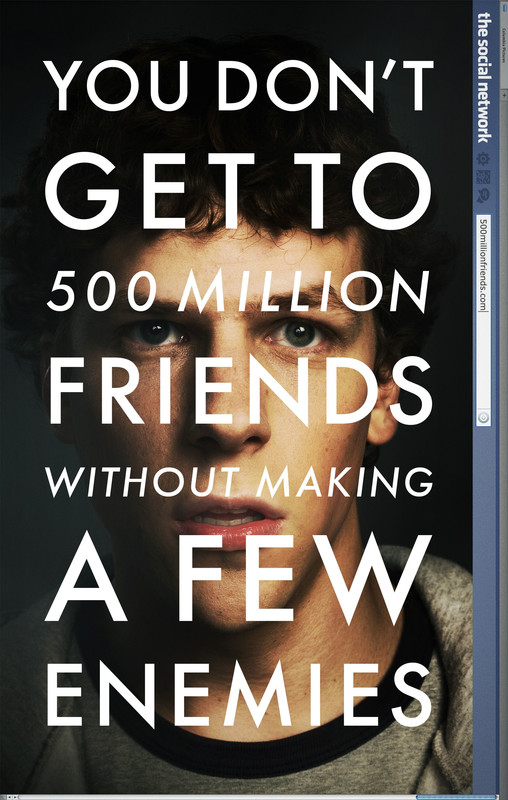
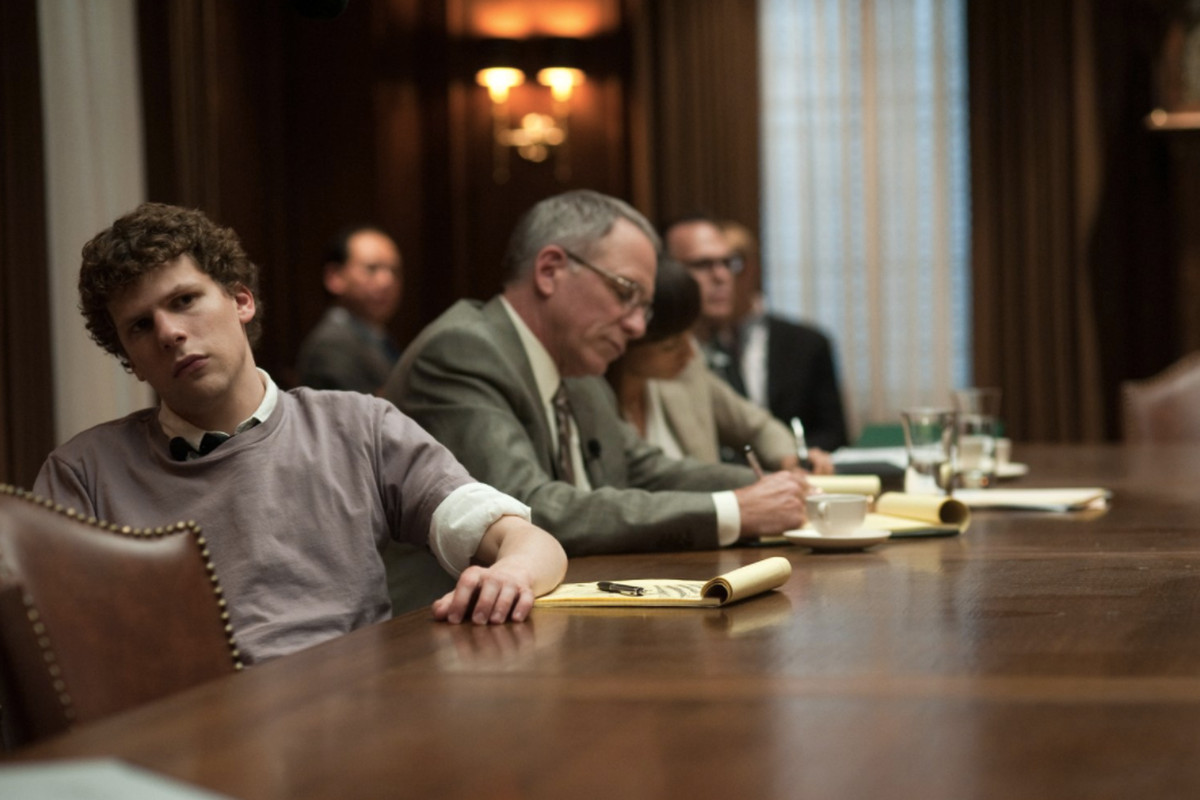
It may boast an A List director in David Fincher, it may feature rising stars Jesse Eisenberg and Andrew Garfield (whose performance here apparently scored him the role as the new Spider-Man), it may provide other rising names like Max Minghella, Justin Timberlake, Rashida Jones and Rooney Mara with striking roles but, make no mistake, the true star of The Social Network is Aaron Sorkin.

Sorkin has form writing for film, his best effort being the underrated The American President, which is notable not only as a great near forgotten film but also as the precursor to Sorkin’s television triumph; The West Wing. If there can be said to be an auteur behind this film then it is not David Fincher but Aaron Sorkin.

The Social Network spins generation-defining myth from recent history – readers well versed in Roger Ebert’s movie glossary will note that several events here have been Libertyvalanced. It revolves around the 2004 creation of Facebook (a website you may have heard of) and the lawsuits that founder Mark Zuckerburg (Eisenberg) had to fight against three former fellow Harvard students (Armie Hammer and Minghella… and Josh Pence, sort of, we’ll get to that) who accused him of stealing their idea and turning it into Facebook and co-founder and former best friend Eduardo Saverin (Garfield), who sued after he was, allegedly, unfairly cut out of the company.

The film sets out its stall early, serving notice with the very first scene that The Social Network is going to move fast, and it expects you to keep up. That first scene; nothing more than a conversation during which Zuckerberg’s girlfriend (Mara, as appealing here as she was appalling in A Nightmare on Elm Street) breaks up with him, is a dizzying display of dialogue writing and delivery. Eisenberg immediately impresses as the almost supernaturally clever Zuckerberg, giving an impression of someone whose brain is running considerably faster than those of most other people. Sorkin’s dialogue, as ever, is not naturalistic; it’s wordy and constructed, people don’t really talk like this, but it’s not forced. There are really two reasons for that, the first is simply the use of language, Sorkin clearly loves words, and he knows how to put them together, make them specific to characters, and lodge lines, or even single words, in your head. It’s also the work of the actors; there is a clear sense that they are relishing the dialogue, and they sell every line.

At the risk of becoming dull, there really is nothing bad to say about this movie. The entire cast is excellent. Eisenberg carries the film (he’s in just about every scene) and does it with an assurance that we haven’t seen from him since his debut in Roger Dodger. Just as much a cornerstone of the film as Eisenberg is British actor Andrew Garfield. Until recently I wasn’t much of a fan of Garfield’s, having found him flat in everything I'd seen, but with this film and with Never Let Me Go I’ve changed my stance on him as an actor (if not as a potential Spider-Man). He’s great as Saverin, showing off a convincing American accent and impressing as the more down to earth counterpart to Eisenberg’s anti-social, dreamy, Zuckerberg. Another surprise is Justin Timberlake; he’s done entirely acceptable work in films like Black Snake Moan, but nothing that suggested the energy and charisma he displays as Napster founder Sean Parker.

Armie Hammer plays both Cameron and Tyler Winklevoss (the Winklevai, as Zuckerberg refers to them), in a performance that is an absolute tour de force of special effects. Eschewing the split screen technique that allowed actors as diverse as Jeremy Irons and Lindsay Lohan to play twins and appear in the same scenes as both characters, Fincher used the same computer technology that allowed him to put Brad Pitt’s face on body doubles of various shapes and sizes in Benjamin Button to allow Hammer, with the help of body double Josh Pence, to play both roles. Happily he’s terrific, and very funny, getting the best out of some of Sorkin’s best lines (including a very funny scene in which the Winklevai take their case of copyright theft to an uncaring Dean of Harvard).

The quality runs deep in this cast; Jurassic Park kid Joseph Mazello pops up as one of Zuckerberg’s roommates, Max Minghella (son of late director Anthony) shows that he’s becoming a diverse talent as Diviya Narendra, Rashida Jones is her familiar adorable self as one of the junior lawyers for Zuckerberg, and Rooney Mara is just about good enough in her two scenes to assuage a little of the doubt about Fincher casting her as Lisbeth Salander in The Girl With the Dragon Tattoo.

The technical aspects of the film are also above reproach. I usually define a good score as being one I don’t notice, but that doesn’t apply to Trent Reznor and Atticus Ross‘ work here. Their mix of a simple, recurring, piano melody and doomy electronics makes for an unusual, ultra modern, soundtrack that makes an effective counterpoint to the film. Jeff Cronenweth makes the film look beautiful, but without dazzling us with his compositions, and risking forcing us out of the drama and the editing by Kirk Baxter and Angus Wall deserves recognition too, if only because they manage to turn sequences of people doing much what I’m doing right now into action scenes.

David Fincher is a director who often imposes himself on a film; he’s as classic an auteur as anyone working today, and yet by largely getting out of the way he makes The Social Network his best and most cohesive work in a long time. Of course, you have to credit him as much as you do Sorkin and the cast the uniformly impressive performance, as much as Prieto for its visuals and as much as --- for the editing, but while the film is technically brilliant there are very few of the flourishes, the conspicuous directorial exercises, of which he is very fond (Think Panic Room's CG assisted tracking shots, taking the camera through the handle of a coffee pot because he could). He lets the actors and the script do the heavy lifting, and focuses on capturing it in the obsessively meticulous detail he’s become famous for.

I don’t for the life of me understand Facebook or its popularity (and no, this movie hasn’t changed that), but this story is nevertheless riveting and its telling just about flawless.
★★★★★

Oct 5, 2010

Film Review: The Town [15]

Dir: Ben Affleck
Ben Affleck took everyone by surprise a couple of years ago, by turning in a muscular, high quality, directorial debut in Gone Baby Gone. For his follow up Affleck hasn’t strayed far from the territory of his debut, turning out another Boston set crime film. The Town is set in the Boston area of Charlestown, which apparently produces more thieves per capita than any other area of the US. Affleck, adapting a novel by Chuck Hogan, focuses on a group of bank and armoured car robbers, centred around lifelong friends Doug (Ben Affleck) and Jim (Jeremy Renner). During a bank heist they take manager Claire (Rebecca Hall) hostage, and as the police and FBI (personified by Mad Men star Jon Hamm) begin to look closely at them Doug attempts to ensure that Claire doesn’t know too much, falling in love with her in the process.

Ben Affleck may not be the best actor in the world, but he’s more than just “the bomb in Phantoms”. He’s solid here, never letting the side down, even though he is in many respects the weak link from a performance standpoint. He’s best when sharing scenes with better actors, establishing strong relationships with Renner and Hall, and sharing a quietly explosive scene with Hamm. Where Affleck really does his best work in The Town is behind the camera. He draws strong performances from an interesting cast. Renner is excellent as Affleck’s impulsive right hand man, making Jim a man who always seems to have an itchy finger hovering over some sort of trigger, especially in the tense scene in which he first sees Affleck and Hall together. Hamm also makes a strong impression, bringing a real sense of purpose to what might otherwise be a thin role as the FBI man chasing Doug and his gang. In smaller roles Pete Postelthwaite struggles a little with a broad Irish accent, and manages little menace as local crime boss ‘the florist’, but Chris Cooper is effective in a single scene as Affleck’s father.

Perhaps even better are the film’s leading women, played by two of the more interesting young actresses working in Hollywood. Rebecca Hall is customarily excellent as Claire. Her trauma after the kidnapping is convincing, but never overplayed, and (at least until the end) Claire’s relationship with Doug works well and is convincing. She’s nothing so trite as the film’s moral centre, but she is the most straightforward person here, but Hall never lets that become an excuse for making Claire two dimensional. Blake Lively’s part as an old flame of Doug’s was initially written for an actress fifteen years her senior, but Lively apparently lobbied hard for the job, and it is easy to see why she won it. Lively’s performance is completely unencumbered by vanity, she plays Krista (who, it is implied, is something of a Charlestown good time girl) as a young woman made old before her time, thanks to life dealing her a bad hand. At first she seems incidental, but her role grows in the film’s third act, and Lively grows to fill it. Taken with her role in The Private Lives of Pippa Lee, this suggests that she’s going to be an interesting, daring, character actress over the next few years.

The Town is by no means original; in fact, it is generic to the core. The story is that old, old one of a career criminal forced into that ‘one last job’, and perhaps being redeemed by the love of a good woman. That said, the performances help lift it beyond just another exercise in genre, and so does Affleck’s handling of the three major heist set pieces. None of them is exactly radically different to what has gone before, but each has its own specific feel, each is executed energetically and excitingly and, happily, the geography is clear in each and every scene, so we always know exactly what is going on (something that seems undervalued in many action scenes lately).

The Town isn’t going to change anyone’s world, and it would be nice, next time, to see Affleck attempt something in another genre (and perhaps another city), but this is a solid, entertaining, crime thriller.
★★★☆☆

Sep 28, 2010

Winter's Bone [15]

Dir: Debra Granik
Debra Granik’s first film, Down to the Bone, served notice of a raw directorial talent, with an eye able to spot as yet under-utilised acting talent (in that film it was Vera Farmiga, who has since gone from strength to strength and collected her first Oscar nomination). Winter's Bone confirms that impression of Granik, and again she’s found an exceptional young actress to take the leading role.

The film is set in the Ozark mountains and follows 17 year old Ree (Jennifer Lawrence), who has been left to raise her young brother and sister herself thanks to a father who spends most his time cooking meth and a mother who is mentally ill, and barely communicates. When her father skips bail Ree and her family stand to lose their house, and everything else they own, so she sets out to find either her father or his body, with reluctant help from her uncle ‘Teardrop’ (John Hawkes).

This is a tough film to pin down; part thriller (though it often moves at a very slow pace), part character study, part exploration of a very insular community (the criminal fraternity that Ree’s father was involved in), it tries to do a lot of things all at once, and almost completely succeeds.

Granik’s eye is humane, but it’s also unflinching, unsparing, unsentimental. She’s not afraid of the ugly parts of this story, nor indeed those of the landscape in which it is set, with the broken down state of everything hammering home the poverty that these characters live in. That said, as ugly as some the settings are, the way Granik films them is striking, she completely immerses us in this world which, happily, is quite alien to most of us (the friend who came to the screening with me remarked that the poverty and the setup of the society struck him as almost feudal). Towards the end of the film there is some tough imagery, notably a beating meted out to Ree for disobeying local drug lord Little Arthur and his wife (Dale Dickey). However, most of the time Winter's Bone deals not in visceral thrills but in tension.

What Granik and co-writer Anne Rosellini really get right here, apart from the outstanding character writing, is the pace. The film moves slowly, but there is an undercurrent of genuine tension in almost every scene. Violence is seldom used, but the threat of it is in every word as Ree begins searching for her father, who has clearly transgressed against his employers. There’s also a disturbing sense that the threat could come from just about anyone, as when Ree first attempts to involve her uncle in the search he responds by telling her that she’d best stop looking.

In the end though, Winter's Bone is held together by a collection of outstanding performances. Jennifer Lawrence is a real find, just 19 when the film was shot, she holds centre stage in practically every frame of the film, and is utterly compelling. Ree’s desperation is visceral and moving, never more so than when she goes to see an army recruiter because she needs the signing bonus to save her home. She’s vulnerable, but there’s also great strength there, and those two qualities play off against each other effectively in Lawrence’s performance. There is loud chatter about an Oscar nomination (and there has been since the film debuted at Sundance), and it wouldn’t be undeserved.

The entire cast is excellent, with Granik handling the cast carefully, and clearly weeding out anything inauthentic. If you didn’t know better, and if you didn’t recognise at least a few players, it would be easy to mistake this for a found footage film, so unaffected is the acting. John Hawkes, a capable character actor who has never really broken out, is excellent as ‘Teardrop’, at first he seems a rather simplistic character, but Hawkes adds layers as the film runs on, culminating in a sad closing scene which leaves his character’s fate ambiguous. For me, the real star turn in the film (besides Lawrence’s) is from Dale Dickey, whose Merab seems to be a matriarch in the Ozarks meth trade. She’s got an incredibly memorable look, with her hard, deeply lined, face, and she gives a performance to match it; all flinty and unfeeling, and though it is Little Arthur we’re told to fear it Merab who is the terrifying figure here.

The only issues with the film are small, but not insignificant. Given Merab’s character in the rest of the film I had slight trouble buying her eventual willingness to help Ree, but much more significant for me is Granik’s use of a short, black and white, dream sequence. That sequence popped me right out of the film, which is a real problem for a movie that exists to plunge us into another person’s reality. There is such a naturalistic feel to the rest of the film that that short sequence, which may as well bellow, “you’re watching a movie” was a real and unwelcome jolt for me.

On the whole, Winter's Bone is hugely rewarding. It marks both Debra Granik and Jennifer Lawrence as names to keep a close eye on in the future.
★★★★