Showing posts with label Restoration. Show all posts

Oct 8, 2020

24FPS @ LFF 2020: Chess of the Wind

Dir: Mohammad Reza Aslani
The story of how Chess of the Wind came to be seen in this new restored version should be a movie in itself. Completed in 1976 and apparently screened only twice; once to hostile critics and once to an empty room, it was banned in 1979 when the Islamic government came to power in Iran. Years later, while Aslani's daughter was researching Iranian auteur cinema, the director's son discovered a complete print of the film in a junk shop. Smuggled out of the country and restored, it can now be seen in its original form.

Set almost entirely within the confines of the ornate home of a rich family where the matriarch has recently died, the film is about the machinations of the remaining members of the household, chiefly a paraplegic daughter who hates her stepfather and schemes with her maid (Oscar nominee Shohreh Aghdashloo in her film debut), to get the inheritance. The opening part of the film is perhaps the hardest for a Western audience to find its way in to, as it seems reliant on tradition and on knowledge of the dynamics of a large family at this point in Iranian history, however, we are drawn in by Aslani's composition and by the web of double and triple crosses he begins to weave. 

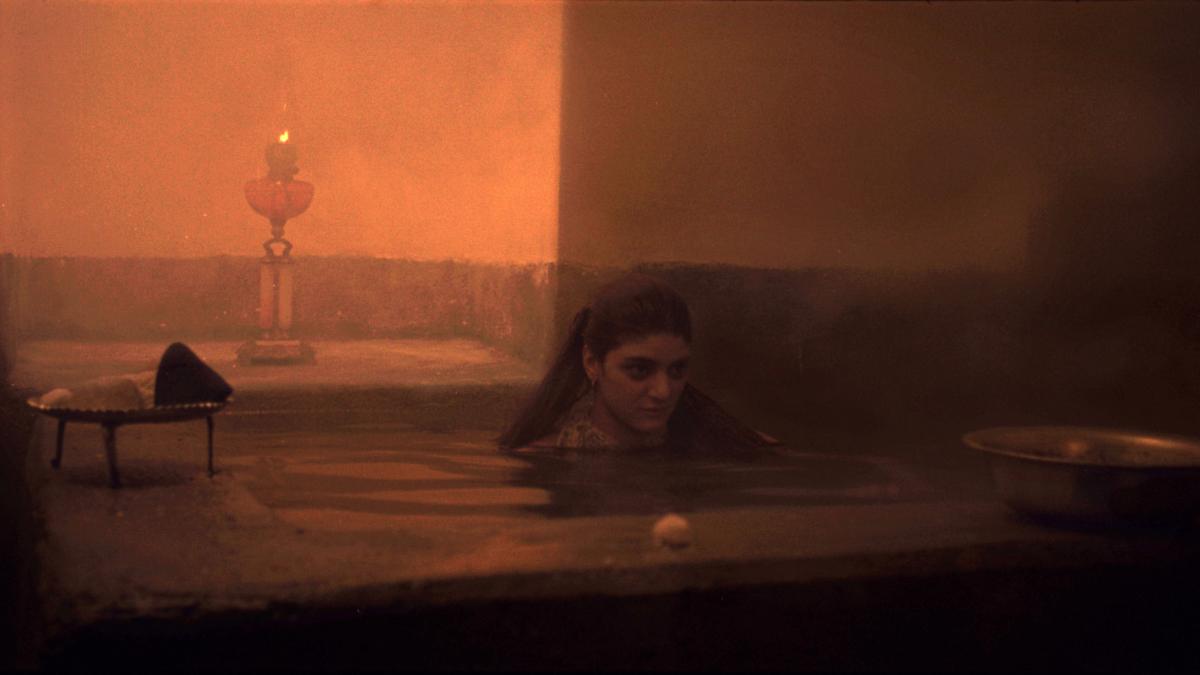
Fakhri Khorvash is a striking presence as the malevolent wheelchair-bound daughter, calculating every move even though she needs help to make them. A handheld flail is her equivalent of the dagger that might be the weapon of choice in a Western gothic horror. Beyond the violence, and the fact that is largely a strong and scheming female who is meting it out, it is easy to see why this film was banned by Iran's Islamic regime. A frisson exists between Khorvash and Aghdashloo's characters throughout, but one scene takes it further, suggesting a lesbian encounter between the two. Aghdashloo is the film's standout performer, immediately her presence—which vacillates between demure, luminous, and menacing—leaps off the screen. Her shifting loyalties are compelling to watch, and she's mesmerizing in the film's closing sequence (see still above), rising from a pool like some thing coming for her mistress.

The last twenty minutes of the film are remarkable. It's noted in the opening captions explaining the restoration that the sequence is influenced by silent cinema, and the orange tint, vividly restored in this version not only looks to the teens and twenties, Aslani makes it his own. A hothouse atmosphere has been building for some time at this point; a growing sense of paranoia and questions of who is out to get whom and whether there have been supernatural goings on. The fiery look of this sequence gives it the feel that everything may literally be going to hell.

Chess of the Wind is great example of exactly why festivals need archive sections. I had never even heard of this film, but I found something that drew me in more with each minute, that made me want to explore more about the culture it was made in to get more out of it (not just the traditional aspects, but the sort of Greek chorus formed by women washing clothes in a fountain outside the home, and the final shot which appears to recontextualise much of the film). The restoration brings out not just the precision of Aslani's shot choices but of the colour and texture of his film. I've not seen much quite like this before, and I hope this new version will enable a lot of people to be as transported by it as I was.
★★★★½

Sep 19, 2019

24FPS @ LFF 2019: Queen of Diamonds

Dir: Nina Menkes
It is clear from the very first moment that Queen of Diamonds is not going to deal much in words. The title card comes up not as text but as a playing card. This is all the introduction we get to Nina Menkes’ demanding but rewarding look at one woman’s life on the outskirts of Vegas.

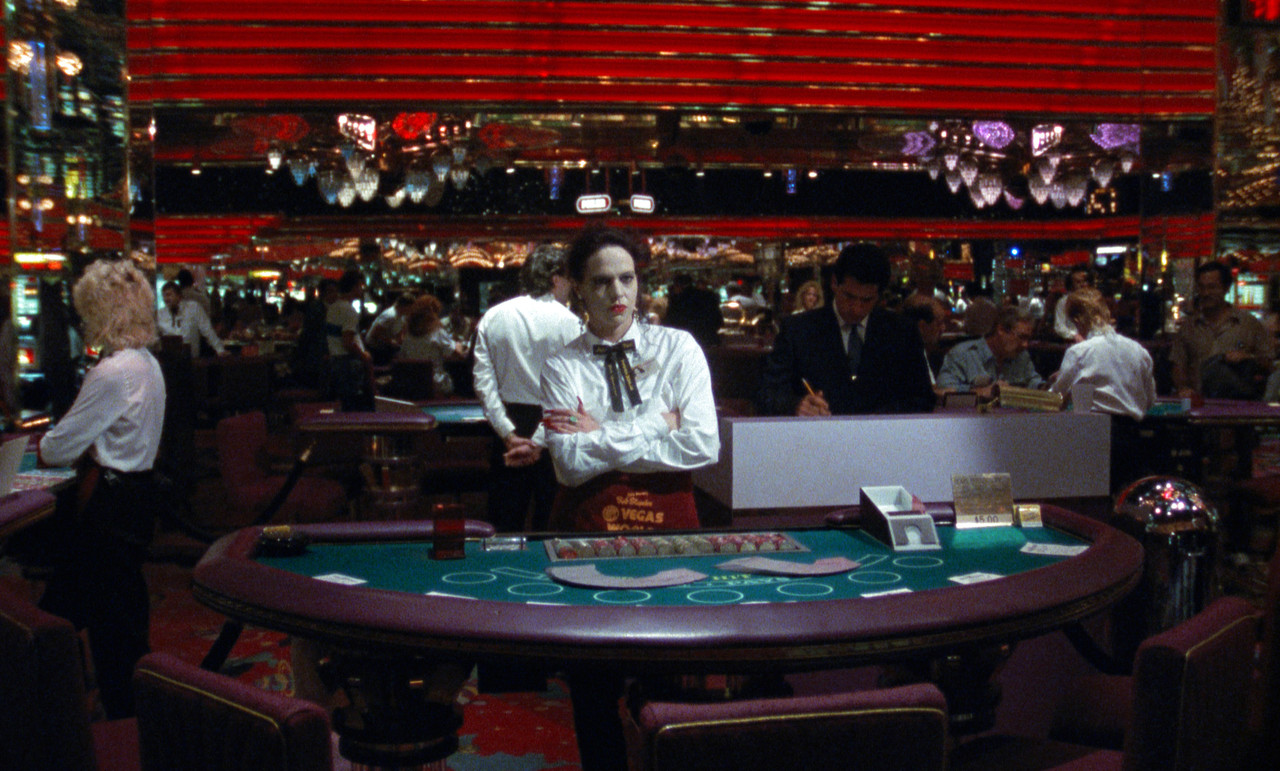
Made in 1991 and recently restored in 4K, this is likely to be one of the big discoveries of the LFF Treasures section for many viewers. It’s hard to ascribe anything approaching a story to this film, it hints at many behind the sometimes disconnected images, but not fully engaging with them is just one of the ways the film skirts any hint of cliche. Tinka Menkes plays Firdaus. We learn she lives in a motel, where her neighbours are an engaged couple and the man is hitting the woman. Firdaus works in what looks like a rather low rent casino and she helps care for an old man. Her husband is missing, but this doesn’t appear to concern her. 

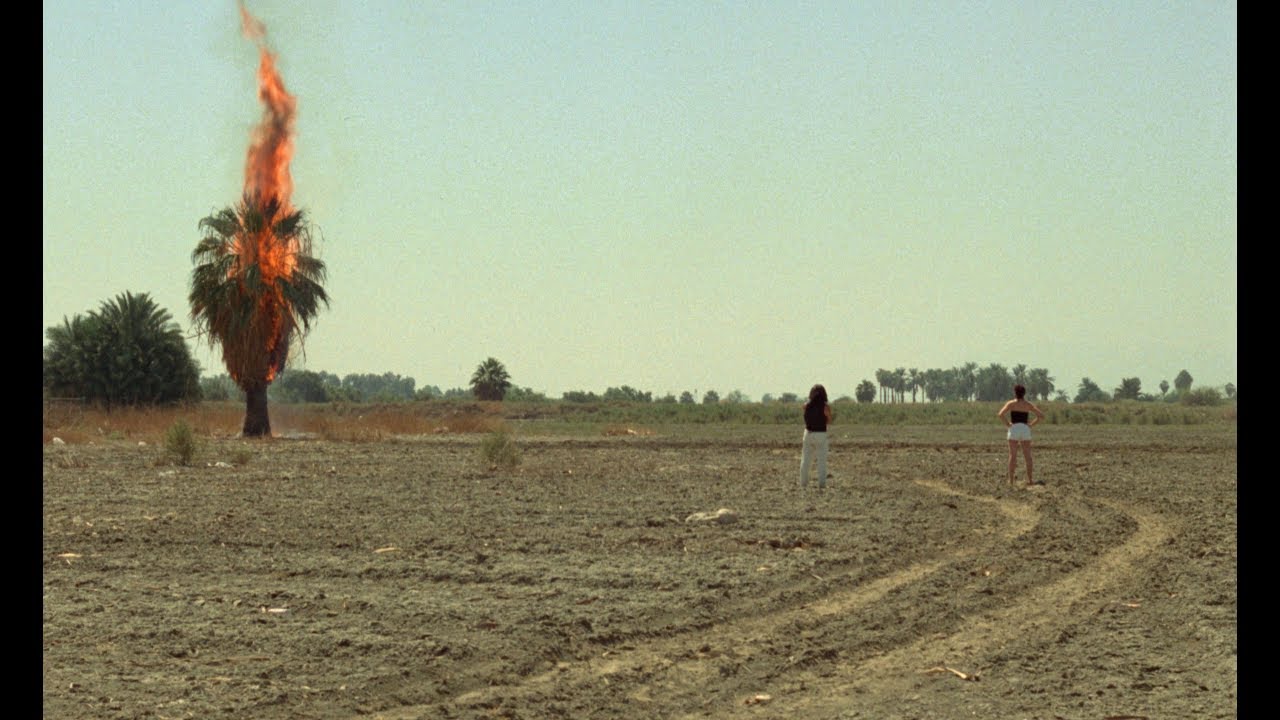
Events are thin on the ground, instead Nina Menkes puts us in a world somewhere between realism and surrealism, capturing the grinding mundanity of Firdaus' day to day life in a series of strikingly framed images, most of them in long shot, silent and unmoving. By so often sitting still on a shot for an extended period of time, Menkes forces us to draw ourselves into each image, to study every part of her framing and construction. The result doesn’t always reveal great meaning in the individual frame, but the beauty of her composition always means that there is pleasure merely in the looking and eventually in trying to piece the images together into some kind of full picture, like a jigsaw that will let us in to Firdaus, who remains a remote figure throughout. Perhaps the most striking image in the early part of the film comes when Firdaus goes for a walk with a man she meets on the beach. Rather than watch them walk we find them next standing at the edge of frame while, on the other extreme edge, a palm tree burns. The man leaves at some point, but we watch with her as it burns out in a shot that doesn’t move for something like three minutes.

Camera movement and cutting are so rare that when, about thirty minutes in, we come to a scene where we see Firdaus at work and Menkes zooms in on something, then cuts, it is almost a shock to the system. For a while it feels like Queen of Diamonds is settling into something approaching a normal filmic rhythm, but that’s only in the first part of the sequence. Menkes drags this sequence out for a long time—in full it is perhaps 10 of the film’s 77 minutes—it is clear the aim is to show us the repetitiveness and perceived length of her main character’s work day. This is highly successful, but not just through the length of the sequence. Images, cuts and camera movements repeat in a cycle, the camera often focusing on how Firdaus always leans on the card chute, or how she pushes money into a bank in the table. Menkes seems to break continuity, emphasising what feels like a time loop of mundane work and all the while she subtly builds a ticking clock into the sound design. It’s a sequence that demands patience and attention, but which is hugely rich and revealing if you give yourself over to it. In one way it’s hugely atypical of the film, in another it’s the whole thing in miniature. The second half of the film does take a few of the qualities of this sequence, but still remains stylistically very true to the still and studied overall style.

Dialogue is thin on the ground, serving little like traditional narrative function when it does appear. Even the sound quality—whether by design or happenstance—underlines this with the dialogue sounding distant, even overheard. Character too, is a slippery notion. We get no real background on Firdaus and her one friend who occasionally appears is equally an enigma. It would almost be fair to say we know more about the neighbour and his fiance, but even so, a long sequence about them towards the end of the film, though the jollity set against the bruises we can see on the bride is perhaps Menkes’ clearest signpost to what the film is saying as a whole, is the only segment that truly feels drawn out.

Queen of Diamonds is something of an enigma, but it’s gorgeous, hypnotic and quite unlike anything else I’ve seen recently. I want to dive into further viewings and try to unpick what lies behind it. One thing, though, is certain: it’s a crime that I hadn’t even heard of Nina Menkes before, and you should take this all too rare opportunity to discover her work. 
★★★★½