Showing posts with label Cronenberg. Show all posts

Jun 17, 2012

Cosmopolis [15]

Dir: David Cronenberg
Recently, several of my favourite directors have released films that just haven't delivered on the promise of their previous work, but the really crushing blow was David Cronenberg's last films, A Dangerous Method; the dullest, most anonymous, film of his now 40 year career. When I heard that he already had another film ready, I was concerned. A furious work rate doesn't usually imply consistency (does it, Woody Allen?), and Cronenberg is far from the most prolific of filmmakers. I was even more concerned when extremely mixed word began coming out of Cannes, if there was one thing I didn't want to have to say about 2012 it was 'this year David Cronenberg released two rubbish films'.

Happily, I don't have to say that. Cosmopolis finds Cronenberg back on form, once again making challenging, searching, intriguing work that fits right within his wheelhouse as an auteur, but doesn't feel like he's going back over old ground. It may well be his best film since eXistenZ, though confirming that, and much more besides, will demand rewatches.

Based (apparently extremely closely) on the novel by Don DeLillo, Cosmopolis has as its protagonist 28 year old billionaire Eric Packer (Twilight heartthrob Robert Pattinson). Packer is on his way across town to have a haircut, but the journey is taking a long time thanks to a presidential motorcade and a funeral, so meetings and doctor's appointments are taken in Packer's 'Prousted' limousine. The day goes further and further off the rails as Packer encounters more and more people, and begins, quite possibly, to lose his mind.

As with most of David Cronenberg's work, there is a lot to say about Cosmopolis, but the first thing that has to be noted is the film's big shock (not in a plot sense, don't worry). I've said some very rude things about Robert Pattinson's performances in the Twilight series (and, sorry fans, I stand by every syllable), but he's revelatory here. The first point of comparison that comes to mind is Hayden Christensen's unexpectedly great performance in Shattered Glass. To begin with, Packer is something of a blank slate - this is a studied and affected pose, and Pattinson is effective playing it as such - but as the film goes on, as we penetrate the impossibly wordy and constructed dialogue, there are layers peeled back by the differences in the ways he interacts with the different people who drift through the film. Some of the best scenes are between Pattinson and Sarah Gadon as his young wife (she also played Emma Jung in A Dangerous Method, and was one of the best things about that film). Gadon gives a very unusual performance, even by this film's standards, but through these scenes you do feel the dislocation between Elise and Packer, and perhaps between Packer and the world at large.

There are many things that may frustrate people about the film. First of all it's fair to say that the cadence of the film; the dialogue and the way it is spoken - theatrically, almost as if it is a series of lectures at times - requires a period of adjustment because it is so completely unlike the established rhythm of either life or cinema. Give it twenty minutes to settle, because once it does it becomes clear just how much is going on here, and just how funny the film is. There are inter-personal relationships (particularly interesting in this respect is a scene with Emily Hampshire in which Packer gets his prostate examined as he takes a meeting), but there are bigger themes weaving in and out of the words here, most notably surrounding both the reality and the morality of the financial crisis and other current events (some of which, like the custard pie attack on Rupert Murdoch and Occupy Wall Street, the film mirrors in ways that are downright eerie).

Cronenberg also seems to be packing his commentary into the visuals. This is tough to describe, but bear with me, because I think it's the film's key motif. There is a visual disconnect between the inside of Packer's limo, and Packer and his wife, and the rest of the world. I don't know quite how the film was made, but it seems at times in the film's first two thirds that all the backgrounds and everything outside the limo have been digitally added around Pattinson. The effect is curious, and distracting until you think about it on a metaphorical level of this rich and powerful young man having to truly engage with the world so seldom that he is becoming physically separate from it. I don't know that this was Cronenberg's intent, but it's also supported by the fact that this particular stylisation begins to recede after Packer leaves the limo behind and, in a sense, re-enters the world. Whatever it means, it makes the film fascinating and different to look at.

Inside the limo is almost another world: Cronenberg seems to stretch the screen to give us the odd combination of cramped and spacious that interior provides, and the visuals seem sharper on the inside, as if the world outside isn't quite as real, even when the windows open and it's JUST outside. All these things and more speak very much of Cronenberg's ever-recurring obsessions with identity, with our place in then world. There is less of the body-focused Cronenberg of old, but it's hard to ignore the frequent references to Packer's asymmetrical prostate.

The structure may be another sticking point for some people, as Cosmopolis unfolds essentially as a series of moments; individual scenes with little connective tissue or narrative drive ('I need a haircut' is basically the throughline of the 'plot'). It works, for me anyway, because most of those moments are individually brilliant, and the guest stars who come in for five or ten minutes each are frequently brilliant. Among the standouts are the aforementioned Gadon (who will hopefully have a larger part in whatever Cronenberg does next), a never sexier Juliette Binoche as an art dealer that Packer is having an affair with (and whose opening shot echoes a famous one of Holly Hunter in Crash), Samantha Morton, who makes sense of some of the film's most impenetrable dialogue, and Paul Giamatti, who by rights ought to steal the film when he turns up, but doesn't, because he seems to power Pattinson's own performance on to ever greater heights, and that scene becomes one of the unlikeliest great acting scenes of the year. The other really outstanding moment is the most awkward lunch date I've seen in ages, in which Packer and Elise talk at each other in a series of non-sequiters, Pattinson and Gadon are both brilliant here, effortlessly communicating everything about their marriage, though the dialogue is very indirect.

I'm afraid I'm neither selling nor analysing Cosmopolis especially well, because there's not really space to get into every interesting detail, because I need more time to think it through, because I need to see it again so I can immediately surrender to it rather than needing that period of adjustment, and so that I can further contextualise it as a Cronenberg film. What I can say is this; it's a major, interesting work, it should reward multiple viewings and real analysis, and I think it will remain interesting far beyond the current financial climate. It's proper, challenging, thoughtful, adult cinema, and we all could do with more than that. Welcome back David.
★★★★★

Feb 11, 2012

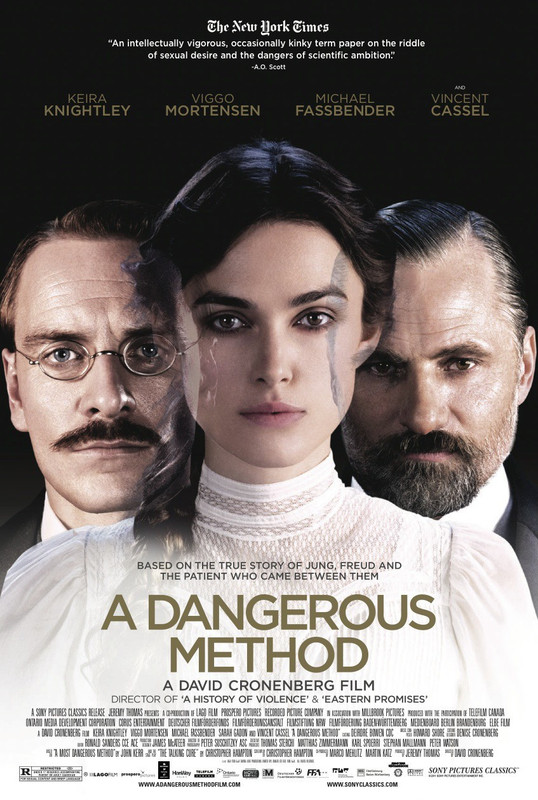
A Dangerous Method [15]

Dir: David Cronenberg
If you were to ask me who I consider the world's greatest working filmmakers, David Cronenberg would be among the first five names I would mention. For four decades, the Canadian master of body-horror has ploughed his own fascinatingly and determinedly perverse furrow through all permutations of the genre.

Lately - notably since his prescient feeling and still hugely underrated eXistenZ in 1999 - Cronenberg has shifted focus slightly, going from looking at the external to the internal; from the body to the mind. At least that's the popular perception.  The reality is while his more recent films have dwelt on questions of the psyche and of identity they have also been as physical as ever. However, the shift becomes much more pronounced with this film, which deals with the relationship of Carl Jung (Michael Fassbender) to two very important people in his life, a patient named Sabina Spielrein (Keira Knightley), with whom he has an affair and his rival and sometime friend Sigmund Freud (Cronenberg's recent muse, Viggo Mortensen). This should be perfect material for Cronenberg, he's explored psychoanalysis before (in The Brood) and ideas of identity and sexuality are a keystone of practically all of his films from Shivers to A History of Violence. That's why I'm so baffled by A Dangerous Method, it should have been the ne plus ultra of Cronenberg films, but instead it finds him in bloodless, anonymous, uninspired form.

There are few filmmakers as readily identifiable as David Cronenberg. His style is always in motion, evolving with each new work, but the touchstones have always been in place and the texture of his work has remained largely unaltered over the years. I've seen all but two (Fast Company and M Butterfly) of Cronenberg's films, I've studied and analysed his work for years, and yet, if not for the possessory credit before the title I would struggle to tell you who made A Dangerous Method, it looks like any standard issue costume drama and I would guess it to be the work of one of ten mid-level journeyman filmmakers before I would pin it on Cronenberg.

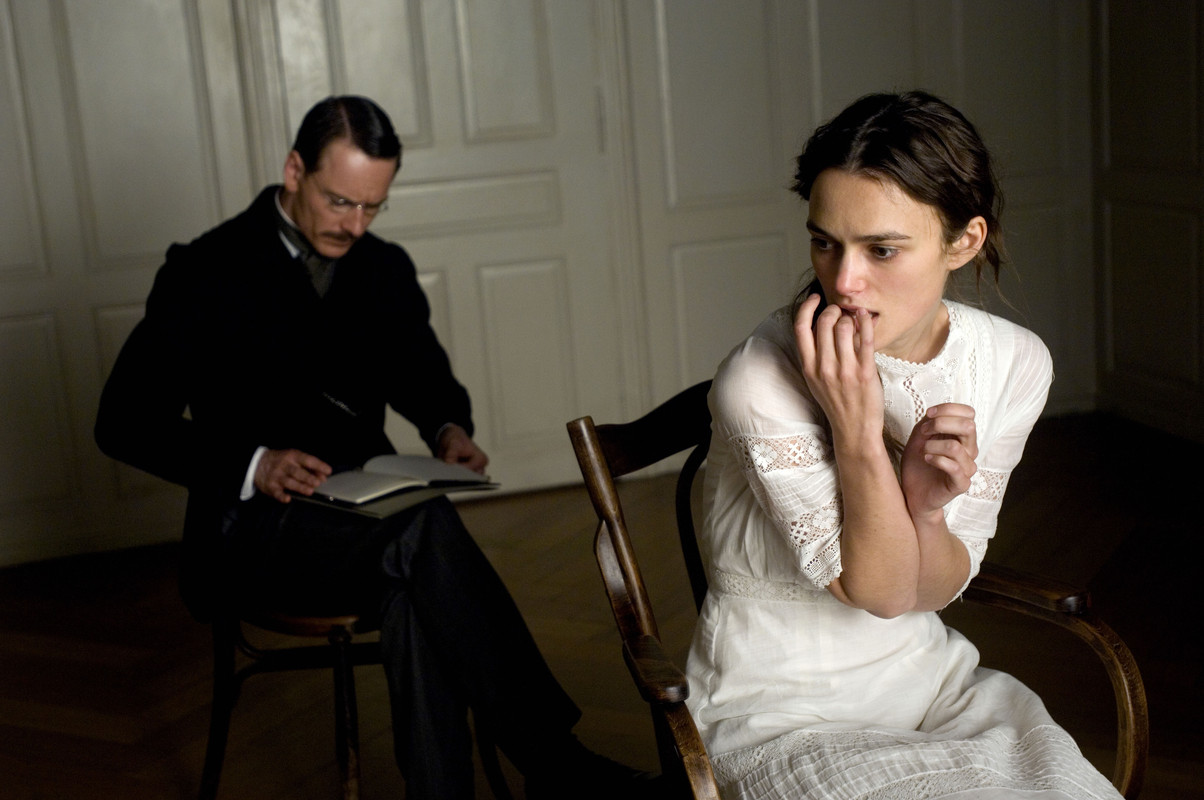
The film's sole truly Cronenbergian image comes early, as Spielrein and Jung have their first meeting, at which he begins using Freud's 'talking cure' on her. Knightley's performance is incredibly physical; she contorts her body in all sorts of ways, notably jutting out her lower jaw to what must have been near dislocating lengths. In these moments Knightley provides, perhaps inadvertently, a tiny glimpse of the Cronenberg we recognise. Unfortunately, this scene is also indicative of one of the film's most totally and instantly hobbling problems; Keira Knightley's genuinely appalling performance - easily her career worst.

I should stress that I am, in general, not on board with the often outright unkind critical consensus on Knightley, indeed I've always liked her. She was not the greatest actress when she started out, but she always had presence, and a beauty that was unusual even for a film star, since then she has grown role by role into a fine and daring young actress who largely eschews the easy choices to make films she finds interesting and consistently impresses me, even when the films don't entirely work. Until now. 'Daring' is certainly true of her work here; were she any more over the top she'd actually be in orbit. 'Fine', however, would be a less accurate description, certainly Knightley is doing a lot of acting here, indeed there's more acting in her performance alone than in most regular cinema release weeks taken as a whole.  That's exactly the problem, it never feels like anything but acting and, from the physicality to the accent, terrible acting at that. She's so bad here that I wonder whether this is the actress that everyone else has been seeing in her other films and whether I have previously been too kind to her.

Fassbender and Mortensen are both better, and much more restrained, than Knightley, but neither ever seems to get completely under the skin of their famous characters (though, to Mortensen's credit, he doesn't play Freud as merely the image that we have of him). I doubt that this is entirely their fault though, it seems more to do with Christopher Hampton's screenplay, and the overall shape of the film's storytelling.

Cronenberg has always combined the narrative needs of his films with probing character studies (consider how much The Fly owes its effectiveness to the depth of the Seth Brundle character), and you would think, with such interesting characters; intellectual heavyweights proposing revolutionary ideas, this screenplay would play to that strength in Cronenberg, but it never seems to. There is much talk of and depiction of psychoanalysis, but none of it really seems to stick, for me the characters were as elusive by the end of the film as they were at the start. Amazingly it is Jung, who has by far the most screentime, who seems thinnest. By the end of the film he's talking about how much his love of Spielrein has changed him and his life, but the script never makes that feel like a love relationship on either side.  We are only given that impression through Jung's words right at the end of the film, and it rings false. Freud does at least have a few shades; we see him as a petty and professionally jealous man, but Mortensen has too few scenes to allow the film to make up much ground.

The sexuality also lacks impact, again, there is much talk - particularly thanks to Vincent Cassell's all too brief role as Dr Otto Gross, sent by Freud to be treated by Jung, in an episode that feels rather like a short film marooned in this feature - but what action there is lacks impact. The intensity of Jung and Spielrein's relationship never really comes across, because it is given little screentime, and this must surely be Cronenberg's most staid and straightforward depiction of the sexual act. Sex is spoken of here as, and is frequently in Cronenberg's films, the key to understanding people, and yet the sexual scenes hardly advance these characters at all.

The film has its roots in Christopher Hampton's stage play, and while Cronenberg and DP Peter Suschitzky shoot the film handsomely it remains very much stagebound. It's an extremely static film, not always a bad thing, but with thin characters and no real tension (not to mention Knightley's histrionics) there is little to pull you in. One scene, where Jung tells Freud about a dream as they make the crossing to America by ship, suffers from some pretty poor effects, accentuating the stagy feel to the point that it pulled me right out of the film. Hampton's dialogue is not exactly bad, but it lacks any real punch, making the film feel dry and airless.

The big problem with A Dangerous Method is one that I never thought I would find in even the worst of David Cronenberg's work: it's dull. I'm stunned by this, shocked by its lack of personality, amazed by its visual anonymity, dismayed by the surface level treatment of its themes. It's a crashing bore, and a crushing disappointment. Ultimately, and sadly, it's a film about analysis that doesn't bear analysis.
★★☆☆☆