Showing posts with label China. Show all posts

Oct 11, 2021

24FPS @ LFF: All About My Sisters

Dir: Wang Qiong

Starting in 2015, 22-year-old Wang Qiong picked up her camera and began filming her family, focusing on her younger sister Jin. The story she tells across this nearly three hour canvas is about a family that, with two daughters and despite China’s one child policy desperate for a son, first tried to abort and then gave away Jin to one of her uncles, who raised her as his own. Just over 20 years later, Jin is a young mother herself and has an understandably difficult relationship with her parents (who she calls Auntie and Uncle). Qiong’s camera documents their relationship, as well as digging into a family history of abortion and abandonment.

All About My Sisters is, from the start and frequently throughout, an uncomfortable watch. It begins with Jin asking her sister what the point of telling her story is, but as that story unfolds, whether Jin knows it or not, it becomes clear that the point is not only that it is fascinating a devastatingly emotional from a singular point of view, but that Qiong uses it to unfold a critique of how the one child policy drove many people to act. Perhaps the toughest scene to watch is an interview with Jin and Qiong’s uncle, who was one of the local administrators of the policy, and recalls leaving two babies that he and his wife attempted to abort at 8 months out to die. His regret and remorse are clear, as is the implication that this was a routine part of life at the time, but it remains an horrific moment.

The film hammers home the results of the policy not just in moments like Qiong and her other sister Li’s memory of walking over a bridge to school and seeing the bodies of babies, all female, that had been abandoned to die but in a larger, and still prevalent, preference for male children, both at pregnancy and throughout their lives. What emerges is a picture of a society—or at least a section of society—that views women’s lives as almost purely transactional. There are discussions of how much the groom’s family should pay when Jin gets married, of how much families should gift when a woman gives birth to a male child rather than a female, and more besides. 

Watching Jin’s personal story is no easier. It seems clear that her abandonment has affected her both as a person generally and as a parent specifically (some of the scenes of her scolding her two-year-old son are very difficult to watch). Unsparing as Qiong’s camera is of her sister, it’s also sympathetic. She is consistently the family member noting, especially in a late conversation with their 13-year-old brother Sifan, that the situation isn’t Jin’s fault. Many of the questions she asks their brother seem a bit challenging for someone of his age to process, especially when she asks if he thinks Jin was abandoned so that he could be born; that’s a lot to put on him, but it’s a question that hangs heavy on the film and over that relationship, which despite that seems, for much of the film, the closest Jin has with any of her biological family.

For all the moments that Jin is unsympathetic, the film strives to understand the impact of how she grew up on her. She talks about the time she did spend living with her parents and her sisters as feeling “like I was a cleaner in your home”, and the way she is treated by her parents now seems defined more by financial support (an investment in a shop, which then ties her to them) than by anything emotional. Judgments and words are harsh, though to be fair this is not just towards her, at one point her father tells Sifan “you shouldn’t have been born” after he gets in trouble at school. Again though, everything that Jin’s parents are really invested in about her seems driven by money, little emotion comes through, even on her wedding day. The ending is tinged with both sadness at the fact Jin doesn’t seem to be able to find a way forward with her parents and at least a little hope at where it finds her going, and it would be nice to have an update on how she and her family are doing now.

All of Wang Qiong’s points are worthy and often devastatingly made, but it’s fair to say that all of them are made many, many times over and that by the third hour of the film it’s hard to see that she’s adding much new to the argument she’s making. This is an insightful film, and a promising debut for the young director / producer / cinematographer / editor. Next time, it might benefit her to take on fewer jobs herself, as another voice might have focused the film down a bit more, making its points land all the harder by concentrating them. There is much here that could be tightened, from reducing some of the repetitious nature of the sequences to simply trimming back some incidental shots that don’t add a lot to the narrative or the argument. I can see that there is a point to making this an exhausting watch, but after a while, it does dull the emotional punch. 
★★★

Apr 2, 2021

Vanguard [15]

Dir: Stanley Tong
Vanguard is a personal protection agency run by Tang Huating (Jackie Chan). Their client Qin Guoli (Jackson Lou) and his daughter Fareeda (Ruohan Xu) have been kidnapped by Omar (Eyad Hourani), the son of an arms dealer that Qin had previously worked with. Tang and his young team of mercenaries must rescue Qin and Fareeda.

Jackie Chan is a workhorse. This year, as he turns 67, it will be 60 years since he entered Yu Jim Yuen’s chinese opera school, where much of the greatest generation of martial arts actors and directors was forged. For the last 50 years Chan has been making film after film, and since the release of Drunken Master in 1978 he has been essentially uncontested as the biggest star in Asian action cinema. In that time he’s broken just about every bone in his body doing stunts. He has a permanent hole in his head from one that very nearly killed him. In short, you can forgive him for appearing tired.

The last twenty years or so haven’t been the greatest time to be a Jackie Chan fan. There might be the occasional flash of inspiration (among them the rollerskate suit in Chinese Zodiac; creditable dramatic performances in the remake of The Karate Kid and The Foreigner, and the overall surprisingly solid Railroad Tigers) but even the films that have a couple of great moments can be a chore to plod through. It’s also been clear for a while that he’s been using doubles more and had greater CGI assists. Combine all that with the fact that plot, acting and character have never been his strong suits as a filmmaker, and you get the recipe for garbage like Kung Fu Yoga and Bleeding Steel.

There is some promise to Vanguard. Firstly, it reunites Jackie with Stanley Tong, who directed Police Story 3 and First Strike, as well as Rumble in the Bronx (and, ahem, Kung Fu Yoga). Secondly, it appears that Chan has begun to recognise some of his limitations. He’s billed first here of course, but largely takes a supporting role and cedes the spotlight to a younger team of Yang Yang, Lun Ai and Miya Muqi as some of Vanguard’s best protection officers. Initially, this seems like a decent idea, but whether it’s the perfunctory writing (the bromance between Yang Yang and Lun Ai is very forced) or Tong’s direction, none of the younger leads makes much of an impact. The screenplay here doesn't give them much to work with, but the essential thing they lack is anything unique about any of their screen presence, something Jackie always had in spades. None of them establish much personality, neither do they particularly stand out in the action sequences. Unfortunately, Chan can’t save the film on this score, never the most gifted actor, he’s got a poorly defined character and gives little expression to any of his dialogue, while also spending most of his time in the action sequences very much in the background, firing a gun. We probably see less than a minute of actual martial arts technique from him, perhaps half of that in the foreground of the frame.

In their first three collaborations, Stanley Tong brought out the best in Jackie. It may have been that, having directed many of his own films between the late 70s and early 90s, Chan was taking a stronger hand behind the camera, but Tong’s style both in shooting and editing seemed a perfect match for his star. Whether it’s because he remains in thrall to what is becoming an outdated action style or because he is trying to hide limitations in his cast, Tong opts for a choppier style of action here; not full Bourne perhaps, but certainly much shakier and faster cut than his work used to be. This is the worst possible decision because Jackie’s action is uniquely his own style, and in Vanguard it looks like it could come out of any other action film. There’s not even a signature stunt, though a gag excusing that is one of the film’s only proper laughs. Add woeful CGI (the lion) and green screen work, and you’ve got a film that fails on a lot of technical levels.

Vanguard isn’t Jackie Chan’s worst film, but it’s another sign that his place in the future is probably behind the camera. I would love to see him bring his old style and rhythm to films starring a new generation of action actors, but if that’s what Vanguard was going for, it’s a dismal failure.
★ 

Aug 12, 2010

Mini-Reviews: Selected recent viewing

Gainsbourg
Dir: Joann Sfar
Comic book artist Sfar makes an arresting directorial debut with this biopic of a man perhaps best described (by a friend of a friend) as ‘France’s pervert laureate’. Sfar covers most of Gainsbourg’s life, from his childhood (when he was still Lucien Ginsburg) in Nazi occupied Paris, to his controversial career as a musician and his prolific womanising with some of the world’s greatest beauties; Juliette Greco, Brigitte Bardot and Jane Birkin among them. It’s a scattershot film, inevitable really when you are covering roughly 50 years, but it’s also an unusual and entertaining work.

Sfar follows the basic biopic form, most notably in the scene when Gainsbourg writes Je t’aime (moi non plus), which has the same slightly clunking feel as the moment in Ray when Jamie Foxx, as Ray Charles, writes Hit the road, Jack, but in both style and storytelling this is a rather unusual film. Sfar employs a clever device of giving Gainsbourg’s rebellious streak physical form (as a caricature known as Gainsbarre, which is, apparently, a very good pun in French). Doug Jones, surely the cinema’s foremost pantomime artist at the moment, gives Gainsbarre shape, and makes him by turns a funny, mischievous and sinister presence in the film. It’s a contrivance, and one that could have been heavy handed, but it is beautifully handled and the touch of surrealism it lends the film feels strangely appropriate to the unpredictable man at its centre.

The performances are top notch all round, but special notice has to go to Eric Elmosnino, he may look more like a cadaverous cross between Gainsbourg and Rowan Atkinson, but he embodies Gainsbourg completely, to the point that it seems less performance than possession. It’s not an easy part, Gainsbourg grows progressively more loathsome as the film goes on, but Elmosnino makes him entertaining, if not likable. There is also a tinge of sadness to watching the film, because the other stand out performance is given by British actress Lucy Gordon, who makes for an eerily convincing Jane Birkin. Gordon killed herself just weeks after finishing this role; a tragedy made even more senseless when you see how she leaps off the screen here.

I knew nothing about Serge Gainsbourg going into this film, and though I’m not sure I know much more now, I certainly had fun for two hours.
★★★

FAINTHEART
DIR: Vito Rocco
Charming, but ultimately far too safe and familiar to leave any lasting impression, this British rom-com about a battle re-enactor (played by the excellent Eddie Marsan) trying to win back his wife (Jessica Hynes) feels like exactly what it is; a film made by committee. The script, director and several cast members, were chosen through votes on Myspace, who also put up much of the funding (it appears to have been a commercial disaster, as the film never even received a cinema release in the UK).

Faintheart is a custom made feel good movie, almost embarrassingly unoriginal and lack anything constituting a surprise in even one of its plot developments, the fact that it isn’t awful is down largely to the excellent performances. Marsan is more dialled down than normal, since this film he’s made a name playing explosive characters, but he’s effective here as a normal guy just trying to be the best husband and father he can. Jessica Hynes is also effective; from her looks to her naturalistic acting there’s nothing Hollywood about her, and that works well for the film. There’s also a strong comic relief turn from Trainspotting’s Ewen Bremner.

The direction, sadly, is as rote and by the numbers as the screenplay, and the minor roles (the ones, one assumes, cast from Myspace audition tapes) are played by actors more suited to local theatre, but Faintheart gets by on a handful of performances better than the script deserves and a good deal of charm.
★★

Temple Grandin
Dir: Mick Jackson
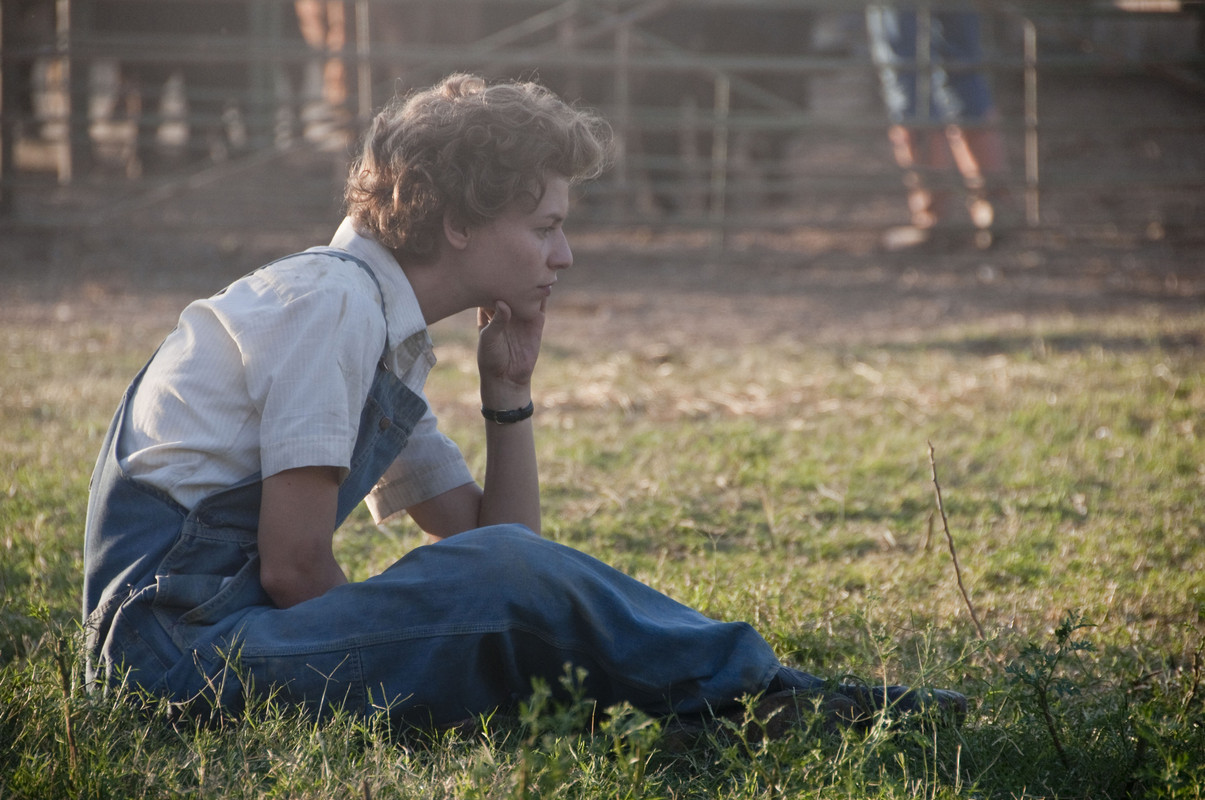
Every now and then, movies offer up a lovely little surprise, and this is certainly one of 2010’s. Claire Danes plays the real Dr. Temple Grandin, a profoundly autistic woman who has overcome many of her anxieties to become a great engineer and a leading expert in the field of the welfare of animals being raised for food. The story is simple enough biopic stuff, but Mick Jackson uses the visuals beautifully, managing to communicate in a way that is neither heavy handed nor unclear, the way that Grandin says she is able to think in pictures.

Jackson also draws an exceptional performance from Claire Danes. She’s always been actress who, to me, has exhibited more charm than skill, but here she completely melts away to leave behind only the character of Temple Grandin. I’ve spent a great deal of time with autistic people, and Danes’ is probably the most sensitive and most accurate portrayal of a profoundly autistic person that I can remember. She’s careful never to use Grandin’s disabilities for comedy, never to mock her, but at the same time she makes no play for sympathy. She presents Grandin as a complete and complex young woman. I’d be tipping her for an Oscar, but unfortunately the film debuted on HBO, and so is ineligible.

Temple Grandin is an excellent film, with fine performances all round from a cast that also includes Julia Ormond, David Strahairn and Catherine O’Hara (terrific in a rare straight role), but it is, at the end of the day, Claire Danes' film, and she carries brilliantly, giving a performance I would never have suspected she had in her.
★★★★