Showing posts with label Chabrol. Show all posts

Sep 22, 2010

The Greatest? Part 4: Huppert Double

Two heavily contrasting films today, one an uncharacteristic foray into comedy, the other one of the most famous tragedies in literature.

I ♥ HUCKABEES
DIR: David O Russell
CAST: Jason Schwartzman, Dustin Hoffman, Lily Tomlin,
Mark Wahlberg, Naomi Watts, Isabelle Huppert, Jude Law


I ♥ HUCKABEES is one of the strangest films of recent years. It's described as an existential comedy, but to me it seems more like an absurdist art exercise, and frankly I'm not entirely sure whether I like that or not.

The story is an odd proposition, in that I've seen the film three times now and I'm not certain to what degree it has a story. It basically revolves around Albert Markovsky (Schwartzman), who is having an existential crisis brought on by a coincidence involving a tall African man. Wanting to discover the meaning of this coincidence, and perhaps by extension his life, Albert enlists existential detectives Bernard (Hoffman) and Vivian (Tomlin). They pair Albert up with another client, Tommy (Wahlberg) who introduces Albert to French philosopher Catherine Vauban (Huppert), whose insistence that life is a collection of disconnected, meaningless cruelties stands in direct opposition to Bernard's blanket theory.

That's an awful lot to process in 90 minutes, and that's not even half of the movie, because we haven't covered Huckabees middle manager Brad Stand (Law), his model girlfriend (Watts), who rebels against her looks and begins dressing in a bonnet or how Shania Twain fits in to this whole mess. A mess is what I ♥ HUCKABEES is, for much of the running time it feels more like Catherine Vauban's vision of the world; a bunch of meaningless scenes and moments, thrown together and struggling to find form and purpose.

It's a scattershot film, and the rumoured chaos and bad feeling of the set seems to bleed through into the film at times, but among the confused (and, frankly, dime store) philosphy there are images and moments that stick. Some of these moments stay in the memory due to their sheer balls out wierdness, none more so than the disturbing, but undeniably funny image of Schwartzman suckling at Law's breasts (I'm not even going to attempt to explain it, so don't ask). The fact that the film doesn't entirely come together isn't the fault of its starry cast. Schwartzman has a weak role, and an unsypathetic one, at the end of the day his Albert Markovsky comes off as a whiner who never grew up, that said, the film and Schwartzman are aware of this, and it's mined for laughs in several of the film's best scenes including a lovely one in which Catherine Vauban all but breaks in to Albert's parents' house and proceeds to scold them for the way they responded when a nine year old Albert was upset when his cat died. I never really warmed to Albert, but it's a testament to Schwartzman's likability that I didn't want to punch him either.

Among the rest of the cast Hoffman and Tomlin, who had long wanted to work together, seem to be having a lot of fun, and Jude Law is appropriately slimy, but the biggest impressions are made by Mark Wahlberg, who is very funny as Tommy, a firefighter whose existential crisis began on September 11th and by Naomi Watts, who seems to enjoy sending up her dazzling beauty.

Isabelle Huppert is an interesting case here, she's perhaps still too limted in her English to be as effective as she is in French, but she nevertheless almost steals the film as Catherine Vauban. Part of it is the casting; she's known (wrongly, I'd say) as an impassive and cold presence, and here she seems to parody that stereotype. Of all the cast she's the one who never winks at the camera, who never lets on that what's going on is supposed to be absurd and funny, and that seriousness makes her even funnier. She's also, at 50, tremendously sexy. Catherine uses sex as part of her method to teach Tommy and Albert (mostly Tommy) about life's random cruelties. The first sex scene is especially strange, as Huppert and Schwartzman take turns dunking each other in a puddle of mud. In interviews at the time a typically nonchalant Huppert remenisced that, when he was a baby, she'd held Jason Schwartzman in her arms (she's friends with his mother, Talia Shire), and now she was doing it again.

At the end of the day I'm not sure how I feel about I ♥ HUCKABEES. It's a bizzare film, but for all its pretensions to philosophical ideas its conclusions seem obvious and half hearted and for all its discussion of meaning I'm not sure that, at the end of the day, it really has one. As a collection of scenes it is strange enough to engage and amuse, at least for the most part, but many scenes fall flat (especially those laying out the film's various competeting philosophies, which often feel like readings from C grade Philosophy 101 papers) and though the odd image and the odd scene stick, the whole feels ephemeral. Of course that may be David O Russell's point, but I'm not sure even he knows whether that's the case.


MADAME BOVARY
DIR: Claude Chabrol
CAST: Isabelle Huppert, Jean-François Balmer, Christophe Malavoy,
Jean Yanne, Lucas Belvaux


Chabrol's apparently reverent adaptation of Flaubert's classic novel is a strange beast. I must admit that I haven't read the book, and so some of the tonal issues may come directly from the source, but whether or not that is the case, this film is still a wierdly mixed bag.

By 1991 Claude Chabrol was in his early 60's, and had made roughly 45 feature films, in short he was one of cinema's great craftsmen, having long since established a regular crew and a comfortable way of working. It is, then, odd to see how cowed, how intimidated he sometimes seems by the burden of MADAME BOVARY. I really can't think of any other reason that a great director like Chabrol, who could do so much with silent images (see, especially, LE BOUCHER) would have reams of dry narration, seemingly lifted directly from Flaubert, describing characters emotional states which, given his talented cast, it would be easier and more satisfying to portray.

Frustratingly there are times when Chabrol's grasp on his film seems as strong and sure as ever. Especially strong is the scene in which a newly married Emma Bovary (Huppert) spends a blissful night at her first society ball. Here Chabrol steps back; he lets the scene play largely through the actors' body language be it Huppert's fleeting, but real, happiness or Jean-François Balmer's proud regard of his beautiful wife, blissfully unaware that she'd happily cuckold him with any one of the men at this party. The sense of period is also strong, Chabrol brings home the squalor that many poor people lived in during the mid 19th century just as well as he portrays the beautifully put together exclusivity of high society, in capturing these two contrasting worlds so well, Chabrol also lets us understand Emma Bovary. She's irresponsible with her husband's limited fortune, but you can see why she wants to put herself across as belonging to a higher social class, because it means more than just status.

All this good work makes the moments that don't play even more disappointing. The dry narration is a problem, but not so much so as the many incredibly overwrought, melodramatic scenes. These have to be Charol's fault, and the cast, notably Huppert, seem visibly uncomfortable. The scenes Huppert shares with Emma's various lovers can be excruciatingly hammy. Melodrama's not a bad thing in and of itself, but it's just not how Huppert acts, and it shows. Her death scene is perhaps the worst work I've ever seen her do, endlessly long and scenery chewing; a performance more suited to amateur theatre.

The reason I think that's Chabrol's fault is simple. First of all, there's little need for these scenes to be so overwrought and, secondly, in the other scenes Huppert is simply sensational. Emma Bovary strikes me as a character who is all but incapable of happiness, and wants to fill her life with things, be they pretty dresses or pretty lovers, to distract her from her misery. As this Emma Bovary, Huppert is perfectly cast. At 35 she's also at the height of her very individual beauty, and convinces on a physical level as the ultimate trophy wife. She's hugely effective when Emma has to hold her emotions in check (as when she meets Leon (Belvaux) at the opera, but is accompanied by her husband), this has always been a great strength of Huppert's,; the ability to let you see the many different emotions that are going on under that practiced, put together, exterior.

The rest of the cast suffer similar fates, all of them are outstanding when the film is more dialled back (particularly Jean Yanne as the pharmacist M. Homais), but when Chabrol cranks the melodrama up to 11, they all struggle.

MADAME BOVARY is a difficult and frustrating film, some of it is brilliant, and some of it is spectacularly over the top. It works perhaps seventy percent of the time, and is still well worth a look for those moments, but the melodrama does become wearing, and I found myself wishing that Chabrol could have had a little more confidence in himself here, and been a little less wedded to the book, however brilliant it may be.

Sep 7, 2010

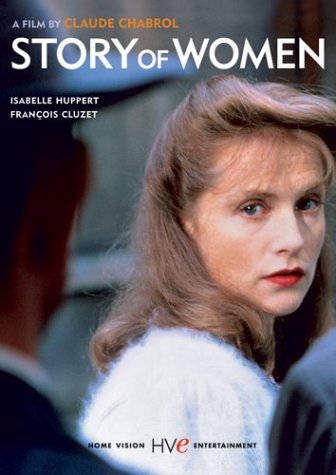
The Greatest? Part 3: Leigh – The Big Picture / Huppert – A Story of Women

The next selections in this series find Jennifer Jason Leigh and Isabelle Huppert working in almost opposite circumstances; UNE AFFAIRE DE FEMMES sees Huppert in an acclaimed period piece, with Claude Chabrol, a favourite director with whom she has worked regularly since 1978’s VIOLETTE) at the helm. On the other hand THE BIG PICTURE finds Jennifer Jason Leigh in a small role in an atypical film from director Christopher Guest and working in broad comedy, which really can’t be described as her comfort zone.

THE BIG PICTURE [1989]
DIR: Christopher Guest
CAST: Kevin Bacon, Emily Longstreth, Michael McKean,
J.T. Walsh, Teri Hatcher, Jennifer Jason Leigh


If there is one thing that is evident from THE BIG PICTURE it is that Christopher Guest thrives as a filmmaker when his work is largely improvised. This film, unlike the subsequent BEST IN SHOW and A MIGHTY WIND, feels very closely scripted and thanks to that it also feels very stiff, bereft of the dazzling comic energy of THIS IS SPINAL TAP and Guest’s other directorial work.

There are several big problems with THE BIG PICTURE, but the most pressing, obviously, is that it’s just not very funny. It’s hard to put your finger on the problem, but to me it felt like the film was just too on the nose, the jokes far too obvious. It’s the story of Nick Chapman (Bacon) who wins an award for his student film and finds himself courted by producer JT Walsh, who sets about allowing Nick to make his dream project… with just a few changes. The head slapping obviousness reaches its zenith in a late scene in which Walsh, whose ‘creativity’ has ended up taking Nick’s black and white film about a love triangle between three middle-aged people and turning it into a pitch called Beachnuts, is in a set that’s clearly supposed to be Hell; the studio head as Satan. It’s not just that though, everything feels rote and lazy, from the opening spoof student films and their makers (one, a conceptual artist, played by Jennifer Jason Leigh) to the sub-plot in which a starlet (Hatcher) attempts to seduce the hot young director, right up to the so predictable that you’ve already guessed it closing shot.

The story clanks through the expected moments. Nick gets a whiff of success then cheats on his girlfriend (the lovely Emily Longstreth), leases a Porsche, begins ignoring his best friend and cinematographer (McKean). Then his deal evaporates, which leads to the hugely unconvincing last half hour, in which Nick reforms, and gets another shot thanks to a homemade music video for a band called Pez People. If anything in this movie should have been a home run it’s this, but the song isn’t funny, the video (despite Leigh’s energetic oddness as a dancer) is terrible, and also not funny. This, as much as the awfulness of Nick’s student film, seriously undermines the whole plot of the film. Ultimately it’s marooned in a wilderness between being believable enough for us to be interested in Nick and his journey and crazy enough to work as comedy.

The cast don’t help very much. Kevin Bacon is uncharacteristically bland as Chapman, Martin Short is at his nigh insufferable worst as Nick’s sycophantic agent (a joke that runs far too long to work in the same way that Spinal Tap’s Artie Fufkin did) and Michael McKean seems as ill at ease as Guest with the heavily written dialogue. On the plus side, Emily Longstreth (who, sadly, hasn’t made a film since 1994) is charming as Bacon’s girlfriend, and she’s fun in a sequence in which Bacon fantasises her as a film noir femme fatale and JT Walsh, despite the fact that all of his character’s actions are the most obvious pieces of ‘satire’ you can imagine, is great value as the slimy producer.

If this weren’t part of a series on Jennifer Jason Leigh her participation in THE BIG PICTURE would hardly rate a mention. She’s on screen for perhaps five minutes in total, and has very little to do. That said, she’s clearly having a good time and even with very little to work with she manages to give Lydia a real identity, and a very particular nervous energy; she moves like she’s being repeatedly electrocuted. It’s not much, I’d really like to see what she could do in one of Guest’s improvised films, but here she’s one of the better and funnier things in what is a disappointing film.


UNE AFFAIRE DE FEMMES
DIR: Claude Chabrol
CAST: Isabelle Huppert, Francois Cluzet, Marie Trintignant


The English language title for this film, A STORY OF WOMEN, may fit it to a certain degree, but what it doesn’t capture is the implication in the original title (explicitly stated in the film) that what its central character, Marie Latour (Huppert) does is essentially a woman’s affair, women’s business.

The film is set in the midst of the second world war, with France occupied and ruled by the Vichy government. As the film begins we find Marie and her two young children living in poverty, but an opportunity comes when Marie’s neighbour asks for help aborting her pregnancy. When the neighbour pays by giving Marie a record player she seems to see the opportunity, and to become determined that she, her children and her wounded husband will begin living better, war or no war. She begins offering further abortions, and letting a room in her house to Lulu (Trintignant), a friend, and one of the local prostitutes. Marie Latour is based on Marie Louise Giraud, who was one of the last women in France to be executed by guillotine.

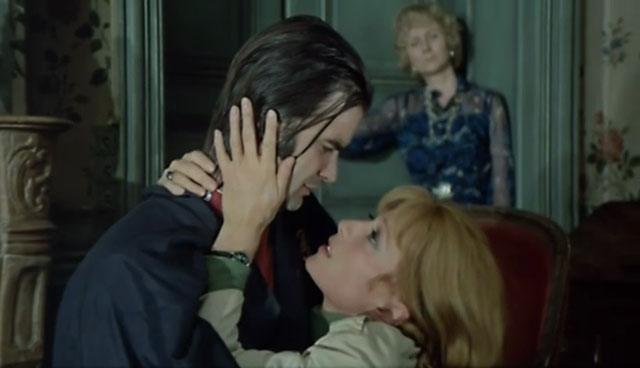
Though its title is plural A STORY OF WOMEN is overwhelmingly the story of this one woman, of her attempt to keep her family (or at least her children, she shuns her returning husband) in some comfort and, equally, of her intoxication at being able to live well when so many weren’t. Marie isn’t a sympathetic character, Huppert plays her as opportunistic, an emotionally neglectful wife and mother, and not a little manipulative, but while it’s hard to feel for her you do understand her. You see the desperate poverty of the opening (in which she’s raggedly dressed and she and her children pick nettles for a very thin soup) and you can understand why, when she gets a little glimpse of what material goods and money can do, especially in the times she’s living, she becomes somewhat drunk on it, and pursues it greedily.

It’s a challenging balancing act for Huppert (whose performance won her the Best Actress prize at the Venice Film Festival in 1988, and a Cesar nomination). She’s spectacular, she never courts sympathy for Marie and, as ever, she’s extremely effective when her character is at her coldest. She’s especially strong in a scene that draws a contrast between the two sides of her life; coldly and dispassionately handing a client over to her ‘trained assistant’ (actually her housekeeper) before becoming sunny and lively on joining her lover (Nils Tavernier) in the next room. Good as she is throughout, it is in the film’s last half hour that Huppert is truly extraordinary. Once Marie is arrested all her facades slip away, both the coldness with her clients and her husband and the freewheeling, flighty woman we see with her lover and with Lulu are gone. Huppert seems tiny in these late scenes, as if the simple act of stripping her of her makeup and hairdressing has shrunk her. She’s also more delicate than ever, this once hard woman, now seemingly made of porcelain. The sheer emotion that Huppert puts across in the scenes in prison and leading up to Marie’s execution will really stick with you, none more so, surely, than her final prayer; crying, she says “Hail Mary, full of shit”. It’s a moment that resonates long after the credits, as does the performance itself.

This is a slightly atypical effort from Claude Chabrol. It lacks the stylisation that marks much of his work, and though his clear fascination with women (and Huppert in particular) persists, few of his other trademarks make it into this film. However, it’s a lean work, with every scene cut right to the bone (many are played with just a couple of images or a handful of sentences) and an expectation that we are intelligent enough to fill in what isn’t explicitly stated. The great advantage of Chabrol’s choices here, which are much more observational than usual, is that he really lets us in to Marie Latour’s world. The period detail isn’t played up, but it’s convincing, and along with Huppert’s and the rest of the cast’s naturalistic performances (Francois Cluzet is especially good as Marie’s frustrated husband) he allows us to forget that we’re watching a film and instead become invested in this woman’s journey to its bitter end. He does put in a little explicit social commentary, having Marie ask of her ‘crime’ “How could a man understand?” and dedicating the film to the children of the condemned (in a very odd late touch, that completely fails to work, he adds narration from Marie’s son, looking back as an adult at his Mother’s arrest and execution). But these are small things, and only the narration detracts (and then very briefly) from what is, overall, one of Chabrol’s and Huppert’s best efforts. This is a sadly underseen film, and well worth looking out.

Jan 4, 2010

The Week in Movies 1

28/12/2009 - 3/01/2010

LA RUPTURE [18]
[THE BREACH]
DIR: Claude Chabrol


One of Chabrol’s justly celebrated Helene cycle of films, which usually deal with a fractious marriage, which often takes in both infidelity and murder and always star his then wife Stephane Audran as Helene. Here Audran is married to a drug addict who, in the opening scene, assaults both her and their young son. Understandably she leaves him, but her rich in laws take their son’s side and hire a private detective (Jean-Pierre Cassel) to discredit Helene, and ensure that she loses custody of her son.

For most of its two hour running time this is a tense thriller, powered by excellent performances from Cassell, Michel Bouquet as the father in law and the outstanding Audran, who is more sympathetic here than usual. In the film’s third act Chabrol mounts an outstanding series of sequences as the detective attempts to create evidence against Helene, but unfortunately, with ten minutes to go, the film runs a little off the rails with a twist and effects that, while they must have seemed trendy in 1970, now feel very dated. It’s a shame, because most of La Rupture packs a real punch. However, this is a minor sag in what is a largely excellent, and visually rather inventive, film from Chabrol.


PERFECT STRANGERS [2003] [15]
DIR: Gaylene Preston
This independent New Zealand film starts promisingly, with a creepy Sam Neill kidnapping and attempting to romance Rachael Blake, but what could have been a tense little thriller loses traction quickly thanks to some risible plot developments. Gaylene Preston is attempting to say something about obsession, and even about Stockholm syndrome, but with a short timeline, a screenplay that never gives its characters much real depth and a middling performance from Blake she’s fighting a losing battle. It’s a nice idea, but chalk this one up as a missed opportunity, despite nice work from Sam Neill.


CLAAY PIGEONS [15]
DIR: David Dobkin


I can’t figure out what this film wanted to be. Is it a comedy? Certainly it’s not funny. Is it a drama? Well, it’s not very engaging. Is it serial killer movie? It’s got nothing to say about crime or criminals. Clay Pigeons sees Joaquin Phoenix suspected of being a serial killer, while he knows that it’s actually his new ‘buddy’ Vince Vaughn. He’s being pursued by an FBI agent played by, of all people, Jeneane Garolalo, whose undoubted comic talents go totally unutilised. Everyone seems to be in a different film; Vaughn is playing broad, for laughs that just aren’t there, Garofalo looks utterly lost without any comedy to play, and Phoenix mumbles his entire part at the floor, so you can’t hear what movie he’s in.

Dobkin, who has since directed Shanghai Knights, Wedding Crashers and Fred Claus (nice career, Dave), shows no visual flair, and at one point there’s a continuity flaw so glaring I can’t believe that nobody fired the editor. It’s a formless, purposeless, mess of a movie.


LA FLEUR DU MAL [15]
[THE FLOWER OF EVIL]
DIR: Claude Chabrol


Chabrol’s 2003 film is a rather typical tale of upper middle class corruption and murder. It concerns the secrets, both present and long buried, of the Charpin-Vasseur family, secrets threatened to be revealed when as Anne Charpi-Vasseur (Nathalie Baye) runs, against the wishes of her husband, for re-election to local office.

The Flower of Evil is a pretty simple, but very tidy thriller. Chabrol is an old master, and he handles both camera and actors with an assured and practiced hand. Baye is excellent as the relatively inexperienced but sharp politician while Benoit Magimel (a frequent collaborator in Chabrol’s later period) and Mélanie Doutey give strong performances as the pseudo incestuous step siblings trying to hide their relationship from their respective parents. A relatively minor Chabrol then, but typically well made and entertaining all the same.


JEANNE LA PUCELLE [PG]
[JOAN THE MAID]
DIR: Jacques Rivette


This is the third film I've seen about Joan of Arc, and another magnificent piece of work that can easily stand alongside both Dreyer and Bresson's films. Rivette's treatment is epic in both scope (covering the last two years of Jeanne's life, rather than zooming in, as the other filmmakers did, on her trial and execution) and in length (five and a half hours, across two very arbitrarily divided parts titled The Battles and The Prisons). In truth Sandrine Bonnaire, in her mid twenties at the time, is a little old to play the 17 - 19 year old Jeanne but that ceases to matter because her performance, which holds centre stage for the entire running time, is remarkable. She portrays Jeanne as a young woman of quiet, yet extraordinary, strength, resolve and faith. You believe that the men she ends up leading would indeed follow this young girl.

Jacques Rivette knows his strengths as a filmmaker, and that they don't really include action, and so the battles themselves are mostly offscreen, detailled by testimony. This may frustrate some, but it makes clear what the film is trying to do, it's an exploration of Jeanne as a person, as a leader, it's not an action movie. What action there is well enough done though, and Sandrine Bonnaire, impressively, does almost all of her own stunt work. The other thing that Rivette misses out is the trial, cutting directly to the sentencing, with a caption that may as well read 'rent the Dreyer or the Bresson'.

Rivette and Bonnaire have here presented the most complete portrait of this extraordinary young woman, it may be slowly paced, and light on action, but the full five and a half hours of this film is a riveting experience and well worth your time for that exceptional central performance.


THE YEAR OF THE RAT
DIR: Julie Ng
This documentary on the making of Willard, by director Glen Morgan’s young assistant, is notable chiefly for its extraordinary access. The on set scenes are pretty typical, if extremely candid, BTS fare. It’s when the film is finished that this documentary becomes fascinating, as Ng candidly documents the process of cutting the film for a PG13 rating, the soul destroying test screenings and the reshoots to make an ending more palatable and commercial. It’s an impressive insight to a world we seldom see clearly.


9TO5: DAYS IN PORN [18]
DIR: Jens Hoffman


I’ve seen several documentaries about pornography (more in fact than I’ve seen porn films) ranging from the almost jaunty Pornstar: The Legend of Ron Jeremy to the unbelievably disturbing Hardcore (which REALLY needs to be released on DVD). Jens Hoffman’s long film falls somewhere in the middle. It’s failing is perhaps in trying to do too much. He touches on so many interesting stories (that of husband and wife pornstars Otto Bauer and Audrey Hollander, that of rising star Sasha Grey, the sad story of Katja Kassin, the inspiring Dr Sharon Mitchell) but he doesn’t take the time to fully explore them. Each story here could well be its own documentary (especially that of Sasha Grey, who is incredibly intelligent and simply oozes charisma) and jamming them all together doesn’t serve them brilliantly.

However, as a patchwork of the modern porn industry 9to5 is intriguing. At times it is a deeply sad film, but then there are people (like Belladonna and the aforementioned Grey) who seem to have their heads and hearts in the right place, and give you a little hope. At times (as when we see Sophie Dee doing what is apparently her first anal scene, and being roughly treated for her trouble) it is difficult to watch, and for a film with much hardcore sex in it it is certainly never arousing, but 9to5 is always interesting. In fact it’s so interesting that I wondered if it would have made a better TV series, where each story could really be given its due attention.


BEWARE THE MOON
DIR: Paul Davis
At 97 minutes this a pretty exhaustive exploration of the making of An American Werewolf in London. Director Paul Davis touches on all the questions fans will want asked, and gets almost everyone associated with the film to talk candidly about it. The only real downside to Beware the Moon is the presence of a presenter, who is completely pointless, has nothing to add to proceedings and looks like he’d rather be shot with a silver bullet than present this film.


POULET AU VINAIGRE [15]
[COP AU VIN]
DIR: Claude Chabrol


Another strong thriller from Claude Chabrol. This one boasts an edgy performance from Jean Poiret as Inspector Lavardin, whose violent investigatory techniques lead him to conspiracy and murder surrounding property developers trying to force a disabled woman (Charol’s by now ex wife and frequent collaborator Stephane Audran) and her teenage son (Lucas Belvaux, who has gone on to become a director of some note himself) out of their home.

All the ingredients of a vintage Chabrol are present and correct, and the film features some strong sequences and nice performances, but Audran is inconsistent and the twist involving her character blindingly obvious, and that undermines the film somewhat. Still, Cop au Vin (and, by the way, et's just take a second to enjoy that pun) is mostly tasty and I’m anxious to follow Poiret’s interesting character and powerful performance to the sequel; Inspector Lavardin.


PAYBACK: DIRECTOR'S CUT [18]
DIR: Brian Helgeland


I haven’t seen Brian Helgeland’s disowned directorial debut since it was in cinemas, and so I don’t remember it especially well, though I remember not liking it much at the time. This Director’s cut though is an interesting beast. It’s ten minutes shorter, at a brisk 90, than the theatrical cut and it has a nicely consistent dark, mean spirited tone to it.

Based on the same source material as Point Blank, Payback sees Porter (Mel Gibson) on a violent mission to claim the money that was stolen from him back from the mob. It’s a nasty tale, filled with violence, profanity and strong guest turns from fine character actors (David Paymer is great as a slimy low level mobster and Maria Bello, who has since matured into one of America’s most interesting and individual actresses, makes an impression as a hooker with a soft spot for Porter).

Helgeland’s stylish direction and his blacker than black script suggest that he should have been given a chance to release his original dark vision to cinemas. It’s no lost classic, there are things here (Lucy Liu as a dominatrix) that just come off as silly, and the plot is a little too linear, often feeling like Porter is a computer game character always advancing to the next (mob) boss, but this version of Payback is more rewarding than I expected.


PEARL OF DEATH [U]
DIR: Roy William Neill

Ever since I first read about him some 15 years ago I’ve wanted to see one of Rondo Hatton’s films. Hatton plays the villainous, deformed, Creeper in this effective Sherlock Holmes film, starring the great Basil Rathbone as Holmes and Nigel Bruce as an amusingly bumbling Watson. At just 65 minutes the story is briskly told, though there’s not much time for any real character depth. Rathbone and Bruce are both excellent though, and bounce off each other nicely, while Evelyn Ankers makes for a beautiful and capable villainess. Rondo Hatton, his face deformed by acromegaly, is a striking silent presence in his first featured role and the whole thing is lensed with a little noirish style by Roy William Neill.

It was also interesting, having just seen Guy Ritchie’s Sherlock Holmes, to note that a scene in which Lestrade has trouble saying the word ‘catatonic’ is drawn, word for word, from this film.


SMASH CUT [18]
DIR: Lee Demarbre


Smash Cut is dedicated ‘to the life and art of Herschell Gordon Lewis’. I know that this is close to blasphemy for a gorehound, but I’ve never seen any of Lewis’ films and, having seen the appalling Smash Cut, I’m no longer sure I want to. There’s a nice idea here; a director of cheap horror films (played by Krug himself, David Hess) accidentally kills a woman, and to hide the body he cuts it up and uses it in his movie, when the footage is praised he keeps killing so he has more ‘prosthetics’. Unfortunately the idea is executed with all the panache of a terrible student film. The effects, even those that are supposed to be real body parts, are patently fake and poorly executed. The performances (including one by Sasha Grey, who promised so much in The Girlfriend Experience) are monotone and tedious and the direction is unimaginative and technically poor.

It may be that the makers of Smash Cut have ended up with exactly the shitty, cheesy mess they set out to make, but intentional or not this IS a shitty, cheesy mess.


FRANKLYN [15]
DIR: Gerald McMorrow


Gerald McMorrow’s feature debut is an ambitious one, it follows four seemingly disparate characters in two separate worlds, which it then has to draw together. On top of this Franklyn also features a great deal of (generally decent) digital effects and quite a few complex action scenes, on a budget about the tenth of that of the Blockbusters it often resembles.

There are things in Franklyn that clunk, some writing that’s a little schematic, a few moments that spoonfeed the audience, but these are certainly outweighed by the times at which the film’s achievement matches the breadth of its ambition. The scenes in the futuristic dystopia of Meanwhile City are extremely well realised, with strong production design (with shades, it has to be said, of Dark City) and some excellent action sequences. It also introduces us to Preest (a typically strong performance from the much underrated Ryan Phillippe) whose look is one of the film’s strongest images, his impassive mask with its black holes for eyes as memorable an image as Rorschach’s mask in Watchmen.

In present day London Bernard Hill gives a fine performance as man looking for his missing son, Eva Green is suitably ethereal in a dual role as a depressed conceptual artist (whose project is, it has to be said, the film’s most tedious aspect) and as a warm primary school teacher and Sam Riley builds on his work in Control with an understated performance as the recently jilted Milo. The interest in the film is discovering how these characters all tie together, and so I shan’t discuss it here, but McMorrow draws his strands together in a clever and rather unexpected way, marking himself out as a talent to watch.


THE HOUND OF THE BASKERVILLES [1939] [PG]
DIR: Sidney Lanfield
The first of Universal’s Sherlock Holmes series, with Basil Rathbone and Nigel Bruce playing the iconic cinematic versions of Holmes and Watson, is based on the most famous of Conan-Doyle’s stories, and it’s a fun and engaging version.

There’s some very big acting here, notably an hilarious performance by Barlowe Borland, whose own Scottish accent is so broad that it actually sounds like a stereotypical comedy scotsman and there are some decidedly wooden turns too, from Richard Greene and Wendy Barrie as the film’s young lovers. However, Rathbone is a great Holmes and Nigel Bruce’s befuddled Watson is very funny indeed. The scenes on the moors look studio bound, but like the rest of the film they are stylish, and establish an iconic look for Holmes (much of the popular image comes not from Conan Doyle but from these films).

All in all this is a light, fast and efficient telling of a strong story, no classic perhaps, but a solid entertainment.


THE BLUE DAHLIA [PG]
DIR: George Marshall


He’s not the best known of names, nor among the revered directors of Hollywood’s golden age, but George Marshall was clearly a skilled filmmaker. With a career that spanned nearly 60 years and almost 200 credits his resume is probably a mixed bag, but The Blue Dahlia is little short of a classic film noir.

Johnny Morrison (Alan Ladd) comes home from the war to find that his wife (Doris Dowling) has become a drunk and is cheating on him, after an argument he leaves her. The next day Mrs Morrison is found murdered with her husband’s gun and Johnny finds himself on the run and getting mixed up in intrigue with his wife’s nightclub owning boyfriend (Howard Da Silva) and a gorgeous, mysterious blonde (Veronica Lake).

Marshall adheres to the classic noir style here, using deep blacks and brilliant whites, making use of inky shadows to create both atmosphere and the shape of his shots. It’s a beautiful looking film of the kind that simply doesn’t get made any more (I love neo-noir, but really, it’s a genre built for black and white). The script, by Raymond Chandler, is sharp as a knife, crackling with hardboiled dialogue and the cast deliver it beautifully. In a film full of strong performances, Doris Dowling stands out in the small part of Mrs Morrison, playing the role as if she were playing a spitting cobra, such venom is there in her every word. Veronica Lake was better known for her dazzling beauty than her acting (and here, in her mid twenties, she is lovelier than ever) but I liked her performance, if anything it’s a little more modern than the others, more natural, less affected.

If you’re even a little bit of a film noir fan then The Blue Dahlia ought to be at the top of your list of films to see, it’s a cracking thriller, stylishly made, with some strong acting, what more could you want?

Mar 20, 2009

The Girl Cut In Two [15]

Dir: Claude Chabrol
Claude Chabrol is amazing. Like Woody Allen he makes a film every year (and he’s been at it longer, 79 in June, he’s been making films since 1958 and his filmography, not counting TV work, numbers in the sixties) unlike Allen he hasn’t suffered a collapse of form, many of his later films – The Bridesmaid, Merci pour le Chocolat and La Ceremonie among them – can stand alongside his celebrated Helene cycle as some of his best work.

The Girl Cut in Two isn’t vintage Chabrol, but it’s still a film with many very strong elements. It surprises me that Chabrol, a great director of women and cinematic connoisseur of beauty hasn’t previously worked with Ludivine Sagnier, who has gone from being an extraordinarily lovely decoration in Francois Ozon films to become one of France’s most interesting young actresses. Here Sagnier plays Gabrielle, a TV weather girl who enchants two men, an author some 30 years her senior (Francois Berleand) and a young, unstable, heir (Benoit Magimel), both of whom fall for her the first time they see her, and whose mutual desire proves destructive. Rather than play this as he might have previously – as a thriller – Chabrol fashions a black and sometimes nasty comedy in which things simmer beneath the surface.

As you might expect of a man who has been making films for as long as Chabrol has, and has spent almost 25 years working with the same core crew, The Girl Cut in Two is technically flawless, it is wonderful to look at, from its costumes, make up and sets, to the way that Chabrol makes his entire cast look beautiful, to the smoothness of the camerawork and a few memorable shots (The red gelled opening and Sagnier, clad in a bustier with a peacock’s tail, crawling into a room come to mind).

Chabrol and Cecile Maistre’s screenplay deals with some quite heavy themes; love, jealousy, obsession, with a nice light touch and a sparkling wit that shows itself in almost every scene. The humor translates well, creating an interesting balance of tones that works in the film’s favour. Another nice touch is Chabrol and Maistre’s decision to keep one pivotal event (which I shan’t spoil), and all description of it, off screen, allowing our minds to fill in the details as we see them.

A distinguished cast all give strong performances. Sagnier’s performances are often overshadowed by her beauty (I met her before the screening, and can assure you that, yes, she is that beautiful), she’s entirely natural here, hardly appears to be acting at all, and yet never strikes a false note; a tough balance to achieve and she seems to do it effortlessly and, she said, with little direction. Benoit Magimel, so impressive opposite Chabrol’s latter day muse Isabelle Huppert in The Piano Teacher, also has tricky job. His is a more theatrical performance, as a character that seems to constantly be dancing on the edge of sanity; it could easily be grating, but Magimel finds the middle ground between funny and frightening, nailing the tone of the film. The last side of the central triangle; Francois Bereland is also impressive; giving a finely judged performance that shifts and plays with your sympathies.

Given all this quality its tough to put a finger on why The Girl Cut in Two doesn’t quite work. There is one large issue: the story doesn’t quite sustain the film’s 115 minute running time, and it runs off the rails in the last twenty minutes, which hardly feel like they belong to the same film. The real issue is harder to define though; it’s mainly that while all the individual elements are excellent they don’t quite gel into a coherent whole. Even if it’s not Chabrol’s best, The Girl Cut in Two is an interesting and engaging film despite its flaws.