Showing posts with label The Greatest. Show all posts

Sep 26, 2010

The Greatest? Part 5: Jennifer Jason Leigh double

With this pair of movies we’re looking at a brief, odd, time in Jennifer Jason Leigh’s career, that brief span of the early 1990’s in which she was, to at least a slightly greater degree, famous. One of these films even embedded itself so much in popular consciousness that it won Leigh one of her surprisingly few awards… the MTV award for Best Villain. Yes, really.

RUSH
DIR: Lili Fini Zanuck
CAST: Jennifer Jason Leigh, Jason Patric,
Max Perlich, Sam Elliott


RUSH is the film where I first really noticed Jennifer Jason Leigh, and made the connection between that and the other films I’d seen her in. Looking at it again, it’s hard to see why this movie turned me into such a big fan, because it really isn’t much good.

It’s based on an autobiographical novel by Kim Wozencraft, who was a narcotics cop in the mid 70’s. Along with her partner, Wozencraft became addicted to the drugs she took to maintain her cover. The film stays relatively faithful to this central idea, casting Jason Patric as the experienced narc and Leigh as his newly recruited, somewhat naïve, partner.

There are moments that work in RUSH, but not a single element that works consistently for the entire running time (including, sadly, Jennifer Jason Leigh’s performance). There are several major issues, but perhaps the biggest is Pete Dexter’s screenplay. It feels like a first draft, with characters not yet coloured in and archetypes in their place. It’s also incredibly heavy on exposition and extremely episodic. There’s act one, in which Kristen Cates (Leigh) is recruited from the Police academy, and learns about drugs at Jim Raynor’s (Patric) knee (this allows Dexter to go into raw exposition mode for minutes on end, notably in a scene in which Jim demonstrates shooting up). Thereafter the rest of the film is an endless episodic series of drug deals with sleazy cameoing actors (William Sadler is memorable), mixed in with an unconvincing relationship between Raynor and Cates and some very cliché struggles with addiction.

Unfortunately debuting director Lili Fini Zanuck, who has not directed a single feature in the ensuing 19 years, shoots the film with all the subtlety and lightness of touch of a man attempting to anaesthetise himself with a mallet. She has directed most of the actors to give almost comically huge performances, none more so than the oddly named Special K McCray whose turn as smack dealer Willie Red is hammier than a buffet to serve 300. At times (notably when they are most strung out) she’s also got Patric and Leigh acting as if to the back of a huge auditorium. Jason Patric is a big problem for the film too, he has zero chemistry with Leigh, and their seemingly instant relationship never has even a grain of credibility, and when not directed to give the most hilariously overblown ‘I’m on loads of drugs, me’ performance I’ve ever seen he brings about the same level of engagement to his performance as I do to my weekly food shopping.

In amongst all this, there are isolated moments in which the film becomes engaging, almost all of them involving Max Perlich as a young dealer Cates and Raynor use as and informant. As in GEORGIA, Perlich has a great rapport with Jennifer Jason Leigh, and they really seem to bring out the best in each other as actors. When she’s with Walker is when we see Kristen at her most human, her most unguarded, and it is in those moments that Leigh really impresses, and gives us a real glimpse of the toll that this double life is taking on Kristen. It’s also notable that, though they aren’t in a relationship in this movie, there is a great deal more chemistry between Leigh and Perlich than she has with Patric.

Lili Fini Zanuck’s direction falls flat on a lot of important levels, from her frankly inexplicable casting of Gregg Allman as the man who Raynor and Cates have been tasked with proving is a major drug dealer to her thuddingly obvious use of montage and her awful choice and use of music. Eric Clapton’s score wails away near constantly (and Tears in Heaven is given an inappropriate airing) and when that’s not plaguing us we’ve got terrible bar bands, and cliché song choices (Freebird, fucking Freebird, really?)

I wish I had liked RUSH better this time around, because it’s actually a pretty important film for me, it led me to discover this great actress, and through that discovery it led me to a mass of great films and many happily spent hours (with many more to come), but that doesn’t make it good. For fans it’s worth seeing, but this is a minor film in a major career.


SINGLE WHITE FEMALE
DIR: Barbet Schroder
CAST: Bridget Fonda, Jennifer Jason Leigh,
Steven Weber, Peter Friedman


If there is a single prevailing theme in Jennifer Jason Leigh’s early career it is her superior taste in and ability to elevate trash. Whether it’s a treacly TV movie like THE BEST LITTLE GIRL IN THE WORLD, Paul Verhoeven’s appropriately titled FLESH AND BLOOD, cult exploitation classic THE HITCHER, or this tawdry little thriller, she can always be relied on to give the part her all, to treat it with the same degree of seriousness and craft that she did her more upmarket roles. It’s no use pretending that SINGLE WHITE FEMALE is anything other than an especially trashy take on the yuppie horror that was so popular in the late 80’s and early 90’s, but while it is trash it is, for the most part, superior, entertaining, trash.

The plot is pretty formulaic. Yuppie Allie (Fonda) throws out her boyfriend (Weber) when she discovers that he’s still seeing his ex-wife on the side. Unable to afford her (HUGE) apartment by herself she advertises for a roommate, eventually giving the place to mousy Hedra Carlson (Leigh). The two become quite close, but when Allie and her boyfriend get back together Hedra begins to try to emulate Allie in some disturbing ways, borrowing more than just the odd dress and spray of perfume.

You can probably guess how it all ends up; in a completely overblown violent conflict, but though the whole thing is desperately formulaic there are many things to like here. Chief among them are the performances. It’s a terrible shame that Bridget Fonda retired from acting following the birth of her son, because she was a genuinely interesting and underrated talent. She makes for a solid and sympathetic anchor here, and generously cedes many scenes to Leigh, but never lets Allie become some cardboard cutout protagonist. There’s also just something likeable about Fonda, she has that indefinable magnetism that allows you to root for just about anyone she plays, and Allie is no exception.

In the hands of a lesser actress the character of Hedra Carlson would have been horrendous to watch. There are moments, even in Leigh’s performance, that are unavoidably hammy (there really aren’t many subtle ways to play the last act of this film), but for the most part she builds a commendably subtle and rather affecting portrait of a young woman who is clearly as damaged as she is deranged. Typically, Leigh did a lot of research for her part, talking to several therapists about Hedra’s pathology, and it pays off, because the transition from the sweet, mousy, girl who comes to view the apartment to the homicidal maniac of the film’s last act is remarkably credible. It also helps that, when dressed the same and given the same (awful) haircut, Leigh and Fonda end up looking eerily alike.

The film does go off the rails in its last act, and director Barbet Schroder seems to throw caution to the wind and ask his stars, especially Leigh, to really ham it up. It is probably no coincidence that in the last few scenes, in which she spends much time stalking Fonda with a gun, Leigh often seems visibly uncomfortable. That said, even in these last twenty minutes there are some strong moments of acting from both women, especially as Hedra prepares to make Allie’s death look like a suicide.

SINGLE WHITE FEMALE is by no means a great film, but it is an entertaining one, it’s a heady mix of silly plotting, copious nudity and overblown violence, elevated by two performances which are far, far better than anything the script demands or earns. It’s perhaps best to turn your brain off, especially in the last act, but if you do you’ll have two hours of unchallenging fun.

Sep 22, 2010

The Greatest? Part 4: Huppert Double

Two heavily contrasting films today, one an uncharacteristic foray into comedy, the other one of the most famous tragedies in literature.

I ♥ HUCKABEES
DIR: David O Russell
CAST: Jason Schwartzman, Dustin Hoffman, Lily Tomlin,
Mark Wahlberg, Naomi Watts, Isabelle Huppert, Jude Law


I ♥ HUCKABEES is one of the strangest films of recent years. It's described as an existential comedy, but to me it seems more like an absurdist art exercise, and frankly I'm not entirely sure whether I like that or not.

The story is an odd proposition, in that I've seen the film three times now and I'm not certain to what degree it has a story. It basically revolves around Albert Markovsky (Schwartzman), who is having an existential crisis brought on by a coincidence involving a tall African man. Wanting to discover the meaning of this coincidence, and perhaps by extension his life, Albert enlists existential detectives Bernard (Hoffman) and Vivian (Tomlin). They pair Albert up with another client, Tommy (Wahlberg) who introduces Albert to French philosopher Catherine Vauban (Huppert), whose insistence that life is a collection of disconnected, meaningless cruelties stands in direct opposition to Bernard's blanket theory.

That's an awful lot to process in 90 minutes, and that's not even half of the movie, because we haven't covered Huckabees middle manager Brad Stand (Law), his model girlfriend (Watts), who rebels against her looks and begins dressing in a bonnet or how Shania Twain fits in to this whole mess. A mess is what I ♥ HUCKABEES is, for much of the running time it feels more like Catherine Vauban's vision of the world; a bunch of meaningless scenes and moments, thrown together and struggling to find form and purpose.

It's a scattershot film, and the rumoured chaos and bad feeling of the set seems to bleed through into the film at times, but among the confused (and, frankly, dime store) philosphy there are images and moments that stick. Some of these moments stay in the memory due to their sheer balls out wierdness, none more so than the disturbing, but undeniably funny image of Schwartzman suckling at Law's breasts (I'm not even going to attempt to explain it, so don't ask). The fact that the film doesn't entirely come together isn't the fault of its starry cast. Schwartzman has a weak role, and an unsypathetic one, at the end of the day his Albert Markovsky comes off as a whiner who never grew up, that said, the film and Schwartzman are aware of this, and it's mined for laughs in several of the film's best scenes including a lovely one in which Catherine Vauban all but breaks in to Albert's parents' house and proceeds to scold them for the way they responded when a nine year old Albert was upset when his cat died. I never really warmed to Albert, but it's a testament to Schwartzman's likability that I didn't want to punch him either.

Among the rest of the cast Hoffman and Tomlin, who had long wanted to work together, seem to be having a lot of fun, and Jude Law is appropriately slimy, but the biggest impressions are made by Mark Wahlberg, who is very funny as Tommy, a firefighter whose existential crisis began on September 11th and by Naomi Watts, who seems to enjoy sending up her dazzling beauty.

Isabelle Huppert is an interesting case here, she's perhaps still too limted in her English to be as effective as she is in French, but she nevertheless almost steals the film as Catherine Vauban. Part of it is the casting; she's known (wrongly, I'd say) as an impassive and cold presence, and here she seems to parody that stereotype. Of all the cast she's the one who never winks at the camera, who never lets on that what's going on is supposed to be absurd and funny, and that seriousness makes her even funnier. She's also, at 50, tremendously sexy. Catherine uses sex as part of her method to teach Tommy and Albert (mostly Tommy) about life's random cruelties. The first sex scene is especially strange, as Huppert and Schwartzman take turns dunking each other in a puddle of mud. In interviews at the time a typically nonchalant Huppert remenisced that, when he was a baby, she'd held Jason Schwartzman in her arms (she's friends with his mother, Talia Shire), and now she was doing it again.

At the end of the day I'm not sure how I feel about I ♥ HUCKABEES. It's a bizzare film, but for all its pretensions to philosophical ideas its conclusions seem obvious and half hearted and for all its discussion of meaning I'm not sure that, at the end of the day, it really has one. As a collection of scenes it is strange enough to engage and amuse, at least for the most part, but many scenes fall flat (especially those laying out the film's various competeting philosophies, which often feel like readings from C grade Philosophy 101 papers) and though the odd image and the odd scene stick, the whole feels ephemeral. Of course that may be David O Russell's point, but I'm not sure even he knows whether that's the case.


MADAME BOVARY
DIR: Claude Chabrol
CAST: Isabelle Huppert, Jean-François Balmer, Christophe Malavoy,
Jean Yanne, Lucas Belvaux


Chabrol's apparently reverent adaptation of Flaubert's classic novel is a strange beast. I must admit that I haven't read the book, and so some of the tonal issues may come directly from the source, but whether or not that is the case, this film is still a wierdly mixed bag.

By 1991 Claude Chabrol was in his early 60's, and had made roughly 45 feature films, in short he was one of cinema's great craftsmen, having long since established a regular crew and a comfortable way of working. It is, then, odd to see how cowed, how intimidated he sometimes seems by the burden of MADAME BOVARY. I really can't think of any other reason that a great director like Chabrol, who could do so much with silent images (see, especially, LE BOUCHER) would have reams of dry narration, seemingly lifted directly from Flaubert, describing characters emotional states which, given his talented cast, it would be easier and more satisfying to portray.

Frustratingly there are times when Chabrol's grasp on his film seems as strong and sure as ever. Especially strong is the scene in which a newly married Emma Bovary (Huppert) spends a blissful night at her first society ball. Here Chabrol steps back; he lets the scene play largely through the actors' body language be it Huppert's fleeting, but real, happiness or Jean-François Balmer's proud regard of his beautiful wife, blissfully unaware that she'd happily cuckold him with any one of the men at this party. The sense of period is also strong, Chabrol brings home the squalor that many poor people lived in during the mid 19th century just as well as he portrays the beautifully put together exclusivity of high society, in capturing these two contrasting worlds so well, Chabrol also lets us understand Emma Bovary. She's irresponsible with her husband's limited fortune, but you can see why she wants to put herself across as belonging to a higher social class, because it means more than just status.

All this good work makes the moments that don't play even more disappointing. The dry narration is a problem, but not so much so as the many incredibly overwrought, melodramatic scenes. These have to be Charol's fault, and the cast, notably Huppert, seem visibly uncomfortable. The scenes Huppert shares with Emma's various lovers can be excruciatingly hammy. Melodrama's not a bad thing in and of itself, but it's just not how Huppert acts, and it shows. Her death scene is perhaps the worst work I've ever seen her do, endlessly long and scenery chewing; a performance more suited to amateur theatre.

The reason I think that's Chabrol's fault is simple. First of all, there's little need for these scenes to be so overwrought and, secondly, in the other scenes Huppert is simply sensational. Emma Bovary strikes me as a character who is all but incapable of happiness, and wants to fill her life with things, be they pretty dresses or pretty lovers, to distract her from her misery. As this Emma Bovary, Huppert is perfectly cast. At 35 she's also at the height of her very individual beauty, and convinces on a physical level as the ultimate trophy wife. She's hugely effective when Emma has to hold her emotions in check (as when she meets Leon (Belvaux) at the opera, but is accompanied by her husband), this has always been a great strength of Huppert's,; the ability to let you see the many different emotions that are going on under that practiced, put together, exterior.

The rest of the cast suffer similar fates, all of them are outstanding when the film is more dialled back (particularly Jean Yanne as the pharmacist M. Homais), but when Chabrol cranks the melodrama up to 11, they all struggle.

MADAME BOVARY is a difficult and frustrating film, some of it is brilliant, and some of it is spectacularly over the top. It works perhaps seventy percent of the time, and is still well worth a look for those moments, but the melodrama does become wearing, and I found myself wishing that Chabrol could have had a little more confidence in himself here, and been a little less wedded to the book, however brilliant it may be.

Sep 7, 2010

The Greatest? Part 3: Leigh – The Big Picture / Huppert – A Story of Women

The next selections in this series find Jennifer Jason Leigh and Isabelle Huppert working in almost opposite circumstances; UNE AFFAIRE DE FEMMES sees Huppert in an acclaimed period piece, with Claude Chabrol, a favourite director with whom she has worked regularly since 1978’s VIOLETTE) at the helm. On the other hand THE BIG PICTURE finds Jennifer Jason Leigh in a small role in an atypical film from director Christopher Guest and working in broad comedy, which really can’t be described as her comfort zone.

THE BIG PICTURE [1989]
DIR: Christopher Guest
CAST: Kevin Bacon, Emily Longstreth, Michael McKean,
J.T. Walsh, Teri Hatcher, Jennifer Jason Leigh


If there is one thing that is evident from THE BIG PICTURE it is that Christopher Guest thrives as a filmmaker when his work is largely improvised. This film, unlike the subsequent BEST IN SHOW and A MIGHTY WIND, feels very closely scripted and thanks to that it also feels very stiff, bereft of the dazzling comic energy of THIS IS SPINAL TAP and Guest’s other directorial work.

There are several big problems with THE BIG PICTURE, but the most pressing, obviously, is that it’s just not very funny. It’s hard to put your finger on the problem, but to me it felt like the film was just too on the nose, the jokes far too obvious. It’s the story of Nick Chapman (Bacon) who wins an award for his student film and finds himself courted by producer JT Walsh, who sets about allowing Nick to make his dream project… with just a few changes. The head slapping obviousness reaches its zenith in a late scene in which Walsh, whose ‘creativity’ has ended up taking Nick’s black and white film about a love triangle between three middle-aged people and turning it into a pitch called Beachnuts, is in a set that’s clearly supposed to be Hell; the studio head as Satan. It’s not just that though, everything feels rote and lazy, from the opening spoof student films and their makers (one, a conceptual artist, played by Jennifer Jason Leigh) to the sub-plot in which a starlet (Hatcher) attempts to seduce the hot young director, right up to the so predictable that you’ve already guessed it closing shot.

The story clanks through the expected moments. Nick gets a whiff of success then cheats on his girlfriend (the lovely Emily Longstreth), leases a Porsche, begins ignoring his best friend and cinematographer (McKean). Then his deal evaporates, which leads to the hugely unconvincing last half hour, in which Nick reforms, and gets another shot thanks to a homemade music video for a band called Pez People. If anything in this movie should have been a home run it’s this, but the song isn’t funny, the video (despite Leigh’s energetic oddness as a dancer) is terrible, and also not funny. This, as much as the awfulness of Nick’s student film, seriously undermines the whole plot of the film. Ultimately it’s marooned in a wilderness between being believable enough for us to be interested in Nick and his journey and crazy enough to work as comedy.

The cast don’t help very much. Kevin Bacon is uncharacteristically bland as Chapman, Martin Short is at his nigh insufferable worst as Nick’s sycophantic agent (a joke that runs far too long to work in the same way that Spinal Tap’s Artie Fufkin did) and Michael McKean seems as ill at ease as Guest with the heavily written dialogue. On the plus side, Emily Longstreth (who, sadly, hasn’t made a film since 1994) is charming as Bacon’s girlfriend, and she’s fun in a sequence in which Bacon fantasises her as a film noir femme fatale and JT Walsh, despite the fact that all of his character’s actions are the most obvious pieces of ‘satire’ you can imagine, is great value as the slimy producer.

If this weren’t part of a series on Jennifer Jason Leigh her participation in THE BIG PICTURE would hardly rate a mention. She’s on screen for perhaps five minutes in total, and has very little to do. That said, she’s clearly having a good time and even with very little to work with she manages to give Lydia a real identity, and a very particular nervous energy; she moves like she’s being repeatedly electrocuted. It’s not much, I’d really like to see what she could do in one of Guest’s improvised films, but here she’s one of the better and funnier things in what is a disappointing film.


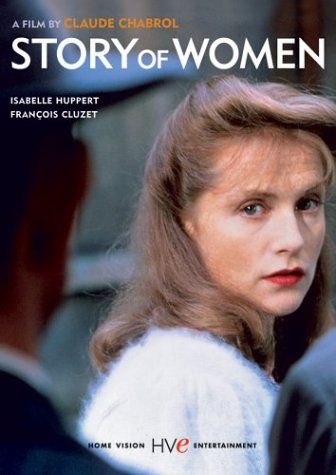
UNE AFFAIRE DE FEMMES
DIR: Claude Chabrol
CAST: Isabelle Huppert, Francois Cluzet, Marie Trintignant


The English language title for this film, A STORY OF WOMEN, may fit it to a certain degree, but what it doesn’t capture is the implication in the original title (explicitly stated in the film) that what its central character, Marie Latour (Huppert) does is essentially a woman’s affair, women’s business.

The film is set in the midst of the second world war, with France occupied and ruled by the Vichy government. As the film begins we find Marie and her two young children living in poverty, but an opportunity comes when Marie’s neighbour asks for help aborting her pregnancy. When the neighbour pays by giving Marie a record player she seems to see the opportunity, and to become determined that she, her children and her wounded husband will begin living better, war or no war. She begins offering further abortions, and letting a room in her house to Lulu (Trintignant), a friend, and one of the local prostitutes. Marie Latour is based on Marie Louise Giraud, who was one of the last women in France to be executed by guillotine.

Though its title is plural A STORY OF WOMEN is overwhelmingly the story of this one woman, of her attempt to keep her family (or at least her children, she shuns her returning husband) in some comfort and, equally, of her intoxication at being able to live well when so many weren’t. Marie isn’t a sympathetic character, Huppert plays her as opportunistic, an emotionally neglectful wife and mother, and not a little manipulative, but while it’s hard to feel for her you do understand her. You see the desperate poverty of the opening (in which she’s raggedly dressed and she and her children pick nettles for a very thin soup) and you can understand why, when she gets a little glimpse of what material goods and money can do, especially in the times she’s living, she becomes somewhat drunk on it, and pursues it greedily.

It’s a challenging balancing act for Huppert (whose performance won her the Best Actress prize at the Venice Film Festival in 1988, and a Cesar nomination). She’s spectacular, she never courts sympathy for Marie and, as ever, she’s extremely effective when her character is at her coldest. She’s especially strong in a scene that draws a contrast between the two sides of her life; coldly and dispassionately handing a client over to her ‘trained assistant’ (actually her housekeeper) before becoming sunny and lively on joining her lover (Nils Tavernier) in the next room. Good as she is throughout, it is in the film’s last half hour that Huppert is truly extraordinary. Once Marie is arrested all her facades slip away, both the coldness with her clients and her husband and the freewheeling, flighty woman we see with her lover and with Lulu are gone. Huppert seems tiny in these late scenes, as if the simple act of stripping her of her makeup and hairdressing has shrunk her. She’s also more delicate than ever, this once hard woman, now seemingly made of porcelain. The sheer emotion that Huppert puts across in the scenes in prison and leading up to Marie’s execution will really stick with you, none more so, surely, than her final prayer; crying, she says “Hail Mary, full of shit”. It’s a moment that resonates long after the credits, as does the performance itself.

This is a slightly atypical effort from Claude Chabrol. It lacks the stylisation that marks much of his work, and though his clear fascination with women (and Huppert in particular) persists, few of his other trademarks make it into this film. However, it’s a lean work, with every scene cut right to the bone (many are played with just a couple of images or a handful of sentences) and an expectation that we are intelligent enough to fill in what isn’t explicitly stated. The great advantage of Chabrol’s choices here, which are much more observational than usual, is that he really lets us in to Marie Latour’s world. The period detail isn’t played up, but it’s convincing, and along with Huppert’s and the rest of the cast’s naturalistic performances (Francois Cluzet is especially good as Marie’s frustrated husband) he allows us to forget that we’re watching a film and instead become invested in this woman’s journey to its bitter end. He does put in a little explicit social commentary, having Marie ask of her ‘crime’ “How could a man understand?” and dedicating the film to the children of the condemned (in a very odd late touch, that completely fails to work, he adds narration from Marie’s son, looking back as an adult at his Mother’s arrest and execution). But these are small things, and only the narration detracts (and then very briefly) from what is, overall, one of Chabrol’s and Huppert’s best efforts. This is a sadly underseen film, and well worth looking out.

Sep 2, 2010

The Greatest? Part 2: Leigh – Introduction / Georgia

I’ve been an admirer of Jennifer Jason Leigh’s for 15 years or more, almost as long as I’ve been a serious movie lover. I don’t remember what the first film I saw her in was (it may well have been THE HUDSUCKER PROXY), but what I do remember is a book I had back then. It was called Young Hollywood, and profiled a lot of that generation of actors. I remember being surprised by Leigh’s entry, by realising that I’d seen several of her films, and not made the connection that it was the same actress in each of them.

Free image hosting powered by PostImage.org Free image hosting powered by PostImage.org Free image hosting powered by PostImage.org
That’s, for me, Leigh’s greatness. She isn’t so much an actress as she is a changeling. Like DeNiro in his heyday she throws herself body and soul into her parts, she doesn’t so much play a person as she becomes her. She’s changed her body for roles, written extensive in character diaries, worked her characters jobs (including one at the same pizza place her character in FAST TIMES AT RIDGEMONT HIGH worked at). She’s never the same twice, and is perhaps the only actor I can watch and, despite having seen her in more than 40 films and knowing a good deal about her, still catch myself not watching Jennifer Jason Leigh but instead her character.

Genius is not too strong a word, or at least it hasn’t been. Lately Leigh has dropped off the radar somewhat. In 2005 she married Noah Baumbach, and since she’s made fewer and fewer screen appearances, more often than not in small parts (four minutes in SYNECDOCHE, NEW YORK, ten in GREENBERG). Can she still be called the greatest working actress? Taken as a whole does her body of work back that up? I’m going to try and figure that out for myself.


GEORGIA [1995]
DIR: Ulu Grosbard
CAST: Jennifer Jason Leigh, Mare Winningham,
Ted Levine, Max Perlich


I first became aware of GEORGIA through the Oscars. I watched the 1995 ceremony, during which Mare Winningham was up for Best Supporting Actress, and though Winningham didn’t win (Mira Sorvino did) and I wasn’t at that time aware that Jennifer Jason Leigh was in the film, it stuck in my mind. Of course after I discovered that Leigh was in it, and that this is generally rated as perhaps her finest performance, I knew I HAD to see it. Unfortunately I was defeated by the fact that, so far as I can tell, GEORGIA never had any kind of home video release in the UK. If it did ever come out on VHS then it is spectacularly rare; I’ve scoured new and second hand stores for a copy for over a decade, and have never even seen one. It’s taken me the best part of 15 years, but I’ve finally seen GEORGIA and it was more than worth the wait.

The story is pretty basic. Two sisters, both singers. Georgia (Winningham) is a country music star with a loving husband (Levine) and a young family. Younger sister Sadie (Leigh) is an alcoholic and drug addict, scraping by from band to band and gig to gig, she’s got the passion for music, but lacks her sister’s real talent. The film is essentially about Sadie, her ever downward spiral, and the way the people around her (including Georgia and a sweet young man named Axel (Perlich) whom Sadie hastily marries) are affected by her.

What really makes GEORGIA the rather extraordinary piece of work that it is isn’t the story, which is familiar, nor even the screenplay (by Leigh’s mother Barbara Turner). The quality here is in the acting. There are exceptional performances all round, from the colourful character parts in the various bands (filled by people like John Doe and John C. Reilly, both of whom have done distinctive work since) right up to the leading players.

The undervalued Max Perlich (who seems to have dropped off the planet) is great as Sadie’s naïve, gentle, 23 year old husband. He comes into her life, ever so politely, when he delivers her groceries. He’s an easy character to like and to feel for, and in that we take a cue from the other characters, who also warm to him. Ted Levine, as identifiable as ever by his one of a kind drawl, makes for another sympathetic figure as Gerogia’s solid husband Jake. His relationship with Sadie is particularly interesting; there’s real warmth between them, but he seems slightly blind to her problems. The Oscar nominated Winningham is, make no mistake, excellent. Georgia is such a straight character that she could be rather bland, but Winningham finds real depth in her conflicted relationship with Sadie. She also performs all her own vocals, showcasing a very impressive (if appropriately MOR) country voice.

And then… and then there’s Jennifer Jason Leigh. My instinct in discussing this performance is to do an impression of Wayne and Garth meeting Alice Cooper, and simply fall to my knees crying, “We’re not worthy”. Think of your favourite superlative and treble it, Jennifer Jason Leigh is still better than that. She quite simply IS Sadie, it’s not acting, it’s not even that she’s living in this person’s skin, Leigh completely and utterly becomes Sadie in a way so complete that it verges on frightening. She hardly even looks like herself, appearing tinier and more fragile than ever, having dieted her 5’ 3” frame down to just 89 pounds. She seems so breakable, as if the wind could knock her over and break one of her tiny arms, and yet she’s also forceful, almost possessed, full of vitriolic energy that takes the place of any great talent on stage. Sadie could easily have been reduced to a mass of actorly tics, but Leigh never does anything predictable. Or twice. From the first moment you see her, Sadie is a living, breathing person, and as the film’s 113 minutes pass Leigh peels back more and more layers, leaving herself, by the end, completely raw; like an exposed nerve. Like Winningham, Leigh does all her own vocals, and her live performances were staged for real. The most notable takes place at a benefit concert (an appearance granted as a favour from Georgia), at which Sadie performs an almost ten minute cover of Van Morrison’s Take Me Back. She repeats lines endlessly, yelling rather than singing, essentially spitting the song in the faces of the audience. It’s like watching a ten minute car crash, and we see and hear every last excruciating note. It is an extraordinary scene, the total breakdown of a person writ large over the duration of a song, and it may well be the single best thing Jennifer Jason Leigh has ever done.

Towards the end the film becomes a little more conventional, as we see Sadie finally confront the depth of her problems, but even this passage is lifted by the performances. Is the film itself a masterpiece? Perhaps not, but GEORGIA is absolutely required viewing if you have any interest at all in screen acting. Jennifer Jason Leigh’s work here is among the best ever put to film, full stop. How she was passed over (AGAIN) by the Oscars while Winningham, who is great but like everyone else completely overshadowed by Leigh’s virtuoso display, was nominated is one of the great mysteries. Hunt this film down. You won’t regret it.

Sep 1, 2010

The Greatest? Part 1: Huppert – Introduction / The Bedroom Window

Why Isabelle Huppert? Of all the many hundreds of actresses out there, what makes her one of my two finalists when deciding who the greatest working actress is? Well, here are a few examples of the first thing that comes to mind…
Free image hosting powered by PostImage.org Free image hosting powered by PostImage.org Free image hosting powered by PostImage.org

In cinema, beauty is commonplace, even expected, especially in women. Even if you don’t think Isabelle Huppert is beautiful (for the record, I certainly do, in fact I’d suggest hers is among the most beautiful faces ever to appear on the big screen) one thing you can’t deny is that her face is fascinating. It is fascinating because it shouldn’t work, but the mass of freckles, the angular structure, the slight bump in the nose, the small, slightly tired eyes and the downturned mouth somehow come together to form a face that is at once completely distinctive and striking, and yet plausibly ordinary, able to fit itself to almost any part be it the rural postmistress of LA CEREMONIE, a hooker in LOULOU or an uptight pianist with secret desires in THE PIANO TEACHER.

Her face is also one of the most expressive things in cinema. Actors often speak of training as honing their instrument (a little pretentious, granted, but go with it for a moment). Huppert’s face is her instrument, and like any virtuoso player she can get almost any register from it. She can open up and let us in, she can be completely walled off, she can gives us a glimpse of what’s going on under that façade, and yet plausibly hide it from the people sharing the screen with her or she can explode with emotion, even if the moment is totally silent.

It is certain, proven beyond doubt by a career that spans almost 40 years of theatre and film, that Isabelle Huppert has been and is a great actress, but the greatest contemporary actress? Over the next month I’ll be looking at at least ten films, some I’ve seen before, some for the first time to try and answer that question, and I’m starting in an unlikely place; Curtis Hanson’s 1987 neo-noir THE BEDROOM WINDOW, which finds Huppert working in English, opposite an unexpected co-star… Steve Guttenberg. Yes. Mahoney. Really.


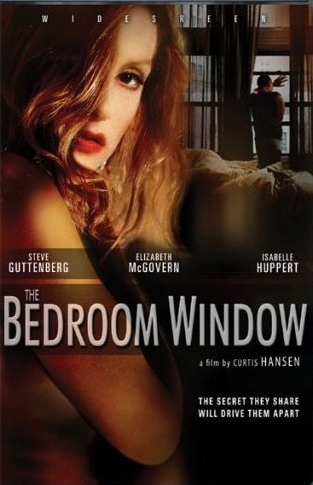
THE BEDROOM WINDOW [1987]
DIR: Curtis Hanson
CAST: Steve Guttenberg, Isabelle Huppert, Elizabeth McGovern


Looking at THE BEDROOM WINDOW as part of Isabelle Huppert’s career is perhaps the most interesting way to see this rather non-descript movie that is otherwise just one more not especially good generic 80’s thriller. The basic plot has Huppert’s character witness an assault while staying with her lover (Guttenberg, hilariously miscast), in order to keep their relationship secret from her husband (his boss) they report the incident to the police, after discovering that it may be connected to a murder, but say that Guttenberg was the witness. When the deception becomes obvious in court Guttenberg finds himself the prime suspect for two murders.

THE BEDROOM WINDOW is an interesting example of just how badly an actor, even one as good as Isabelle Huppert, can be hobbled by circumstance. She’s great casting as the femme fatale, but she’s hamstrung by Curtis Hanson’s very stagy dialogue, by her own still slightly broken English and by the lumpen performance given by Steve Guttenberg (smirk still firmly in place between POLICE ACADEMY movies), which gives her little to play off. Credit to Huppert though, because as the movie runs on, she’s the one aspect that gets better. She gets more and more comfortable in her character’s skin as she becomes harder and colder, and by the hour mark she’s giving a performance a good deal better than the film deserves.

Unfortunately the rest of the film fails to engage. Guttenberg is flat out awful; he looks baffled much of the time (even when he’s not supposed to), clearly completely out of his depth here and imbues his performance with all the charisma of an end table. Elizabeth McGovern, as the assault victim, is better, and probably the most consistent performer here, but her efforts are also undone by the fact that the plot ends up reducing her character to bait in a very flat ending.

Hanson’s direction is uninspired at best and the uneven, often bored seeming, performances suggest a very loose grip on his cast. The visuals aren’t a great deal better; pedestrian outside the early sequence in which Huppert witnesses the key assault and one or two shots that nod rather explicitly to Hitchcock. THE BEDROOM WIMDOW isn’t a good film, but it is an interesting one as an Isabelle Huppert fan, it’s really the only true genre film she’s made, and suggests that she’s ill at ease when boxed in by such conventions.

Aug 26, 2010

September: The Greatest?

Martial Arts Month is winding down, and despite getting sidetracked when I was under the weather, it's been fun and I think we've covered a lot of interesting films (and there are a few more to come, including SCOTT PILGRIM VS THE WORLD and a couple of Sammo Hung films). I'm going to attempt to run a special series every month, so here's September's


In September I'm going to try to answer, for myself, the question of who is the greatest working actress. Now I can't spend the whole month going through contenders, I'd never watch enough films for it to be a fair choice. But that's not really a problem. To me it is pretty clear that there are only two real contenders.

From France there is Isabelle Huppert. She's 57 years old, and next year marks her 40th anniversary as an actress. She first came to notice in the mid 1970's, and though she's not especially famous otside of France she's generally regarded as one of the world's finest actresses, and works constantly on film and on stage.

From America there is Jennifer Jason Leigh. A decade younger at 48, she's currently in her 30th year as an actress, and first gained acclaim at 19 as an anorexic teenager in TV Movie THE BEST LITTLE GIRL IN THE WORLD. She's an acclaimed actress, hugely respected in the industry and famous for her incredibly detailed research for roles.

It's interesting to me that Huppert and Leigh have a lot in common. Both shun the limelight, giving only rare and often reluctant interviews, and both are extremely reticent to talk about themselves or their private lives (Huppert won't even confirm whether she is married, or her exact date of birth). Both, too, are breathlessly acclaimed by critics and peers alike, and neither has ever even been nominated for an Oscar.

So, I'm going to look at ten films featuring Isabelle Huppert and another ten with Jennifer Jason Leigh (it's a crying shame they've never worked together, but I guess I can dream). That will make twenty new reviews, and hopefully by the end of the month I'll have a better idea of just who really is the greatest actress working today. I'm going to enjoy September. I hope you will too.