Showing posts with label Star Wars. Show all posts

May 27, 2018

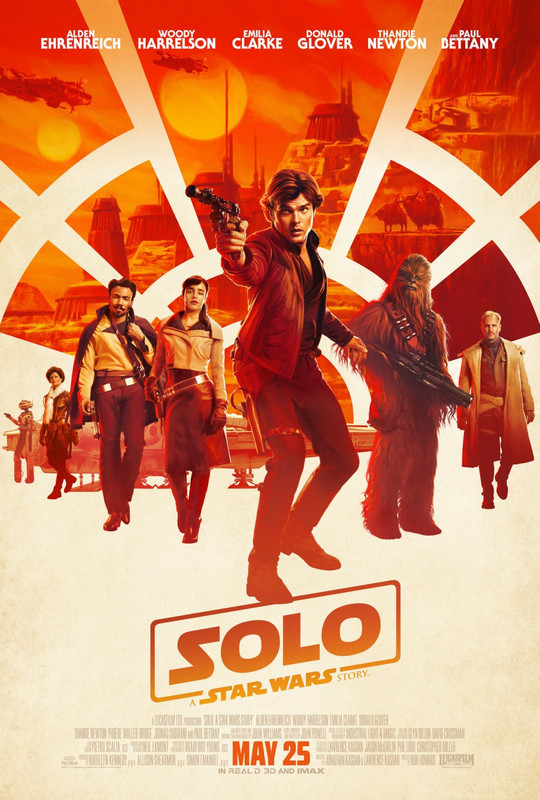
Solo [2D] [12A]

Dir: Ron Howard
I am of a generation that just missed out on seeing the original Star Wars films (in their original versions) at the cinema. When Return of The Jedi came out in 1983 I was two and by the time the Special Editions rolled around in 1997 I was turning sixteen and the films, while I’d seen them many times as a child, were already something I felt myself growing out of. It’s been a sense of duty as a movie fan, more than anything, that has kept me watching the films since the debacle that was The Phantom Menace in 1999. That sense of duty lapsed when it came to seeing The Last Jedi, but the first of the standalone Star Wars Story films, Rogue One surprised me by delivering a compelling side story with a tone different to that of the films in the Skywalker saga. Still, I was more curious than optimistic when it came to the prospect of Solo.

It has been no secret that there were serious bumps in the road to Solo. The film was to be directed by 21 Jump Street and The Lego Movie's Chris Miller and Phil Lord, but they were replaced after, by all accounts, a substantial amount of the film was theoretically completed. It seems the tonal approach they were going for was deemed too far against the grain for the Star Wars brand and Ron Howard - a fine director, but a reliable pair of hands more than he is an auteur - was brought on board. Howard is said to have reshot around 70% of Lord and Miller's material, but that's not to say the film is 30% theirs, as Howard and his team added and altered characters and shot material unique to this version. We'll likely never know what this film might have been, but that's beside the point, let's consider what it is.

Solo picks up with Han (Alden Ehrenreich) as he and his girlfriend Qi'ra (Emilia Clarke) try to escape from their lives as pawns of a criminal gang on Corellia. Han manages to get away, but Qi'ra is captured at the last minute and he vows to get back to her. Three years later Han, wanting to become a pilot, has found himself conscripted into the imperial army but sees another chance to escape and get back to Corellia when he meets Tobias Beckett (Woody Harrelson) and his crew of smugglers. When things go wrong the crew are indebted to Dryden Vos (Paul Bettany), who insists they repay him by taking on a dangerous mission and take along his right-hand woman - Qi'ra.

There is a fundamental challenge in prequels, one that is all the more acute with a series as iconic as Star Wars. Practically every film fan who is in their late 40s or younger grew up, to some degree, with Star Wars. Almost every one of those fans will have placed themselves in the roles of their favourite characters and many of them will have imagined where those characters came from, who they were before we met them. In a lot of ways, Solo is fighting a losing battle from the get-go. If, for instance, they didn't assume it was his given name, fans will have had their own ideas about how Han came by his name, and I bet 99 percent of them were more satisfying than the version we're shown here. The question is so much more interesting than the answer, and that's something the film comes up against time and again.

The other issue with prequels is that they are inherently low stakes. We know there is no actual peril, that things have to go a certain way in order to put us in a position to find the character where we meet them in the films we've already seen. We know how their personality will change, we know who they are going to encounter and how those relationships will play out, we even know exactly how certain events will play down to small details (ask a Star Wars fan about how Han's Kessel run worked out). We know, eventually, we're destined for square one (though this film, to make room for sequels, ends with us on square minus one). For much of its running time, Solo manages its way around these inherent challenges. It's following the formula, it's taking few risks, if any, but it's largely amiable fun. 

You have to feel for Alden Ehrenreich, he's been handed an almost impossible task. Replacing Harrison Ford as Han Solo is about as poisoned as chalices come. If you do an impression and do it well, then all you're doing is an impression, do it badly and you're insulting an iconic performance. Go your own way and even if you're great, you're just not 'Han'. To his credit, Ehrenreich walks this line as well as anyone possibly could. He captures the flavour of Ford's Han without copying him, he has a few moments where he leans in to something close to Ford's voice, but again he never takes it to a place of doing an impression, it's more in the cadence, a hint of Ford's inflections. On his own merits, Ehrenreich is good,  convincing as a roguish character who is generally looking out for number one, but would prefer to basically be one of the good guys along the way. He nails the tone and hits the humour without winking at the audience while proving a charismatic anchor for the film. Where he really convinces as Han is in the relationship with Chewbacca (former basketball player Joonas Suotamo inheriting the hairy suit from Peter Mayhew), which we see the founding of here and which immediately settles in to the dynamic familiar from the original trilogy.
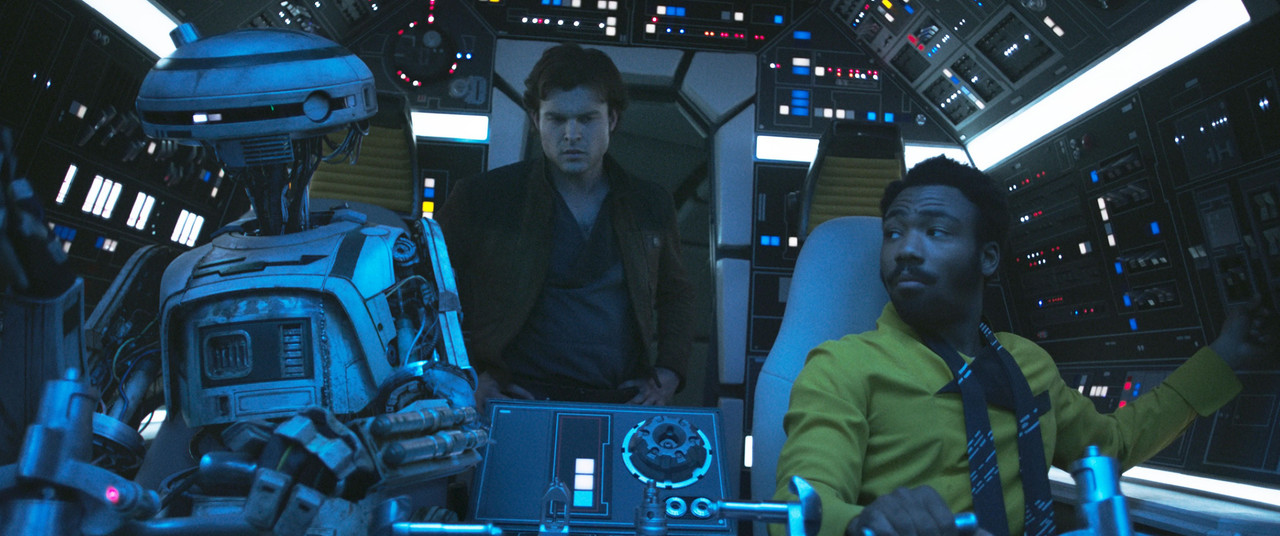
It is perhaps appropriate, given their characters' relationship, that Ehrenreich ends up having quite a few scenes stolen from him by Donald Glover as the young Lando Calrissian. His scenes are probably the film's best, he charms the audience as effectively as he does many of the characters. Also stealing most of his scenes is Paul Bettany, cast by Howard in a role that was apparently filled by a different character altogether (played by Michael K. Williams, who couldn't return for the reshoots) in Lord and Miller's film. His bad guy turn as Dryden Vos is fairly one note, but Bettany plays it with richly apparent relish and gets to take part in the film's best fight. 

Ron Howard keeps proceedings moving, executing the action sequences with the assurance you'd expect. The thing is, Howard doesn't seem to bring much that is individual to the table. The look, the tone, the blend of elements, it's all very safe, very Star Wars. It contributes to the feel of Solo as a content delivery system rather than anything particularly interested in finding its own way within an established world. It's never dull, but even in its best moments, Solo fails to do anything that would grab us and shake us. It never makes us look at an established character differently, nor does its own smaller scale and smaller stakes narrative do anything to truly surprise us.

Perhaps the least 'Star Wars' thing about Solo is Woody Harrelson. His character name - Tobias Beckett - sounds more like the posh kid you went to primary school with than it does a Star Wars character and, while his performance is fine, he doesn't do anything more than play Woody Harrelson. Emilia Clarke's godawful acting is one of the main reasons I haven't watched Game of Thrones beyond the first season. She's improved a bit from that and her disastrous turn in Terminator: Genisys, in that she's not distractingly bad here, but she's also not especially good. She and Ehrenreich have little chemistry and Qi'ra's character development falls flat because that's how Clarke plays everything. Better, but underused, is Thandie Newton as Val, who does convince us of her character's history with Beckett, giving us one of the film's very few emotionally charged moments in the middle of an early action setpiece. I can't decide where I stand on Lando's droid co-pilot, L3. Phoebe Waller-Bridge does a great job with what she's got; she's funny and engaging from the off, but the social commentary the film uses the character for is clangingly unsubtle (which isn't to say it doesn't make sound points). This is the element of the film that seems most likely to have come from Lord and Miller's work - it's not bad, but just feels oddly out of step with the film around it.

The word that comes to mind when I think about this film is 'competent'. It delivers. The action is fun, the comedy largely plays well, the actors give their best and are generally doing a solid job. Bradford Young's cinematography keeps the film feeling like it belongs to the same universe as the others while throwing up some striking images. Towards the end of the film it seeds an interesting idea (no, not THAT twist). It does all this and yet, it all feels inconsequential. This is a film that exists because audience analysis suggested it would be a good idea, financially, if it existed. There's no sense that it adds anything to our understanding of Han or the Star Wars universe, it's hard to invest because we know going in what's likely to happen and which characters are likely to matter in the long term. If you want to know what happened to Han Solo before A New Hope then this could have been a lot worse, but it still, fundamentally, feels less interesting to know than to wonder.
★★★

Dec 23, 2015

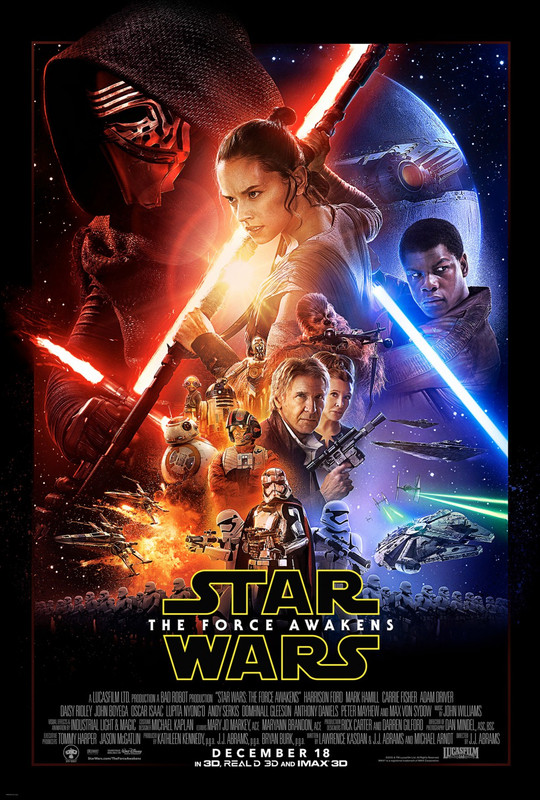
Star Wars: The Force Awakens [2D] [12A]

Dir: JJ Abrams
I'm not a big Star Wars fan. Like most movie lovers born post 1977 I did, to some degree, grow up on the original trilogy, but these days those films - much as I respect The Empire Strikes Back - hold little importance for me. The relationship I had to them last time I saw them was like meeting an old primary school friend for the first time in twenty years and realising you don't have much to say to each other anymore. It's not that they're suddenly bad films (well, except Jedi, though I reject the word 'suddenly' there), but they have no great relevance to me any more.

Given this, I was entirely ambivalent about seeing The Force Awakens; the seventh chapter of the saga and the first to be made without any input from franchise creator George Lucas. Ultimately I saw it because it was the screening that fitted into my day at the cinema.

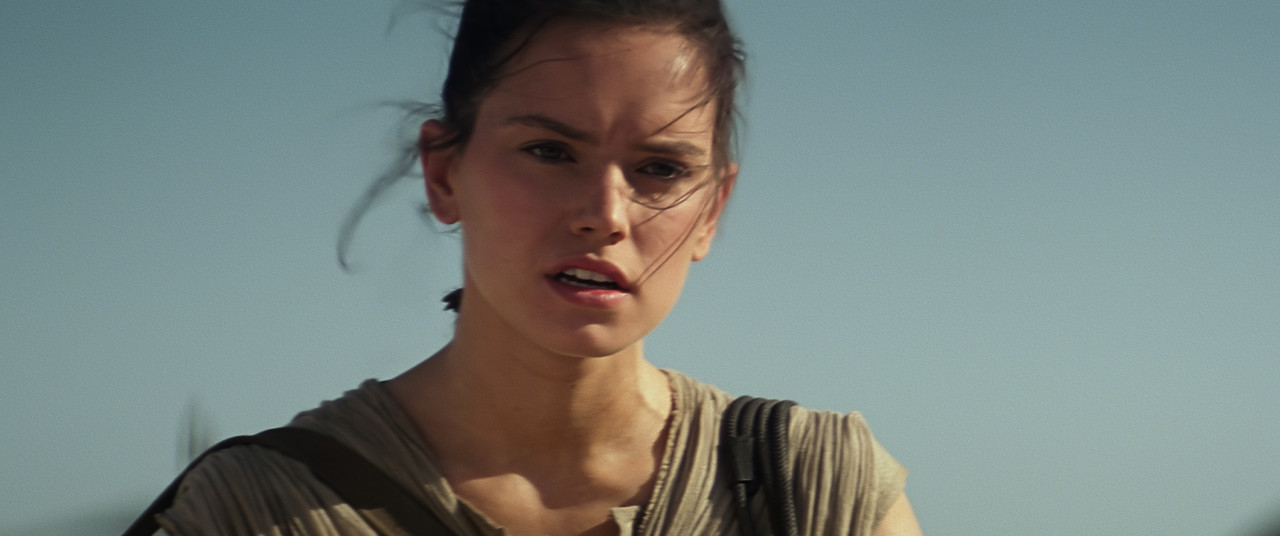
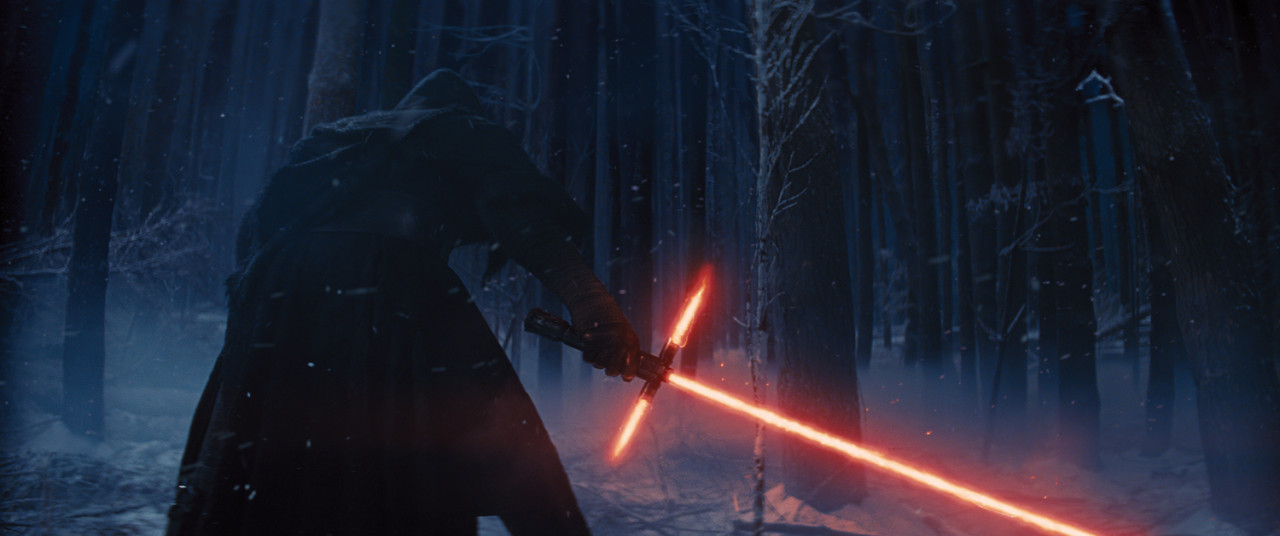
The film picks up 30 years after the events of Return of the Jedi. Luke Skywalker is missing, presumed (in some quarters) dead and a new power; The First Order has risen in place of the Empire. Early on a stormtrooper, soon renamed Finn, (John Boyega) abandons his post and he, a scavenger named Rey (Daisy Ridley) and a droid called BB-8 become targets for Kylo Ren (Adam Driver), the most powerful Jedi in the First Order. This throws them into an adventure that also involves many of the characters from the original trilogy.

The good news is that if you're a Star Wars fan then I imagine that The Force Awakens is everything you'd ever dreamed it would be and then some. At the very least, even for a non-fan like myself, this is largely a very entertaining and engaging film, one that deserves to sit near the top of the pile in the franchise. It is, however, flawed in a lot of ways.

Let's start with the good stuff, because for the first time in the recent history of the franchise, there's plenty to say. The film gets off to a flying start. Minutes in we get our first glimpse of the First Order in action, with Kylo Ren and chrome suited Stormtrooper commander Captain Phamsa (Gwendoline Christie) established in short order as a credible and serious threats. All of the new characters are introduced well, with Boyega's conflicted Stormtrooper immediately signaling something more morally interesting about this entry. In a franchise that has often tended to draw good and bad as two sides of a coin, the moral uncertainty of this character, and perhaps another, is solid new ground to tread.

After the text crawl (no mention of taxes), the film is on rails for a while. The first 45 minutes are breathless. Abrams introduces new characters quickly, trusts us to read their place in the film's world, and spends more time giving them at least a semblance of depth than setting the pieces. The action also flows well during this time, with large scale scenes like the opening first order attack complemented well by smaller beats such as Rey and Finn's first meeting. 

By this time we've already established that Rey has been fending for herself in the deserts of Jakku for some time, but here we also see that she can fight and we soon learn that she is also skilled with machines and can fly a spacecraft. This combination of skills has led some to see Rey as a Mary Sue. I've always seen this as describing a character with little or no personality who magically saves the day and is there as a blank for the audience to pour themselves into in place of a main character with actual traits. These characters are prevalent in YA cinema, but Rey is not one. Her strength and intelligence come through in Ridley's performance from the off, and her growth in confidence is both organic and well played. Her saving the day on Jakku comes across as something she digs into herself and finds the resources and confidence to do. That is a plot point, of course, but her growing abilities add to her character rather than serving as a replacement for it. Her very growth is also how she's no Mary Sue. They don't have to grow at all; the story already thinks they're perfect.

The best part of both this first act and, for much of the running time, the film as a whole is the chemistry between Boyega and Ridley. Boyega has a magnetic screen presence and as Finn grows in character the mutual connection between him and Rey becomes more powerful and better played with each scene. I found myself invested in their friendship and in the way it grew through the action. To go into much of this would be to stray into spoiler territory, but I love the way the plot turns towards the end of the film, definitively away from any damsel in distress trope.

Adam Driver (and his costume designer) manage a menacing turn as Kylo Ren, which Driver sometimes, fascinatingly, turns into an immature petulance which is frightening in a different way than Darth Vader ever was. Vader was all control, Ren might fly off the handle at any time and that makes him a true threat. 

However, not all of the new characters work. Captain Phasma, cool as she looks, is sadly underused and almost literally tossed away in the third act and Lupita Nyong'O's Maz Kanata, while no Jar Jar, is a rather weightless CG creation and exists only as an expository prop, otherwise a rare quality here.  The true disappointment comes from two of the other lead villains. The all CG Supreme Leader Snoke (Andy Serkis) is by far the film's worst effect, and holds little character or menace, while Domhnall Gleeson, as General Hux, pushes the boat out so far in his Nuremberg inspired speech that for me he inspired sniggers rather than unease.

When it's forward looking, seeking out the future of the franchise, The Force Awakens counts as one of my better and bigger surprises of 2015. Less so when it looks back. In a way it does this constantly; the shape of the film is so close to that of A New Hope that it sometimes feels like a remake. However, it's when the film really starts trying to hit the nostalgia buttons that, for me, it loses something. 

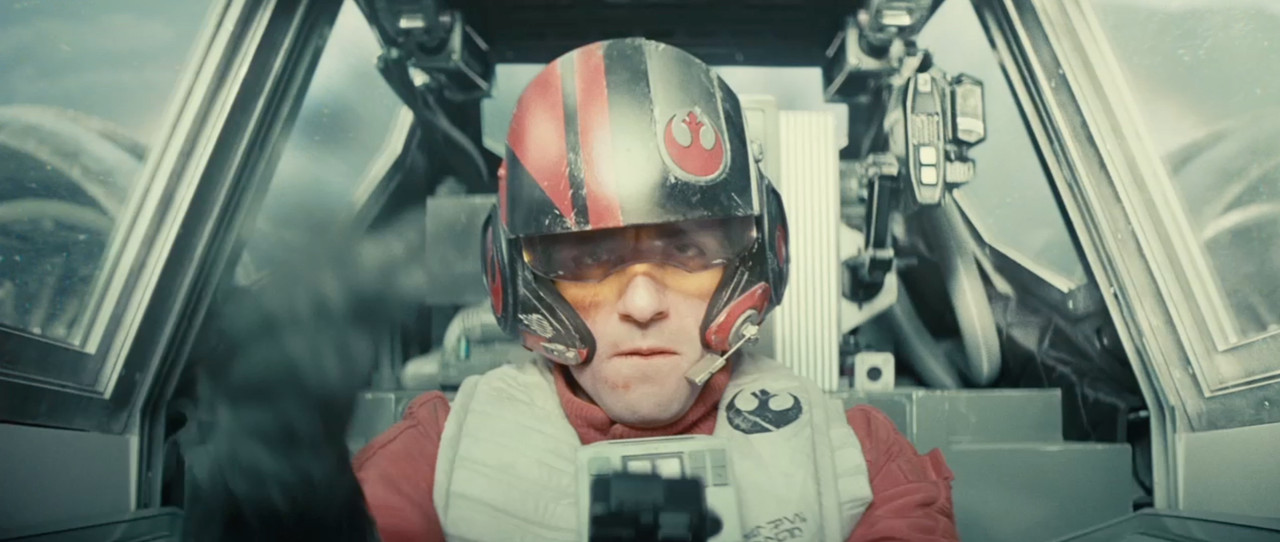
Harrison Ford's Han Solo has by far the most screen time of any of the returning characters. Ford has seemed, for some time now, to be tired of the film business and to be in it solely for the clearly absurd amounts of money. He's more animated here than he's been for a while, the character fits him like a rumpled suit and that, along with the weariness we sometimes feel from him, works for Han. What works less well is his introduction, which gives us a long setpiece that goes nowhere and never pays off, it seems only to be there to give the leads of The Raid a cameo. Han's scenes also lean a bit hard on the callbacks (as does much of the stuff with the old characters), though never to an extent that would exclude newcomers. Having Han and the other old characters does serve to accentuate just how closely, almost beat for beat, the film hews to A New Hope, and over 30 years you'd have hoped to see perhaps a little more evolution in Han and Leia (a returning Carrie Fisher). A plot twist I can't give away, though it's not at all unexpected, adds a little depth and gives us an outstanding scene late in the film, but otherwise I found Han and Chewie much less engaging than the new characters, especially now that we have Oscar Isaac, in a charismatic turn as heroic pilot Poe Dameron.

The similarities to A New Hope become problematic in the third act. The final dogfight scenes, impressively realised though they are, feel like we've seen them before, so similar is the goal and even the methods to those we saw in Episode 4. I found myself groaning inwardly every time we cut away from Ren, Finn and Rey to go to the aerial battle. 

JJ Abrams largely does a good job behind the camera. Usually I might say that a director failing to stamp his visual authority on a film was a problem, but in Abrams case it's a blessing, His beloved lens flare, which so marred Super 8 and both his Star Trek films, is almost entirely absent here, instead he surrenders to the look of the world of Star Wars. I always felt that the series' best aspect was the production design, and The Force Awakens is no slouch in that department, weird and wonderful creatures abound and the costume design, especially the intelligent updating of the Stormtroopers and Kylo Ren's instantly iconic mask, is superb throughout. That said, I'm not sure why people are going so nuts about BB8, it's just R2D2 crossed with a beachball. Abrams only drops the ball occasionally, but the slowdown of the second act, especially the long interlude with Maz Kanata, is disappointing after the relentless first 45 minutes. There are probably ten minutes that could be tightened here to bring the film, pre credits, under two hours.

Abrams seems acutely aware of what the fans will want and he goes out of his way to try to give it to them, both in what he includes and what he excludes. The slapstick comedy of the prequels and the dramatic tonal shifts it caused are largely absent. There's no equivalent to Jar Jar Binks, no discussion of trade routes and blessedly limited exposure to C3PO (though he is still teeth-grindingly irritating when he appears). I think he's achieved what they will want him to have achieved, and that's all you can ask of him, other than a closing shot to send shivers of anticipation up their spines. He's also got that.

For me, The Force Awakens isn't a triumph, but it's a lot better than I expected and the best entry in the franchise bar The Empire Strikes Back. I think its flaws feel deeper for me because Star Wars just doesn't mean to me what it does to many people. Feel free to add a star to my grade if it does to you (I came close to doing so myself). I do, however, understand what fans see in this film. Much of it is a great entertainment and more than that it respects the series and the people who love it. The Indiana Jones series is for me what Star Wars is for the crowd this film is for and so I'll close with this: If Indiana Jones and the Kingdom of the Crystal Skull had recaptured this much of what was good about the original trilogy, I'd have been ecstatic.
★★★

Sep 19, 2013

Star Wars Week: Day 3

Episode 3: Revenge of the Sith
Dir: George Lucas
Buried somewhere in the wreckage of Star Wars Episode 3 there is a good movie struggling to get out.  It's a film that deals in how a previously good man is lured by lies, arrogance and the failure of his friends to embrace evil in service of a cause he is misguided to see as noble.  It's a film packed with high stakes action that pits friend against friend.  It's a film that engages with politics, taking a nuanced approach to look at how evil can be presented as a rational choice.  It's not the film I just watched.

There are a variety of reasons that this is the case, but many can be traced back to the fact that the groundwork laid in the first two entries in Star Wars' prequel trilogy is so poor that even though this is in many ways a much better film, it is still almost fatally hobbled by earlier poor decisions (well, that and George Lucas continued vacillation from bald exposition to laughably bad 'serious' dialogue).  As I said in the Episode 2 review, Anakin's journey to the dark side in that film comes off as a teenage strop (something that even the supposedly darkest moments of this film also suffer from, thanks to the terrible dialogue and delivery), and that means that when he goes to darker places - like murdering a temple full of children in cold blood - I just don't buy it.  Of course this is also due to Hayden Christensen's laughable performance, in which he mistakes scowling and talking through his teeth for a deep darkness of the soul.

It's a pity that the writing and performance so undermine the story, because for all the criticism you can level at George Lucas as a writer, the overall shape of Episode 3 isn't bad.  He sets up the way that Anakin is drawn to the dark side - through promises that he can gain the power to save Padme, who is now pregnant, and whose death in childbirth he has been seeing in his dreams - in reasonably convincing fashion, benefiting from a reptilian, if sometimes overly campy, performance from Ian McDiarmid.  The muddy sense of good and evil is also a potentially interesting avenue, but again Lucas' schematic writing strips it of effect and bludgeons you with the point (Anakin whining "From my point of view the Jedi are evil").

Another way that the earlier films conspire against this one is seen in Obi Wan's story, as he is sent to pursue General Greivous, leader of the droid army.  Greivous is a new character in this installment, and thus he carries little weight, had Lucas not killed off Darth Maul in so perfunctory a fashion in Episode 1 this storyline could have had real purpose in terms of Obi Wan's character arc; killing the Sith that killed his master rhyming thematically with the loss of his apprentice to the dark side, but instead we get to watch Obi Wan chase an asthmatic (?!) robot across the galaxy in an arc that seems designed merely to keep him out of the way.  Also shunted to the side, after showing some ability to kick arse in the previous film, is Natalie Portman, whose role this time is merely to be pregnant and look winsome.

As I said though, the overall shape of the film works, and though details clunk (Padme dies of dramatic irony, C3PO's memory is wiped in a retcon that shows how little his presence adds to the prequels beyond fan service), Lucas does manage to draw together a lot of very disparate strands in a way that leads somewhat naturally into the original trilogy.

Individual sequences also work well, some even brilliantly.  Order 66, which sees the clone armies turn on the Jedi, is executed in grand scale, with a montage of death that is almost Godfather-esque (yep, I went there).  This is when the enormity of the power of Palpatine and the Sith hits home and when, for all the terrible elements, the plodding setup of the first two films does pay off to some degree, because it's when you can see just how meticulous and long standing Palpatine's plan has been.  The other great sequence is the battle between Obi Wan and Anakin, again, It's easy to wish the setup had been better, and the one tone backdrop of a planet that seems to be entirely lava can be rather dull, but the fight itself is great.  McGregor and Christensen throw themselves into it; it's fast and exciting and varied enough that it can sustain a ten minute plus running time.  This sequence also features some of McGregor's best acting work in the series, you believe how broken Obi Wan is to see how deeply he has failed.  Unfortunately the other side of these moments features Christensen at his worst, the scream of "I hate you" should come loaded with so much baggage, but it still just sounds like a six year old kicking his toys at his Dad.

Once again though, for every thing that works, several don't.  Many potentially good scenes are marred by awful dialogue and performances.  Take the scene in Palpatine's office that is the real birth of Darth Vader, in which Ian McDiarmid's hissing villain goes from subtly playing on Anakin's weakness to full on panto villain in seconds.  It doesn't work, and when I was supposed to be feeling foreboding at the birth of the Emperor, I was in fact giggling and trying to decide which of the digital effects on his face or McDiarmid's performance were the lowpoint of the scene.

Let's imagine for a moment that Episode 3 were just about perfect; that Christensen came into his own and oozed menace, that the romantic dialogue between him and Portman made you believe in and root for that relationship, that the action and the politics were perfectly balanced.  All that could be true, and the first moment we see Darth Vader in his iconic costume would still ruin the film.  The first problem is one of size.  Vader is an imposing figure, but here he looks tiny, as if the scene had been shot with a toy, but the crowning embarrassment - the moment that sums up the way that the prequel trilogy as a whole shits on the legacy of the first three films - is when Vader lurches from his shackles and shouts "NOOOOOOOO".  In this moment the betrayal of one of the coolest villains in cinema is complete, the prospect of him ever being menacing removed.  Even as someone who isn't a huge Star Wars fan, watching this moment is like watching the death of my childhood.

So yes, this is the best of the Star Wars prequels, but that's really an all but meaningless standard, and by any other standard it's not a good film.  There is a good film somewhere in the prequels, but it's buried under a mountain of bad decisions, and a system's unwillingness to tell George Lucas that you can write this shit, but you sure can't say it.

Sep 17, 2013

Star Wars Week: Day 2

Episode 2: Attack of the Clones [PG]
Dir: George Lucas
On the one hand, Star Wars Episode 2 is a big improvement over its immediate predecessor.  On the other hand, how many films are worse than Star Wars Episode 1?  I doubt you have to be able to count much higher than my 4 year old niece can to tell me.

Attack of the Clones picks up the story a decade after the end of The Phantom Menace, and finds Anakin (Now played by Hayden Christensen) as a brilliant but disobedient student to Obi Wan Kenobi (Ewan McGregor).  Former queen Padme Amidala (Natalie Portman) has served her two terms in that position (because, again, that's how monarchy works) and is now a senator (appointed by the new queen, rather than elected, because that's how democracy works).  There have been several attempts to assassinate Padme, so Obi Wan and Anakin are tasked to protect her, with Obi Wan pursuing a bounty hunter and Anakin staying with Padme as security.  Obi Wan discovers that armies - one of droids and one of clones - are being built by opposing factions in what seems likely to become a civil war for control of the Republic, and raises fears that a Sith lord may be controlling events in the senate.

While an improvement over the previous film, Episode 2 does share many of its problems, especially in the far weaker first half.  When the film divides, one story following Obi Wan, the other Anakin and Padme, it essentially becomes two different films; one is actually reasonably entertaining and solidly structured, the other is tedious, features some of the worst dialogue you've ever heard, and eventually advances the plot in ways that simply don't ring true given the narrative.

Obi Wan's story is by far the better of the duelling Jedi arcs.  It starts with an investigative slant, as Obi Wan gets clues to where the bounty hunter came from, then searches out a star system that seems to have been deliberately hidden from the Jedi, before ending up in a pretty solid fight scene between Obi Wan and Jango Fett (Temura Morrison).  Ewan McGregor still has to contend with George Lucas' terrible dialogue, but he seems much more at ease than he was in Episode 1, and has grown into the character somewhat, rather than just doing Alec Guinness karaoke this time round.  It's by no means perfect, but it's an effective use of the character, and has a forward momentum that Anakin and Padme's story desperately needs.

The clue that the Anakin and Padme story is going to make painful viewing - and not in a good way - comes early.  When they are reintroduced Padme tells Anakin that he's grown, and he replies 'So have you, grown more beautiful I mean'.  This is just the beginning of the unintentionally creepy and supremely awkward romantic dialogue.  The romance between these two fails on so many levels, but it's made worse by the fact that you remember how wide the age gap seemed in the previous film. When Episode 1 was shot, Portman was 17 and Jake Lloyd 9, it's a reasonable assumption that the characters are the same age.  When Attack of the Clones was shot both Portman and Hayden Christensen would have been 20, and both look it, if anything Christensen looks older.  This makes the continuity strange, but I still can't get out of my head that the context that Padme knows Anakin in is as a little kid who had puppy dog eyes for her (his clanging 'are you an angel?' is one of the worst lines in the saga).  Even before you get into how creepy Anakin is and how badly the romance is developed it just doesn't feel quite right.

Of course during all this Anakin's turn to the dark side has to be developed.  Lucas has the character searching for his mother, which makes sense, and when he finds her, kidnapped and dying, Anakin slaughters an entire village.  It doesn't work.  This is because to this point the 'signs of darkness' have largely been that Anakin is a stroppy and immature teenager (there's a real Kevin the Teenager feeling when he say 'it's not fair' to Obi  Wan), and even with significant provocation like this you don't buy that he's far enough down a dark path to murder children in cold blood.  This further undermines the romantic angle, because he confesses to Padme - who has a real feeling of being representative of the side of good and light - and she seems to simply shrug it off.

Of course the screenplay and George Lucas' Tab A into Slot B approach to direction are largely to blame for how the Anakin / Padme storyline is alternately dull and laugh out loud awful (the abysmal 'I don't like sand' speech is perhaps the stupidest romantic dialogue ever written), but it's not as though Portman or Christensen help.  Portman is just as wooden as she was in Episode 1, plodding through the romance plot with little enthusiasm, but here she has the benefit of acting next to Hayden Christensen, who reads every line as if it's the first time he's seen words and has no care for inflection or emphasis.

The second half of the film brings the two storylines together on Geonosis, and things largely improve from here.  The dialogue still clunks, Christensen is still awful, and Padme's confession that she returns Anakin's love comes out of thin air, but there are compensating qualities.

The film's major setpiece finds Obi Wan, Padme and Anakin about to be executed in a coliseum on Geonosis, leading to a long and largely excellent action scene.  It's not perfect, the CGI that dominates almost every frame of the film is at its most prevalent in this sequence, and it can look unreal, especially as CGI ages, to my eyes at least, far worse than practical effects.  There are many creatures in the film that feel plasticky and many instances of characters not seeming that well integrated with the background (Obi Wan in the speeder at the start of the film), but despite these issues the coliseum action scene is well designed and shot.  The sequence has a solid structure, almost unfolding as a mini three act drama: first the three captives fight against the creatures set on them, then Samuel L Jackson's purple lightsaber wielding Mace Windu and his Jedi show up, then Yoda and the clone army end up saving them.  It's a strong build and throughout the action is frenetic but exciting, and you always have a sense of what is going on where.  The only major downside to this sequence is the irksome comic relief with a punning C3PO.

Of course the second half of the film isn't immune from being stupid for long.  The battle between Christopher Lee's Count Dooku and first Obi Wan then a dual saber wielding Anakin is, despite the odd ropy bit of CGI, pretty solid stuff, and the two lying injured would be a great image on which to segue to the film's rather dark wrap up, but no, for it is fan service time.  The ways in which Yoda fighting a lightsaber battle is stupid are too numerous to go into, but what really makes it irritating is how entirely pointless the sequence is.  It adds nothing to Yoda's character, and really only takes away from how broken the Jedi should be at this point.  It was cool for about 3 seconds at the cinema, but then you realise how idiotic it is.

On the whole, Episode 2 is much more of a mixed bag than the catastrophic Episode 1, but that's not the same as it being a good, or even really an average film.  The flaws are chasmic, the dialogue calamitously stupid, to the point that it undermines the story the film is attempting to tell, and while the film has a few strong moments, it never coalesces into something that is good as a whole.  It's a film made for judicious use of the fast forward button to get to those cool moments.

Sep 16, 2013

Star Wars Week: Day 1

I am, at best, a lapsed Star Wars fan.  I grew up on the films, and one of my first memories is figuring out that I needed glasses because I was sitting incredibly close to the TV to be able to see A New Hope.  We had the films on VHS when I was young, and I watched them a lot.

As I grew up I began to find Star Wars less interesting, first becoming bored with the more child oriented tone of The Return of the Jedi, and then, especially following the Special Editions, beginning to see increasing problems in the original film.

What really killed the series for me was Episode 1.  I was 18 when the film came out in 1999, and I had been looking forward to it, sure, I had drifted away from the series, but the trailer was great and I had never been able to see the original versions of episodes 4 - 6 in the cinema.  I admit, I got chills when the music kicked in.  And then... well, you know what happened.  That was 14 years ago.  Since then I've seen the subsequent prequels on their cinema releases (I didn't like them much), but otherwise I've not touched Star Wars in all that time.  

So, why revisit them now?

There are few series' of films with anything like the kind of audience love and following that Star Wars has.  These films mean so much to so many, and that level of devotion always makes me wonder, if I am not part of that fanbase, what people see that I don't.  After nearly fifteen years of essentially ignoring the franchise - though the original trilogy is burned into my memory from when I was a kid - I feel that I have an appropriate distance to look afresh at the series and to form a definitive opinion of where I stand on these films as an adult and as a critic, which I was really just starting to be when Episode 3 came out.

I'll be looking at the series this week, covering one film a day.

Episode 1: The Phantom Menace
Dir: George Lucas
It's never a good sign when within 20 seconds of a film starting it makes what seems like a massive miscalculation.  Consider the first two sentences of the opening text crawl of Star Wars Episode 4: A New Hope. "It is a period of civil war. Rebel spaceships, striking from a hidden base, have won their first victory against the evil Galactic Empire."  That sounds pretty cool; civil war; hidden bases; rebels against an evil empire.  Sign me up for some sci-fi action.  Now consider the opening two sentences of Episode 1's crawl.  "Turmoil has engulfed the Galactic Republic. The taxation of trade routes to outlying star systems is in dispute."  Taxation.  TAXATION?!  Have I walked in to the wrong film?  Why the blue hell is Star Wars talking about taxation (and trade blockades)?  That sounds exciting, right?  When you were playing with Star Wars figures as a kid surely you had them sit around and discuss tax policy.  It's not a good sign, and the movie delivers on this astounding lack of promise.

The Phantom Menace makes a two-pronged misjudgement of tone, at once skewed too mature for youngsters, with its endless political machinations and talk of tax and trade and too juvenile for adult fans, thanks to the twin annoyances of Jake Lloyd's Anakin Skywalker and Ahmed Best, hidden behind CGI, as Jar Jar Binks; a crude caricature who descends to near Stepin Fetchit levels of uncomfortable stereotyping.

There's no problem with making a political sci-fi film, even one that is concerned with the machinations of government, as this one is for much of its running time, but George Lucas is not the person to write or direct it.  Episode 1 is hardly The West Wing in space, rather Lucas' bald and expository dialogue, coupled with the determinedly monotone performances of the whole cast make these sequences incredibly boring.  There's a further problem if you don't already know the series, and haven't figured out the 'twist' about the identity of Darth Sidious, because without that foreknowledge even the supposed (but not very effective) sense of menace that should come from the birth of the Empire is totally absent, rendering these scenes even more tedious.

It's not just the political side of the film that is boring.  When Jedi Qui Gon (Liam Neeson) and Obi Wan (Ewan McGregor, doing a decent Alec Guinness, but not being allowed to act beyond that) arrive on Naboo they are stuck there by a deus ex machina that takes nearly an hour of nothing much happening to resolve.  Of course we have to be introduced to Anakin, but it feels so - ahem - forced.  This might be less of an issue if when we met him there was something even semi-competent about the way the character was written and acted, but unfortunately this is un film de George Lucas.  

Anakin is incredibly annoying, and Jake Lloyd gets the performance completely wrong.  Anakin is painted as smart (he built C3PO) and energetic, but Lloyd fumbles both of these basic traits.  To be fair to Lloyd, the fact that you don't buy Anakin's precocious intelligence isn't his fault.  Lucas simply tells us that he's a genius, but never really shows us.  C3PO is already the droid we recognise, and we never see Anakin work on him, nor do we see him build the podracer that figures in a key scene.  The fact we don't buy into Anakin's intellect is perhaps also down to the way Lloyd misses the mark on the character's energy.  Even when he's called upon to shout "Yippee" (which he is all too often), Lloyd delivers his lines as if he's coming round from an anesthetic.

The rest of the acting is no better.  Neeson tries, he can't get much out of Lucas' tin-eared dialogue, but there does seem to be some effort there.  Ewan McGregor is a legitmately great actor, as good as Neeson on their respective best days, but he too is hamstrung both by awful dialogue and by the fact he's shackled to the ghost of Alec Guinness.  Natalie Portman - a variable talent who seems to need strong direction - offers a monotonous drone of a performance in a dual role as Queen Amidala (who is elected, because that's how politics works) and her handmaiden Padme, the drone is on a different register as Amidala, but I suspect there may have been some post production work on that front, so it's hard to credit Portman for it.

The Star Wars films have always displayed a great visual imagination, and if nothing else Lucas has shown himself, in this series, to have knack for world building.  To be fair, much of the new design, especially Darth Maul and the half finished C3PO, is extremely cool.  I'm not a fan of CGI, nor some of the other design work (especially the laugh out loud funny Amidala costumes and make up and the younger version of Jabba, which still has little connection to the amazing puppet in Jedi), but Lucas does capably expand the universe in the visual respect.  

The problem is that there is nothing to engage with beyond the creature design this time.  The main plot is insanely dull, the Jedi plot is stuck in neutral for a good hour (bar the podrace sequence, a boring - if competently executed - scene that seems shoved in because Lucas realised he needed some action) and the sense of a building threat that should come from Darth Maul never does, because he is such a muted presence; anonymous despite his striking look.  When Darth Maul does finally, blessedly, pay off it results in the film's one legitimately decent scene; the three way lightsaber fight between Maul, Qui Gon and Obi Wan.  It's well choreographed and executed, and it's incredibly irritating that Lucas cuts away for minutes on end to the wacky adventures of Anakin and R2D2.  However, in this film every silver lining must have a cloud, and Lucas manages to end that battle in absurdly brief and anti-climactic fashion.

Star Wars Episode 1 is a boring, stupid, annoying, badly written and acted piece of work.  The tone is totally miscalculated, and the attempts to combine the serious and silly sides of the franchise simply don't work.  Had this actually been the first film in a series I would never have had to do a Star Wars week, because it would likely have been - rightly - rejected and forgotten.  To be fair to Star Wars fans, I know that most of what I'm saying about this film won't be very controversial, and that even people who love the series will not often stand up for this film.  I'm just glad that Star Wars week has already hit its low point.