Showing posts with label Netflix. Show all posts

Feb 20, 2022

Texas Chainsaw Massacre [2022]


Dir: David Blue Garcia
Like many things, horror franchises move in cycles. Occasionally, individual films start trends, but further franchise entries tend to be trying to catch up with them. The original Texas Chain Saw Massacre wasn’t so much a trendsetter as something that the films that came in its wake—very much including most of the eight various sequels, remakes and reboots—tried and failed to recapture the lightning in a bottle feel of. Tobe Hooper’s film was a nightmare to make; the set and costumes reeked, the set wasn’t especially harmonious, Hooper was a real taskmaster, and the dinner sequence was a more than 24 hour shooting day purgatory. As well as the grain conferred by a low-budget 16mm shoot, the film has an air of madness about it; a feeling of a waking nightmare that bleeds into every frame. Texas Chainsaw Massacre 2022, on the other hand, is a glossy-looking Netflix movie.

TCM 2022 is also chasing a trend, for legacy sequels, and most prominently the template set by Halloween 2108. The plot isn’t well developed, but as far as I can figure out chefs/influencers Melody (Sarah Yarkin) and Dante (Jacob Latimore) have bought the entire, almost totally deserted, town of Harlowe, Texas, and are arriving there to set up (apparently with about seven minutes to spare) for a busload of investors to come in and lease space from them to turn it into a tourist hotspot. Along for the ride are Dante’s girlfriend Ruth (Nell Hudson) and Melody’s sister Lila (Elsie Fisher). Soon after arriving, they find the local orphanage is still occupied by an old woman and her adult ‘son’. No prizes for guessing who the son is. The only real background we get on any of the characters is that Lila is a survivor of a school shooting, and thus very uncomfortable when, stopping for gas, the group sees a man with a large gun strapped to his waist, Of course, he turns out to be their contractor in Harlowe, Richter (Moe Dunford). 

Despite the lack of much story, Texas Chainsaw Massacre does seem to want to say something. It’s as confused here as in other areas. It seems to be against Melody and Dante coming in and buying up the town, perhaps trying to criticise gentrification, but if that’s what it wants to do the commentary might be more effective if they were turfing out more than the last two people from what is otherwise a ghost town. It mocks social media a little but doesn’t show that it knows anything about influencer culture. We never see anything of Melody and Dante’s content, nor is it really explained why that content makes Harlowe a place they think they could do something with. You have to wonder just how popular they are because I’d question whether even someone with as powerful a following as Kim Kardashian could pull off what they seem to be attempting here. 

What throughline there is to the film’s attempt at a message seems weirdly right-wing. The  “You’re canceled” joke, which works no better here than in the trailer, is a lazy trope of right-leaning ‘wit’, but what is truly distasteful is the way the film plays Lila’s backstory. Lila’s journey is one of not just losing her fear of guns but re-embracing them in the wake of her traumatic experience. It leaves a horrible taste in the mouth and gives the whole film a reactionary feel that, while not quite as bad, recalls last year’s odious Run Hide Fight.

Terrible and badly communicated as all this is, I do realise that suspect politics won’t be the main thing that people are coming to Texas Chainsaw Massacre either to see or to criticise. At just 73 minutes pre-credits, the saw has to rev up pretty quickly this time, dispensing with character beats to favour set pieces. On the plus side, at least there’s no messing about in getting to the meat of the film. On the other hand, this haste undermines its interest as a legacy sequel. For as much as it got wrong David Gordon Green’s Halloween did at least devote considerable time to re-establishing and letting us understand where Laurie Strode had ended up. If those beats were there for Sally Hardesty (Olwen Fouéré, doing a decent enough job subbing for the late Marilyn Burns) they have hit the cutting room floor. There’s no insight into what she’s been doing for 45 years or more and less (beyond ‘the film’s not long enough’) into why she doesn’t take several chances she has. There is really no reason for both Sally and these random kids to be in this story. If it’s to be a legacy sequel, then there is something to be made of a weary Sally following one last lead to finally destroy this monster. If you want Leatherface to kill Gen Z Tik Tok users… fine, I guess, but I’m not sure that’s the same movie, especially at this running time.

To give director David Blue Garcia some credit, he came into a difficult situation with this film, replacing the original directors with a week of production already completed. I’m not a fan of the look of the film overall, especially the teal and yellow palette that he and cinematographer Ricardo Diaz arrive at for the entirety of the third act, but there are a few memorable images here, most strikingly Leatherface rising from a field of dead sunflowers. While the original film famously implies almost all of its gore, it’s fair to say that the rest of the franchise has been defined by excess in that area, and you have to hand it to this iteration; it goes for broke and doles out some memorably bloody carnage. While the way the bus sequence starts is a disaster, there are also some brilliantly gross moments as Leatherface chops his way through to the fleeing Melody and Lila, and the showdown with Sally is equally brutal (so much so that a later moment is total nonsense).

Character, as mentioned, isn’t the film’s strong suit, and that’s a pity because with a more robust script I could imagine this cast working well. In the brief preamble, though the dialogue clunks, the dynamic is convincing enough, and Yarkin and Fisher both have strong Final Girl energy about them. The problem is that film lacks either the will or the space to develop them enough for that to be something we can really hang on to. 

Like most of the other Chainsaw films, this one is never scary. In this respect the original works because the atmosphere simply drips with oppressive terror, while in Hooper’s sequel that’s gone, but I like and care about Stretch and, to a degree, Lou enough to be worried about what happens to them. Neither of those things is present here. The gloss of the way it’s shot strips away any real atmosphere, and there’s no opportunity to know the characters enough to care whether they live or die, so it’s not scary. For some, the simple thrill of the gore and the pace at which the film comes at you may be satisfying enough. That can be a lot of fun, but when you’re attempting, for at least the third time, to directly follow up one of the most uniquely terrorising films ever made, this just doesn’t… ahem… cut it.
★½

Sep 10, 2021

Kate


Dir: Cedric Nicolas-Troyan
Kate (Mary Elizabeth Winstead) has been trained as an assassin since she was a child. During a job in Osaka, she kills a man in front of his teenage daughter. Feeling guilty, she tells her handler, Varrick (Woody Harrelson) that she wants out, but there’s one more job to finish. During that job, Kate is poisoned by the yakuza and, with less than a day to live, goes looking for vengeance.

I like Die Hard 4.0 [aka: Live Free or Die Hard] more than most, sure, it’s barely a Die Hard movie, but I like it on its own merits as a big, stupid action film. Since I first saw it though, I’ve always thought it could have done more with Mary Elizabeth Winstead’s fierce performance as Lucy McClane. Happily, in the past couple of years, Winstead has started to capitalise on the potential I thought she showed as an action star, first in Gemini Man, then as Huntress in Birds of Prey and now as Joan Wick… sorry, Kate.

Kate is a patchwork of old ideas. The story takes classic noir DOA’s premise of a person investigating their own murder and ties it to a revenge actioner, with shades of Leon in the relationship that eventually develops between Kate and the mobster’s niece (Miku Martineau) she kidnaps for blackmail purposes. It’s all extremely obvious and pretty much the entire audience will be able to call the final villain from very early on but, as with so much of the genre, the story is really just a skeleton on which to hang the action.

To his credit, Cedric Nicolas-Troyan (The Huntsman: Winter’s War) delivers a kinetic and colourful film that keeps you on board through sheer momentum, never really giving you time, in the moment at least, to care that the plot is threadbare and that Kate has approximately two traits where you’d hope a character would be. While it’s clearly shot on location, the Tokyo setting is largely set dressing rather than something the film feels particularly embedded in, but that set dressing often looks pretty spectacular, from a geisha house that hosts the film’s first, and probably best, fight to the car that Kate steals which, the second she turns it on, lights up with neon and blasts out Japanese rock band Band Maid’s Blooming (the band also appear, playing a different song, in a concert scene). 

Most of the action is very good, which shouldn’t be a surprise with John Wick 3 and Birds of Prey stunt coordinator Jonathan Eusebio playing the same role here and serving as second unit director. Though Winstead is clearly doing a good amount of her own fighting, and is largely excellent at it, credit should also go to her double, Elisabeth P. Carpenter. The action, for the most part, is dynamic and bloody. The aforementioned geisha house sequence sees Winstead ploughing through an array of yakuza, largely with knives. It feels indebted to John Wick and The Raid, but also, in the way it uses blood splatter, particularly at the end of the sequence, to Japanese action films. The only exception to this trend of good action sequences is a glaring one; a penthouse set fight in which everything appears to have gone wrong. Japanese musician and actor Miyavi cameos in this sequence, and I can only wonder if they simply didn’t have the time to rehearse or do as many takes as were needed with him. Much of the time, this fight feels as though it is moving at three-quarter speed. Throughout, there are shockingly obvious missed and pulled impacts. In the background, there’s equally misguided and poorly shot comic business with Miku Martineau trying to load a gun. It’s a genuinely terrible scene in the middle of a film that otherwise has solid action throughout.

Mary Elizabeth Winstead is, whatever she’s in, one of those actors who makes the film around her better. She digs in here and, despite not having much to play, and the writing never making the relationship between her and Martineau’s often grating Ani convincing, she delivers on the physicality of the role. For most of the film, and increasingly as it goes on, Kate is a wreck. From Winstead we get a performance of a woman trying desperately (and, to be fair, often wildly implausibly), to extend her last gasp. Through it all, Winstead holds the camera with her customary charisma, seldom more so than walking in for the final confrontation; shades on, cigarette dangling from her mouth, backed by a phalanx of machine gun-wielding yakuza. In a way it’s a shame that we know from the beginning that Kate can’t be saved, because Winstead makes enough of an impression that I’d happily watch another film with this character, certainly much more so than the franchise threatened at the end of Kate Beckinsale’s similar, but far worse, Jolt.

So, why not a higher grade? For as fun as it can be, there’s not much to Kate. There’s nothing to really invest in. Ani, the one character we might have an investment in is, unfortunately, written to be an irritant. Equally while the Japanese cast, including Tadanobu Asano and Jun Kunimura, make what they can of the material, there isn't much depth to the villains, or to the depiction of Japanese characters on the whole. That all being the case, and all aspects of the ending being obvious from the off, it’s difficult to get much more out of the action sequences than an occasional ‘that was cool’. While the action is good, it’s not quite of the very top rank. Jonathan Eusebio and his stunt team do some sterling work, but clearly former effects artist Cedric Nicolas-Troyan doesn’t have the same innate understanding of action that John Wick director and former stuntman Chad Stahelski seems to. Overall then, Kate is a fun time, but one that only lingers until the credits run.
★★★

Jan 31, 2020

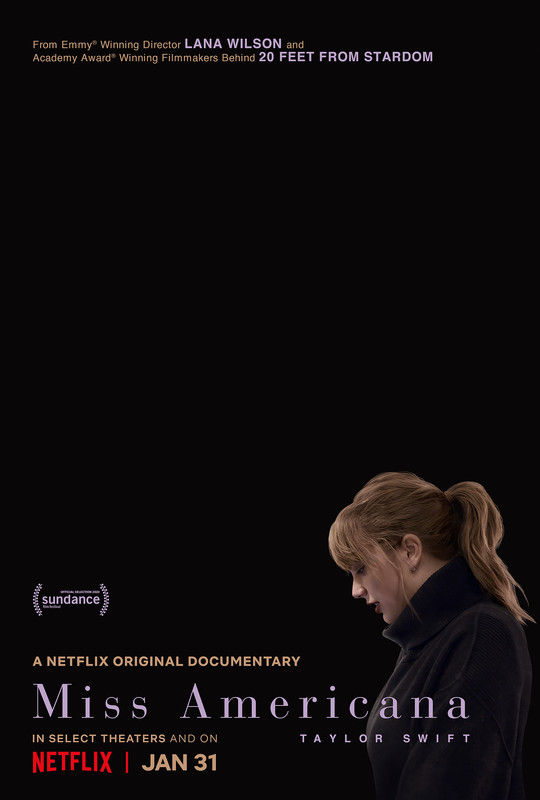
Miss Americana

Dir: Lana Wilson
Among my peers, being a Taylor Swift fan is perhaps not the most fashionable position I hold. I am a fan though. Particularly since her third album, Red, I’ve found her a talented songwriter with a knack for a well-turned lyric and, even when the record doesn’t work (as Reputation, for me, largely didn’t), her tendency to wear her themes on her sleeve means that she’s seldom less than interesting.

Lana Wilson’s documentary picks Swift up after the release of Reputation, and follows her through some of that tour and the writing and recording of her most recent album, Lover, while also looking back at her whole life as a performer. It’s a lot to try to do in 85 minutes.

Surprisingly for a film about someone who has spoken on a global scale for over a decade, Miss Americana’s overarching narrative is largely about Taylor Swift finding her voice. Swift has always been confessional in her songs, writing about boyfriends and breakups, about haters and feuds. Despite this, until an intervention in the 2018 midterm elections, she’d never (aside from supporting her LGBTQ fans) taken clear political positions, leading some on the right to assume that she was on their side and simply afraid to say so, because of potential backlash. 

Some of the film’s most interesting material addresses this shift in Swift’s public engagement. We’re told how the sexual assault court case, in which she counter-sued a DJ who had been fired after he inappropriately touched her during a meet and greet, and then sued her for damages, was the tipping point for her wanting to speak out on politics on a bigger scale. This sequence leads into one of the few extended performance clips in the film, of Reputation highlight Clean. That song was always clearly about the case, but seeing them juxtaposed so closely lends even greater power to the performance. 

We also see how nervous this new political engagement makes Swift’s team, with memories of what happened to the Dixie Chicks’ career after they said a single sentence speaking out against George Bush, and the eventual result when she does put out a statement. This material is some of the film’s most honest, and it really does seem as though a switch has flipped in Swift when she’s talking about it. Early interviews (often used as voiceover) say all the right things, as she talks about always looking for—living for—approval, but these interviews feel a little stiff, like she’s trying very hard to make sure that every word sounds right. Later scenes and later interviews make very plain why she is so on guard. It feels as though a breakthrough comes in the writing of The Man, a standout track from Lover that imagines how people (the press in particular) might talk about Swift if she did all the same things, but were male. Set against an interview used as voiceover late in the film about the pressures and requirements that come with being female in the entertainment industry, that song gains even greater resonance as a woman working out what she wants to simply say, in the mode she’s always been most comfortable communicating in.

This material is honest, and shows a side of Taylor Swift that we’re not used to seeing. She also exposes other vulnerabilities she hasn’t acknowledged before, notably an eating disorder, which she now appears to be dealing with in a healthy way. For all the honesty though, this film does still feel like it is maintaining a carefully curated image. It plays like an approved product, eliding over some more uncomfortable moments (notably much of the Famous controversy with Kanye West) and not delving into the degree to which Lover feels like a naked course correction from the darkness, and sometimes the pettiness, of Reputation. This isn’t to say director Lana Wilson fails to get her subject to open up, but it does have a feeling of butting up against how much Swift wants to reveal: thus far, Miss Americana (both film and person) says, but no further.

The only times the film and Swift seem to fully escape this feeling of stage management is when they are fully embedded in the making of music. This is when we see Taylor Swift, seemingly, truly happy; humming melodies for producers to help her work on, filling in missing bits of lyrics, and the moments of joy when she feels she’s hit on something. Whether her music is for you or not, I think it would be tough to watch these sequences and say she doesn’t work hard at her craft or that she’s not doing exactly what she does best.

Neither Taylor Swift or Miss Americana are perfect, but they both have something to say, and they will likely both speak to a big audience who might not otherwise engage with these ideas in the same way. There’s a lot to be said for that.
★★★½