Showing posts with label Censorship. Show all posts

Dec 1, 2012

Blu Ray Review: Zombie Flesh Eaters [18]

Dir: Lucio Fulci

The Film 
I have, perhaps oddly, a rather nostalgic fondness for Zombie Flesh Eaters.  My interest in horror films was sparked initially by my interest in censorship, and my desire to see movies that I wasn't supposed to see, and Zombie Flesh Eaters (albeit in a cut version which missed out some of the 'best' moments) was one of the first 'video nasties' I ever saw.  Though I've discovered more and better films by its director Lucio Fulci in the years since, I often come back to Zombie Flesh Eaters because it's a fun and undemanding gut muncher.

The story, such as it is, involves zombies, probably raised by voodoo, taking over a Carribbean island where Anne Bowles (Tisa Farrow) and Peter West, a reporter (Ian McCulloch) have journeyed to try to find her missing father.  They meet Dr Menard (Richard Johnson), who had been working to treat the zombie-causing illness with Anne's father.  Mayhem ensues.

Though titled Zombi 2 in Italy, to make it appear to be a sequel to George Romero's Dawn of the Dead (released there as Zombi), Lucio Fulci's first zombie film - he would make three more - strikes a very different tone from its notional model.  Fulci has little interest in using his zombies as metaphors, or in filling his narrative with commentary on ideas of race or consumerism, rather Fulci is a shamelessly, and rather joyfully, sensationalist filmmaker.  The script is more a loose series of scenes designed to knit together Fulci's set piece moments, and while I'm all for deep and multi-layered horror films, not everything in the genre needs to be cerebral.

The cast, a mix of American and English C-Listers and reliable but not hugely expensive international players acquit themselves as well as the dialogue and dubbing will allow.  Farrow and McCulloch have little chemistry, but the attraction the script shoehorns in is hardly key to the film, and they both do solid work, giving the credulity straining situations as much credibility as possible.  Richard Johnson, however, is in a different league; his sweaty browed scenery chomping is one of the film's great joys, and he strikes just the right tone as Dr Menard, even when chewing on some pretty awful lines.  Other players make an impact for different reasons.  You'd be hard pressed to say that either Olga Karlatos (as Menard's wife) or Auretta Gay (as one of a tourist couple that Anne and Peter hitch a boat ride with) give especially good performances, but they both make for stunning set decoration, and each have a part to play in some of the film's most memorable moments, even some of the zombies carve themselves into the memory, particularly the first one we see, played by the magnificently named Captain Haggerty.

The reason that Zombie Flesh Eaters works, the reason it's still compelling today, isn't really as much to do with the people in front of the camera as it is the people behind it.  At the time of the video nasties panic these films were seen as hack work; ugly films made by people with little talent and no standards - and to be fair some were - this isn't the case with Zombie Flesh Eaters.  Fulci trained with Fellini, and while they had wildly divergent careers and styles Fulci had honed a keen, sharp, and very identifiable directorial eye.  With DP Sergio Salvati providing a largely bright and soft lighting scheme that sets the film apart from many in the genre, Fulci wheels out trademarks like his extensive and impactful use of close ups on and his fondness for violence to eyes and sprinkles them through a series of varied set pieces.

The set pieces are just stunning, from a suspenseful opening to the closing zombie walk across the Brooklyn Bridge, but three really need discussing.  The famed Zombie V Shark sequence is as remarkable as it ever was.  It's brilliantly choreographed and shot, at times reminiscent of Creature From the Black Lagoon, and it looks amazingly dangerous, seemingly staged without a hint of fakery.  It's the sort of thing you could just never shoot now; the shark would be CG, and the sequence would lose all of its excitement.  There is also the graveyard scene, sometimes omitted between the breathless praise for the other set pieces, but perhaps the one that combines viscera and suspense most effectively.  There is an eerie slowness to Gianetto DeRossi's zombies as they rise from the ground, along with that creaking, tearing sound that is so unnatural, and that only makes it more shocking when the zombies swiftly attack.  Most striking though is the eye scene which, though famed for its visceral payoff, also has a stunning slow build as zombies try and break into Dr Menard's house to eat his wife (who, because this is an exploitation film, has just had a shower).  Almost as nightmarish as the amazing effect that ends the scene is the  build up, because even on a first watch you can be pretty sure where the scene is headed, and it makes the skin crawl.

Talking of effects, Gianetto DeRossi, who created the make up and gore effects, is really the star of the film.  Working with low tech tools like clay, he created some of the most disgustingly convincing zombies I've seen on screen.  The zombies were always my problem with Dawn of the Dead; they just looked like spray painted people.  The zombies here look dead, and as if they are rotting, bits being baked off them in the Caribbean sun.  There is also a strong variety in the zombie design, as well as some seriously painful looking blood and prosthetic effects (the aforementioned eye, a ripped out throat).  On occasion you can see the joins, but the film is such fun, and most of the effects work so spot on, that it's hard to mind very much.

I've no desire to get critically high-minded about this film; it's an entirely unpretentious feast of silliness and gore, and that's exactly the way I've always approached and enjoyed it.  Honestly, your reaction to the film will largely be dictated by your reaction to the title, if "Zombie Flesh Eaters" has you thinking there's a fun evening of horror in store then that's exactly what you'll get, if it makes you picture an idiotic waste of time then I'd imagine that's what you'll find, and if you're picturing a morally reprehensible 'Video Nasty', well, you'll probably find that here as well.  Me?  I'm just going to revel in the great photography and the fun, splashy, set pieces once more. 

The Picture and Sound
Arrow Video have earned a very good reputation for the care and attention they have shown to genre films that might not have previously received such lavish treatment.  Their restorations of Fulci's The Beyond and City of the Living Dead were both hugely impressive, but this presentation of Zombie Flesh Eaters absolutely blows them out of the water.  This is a spectacular restoration, revealing not only undreamed of detail, but shedding much more light on how brilliantly the film was photographed by Fulci and Sergio Salvati and how impressive the composition is.  The clarity does sometimes show a few of the joins in the effects, but it also shows the breathtaking detail and quality of the make up work.

The sound (though I can't comment on any surround use) is strong, with the impressive and haunting score (something sometimes undervalued in Italian exploitation films) coming through strongly, but never dominating above the dialogue.  I only listened to the English language track, because that has the real voices of at least the principal cast, but the original Italian dub is also available. 

The Extras
A generous package split across two Blu Ray discs.  On the main menu you'll get to choose from the three titles that Zombie Flesh Eaters went under.  The only difference is in which title sequence you see, the film itself is the same; a cute bonus, but not a terribly exciting one.  When you start the film (under whichever title) you'll also get a short intro from Ian McCulloch, who, as ever, seems surprised but happy that anyone remembers this movie.

The major video extra on disc one is an hour long documentary about the lineage of zombie movies, tracking from Night of the Living Dead, through Fulci's zombie quartet, and then to the many Italian films that cashed in on Zombie Flesh Eaters.  There's not much new here for genre fans, but the talking heads are intelligent, and the clips are fun. People just discovering these films would be well advised to watch it with a notebook handy to write down titles.

If you want to truly appreciate how good the film looks on this Blu Ray, have a look among the selection of Trailers at the trailer for the old Vipco release, which looks like third generation VHS.  The trailers are fun, but not something I would find myself watching much.  Also among the trailers are some brilliantly silly Radio Spots.

The major audio extras on the disc come in the form of two audio commentaries.  The first is with co-screenwriter Elisa Briganti and moderator Callum Waddell, it seems to have been recorded in a somewhat echoy room, which can be pretty grating, it's quite a general commentary for the most part, but Briganti is animated and Waddell gets some good, if not screen specific, stories from her.  It's worth a listen, but is really for fans more than casual viewers.  More essential is the second commentary, driven largely by Stephen Thrower, who literally wrote the book on Fulci (it's called Beyond Terror, and belongs in every horror fan's library).  Thrower is a fantastically engaging speaker, and here he's joined by Alan Jones; another encyclopedic authority on Italian horror films.  The two stick closer to what's on screen, but also talk around their subject about the Italian film industry and the larger careers of many of the people who worked on this film.  It's a very good track, and recommended to anyone with an interest in Fulci and his work.

The second disc of extras is led by a 46 minute interview with Ian McCulloch.  He tells a few familiar stories, but is as genial and informative as I found him in our chat.

Zombie Flesh Eaters: From Script to Screen is an utterly pointless feature in which [uncredited] screenwriter Dardano Sachetti show us the original draft of the screenplay.  Unfortunately we can't read any of it because the feature is not even 3 minutes long, is shot in wobblyvision, and largely consists of Sachetti flicking through the script.  If you're going to do a feature like this either make it an interview or put the original screenplay on the disc as a PDF.

A half hour Q and A with the film's composer Fabio Frizzi is a welcome and interesting addition, but it would probably benefit from optional subtitles, because the sound quality isn't brilliant, particularly on Frizzi's translator.  Still, it's very watchable and if you listen carefully you won't miss anything.  It's very nice to see Frizzi get his due on this disc; his soundtrack is one of the great things about the film.

Finally for the video extras The Meat Munching Movies of Gino DeRossi provides a 26 minute look at the work of Italy's own Baron of Blood.  Seeing inside his workshop is a real treat for a gorehound (the exploded head from The Beyond is still sitting on a shelf, and still looks amazing) and DeRossi comes across as personable, dedicated and hugely fond of his work.  He's also got a lot of interesting recollections about the films he's worked on.  Arrow need to get him to do a commentary one of these days.

The extras are rounded off by a booklet, which sounds very exciting, but was not made available for review.

Verdict
One of the essential releases of 2012 for horror fans; a classic film, with a stunning transfer, backed up by extensive and mostly intriguing extras.

The Film: ★★★★★ 
The Disc: ★★★★★

Nov 29, 2012

Interview: Ian McCulloch

31 years after it was made, Lucio Fulci's legendary video nasty Zombie Flesh Eaters [or Zombi 2, or Zombie] is finally making its way to Blu Ray, thanks to those gorehounds at Arrow Video. In celebration, 24FPS was lucky enough to sit down for a phone interview with the film's star Ian McCulloch.

In the brief preamble before the interview I told Mr McCulloch that Zombie Flesh Eaters was, at least in part, responsible for me doing what I do, as it was one of the films that really turned me into a horror fan, which led to this little exchange...

Ian McCulloch and Co-Star Tisa Farrow in Zombie Flesh Eaters
Ian McCulloch: You don't have a tattoo of me do you?

24FPS: No, I don't. Is that something you see a lot of?


Ian McCulloch: I've met quite a few people who have tattoos of me on their backs, and a lot who have tattoos of various scenes from Zombie Flesh Eaters on various parts of their anatomy.


24FPS: It must be quite an experience, meeting someone who has a tattoo of you.  What's that like for you?


Ian McCulloch: It is horrifying. I don't like tattoos anyway, I dread that one day one of my children might get a tattoo, or that my wife might suddenly say that she has one, but if it's me that makes it even worse. [Laughs] It's not a pleasant sight or a pleasant thought.


24FPS: I wasn't actually meaning to begin by talking about Zombie Flesh Eaters, I wanted to go back, and ask how and when you decided to become an actor.


Ian McCulloch: Well, that's nice. That's the first time anyone's asked me that question. When I was at school I used to get the main acting parts, mainly because I spoke English in a fairly proper way, and hopefully because I had a bit of talent as well. When I was 14 somebody saw a school play and said "Ian's good" and that I could play character parts and leading parts, and should think about being an actor. My English master quoted that to me, and from that moment until I became an actor as far as I was concerned that was what I was going to do.


So I left school, I had to do my national service, and then I went to Oxford, but I always assumed that acting was what I was going to do, it was what I wanted to do, but that was what I was going to do, and I was fortunate that when I was at Oxford I was talent spotted by the Royal Shakespeare Company, and offered a long term contract before I sat my finals. So I knew that I had three years work guaranteed, two terms before I left University, so it didn't matter whether I got my degree or not - well, I did - but it didn't matter. I had a very fortuitous start; the fulfillment of all my ambitions and dreams just sort of happened, almost by accident.


24FPS: I know that after the RSC you did a bit of British TV, and that was fundamental in getting you into Zombie Flesh Eaters. Could you tell us a bit about that, and how you found out about and were cast in the film?


Ian McCulloch: I did quite a lot of TV.  I did one episode of Colditz, which was a wonderful acting part, and the director was Terry Dudley, and then he was the producer on this BBC series called Survivors and he cast me in one of the leading roles in that.  Survivors was a big hit all over the world, but particularly in Italy, the first series was a huge success.  I was rehearsing a play in Plymouth, and I got a phone call from my agent who said there was an Italian film company that wanted me to play a lead role in a film about zombies, it had location work in New York, the Carribbean, the Mediterranean coast, they'd pay me a good wage, give me a living allowance, they'd fly my girlfriend out to any of the locations first class.  They didn't want to see me, they just wanted me to say yes.  I said yes very very quickly.


I met Fulci and the casting director, I had dinner with them in London, just to say hello, and the next thing I knew I was on a plane to New York to do the film. 


24FPS: Were you able to see the screenplay before you signed on?


Ian McCulloch: No, I was just told it was about zombies, which I thought might be like a Bob Hope film, or a Hammer horror.  I had no idea what it would be like or what it would entail.  I obviously had no idea what the end product would be like, which did come as quite a surprise when I saw it 25 years after I'd made it.


24FPS: I want to ask you about that in a little while, but before I do, the link with your earlier career and Zombie Flesh Eaters is Richard Johnson, I understand you were contemporaries at the RSC.


Ian McCulloch: Well, Richard is ten years older than me, and he was the leading man at the RSC when I arrived, and of all the actors there he was the one that I, arriving, admired the most, both as an actor because I thought he was formidable and as a - Lothario is not the word - as a man about town.  Richard was never out of the papers, and always associated with some of the most beautiful women there have ever been, I mean he was married to Kim Novak.  He seemed to have a gilded existence both on the stage and off, which I sort of envied and admired, and hoped that I might one day emulate.  Principally it was his acting, I just thought he was a stunning actor; wonderful face, fantastic voice.  I've always been a fan of Richard's, so I was going to be doing some thing that I hoped would be fairly respectable and would have some decent acting in it.


24FPS: Did Richard have any advice for you, because obviously he had done some Italian horror films before this?


Ian McCulloch: No, again, no one's ever asked me that question.  I think I vaguely asked 'how do they do things' or 'why do they do that' because the impressive thing about the Italians is their work ethic.  Having done small parts in big films like Cromwell and Where Eagles Dare, they waste so much time setting things up, and everything moves at such a snails pace.  In Italy they work like slaves - happily, they're not under any pressure - but you'd think they could make six films in the time it would take a British unit to make one. 


So I may have asked how do they do things and what does one do.  I think he just said, because he'd done quite a lot of these, 'This is the way they do thing, just sit back, know your words, hit your marks, and everything will be happy'.


24FPS: In terms of your part.  With the greatest respect to them, because I love these films, but Italian zombie films tend not to be known for their great acting [laughter on the other end of the line], given that, did you approach playing the part in the same way that you would any other part, did you do any preparation for it?

Ian McCulloch: No, no.  I may qualify as one of those lazy actors in that I don't really do much preparation in terms of psychology or personality for anything I'm doing, whether it's Shakespeare, David Hare, Dr Who.  I tend to say that something will evolve as I'm doing it, which more or less has always worked.


I was laughing when you were asking the question because there's the story about someone at the BBC seeing Gregory Peck's old script and page after page marked with NAR and one marked AR.  When asked what it was he said "Well, AR is Acting Required".  I have sort of felt that other than pulling faces and doing the physical, macho stuff, there's very little acting required in these films.  The film is carried by the zombies, the bizarre plot and the effects.  The lines more or less link up the iconic bit that people remember about the film.


24FPS: Talking of those bits, Lucio Fulci had something of a reputation of being difficult to work with, particularly for his female stars I think, so how did you find him on set and as a director?


Ian McCulloch: Well I have to sort of retract things that I've said earlier, though I don't do it fully.  I always got on quite well with Lucio, but I thought he was sort of a bully.  I don't know that he did it with leading actresses, but like a lot of people in theatre and film they need a whipping boy to vent their anger or frustration on.


Fulci picked on Auretta Gay, who was the beautiful Italian girl in it, who did the swimming stuff, who wasn't an actress.  I think she may have been a model, but anyway it was her first job.  He treated her pretty poorly but his view was that unless he bullied her he wouldn't get a performance out of her, that he wasn't getting anything out of her by being nice to her so he felt he had to be fairly ruthless and unkind, which he certainly was, sometimes deliberately, sometimes unconsciously.  During one of the scenes in the water she was actually drowning, they were still filming and she was calling out "Help, Help" in the water.  I dived in and, I didn't save her life, but I certainly kept her afloat in the water. 


He sort of picked on her, but the other side of that coin was when you said he was unkind to leading actresses... I was at a convention in America and there were about twelve Italian actresses who had done films with him and the interviewer went round the table and said exactly your question, and they all said the most wonderful things about him; that he was charming, courteous, civilised, that he had beautiful manners and couldn't have been nicer and one by one they all said this, and it was just me at the end of the line saying that he was rather different from all that.


Because of that, I should have done it before, but I looked at his track record and saw that he trained with some of the greatest people in Italian cinema, that his CV was full of films, and that he really was quite a distinguished director who, because of Zombie, got stuck in this genre and died in it, making his last films.


24FPS: We touched on this earlier, but when you were working on Zombie, did you have any expectations for it, any hopes for it, for instance did you think we'd be having this conversation 32 years later?


Ian McCulloch: I was astonished however long ago it was to be asked to do a commentary for the 25th anniversary DVD of it, I thought it would just have a short life in the cinema, might come out on tape and that would be it.  That people would be talking about it thirty plus years on, 14, 15, 16 year olds who came up to me in Florida two weeks ago and think it's the most wonderful film they've ever seen.  It's amazing, and I can't explain it, so I certainly had no thought when I did it and even when I'd finished it that it would have a life expectancy of more than a year, but it has, and I presume once the Blu Ray is done someone will probably bring out a 3D version of it.


24FPS: Let's hope not.


Ian McCulloch: Then we'll be talking again two years down the line, asking the same questions.


24FPS: Well, I'll think of some different ones if we have to do that interview.  Talking of the video release, that was a big controversy over here, and you have the distinction, along with your co-star Tisa Farrow, of being in two of the 'Video Nasties' ...


Ian McCulloch: I was in three of them...


24FPS: Oh.  I didn't realise Zombie Holocaust was an official nasty [Note: This is still very unclear, some regional lists seem to have included Zombie Holocaust, but neither the definitive book on the nasties, See No Evil, nor the excellent censorship website Melon Farmers list it as an official DPP list member]


Ian McCulloch: I may be wrong, but I've always said three.  It's an old family story, but it's true, I met my wife's uncle [who was a member of the House of Lords at the time of the Video Nasties moral panic] in London and he didn't look very happy - less happy than he normally did - and I said "What's the matter Martin?" and he said the Metropolitan Police had put together a compilation of films they thought should be banned, and obviously I'd heard about it, so I said "Well, you're in luck because you'll see me, because I'm in three of them", and he just looked at me with total disdain and said "Ian, how could you?"  And then off he went and they banned them.


24FPS: What did you make of the controversy at the time, as somebody was in them?


Ian McCulloch: Well, I hadn't seen them, so I didn't know how much had been added to them by the special effects, even though I'd heard word of mouth.  I just thought it was ridiculous, I mean, to ban Contamination was just... it's one of the most stupid films that has ever been made, with one of the silliest stories and terrible special effects.  How it could be seen as obscene or likely to corrupt the morals of the British public was beyond me, I just thought it was stupid.  But, having said that, without it I'm quite sure we wouldn't be talking about it now.  That was what, I think, mainly led to its longevity.


24FPS: I know you only saw the film the first time when you recorded the commentary for the laserdisc.  What was that like, to see it for the first time after so long?  How did you feel about it, and has that reaction changed if you've seen it since?


Ian McCulloch: The main thing was that I was actually seeing the story from beginning to end, but the problem was I was in another studio, watching it through a window, and what I'd been asked to do was if I saw something to tell a story about what had happened at scene, or something I remembered about one of the actors so, having seen that moment I then came back to my microphone and missed everything until I had finished talking an went back to the screen so I didn't see all the film.


I didn't see it in full until two or three years ago, I showed it at the Burns Centre in Dumfries, and I did a Q and A afterwards, that was the first time I saw it in full on a big screen.  I thought it looked fantastic; it's a credit to Fulci and his director of photography that it looks superb.


24FPS: What do you make of yourself in it?

Ian McCulloch: [Laughs] I'm not the greatest fan of myself.  Being rather crude, but when I was in Stratford, it was the early days of television and there was an actor there called John Hussey, and one night he was talking about watching yourself, and he said watching yourself on TV was like masturbating in front of a mirror.  It is not a pleasure watching myself on screen, I don't like the way I look and I don't the way I sound.

24FPS: I know you probably didn't work with him much, but you did work with his creations, and fans would probably not forgive me if I didn't ask you about Gianetto DiRossi, and what he was like, and what your reaction was to his work on set.


Ian McCulloch: I've said it before, and I'm happy to say it again; as far as I'm concerned the star of the film is Gianetto DiRossi.  It's his special effects that carry scene after scene, and carry the conviction which makes the film plausible in the ways that it is, and leaves a deep memory in people's minds.


He was a lovely bloke, his wife was there working on the film.  He was a fairly athletic bloke, a great tennis player, and I bought my first tennis racquet on his recommendation, a Bjorn Borg special, which I still have.  It's very old fashioned now.  I haven't seen him since the film ended, the second film [Zombie Holocaust] his assistant did, but with very little of the finesse or cleverness that he had.  He's still around isn't he?  But as I said, a really nice bloke and a fantastic professional.


24FPS: I've just got two quick final questions from two of my Twitter followers.  @Supermarcey asks if you had any particular high and low points from during the making of Zombie Flesh Eaters.


Ian McCulloch: [After a LONG pasue] I think the high was actually getting the job in the first place, because it was so totally unexpected.  I was doing an Alan Bennett play and the last thing in the world that I expected was to be offered something like like this.  I'd done The Ghoul, which was a moderately successful independent British film, this was just so out of the blue, and to be offered it with all the places it was going to and be paid for doing it was probably the highlight.


The low was not really about Zombie but all of those Italian films.  There was never any professional reward at the end.  I don't mean in a financial sense but in a working sense.  They, particularly Zombie but the others as well, made huge amounts of money, and you'd think that being associated with them would put you in demand to do other things, and the biggest disappointment was that when I finished them I never had another interview for a film, ever.  I know that probably isn't the answer she wanted, but in all honesty that is the high and low of my Italian career.


24FPS: Well, I hate to bring you down at the end, so here's another from @conor9613.  Do you think the zombie apocalypse will happen, and if so how?


Ian McCulloch: [Laughing] Erm... No.  I mean, they don't exist.  They're a successful part of drama and culture, but there's nothing about them that's real.  It's a wonderful launching pad for lots of films and TV, it makes some people a lot of money, and gives many more people a lot of pleasure.  But I think no one's ready for the zombie apocalypse, and if it happens we're all going to be in trouble.


Many thanks to Ian McCulloch for taking the time and for taking a few silly questions quite seriously, and thanks to Will at Noble PR for setting up the interview.  


The restored edition of Zombie Flesh Eaters is available on Blu-ray, DVD and Steelbook from December 3rd (Arrow Video).   If you order from the link below you can help out 24FPS, free of charge.  

Feb 4, 2012

News: Visions of Ecstasy release details

I've never made a secret of my interest in controversial film, the cut, the banned, the frowned upon and the forbidden. Well, on March 26th one of the more notable (and one of the more effectively suppressed) examples comes to UK DVD, 23 years after it was banned for blasphemy. Nigel Wingrove's Visions of Ecstasy was rejected by the BBFC, the Video Appeals Committee and eventually the European Court of Human Rights, but the blasphemy law which sealed its fate was repealed in 2008, and the film has now been passed uncut by the BBFC. Here are the release details and cover art (just an aside here; I LOVE that Graham Bright is quoted, that should annoy him):

One of the most controversial films ever to be released in the UK

The only film in the UK to ever been banned for blasphemy

Visions of Ecstasy, a short, experimental art film made in 1989, is the only film ever to have been banned outright in the UK solely on the grounds of blasphemy. Further its depiction and interpretation of the erotic imaginings of the 16th Century Carmelite nun, St. Teresa,were such that the films banning was upheld in an historic judgement at the European Court of Human Rights in Strasbourg in a case that took seven years to reach its conclusion. Now, due to the abolition of the UK's blasphemy laws in 2008, Visions of Ecstasy is finally being released.

Included with this historic film is also a 40 page, booklet written by the films director, Nigel Wingrove, in which he explains how the film came to be made, the effect its banning had on his life and future work, and how his continuing battles against film censorship led eventually to the resignation of the BBFC's then director, James Ferman, the legalisation of pornography and a general relaxations of film classification overall.

Also included on this DVD are the director s first erotic short film, Axel (1986) and his nunsploitation feature, Sacred Flesh (2000), in which a Mother Superior struggles with her sexual desires in a series of imagined dialogues with Mary Magdalene will her mind torments her with images of sexual perversion, lesbianism and sadomasochism.

Additional extras include extensive stills, press gallery and interviews.


I've written a pretty extensive article on Visions of Ecstasy and the history of blasphemy in UK film censorship over at The New Journalist, so if you're interested in the film, check that article out HERE

If you'd like to pre-order the DVD, please use this link and help out 24FPS, at no extra cost to you. Cheers.

May 27, 2011

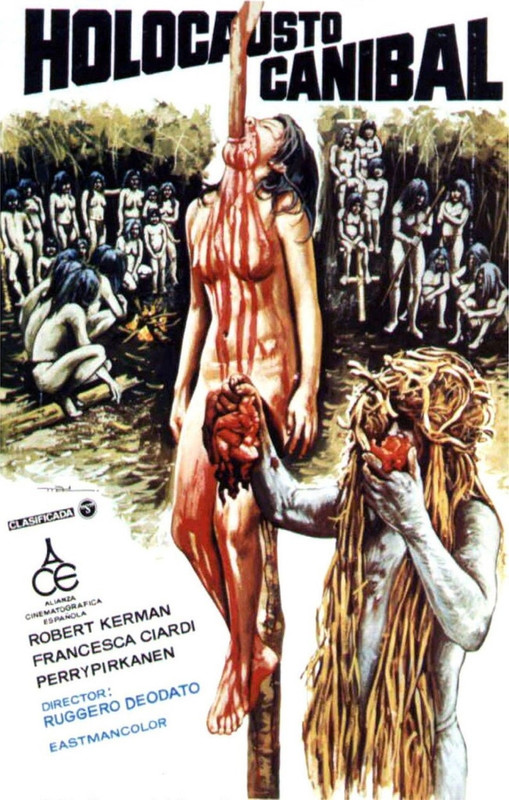
Cannibal Holocaust [2011 Cut] [18]

Dir: Ruggero Deodato
In 1984 the office of the Director of Public Prosecutions in the UK drew up a list of movies that would become known as the video nasties. Films so repellent, so brutal, that their release made their publishers liable to prosecution under the Obscene Publications Act. Ironically, for the most part, the DPP ended up granting a now nearly 30-year long spotlight to these films, films which otherwise would mostly have drifted into deserved obscurity.

However, it has also preserved a handful of good films, and even a couple of classics. Cannibal Holocaust, perhaps the most transgressive of the nasties, falls into that last category. Far from being a simple exploitation film, Deodato's magnum opus is a film of ideas and which plays with form in ways that provoke revulsion, fear, and most importantly thought, in its audience.

Last night I was finally able to see this groundbreaking film at the cinema (the last screening I had wanted to attend was pulled by Police). However, this was still not quite the original film, rather it is Deodato's 2011 edit, cut to get around some of the problems that the British Board of Film Classification have historically had with the film (largely its extensive unsimulated animal cruelty). This is the version which will be released on Blu Ray later this year by the exceptional Grindhouse company Shameless.

Rather than cutting the contentious moments, Deodato has generally chosen to obscure them with what are ostensibly flaws in the film. This is clever; an artful way to make the edits, in keeping with the form of the film (the second half of which purports to consist of documentary footage left in poor conditions in the jungle for months), and it doesn't take much away from the film, only the early killing of a muskrat is entirely deleted.

These considerations aside, Cannibal Holocaust remains a brilliant film. The performances are really only serviceable, but even that's quite high praise for Italian exploitation movies, but Deodato's direction is what really transforms this film from a simple gorefest into something genuinely interesting. The first half of the film is pretty straightforward narrative cinema, following a rescue operation to attempt to recover four missing filmmakers and their footage, and here Deodato reveals a genuinely artistic eye, developing many memorable shots and set pieces. The second half is even more striking; Deodato develops the faux documentary styling brilliantly, using them to draw us in in a much more visceral way than if we had been able to sit at one remove from the film, and manipulating technical 'flaws' to make the verisimilitude ever more convincing, and thus ever more disturbing.

The film's moral questions are simplistically phrased (summed up in a final line of voiceover), but they remain troubling, and can be extended into far less extreme situations with equally troubling implications. Cannibal Holocaust may have begun (as Deodato said before the film) as a reaction against explicit violence in news footage, but today it could easily be seen as being about war reporting, or even the morals of any reporting.

It may not quite be complete, but this is as good a version of Cannibal Holocaust as the UK is ever likely to see, and it was a treat (an odd term I know) to feel the full force of its impact on a big screen. It's an essential film, and a genuinely great and interesting one at that.
★★★★★

Nov 30, 2010

A Serbian Film: BBFC Cut version [18]

Dir: Srdjan Spasojevic
You really can’t separate A Serbian Film from the hype that has surrounded it since it was first seen in January. Horror cinema has lately been going through another of those periodic patches in which it is becoming notably more extreme, with each release seeming to aim for a new high (or low, depending on your point of view) watermark in how testing an experience it can be for its audience, and it seems that for many people A Serbian Film is that latest high (or low) point – that said I’ve since heard that another Serbian film; The Life and Death of a Porno Gang, is even more extreme. Certainly this film has attracted more criticism for its violence than almost any in recent memory, with mere descriptions of scenes, especially the now infamous ‘newborn porn’ scene, serving for some as an indictment of how far the horror genre will stoop to excite its audience. It is perhaps this infamy, rather than the film’s content as such, which has resulted in the BBFC demanding 49 separate cuts – a total of four minutes and twelve seconds – to the version of the film I’m now reviewing.

This hype was one of two things I carried with me into the screening. The other was an awareness of director Srdjan Spasojevic’s repeated claims that his film, far from being a mere exercise in prurient violence, is in fact an allegorical tale about how Serbia has been mistreated by the political class. On the surface, at least, the film is about Milos (Srdjan Todorovic), a former porn star who is lured out of family life with a big payday to work for a director (Sergei Trifunovic) who says that he wants to make a hardcore art film, and tells Milos that he’s to know nothing more about the project. As the film becomes more and more depraved, with violent sex scenes, often performed with young children watching, Milos decides that he wants to leave, but when he tries he is drugged and forced to continue with ever more depraved scenes for the film.

Whatever A Serbian Film is, subtle it is not. Once you are made aware of the fact that the filmmakers claim that it is an allegory that fact is obvious in almost every scene, in fact it’s an incredibly simplistic message, casting Serbia as a rape victim and ‘porno artist’ Vukmir as the corrupt political class beating it and fucking it, if only from a distance. This is never more nakedly expressed than in the ‘newborn porn’ scene. Perhaps if I knew more about Serbian society and politics this would seem insightful and clever, but to be frank I just felt like someone was shouting an unconvincing argument at me. For all its heavy-handed attempts at bringing this message to bear on the film, I found it an empty experience. Even in this cut version it is relentlessly (often boringly) brutal, and I found little of the intelligence and weight that lifted films like Martyrs and Antichrist out of the torture porn ghetto.

I can’t deny that A Serbian Film is well made. The gore effects are brilliantly handled, with a decapitation towards the end of the film being especially nasty and convincing, and Srdjan Spasojevic definitely shows promise as a director, as the level of craft that he’s put into the design of his shots here (especially during the shooting of Vukmir’s film) is diverting. This is when it’s a real shame that the film is so heavily cut, because there is obviously real thought behind the film’s visuals and its editing (it’s notable that there is actually relatively little really explicit gore here, much of the worst violence is cleverly shot to hide some of the detail without losing the impact). There is also an almost surreal quality to the film within the film, and that sense of Milos’ entering another world when he steps on to set is heightened by the stark and stylised lighting choices and the strange, structure free, dialogue of the porn film. The acting is also largely impressive (though Sergej Trifunovic does push the boat out too far towards the end, becoming a cartoonish embodiment of the already bludgeoned in message), but whatever the level of craft there was just something missing here for me.

A Serbian Film wants to shock you. It probably will, but personally I need to be really involved in a film to be affected by it in that way, and I just wasn’t with this one. The message was so front and centre that it really got in the way, for me, of engaging with the characters on a purely human level, to me everything in this film ends up feeling like a piece of Spasojevic’s personal allegorical jigsaw. There also came a point at which the film was pushing the boat out so ridiculously far in its violence and transgression that I began guessing at the most fucked up thing they could do next, and ended up guessing much of the content of the last quarter of an hour. The one moment I didn’t see coming, by the way, is so utterly ridiculous that it too undermined any shock value of the scene.

As unconvinced and as disappointed as I am by A Serbian Film as a whole, there is enough going on here to interest me in Srdjan Spasojevic’s next film, providing that he elects to tell a story rather than provide a blood drenched and unconvincing lecture. There is, of course, the possibility that restoring the missing four minutes and twelve seconds will transform the film into the masterpiece that some have claimed it to be, but somehow I doubt it.
★★☆☆☆

Jun 7, 2010

Cinematters: The gutter press

Last Wednesday, in an incident that lasted three hours, and ranged over several towns and villages in the English county of Cumbria, 52 year old Derrick Bird, armed with a shotgun and a .22 rifle, went on a rampage. He shot and killed 12 people, and wounded another 25, before shooting himself as Police closed in. Obviously whenever this sort of thing happens there is a need for the public and for the press to know why it happened, to have something to point to and say "that's why he did it". I'm surprised it took so long, but disgusting right wing rag The Daily Mail has now decided, once again, to infer that a film - Steven Seagal starrer Exit Wounds - is to blame.

Here's the boxout dealing with the film from their latest story on Bird (click to enlarge)
Free image hosting powered by PostImage.org

It's easy to understand the impulse. Saying that a movie, or a video game, or a piece of music has warped someone's mind is much easier, and rather less disturbing, than confronting either the idea that someone is evil or the fact that systemic failures, be it with Police or mental health services, led to problems going untreated or other more minor offences unpunished. Not all of these things may apply to Derrick Bird, but some likely do, and frankly it's easier to blame a movie than to spend the time, effort and money to discover the real causes behind this hideous act.

Our papers have form in this regard. This is the third gun massacre in recent UK history, following Michael Ryan's Hungerford rampage in 1987 and the 1996 killings in Dunblane Primary School, perpetrated by Thomas Hamilton. After Hungerford the papers focused on Rambo, despite the fact that there were no similarities between the crime and either of the first two Rambo films (the third was released in 1988, prompting tabloids to dredge up the Hungerford 'connection' again to try and stoke moral outrage). Even more damning to their case was the fact that there was absolutely no evidence, besides the fact that he owned a TV and VCR, that Ryan had even seen either Rambo film.

With Thomas Hamilton the papers adopted a more scattergun approach. 1993 had seen the murder of James Bulger, and out of that, and its utterly made up 'connection' to Child's Play 3, had come a campaign against violent videos of all kinds, led by the tabloid press, especially the Mail. Hamilton's crime re-stoked that fire. "Who supports violent films now?" asked a Times headline after Dunblane, without connecting any one to Hamilton.

Before we take a closer look at the boxout which makes the case for the influence of Exit Wounds in this crime, let's take a second to look at the several other things the Daily Mail thinks might be to blame for Derrick Bird's actions... (all these are clickable to full articles. Click only if you have a large tolerance for shitty journalism).
Being dumped by his Thai girlfriend, and subsequent 'ribbing' from fellow taxi drivers.
Antidepressants (this is a really nasty article, by Peter Hitchens)
Fellow taxi drivers stealing fares
Fear of prison over an unpaid tax bill. A row over a family will.

It's pretty easy to see the pattern here; a desperate search for answers, none of them very satisfactory. Now let's take a look at the boxout. I'm going to take it apart, the Daily Mail's words will be in blockquotes, my responses in normal type.

Derrick Bird watched a violent film which shows numerous killings using guns the night before his rampage through Cumbria.

Assuming this is true (a hell of an assumption, given the Rambo and Child's Play 3 cases, among many others) So what? I watched The Killer Inside Me on the Monday of that week, and I didn't go and beat a woman on Tuesday. He's also alleged to have watched it with a friend, which, had the film been the causal influence, would surely have meant that two men would have been on this rampage.

There's also a LOT of accounts of where Bird was on the Tuesday night, and much of what he's reported to have said mitigates against the idea that Exit Wounds had any part to play in his actions, rather they suggest that he was set on his course already. A Mail story from June 3rd says "After a heated argument on Tuesday night, Derrick Bird is said to have stormed off saying: 'There's going to be a rampage tomorrow.'" This has to precede the viewing of the film, which ended in the early hours of Wednesday morning. That means that this plan MUST also pre-date the viewing of the film (and, indeed, that even if he'd watched Care Bears: The Movie on Tuesday night this masscare would still have happened). Another quote from June 3rd: "A friend, Peter Leder, said Bird had told him hours before the killings: 'See ya Peter, but I won't see you again.'" Does this sound like a man who killed people because he saw a movie?

Bird watched the film at his friend Neil Jacques's house and left looking like a 'zombie' around 12:30am once it had ended.

Note the total lack of attribution, the absence of quotes except around the word zombie, both decent indicators for something being made of bullshit. Might I also suggest that, given other anecdotal evidence he was looking like a 'zombie' because he knew that he'd entered his last day of life. Or perhaps, I don't know, he was sleepy at half past midnight, rather than in a zombified daze thanks to a violent movie?

It features Detriot cop Orin Boyd, played by Seagal, who wages war against violent drug barons.

Which, obviously, is exactly like a middle aged cabbie from Cumbria gunning down random people.

During the film Seagal's boss is killed by the chief of Police, who shoots him four times with a shotgun while yelling 'You're fired'.

I haven't seen Exit Wounds, but it sounds to me like they've got their facts wrong here. If he's a cop the surely Seagal's boss IS the chief of Police. So, who gets shot by who? As well as likely being wrong this exhibits little connection to Bird's crime. Yes he used a shotgun, but that's because it was one of two licensed weapons he owned, not because he saw a movie (a few days previously, it is reported, he was so angry he went to grab his gun and go shooting, but was talked down by a friend). In addition it has not been reported that he used the words "You're fired!" to any victim, nor that he shot any victim four times.

Firearms consultant Mike Yardley... provided a report on violence in films to the Government after the Dunblane massacre in 1996. He found that there were an average of 13 firearms killings in each of the top ten rental films at the time. He believes the figure is far higher now.

Note, again, the lack of any specifics, or a quote. How do we know Yardley believes this, when did he say he believed this? Also, what this essentially breaks down to is "Man makes guess". There's no inference of new research here, not even any indication that Yardley has seen the films he's commenting on (whatever they may be). Assuming Yardley's right, doesn't that disprove the point the Mail wants to make? If violence in film has a causal relationship to violence in real life, and an increase of average gun deaths in movies is a bad thing, shouldn't we have had an increasing incidence over that period of incidents like Derrick Bird's rampage? In fact there was a longer gap between Dunblane and Cumbria (14 years) than between Hungerford and Dunblane (9 years). Wouldn't that make an argument that, if anything, screen violence is cathartic, and may help pacify a violent impulse in people? Certainly it's no more ludicrous than the inference that Exit Wounds had something to do with Derrick Bird's actions last Wednesday.

I despise journalism like this. News reporting should be about uncovering truth and understanding why things happen, not obfuscating, political agendas and reaching for easy blame, which is the Daily Mail's stock in trade.

If you've any thoughts on this article then please use the comments.

Mar 3, 2010

BBFC Report 1

This first BBFC report, which will detail classification decisions on most theatrical and selected DVD and Blu-Ray releases, will be longer than those that will follow. In future I’ll publish this article every other Wednesday. I’ll note any cuts, and provide a link to the BBFC’s cut details where appropriate. I won’t be reporting on R-18 films, because this blog doesn’t deal with porn.

Within each certificate films are listed alphabetically by title


HACHI - A DOG'S TALE Contains no material likely to offend or harm.
LOURDES Contains no material likely to offend or harm.


ALICE IN WONDERLAND [2D / 3D] Contains moderate fantasy violence.
EXTRAORDINARY MEASURES Contains mild language
THE LAST SONG Contains mild violence, language and emotionally intense scenes.
OLD DOGS Contains mild slapstick violence.
OCTPOB [ISLAND] Contains mild language and violence.
THE SPY NEXT DOOR Contains moderate comic action violence.
TOOTH FAIRY Contains infrequent mild language and sporting violence.
WHEN IN ROME Contains mild language and comic gore in a magic trick.


THE BLIND SIDE Contains infrequent moderate violence, language and sex references.
CAPITALISM: A LOVE STORY Contains strong language.
DEAR JOHN Contains infrequent moderate sex and violence.
GENTLEMEN BRONCOS Contains infrequent crude humour.
MY LAST FIVE GIRLFRIENDS Contains infrequent strong language.
NO ONE KNOWS ABOUT PERSIAN CATS PERSIAN CATS Contains moderate injury detail.
ONDINE Contains moderate violence, injury detail and infrequent strong language.
LE PERE DE MES ENFANTS [THE FATHER OF MY CHILDREN] Contains moderate violence and scenes of smoking.
THE SKY CRAWLERS Contains moderate violence.
WHIP IT Contains moderate language, drug and sex references.


BLACK DEATH Contains strong violence.
BOOGIE WOOGIE Contains strong language, sex and nudity and hard drug use.
BRONCO BULLFROG Contains strong language and one written use of very strong language.
CASE 39 Contains strong sustained threat and bloody violence.
CENTURION Contains frequent strong bloody violence and strong language.
CHERRYBOMB Contains drug use, strong violence and strong language, once very strong.
COP OUT Contains strong language and sex references and infrequent strong violence.
DATE NIGHT Contains moderate sex references and one use of strong language.
EXTRACT Contains strong language, sex references and drug use.
THE GHOST Contains strong language, once very strong.
GREENBERG Contains strong language and sex and hard drug use.
GREEN ZONE Contains strong language and violence
I LOVE YOU PHILLIP MORRIS Contains strong language and sex.
THE INFIDEL Contains strong language, once very strong, and depictions of racism.
IO SONO L'AMORE [I AM LOVE] Contains strong sex.
JOHN RABE Contains strong bloody war violence and injury detail.
KICK-ASS Contains strong language, once very strong, & strong bloody comic violence.
KICKS Contains strong language, sex and injury detail.
LEGION Contains strong language, once very strong, and strong bloody violence.
LIFE DURING WARTIME Contains very strong language, strong sex and references to paedophilia.
MOTHERHOOD Contains one mouthed use of very strong language.
PARANORMAL ACTIVITY [ALTERNATE VERSION] Contains strong language and threat.
PERRIER'S BOUNTY Contains very strong language, strong violence, sex references and drug use.
PSYCH 9 Contains strong violence, psychological threat, language & sexual abuse.
RAGING PHOENIX Contains strong violence. [DVD]
THE REBOUND Contains strong language, moderate sex references and soft drug use.
SAMSON & DELILAH Contains frequent substance misuse and strong language.
THE SCOUTING BOOK FOR BOYS Contains strong language,. once very strong and one scene of strong violence.
SHELTER Contains strong threat and menace.
SHE'S OUT OF MY LEAGUE Contains strong language and sex references.
THE SHOUTING MEN Contains strong language and sex references.
SHUTTER ISLAND Contains strong language, bloody injury and disturbing images.
SKATE OR DIE Contains strong language, sex and drug use.
VINCERE [WIN] Contains strong sex and nudity.


THE DISAPPEARANCE OF ALICE CREED Contains very strong language, strong sex, violence and threat.
DOGTOOTH Contains incest theme and infrequent real sex.
HEARTLESS Contains one scene of very strong gore.
THE HOUSE OF THE DEVIL Contains strong violence and gore.
THE KREUTZER SONATA Contains strong bloody violence and strong sex.
MAN SOM HATAR KVINNOR [THE GIRL WITH THE DRAGON TATTOO] Contains scenes of sexual violence.
[REC] 2 Contains strong bloody violence and sustained terror.
REPO MEN Contains strong bloody violence.

Oct 9, 2009

BBFC Update 3


Vanishing of the Bees [very mild language]


Toy Story [3D] [mild violence, scary scenes and some dangerous behaviour]
Fantastic Mr. Fox [mild violence and scary scenes]
Fame [mild language and sex references]
Seraphine [infrequent mild sex references and scenes of emotional distress]
Where the Wild Things Are [mild threat and brief violence]
A Christmas Carol [2D and 3D Versions] [mild threat, scary scenes and mild language]


Driving Aphrodite [moderate sex references]
Cold Souls [one use of strong language and moderate sexualised nudity]
Glorious 39 [strong language and one gory image]
All About Steve [moderate sex references0
Departures [emotionally intense scenes of bereavement]
The Boys are Back [one crude sex reference and implied strong language]
Gentlemen Broncos [infrequent crude humour]
2012 [sustained moderate threat and one use of strong language]


A Serious Man [strong language and soft drug use]
Ip Man [moderate martial arts violence and bloody injury]
Monty Python: Almost the Truth - The Lawyer's Cut [strong language]
Johnny Mad Dog [strong violence, sexual violence, sex and frequent strong language]
Pandorum [strong language and bloody violence]
Surviving Evil [strong violence and language]
Goodbye Solo [strong language]
Ong Bak - The Beginning [frequent strong violence]
Love the Beast [strong language]
L'Enfer 'Henri-Georges Clouzot [sexualised nudity]
Pontypool [strong language, threat and menace]
Dead Man Running [strong language and drug use]
The White Ribbon [child abuse references]
Dark Nature [strong bloody violence]
Carriers [moderate horror]
Humpday [strong language, sex, sex references and soft drug use]
Leaving [strong sex and language]
Couples Retreat [moderate sex references]


Colin [strong bloody violence and horror]
Vinyan [strong sex]
Ninja Assassin [frequent strong bloody violence]
Halloween II [very strong bloody violence]
Saw VI [strong bloody violence]

Sep 27, 2009

Cinematters: Makin' the law, Makin' the law


As previously reported, the Video Recordings Act, which has regulated film censorship for the home in the UK since 1984 was, by some oversight by the Government, never actually enacted into law. Of course the act will be re-enacted, and in the interim all is proceeding pretty much as normal. BBFC recently released a statement on the matter on the front page of their website. It reads, in part…

The Government has set in train the actions necessary to remedy this situation as soon as possible and, as part of that process, have notified the Commission of the new draft Act and the Labelling Regulations deriving from it.

The Government has made clear to the BBFC that, once the process of re-enacting the VRA is complete, all video classification certificates issued by the BBFC since 1984 will be valid, and the legal consequences of non-compliance with the classification regime will be re-instated and enforced as vigorously as previously. Any video recording containing an unclassified video work which has been released in the interim period will need to be withdrawn from sale once the new Act is in force, unless the work can claim exemption.

The Government has therefore urged the industry in the interim to comply with the provisions of the VRA on a voluntary and best practice basis. The BBFC will continue to classify video works submitted by distributors on a voluntary basis for this period.


Essentially, for the moment, little is changing. However, in a climate that has recently seen the tabloids kick up a huge fuss about the release of Antichrist, asking whether it’s uncut certification means that censorship has been rendered pointless, this 25 year old oversight provides the Government a very easy way to tinker with the law, and possibly score some populist points in the run up to an election. So, if the VRA is going to be revised, I thought I’d put my two cents in, and rewrite the British film censorship system, as I would see fit.

1: It will be written into the VRA 2009 that at 18 the assumption will be that adults should be free to choose their own entertainment.
This is already BBFC policy, but enshrining this in law would make it considerably harder for films intended for adults to be censored. This, of course, would not include images that would fall foul of common law. Whenever the discussion of essentially repealing censorship of films for adults comes up somebody, who always seems convinced that they are the first to think of these questions and thus will really stump me, tends to ask one or both of the following questions.

Q1: If we’re going to allow everything does that mean that child porn should be legal?
A: No. Idiot. Because both the acts of producing, purchasing and viewing that material are already illegal, and punishable by custodial sentences, under common law. The same goes for so called ‘snuff’ films (which likely don’t exist, but are so pervasive an urban myth that they often come up in this discussion), for the sort of spycam videos that BBFC have previously refused to classify and for films and sequences of genuine cruelty to animals.

Q2: So you think children should be able to see all the sex and violence they want?
A2: Again, no, of course not. But I’m a responsible adult without children, it’s not my responsibility to make sure that other people’s children don’t see sex and violence, it’s theirs. If they aren’t able to do that then that’s their fault and they should have to deal with and answer for that. The thing is that some people want to limit my freedoms, and yours, because some people are crap parents, and they shouldn’t be allowed to do so. It is not hard to keep kids away from films that are unsuitable for them, my parents managed it and that was without the technology that is now available to make it easier.

2: The VRA 2009 will not be linked to the Obscene Publications Act 1959.
The OPA, as you might expect, is a hopelessly outdated piece of legislation, and yet, our censorship system is still largely predicated on its rule that an article is obscene (and thus subject to suppression) if…

its effect or (where the article comprises two or more distinct items) the effect of any one of its items is, if taken as a whole, such as to tend to deprave and corrupt persons who are likely, having regard to all relevant circumstances, to read, see or hear the matter contained or embodied in it.


This is a ludicrous standard, by which almost anything could be deemed to be obscene. It’s also problematic because it provides no definition of what it regards as a tendency to deprave and corrupt. In the US there was a shooting at a screening of Schindler’s List. Does this one incident at one screening of a film seen by millions mean that the film exhibits a tendency to deprave and corrupt? Certainly you could make the argument. Does the fact that Jeffrey Dahmer, the infamous cannibalistic killer, sometimes wore yellow contact lenses so he would more resemble the Emperor in his favourite film - Return of the Jedi - mean that that innocuous seeming film depraved and corrupted Dahmer? Is that enough to constitute a tendency? What about the several cases of murderers who cited Natural Born Killers as an inspiration? The only one that came to trial (backed by John Grisham, whose friend had been a victim in that series of crimes) was thrown out of court in very short order. In all the hundreds of times that films have been cited as inspiration in the commission of serious crimes not once has the connection been proven, nor, even in the cases in which a film may have inspired a method of murder has that film been shown to have been the direct cause of that crime. No film has ever been banned of withdrawn as the result of a crime, with the exception of A Clockwork Orange. That’s a special case; it was not withdrawn under the OPA, but by Stanley Kubrick himself, as a result of threats received to his family.

This is not to say that no films have ever been found to be obscene, many of the films on the DPP list that led to the foundation of the VRA in 1984 were convicted, and people even imprisoned for supplying them. Zombie Flesh Eaters, Tenebrae, Driller Killer, Possession, Dead and Buried, The Bogeyman and The Toolbox Murders were all convicted, among others. All of these films, with the exception of The Toolbox Murders, are now available uncut.

This point leads on to another massive flaw in the OPA; the sentence that is its very foundation is one that cannot be objectively applied, it simply can’t be done. What one person (or twelve people) considers depraving and corrupting is a value judgement. Values vary not just over time but also from person to person, and thus trying to regulate art on that basis is ludicrous.

3: Enforcement has to mean something.
The problem of children seeing films that are unsuitable for them arises not from the fact that the VRA is unfit for purpose but the fact that enforcement at both shop and police level is extremely lax. Countless are the times that I’ve seen a clearly underage kid buying an 18 certificate film, or, worse, a parent purchasing an 18 rated film for their very young child. Honestly, what kind of parent buys a copy of Robocop for a nine year old? I understand that a shop assistant can’t do much about the latter case (at least at the till, a friendly word of advice on the shop floor couldn’t go amiss though) but in the former case assistants need to be trained to question younger shoppers more frequently.

Prosecutions under the VRA tend to be for piracy, which is fine, but if the rules are truly going to work then shops need to be made to understand that if they are caught selling films to underage purchasers they will be prosecuted. We don’t need a draconian law, because we ought to be encouraging both artistic freedom for filmmakers and freedom of choice for audiences. We may, however, at least for a while, need draconian enforcement, because the laws need to work, and there are always going to be films that need to be restricted, as effectively as possible, to an adult audience.

Aug 25, 2009

Freedom?

It seems that the 25-year-old law governing video censorship in the UK was, through some oversight, never actually enacted. It was a simple oversight: the European Commission was never notified of the act, but it now means that the 1984 act and the revisions of 1993 and 1994 are invalid and that, in effect, the system of classifying films for video release no longer exists.

This will likely prompt tabloid scare stories about how our children can now be sold porn. Technically this may be true, as there can now be no legal penalty for supplying films to underage customers, but it’s a distraction from the actual issue. Shops aren’t suddenly going to begin selling 18 rated films to five year olds just because of a loophole in the law. The more disturbing part of this is what it may mean for the future of our system of classification and censorship.

This legal issue, discovered during a routine look at the act before the latest amendment, enacting classifications for video games, essentially means that, should it wish to, the government can now throw out the entire system we’ve had over the last quarter of a century and rewrite the guidelines. This worries me. With lunatic fringes like Mediawatch and Christian Voice well organised to mount high pressure campaigns for more restrictive censorship and a Government unpopular and headed into an election year there is a real danger here for movie lovers, this could genuinely affect and restrict our freedom to choose what we watch.

The BBFC, as yet, have made no public comment on the issue, if they don’t do so soon I shall write and ask them about it. I’ll have more on this as it develops, including my own proposal for what a new system (should such a thing be proposed) ought to look like.

Aug 19, 2009

Cinematters: Offend in every way


Movieguide.org, a US website that bills itself as “A family guide to movies and entertainment” has recently declared that the ratings system of the MPAA (American equivalent to our BBFC) has “failed”. In an article posted on their website on August 13th Movieguide founder Ted Baehr called for a return to “A standards based code of decency”. Baehr said “it is clear that the entertainment industry must return to the kind of system it had during the Golden Age of Hollywood and the Golden Age of Television, when it was a wonderful life in America because Mr. Smith went to Washington, Ricky still loved Lucy, and the Bells of St. Mary's rang out across the whole land.”

The system he is referring to is that of the Motion Picture Production Code, better known as the Hays Code. The code, though adopted in 1930, was enforced between 1934 and 1968. Prior to the code censorship in America was State run and unpredictable, because producers had to deal with many different sets of censor, each of whom might have different standards. The code wasn’t forced on Hollywood; rather it was adopted as a way to avoid the advent of central governmental censorship.

The code set out three general principles:
No picture shall be produced that will lower the moral standards of those who see it. Hence the sympathy of the audience should never be thrown to the side of crime, wrongdoing, evil or sin.

Correct standards of life, subject only to the requirements of drama and entertainment, shall be presented.

Law, natural or human, shall not be ridiculed, nor shall sympathy be created for its violation.


These would seem to be a reaction to the gangster films that were popular in the early 1930’s, and certainly the code had a major impact on the original 1932 version of Scarface (a film still violent enough to get a 15 certificate in the UK, to be fair). The original version was judged to glorify gangsters, and so censors insisted on a title change (Scarface: The Shame of a Nation), the addition of a text introduction and the softening of the film’s ending. Director Howard Hawks disowned this version of the film.

The code’s more detailed rules and prohibitions were grouped together under headings like… Crimes Against The Law, Sex, Vulgarity, Obscenity, Profanity, Costume, Dances (i.e. suggestive movements), Religion, Locations (i.e. the bedroom), National Feelings, Titles and "Repellent Subjects" (extremely graphic violence). The code included rules on such petty considerations as how long a kiss could last (three seconds) and the position a couple could be seen in on a bed (at least one foot had to remain on the floor). Alfred Hitchcock, ever the prankster, circumvented the three second rule in this famously sexy scene from Notorious.


The code also included prohibitions that would today seem, at best, outdated and at worst - as in the forbidding of the depiction of interracial relationships - offensive in themselves. Of course Movieguide may not be suggesting that we re-adopt the Hays Code as a whole, but that we apply the morals of today to generating a new code. Fair enough. Whose morals? The answer, of course, ought to be ‘those of the majority’ which is, essentially, what MPAA and even the less restrictive BBFC do in applying their certificates. What Movieguide are suggesting, actually, is that movies should be governed by the morality of the small minority that is the Christian right, for no reason other than, well, that’s what they think.

The problem with basing censorship on moral, rather than legal, grounds is that morals change a great deal, in short space of time. Here is a film that, when first shown in 1896, got this notice from a contemporary commentator: "The spectacle of the prolonged pasturing on each other's lips was beastly enough in life size on the stage but magnified to gargantuan proportions and repeated three times over it is absolutely disgusting." What do you think?


Okay, they aren’t the world’s best looking people, but surely there is nothing remotely offensive about that. At the time though people wanted it banned. Of course you can make the case that the reaction to that particular film was because film itself was so new that seeing these images was shocking, so let’s move forward a bit, to 1953. That year The Wild One came before the BBFC, it was deemed scandalous and dangerous, a charge exemplified by this famous quote:
Mildred: What're you rebelling against, Johnny?
Johnny: Whaddya got?
The film was banned for 15 years, finally receiving an X rating in 1968. Forty one years later, The Wild One is a PG and few, I imagine, would try to argue that rating.

The other problem with basing a censorship system on morals is that everyone’s morals differ. Mine are not even the same as my parents’, so how can we possibly find a representative system this way? This is not to say that there aren’t films being made that I find morally objectionable, there certainly are, in fact there has been a glut of them this year. The thing that has troubled me most lately is that many Hollywood films seem to have adopted a vein of misogyny, played for laughs, which disgusts me. For example Summit Entertainment (a subsidiary of Sony) released The Hottie and the Nottie, a disgusting, body fascist movie that tells its audience of teenage girls that they must subject themselves to painful surgical procedures to fit the ideal of beauty. Lionsgate released Crank: High Voltage, in which every single woman is either a stripper or a prostitute and Columbia and Sony are both involved with The Ugly Truth, which tells women that if they want to meet and keep a man they must live as a reductive male fantasy. I find all those movies morally repugnant, and I would assume that Movieguide (and British counterparts like Mediawatch) would agree with me. The difference between me and them is that I don’t assume that my being offended trumps either a filmmaker’s right to say what they want to say, or anyone else’s right to watch them say it, even if it is repugnant.

Another problem with introducing a moral code is that it can be argued that offensive films (and books, and music) are actually good for us as a culture. A healthy culture has a wide variety of forms of expression, it allows people to tell the stories they feel they want or need to tell, in the way that best suits those stories. That might mean Pingu, but it might also mean Antichrist. Boxing filmmakers in with set of largely arbitrary and draconian rules will not enrich our culture, it will deaden it. Some of the greatest films ever made have been considered, in their own times, to be offensive. Take Universal’s horror cycle of the 1930’s and 1940’s, produced under the Hays code, but still judged so dangerous that the BBFC created a whole new certificate to cover them: H, for Horrific. Those films didn’t pass the Hays office without incident though. One of the best scenes in Frankenstein was long thought lost because the Hays office insisted on its deletion; that lyrical scene in which the Monster accidentally drowns a little girl is one of the most beautiful in James Whale’s film, it was restored in the 1980s for a video release. Also deleted by the Hays office was the climax of the scene in which the Monster is created, with Colin Clive shouting, “Now I know what it feels like to be God.”

Perhaps the most repugnant film ever made is DW Griffith’s 1915 landmark The Birth of a Nation. Racist doesn’t even begin to describe this adaptation of a story called The Klansman. It depicts black people (mostly played by white actors with boot polished faces) as little more than animals, and ends with the Ku Klux Klan riding to the rescue of the main characters. However, hateful as the film is, you can’t deny its brilliance. Griffith pioneered many of the techniques that made film the artform it is today, without The Birth of a Nation cinema itself would be very different. You shouldn’t ban films like this, or like Leni Riefenstahl’s documentaries, because they feature repugnant philosophies, and if you shouldn’t do that then you shouldn’t be able to suppress films on any moral grounds.

Blasphemy is an interesting case, largely because I imagine that Movieguide would consider a ‘blasphemous’ film a prime target for banning. Only one film is currently, officially, banned in the UK because it is blasphemous. Nigel Wingrove’s Visons of Ecstacy is a 19-minute nunsploitation short, eaturing a depiction of Saint Teresa of Avila caressing the body of Jesus on the cross. Here’s a clip, if you watch it please don’t send me mail about how offended you are, I’ve warned you about the content.


However, blasphemy has come up in reference to other offensive films such as The Last Temptation of Christ, Monty Python’s classic The Life of Brian (you can throw that DVD away if censorship is considered under a moral code) and even the Harry Potter films. Religious issues are also interesting because they have a tendency to expose the hypocrisy of those who seek to censor. Lets take a look at CAPalert, the site of Thomas Carder (who is, essentially, a more bonkers version of movieguide). Carder says that he makes no allowances for the message of a movie in analysing it for ‘sinful’ content. Well, in his review of The Passion of the Christ, while he notes how violent the film is, Carder offer excuses for the violence “The Passion of the Christ,… is viciously brutal and intensely violent, but it truthfully depicts what Jesus suffered for you and I that we might have eternal life.” He even suggests that you might want to let children see this (18 rated) movie “That it is truthful to the actual events does not excuse exposing your kids to it unless you, mom/dad, say so.” Let’s, just for a second, imagine that there was a film with the exact same content as The Passion of the Christ, but that it was about a man named Ted, rather than a man named Jesus. Would Carder then suggest that it should be seen by children, or indeed by anyone? Morals are malleable, and thus you can’t base censorship on them.

We need offensive films, just as surely as we need completely inoffensive ones, if only because if we attempt to remove all offensive material from films we’ll end up with no film at all, because whatever material you have you’re almost certain to find someone who for some reason finds it offensive.